
Reports
The Global Glassware Market was valued at USD 22080 Million in 2025 and is anticipated to reach a value of USD 32226.65 Million by 2033 expanding at a CAGR of 4.84% between 2026 and 2033. Growth is driven by premiumization of drinkware, expansion of HoReCa procurement, and substitution of plastic with durable soda-lime and borosilicate products, with drinkware representing about 40% of global glassware value in 2025.
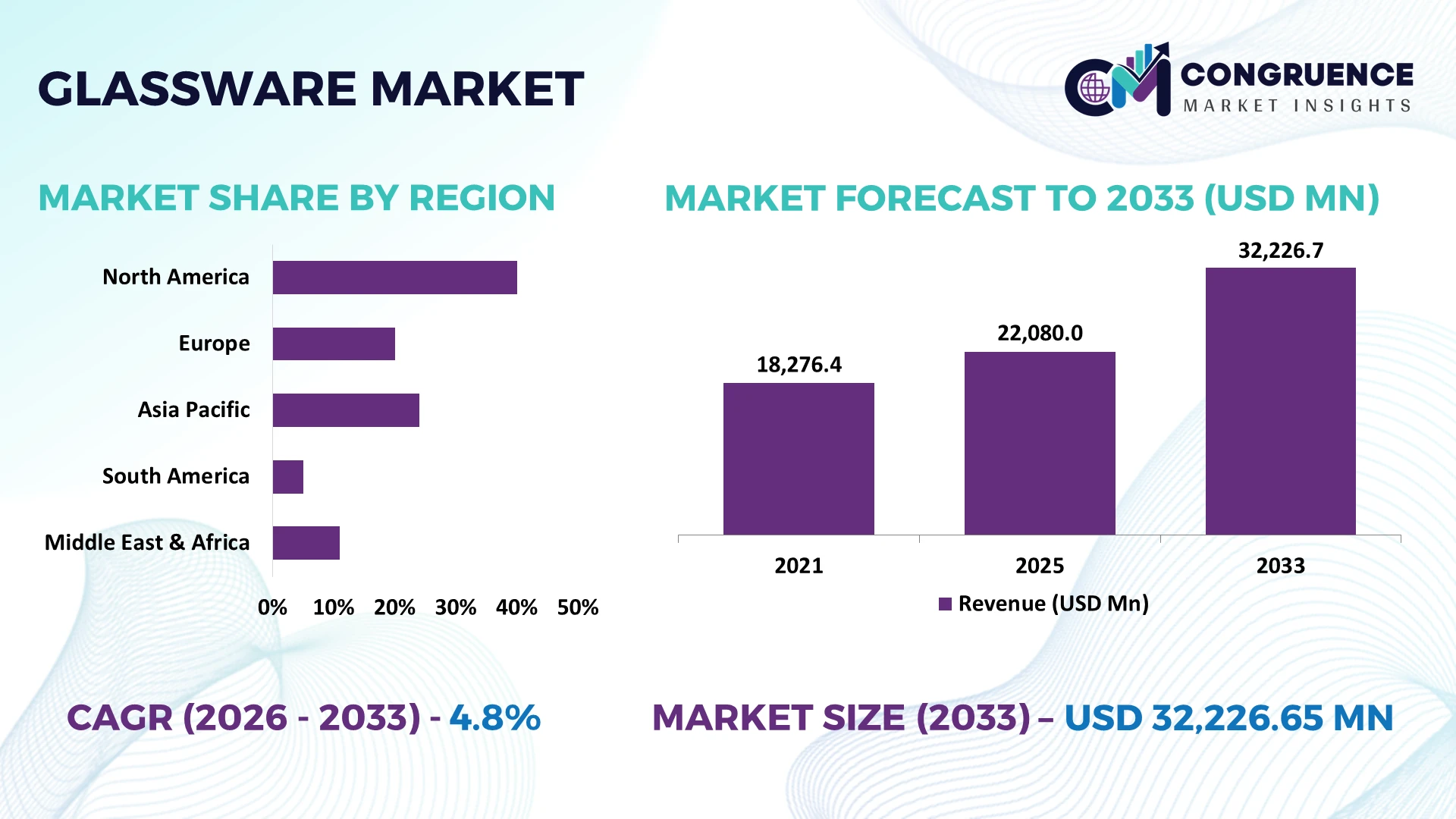
China remains the dominant manufacturing base, contributing about 6.97% of global glassware market value while supporting extensive export-oriented production; its broader glass output reached roughly 59.4% of global production in 2025. India is accelerating premium borosilicate adoption, where branded glassware is valued at approximately ₹7,900 crore and growing about 6.5% annually, strengthening Asia-Pacific competition.
Strategically, manufacturers should prioritize lightweight premium designs, recycled-content production, regional sourcing, and energy-resilient capacity to protect margins and capture high-growth consumption clusters.
Market Size & Growth: USD 22.08 billion in 2025 to USD 32.23 billion by 2033, supported by premium drinkware and plastic substitution.
Top Growth Drivers: Premiumization 40%; soda-lime adoption 52%; online retail expansion 7%+.
Short-Term Forecast: By 2030, automated forming and furnace optimization target 5–8% energy-efficiency gains.
Emerging Technologies: AI inspection, automated forming, lightweight glass, and advanced borosilicate compositions are reshaping production.
Regional Leaders: Asia-Pacific leads with a projected USD 10.4 billion by 2033; Europe approaches USD 4.6 billion by 2030; North America remains a major premium market.
Consumer/End-User Trends: Household drinkware represented 54.7% of global drinkware demand in 2025, while hospitality captured 45.3%.
Pilot/Case Example: 2025 UK deployment of Saint-Gobain ORAÉ used at least 64% recycled glass and delivered a 42% lower carbon footprint.
Competitive Landscape: Sisecam leads at about 7.8%; Libbey, Arc International, Bormioli Luigi, and Riedel reinforce a fragmented top tier.
Regulatory & ESG Impact: Higher recycled-content requirements are accelerating circular production; 10% additional cullet can reduce furnace energy use by about 2–3%.
Investment & Funding: Arc operates six global production locations and produces about 4 million items daily, reflecting continued capacity localization and export investment.
Innovation & Future Outlook: Smart glassware, lightweight designs, automation, and recycled-content products are shifting competition toward differentiated, lower-carbon portfolios.
The Global Glassware Market is increasingly shaped by premium drinkware, reusable storage, hospitality procurement, and borosilicate products designed for heat resistance and durability. Drinkware holds about 40% of global market value, while India’s branded borosilicate segment is growing around 6.5% annually. Supply-chain localization and Middle East energy disruptions are reinforcing the value of resilient regional manufacturing, setting up the strategic discussion.
Lightweighting Reshapes Production Lines: Manufacturers are reducing wall thickness by 5–10% while preserving strength, cutting material consumption and transport weight. European producers are integrating lightweight forming with automated inspection, reducing breakage-related waste by roughly 3–5%. This shift is accelerating as energy and freight costs remain volatile, prompting plants to upgrade molds, forming controls, and quality-monitoring workflows.
Digital Inspection Gains Ground: AI-assisted machine vision is moving beyond pilot cells into high-volume glassware lines, targeting defect-detection accuracy above 95% and reducing manual inspection requirements by 20–30%. Chinese and European manufacturers are pairing cameras with automated rejection systems, improving throughput consistency while addressing skilled-labor shortages and enabling tighter dimensional tolerances.
Premium Borosilicate Expands Applications: Borosilicate glass is gaining share in heat-resistant cookware, laboratory products, and pharmaceutical storage, with specialty applications growing roughly 6–8% in selected markets. Indian manufacturers are expanding localized production, while global suppliers are developing thinner, stronger formulations. The non-obvious shift is cross-category manufacturing, allowing producers to use specialty-glass capabilities across multiple higher-margin applications.
Circular Feedstock Becomes Operational: European glassmakers are increasing cullet utilization as recycled-content requirements and energy pressures reshape furnace economics. Using 10% additional cullet can reduce furnace energy consumption by approximately 2–3%, while closed-loop scrap recovery can redirect nearly 100% of internal production waste into remelting. Companies are therefore strengthening collection partnerships and redesigning procurement around consistent cullet quality.
Container Glass remains the leading type, accounting for approximately 43% of market demand because standardized forming, high-volume production, and established recycling infrastructure support cost-efficient scalability. Tableware Glass follows with nearly 27%, benefiting from household replacement cycles and hospitality procurement. Flat Glass remains strategically relevant for architectural and industrial integration, while Laboratory Glass maintains a smaller but specification-intensive niche requiring thermal and chemical resistance.
Specialty Glass is the fastest-growing segment, expanding around 7% in selected applications as manufacturers adopt borosilicate, chemically strengthened, and heat-resistant formulations. Companies are shifting investment toward specialty furnaces, precision forming, and application-specific partnerships rather than relying exclusively on commodity capacity. The mature Container Glass segment remains volume-driven, whereas Specialty and Laboratory Glass increasingly support margin expansion through differentiated performance and certification requirements.
Food & Beverage Packaging leads applications at approximately 46%, supported by repeat consumption, product protection requirements, and established bottling infrastructure. Household Use accounts for about 25%, while Interior Decoration remains closely tied to construction and premium design cycles. Laboratory Testing represents a smaller but specification-heavy segment, where thermal resistance and chemical stability determine purchasing decisions.
Pharmaceutical Storage is the fastest-growing application, with adoption increasing around 7–9% in specialized packaging programs as drug stability, contamination control, and regulatory traceability become more stringent. Manufacturers are expanding pharmaceutical-grade capabilities and strengthening validation partnerships, while laboratory suppliers are improving precision forming. The strategic shift is from volume-only packaging toward higher-value glass applications where performance specifications create stronger customer retention and qualification barriers.
Food & Beverage is the leading end-user, representing roughly 44% of demand because bottling, food preservation, hospitality supply, and beverage-service operations require high-volume standardized glassware. Household Consumers contribute approximately 25%, supported by replacement purchases and premium tableware. Hospitality remains operationally important, particularly for standardized procurement, while Research Laboratories prioritize specialized thermal and chemical resistance.
Healthcare & Pharmaceuticals is the fastest-growing end-user group, with specialized glass consumption rising approximately 7–9% as pharmaceutical storage, laboratory handling, and contamination-sensitive workflows expand. Suppliers are responding with customized borosilicate products, qualification support, and direct partnerships with pharmaceutical manufacturers. The competitive divide is increasingly based on compliance and technical consistency rather than unit price. Companies serving regulated healthcare buyers are therefore prioritizing certification, traceability, and smaller-batch customization to secure long-term contracts.
Europe accounted for the largest market share at 32% in 2025 however, Asia-Pacific is expected to register the fastest growth, expanding at a CAGR of 6.1% between 2026 and 2033.

Premiumization and automated foodservice supply reshape demand
North America remains a high-value glassware market, supported by established foodservice procurement, premium household products, and replacement demand. The United States dominates regional consumption, with commercial foodservice creating concentrated purchasing volumes across restaurants, hotels, catering groups, and institutional operators. Libbey maintains strong positioning through broad hospitality distribution and value-to-premium product coverage. Automated inspection, lightweight forming, and durable tempered designs are increasingly integrated into production workflows to reduce breakage and labor intensity. Regional suppliers are also strengthening domestic sourcing as freight volatility and changing trade conditions encourage shorter supply chains. The strategic shift is toward specification-based procurement, where durability, stacking efficiency, and lifecycle cost increasingly outweigh low unit pricing. Manufacturers are responding through product redesign, hospitality partnerships, and selective capacity modernization.
United States Market Outlook: The United States combines the region's strongest hospitality procurement infrastructure with sophisticated retail distribution. High-volume restaurant chains increasingly standardize glassware specifications to control replacement costs and inventory complexity. Premium crystal and durable tempered products are gaining attention, while domestic manufacturers emphasize shorter replenishment cycles and customized institutional programs. Libbey's extensive foodservice relationships reinforce its competitive advantage.
Circular manufacturing becomes a procurement differentiator
Europe retains the strongest glassware ecosystem, combining premium tableware manufacturing, mature hospitality demand, established recycling infrastructure, and stringent sustainability requirements. France, Italy, Germany, and the United Kingdom form important production and consumption hubs, with France particularly significant through Arc International's manufacturing base. European producers are increasingly integrating recycled cullet, lightweighting, and furnace-efficiency programs into procurement and production planning. Circular-economy requirements are pushing manufacturers to redesign packaging, sourcing, and production workflows rather than treating sustainability as a marketing layer. Premium and specialty glassware also benefits from Europe's concentration of luxury hospitality and fine-dining operators. Companies are strengthening regional supply chains, investing in energy-efficient production assets, and expanding recycled-material partnerships to protect competitiveness against lower-cost Asian suppliers.
France Market Outlook: France holds a strategically important position through concentrated glassware manufacturing and strong access to European hospitality and retail channels. Arc International's production footprint gives the country substantial export reach, with products distributed across more than 160 countries. French manufacturers are prioritizing recycled content, energy efficiency, and premium product differentiation to defend manufacturing competitiveness.
Manufacturing scale drives the next competitive reset
Asia-Pacific combines the world's deepest manufacturing ecosystem with rapidly expanding hospitality, household, pharmaceutical, and food-processing demand. China remains the principal industrial hub, while India is strengthening its position in borosilicate, tableware, and specialty products. China's broader glass and glass-products industry generated 95.1% of demand from B2B channels in 2025, highlighting the importance of institutional procurement and industrial-scale supply relationships. Imports represented only 4.6% of China's market, demonstrating strong domestic production depth. Manufacturers are responding through automated forming, export diversification, localized sourcing, and higher-value product development. India provides a complementary growth pathway through organized retail, hospitality expansion, and premium cookware. The region's advantage increasingly rests on combining manufacturing scale with faster product customization and cost-efficient regional distribution.
China Market Outlook: China remains the region's strongest manufacturing center, supported by extensive domestic suppliers and industrial infrastructure. Its glass and glass-products industry included 67,557 companies in 2025, while exports represented 12.9% of production output. This scale gives manufacturers substantial flexibility across commodity and customized glassware, although fragmentation increases the importance of automation and consolidation.
Brazil anchors regional manufacturing and hospitality demand
South America remains centered on Brazil, where food and beverage processing, hospitality, household consumption, and retail distribution provide the strongest glassware demand base. Local production benefits from proximity to beverage bottlers and major consumer markets, reducing replenishment exposure compared with long-distance imports. Brazil's large hospitality and food-processing ecosystem also supports standardized procurement of durable tableware and packaging-related glass products. Currency volatility and logistics costs remain operational constraints, encouraging manufacturers to localize inputs and prioritize higher-volume SKUs. Companies are increasingly balancing imported premium products with domestically produced mainstream ranges, while distributors are expanding inventory closer to major urban centers. The strategic opportunity lies in combining localized manufacturing with premium product differentiation rather than competing solely on imported low-cost supply.
Brazil Market Outlook: Brazil is the region's most strategically significant country because of its large consumer base, beverage-processing infrastructure, and established industrial glass ecosystem. Manufacturers benefit from proximity to major food and beverage producers, while hospitality operators support recurring commercial purchases. Companies are strengthening local distribution and emphasizing durable, standardized products to limit logistics and replacement costs.
Hospitality investment accelerates premium glassware deployment
The Middle East & Africa market is increasingly influenced by hospitality construction, tourism infrastructure, premium foodservice, and large-scale commercial developments. Saudi Arabia and the UAE are particularly important as hotel, resort, restaurant, and entertainment projects expand procurement requirements for durable and premium glassware. The UAE's position as a regional logistics hub supports efficient import and redistribution networks, while Saudi Arabia is developing greater local manufacturing depth. Hospitality operators increasingly specify tempered, stackable, and design-oriented products to control breakage and replacement costs. Suppliers are responding through distributor partnerships, localized warehousing, project-based contracts, and customized hospitality collections. The key structural shift is the movement from transactional imports toward specification-led procurement linked to hotel development pipelines, creating opportunities for suppliers capable of guaranteeing consistent quality and rapid replenishment.
Saudi Arabia Market Outlook: Saudi Arabia offers the strongest strategic opportunity through hospitality, tourism, and infrastructure investment linked to Vision 2030. Large hotel and entertainment developments are increasing requirements for commercial-grade tableware, while local-content objectives encourage deeper domestic supply participation. Manufacturers and distributors are strengthening project partnerships, regional warehousing, and customized procurement programs to serve large hospitality accounts.
Sisecam, Libbey, Arc International, Bormioli Luigi, and Riedel compete directly across global tableware, hospitality, premium drinkware, and institutional channels, while regional producers challenge them on cost and localized supply. The top five players collectively hold about 20.4%, confirming a fragmented structure. Sisecam leads near 7.8%, using vertical integration and scale, while Arc emphasizes distribution breadth and Libbey leverages North American foodservice relationships. Competition increasingly centers on 5–10% material reduction, 2–3% furnace-energy gains from higher cullet use, customization speed, and supply reliability. Players are expanding production, forming hospitality partnerships, upgrading automation, and strengthening recycled-material sourcing. The competitive shift favors suppliers combining cost discipline with premium design and circular manufacturing rather than commodity volume alone. Entry barriers remain significant because furnace assets, tooling expertise, quality certification, distribution relationships, and energy economics require substantial investment. Winning requires integrated manufacturing, resilient sourcing, differentiated products, and rapid fulfillment across institutional and consumer channels.
Sisecam Group
Libbey
Arc International
Bormioli Luigi
Riedel Glassworks
Zwiesel Kristallglas
SCHOTT AG
Bormioli Rocco
Oneida
Ocean Glass Public Company
Borosil Limited
Villeroy & Boch
Taiwan Glass Industry Corporation
Shandong Huapeng Glass
Current glassware production is shifting from conventional forming toward automated forming, machine-vision inspection, and digitally controlled furnaces. AI-enabled video monitoring is moving into full-plant deployment, as demonstrated by Stölzle Lausitz, improving disruption response and reducing manual intervention. Compared with legacy manual inspection, automated vision systems can improve defect-detection consistency by 5–8%, while advanced process controls target 2–3% efficiency gains. Adoption is strongest among large automated plants where throughput and quality consistency directly affect margins.
Emerging technologies center on lightweighting, high-cullet melting, advanced borosilicate formulations, and integrated production analytics. Increasing recycled-glass utilization can lower furnace energy requirements by approximately 2–3% for each additional 10% cullet input, while lightweight forming can reduce material usage by 5–10% in selected products. European manufacturers benefit from circular-production expertise, whereas Chinese and Indian producers gain through scale, automation, and faster equipment deployment.
From 2026–2028, disruptive advantage will come from connected furnaces, predictive maintenance, AI quality control, and closed-loop material recovery. Digital production platforms can reduce unplanned downtime by 3–5%, strengthening asset utilization. Şişecam’s Plant of the Future initiative demonstrates this integration of digitalization, sustainability, suppliers, and technology providers. Large integrated manufacturers benefit first because they can combine automation, data, energy optimization, and product engineering across multiple facilities.
March 2026 — Borosil approved INR 420 million for a new Gujarat glassware facility with dedicated mass-production lines and plans to raise pressware furnace capacity from 25 to 32 tonnes/day. The expansion addresses capacity bottlenecks and broadens domestic manufacturing. Source: glass-international.com
December 2025 — Şişecam operated 47 production facilities across four continents and employed 23,000 people, demonstrating continued global manufacturing scale. The company is targeting top-three positions while emphasizing advanced technologies, R&D, and sustainable production. Source: sisecam.com
February 2025 — Stölzle Lausitz expanded Cerrion’s video-AI agents across its entire Weißwasser plant in Germany. The deployment improves response to transport blockages, broken glass, and production jams, strengthening operational visibility and process continuity. Source: glass-international.com
April 2024 — Cello World announced a Rajasthan manufacturing facility using European machinery designed for high productivity and precision. The project expanded local glassware capacity and supported faster product development across drinkware, dinnerware, bakeware, and kitchen categories. Source: glass-international.com
The Glassware Market Report covers Container Glass, Tableware Glass, Laboratory Glass, Flat Glass, and Specialty Glass across Food & Beverage Packaging, Household Use, Laboratory Testing, Pharmaceutical Storage, and Interior Decoration. End-user analysis includes Food & Beverage, Healthcare & Pharmaceuticals, Hospitality, Research Laboratories, and Household Consumers, providing a structured view of demand concentration and purchasing intensity.
Regional coverage spans North America, Europe, Asia-Pacific, South America, and the Middle East & Africa, with country-level analysis emphasizing manufacturing scale, technology deployment, supply-chain localization, and investment activity. The report evaluates automated forming, AI-enabled inspection, lightweighting, recycled-cullet processing, borosilicate technologies, and digital production systems. Competitive assessment of major manufacturers supports investment planning, capacity expansion, partnership decisions, product positioning, and technology prioritization through 2026–2033.
| Report Attribute/Metric | Report Details |
|---|---|
Market Revenue in 2025 | USD 22080 Million |
Market Revenue in 2033 | USD 32226.65 Million |
CAGR (2026 - 2033) | 4.84% |
Base Year | 2025 |
Forecast Period | 2026 - 2033 |
Historic Period | 2021 - 2025 |
Segments Covered | By Type
By Application
By End-User
|
Key Report Deliverable | Revenue Forecast, Growth Trends, Market Dynamics, Segmental Overview, Regional and Country-wise Analysis, Competition Landscape |
Region Covered | North America, Europe, Asia-Pacific, South America, Middle East, Africa |
Key Players Analyzed | Sisecam Group, Libbey, Arc International, Bormioli Luigi, Riedel Glassworks, Zwiesel Kristallglas, SCHOTT AG, Bormioli Rocco, Oneida, Ocean Glass Public Company, Borosil Limited, Villeroy & Boch, Taiwan Glass Industry Corporation, Shandong Huapeng Glass |
Customization & Pricing | Available on Request (10% Customization is Free) |




