
Reports
The Global Glacial Acrylic Acid Market was valued at USD 3,810.4 Million in 2025 and is anticipated to reach a value of USD 5,017.6 Million by 2033 expanding at a CAGR of 3.5% between 2026 and 2033. Growth is driven by rising demand for high-purity acrylic acid in superabsorbent polymers, adhesives, coatings, and specialty polymers, alongside investments in energy-efficient oxidation, purification, and integrated propylene-to-acrylic-acid production.
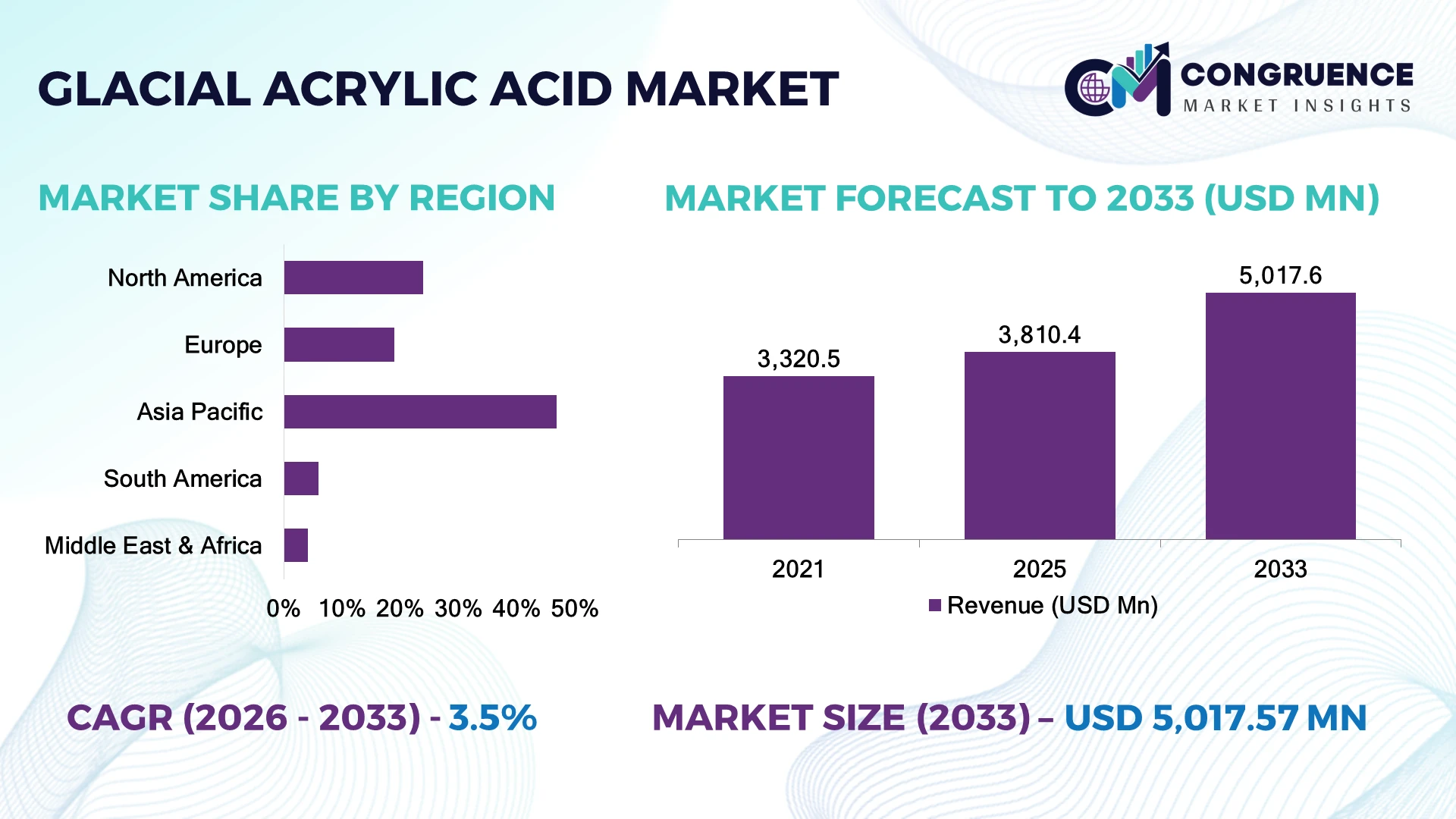
China is the dominant production base, accounting for approximately 35% of global acrylic acid capacity, supported by large superabsorbent polymer, coatings, and adhesive industries; the United States contributes roughly 17%, with stronger integration between propylene supply and downstream specialty chemicals. Advanced reactor and purification systems can reduce energy intensity by 8–12%. Supply-chain restructuring following Red Sea shipping disruptions is strengthening regional inventory strategies and encouraging localized chemical production.
Strategically, producers with integrated propylene feedstock, high-purity purification, efficient oxidation technology, and geographically diversified supply networks will capture the strongest margin and reliability advantages.
Market Size & Growth: USD 3,810.4 Million in 2025 to USD 5,017.6 Million by 2033 at a 3.5% CAGR, supported by superabsorbent polymer and specialty-coating capacity expansion.
Top Growth Drivers: Superabsorbent polymers 38%; adhesives and sealants 24%; coatings and surface treatments 18%.
Short-Term Forecast: By 2028, advanced reactor optimization will improve selected production efficiency by 5–8% and reduce energy consumption by 6–10%.
Emerging Technologies: AI process control, high-efficiency oxidation catalysts, advanced distillation, and membrane-assisted purification are reshaping high-purity acrylic acid production.
Regional Leaders: Asia-Pacific approaches USD 1.9 Billion, North America USD 1.1 Billion, and Europe USD 0.9 Billion, with regional producers increasing integrated downstream capacity.
Consumer/End-User Trends: Approximately 32% of major downstream buyers are increasing procurement of higher-purity acrylic acid for specialty polymer and formulation applications.
Pilot/Case Example: 2025 reactor optimization programs demonstrated approximately 6–9% improvements in conversion efficiency and 8% reductions in selected utility consumption.
Competitive Landscape: China leads with approximately 35% of global capacity; BASF, Dow, Arkema, LG Chem, and Nippon Shokubai remain major participants across integrated production and specialty derivatives.
Regulatory & ESG Impact: Process modernization targets 10–15% reductions in energy intensity and lower emissions through improved oxidation efficiency and heat recovery.
Investment & Funding: More than USD 1.5 Billion is being directed toward acrylic acid, superabsorbent polymer, purification, and downstream specialty-chemical capacity expansion.
Innovation & Future Outlook: 2026–2028 priorities center on catalyst optimization, digital process control, low-energy purification, localized supply chains, and higher-value acrylic derivatives.
Glacial Acrylic Acid is increasingly positioned as a strategic intermediate for superabsorbent polymers, acrylic esters, adhesives, coatings, and water-treatment formulations. Demand is strongest where high purity and consistent polymerization performance are critical, while approximately 30% of new downstream capacity increasingly targets specialty rather than commodity applications. Producers are also strengthening regional inventories and feedstock integration as global logistics remain exposed to shipping disruptions, creating a clear transition toward resilient, technically differentiated supply.
Glacial acrylic acid is becoming strategically important because its purity directly influences polymerization consistency, odor profile, color, and downstream product performance. This makes reliable supply increasingly critical for superabsorbent polymers, adhesives, coatings, and specialty formulations. Supply-chain restructuring is also encouraging producers to integrate propylene sourcing, acrylic acid production, purification, and downstream esterification within closer geographic footprints.
Technology investment is shifting from conventional thermal processing toward optimized oxidation catalysts, advanced heat recovery, digital process control, and higher-efficiency purification. Modernized systems can improve selected conversion efficiency by 5–10% and reduce energy intensity by 8–12% compared with less-integrated legacy operations. China benefits from large-scale integrated chemical complexes, while the United States emphasizes feedstock integration and high-value downstream applications; European producers place greater emphasis on energy efficiency and emissions management.
Over the next 2–3 years, automated process monitoring and predictive maintenance are positioned to reach broader deployment across large production facilities, targeting 5–8% higher equipment utilization and fewer unplanned interruptions. A practical deployment model combines real-time temperature, pressure, and oxygen monitoring with automated catalyst and purification controls. Companies are therefore prioritizing plant modernization, downstream partnerships, and regional inventory resilience. Competitive advantage will increasingly depend on high-purity output, feedstock security, energy efficiency, and dependable delivery rather than production scale alone.
Expansion of superabsorbent polymer capacity is increasing demand for high-purity glacial acrylic acid, particularly across China, the United States, and Japan. Superabsorbent polymers represent approximately 38% of downstream demand, while hygiene applications account for nearly 45% of acrylic-acid-derived polymer consumption. Newer purification systems can improve product consistency by 5–8% and reduce processing losses by 3–6%. China's expansion of hygiene-product manufacturing is reinforcing domestic acrylic acid integration, while U.S. producers are strengthening propylene-to-acrylic-acid linkages. Producers are responding through integrated oxidation and purification investments, long-term feedstock contracts, and downstream partnerships. The non-obvious advantage is that tighter purity control allows suppliers to secure higher-value polymer contracts without proportionally increasing production volumes.
Propylene remains the critical feedstock for acrylic acid production, creating substantial exposure to petrochemical price cycles. Feedstock and energy costs can collectively represent 60–70% of production economics, while propylene price movements of 10–15% can materially alter producer margins. European manufacturers face additional pressure from comparatively high industrial energy costs, while Asian producers remain exposed to imported feedstock and freight volatility. Shipping disruptions around the Red Sea have periodically increased transit uncertainty for chemical intermediates and derivatives. Producers are reducing exposure through integrated propylene supply, indexed procurement contracts, regional inventory buffers, and energy-efficiency upgrades. The key strategic constraint is not feedstock availability alone but the ability to maintain conversion economics when upstream hydrocarbon pricing changes faster than downstream contract prices.
Higher-purity glacial acrylic acid creates opportunities beyond conventional superabsorbent polymers, particularly in electronic materials, specialty adhesives, advanced coatings, and high-performance dispersants. Specialty applications can command substantially tighter specification premiums, while advanced purification can reduce impurity levels by 10–20% and improve batch consistency by 5–8%. Japan and South Korea offer attractive opportunities because electronics and precision-material manufacturers require controlled chemical inputs. Digital quality monitoring is also enabling tighter control of inhibitor concentration and trace contaminants. Producers are investing in purification upgrades, application laboratories, and formulation partnerships with specialty-chemical manufacturers. A distinctive opportunity lies in using existing acrylic-acid infrastructure for higher-specification grades, allowing companies to improve product mix and customer retention without building entirely new production chains.
Large acrylic acid facilities increasingly integrate oxidation, absorption, purification, inhibitor management, heat recovery, and downstream esterification, increasing control-system complexity. Poor synchronization between process stages can reduce throughput by 5–8%, while unplanned equipment interruptions can lower annual utilization by 3–6%. Catalyst degradation, corrosion, thermal instability, and inhibitor control require continuous monitoring, particularly in older plants across Europe and Japan. Workforce shortages in process engineering further complicate modernization and knowledge transfer. Companies are deploying predictive maintenance, digital twins, advanced distributed-control systems, and automated quality analytics to improve operating consistency. The deeper challenge is balancing higher plant integration with safe process control: modernization that improves energy performance but creates poorly coordinated control layers can introduce greater operational fragility rather than resilience.
Purity Specifications Are Tightening: Specialty buyers are increasingly demanding tighter inhibitor and trace-impurity control, with advanced purification systems improving batch consistency by 5–8% and reducing off-specification output by 3–5%. Japanese and South Korean chemical manufacturers are strengthening qualification protocols, pushing producers toward automated analytical monitoring and dedicated high-purity production campaigns.
Integrated Heat Recovery Expands: Producers are upgrading reactors, absorbers, and distillation systems to recover process heat, targeting 8–12% lower energy intensity and 5–7% lower steam consumption. European energy-price pressure has accelerated retrofit activity, while integrated plants increasingly connect heat recovery with utility-management platforms rather than treating it as an isolated efficiency project.
Inventory Strategies Are Regionalizing: Shipping disruptions and volatile freight conditions are encouraging producers and buyers to hold 10–15% higher strategic inventories of acrylic acid and derivatives in selected supply chains. U.S. and Asian manufacturers are increasingly combining local storage with diversified sourcing, reducing exposure to single-route logistics disruptions and improving contract-delivery reliability.
Downstream Integration Is Deepening: Acrylic acid producers are increasing links with acrylate esters, superabsorbent polymers, adhesives, and coatings, with integrated downstream consumption accounting for more than 60% of output at some major chemical complexes. This structure improves feedstock utilization and demand visibility while encouraging companies to prioritize captive conversion capacity over standalone merchant volumes.
High-purity Glacial Acrylic Acid, generally at 99.5% or above, represents approximately 72% of market demand because its controlled impurity profile supports superabsorbent polymers, acrylate esters, adhesives, and specialty coatings. Standard industrial-grade material accounts for roughly 20%, while customized or application-specific grades represent about 8%. High-purity grades maintain the largest installed base, but customized grades are expanding faster, with adoption increasing approximately 9–11% as downstream manufacturers tighten polymerization and formulation specifications.
The shift favors suppliers with integrated purification and quality-control infrastructure. Producers are investing in advanced distillation, inhibitor management, automated analytics, and dedicated storage, improving batch consistency by approximately 5–8%. Standard grades remain important for cost-sensitive coatings and industrial formulations, whereas specialized grades offer stronger margin potential. Companies are therefore reallocating investment toward flexible purification capacity and downstream technical partnerships, particularly in China, Japan, and the United States. This increases the strategic value of process control rather than simply adding commodity production capacity.
BASF completed mechanical construction of its Zhanjiang acrylics complex in 2025, including glacial acrylic acid facilities, reinforcing the industry's move toward integrated, world-scale acrylic value chains in China.
Superabsorbent polymers represent approximately 39% of Glacial Acrylic Acid consumption, making hygiene products the principal application because acrylic acid provides the polymer backbone required for high water absorption. Acrylic esters follow at around 25%, supported by coatings, adhesives, and sealants, while water treatment and detergent formulations together account for roughly 18%. Superabsorbent polymer demand remains mature, but acrylic-esters-based applications are expanding faster at approximately 8–10% as construction, packaging, and industrial coatings adopt higher-performance formulations.
Application requirements increasingly determine grade selection, with hygiene manufacturers emphasizing purity and polymerization consistency while coatings producers prioritize reactivity and formulation compatibility. Companies are expanding integrated acrylic acid-to-ester capacity and establishing closer technical relationships with downstream formulators. In China, integrated chemical complexes are shortening supply chains, whereas Japanese and U.S. producers emphasize specification control and specialty formulations. The business implication is a widening value gap between commodity-volume applications and technically qualified grades, encouraging producers to optimize product portfolios rather than maximize undifferentiated output.
Dow identifies superabsorbent polymers, water treatment, paints and coatings, adhesives, detergents, and enhanced oil recovery among established glacial acrylic acid applications, confirming its role as a versatile chemical intermediate across multiple downstream chains.
Hygiene-product manufacturers account for approximately 36% of Glacial Acrylic Acid demand, reflecting the intensive use of acrylic-acid-derived superabsorbent polymers in diapers, adult incontinence products, and feminine hygiene products. Coatings and adhesives producers represent approximately 27%, while water-treatment and industrial chemical users contribute about 17%. Hygiene remains the largest established buyer group, but specialty coatings and adhesive manufacturers are expanding faster, with procurement increasing approximately 8–10% as formulation performance and durability requirements rise.
Large hygiene producers typically prioritize supply continuity, polymer consistency, and qualification stability, whereas coatings and adhesive manufacturers increasingly require customized grades and tighter technical specifications. Companies are responding through long-term supply agreements, regional warehousing, integrated ester production, and application-development partnerships. BASF's global acrylic value chain illustrates the importance of serving hygiene customers while maintaining downstream acrylic monomer and polymer capabilities. The purchasing shift favors suppliers capable of serving both high-volume standardized contracts and technically demanding specialty accounts, improving customer retention and reducing dependence on a single downstream industry.
BASF introduced a zero-product-carbon-footprint polyacrylate superabsorbent polymer for hygiene applications in 2025, demonstrating how downstream hygiene requirements are increasingly incorporating measurable carbon-performance criteria alongside absorbency and product consistency.
Asia-Pacific accounted for the largest market share at 46.8% in 2025 however, Middle East & Africa is expected to register the fastest growth, expanding at a CAGR of 4.6% between 2026 and 2033.
Integrated petrochemical chains reinforce supply reliability and specialty-grade production
North America represents approximately 24% of the global Glacial Acrylic Acid Market, supported by integrated propylene networks, established acrylic monomer facilities, and concentrated demand from superabsorbent polymers, adhesives, coatings, and water-treatment chemicals. The United States accounts for the majority of regional production, with Gulf Coast chemical clusters providing feedstock, utilities, storage, and downstream connectivity. Producers are increasingly upgrading oxidation catalysts, purification systems, and process controls, targeting 5–8% higher conversion efficiency and 6–10% lower energy intensity. Stronger domestic sourcing is also reducing exposure to imported acrylic intermediates. Large producers are prioritizing debottlenecking and downstream integration rather than standalone capacity additions, strengthening supply resilience and improving product-mix flexibility for higher-purity grades.
United States Market Outlook: The United States remains the region's primary production and consumption hub because of extensive propylene availability and integrated petrochemical infrastructure. Gulf Coast facilities benefit from proximity to refineries, chemical terminals, pipelines, and major downstream polymer producers. Approximately 60% of U.S. acrylic-acid-derived consumption is linked to polymer, coating, adhesive, and absorbent-material applications, supporting stable industrial utilization and encouraging producers to optimize integrated production economics.
Energy optimization and specialty-grade production reshape plant economics
Europe contributes approximately 19% of global Glacial Acrylic Acid demand, with Germany, France, Belgium, and the Netherlands forming the principal chemical-processing corridor. High electricity and natural-gas costs are accelerating investment in heat recovery, catalyst optimization, and energy-efficient purification, with modernization programs targeting 8–12% reductions in selected utility intensity. Regulatory pressure on emissions and hazardous-chemical handling is also increasing the value of tightly controlled production systems. European manufacturers are emphasizing specialty acrylic derivatives, technical-grade consistency, and integrated downstream conversion rather than competing primarily through volume. This structural shift is strengthening demand for advanced process analytics and closed-loop quality control.
Germany Market Outlook: Germany remains strategically significant because its chemical manufacturing base connects acrylic intermediates with coatings, adhesives, construction chemicals, automotive materials, and specialty polymers. Producers increasingly prioritize energy-efficient reactors and digitally monitored purification systems, with automated quality controls capable of reducing selected batch deviations by approximately 5–8%. Strong environmental compliance requirements further favor modern facilities with lower emissions intensity and optimized solvent and heat management.
Large integrated complexes drive capacity scale and downstream specialization
Asia-Pacific accounts for approximately 46.8% of the global Glacial Acrylic Acid Market, led by China, Japan, South Korea, and India. China dominates regional production through large petrochemical complexes integrating propylene, acrylic acid, acrylate esters, and superabsorbent polymers. BASF's Zhanjiang Verbund site further strengthens integrated acrylics infrastructure, while domestic producers continue expanding downstream conversion. Regional manufacturers are increasing high-purity production and automated process monitoring, with advanced facilities targeting 5–10% improvements in conversion efficiency. Japan and South Korea remain technologically important for specialty polymers and precision formulations, while India is strengthening domestic acrylic-value-chain capacity to reduce dependence on imported intermediates.
China Market Outlook: China is the region's principal manufacturing hub, combining large petrochemical feedstock availability with extensive hygiene, coatings, adhesives, and polymer-processing industries. Integrated chemical parks increasingly connect acrylic acid with downstream acrylates and superabsorbent polymers, improving feedstock utilization and reducing logistics dependence. BASF's Zhanjiang complex represents a major infrastructure addition, with the integrated site designed to support multiple acrylic-value-chain products and strengthen local supply capability.
Downstream chemical localization creates selective import-substitution potential
South America represents approximately 6% of global Glacial Acrylic Acid demand, with Brazil accounting for the largest share because of its chemical manufacturing base and extensive coatings, adhesives, hygiene, and construction-material industries. The region remains more dependent on imported acrylic intermediates than North America or China, making freight costs and currency movements important procurement variables. Brazil's downstream polymer and coatings sectors are encouraging localized formulation and storage capacity, while producers and distributors increasingly use longer-term contracts to stabilize availability. Regional buyers can face 10–15% landed-cost variation during major freight or currency disruptions, reinforcing the commercial value of inventory planning and diversified sourcing.
Brazil Market Outlook: Brazil provides the strongest South American demand base because its large consumer market supports hygiene products, paints, adhesives, construction chemicals, and water-treatment formulations. Domestic chemical infrastructure around São Paulo, Rio de Janeiro, and Bahia supports downstream conversion, although acrylic acid availability remains more import-dependent than in major producing countries. Companies are therefore strengthening terminal inventories and distributor partnerships, improving supply continuity for customers operating with limited intermediate storage.
Petrochemical integration is creating a stronger regional production platform
Middle East & Africa accounts for approximately 3.7% of global Glacial Acrylic Acid demand, but Saudi Arabia and the UAE are strengthening their position through integrated petrochemical infrastructure and downstream manufacturing investment. Abundant propylene-linked feedstock, industrial utilities, export terminals, and chemical clusters provide structural advantages for acrylic-value-chain expansion. Saudi Arabia's industrial strategy is encouraging greater conversion of petrochemical feedstocks into higher-value chemicals, while regional hygiene, coatings, construction, and water-treatment applications broaden domestic demand. Integrated production can reduce selected feedstock and logistics costs by 8–12% compared with fragmented import-dependent supply chains. Producers are consequently emphasizing downstream partnerships, storage infrastructure, and specialty chemical conversion.
Saudi Arabia Market Outlook: Saudi Arabia is the region's strongest strategic market because of its world-scale petrochemical infrastructure, feedstock availability, and expanding downstream chemical ecosystem. Jubail and Yanbu provide integrated industrial platforms connecting hydrocarbon feedstocks with chemical manufacturing, utilities, logistics, and export infrastructure. The country's downstream transformation agenda is increasing the attractiveness of acrylic derivatives, while localized production can reduce reliance on imported intermediates and improve supply reliability for hygiene, coatings, and industrial chemical manufacturers.
BASF, Arkema, Nippon Shokubai, LG Chem, and Dow compete through integrated acrylic chains, while Satellite Chemical, Sinopec, and other Chinese producers challenge global leaders on scale and cost. The top five players hold an estimated 40–45% combined share. Competition centers on feedstock integration, purification technology, logistics, product consistency, and sustainability: advanced purification can improve energy efficiency 8–12%, while digital process control can reduce downtime 10–15%. BASF is expanding integrated capacity in China; Arkema is upgrading purification in France; Nippon Shokubai is strengthening vertically integrated acrylic acid-to-SAP operations; and LG Chem is developing bio-based routes. The competitive shift is toward localized, vertically integrated supply and lower-carbon production rather than standalone commodity volume. High capital intensity, hazardous-process expertise, feedstock access, and customer qualification create formidable entry barriers. Winning requires reliable propylene access, efficient purification, geographically diversified assets, differentiated low-carbon grades, and strong downstream integration.
BASF SE
Arkema S.A.
Nippon Shokubai Co., Ltd.
LG Chem Ltd.
Dow Inc.
Mitsubishi Chemical Group Corporation
Formosa Plastics Corporation
Sinopec Corporation
Satellite Chemical Co., Ltd.
Shanghai Huayi Acrylic Acid Co., Ltd.
Wanhua Chemical Group Co., Ltd.
Sasol Limited
Sanyo Chemical Industries, Ltd.
Hexion Inc.
Modern glacial acrylic acid plants are adopting advanced oxidation catalysts, heat-integrated distillation, automated inhibitor control, and online purity analytics. Catalyst optimization can improve propylene conversion by 3–5%, while heat recovery reduces energy intensity 8–12%. Large integrated facilities increasingly deploy distributed control systems, with digital monitoring covering more than 60% of critical process variables. The advantage is tighter purity control, fewer off-specification batches, and stable throughput.
Emerging technologies include membrane-assisted purification, predictive maintenance, and AI-based process optimization. Predictive analytics can reduce unplanned downtime 10–15%, while advanced purification can lower solvent or utility consumption 5–8%. Compared with conventional manual monitoring, automated quality control improves response speed by approximately 20–30%. BASF, Arkema, LG Chem, and Nippon Shokubai benefit from integrated assets because technology investments can be coordinated across acrylic acid, acrylates, and superabsorbent polymers.
From 2026–2028, bio-based feedstocks, mass-balance certification, digital twins, and lower-carbon purification will move toward broader integration. Arkema’s Carling modernization targets 25% higher energy efficiency and 20% lower carbon intensity, illustrating the direction of capital spending. Companies acting now can protect margins through lower utilities, improve customer qualification, and differentiate products through traceable carbon performance. The competitive edge will favor producers combining feedstock integration, process analytics, and verified sustainability attributes.
July 2025 BASF completed mechanical construction of GAA and butyl acrylate plants at Zhanjiang, advancing a world-scale acrylics complex. The site targets shorter Asian lead times; its BA unit provides 400,000 tonnes annually, strengthening integrated regional supply and service further. Source: basf.com
June 2025 Nippon Shokubai’s U.S. group companies obtained ISCC PLUS certification for acrylic acid and SAP. Certification covered locally produced AA and SAP, enabling lower-carbon supply claims and strengthening sustainability positioning across paints, adhesives, diapers, and sanitary products globally markets. Source: shokubai.co.jp
March 2025 Arkema advanced its €130 million Carat project at Carling, France, installing major purification equipment. The new process targets 25% better energy efficiency and 20% lower carbon intensity, strengthening competitiveness while increasing acrylic monomer production capability and output capacity. Source: arkema.com
January 2025 Satellite Chemical started construction of a 90,000-tonne acrylic acid and 100,000-tonne refined acrylic acid project in Jiaxing, backed by CNY 440 million investment. The expansion deepens downstream integration and strengthens China’s domestic acrylic supply chain resilience commercial competitiveness. Source: Sky7 Chemical
The Glacial Acrylic Acid Market Report covers product types including high-purity and industrial grades, applications across superabsorbent polymers, acrylate esters, adhesives, coatings, water treatment, and specialty formulations, and end-users spanning hygiene-product manufacturers, chemical producers, coatings companies, adhesive formulators, and industrial processors. Regional analysis covers North America, Europe, Asia-Pacific, South America, and Middle East & Africa, with country-level assessment of major production and consumption hubs.
The report evaluates oxidation catalysts, advanced purification, heat recovery, automation, digital process control, bio-based feedstocks, and mass-balance production. Quantitative analysis addresses capacity concentration, segment shares, technology adoption, plant expansion, and downstream integration, enabling investment planning, capacity decisions, sourcing strategies, partnership development, and competitive positioning. The 2026–2033 outlook identifies opportunities in specialty grades, low-carbon acrylic materials, localized supply chains, and integrated acrylic acid-to-derivative production.
| Report Attribute/Metric | Report Details |
|---|---|
|
Market Revenue in 2025 |
USD 3,810.4 Million |
|
Market Revenue in 2033 |
USD 5,017.6 Million |
|
CAGR (2026 - 2033) |
3.5% |
|
Base Year |
2025 |
|
Forecast Period |
2026 - 2033 |
|
Historic Period |
2021 - 2025 |
|
Segments Covered |
By Type
By Application
By End-User
|
|
Key Report Deliverable |
Revenue Forecast, Growth Trends, Market Dynamics, Segmental Overview, Regional and Country-wise Analysis, Competition Landscape |
|
Region Covered |
North America, Europe, Asia-Pacific, South America, Middle East, Africa |
|
Key Players Analyzed |
BASF SE, Arkema S.A., Nippon Shokubai Co., Ltd., LG Chem Ltd., Dow Inc., Mitsubishi Chemical Group Corporation, Formosa Plastics Corporation, Sinopec Corporation, Satellite Chemical Co., Ltd., Shanghai Huayi Acrylic Acid Co., Ltd., Wanhua Chemical Group Co., Ltd., Sasol Limited, Sanyo Chemical Industries, Ltd., Hexion Inc. |
|
Customization & Pricing |
Available on Request (10% Customization is Free) |




