
Reports
The Global Geopolymer Repair Mortars Market was valued at USD 7330 Million in 2025 and is anticipated to reach a value of USD 11595.02 Million by 2033 expanding at a CAGR of 5.9% between 2026 and 2033. Growth is driven by aging concrete infrastructure, demand for rapid industrial-floor rehabilitation, and the adoption of alkali-activated binders that reduce Portland cement dependence and accelerate structural repair schedules.
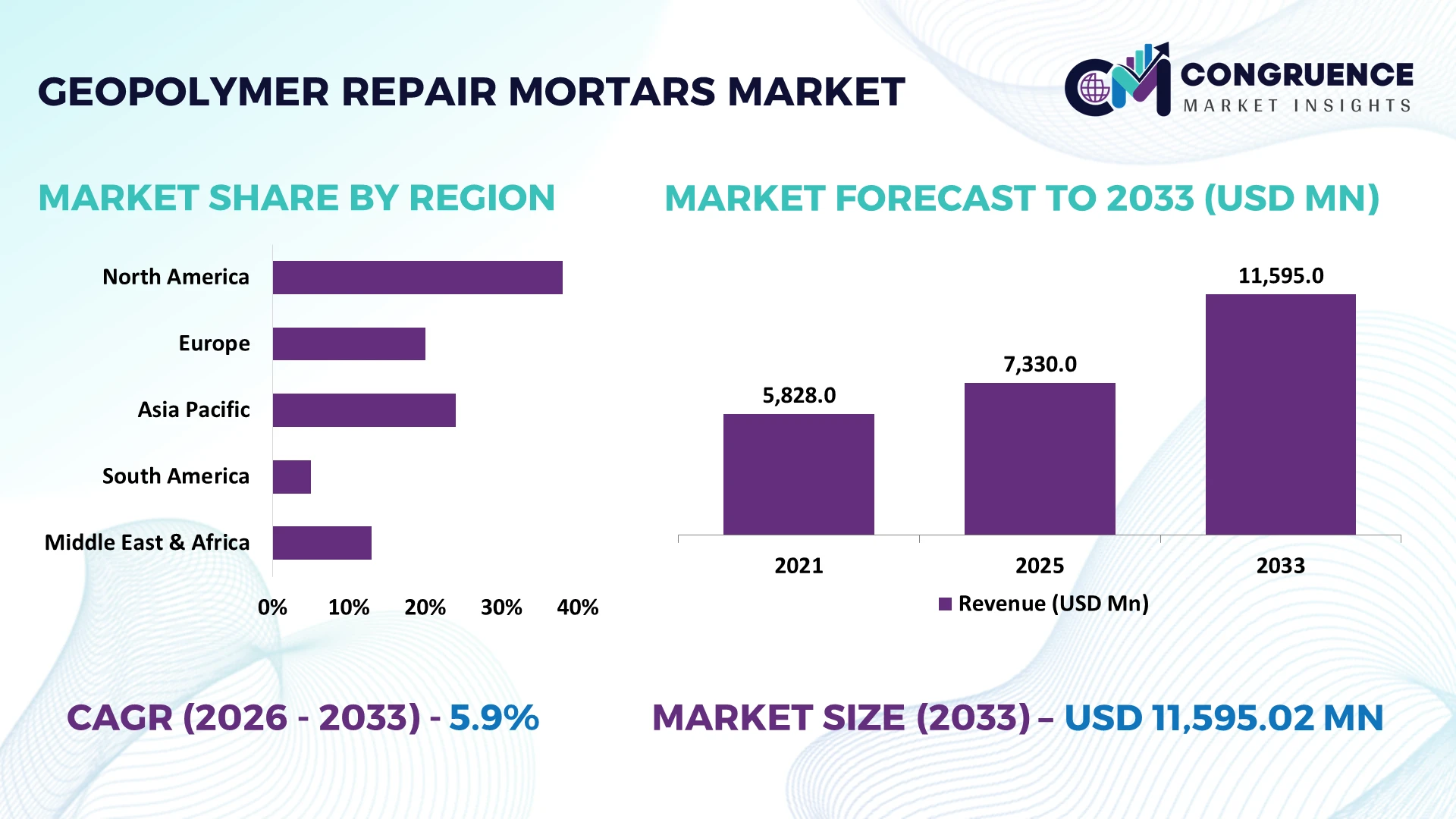
China holds a leading position in geopolymer repair adoption across Asia-Pacific, supported by highway rehabilitation, urban drainage upgrades, and industrial infrastructure renewal. Asia-Pacific accounted for 37.13% of the geopolymer repair mortars market in 2026, while India's USD 1.5 trillion National Infrastructure Pipeline strengthens the addressable opportunity for bridge, road, and water-network restoration. China's infrastructure renewal requirements favor chemical-resistant, rapid-setting formulations, whereas India's project economics emphasize locally available fly ash and slag. China's highway maintenance research also demonstrates a 46.9% reduction in road-maintenance emissions using geopolymer grouting compared with conventional cement-based methods. Strategic priority should center on qualified local precursor supply, documented durability, and public-infrastructure specifications.
Market Size & Growth: The market is projected to increase from USD 7,330 million in 2025 to USD 11,595.02 million by 2033 at a 5.9% CAGR, supported by low-carbon infrastructure rehabilitation and advanced repair formulations.
Top Growth Drivers: Aging infrastructure contributes an estimated 2.8% growth impact, low-carbon procurement 2.5%, and chemical-resistance requirements 1.8%, strengthening demand across transport and wastewater assets.
Short-Term Forecast: By 2028, wider adoption of one-component mortars is positioned to simplify field mixing and reduce activator-handling requirements; project-level cost and efficiency improvements require validated deployment data.
Emerging Technologies: One-component formulations, fiber-reinforced mortars, and digitally documented carbon performance are advancing; fiber-reinforced products are projected to grow at a 12.56% CAGR through 2032.
Regional Leaders: Asia-Pacific holds a 37.13% share in 2026 and leads regional adoption; North America benefits from embodied-carbon procurement, while Europe advances through wastewater-rehabilitation approvals. Comparable regional revenue forecasts are not established here.
Consumer/End-User Trends: Infrastructure and public works account for 38.28% of 2026 demand, while water and wastewater utilities represent a high-growth application with a projected 13.27% CAGR through 2032.
Pilot/Case Example: A 2025 Chinese highway-maintenance life-cycle assessment reported 46.9% lower CO₂ emissions per kilometer using geopolymer grouting, reinforcing the case for lower-carbon road rehabilitation.
Competitive Landscape: The market remains fragmented, with no verified individual leader share established here. Sika AG, BASF, RPM International, Heidelberg Materials, and Wagners compete through product development, distribution, and technical qualification.
Regulatory & ESG Impact: Canada's embodied-carbon procurement requirements specify at least 30% lower embodied carbon against the project baseline for relevant procurements initiated after September 1, 2025, favoring products with verified environmental documentation.
Investment & Funding: Heidelberg Materials agreed to acquire a facility with 150,000 tons per year of slag-grinding capacity in November 2025, strengthening low-carbon material supply; a comparable industry-wide investment total is not established.
Innovation & Future Outlook: Between 2026 and 2033, competitive differentiation will increasingly depend on durable fiber-reinforced systems, easier field application, reliable alternative precursors, and documented lifecycle performance.
Geopolymer repair mortars are gaining relevance in bridge rehabilitation, wastewater networks, industrial flooring, tunnels, and chemically aggressive environments where repeated repairs increase operating costs. Product innovation centers on one-component, fiber-reinforced, and rapid-setting formulations that simplify site handling and improve crack resistance. A 2025 highway-maintenance assessment reported 46.9% lower CO₂ emissions per kilometer with geopolymer grouting than conventional cement-based repair, highlighting the environmental value of material selection. Canada's embodied-carbon procurement requirements further strengthen the importance of verified environmental performance. These developments make durability validation, precursor availability, and lifecycle economics central to strategic investment decisions.
Geopolymer repair mortars are becoming strategically important as infrastructure owners prioritize faster rehabilitation, chemical resistance, and lower embodied carbon without compromising structural performance. Their competitive value lies in reducing maintenance interruptions while converting industrial by-products such as fly ash and ground-granulated blast-furnace slag into engineered repair materials. Canada's embodied-carbon procurement requirements and China's infrastructure-renewal programs are strengthening the commercial relevance of performance-verified alternatives to conventional cement-based systems.
Supply chains are also shifting toward locally available aluminosilicate precursors, reducing dependence on long-distance material transportation while creating new quality-control requirements. Conventional cementitious repairs remain established, but geopolymer formulations offer application-specific advantages in aggressive wastewater environments and selected rapid-repair operations. Performance comparisons must account for curing conditions, substrate preparation, and service-life requirements rather than relying solely on initial setting time or material cost.
Over the next 2–3 years, competitive advantage will depend on standardized field testing, repeatable curing performance, and contractor familiarity. Chinese road and drainage rehabilitation projects provide deployment opportunities, while Indian infrastructure contractors can develop localized formulations using suitable industrial by-products. Manufacturers are best positioned to combine regional precursor sourcing, application-specific product development, and engineering partnerships. Long-term differentiation will come from independently validated durability, predictable installation economics, and documented lifecycle performance.
Aging bridges, industrial floors, and wastewater assets are increasing demand for repair materials that withstand chemical exposure and reduce repeat maintenance. Research indicates that geopolymer systems can deliver 16%–90% lower global warming potential than ordinary Portland cement concrete, depending on formulation and assessment boundaries. Their resistance to acid attack and chloride penetration also supports applications where conventional repairs deteriorate prematurely. Canada's embodied-carbon procurement framework strengthens incentives to document material-level environmental performance. Manufacturers are responding through fly ash–slag formulation development, application-specific testing, and contractor partnerships. The strategic advantage lies in targeting assets with high corrosion exposure and costly shutdowns, where lifecycle maintenance savings justify qualification and installation costs.
Alkaline activators, formulation complexity, and inconsistent precursor quality constrain commercial scalability. Research indicates that alternative activator formulations can reduce geopolymer costs by up to 58% compared with commercially available activators, demonstrating the sensitivity of economics to mix design. However, this saving is formulation-specific and does not represent a universal reduction in installed repair costs. Fly ash chemistry, slag composition, moisture, and seasonal availability also influence setting behavior and mechanical performance. Indian manufacturers face a procurement challenge when industrial by-products originate from multiple facilities with variable chemical profiles. Companies must qualify multiple suppliers, establish incoming-material specifications, and optimize activator dosage. Without these controls, batch variability increases rejection rates, installation uncertainty, and project-approval costs.
One-component geopolymer repair mortars create an opportunity to simplify field operations by replacing separately handled alkaline solutions with dry formulations activated by water. Research published in 2024 demonstrated the feasibility of ambient-cured, micro-fiber-reinforced one-component mortars for concrete repair, addressing handling complexity while targeting crack resistance. Separately, alternative activator research has demonstrated potential cost reductions of up to 58% against commercial activators, although performance depends on formulation. Indian manufacturers can develop localized products using qualified fly ash and slag supplies for bridges, drainage systems, and industrial wastewater facilities. Investment priorities should include formulation laboratories, contractor field trials, and partnerships with infrastructure maintenance providers. The strongest opportunity is standardized repair kits supported by application-specific performance data.
Consistent performance across climates, substrates, and curing conditions remains a major execution challenge. Research reviews identify carbonation resistance and alkali–aggregate reactions as potential weaknesses in certain geopolymer systems, despite advantages in chemical resistance and chloride penetration. Laboratory results also vary with precursor chemistry, activator concentration, curing regime, and exposure conditions, limiting direct transfer to infrastructure projects. Research comparing electrical and heat curing found heat-curing electricity costs were 6.78 times higher under the study's tested conditions, illustrating how processing choices affect deployment economics. Indian contractors must validate bond strength, shrinkage, curing behavior, and durability under local site conditions. Manufacturers need standardized quality protocols, extended field monitoring, and engineering partnerships to convert promising laboratory performance into repeatable infrastructure-scale outcomes.
Low-Carbon Procurement Accelerates: Geopolymer formulations target up to 80% lower CO₂ emissions than conventional Portland cement-based materials in selected formulations, although actual reductions depend on precursor composition, activator production, and curing. Canada's federal embodied-carbon procurement requirements are increasing scrutiny of environmental product declarations. Manufacturers are strengthening lifecycle assessments and emissions documentation to qualify for infrastructure contracts and improve competitiveness in sustainability-focused procurement.
Precursor Quality Controls Tighten: Fly ash and slag variability directly affects setting time, compressive strength, and shrinkage. A 10% change in reactive precursor content can alter activator requirements, although the effect depends on material chemistry. Manufacturers are strengthening chemical testing, supplier qualification, and batch monitoring to reduce production inconsistencies. These controls improve formulation reliability and reduce rejected batches when industrial by-products originate from multiple facilities.
Field Mixing Becomes Simpler: Water-activated, dry-blended formulations eliminate separate liquid-activator handling at repair sites. Manufacturers are refining packaging, mixing instructions, and working-time specifications to reduce installation errors. Cutting the number of separately handled components simplifies logistics and improves workflow consistency, particularly on bridge and industrial-floor repairs where shorter closures directly affect operating costs.
Durability Testing Gains Priority: Infrastructure owners are assessing bond strength, shrinkage, chemical resistance, and curing performance alongside compressive strength. Research on geopolymer-to-concrete bonding has reported early-age bond development exceeding 70% of the 28-day value under specific experimental conditions. Manufacturers are expanding application-specific testing for bridges, tunnels, and wastewater assets to demonstrate field reliability and strengthen specification acceptance.
Fly Ash-Based Mortars benefit from established industrial by-product supplies, competitive raw-material economics, and suitability for multiple concrete-repair applications. A precise market-share percentage for this type is not independently verified, so assigning a numerical share would risk misrepresenting market structure. Slag-Based Mortars support applications requiring chemical resistance and favorable mechanical performance, while Metakaolin-Based Mortars offer greater control over precursor reactivity and formulation consistency. Hybrid Geopolymer Mortars combine aluminosilicate sources to balance workability, strength development, and curing requirements. Manufacturers are improving precursor qualification to maintain consistent performance across batches.
Rapid-Setting Mortars address repairs requiring shorter operational shutdowns, particularly in transportation and industrial facilities. Fiber-Reinforced Mortars offer opportunities through improved crack control and tensile behavior. Research on engineered geopolymer composites has demonstrated tensile strain capacity approaching 8% under specific experimental conditions, highlighting their potential in specialized applications. Companies are prioritizing application-specific testing, reinforcement technologies, and controlled curing protocols. Investment decisions increasingly depend on installation speed, durability, and lifecycle economics rather than raw-material availability alone.
Structural Rehabilitation is a strategically important application because deteriorated concrete requires reliable bonding, mechanical compatibility, and long-term durability. Concrete Crack Repair addresses localized deterioration, while Bridge Repair targets damage associated with moisture penetration, chloride exposure, and reinforcement corrosion. Industrial Floor Repair serves facilities requiring abrasion resistance and reduced production interruptions. Verified market-share percentages for these seven applications are unavailable, so precise numerical rankings cannot be substantiated.
Corrosion-Damaged Concrete Repair offers opportunities in assets exposed to aggressive environments, while Tunnel Repair and Marine Structure Repair require application-specific resistance to moisture and chemical exposure. In experimental research, geopolymer-to-concrete bond strength exceeded 70% of the 28-day value after seven days under specified test conditions, demonstrating the importance of early-age bonding. Manufacturers are developing specialized formulations and installation protocols to improve repair consistency. Investment priorities increasingly favor applications where downtime, restricted access, and recurring maintenance create measurable operational costs.
Government Authorities and Infrastructure Developers are strategically important end-users because public roads, bridges, drainage networks, and civil assets require planned rehabilitation and documented material performance. Transportation Agencies also generate demand through pavement and bridge maintenance, while Industrial Facilities prioritize chemical resistance, abrasion performance, and reduced production interruptions. Commercial Property Owners generally focus on localized concrete deterioration, whereas Marine Operators require materials suited to moisture and aggressive exposure. Independently verified market-share percentages for these seven end-user categories are unavailable, preventing reliable numerical ranking.
Purchasing decisions increasingly emphasize lifecycle maintenance, installation scheduling, and documented performance rather than initial material price alone. Manufacturers are strengthening contractor partnerships, technical training, and application-specific product development to improve adoption. For industrial facilities, reducing repair-related downtime by even 10% would provide a measurable operational benefit, although this represents a business target rather than an established market-wide result. Infrastructure suppliers are therefore prioritizing field validation, consistent curing performance, and procurement-ready technical documentation to strengthen competitiveness.
Asia-Pacific accounted for the largest market share at 37.13% in 2025 however, Asia-Pacific is expected to register the fastest growth, expanding at a CAGR of 12.78% between 2026 and 2033.
Low-Carbon Procurement and Infrastructure Rehabilitation
North America's strategic position is shaped by aging bridges, wastewater networks, industrial facilities, and increasing scrutiny of construction-material emissions. The United States drives demand through transportation rehabilitation and industrial maintenance, while Canadian procurement policies strengthen incentives for lower-carbon construction materials. Federal infrastructure programs have expanded the addressable repair market, including a US bridge-rehabilitation initiative that had initiated 12,306 bridge projects by early 2025. However, geopolymer repair mortar adoption depends on engineering approvals, field-proven durability, and compatibility with established repair specifications. Suppliers are strengthening technical validation, expanding contractor training, and developing application-specific formulations. The strongest commercial opportunities lie in projects where chemical resistance, reduced maintenance interruptions, and documented environmental performance justify material qualification and installation costs.
United States Market Outlook: The United States benefits from extensive transportation infrastructure, established construction-chemical distribution, and demand for specialized concrete rehabilitation. Bridge decks, industrial floors, and wastewater assets provide opportunities for high-performance repair systems. Manufacturers can strengthen their position through engineering partnerships, infrastructure-contractor relationships, and testing that demonstrates bond strength and durability under freeze-thaw and chloride exposure. Federal procurement requirements and project-level carbon accounting also increase the value of verified environmental performance.
Environmental Compliance and Specialized Infrastructure Repair
Europe's market is shaped by aging civil infrastructure, wastewater rehabilitation, stringent construction standards, and growing attention to embodied carbon. Germany, France, and the United Kingdom provide important opportunities through industrial maintenance, transport structures, and municipal infrastructure renewal. Germany's DIN 19573 framework addresses mortars used in wastewater engineering, creating a technical pathway for qualifying suitable geopolymer systems. In March 2025, Vortex Europe announced certification of its Quadex GeoKrete geopolymer repair mortar by Germany's DIBt for wastewater rehabilitation applications. Such approvals strengthen commercial credibility and reduce specification barriers for qualified products. Manufacturers are concentrating on documented chemical resistance, application-specific testing, and partnerships with infrastructure-maintenance contractors. Product qualification and demonstrated service performance remain decisive factors in converting sustainability objectives into procurement demand.
Germany Market Outlook: Germany combines advanced construction-material engineering with established wastewater infrastructure standards. Its industrial facilities, sewer networks, and transport assets create demand for repair systems that withstand chemical exposure and extend service life. Suppliers can differentiate through certified formulations, reliable installation procedures, and evidence of durability under aggressive operating conditions. Partnerships with specialist rehabilitation contractors provide a practical route to adoption in regulated infrastructure projects.
Infrastructure Scale and Industrial Precursor Availability
Asia-Pacific benefits from extensive infrastructure construction, expanding rehabilitation requirements, and the availability of industrial by-products used in geopolymer formulations. China supports demand through bridge, tunnel, sewer, and highway maintenance, while India offers opportunities across transport infrastructure, water networks, and industrial facilities. The region accounted for an estimated 37.13% of the market in 2026, reflecting its strong infrastructure base and precursor availability. China's large fly ash and slag supply supports localized formulation development, while India's infrastructure investment pipeline strengthens the long-term project base. Manufacturers are developing regionally sourced formulations and expanding technical collaboration with contractors. Competitive advantage increasingly depends on balancing material consistency, installation economics, and performance qualification across different climatic and operating conditions.
China Market Outlook: China's extensive highway network, urban drainage systems, and industrial infrastructure support demand for durable concrete rehabilitation materials. Domestic availability of fly ash and slag offers manufacturers opportunities to develop locally sourced geopolymer formulations. Companies can strengthen market access through partnerships with infrastructure contractors, testing institutions, and municipal maintenance authorities. Consistent precursor chemistry and validated field performance remain essential to scaling deployment beyond specialized projects.
Infrastructure Maintenance and Localized Material Sourcing
South America's opportunity is associated with bridge rehabilitation, industrial concrete maintenance, wastewater infrastructure, and deterioration in humid or chemically aggressive environments. Brazil represents a strategically important market because of its industrial base, transport corridors, mining operations, and municipal infrastructure requirements. Chile and Peru also present specialized opportunities around mining and mineral-processing facilities. However, adoption remains dependent on product availability, contractor familiarity, technical specifications, and the economics of sourcing alkaline activators and suitable aluminosilicate precursors. Manufacturers can reduce market-entry barriers through local distribution partnerships, application demonstrations, and procurement relationships with mining and infrastructure operators. Rather than pursuing broad geographic expansion immediately, suppliers should prioritize projects where chemical resistance, maintenance frequency, and access constraints create a measurable advantage over conventional repair systems.
Brazil Market Outlook: Brazil offers opportunities through highway maintenance, industrial flooring, wastewater infrastructure, and mining-related concrete rehabilitation. Its large industrial and construction sectors provide potential demand for specialized repair mortars, particularly where downtime affects production or logistics. Suppliers should focus on local precursor qualification, contractor training, and performance testing under tropical exposure conditions. Partnerships with established construction-material distributors can improve availability and support adoption in geographically dispersed infrastructure projects.
Water Infrastructure Investment and Industrial Durability
The Middle East & Africa market is shaped by water-network modernization, desalination infrastructure, industrial construction, and concrete deterioration under saline and high-temperature conditions. Saudi Arabia and the United Arab Emirates offer opportunities through major infrastructure programs, while South Africa presents demand associated with industrial facilities, mining, and water infrastructure maintenance. Dubai's stormwater-management program, supported by a planned investment of AED 30 billion, illustrates the scale of infrastructure spending relevant to durable repair materials. However, geopolymer adoption requires validation under local curing conditions, reliable precursor supply, and contractor expertise. Manufacturers are best positioned to prioritize wastewater structures, industrial facilities, and assets exposed to aggressive environments. Regional expansion strategies should combine local technical support, application-specific testing, and partnerships with engineering and rehabilitation contractors.
Saudi Arabia Market Outlook: Saudi Arabia's infrastructure modernization, industrial expansion, and water-management requirements create opportunities for specialized concrete repair systems. High temperatures, saline exposure, and demanding operating environments make material qualification particularly important. Suppliers can target wastewater facilities, industrial floors, and transport infrastructure through partnerships with engineering contractors and project developers. Demonstrating curing reliability, chemical resistance, and predictable installation performance will strengthen competitiveness in technically demanding projects.
The market combines established construction-chemical suppliers, specialist geopolymer formulators, and regional manufacturers competing for infrastructure rehabilitation contracts. Sika AG, Saint-Gobain, BASF, and The Euclid Chemical Company compete through repair-system portfolios, distribution networks, and contractor relationships, while Wagners and specialist producers differentiate through geopolymer technology and alternative-binder expertise. The top-five combined market share is not independently verified; assigning a precise percentage would imply unsupported concentration. Competition centers on formulation performance, chemical resistance, precursor availability, installation speed, and technical qualification. A 10% reduction in installed repair cost or a 20% reduction in closure time can strengthen a bid, but these are competitive targets rather than established market averages. Companies are responding through product development, technical partnerships, localized sourcing, and expansion of application-specific solutions. Certification and long-term durability evidence remain significant entry barriers, particularly in regulated wastewater and transport projects. Suppliers that combine dependable field performance, competitive lifecycle economics, and qualified local distribution will be best positioned to secure repeat infrastructure contracts.
Sika AG
Saint-Gobain
BASF SE
The Euclid Chemical Company
Wagners Holding Company Limited
Pidilite Industries Limited
RPM International Inc.
Fosroc International Limited
Remmers Gruppe AG
MAPEI S.p.A.
Vortex Companies
Heidelberg Materials AG
Geopolymer repair technology is shifting toward one-component, ambient-cured formulations that simplify field preparation by replacing separately handled alkaline solutions with water-activated powders. A 2024 study in Construction and Building Materials evaluated micro-fiber reinforcement, workability, strength, and fatigue resistance. These formulations improve handling practicality, while measured performance remains dependent on precursor chemistry and curing conditions. Commercial suppliers are targeting infrastructure contractors requiring repeatable application and reduced chemical-handling complexity.
Hybrid geopolymer mortars combine alkali-activated materials with conventional cementitious components to balance installation familiarity and specialized performance. Sika's SikaMonoTop-4500 Geo Hybrid product documentation specifies an initial setting time of approximately 60–70 minutes, supporting repair scheduling. Research on geopolymer bonding also demonstrated approximately 14 MPa shear-bond strength under tested substrate conditions, illustrating the potential for demanding rehabilitation applications. Automated spraying and spin-casting further support consistent material placement in pipes, culverts, and wastewater structures.
During 2026–2028, competitive differentiation will center on formulation consistency, curing reliability, and verified durability. Compared with two-component systems, one-component products eliminate separate activator handling, although universal percentage improvements in labor cost or installation efficiency remain unverified. Specialist manufacturers benefit from application expertise, while established suppliers leverage distribution and technical support. Companies investing in field validation, automated application compatibility, and standardized quality controls will strengthen project qualification and repeat-contract potential.
The Geopolymer Repair Mortars Market Report evaluates industry structure, material innovation, application demand, and competitive positioning across the 2026–2033 forecast period. Coverage includes six types: Fly Ash-Based Mortars, Slag-Based Mortars, Metakaolin-Based Mortars, Hybrid Geopolymer Mortars, Rapid-Setting Mortars, and Fiber-Reinforced Mortars. Application analysis spans concrete crack repair, structural rehabilitation, bridge repair, industrial floors, marine structures, tunnels, and corrosion-damaged concrete. End-user coverage includes construction companies, infrastructure developers, government authorities, industrial facilities, transportation agencies, marine operators, and commercial property owners.
Regional analysis examines North America, Europe, Asia-Pacific, South America, and the Middle East & Africa, highlighting country-level infrastructure priorities, material availability, regulatory requirements, and deployment conditions. Technology coverage assesses one-component formulations, hybrid binders, fiber reinforcement, curing performance, and automated application methods. Competitive analysis evaluates product differentiation, technical qualification, supply-chain positioning, and strategic expansion. These insights support investment allocation, market-entry planning, product development, procurement decisions, and competitive positioning by identifying application-specific opportunities, operational constraints, and emerging infrastructure-rehabilitation requirements.
| Report Attribute/Metric | Report Details |
|---|---|
Market Revenue in 2025 | USD 7330 Million |
Market Revenue in 2033 | USD 11595.02 Million |
CAGR (2026 - 2033) | 5.9% |
Base Year | 2025 |
Forecast Period | 2026 - 2033 |
Historic Period | 2021 - 2025 |
Segments Covered | By Type
By Application
By End-User
|
Key Report Deliverable | Revenue Forecast, Growth Trends, Market Dynamics, Segmental Overview, Regional and Country-wise Analysis, Competition Landscape |
Region Covered | North America, Europe, Asia-Pacific, South America, Middle East, Africa |
Key Players Analyzed | Sika AG, Saint-Gobain, BASF SE, The Euclid Chemical Company, Wagners Holding Company Limited, Pidilite Industries Limited, RPM International Inc., Fosroc International Limited, Remmers Gruppe AG, MAPEI S.p.A., Vortex Companies, Heidelberg Materials AG |
Customization & Pricing | Available on Request (10% Customization is Free) |




