
Reports
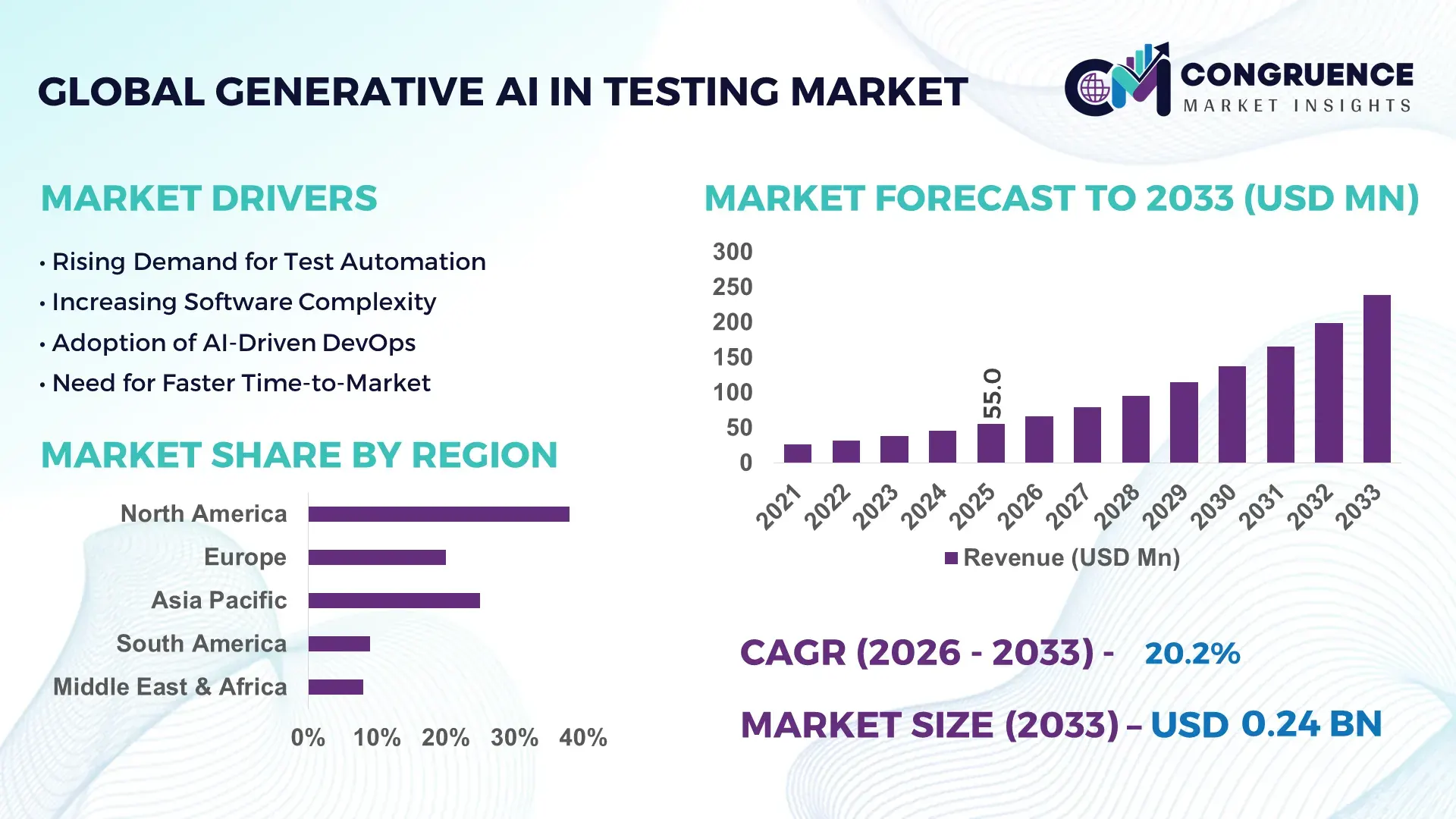
The Global Generative AI in Testing Market was valued at USD 54.98 Million in 2025 and is anticipated to reach a value of USD 239.09 Million by 2033 expanding at a CAGR of 20.17% between 2026 and 2033. This growth is primarily driven by the increasing enterprise demand for AI-powered automation to enhance software quality, accelerate release cycles, and reduce manual testing efforts.
The United States remains a major hub for generative AI in testing innovation, supported by strong enterprise adoption and advanced technological infrastructure. More than 68% of large enterprises have incorporated AI-enabled testing tools into their DevOps pipelines, while investments in AI-based testing technologies surpassed USD 1.2 billion in 2024. The country also accounts for a significant concentration of AI testing startups, with over 45% of global innovation originating from this region. Additionally, more than 55% of QA teams actively use generative AI for automated test case generation and predictive defect analytics. High R&D expenditure, exceeding 2.8% of GDP, further supports continuous advancements in autonomous testing frameworks and scalable AI-driven quality engineering solutions across industries such as BFSI, healthcare, and e-commerce platforms.
Market Size & Growth: USD 54.98 Million in 2025 projected to reach USD 239.09 Million by 2033 at a CAGR of 20.17%, driven by rising demand for intelligent test automation solutions.
Top Growth Drivers: 65% enterprise adoption of AI testing tools, 40% reduction in testing cycle time, 30% improvement in defect detection accuracy.
Short-Term Forecast: By 2028, organizations are expected to achieve up to 45% reduction in QA costs and 50% faster software release timelines.
Emerging Technologies: Natural language-based test generation, self-healing automation frameworks, and AI-driven predictive testing analytics.
Regional Leaders: North America projected at USD 95 Million by 2033 with high enterprise penetration; Asia-Pacific at USD 70 Million driven by outsourcing expansion; Europe at USD 55 Million focusing on compliance-centric testing.
Consumer/End-User Trends: Strong adoption among DevOps teams, QA engineers, and cloud-native enterprises integrating continuous testing practices.
Pilot or Case Example: In 2024, a fintech deployment achieved 38% reduction in defect leakage and improved regression testing efficiency by 42% using generative AI.
Competitive Landscape: Leading vendor holds approximately 22% share, followed by multiple enterprise software providers and emerging AI-driven testing startups.
Regulatory & ESG Impact: Increasing emphasis on ethical AI validation, data security compliance, and responsible testing frameworks across regulated industries.
Investment & Funding Patterns: More than USD 2.5 billion invested globally in AI-driven testing innovations between 2023 and 2025.
Innovation & Future Outlook: Growth in autonomous testing ecosystems, low-code integration, and AI-powered continuous quality engineering platforms.
The generative AI in testing market is witnessing strong adoption across multiple industry sectors, with IT and telecom accounting for approximately 35% of demand, followed by BFSI at 25% and healthcare at 15%. Technological advancements such as transformer-based AI models and synthetic data generation tools are significantly improving testing precision and scalability. Regulatory developments promoting secure and explainable AI are shaping enterprise adoption strategies, particularly in developed regions. Asia-Pacific continues to emerge as a high-growth region due to rapid digital transformation and increasing software outsourcing activities. Enterprises are increasingly integrating generative AI with DevOps pipelines to enable continuous testing, while innovations in autonomous QA systems and predictive analytics are expected to further streamline testing workflows, optimize operational efficiency, and reduce time-to-market in complex software environments.
The Generative AI in Testing Market holds strong strategic relevance as enterprises prioritize intelligent quality assurance to support complex digital ecosystems and rapid software deployment cycles. AI-driven testing is increasingly embedded into DevOps and CI/CD pipelines, enabling faster defect detection and reduced manual intervention. Notably, generative AI-based test automation delivers up to 40% improvement in testing efficiency compared to traditional scripted automation methods. North America dominates in volume due to large-scale enterprise deployments, while Asia-Pacific leads in adoption with over 60% of IT service providers integrating AI-driven testing into outsourced development projects. This shift reflects a broader move toward scalable, cloud-native testing environments.
By 2028, autonomous testing frameworks powered by generative AI are expected to reduce regression testing time by nearly 50% while improving defect detection accuracy by over 35%. Firms are committing to ESG-aligned digital strategies, including reducing IT operational waste by 20% through optimized test automation and energy-efficient cloud testing platforms by 2030. In 2024, a leading enterprise in India achieved a 37% reduction in testing cycle time through AI-driven test case generation and self-healing automation, demonstrating measurable gains in productivity and software quality. As digital transformation accelerates, the Generative AI in Testing Market is emerging as a critical pillar supporting operational resilience, regulatory compliance, and sustainable innovation across enterprise IT environments.
The Generative AI in Testing Market is evolving rapidly, driven by the convergence of artificial intelligence, cloud computing, and agile software development practices. Enterprises are increasingly adopting AI-enabled testing tools to enhance accuracy, reduce testing cycles, and support continuous delivery models. The integration of generative AI into QA processes enables automated test case creation, predictive defect analysis, and real-time adaptation to code changes. Additionally, the growing complexity of enterprise applications, including microservices and API-driven architectures, is intensifying the need for scalable and intelligent testing solutions. Industry demand is further shaped by regulatory requirements for secure and reliable software systems, pushing organizations toward AI-driven validation frameworks.
The rapid adoption of DevOps and continuous integration practices is significantly driving demand for generative AI in testing solutions. Over 70% of enterprises now implement DevOps pipelines, requiring automated and continuous testing to maintain release velocity. Generative AI enables dynamic test case generation, reducing manual scripting efforts by up to 50% and accelerating deployment cycles. Furthermore, organizations using AI-driven testing report up to 35% improvement in defect detection rates, ensuring higher software reliability. The need for faster time-to-market and seamless integration of testing within development workflows is compelling enterprises to invest in AI-powered testing platforms, particularly in large-scale, cloud-native environments.
Data privacy and security concerns present a significant restraint in the adoption of generative AI in testing. AI models often require access to large datasets, including sensitive enterprise and customer information, raising compliance challenges with regulations such as GDPR and other data protection frameworks. Approximately 45% of organizations cite concerns over data leakage and unauthorized access when implementing AI-driven testing solutions. Additionally, ensuring secure handling of synthetic and real-world test data increases implementation complexity. Enterprises in regulated industries, including BFSI and healthcare, face stricter compliance requirements, which can delay or limit the deployment of generative AI testing tools despite their operational benefits.
The rapid expansion of cloud-native applications presents substantial growth opportunities for the generative AI in testing market. Over 65% of enterprise workloads are expected to run on cloud platforms, increasing the need for scalable and automated testing solutions. Generative AI enables real-time test generation and execution across distributed cloud environments, improving testing coverage by up to 40%. Additionally, the rise of microservices architectures and containerization is creating demand for continuous and adaptive testing frameworks. This environment allows AI-driven tools to optimize testing processes dynamically, reduce infrastructure costs, and enhance system reliability, making them highly valuable for modern digital enterprises.
The shortage of skilled professionals in AI and software testing poses a key challenge to the growth of the generative AI in testing market. Nearly 50% of organizations report difficulties in hiring experts capable of implementing and managing AI-driven testing systems. The complexity of training generative models, integrating them into existing QA workflows, and maintaining model accuracy requires specialized expertise. Additionally, organizations must invest in upskilling existing teams, which can increase operational costs and delay deployment timelines. This talent gap limits the scalability of AI testing initiatives, particularly among small and medium-sized enterprises that lack access to advanced technical resources.
AI-Driven Autonomous Testing Achieves 45% Efficiency Gains: Enterprises are rapidly adopting autonomous testing frameworks powered by generative AI, with over 62% of QA teams integrating self-learning algorithms into testing workflows. These systems reduce manual intervention by nearly 50% and improve defect detection accuracy by 35%. Automated test generation tools now cover up to 80% of regression scenarios, significantly accelerating release cycles. Large enterprises report a 45% increase in testing efficiency and a 30% reduction in production defects, highlighting the shift toward fully autonomous quality engineering environments.
Expansion of AI-Powered Synthetic Test Data Usage by 60%: The use of synthetic data for testing has increased by over 60% across enterprises handling sensitive datasets. Generative AI enables the creation of realistic test environments without exposing confidential information, reducing compliance risks by 40%. Around 55% of organizations in BFSI and healthcare sectors now rely on synthetic data for test validation. This approach also improves test coverage by nearly 35%, enabling enterprises to simulate rare edge cases and complex system behaviors with greater accuracy.
Integration with DevOps and CI/CD Pipelines Reaches 70% Adoption: Generative AI is increasingly embedded into DevOps ecosystems, with nearly 70% of enterprises incorporating AI-driven testing tools into continuous integration and delivery pipelines. This integration reduces testing cycle times by up to 50% and accelerates deployment frequency by 45%. Organizations leveraging AI in CI/CD environments report a 32% improvement in software quality metrics and a 28% reduction in release delays, making AI-driven testing a critical component of modern software development strategies.
Rising Demand for Self-Healing Test Automation Improves Stability by 38%: Self-healing test automation is emerging as a key trend, with adoption growing by 48% among enterprises managing complex applications. These systems automatically adapt to UI and code changes, reducing test maintenance efforts by 40%. Approximately 58% of organizations report improved test stability, while failure rates in automated test scripts have decreased by 38%. This trend is particularly strong in cloud-native and microservices-based architectures, where frequent updates require adaptive testing frameworks.
The Generative AI in Testing Market is segmented by type, application, and end-user, reflecting diverse enterprise adoption patterns. By type, AI-driven test automation tools dominate, supported by widespread use in continuous testing environments. Applications are led by regression testing and test case generation, accounting for a significant portion of deployments due to their scalability and efficiency benefits. End-user segmentation highlights IT and telecom as the leading sector, followed by BFSI and healthcare, driven by increasing demand for secure and reliable software systems. Over 65% of enterprises prioritize AI-based testing for cloud-native applications, while adoption in SMEs is steadily increasing with simplified, low-code AI testing platforms.
The Generative AI in Testing market is categorized into AI-driven test automation tools, test data generation tools, defect prediction systems, and self-healing testing platforms. AI-driven test automation tools currently lead the segment, accounting for approximately 48% of total adoption, driven by their ability to automate up to 70% of repetitive testing tasks and significantly reduce manual effort. Test data generation tools hold around 22% share, widely used in regulated industries for secure data simulation. However, self-healing testing platforms represent the fastest-growing segment, expanding at an estimated CAGR of 24%, due to their ability to reduce maintenance efforts by nearly 40% and adapt dynamically to code changes. Defect prediction systems and other niche tools collectively contribute about 30% of the market, supporting predictive analytics and quality assurance optimization.
Applications in the Generative AI in Testing market include regression testing, test case generation, performance testing, and security testing. Regression testing dominates with approximately 44% share, as enterprises prioritize continuous validation of existing functionalities in agile environments. Test case generation accounts for nearly 26%, leveraging generative AI to create dynamic and context-aware test scenarios. Performance testing is the fastest-growing application, with an estimated CAGR of 23%, driven by increasing demand for scalable systems capable of handling high user loads and complex architectures. Security testing and other applications contribute around 30%, particularly in sectors requiring strict compliance and risk management.
End-users in the Generative AI in Testing market include IT and telecom, BFSI, healthcare, retail, and manufacturing sectors. IT and telecom lead with approximately 35% share, driven by large-scale software development and continuous deployment requirements. BFSI accounts for nearly 25%, leveraging AI testing to ensure compliance and security in digital banking platforms. Healthcare is the fastest-growing end-user segment, expanding at an estimated CAGR of 22%, supported by the increasing adoption of digital health systems and regulatory requirements for accurate software validation. Retail and manufacturing sectors collectively contribute around 40%, utilizing AI-driven testing to optimize digital platforms and operational systems.
Region North America accounted for the largest market share at 38% in 2025 however, Asia-Pacific is expected to register the fastest growth, expanding at a CAGR of 23% between 2026 and 2033.
North America benefits from over 65% enterprise adoption of AI-driven testing tools, while Europe holds approximately 27% share with strong compliance-focused deployments. Asia-Pacific contributes nearly 25% of global demand, supported by over 60% IT outsourcing penetration in countries like India and China. South America accounts for around 6%, driven by increasing digital transformation initiatives, while the Middle East & Africa region holds close to 4%, with rising investments in smart infrastructure and cloud-based testing environments.
North America holds approximately 38% market share, led by strong adoption in IT, BFSI, and healthcare sectors. Over 68% of enterprises utilize AI-driven testing tools within DevOps frameworks. Regulatory focus on data security and compliance is shaping demand for explainable AI testing solutions. Digital transformation initiatives have led to a 45% increase in AI-integrated QA automation. A leading regional player has implemented generative AI testing across cloud platforms, improving defect detection by 35%. Consumer behavior reflects high enterprise reliance on automation, particularly in finance and healthcare industries requiring precision and regulatory compliance.
Europe accounts for nearly 27% of the market, with key countries including Germany, the UK, and France driving adoption. Strict regulatory frameworks have led to a 50% increase in demand for explainable and secure AI testing tools. Sustainability initiatives are encouraging energy-efficient cloud testing solutions, reducing operational footprints by 20%. Around 58% of enterprises in the region focus on integrating AI into testing processes. A regional technology provider has enhanced AI testing frameworks to meet regulatory compliance, improving testing accuracy by 30%. Consumer behavior reflects strong emphasis on data protection and ethical AI usage.
Asia-Pacific ranks as the fastest-growing region, contributing nearly 25% of market volume, with China, India, and Japan as key contributors. Over 60% of IT service providers in the region have adopted AI-based testing solutions. Rapid expansion of cloud infrastructure and digital platforms has increased demand for scalable testing tools by 45%. Innovation hubs across India and China are driving advancements in AI testing technologies. A regional firm has deployed AI-driven testing for e-commerce platforms, improving system efficiency by 40%. Consumer behavior shows strong growth driven by mobile applications and digital services adoption.
South America holds approximately 6% market share, led by Brazil and Argentina. Increasing investments in IT infrastructure have driven a 35% rise in AI testing adoption across enterprises. Government incentives supporting digital innovation are accelerating market penetration. Media, fintech, and telecom sectors are key demand drivers. A regional technology provider has implemented AI-based testing solutions, reducing testing time by 28%. Consumer behavior reflects growing demand for localized software solutions and language-specific testing capabilities, particularly in digital media and online platforms.
The Middle East & Africa region accounts for nearly 4% of the market, with key growth in the UAE and South Africa. Investments in smart cities and digital infrastructure have increased AI testing adoption by 32%. Oil & gas and construction sectors are integrating AI testing for operational software reliability. Government-led digital transformation programs are driving adoption of cloud-based testing platforms. A regional enterprise has deployed AI testing solutions to improve system performance by 27%. Consumer behavior indicates rising interest in automation-driven testing aligned with large-scale infrastructure projects.
United States – 34% share: Generative AI in Testing market leadership driven by high enterprise adoption, advanced cloud infrastructure, and strong R&D investments.
China – 18% share: Generative AI in Testing market growth supported by expanding IT services sector, rapid digitalization, and large-scale AI integration initiatives.
The Generative AI in Testing market is moderately fragmented, with over 60 active global and regional players competing across enterprise software, AI platforms, and specialized QA solutions. The top five companies collectively account for approximately 48% of the market, indicating a balanced mix of established leaders and emerging innovators. Market participants are focusing on strategic partnerships, with over 35% of companies engaging in collaborations to integrate AI testing into cloud and DevOps ecosystems. Product innovation remains a key competitive factor, with nearly 50% of vendors launching AI-driven automation features such as self-healing test scripts and predictive analytics tools.
Mergers and acquisitions activity has increased by 28% over the past two years, aimed at expanding AI capabilities and market reach. Additionally, over 40% of companies are investing in low-code and no-code AI testing platforms to attract SMEs and non-technical users. Competitive differentiation is also driven by advancements in natural language processing and machine learning models, enabling up to 45% improvement in testing efficiency. The market continues to evolve with increasing focus on scalable, cloud-integrated, and compliance-ready AI testing solutions.
IBM
Microsoft
Amazon Web Services (AWS)
Accenture
Capgemini
Infosys
Tata Consultancy Services (TCS)
Cognizant
Wipro
Tricentis
SmartBear
Generative AI in testing is being shaped by rapid advancements in transformer-based models, large language models (LLMs), and reinforcement learning algorithms. Over 65% of enterprises now utilize LLMs for automated test script generation using natural language inputs, reducing manual scripting efforts by up to 50%. Self-healing automation frameworks are gaining traction, with nearly 58% adoption among organizations managing dynamic applications, enabling real-time adaptation to UI and code changes and reducing maintenance overhead by 40%.
Synthetic data generation technologies are increasingly deployed, with usage rising by over 60% in regulated industries such as BFSI and healthcare, improving test coverage by approximately 35% while ensuring data privacy compliance. AI-driven predictive analytics tools are enhancing defect detection accuracy by up to 30%, leveraging historical data patterns and anomaly detection models. Additionally, integration with cloud-native platforms and containerized environments has increased scalability, allowing up to 70% faster test execution across distributed systems.
Emerging innovations include multimodal AI testing, combining text, code, and visual inputs, and autonomous testing agents capable of executing end-to-end testing workflows with minimal human intervention. These technologies are redefining quality assurance by enabling continuous, intelligent, and adaptive testing ecosystems aligned with modern software development practices.
• In May 2025, Microsoft expanded its AI-powered testing capabilities within Azure DevOps by integrating advanced generative AI features for automated test case generation and defect prediction, improving testing efficiency by over 30% across enterprise deployments. Source: www.microsoft.com
• In October 2024, IBM introduced enhancements to its watsonx platform, enabling generative AI-driven software testing automation with improved natural language processing, allowing QA teams to generate test scripts 40% faster and reduce manual intervention significantly. Source: www.ibm.com
• In March 2025, Accenture launched a generative AI testing accelerator designed to automate quality engineering processes, helping enterprises achieve up to 35% faster release cycles and improve defect detection accuracy in large-scale digital transformation projects. Source: www.accenture.com
• In August 2024, Tricentis integrated generative AI capabilities into its testing platform, enabling self-healing test automation and intelligent test design, reducing test maintenance efforts by nearly 40% and enhancing testing coverage for enterprise clients. Source: www.tricentis.com
The Generative AI in Testing Market Report provides a comprehensive analysis of key segments, including AI-driven test automation tools, synthetic data generation systems, and predictive testing platforms, which collectively account for over 70% of enterprise adoption. The report covers applications such as regression testing, test case generation, performance testing, and security validation, with regression testing representing approximately 44% of usage across industries.
Geographically, the report evaluates major regions including North America, Europe, Asia-Pacific, South America, and the Middle East & Africa, highlighting regional adoption variations where North America contributes over 35% of demand, while Asia-Pacific shows strong expansion driven by over 60% IT outsourcing penetration.
The scope further includes end-user industries such as IT and telecom, BFSI, healthcare, retail, and manufacturing, where IT and telecom account for nearly 35% of demand. Additionally, the report examines emerging technologies such as LLM-based testing, self-healing automation, and multimodal AI systems, along with niche segments like low-code AI testing platforms and autonomous QA agents. It also outlines key operational metrics, including up to 50% reduction in testing cycles and 30–40% improvement in defect detection accuracy, providing actionable insights for strategic decision-making.
| Report Attribute/Metric | Report Details |
|---|---|
|
Market Revenue in 2025 |
USD V2025 Million |
|
Market Revenue in 2033 |
USD V2033 Million |
|
CAGR (2026 - 2033) |
20.17% |
|
Base Year |
2025 |
|
Forecast Period |
2026 - 2033 |
|
Historic Period |
2021 - 2025 |
|
Segments Covered |
By Types
By Application
By End-User
|
|
Key Report Deliverable |
Revenue Forecast, Growth Trends, Market Dynamics, Segmental Overview, Regional and Country-wise Analysis, Competition Landscape |
|
Region Covered |
North America, Europe, Asia-Pacific, South America, Middle East, Africa |
|
Key Players Analyzed |
IBM, Microsoft, Google, Amazon Web Services (AWS), Accenture, Capgemini, Infosys, Tata Consultancy Services (TCS), Cognizant, Wipro, Tricentis, SmartBear |
|
Customization & Pricing |
Available on Request (10% Customization is Free) |




