
Reports
The Global Generative AI in Accounting Market was valued at USD 6707.27 Million in 2025 and is anticipated to reach a value of USD 86448.1 Million by 2033 expanding at a CAGR of 37.65% between 2026 and 2033. Growth is accelerating as enterprises integrate generative AI into financial close, tax compliance, audit documentation, accounts payable automation, and regulatory reporting to reduce manual processing time and improve financial accuracy.
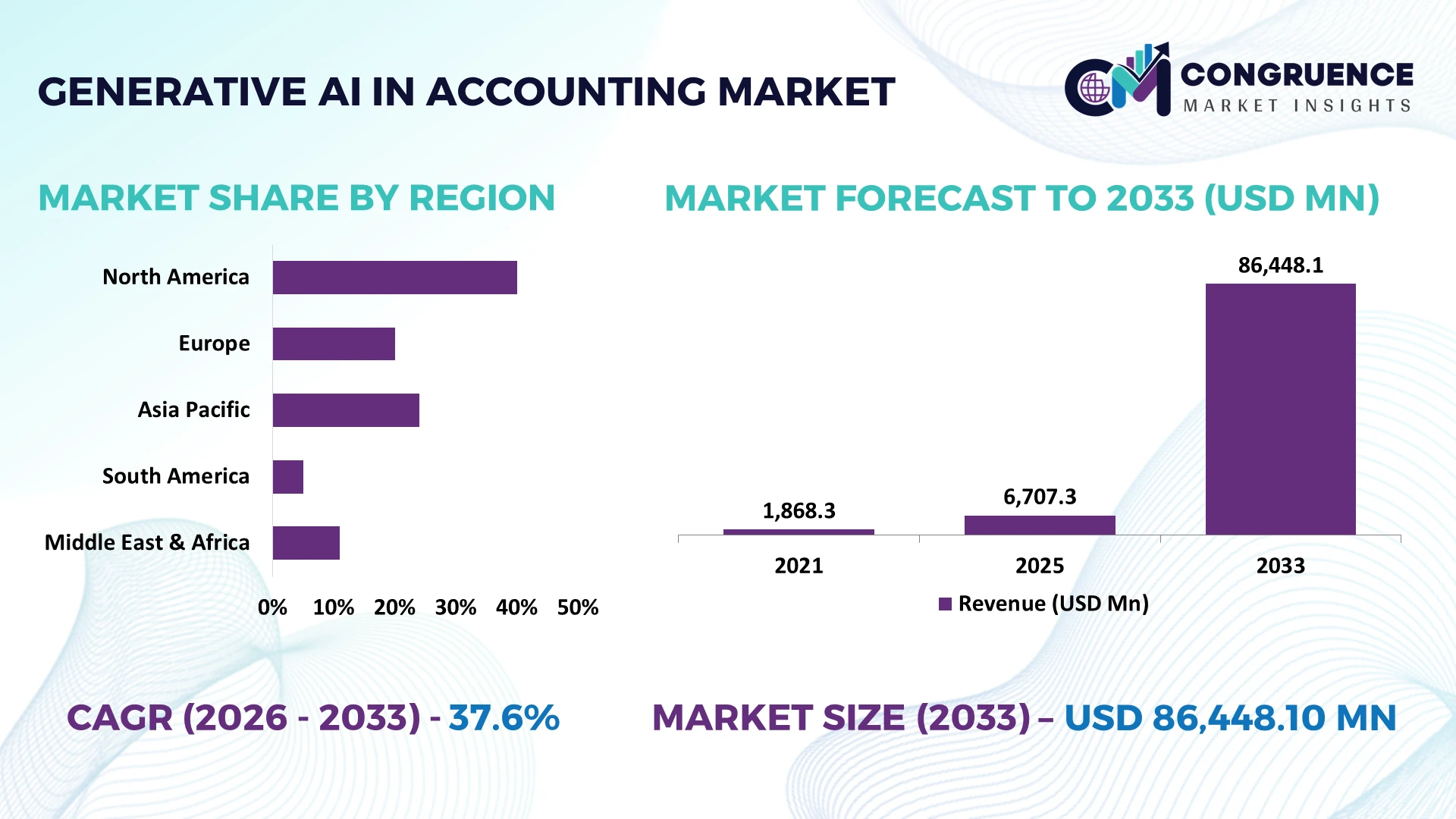
The United States dominates the global Generative AI in Accounting Market with approximately 38% share, supported by strong enterprise AI investments, cloud-first financial ecosystems, and widespread adoption across banking, healthcare, retail, and professional services. More than 65% of large enterprises are expanding AI-enabled finance operations, while the U.K. advances through financial regulation modernization and digital accounting transformation, creating a clear competitive gap in enterprise-scale deployment. Rising AI governance initiatives following the implementation of the EU AI Act are further strengthening enterprise compliance frameworks across developed markets.
Organizations investing early in enterprise-grade generative AI accounting platforms are positioned to improve operational resilience, accelerate financial decision-making, and strengthen long-term competitive advantage.
Market Size & Growth: USD 6707.27 Million in 2025 is projected to reach USD 86448.1 Million by 2033 at a CAGR of 37.65%, driven by enterprise finance automation and AI-powered compliance.
Top Growth Drivers: AI-assisted bookkeeping improves productivity by 45%, automated financial reporting cuts processing time by 60%, and intelligent audit workflows reduce manual effort by 50%.
Short-Term Forecast: By 2028, finance teams achieve up to 35% lower operational costs and 40% faster month-end closing through advanced AI deployment.
Emerging Technologies: Large language models, autonomous finance agents, and retrieval-augmented generation improve accounting workflow accuracy by nearly 30% across global enterprises.
Regional Leaders: North America exceeds USD 31 Billion, Europe approaches USD 22 Billion, and Asia-Pacific surpasses USD 19 Billion by 2033, supported by cloud finance modernization and regional digital expansion.
Consumer/End-User Trends: More than 58% of large enterprises integrate generative AI into finance operations, with banking and manufacturing leading adoption.
Pilot/Case Example: In 2026, enterprise finance transformation programs reported up to 52% faster invoice processing and 30% fewer reconciliation exceptions using AI-assisted accounting.
Competitive Landscape: Leading vendors collectively account for approximately 42% market share, with Microsoft, Oracle, SAP, Intuit, and IBM expanding enterprise AI accounting capabilities.
Regulatory & ESG Impact: AI governance frameworks reduce compliance review effort by nearly 25% while strengthening audit transparency following global regulatory expansion.
Investment & Funding: More than USD 8 Billion in enterprise AI finance investments supports strategic partnerships, cloud platform expansion, and intelligent accounting software development.
Innovation & Future Outlook: Next-generation autonomous finance assistants, multimodal AI, and real-time financial intelligence are accelerating enterprise-wide digital accounting transformation and strategic decision-making.
Generative AI in Accounting is reshaping financial operations by enabling automated reconciliations, intelligent tax preparation, predictive cash-flow analysis, and AI-assisted audit documentation. More than 55% of enterprise finance leaders are prioritizing AI-native accounting platforms to improve productivity and compliance. Increasing regulatory scrutiny over AI governance is driving demand for explainable financial models, positioning trusted automation as the next phase of enterprise accounting transformation.
Generative AI in Accounting has become a strategic capability as enterprises shift finance functions from transaction processing to real-time decision support. Competitive advantage increasingly depends on AI-driven financial intelligence, while stricter reporting frameworks and enterprise digital transformation accelerate deployment across regulated industries. The implementation of AI governance policies, including the EU AI Act, is encouraging organizations to adopt transparent and auditable accounting models that align innovation with compliance.
Modern generative AI accounting platforms complete invoice classification and financial reconciliation approximately 45% faster than conventional rule-based automation while reducing manual review effort by nearly 35%. The United States leads enterprise-scale deployment through mature cloud finance ecosystems, whereas Japan emphasizes AI integration for workforce productivity and precision accounting in manufacturing. Over the next two to three years, more than 60% of large enterprises are expected to integrate generative AI into core finance workflows, expanding automation beyond routine bookkeeping.
A multinational manufacturing company deploying AI-assisted accounts payable automation can reduce invoice processing cycles by nearly 50% while improving exception detection through intelligent document analysis. Software providers are expanding strategic partnerships with ERP vendors, cloud providers, and compliance specialists to deliver integrated finance platforms. Organizations establishing scalable AI governance and enterprise-wide accounting automation today will secure stronger operational resilience, faster financial reporting, and sustainable competitive differentiation.
Enterprise demand for automated financial operations is the primary structural driver reshaping the Generative AI in Accounting Market. More than 62% of large organizations are increasing AI investment across finance departments, while intelligent document processing reduces reconciliation effort by approximately 40% and improves reporting accuracy by nearly 30%. The United States continues expanding AI-enabled finance modernization following stricter governance requirements for financial transparency, encouraging software vendors to embed explainable AI into accounting platforms. This shift enables organizations to accelerate month-end closing, strengthen audit readiness, and reduce operational bottlenecks. Companies are responding through ERP integration partnerships, AI platform expansion, and specialized accounting copilots that improve workflow standardization while creating measurable productivity gains across enterprise finance functions.
Legacy finance infrastructure and fragmented enterprise data remain significant barriers to large-scale deployment. Around 48% of organizations continue operating multiple disconnected accounting environments, while integration projects increase implementation costs by nearly 25% compared with standardized cloud deployments. Germany's highly regulated industrial sector illustrates how complex compliance requirements extend validation timelines before AI systems reach production. Inconsistent financial master data further limits model accuracy and cross-business interoperability, affecting reporting consistency and deployment scalability. To reduce these operational constraints, technology providers are investing in standardized APIs, localized compliance frameworks, and hybrid deployment architectures while enterprises prioritize phased modernization instead of full infrastructure replacement, minimizing disruption to mission-critical financial operations.
The next phase of market expansion lies in autonomous finance operations combining generative AI, intelligent agents, and predictive analytics. AI-assisted financial planning can improve forecasting accuracy by approximately 28%, while automated compliance validation reduces manual verification effort by nearly 35%. Singapore continues supporting enterprise AI adoption through digital innovation initiatives, encouraging software developers to expand intelligent finance capabilities across multinational businesses. Companies are investing in AI-native accounting platforms, domain-specific financial language models, and ecosystem partnerships connecting ERP, banking, and tax applications. A notable strategic opportunity exists in mid-market enterprises seeking enterprise-grade automation without large consulting engagements, creating demand for scalable subscription-based accounting intelligence solutions with rapid implementation cycles.
Long-term market expansion depends on balancing intelligent automation with secure, accountable financial decision-making. Approximately 41% of finance executives identify AI governance as a major deployment challenge, while nearly 36% report shortages of professionals capable of validating AI-generated financial outputs. The United Kingdom's evolving AI oversight environment highlights increasing expectations for transparency, explainability, and auditability across enterprise finance systems. Cybersecurity, model monitoring, and continuous compliance verification require sustained investment beyond initial deployment. Companies must strengthen governance frameworks, expand workforce upskilling, and establish partnerships with cybersecurity and compliance specialists to ensure consistent AI performance, maintain stakeholder confidence, and achieve scalable enterprise-wide accounting transformation.
AI Copilots Transform Finance Enterprise finance teams are embedding generative AI copilots into daily accounting workflows, with more than 61% of large organizations expanding AI-assisted journal entries and financial reporting. Automated content generation reduces documentation time by nearly 42% while improving review consistency by 30%. Following stricter AI governance requirements in Europe, software vendors are strengthening explainable AI capabilities and forming ERP partnerships to accelerate secure enterprise deployment.
Continuous Accounting Expands Organizations are replacing periodic accounting cycles with continuous, AI-driven financial operations. Around 57% of enterprises now prioritize real-time reconciliation, while automated exception detection lowers manual review by approximately 38% and accelerates month-end closing by 35%. Labor shortages in finance departments are encouraging companies in the United States to restructure accounting operations around intelligent automation instead of expanding workforce capacity.
Private AI Deployment Accelerates Nearly 54% of multinational enterprises are implementing private or hybrid generative AI environments to protect confidential financial records. Secure deployment models reduce external data exposure by roughly 45% while improving compliance monitoring across regulated industries. Software providers are expanding sovereign cloud partnerships and localized infrastructure to satisfy enterprise governance requirements without sacrificing AI performance.
Industry-Specific Models Gain Ground Finance-focused language models trained on accounting terminology are improving transaction classification accuracy by approximately 33% while reducing audit preparation effort by 28%. Manufacturing and banking organizations in Japan are adopting domain-specific AI faster than general-purpose platforms because specialized models require fewer manual corrections. Vendors are responding through targeted product portfolios, industry alliances, and modular AI services that simplify enterprise integration.
Cloud-Based solutions dominate the Generative AI in Accounting Market with an estimated 46% market share, driven by rapid scalability, lower infrastructure costs, and seamless integration with enterprise ERP and financial management systems. Organizations increasingly favor cloud-native deployments because implementation timelines are nearly 40% shorter than traditional environments while enabling centralized AI model updates and stronger collaboration across distributed finance teams. SaaS platforms continue expanding adoption among mid-sized enterprises by providing subscription-based AI capabilities with lower upfront investment, making advanced accounting automation more accessible.
Hybrid deployments represent the fastest-growing segment as regulated industries balance cloud innovation with data residency and governance requirements. Approximately 34% of large enterprises now prefer hybrid architectures to combine cloud-based analytics with on-premises financial records. On-Premises deployments remain strategically relevant for defense, government, and highly regulated financial institutions requiring complete infrastructure control. Vendors are strengthening interoperability, expanding cloud partnerships, and developing flexible deployment models that allow enterprises to transition gradually without disrupting mission-critical accounting operations.
Financial Reporting holds the leading position with approximately 37% market share because enterprises prioritize faster reporting cycles, regulatory accuracy, and executive decision support. AI-generated narratives, automated disclosures, and intelligent reconciliation reduce reporting preparation time by nearly 40% while improving consistency across multinational operations. Invoice Processing continues expanding through AI-powered document recognition and workflow automation, reducing processing delays by approximately 45% in high-volume finance environments.
Audit Automation is the fastest-growing application as organizations strengthen continuous compliance monitoring and risk detection. Nearly 52% of enterprise audit teams are expanding AI-assisted testing to improve anomaly identification and documentation quality. Tax Management is also gaining momentum through automated regulatory interpretation and intelligent tax calculation, particularly among multinational corporations managing complex compliance obligations. Software providers continue integrating multiple accounting functions into unified AI platforms, strengthening workflow connectivity and enterprise-wide financial visibility.
BFSI represents the largest end-user segment with approximately 35% market share, reflecting intensive regulatory reporting requirements, complex transaction volumes, and continuous compliance obligations. Large financial institutions are deploying generative AI across financial reporting, audit documentation, and customer finance operations, improving processing efficiency by nearly 43%. Healthcare follows with increasing adoption to automate reimbursement documentation, compliance reporting, and financial administration while reducing administrative workload by approximately 30%.
Professional Services is emerging as the fastest-growing end-user segment as accounting firms and consulting organizations deploy AI to enhance advisory services, automate documentation, and improve client responsiveness. Retail organizations are scaling AI for invoice management and supplier reconciliation, while manufacturing companies integrate intelligent accounting into procurement and production finance processes. Vendors are responding with industry-specific AI models, customized pricing strategies, and strategic partnerships that address sector-specific accounting workflows and strengthen long-term customer retention.
North America accounted for the largest market share at 39.2% in 2025 however, Asia-Pacific is expected to register the fastest growth, expanding at a 40.8% between 2026 and 2033.
Enterprise AI Leadership and Finance Modernization
North America maintains the leading position through mature enterprise software ecosystems, advanced cloud infrastructure, and strong adoption across BFSI, healthcare, manufacturing, and professional services. The region represents approximately 39.2% of global deployment, supported by extensive ERP modernization and AI-native accounting platforms. More than 68% of large enterprises are integrating generative AI into finance workflows, while strategic partnerships between cloud providers and enterprise software vendors continue accelerating deployment. Financial institutions are expanding intelligent audit, compliance, and reporting capabilities to improve operational efficiency and governance. Increasing investment in secure AI infrastructure and private cloud environments further strengthens enterprise adoption, particularly for highly regulated accounting functions requiring explainability and data protection.
United States Market Outlook: The United States remains the regional innovation hub due to extensive enterprise AI investment, advanced cloud infrastructure, and a large concentration of multinational finance operations. More than 70% of Fortune 500 organizations have expanded AI-assisted finance transformation initiatives, while technology vendors continue integrating generative AI into enterprise accounting suites. Strong venture investment, evolving AI governance frameworks, and deep ERP penetration reinforce the country's leadership in commercial deployment and product innovation.
Regulatory-Driven Intelligent Finance Transformation
Europe continues strengthening its market position through digital finance modernization and AI governance initiatives. The region accounts for approximately 27% of global adoption, supported by widespread enterprise cloud migration and demand for transparent financial reporting. The implementation of the EU AI Act is accelerating enterprise investment in explainable AI, secure accounting automation, and governance-ready finance platforms. More than 55% of large enterprises are modernizing accounting infrastructure to improve compliance efficiency and reporting consistency. Software providers are expanding partnerships with financial institutions and consulting firms to deliver integrated AI accounting solutions aligned with evolving regulatory expectations.
Germany Market Outlook: Germany leads the European market through its strong industrial economy, advanced enterprise software adoption, and extensive digital transformation across manufacturing and financial services. Nearly 60% of large industrial enterprises are expanding AI-assisted financial operations to improve compliance and productivity. Domestic demand for secure enterprise platforms and localized AI deployment continues encouraging technology vendors to establish strategic partnerships and regional development centers.
Digital Scale and Enterprise Expansion
Asia-Pacific is emerging as the fastest-expanding regional market due to rapid enterprise digitization, expanding cloud infrastructure, and strong AI investment across financial services and manufacturing. The region contributes nearly 24% of current market activity while recording the highest deployment momentum among developing enterprise economies. More than 58% of new enterprise finance transformation projects now include AI-enabled accounting capabilities. Governments continue supporting digital business infrastructure, while technology providers expand regional cloud capacity and enterprise partnerships to meet growing demand. Large organizations increasingly deploy AI-powered accounting to improve operational efficiency across multi-country business networks.
China Market Outlook: China leads regional deployment through extensive enterprise digitization, expanding cloud ecosystems, and large-scale AI investment. More than 65% of leading digital enterprises are integrating AI into financial management and reporting workflows. Domestic software providers continue strengthening enterprise AI capabilities through localized innovation, strategic infrastructure expansion, and partnerships supporting intelligent finance operations across manufacturing, retail, and technology industries.
Enterprise Digital Adoption Accelerates
South America is witnessing increasing adoption of generative AI in accounting as enterprises modernize finance operations and improve compliance efficiency. The region contributes approximately 5% of global deployment, with banking, retail, and professional services leading implementation. More than 42% of large organizations are investing in finance automation platforms to reduce operational complexity and accelerate reporting. Infrastructure limitations and uneven cloud maturity continue affecting deployment speed, yet international software vendors are expanding regional partnerships and localized support services to strengthen enterprise adoption and improve implementation success.
Brazil Market Outlook: Brazil represents the region's largest opportunity through its sizable financial sector, expanding cloud infrastructure, and growing enterprise digital transformation initiatives. AI-assisted accounting adoption continues increasing among banks, large retailers, and consulting firms seeking faster financial operations. More than 45% of enterprise modernization projects now include intelligent finance automation, encouraging software providers to expand local partnerships, implementation services, and regulatory compliance capabilities.
Digital Transformation and Smart Infrastructure Investment
The Middle East & Africa market is advancing through national digital transformation strategies, cloud infrastructure investment, and modernization of enterprise finance systems. The region represents approximately 4.8% of global deployment, with increasing adoption across banking, government, and energy sectors. Around 39% of large organizations are implementing AI-enabled finance solutions to improve operational transparency and reporting efficiency. Strategic partnerships between global software providers and regional technology firms are expanding cloud-based accounting capabilities while supporting secure enterprise deployment across highly regulated industries.
United Arab Emirates Market Outlook: The United Arab Emirates leads regional adoption through ambitious digital economy initiatives, world-class cloud infrastructure, and strong investment in enterprise AI technologies. Financial institutions and government organizations are accelerating intelligent accounting deployment to enhance compliance and operational efficiency. Enterprise AI implementation continues expanding through technology partnerships, innovation hubs, and regulatory frameworks supporting advanced digital finance transformation.
The market is led by Microsoft, Oracle, SAP, Intuit, and IBM, competing directly with enterprise AI specialists such as Workday and Sage, while regional accounting software vendors compete through localization and industry-specific customization. The top five players collectively control approximately 48% of the market, driven by integrated cloud ecosystems and enterprise finance platforms. Competition centers on AI accuracy, deployment speed, and workflow integration, with advanced platforms reducing finance processing time by nearly 40% and implementation cycles by around 30% compared with legacy solutions. Vendors are expanding through ERP partnerships, cloud alliances, AI model innovation, and acquisitions to strengthen end-to-end finance capabilities. The competitive landscape is shifting toward platform consolidation as enterprises prefer unified accounting, compliance, and analytics solutions over standalone applications. High integration complexity and regulatory compliance requirements remain major entry barriers. Sustainable success depends on trusted AI governance, seamless enterprise interoperability, rapid deployment, and continuous innovation that delivers measurable operational value.
Microsoft
Oracle
SAP
Intuit
IBM
Workday
Sage
Xero
Zoho Corporation
BlackLine
AppZen
Vic.ai
OneStream Software
UiPath
Generative AI in Accounting is rapidly transitioning from workflow assistance to autonomous financial operations. Large language models integrated with ERP, cloud accounting, and intelligent document processing platforms reduce financial reconciliation time by approximately 42% while improving transaction classification accuracy by nearly 31%. Around 61% of large enterprises have deployed AI-enabled accounting capabilities across reporting, invoice processing, and compliance workflows. Retrieval-augmented generation and vector databases are strengthening financial knowledge retrieval, enabling faster audit preparation and improving decision consistency across distributed finance teams.
Emerging technologies between 2026 and 2028 include AI agents, multimodal document intelligence, and explainable AI governance integrated with enterprise accounting ecosystems. Agentic AI reduces manual workflow orchestration by nearly 35%, while multimodal invoice interpretation improves extraction accuracy by approximately 28% compared with conventional OCR systems. Nearly 46% of enterprise software providers are embedding finance-specific AI copilots into accounting platforms. Organizations gain competitive advantage through continuous accounting, automated compliance monitoring, and real-time financial insights without expanding finance headcount.
Compared with legacy rule-based accounting automation, modern generative AI platforms improve end-to-end finance process efficiency by approximately 45% while reducing operational costs by nearly 30%. Global enterprise software leaders benefit through integrated ERP ecosystems, whereas AI-native accounting vendors compete through faster deployment and specialized financial intelligence. Between 2026 and 2028, enterprises investing in secure AI governance, autonomous finance agents, and interoperable accounting platforms will establish stronger operational resilience, accelerate reporting cycles, and outperform competitors in finance transformation.
March 2024 Oracle introduced more than 50 generative AI capabilities across Oracle Fusion Cloud ERP, including finance automation and reporting assistance, with human review built into workflows to improve enterprise productivity and financial accuracy. Source: Reuters
April 2025 SAP announced Joule for SAP Concur Expense, enabling natural-language management of expense reports and automated finance tasks across enterprise workflows, expanding AI-driven accounting operations while improving reporting efficiency and user productivity. Source: SAP Help Portal
January 2026 SAP confirmed general availability of bidirectional integration between Joule and Microsoft 365 Copilot, enabling unified enterprise finance workflows and introducing tenant-level adoption analytics through the Joule Analytics Center for stronger operational visibility. Source: SAP News Center
May 2026 SAP unveiled autonomous enterprise capabilities featuring over 200 specialized AI agents and reported a 70% operational efficiency improvement with a 50% reduction in manual errors in a customer deployment, accelerating intelligent finance automation.
This report provides comprehensive analysis of the Generative AI in Accounting Market across Cloud-Based, On-Premises, Hybrid, and SaaS deployment models, together with Financial Reporting, Invoice Processing, Audit Automation, and Tax Management applications. It evaluates demand across BFSI, Retail, Manufacturing, Healthcare, and Professional Services while assessing enterprise deployment patterns, technology adoption, competitive positioning, and operational transformation. More than 60% of enterprise implementations emphasize integrated cloud-based finance automation and AI-assisted compliance workflows.
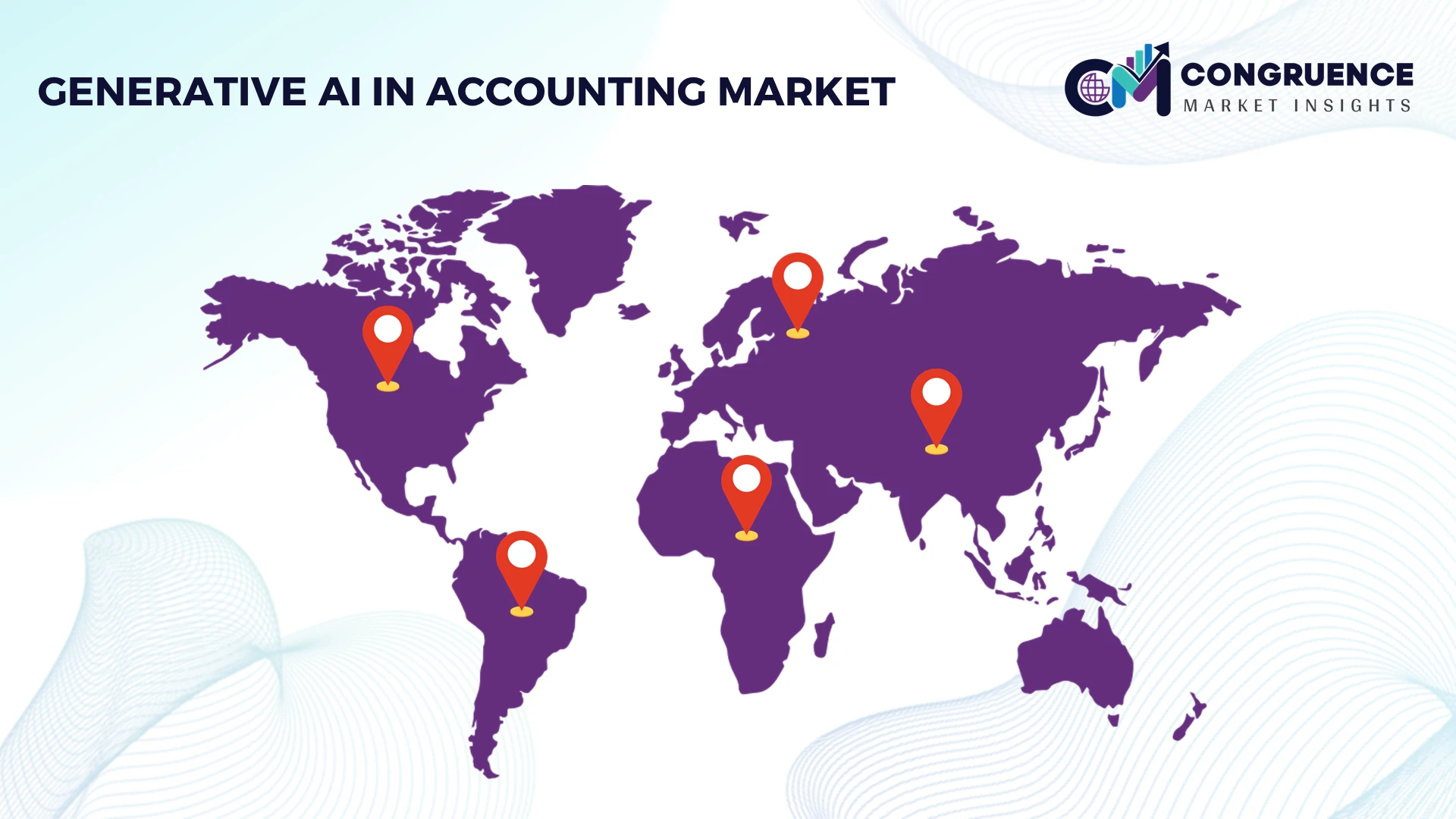
The report covers North America, Europe, Asia-Pacific, South America, and the Middle East & Africa, highlighting country-level investment priorities, deployment maturity, and enterprise modernization trends. It examines advances in large language models, AI agents, intelligent document processing, explainable AI, and ERP integration while evaluating company strategies, product innovation, and ecosystem partnerships. The analysis supports investment planning, market expansion, competitive benchmarking, portfolio development, and long-term strategic decision-making across the 2026–2033 outlook period.
| Report Attribute/Metric | Report Details |
|---|---|
Market Revenue in 2025 | USD 6707.27 Million |
Market Revenue in 2033 | USD 86448.1 Million |
CAGR (2026 - 2033) | 37.65% |
Base Year | 2025 |
Forecast Period | 2026 - 2033 |
Historic Period | 2021 - 2025 |
Segments Covered | By Type
By Application
By End-User
|
Key Report Deliverable | Revenue Forecast, Growth Trends, Market Dynamics, Segmental Overview, Regional and Country-wise Analysis, Competition Landscape |
Region Covered | North America, Europe, Asia-Pacific, South America, Middle East, Africa |
Key Players Analyzed | Microsoft, Oracle, SAP, Intuit, IBM, Workday, Sage, Xero, Zoho Corporation, BlackLine, AppZen, Vic.ai, OneStream Software, UiPath |
Customization & Pricing | Available on Request (10% Customization is Free) |




