
Reports
The Global General Purpose Server Market was valued at USD 98,140.0 Million in 2025 and is anticipated to reach a value of USD 1,61,205.2 Million by 2033 expanding at a CAGR of 6.4% between 2026 and 2033. Growth is driven by agentic AI workloads that require CPU-intensive task orchestration and tool invocation, pulling general-purpose servers back into hyperscale procurement cycles.
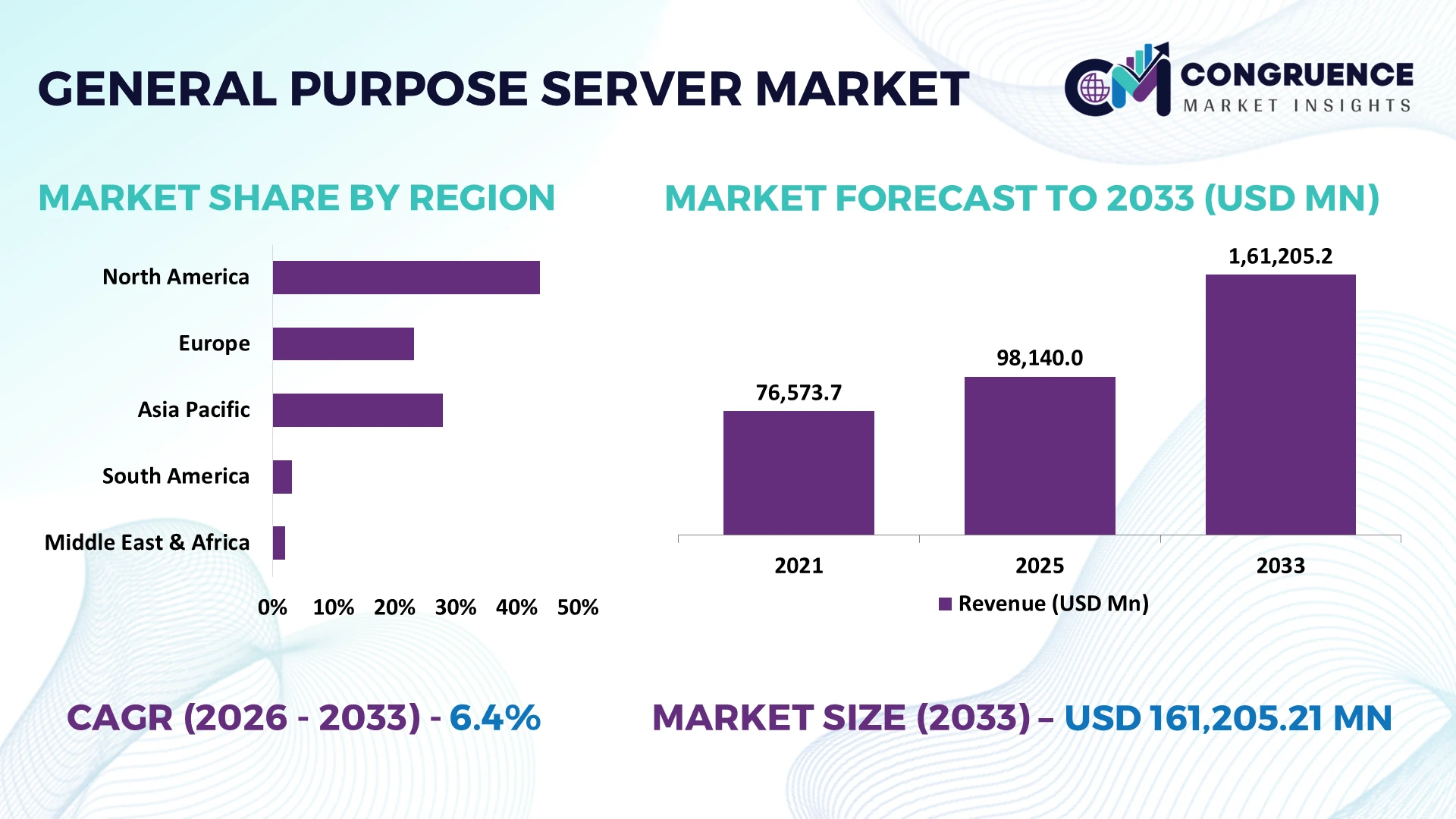
The United States dominates with 67.4% of global server revenue, reaching USD 112.2 billion in Q2 2026, driven by hyperscaler capacity expansion across cloud, AI inference, and enterprise replacement cycles. China follows at USD 19.2 billion in Q1 2026, with domestic carriers shifting toward ARM architecture—China Mobile's 2026–2027 PC server tender allocated 65.01% to ARM versus 33.09% to x86. This divergence signals that U.S. hyperscalers prioritize scale and AI integration, while Chinese operators pursue architectural sovereignty.
Strategic implication, vendors must localize supply chains and align with regional architecture preferences to capture share.
Market Size & Growth: Valued at USD 98,140.0 million in 2025, projected to reach USD 161,205.2 million by 2033, driven by agentic AI inference workloads demanding CPU-intensive orchestration.
Top Growth Drivers: Agentic AI adoption (+15% hyperscaler general-purpose procurement), installed-base replacement cycles (2019–2021 cloud boom servers), and hybrid cloud consolidation (50.2% ODM Direct share).
Short-Term Forecast: By 2027, power-efficient designs cut data center energy overhead by 18–22%, while VM density per rack rises 25–30% through higher core counts.
Emerging Technologies: Agentic AI orchestration, ARM-based server architectures (65.01% of China Mobile's tender), and heterogeneous compute management platforms.
Regional Leaders: United States at USD 112.2 billion (Q2 2026, 67.4% share); China at USD 19.2 billion (Q1 2026); Taiwan manufacturing ~90% of global AI servers.
Consumer/End-User Trends: 46% of Chinese enterprise AI accelerator budgets shift to domestic chips within 12 months, reshaping server configuration demand.
Pilot/Case Example: 2026 China Mobile ARM tender—65.01% ARM allocation (40,896 units) versus 33.09% x86, signaling carrier-grade architecture migration.
Competitive Landscape: Dell leads branded OEM share; key players include HPE, Inspur (27.5% China Q1 2026), Supermicro, and Huawei (22%+ China ecosystem share).
Regulatory & ESG Impact: U.S. export controls limit advanced GPU access to China; Nvidia requires cloud partners to sell 51%+ services to non-Chinese clients, restructuring regional supply flows.
Investment & Funding: Amazon committed ~USD 200 billion 2026 capex for AI infrastructure and data centers; Microsoft allocated USD 30 billion across U.K. facilities.
Innovation & Future Outlook: Heterogeneous compute platforms supporting 90% of AI chip variants; software-defined orchestration becomes the differentiation layer as hardware commoditizes.
The General Purpose Server Market is being reshaped by inference-era demand, where CPU-centric systems handle pre- and post-processing for AI workloads rather than pure training. Recent innovations include multi-vendor accelerator compatibility—Inspur's open architecture supports 90% of industry AI chips, compressing development cycles to 6–8 months. A key emerging trend is architectural bifurcation: China's state carriers now allocate 65% of new tenders to ARM, while U.S. hyperscalers remain x86-dominant. Operationally, export-control compliance now dictates supply routing, with Nvidia requiring 51% non-Chinese client thresholds for partners. These dynamics set the stage for strategic realignment across procurement, partnerships, and regional manufacturing footprints.
General-purpose servers have re-emerged as strategic infrastructure because agentic AI inference depends on CPU orchestration, not just GPU acceleration. U.S. hyperscalers—Amazon, Microsoft, and Google—collectively raised general-purpose procurement by 15%+ in Q2 2026 to handle Copilot and Gemini inference traffic. This shift restructures supply chains: Taiwan now manufactures approximately 90% of global AI servers, while U.S. export controls force Nvidia to restrict partner sales to Chinese clients at 51% non-Chinese thresholds.
Technically, modern general-purpose platforms deliver measurable advantages over legacy systems. Higher core density and faster network interfaces increase virtual machine density per rack by 25–30% while reducing power consumption per workload by 18–22%, directly lowering operational expenditure in power-constrained data centers. Regionally, the contrast is stark: U.S. deployments prioritize scale and AI integration, while China Mobile's 2026–2027 tender allocated 65.01% to ARM architecture, reflecting sovereignty-driven procurement over raw performance metrics. Over the next 24–36 months, enterprise replacement cycles will accelerate as 2019–2021 cloud-era servers reach end-of-life.
Operationally, hyperscalers are adjusting through vertical integration and ODM partnerships. ODM Direct channels captured 50.2% of Q1 2026 server revenue, bypassing traditional OEM margins. Companies are redirecting investment toward software-defined management layers and multi-vendor compatibility rather than proprietary hardware lock-in. Strategic conclusion: competitive advantage now hinges on regional supply-chain alignment, architecture flexibility, and inference-optimized density—not raw compute acquisition.
Agentic AI workloads—task coordination, tool invocation, and automated workflow execution—are pulling general-purpose servers back into hyperscale demand cycles. Amazon, Microsoft, and Google each increased Q2 2026 general-purpose server procurement by over 15%, driving global shipments past 5 million units for the first time. U.S. hyperscalers are responding by expanding CPU capacity alongside GPU clusters, recognizing that inference orchestration demands balanced architectures. Taiwan's manufacturing ecosystem, which produces roughly 90% of global AI servers, absorbs this demand through ODM partnerships with Quanta and others. A non-obvious insight: agentic AI does not cannibalize general-purpose servers—it reconstitutes them as the coordination layer that makes GPU acceleration operationally viable at scale. Companies investing in high-core-density, power-efficient platforms now lock in efficiency advantages as inference traffic compounds.
U.S. export restrictions on advanced GPUs are restructuring global server procurement with measurable friction. Nvidia now requires cloud partners to sell at least 51% of services to non-Chinese clients, constraining Chinese hyperscalers' access to leased compute in Malaysia and Indonesia. Chinese firms ordered approximately 6 million RTX Pro 5500 chips but expect to receive only 1% in the near term, forcing reconfiguration toward domestic accelerators. These controls directly impact scalability: Chinese cloud providers must redesign architectures around Huawei Ascend or Cambricon alternatives, extending deployment timelines by 6–9 months. Companies are mitigating through domestic chip qualification programs and regional diversification—46% of Chinese enterprise AI accelerator budgets now target domestic suppliers within 12 months. The operational insight: compliance overhead is becoming a fixed cost of market participation, favoring vendors with dual-supply-chain flexibility.
The fragmentation of AI accelerators—Nvidia, Huawei Ascend, Cambricon, Kunlunxin, and others—creates an untapped opportunity in unified orchestration software. Inspur's open architecture now supports 90% of industry AI chips across x86 and ARM platforms, compressing chip-to-system development cycles to 6–8 months. China's domestic AI chip budget allocation is projected to reach 46% within 12 months, up from 30% today, creating demand for platforms that abstract hardware heterogeneity. Non-obvious opportunity: server vendors that deliver software-defined compatibility layers capture margin regardless of which chip wins. Companies positioning through R&D in compiler optimization, firmware abstraction, and multi-vendor validation will own the integration layer as hardware commoditizes.
Deploying heterogeneous general-purpose servers at scale requires engineering competencies that remain scarce. China's server ecosystem faces a widening gap: Inspur leads with 27.5% revenue share, but net margins remain in single digits, constraining reinvestment in talent and support infrastructure. Integration complexity compounds this—each accelerator variant requires distinct firmware, driver stacks, and thermal profiles, extending deployment cycles by 30–40% compared to homogeneous x86 environments. The impact on competitiveness is direct: vendors that cannot staff multi-architecture validation teams cede enterprise accounts to larger competitors with established service networks. Companies must solve this through partnerships with chip vendors for co-engineering and investment in remote management platforms that reduce on-site engineering dependency. Strategic necessity: operational consistency across heterogeneous fleets becomes the differentiator as hardware diversity accelerates.
CPU-GPU Ratios Compress Toward 1:1 Agentic AI task orchestration is forcing server architects to rebalance compute ratios. Configurations that once ran at one CPU per eight GPUs now shift toward 2:1 and even 1:1 as autonomous workflow execution demands real-time scheduling and low-latency instruction throughput. Global server CPU shipments are projected to rise 31% in 2026, with growth exceeding 40% in 2027. Companies are redesigning rack-level power and thermal envelopes to accommodate denser CPU populations, prioritizing core count over raw clock speed.
ARM Architecture Crosses Enterprise Threshold ARM-based server CPUs are projected to capture over 20% market share in 2026, climbing toward 30% by 2027. China Mobile's 2026–2027 PC server tender exemplifies this shift, with domestic carriers allocating the majority of volume to ARM-compatible platforms. Cloud service providers and technology firms are deploying self-designed ARM variants for general-purpose workloads, eroding x86's long-standing default status. Vendors are responding by validating firmware stacks across dual architectures, compressing qualification cycles to maintain bid eligibility.
DRAM Allocation Diverts to Accelerators Memory suppliers are prioritizing DRAM and NAND capacity for AI servers and GPU-adjacent products, tightening component availability for standard general-purpose configurations. This allocation bias directly constrains x86 server shipment volumes even as order books remain full. Enterprise buyers face extended lead times and higher average unit prices, prompting procurement teams to lock pricing earlier and accept partial shipments. ODM partners are restructuring build schedules around memory availability rather than CPU supply, inverting historical planning logic.
Hyperscaler Capex Reshapes ODM Share Combined 2026 capital expenditure guidance across Amazon, Alphabet, Microsoft, and Meta has climbed to USD 720–745 billion, with roughly 60% of Alphabet's quarterly spend directed toward servers. ODM Direct channels captured 53.2% of Q4 2025 server revenue, bypassing branded OEM margins entirely. This concentration empowers hyperscalers to dictate component specifications and delivery cadence, leaving traditional OEMs to compete for enterprise replacement cycles where standardized SKUs and service networks still command premium pricing.
Rack servers command the dominant share of general-purpose server deployments, sustaining approximately 55–60% of unit volume through hyperscale and enterprise data center standardization. Their dominance rests on modular scalability, straightforward thermal management, and compatibility with ODM direct manufacturing models that now represent 53.2% of total server revenue. Blade servers represent the fastest-growing type, gaining traction as enterprises consolidate high-density workloads and reduce cabling complexity by 30–40% per rack. Tower servers retain relevance in edge and SMB deployments but face gradual displacement as space efficiency becomes operationally critical.
Companies are responding by prioritizing rack platform refresh cycles while investing in blade chassis ecosystems that support heterogeneous compute modules. Dell's 10% revenue share leadership reflects its rack-scale integration capability, while Inspur's 4.1% share in China hinges on domestic rack deployments. Investment priorities are shifting toward rack designs that accommodate both x86 and ARM compute nodes within identical power envelopes, reducing reconfiguration costs as architecture diversification accelerates.
Cloud and hyperscale applications account for the largest general-purpose server demand pool, representing approximately 60–65% of deployment volume as hyperscalers build out CPU capacity to orchestrate agentic AI workflows. Amazon, Alphabet, and Microsoft collectively guided 2026 capital expenditure above USD 600 billion, with server allocations comprising the majority of spend. The fastest-growing application segment is AI inference orchestration, where general-purpose servers execute task decomposition, tool invocation, and result synthesis for agentic systems—workloads that demand CPU density rather than GPU throughput.
Enterprise on-premises applications remain stable but cautious, with traditional buyers extending refresh cycles and prioritizing hybrid cloud integration over forklift upgrades. Government and defense applications are strengthening in China, where domestic server procurement now emphasizes sovereignty-compliant architectures. Companies are adapting by developing application-specific reference designs: inference-optimized SKUs with higher core counts, memory bandwidth, and network interface density for cloud providers, versus cost-optimized configurations for enterprise replacement cycles.
Hyperscale cloud providers and large service operators constitute the dominant end-user group, driving an estimated 55–60% of general-purpose server consumption through direct ODM engagements and custom specification authority. Their procurement scale—Amazon alone guided USD 220 billion in 2026 capital expenditure—enables pricing leverage and configuration control that traditional enterprises cannot replicate. The fastest-growing end-user segment is mid-tier cloud service providers and regional data center operators, particularly in Asia-Pacific markets where digital sovereignty requirements mandate local infrastructure buildout.
Enterprise end-users remain the second-largest but most cautious buyer group, with IDC noting that traditional on-premises spending trails hyperscale demand recovery. Companies are targeting these segments through differentiated engagement models: direct engineering partnerships with hyperscalers for custom ODM designs, and channel-enabled standardized platforms for enterprise accounts requiring service-level guarantees and hybrid cloud compatibility. Lenovo's 4.0% share reflects its dual strategy of hyperscale supply relationships and enterprise channel presence, while HPE's 3.1% share signals its strategic pivot away from high-volume x86 toward edge and mission-critical segments.
North America accounted for the largest market share at 43.7% in 2025 however, Middle East & Africa is expected to register the fastest growth, expanding at a CAGR of 15.9% between 2026 and 2033.
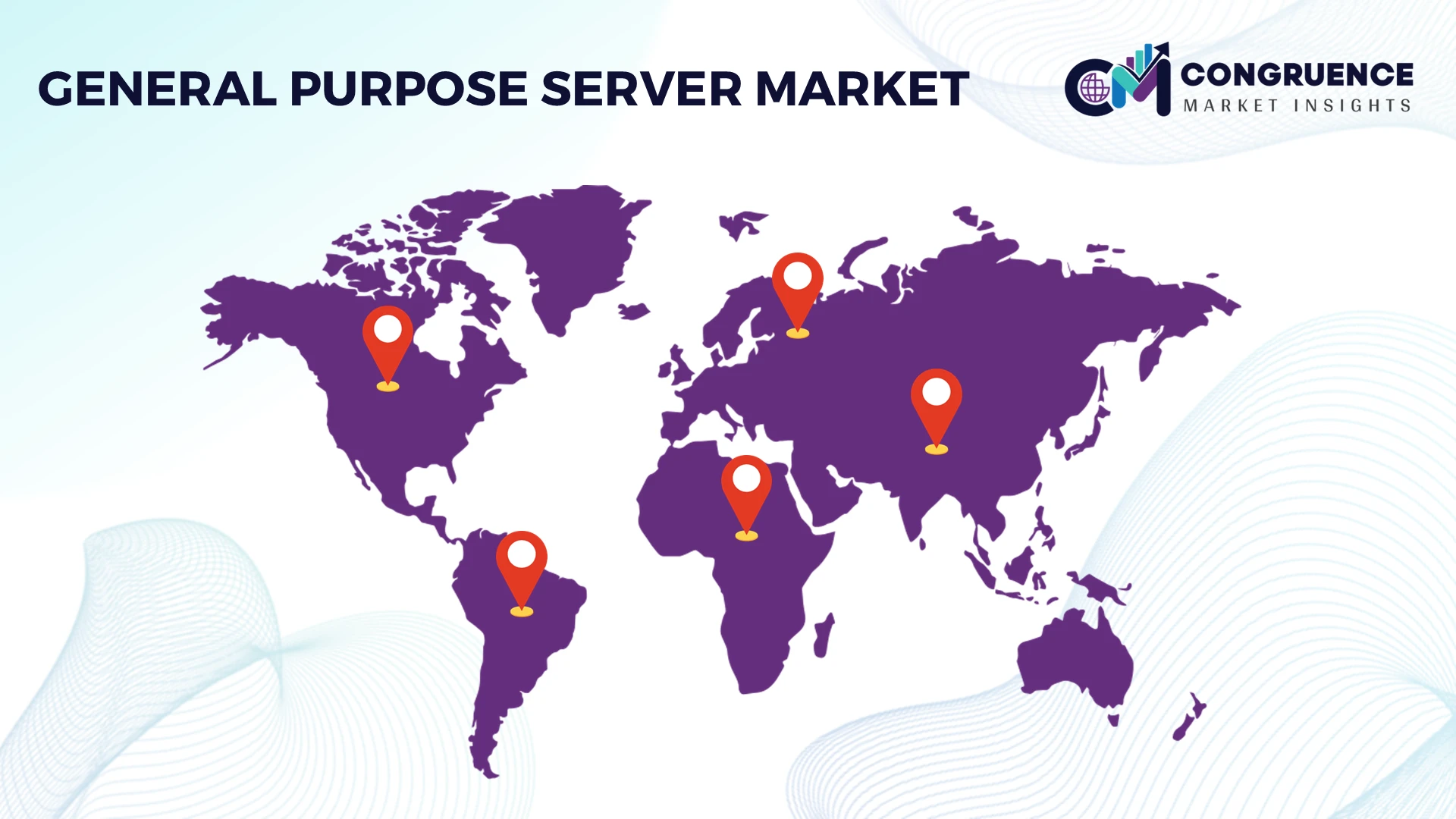
North America commands the largest regional share at 43.7%, anchored by unprecedented hyperscaler capital deployment across U.S. data center corridors . Amazon, Alphabet, Microsoft, and Meta collectively guided 2026 capital expenditure exceeding USD 700 billion, with server allocations representing the single largest infrastructure category. Deployment concentration centers on accelerated computing clusters in Virginia, Oregon, and Texas, where general-purpose servers execute inference orchestration and agentic workflow coordination. The region's operational advantage rests on domestic ODM engineering partnerships—Quanta, Wiwynn, and Celestica maintain U.S.-adjacent manufacturing capacity—reducing lead times by 15–20% versus offshore alternatives. This vertical integration model compresses procurement cycles and enables specification control that enterprise buyers cannot replicate.
United States Market Outlook: The United States dominates regional volume through hyperscale procurement authority, with IDC recording 72.4% year-over-year server revenue growth in Q4 2025, driven by an 80.1% surge in accelerated server deployments . Domestic cloud providers exercise direct ODM engagement models, bypassing traditional OEM channels and setting component specifications that cascade through global supply chains.
Europe holds a 23.2% regional share, with demand increasingly structured around data sovereignty compliance and energy efficiency mandates. Germany, France, and the Netherlands lead deployment activity, where GDPR-aligned infrastructure requirements favor in-region hosting and restrict cross-border data flows. The region's operational profile differs from North America: enterprise replacement cycles dominate over hyperscale greenfield builds, with average refresh intervals extending to 5–6 years. Sustainability regulation—particularly the EU Energy Efficiency Directive—forces server procurement teams to prioritize power-performance ratios, accelerating adoption of high-core-density platforms that reduce watts per workload by 18–22%. Investment momentum centers on sovereign cloud initiatives, with national governments funding domestic capacity to reduce reliance on U.S. hyperscalers.
Germany Market Outlook: Germany anchors European demand through its industrial enterprise base and sovereign cloud programs. The country's data center operators face binding energy efficiency targets under national legislation, driving procurement toward platforms validated for reduced power consumption. Frankfurt's position as a financial services hub sustains replacement demand for general-purpose servers running transaction processing and compliance workloads.
Asia-Pacific represents 27.8% of global share, distinguished by its dual role as production epicenter and fragmented consumption market. Taiwan manufactures approximately 90% of global AI servers, with ODM facilities supplying U.S. and European hyperscalers under contract manufacturing arrangements. China operates as the region's largest consumption market, but procurement patterns diverge sharply from Western norms: domestic carriers now allocate the majority of server tenders to ARM-compatible platforms, reflecting sovereignty-driven architecture preferences. Japan and South Korea sustain enterprise replacement demand, while Southeast Asian markets—Vietnam, Malaysia, Thailand—absorb supply-chain relocation investment as manufacturers diversify beyond China. The region's operational distinctiveness lies in this coexistence of export-oriented manufacturing scale and import-substituting consumption policy.
China Market Outlook: China's server demand is structurally reshaped by domestic accelerator qualification programs and carrier procurement mandates. China Mobile's 2026–2027 tender allocated 65.01% to ARM architecture, signaling state-directed migration away from x86 dependency. Domestic vendors Inspur and Huawei capture share through sovereignty-compliant platforms, while export controls constrain access to advanced GPU-adjacent components.
South America contributes 3.2% of global share, with Brazil and Argentina representing the primary demand centers. Deployment activity concentrates in financial services, telecommunications, and government digitization programs, where server procurement follows broader IT modernization cycles rather than AI-driven acceleration. The region's operational constraint is infrastructure readiness: data center capacity remains limited outside São Paulo and Buenos Aires, and power reliability in parts of Argentina and Colombia restricts sustained high-density deployment. Enterprise buyers favor cost-optimized configurations and extended refresh cycles, prioritizing capital preservation over performance upgrades. Growth potential exists in cloud service localization, but execution depends on regulatory stability and utility infrastructure investment.
Brazil Market Outlook: Brazil leads regional demand through financial services modernization and public sector digitization. São Paulo's data center cluster absorbs the majority of general-purpose server deployments, serving banking, insurance, and telecommunications workloads. Procurement patterns favor established OEM channels with local service networks, as enterprise buyers prioritize support availability over ODM cost advantages.
The Middle East & Africa region holds 2.1% of global share but represents the fastest-expanding deployment pipeline, driven by government-directed AI infrastructure programs . Saudi Arabia and the UAE anchor regional demand through Vision 2030 digital initiatives and sovereign cloud buildouts. Saudi Arabia alone accounted for USD 3.22 billion in server spending in 2025, with projections indicating 41.8% of regional revenue by 2035 . The UAE captures 28.0% of regional share, with Dubai and Abu Dhabi concentrating cloud, financial services, and logistics workloads. Deployment patterns differ from mature markets: greenfield hyperscale facilities bypass legacy replacement cycles entirely, adopting current-generation platforms from inception. Power availability remains the primary execution variable.
Saudi Arabia Market Outlook: Saudi Arabia dominates regional demand through sovereign AI investment and smart city development. Government programs fund data center capacity at scale, with procurement structured around strategic partnerships rather than transactional purchasing. The country's operational advantage lies in capital availability and political commitment to infrastructure modernization, though workforce development and local technical capacity remain evolving constraints.
Dell, Lenovo, Supermicro, HPE, and IEIT Systems form the branded OEM competitive set, while ODM Direct manufacturers compete separately on scale and customization for hyperscaler contracts. The top five branded players collectively hold roughly 36.7% of x86 server revenue, with Dell leading at 9.6% and Lenovo at 9.0% in Q2 2026. Competition pivots on supply-chain allocation as AI servers command priority for critical components—general-purpose lead times stretch to 35–40 weeks for power management ICs, forcing buyers toward vendors with secured inventory. Lenovo captured the x86 shipment crown with 7.4% unit share, reflecting aggressive pricing and volume strategies, while Dell defends revenue leadership through enterprise service networks and multi-silicon support. The competitive shift is structural: ODM Direct bypasses branded channels entirely for hyperscale accounts, compressing OEM margins and forcing differentiation toward management software, liquid-cooling readiness, and regional supply localization. Entry barriers are rising—component allocation leverage and multi-architecture validation capacity now determine bid eligibility. Winning requires secured supply contracts, dual-architecture engineering depth, and direct hyperscaler relationships that transcend transactional hardware sales.
Dell Technologies
HPE (Hewlett Packard Enterprise)
Lenovo
Inspur (IEIT Systems)
Supermicro
IBM
Cisco Systems
H3C
Huawei
Fujitsu
xFusion
NetApp
Oracle
NEC Corporation
Current deployments center on high-core-density x86 platforms with DDR5 memory and PCIe Gen5 interfaces, where power efficiency per workload improves 18–22% over prior generations. Adoption signals show 31% projected growth in server CPU shipments for 2026, with enterprises prioritizing virtualization density and total cost of ownership over raw clock speed. Dell’s 18th-generation PowerEdge demonstrates the consolidation thesis: 13 older servers fold into one, delivering 70% generational performance gains while freeing rack space and power for AI workloads.
Emerging architecture competition is intensifying as ARM-based platforms cross the 20% market share threshold in 2026. Non-x86 server revenue surged 146.4% year-over-year in Q4 2025, driven by hyperscaler custom silicon and sovereign procurement mandates. The competitive beneficiary is Lenovo and ODM partners with dual-architecture validation capacity; x86-only vendors face bid exclusion in Chinese carrier tenders where ARM allocations dominate. Integration trends favor software-defined management layers that abstract silicon heterogeneity, reducing reconfiguration costs by 30–40% across mixed fleets.
Disruptive pressure comes from component allocation bias—AI servers absorb priority supply for PMICs and BMCs, extending general-purpose lead times to 35–40 weeks. By 2026–2028, vendors with secured component contracts and liquid-cooling-compatible rack designs will capture replacement-cycle demand. The strategic imperative is clear: multi-silicon support and supply-chain resilience now determine competitive viability, not hardware specifications alone.
September 2026, Lenovo Captured global x86 server shipment leadership with 286,000 units and 7.4% market share, while revenue reached USD 8.26 billion, a 96.0% year-over-year increase, narrowing the gap with Dell to USD 570 million. Business impact: volume strategy validates dual-architecture portfolio positioning against Dell's revenue leadership. Source: zhidx.com
April 2026, TrendForce (Industry Monitor) Reported general-purpose server lead times extending to 35–40 weeks for power management ICs as AI servers command priority allocation; overall server shipment growth adjusted to 13% from potential 20%. Business impact: component scarcity becomes a structural procurement constraint, favoring vendors with secured supply contracts. Source: cna.com.tw
October 2026, Dell Technologies Announced 18th-generation PowerEdge servers achieving 13-to-1 consolidation versus 14th-generation systems, with 70% generational performance gains and rack-level density improvements through 3U two-socket designs. Business impact: consolidation economics directly address power and space constraints in AI-adjacent data centers. Source: siliconangle.com
June 2026, IDC (Institutional Data) Q1 2026 global server revenue reached USD 122.6 billion, up 30.4% year-over-year, with Dell at 16.5% revenue share and Supermicro at 7.6%, reflecting sustained hyperscale and enterprise demand across general-purpose and accelerated platforms. Business impact: market expansion validates replacement-cycle acceleration and multi-vendor competitive intensity. Source: silicon.es
The report covers the global general-purpose server landscape across air-cooled and liquid-cooled configurations, rack, tower, and blade form factors, and x86 versus non-x86 processor architectures. Application coverage spans enterprise databases, virtualization, cloud services, web hosting, telecommunications, and file storage, while end-user segmentation addresses hyperscale cloud providers, enterprises, government, and mid-tier service operators. Regional analysis extends across North America, Europe, Asia-Pacific, South America, and Middle East & Africa, with country-level granularity for the United States, China, Germany, Brazil, and Saudi Arabia.
Quantitative indicators include segment distribution across processor architectures—with non-x86 platforms gaining measurable traction in sovereign procurement—and deployment patterns reflecting installed-base replacement cycles across enterprise and hyperscale environments. Company participation levels are mapped across branded OEMs and ODM Direct channels, capturing the competitive bifurcation reshaping vendor strategies. The report supports investment planning through supply-chain risk assessment, expansion strategy via regional demand mapping, and competitive positioning through architecture and form-factor alignment. Strategic direction between 2026 and 2033 emphasizes component allocation dynamics, liquid-cooling adoption, and the divergence between U.S. scale-driven procurement and China's sovereignty-focused architecture mandates.
| Report Attribute / Metric | Details |
|---|---|
| Market Revenue (2025) | USD 98,140.0 Million |
| Market Revenue (2033) | USD 1,61,205.2 Million |
| CAGR (2026–2033) | 6.4% |
| Base Year | 2025 |
| Forecast Period | 2026–2033 |
| Historic Period | 2021–2025 |
| Segments Covered |
By Type
By Application
By End-User
|
| Key Report Deliverables | Revenue Forecast; Market Trends; Growth Drivers & Restraints; Technology Insights; Segmentation Analysis; Regional Insights; Competitive Landscape; Regulatory & ESG Overview; Recent Developments |
| Regions Covered | North America; Europe; Asia-Pacific; South America; Middle East & Africa |
| Key Players Analyzed | Dell Technologies; HPE (Hewlett Packard Enterprise); Lenovo; Inspur (IEIT Systems); Supermicro; IBM; Cisco Systems; H3C; Huawei; Fujitsu; xFusion; NetApp; Oracle; NEC Corporation |
| Customization & Pricing | Available on Request (10% Customization Free) |




