
Reports
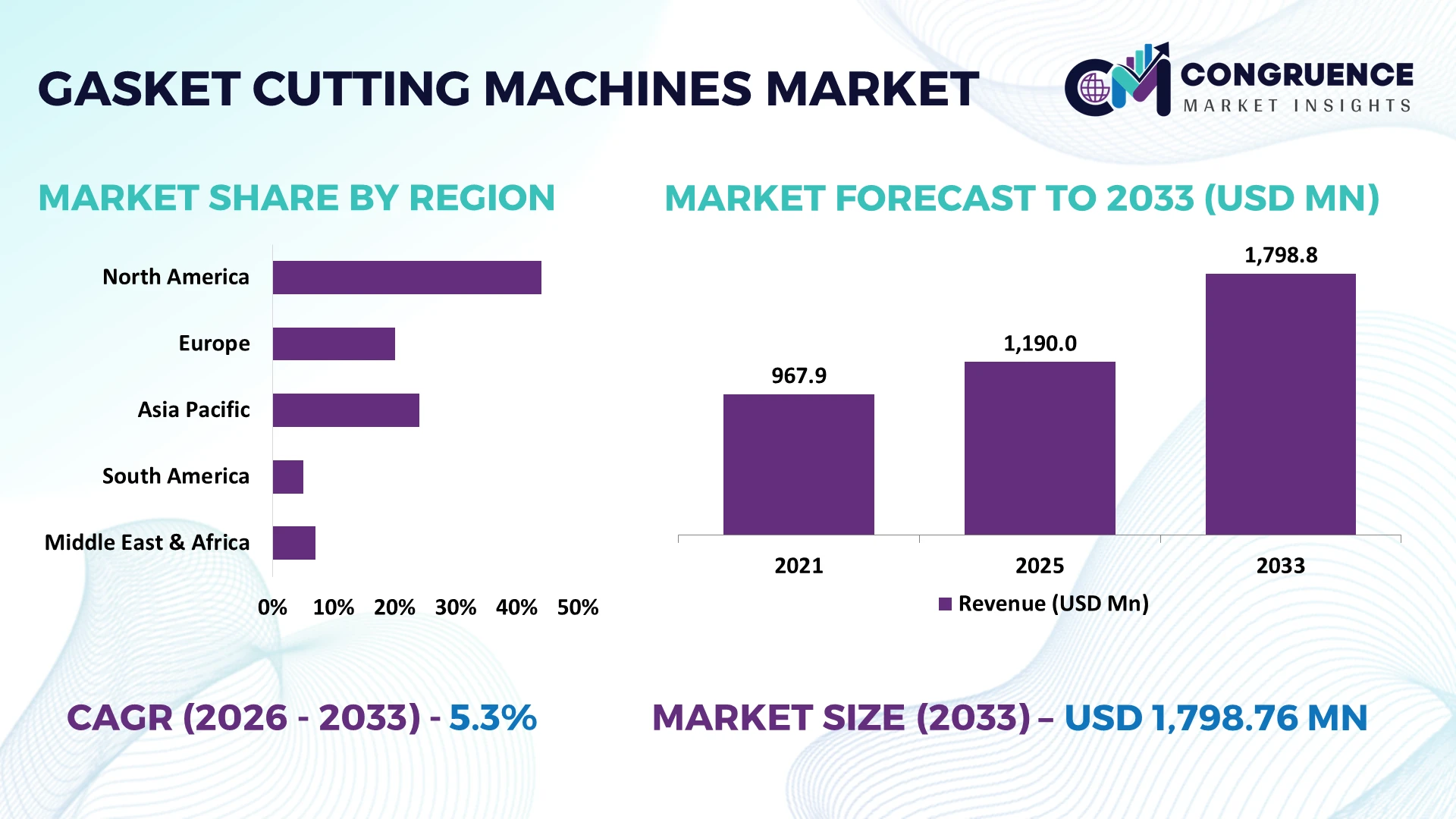
The Global Gasket Cutting Machines Market was valued at USD 1190 Million in 2025 and is anticipated to reach a value of USD 1798.76 Million by 2033 expanding at a CAGR of 5.3% between 2026 and 2033. Growth is driven by automated CNC knife cutting, digital nesting, and precision machining that reduce material waste by 8–12% while supporting tighter sealing specifications across automotive, chemical processing, oil & gas, and industrial equipment manufacturing.
China holds the dominant position, accounting for approximately 32% of global gasket-cutting machine production capacity, supported by automotive manufacturing, machinery exports, and expanding industrial automation. Japan follows at roughly 12%, with higher precision-equipment adoption and advanced CNC integration. China’s broader manufacturing base and 15% faster equipment deployment strengthen its regional advantage amid global supply-chain diversification and nearshoring pressures.
Strategically, manufacturers prioritizing automated precision cutting and localized production capacity gain stronger cost control, faster order fulfillment, and competitive resilience.
Market Size & Growth: USD 1,190 million in 2025 rising to USD 1,798.76 million by 2033 at 5.3% CAGR, supported by CNC automation and lower material waste.
Top Growth Drivers: CNC automation contributes 12%, precision manufacturing 10%, and industrial equipment replacement 8% to growth momentum.
Short-Term Forecast: By 2028, automated cutting adoption is projected to improve production efficiency by 15% while reducing material costs by 9%.
Emerging Technologies: AI-assisted nesting, automated vision inspection, and advanced CNC knife systems are increasing cutting precision by approximately 10%.
Regional Leaders: Asia-Pacific approaches USD 920 million, Europe USD 470 million, and North America USD 410 million by 2033, with automation adoption accelerating across industrial plants.
Consumer/End-User Trends: More than 40% of large gasket manufacturers increasingly use digitally programmed cutting systems for customized, short-run orders.
Pilot/Case Example: A 2024 automated gasket-production deployment achieved approximately 18% lower material waste and 14% faster cutting cycles.
Competitive Landscape: China-based manufacturers hold an estimated 32% production-capacity share, competing with Atlas Copco, Klinger, F. M. R. and specialized CNC equipment suppliers.
Regulatory & ESG Impact: Waste-minimization programs and tighter industrial-emission requirements are driving approximately 8% greater adoption of material-efficient digital cutting.
Investment & Funding: More than USD 180 million in recent machinery modernization investments is supporting CNC upgrades, factory automation, and regional production expansion.
Innovation & Future Outlook: Next-generation machines integrate AI nesting, robotic loading, digital twins, and predictive maintenance, shifting competition toward precision, throughput, and lifecycle efficiency.
Gasket cutting machines are gaining traction where customized sealing components, rapid replacement cycles, and complex geometries require high repeatability. Automated CNC platforms increasingly reduce setup intervention and support material utilization improvements of around 10%. Supply-chain diversification following geopolitical disruptions is also encouraging localized gasket production, while digital manufacturing strengthens responsiveness to automotive and industrial equipment orders. These shifts position automation as a central strategic differentiator.
Gasket cutting machines are becoming strategically important as manufacturers shift from labor-intensive fabrication toward digitally controlled, low-waste sealing production. CNC knife and automated nesting systems can improve material utilization by 8–12% and shorten cutting cycles by 10–15% versus conventional manual or semi-automated methods. This transition strengthens cost control while enabling customized gasket production for automotive, chemical, energy, and industrial equipment applications.
Supply-chain restructuring is accelerating localized component production, particularly as manufacturers seek shorter lead times and greater control over critical maintenance parts. China combines approximately 32% of global production capacity with rapid automation deployment, while Germany emphasizes high-precision engineering and Industry 4.0 integration. Over the next 2–3 years, automated loading, digital nesting, and inspection adoption is expected to expand among larger plants, with productivity improvements of roughly 12–18%.
A practical deployment involves CNC cutting cells integrated with CAD/CAM workflows, allowing manufacturers to move directly from digital gasket drawings to production while reducing setup intervention. Companies are increasing investment in automation, forming technology partnerships, and prioritizing modular machines that support multiple materials and geometries. Competitive advantage will increasingly depend on precision, throughput, material efficiency, and digitally connected production rather than machine capacity alone.
CNC automation is the strongest structural driver, with digitally controlled cutting improving material utilization by 8–12%, reducing manual intervention by approximately 20%, and accelerating customized production by 10–15%. Automotive and industrial manufacturers in China are expanding automated fabrication cells as labor-intensive processes become less competitive. Integration with CAD/CAM platforms also enables rapid specification changes without extensive tooling adjustments. Manufacturers are responding through machine upgrades, software partnerships, and modular production-line investments. A non-obvious advantage is reduced dependence on dedicated dies for short production runs, allowing plants to economically handle fragmented orders and complex gasket geometries while improving scheduling flexibility.
High equipment costs and material-specific cutting requirements constrain adoption among smaller manufacturers. Advanced CNC systems can require 15–25% higher initial investment than basic mechanical equipment, while incompatible tooling or software can increase conversion expenses by 8–10%. Manufacturers handling graphite, rubber, PTFE, composite, and metallic gasket materials often require different cutting configurations, complicating standardization. Volatility in specialty material availability also pressures operating budgets. Companies are reducing exposure through modular machines, multi-year supplier contracts, localized component sourcing, and standardized CAD/CAM interfaces. The key operational limitation is not machine availability but achieving consistent cutting performance across diverse materials without creating excessive tooling and programming complexity.
AI-assisted nesting, machine vision, and predictive maintenance create an opportunity to raise material utilization by 10–15%, improve inspection consistency by approximately 12%, and reduce unplanned downtime by 8–10%. Manufacturers in Japan and Germany are well positioned to integrate these capabilities with connected factory platforms and digital production records. Emerging machines increasingly combine automated loading, vision-guided positioning, and real-time parameter optimization. Companies are directing R&D toward software-enabled equipment and partnering with industrial automation providers rather than treating cutters as standalone assets. The strongest opportunity lies in transforming gasket cutting from a discrete fabrication step into a data-driven production cell capable of continuous optimization.
Long-term deployment faces integration complexity, workforce shortages, and inconsistent digital infrastructure. Approximately 15–20% of modernization projects can require additional integration work when legacy CAD/CAM systems, controllers, and factory software lack interoperability. Skilled programming and maintenance requirements can further raise commissioning time by 10–15%. In India, expanding industrial automation is increasing demand for technicians capable of CNC programming, machine calibration, and digital troubleshooting. Companies are responding with operator training, remote diagnostics, standardized interfaces, and partnerships with automation specialists. The critical challenge is achieving consistent machine performance across multiple facilities; fragmented digital architectures can undermine otherwise strong productivity gains and delay scalable automation programs.
Digital Workflow Integration Accelerates: CAD/CAM connectivity is expanding as manufacturers target 10–15% faster programming and 8–12% lower setup time. German and Japanese plants are integrating cutting systems with production software, while suppliers increasingly package machines with digital workflow capabilities to improve order responsiveness and reduce manual data transfer.
Material Waste Controls Tighten: Manufacturers are prioritizing optimized nesting and automated toolpaths, delivering 7–11% better material utilization and reducing scrap-related costs by 6–9%. Higher raw-material volatility and supply-chain disruptions are reinforcing this shift, particularly among Chinese automotive suppliers that are scaling software-driven cutting to protect margins and stabilize production planning.
Flexible Production Gains Ground: Short-run and customized gasket orders are increasing machine utilization flexibility, with digitally programmed systems reducing changeover requirements by approximately 15% and supporting 10% more product variants per production cell. Companies are restructuring fabrication workflows around modular tooling and multi-material platforms rather than dedicated equipment, creating a non-obvious advantage for suppliers serving fragmented industrial demand.
Automation Reshapes Workforce Allocation: Automated loading, inspection, and programmable cutting are reducing direct operator intervention by roughly 20%, while global factory robot density reached 162 units per 10,000 employees in 2023, according to the International Federation of Robotics. Manufacturers are reallocating skilled workers toward programming, maintenance, and quality control, making automation capability increasingly central to plant competitiveness.
CNC Cutting represents the leading type at approximately 46% market share, supported by repeatability, multi-material compatibility, rapid customization, and straightforward CAD/CAM integration. Its ability to produce complex geometries without dedicated tooling gives manufacturers 10–15% faster changeovers than conventional die-based workflows. Die Cutting remains important for high-volume standardized gaskets, particularly where cycle consistency and tooling amortization favor established production lines. Laser Cutting holds a smaller position but delivers strong edge-quality and intricate-profile capabilities, with adoption concentrated in precision applications where dimensional control outweighs higher equipment complexity.
Waterjet Cutting is the fastest-growing type, expanding adoption as manufacturers process thicker, heat-sensitive, or difficult materials without introducing thermal distortion. Its use is gaining traction in specialized industrial applications, with deployment intensity rising approximately 12–16% as material diversity increases. Companies are therefore shifting investment toward hybrid machine portfolios rather than replacing mature technologies outright, using CNC for flexible production and waterjet or laser systems for specialized geometries.
Automotive Gaskets lead application demand with an estimated 38% share, reflecting high production volumes, tight dimensional requirements, and continuous model diversification. Automotive manufacturers increasingly require rapid gasket customization for engine, transmission, exhaust, and thermal-management assemblies, encouraging CNC adoption that can reduce changeover time by 12–15%. Industrial Gaskets remain a broad mature application, while Pipe & Flange Gaskets maintain strong demand across process equipment and maintenance operations where replacement speed is operationally critical.
Engine Gaskets represent the fastest-growing application, supported by tighter sealing specifications, lightweight component development, and precision manufacturing. Adoption of digitally controlled cutting in this segment is increasing approximately 14–18%, particularly among suppliers serving hybrid and advanced powertrain platforms. Hydraulic Seals continue to benefit from construction and industrial equipment maintenance, with automated cutting improving repeatability by roughly 10%. Companies are expanding application-specific tooling, strengthening OEM partnerships, and prioritizing flexible CNC platforms capable of producing short-run variants without sacrificing throughput.
Automotive is the leading end-user group, accounting for approximately 35% of machine demand because high-volume assembly, frequent component changes, and stringent sealing tolerances require repeatable cutting performance. Large automotive suppliers are increasingly integrating CNC cutters into digitally connected production cells, improving throughput by roughly 10–15% while reducing manual handling. Oil & Gas remains a capital-intensive buyer, particularly for Pipe & Flange Gaskets, where maintenance schedules and harsh operating environments prioritize reliability over lowest upfront equipment cost.
Chemical Processing is emerging as a high-value growth segment as manufacturers require specialized gasket geometries and material compatibility for corrosive environments. Adoption of automated cutting is rising approximately 13–17% in advanced facilities, while Power Generation increasingly prioritizes traceable production and repeatable sealing specifications. Industrial Manufacturing remains the broadest diversified buyer base, favoring modular systems capable of handling multiple materials and order sizes. Companies are responding with sector-specific configurations, service partnerships, and scalable automation packages rather than one-size-fits-all machines.
North America accounted for the largest market share at 31% in 2025 however, Asia-Pacific is expected to register the fastest growth, expanding at a CAGR of 6.8% between 2026 and 2033.
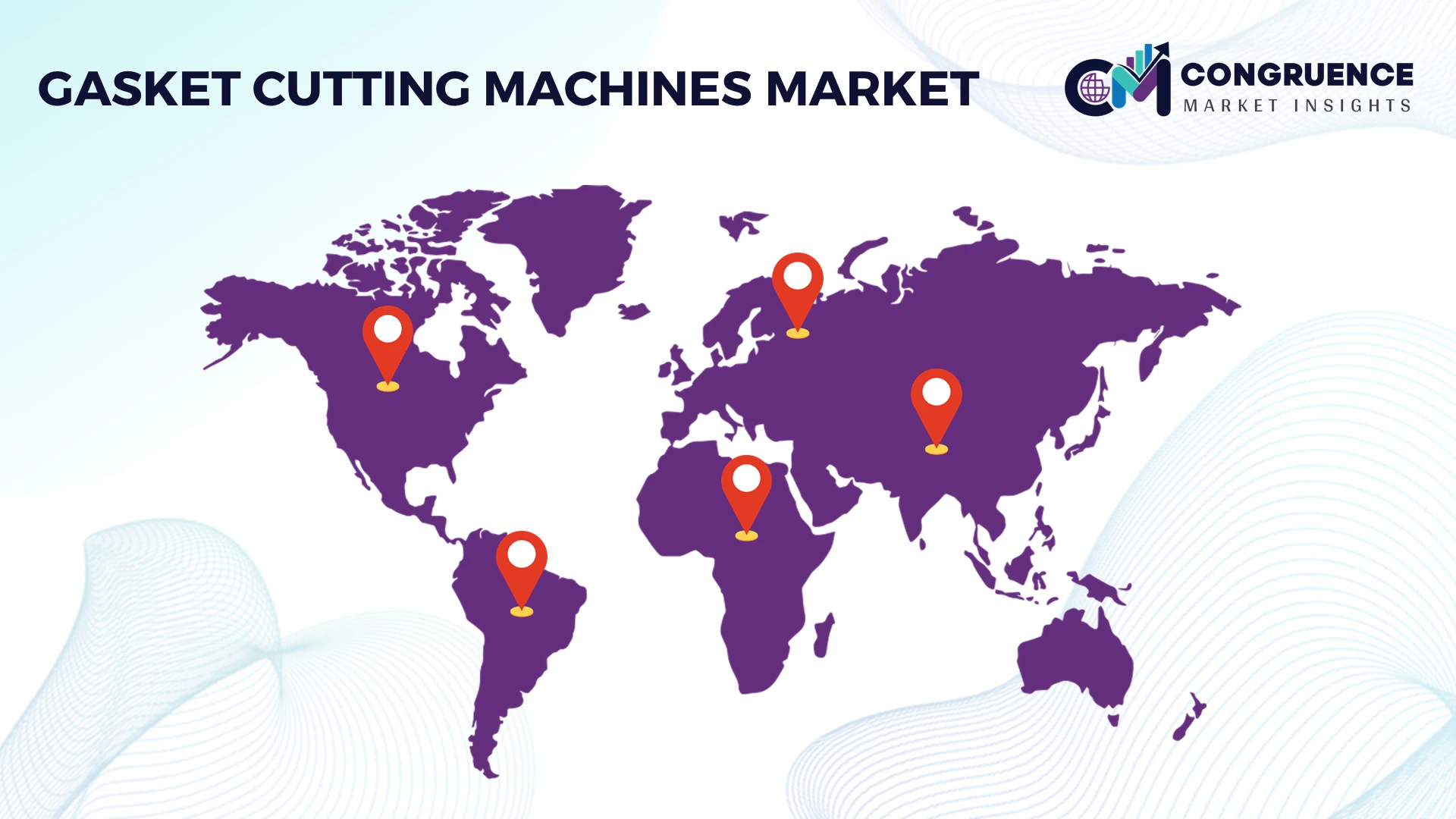
North America represents approximately 31% of global gasket cutting machine demand, supported by concentrated automotive, aerospace, petrochemical, power-generation, and industrial maintenance activity. The United States dominates regional deployment, particularly among manufacturers requiring rapid production of customized sealing components. CNC adoption is increasing as plants replace manual fabrication with CAD/CAM-linked cutting cells, improving material utilization by roughly 9–13%. Nearshoring and supply-chain localization are also encouraging manufacturers to establish shorter, more responsive gasket production workflows. Equipment suppliers are responding with modular cutters, automated feeding, and remote diagnostics. The region’s strongest operational advantage is its high concentration of maintenance-intensive industries, where rapid replacement gasket production can reduce equipment downtime and inventory dependence.
United States Market Outlook: The United States remains the strategic center of North American demand because of its extensive refinery, chemical, automotive, aerospace, and power infrastructure. Industrial plants increasingly prioritize on-demand gasket fabrication, with digitally controlled systems reducing setup intervention by approximately 15%. Manufacturers are investing in flexible machines that support multiple materials and complex geometries.
Europe accounts for approximately 25% of global demand, with Germany, Italy, France, and the United Kingdom forming the principal industrial centers. Germany leads high-precision deployment through advanced machinery manufacturing and Industry 4.0 integration. Digitally connected cutters are improving production consistency by around 10–14%, while automated nesting reduces material waste by 7–11%. Sustainability requirements and tighter industrial efficiency targets are encouraging manufacturers to optimize material consumption rather than simply increase machine throughput. European suppliers are strengthening partnerships with automation and software providers, emphasizing traceability, precision, and lifecycle performance. Investment is shifting toward equipment capable of integrating with existing smart-factory infrastructure, giving technologically advanced manufacturers an advantage in customized, short-run gasket production.
Germany Market Outlook: Germany maintains the strongest European position through its concentration of precision machinery, automotive, chemical, and industrial equipment manufacturers. Its advanced factory infrastructure supports CAD/CAM-connected cutting and automated inspection. Manufacturers increasingly prioritize equipment with approximately ±0.1 mm-class precision and digital monitoring, strengthening Germany’s role as a high-value technology and engineering hub.
Asia-Pacific is the largest production base and represents approximately 34% of global gasket cutting machine demand, led by China, Japan, South Korea, and India. China combines extensive automotive and machinery manufacturing capacity with competitive CNC equipment production, while Japan emphasizes precision and advanced automation. Regional manufacturers are expanding digital cutting deployment to support high-volume production and increasingly fragmented orders. Automated systems can improve cutting productivity by approximately 12–18% while reducing manual setup requirements. Export-oriented Chinese suppliers are also expanding international distribution and remote-service capabilities, intensifying price competition. India is emerging as an important adoption market as automotive, chemical, and engineering plants modernize fabrication operations and reduce dependence on imported replacement components.
China Market Outlook: China holds the region’s strongest manufacturing position, supported by extensive machinery, automotive, petrochemical, and industrial production networks. Domestic CNC suppliers increasingly offer customized flatbed systems, automated feeding, and CAD-based operation. Export-oriented manufacturers are using shorter delivery cycles and competitive equipment pricing to expand international penetration while improving machine sophistication.
South America represents approximately 8% of global demand, with Brazil accounting for the largest share because of its automotive, oil and gas, mining, chemical, and power-generation infrastructure. Local manufacturers increasingly use gasket cutting equipment for maintenance-intensive operations where imported replacement components create delays. CNC adoption is gradually increasing, with digitally programmed systems reducing manual fabrication time by approximately 10–14%. Supply-chain volatility and currency pressures encourage buyers to prioritize durable, serviceable equipment with accessible replacement parts. Brazilian industrial suppliers are developing localized service relationships and sourcing strategies to reduce downtime. The main strategic opportunity is decentralized gasket production near industrial sites, particularly where remote operations require faster replacement-part availability.
Brazil Market Outlook: Brazil offers the strongest South American deployment base because its industrial economy combines heavy manufacturing with extensive mining, energy, petrochemical, and transport infrastructure. Maintenance workshops increasingly favor flexible cutting equipment capable of producing replacement components on demand. Local service availability remains critical, with buyers placing greater emphasis on spare-parts accessibility and technician support.
Middle East & Africa accounts for approximately 7% of global demand, with Saudi Arabia, the United Arab Emirates, and South Africa representing important deployment centers. Oil and gas, petrochemical, power, water infrastructure, and heavy industrial maintenance generate strong demand for reliable gasket fabrication. Saudi industrial modernization programs are encouraging greater local manufacturing capability, while UAE facilities emphasize automated maintenance workflows. CNC adoption is increasing by approximately 11–15% in advanced industrial facilities as operators seek faster production and lower inventory dependence. Suppliers are responding through distributor partnerships, localized service networks, and equipment packages designed for harsh operating environments. The non-obvious advantage is the ability to manufacture replacement gaskets close to remote assets, reducing logistics exposure and maintenance delays.
Saudi Arabia Market Outlook: Saudi Arabia is the region’s most strategically significant market due to its concentration of oil, gas, petrochemical, power, and infrastructure assets. Industrial localization initiatives are strengthening domestic maintenance capabilities. Automated gasket cutting systems increasingly support rapid component replacement, helping plants reduce dependence on external fabrication and improve maintenance responsiveness.
The market features global precision-equipment suppliers, specialized gasket machinery manufacturers, and lower-cost Chinese CNC producers competing through technology, customization, service, and delivery speed. F. u. J. Peters competes on German precision and durability, while Shilai CNC, Shandong Yuchen CNC, AMOR, and MNT target digitally controlled, die-less production. Regional suppliers compete through price and application-specific engineering. The top five players together represent an estimated 28% of the market, indicating a fragmented structure rather than concentrated control. Technology-led suppliers can deliver 8–12% better material utilization, while automation-focused systems reduce setup time by 10–15%. Players are expanding export networks, integrating CAD/CAM software, adding automated feeding, and partnering with gasket manufacturers. The competitive shift favors flexible CNC platforms over dedicated tooling as short-run orders increase. Entry barriers center on precision control, software integration, material compatibility, and service coverage. Winning requires combining cutting accuracy with rapid customization, localized support, competitive total cost, and scalable automation.
F. u. J. Peters Apparate und Maschinenbau GmbH & Co. KG
Jinan Shilai Technology Equipment Co., Ltd.
Shandong Yuchen CNC Co., Ltd.
AMOR CNC
MNT Cutting
Shanghai Kaiwei Intelligent Technology (Group) Co., Ltd.
Dalian Jinjie Innovation Technology Co., Ltd.
Cixi Flyseal Co., Ltd.
MSO Seals and Gaskets
Heroos Sealing Materials Co., Ltd.
Sunshine Sealing Technology Co., Ltd.
GSKET srl
Ordinem Engitech (India) Pvt. Ltd.
Dongguan IBON Automation Technology Co., Ltd.
Current technology is centered on CNC oscillating-knife cutting, CAD/CAM integration, automatic nesting, vacuum hold-down, and servo motion control. Intelligent nesting can improve material utilization by 10–20%, while automated feeding cuts manual handling by about 15%. Adoption is strongest among digitally equipped automotive and industrial plants, where die-less production enables faster customization and shorter setup cycles.
Emerging systems combine machine vision, multi-tool heads, automated loading, and real-time parameter control. Vision-assisted positioning can improve placement consistency by 2–4%, while predictive monitoring can reduce unplanned stoppage by 3–5%. Advanced platforms increasingly support rubber, PTFE, graphite, silicone, and composite sheets through interchangeable tooling. Manufacturers integrating these technologies gain higher throughput, broader material capability, and better response to fragmented orders.
The disruptive shift is from fixed dies toward software-defined cutting, particularly for short runs and complex geometries. Compared with manual or basic die workflows, modern CNC systems can improve production efficiency by 20–30% and reduce tooling-related costs by 15–25%. Adoption will accelerate through 2026–2028 as connected cutters integrate with MES, digital work orders, and automated inspection and centralized production analytics. Technology leaders and cost-efficient Chinese manufacturers benefit most, while legacy operators face pressure to digitize quickly.
June 2025 Shilai CNC introduced an automatic CNC gasket cutter using high-frequency vibration cutting, CAD input, and accuracy within 0.1 mm. The launch strengthens die-less production for complex, small-batch gaskets, improving repeatability and shortening setup requirements for manufacturers. Source: slcnccut.com
December 2025 DEWA issued a procurement request for one FRIPA P 125-302 gasket cutting machine, supporting 30–300 mm cutting diameters and 20 mm thickness. The purchase demonstrates utility-sector equipment modernization programs and strengthens in-house maintenance fabrication capability on-site. Source: dewa.gov.ae
July 2026 Banco Gaskets was reported to have an Ankhi plant exceeding 180 million-gasket annual capacity, including in-house gasket cutting. The facility strengthens manufacturing scale, supply responsiveness, and OEM and aftermarket coverage while supporting international aftermarket distribution markets. Source: careratings.com
June 2024 Ruizhou highlighted CNC gasket cutting with intelligent feeding, vacuum holding, and modular cutting heads, reporting 30% energy savings through an imported frequency converter. The development improves operating efficiency and supports multi-material production with lower energy consumption. Source: ruizhoucnc.com
The report covers the Gasket Cutting Machines Market across CNC Cutting, Die Cutting, Laser Cutting, and Waterjet Cutting, with application analysis spanning Automotive Gaskets, Industrial Gaskets, Pipe & Flange Gaskets, Engine Gaskets, and Hydraulic Seals. End-user coverage includes Automotive, Oil & Gas, Chemical Processing, Power Generation, and Industrial Manufacturing. The assessment compares mature production methods with emerging digital cutting platforms.
Regional coverage includes North America, Europe, Asia-Pacific, South America, and Middle East & Africa, with country-level emphasis on major manufacturing and industrial hubs. The report evaluates CNC automation, CAD/CAM integration, nesting, automated feeding, machine vision, and multi-material cutting, alongside adoption patterns and competitive positioning. Findings support equipment investment, capacity expansion, technology selection, supplier strategy, localization, and competitive planning through 2026–2033, with particular attention to customized production and maintenance-driven demand.
| Report Attribute/Metric | Report Details |
|---|---|
Market Revenue in 2025 | USD 1190 Million |
Market Revenue in 2033 | USD 1798.76 Million |
CAGR (2026 - 2033) | 5.3% |
Base Year | 2025 |
Forecast Period | 2026 - 2033 |
Historic Period | 2021 - 2025 |
Segments Covered | By Type
By Application
By End-User
|
Key Report Deliverable | Revenue Forecast, Growth Trends, Market Dynamics, Segmental Overview, Regional and Country-wise Analysis, Competition Landscape |
Region Covered | North America, Europe, Asia-Pacific, South America, Middle East, Africa |
Key Players Analyzed | F. u. J. Peters Apparate und Maschinenbau GmbH & Co. KG, Jinan Shilai Technology Equipment Co., Ltd., Shandong Yuchen CNC Co., Ltd., AMOR CNC, MNT Cutting, Shanghai Kaiwei Intelligent Technology (Group) Co., Ltd., Dalian Jinjie Innovation Technology Co., Ltd., Cixi Flyseal Co., Ltd., MSO Seals and Gaskets, Heroos Sealing Materials Co., Ltd., Sunshine Sealing Technology Co., Ltd., GSKET srl, Ordinem Engitech (India) Pvt. Ltd., Dongguan IBON Automation Technology Co., Ltd. |
Customization & Pricing | Available on Request (10% Customization is Free) |




