
Reports
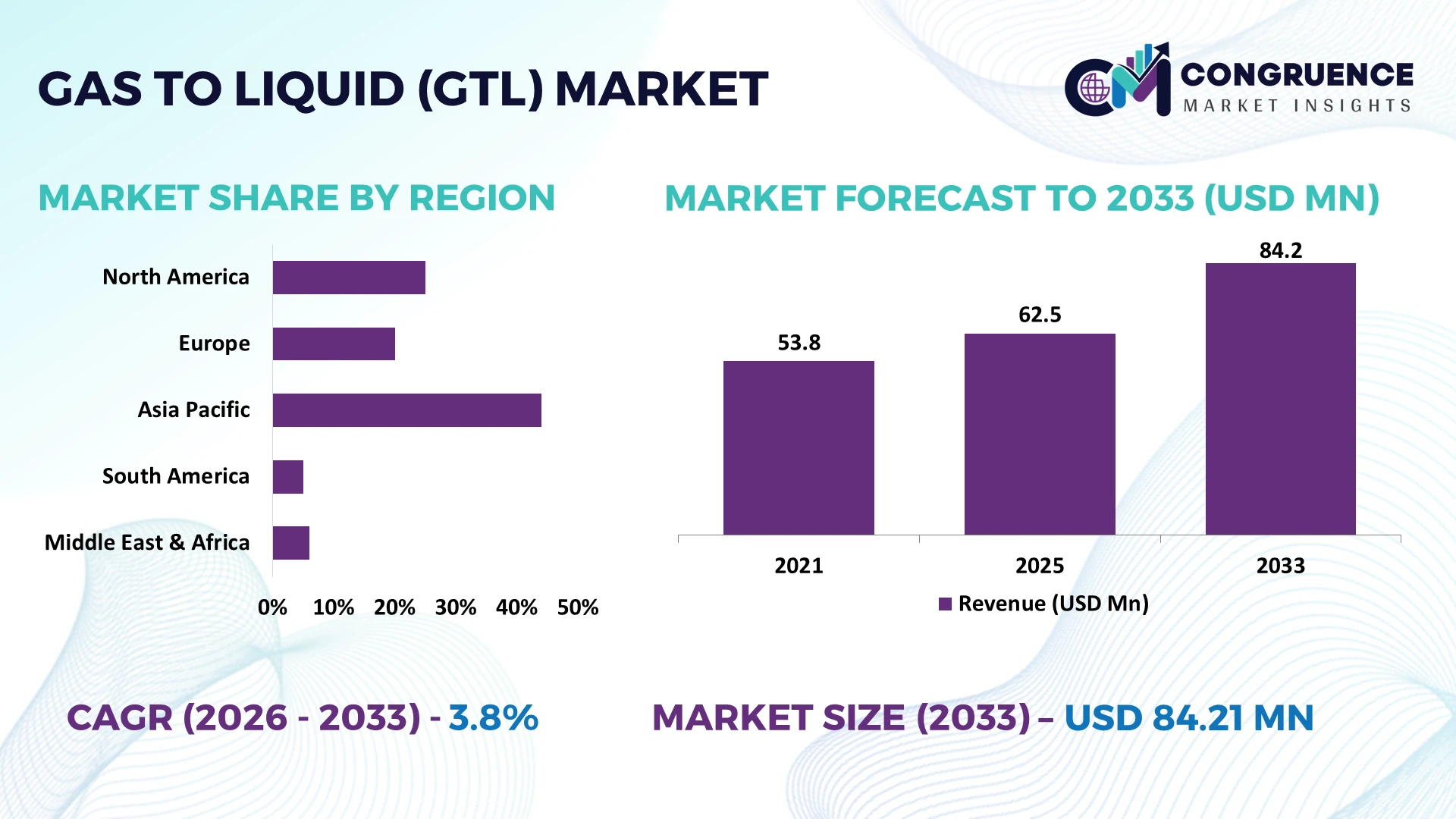
The Global Gas-to-Liquid (GTL) Market was valued at USD 62.48 Million in 2025 and is anticipated to reach a value of USD 84.21 Million by 2033 expanding at a CAGR of 3.8% between 2026 and 2033. Growth is driven by natural gas monetization, Fischer Tropsch catalyst improvements, and increasing production of ultra clean synthetic diesel, base oils, and specialty chemicals.
Qatar dominates global commercial GTL production through its integrated natural gas processing and synthetic fuel infrastructure. Shell's Pearl GTL facility has approximately 140,000 barrels per day of GTL product capacity, while Oryx GTL adds around 34,000 barrels daily, providing Qatar approximately 174,000 barrels of daily GTL capacity. South Africa's Sasol Secunda complex processes coal and gas feedstocks through synthetic fuel technologies, offering a contrasting production model. Qatar's North Field gas resources and established industrial infrastructure strengthen its feedstock security, production efficiency, and export competitiveness.
Strategically, GTL investors should prioritize integrated gas supply agreements, catalyst optimization, and premium synthetic fuel applications to strengthen asset utilization and processing margins.
Market Size & Growth: USD 62.48 million in 2025, reaching USD 84.21 million by 2033 at 3.8% CAGR, supported by natural gas monetization and specialty fuel demand.
Top Growth Drivers: GTL diesel contains virtually 0% sulfur, paraffinic products achieve over 70 cetane, and selected Fischer Tropsch catalysts deliver above 90% carbon monoxide conversion.
Short Term Forecast: By 2028, operators targeting 5% catalyst productivity improvement can strengthen output efficiency; this represents an operational target rather than a verified forecast.
Emerging Technologies: Three innovations include microchannel reactors, advanced cobalt catalysts, and AI assisted process optimization, improving modular production flexibility and reaction control.
Regional Leaders: Middle East, Africa, and Asia Pacific maintain significant GTL activity; independently verified regional USD projections are unavailable, while integrated gas processing drives deployment.
Consumer and End User Trends: Synthetic GTL diesel commonly achieves cetane ratings above 70, supporting premium fuel blending and industrial engine applications.
Pilot and Case Example: Shell's Pearl GTL facility in Qatar delivers approximately 140,000 barrels daily of GTL products, demonstrating large scale natural gas conversion.
Competitive Landscape: Shell operates a leading GTL facility with 140,000 barrels daily capacity; Sasol, Chevron, PetroSA, and Velocys participate across commercial and technology segments.
Regulatory and ESG Impact: GTL diesel contains near 0% sulfur, supporting compliance with stringent fuel sulfur specifications and reducing sulfur oxide emissions during combustion.
Investment and Funding: Pearl GTL involved approximately USD 19 billion in development expenditure, highlighting the capital intensity of integrated synthetic fuel infrastructure.
Innovation and Future Outlook: Modular Fischer Tropsch systems, improved catalyst selectivity, and 3 emerging applications in aviation fuels, specialty waxes, and premium lubricants reshape investment priorities.
The Gas to Liquid (GTL) Market is evolving through integrated natural gas conversion, advanced synthesis catalysts, and increasing specialization in high purity hydrocarbon products. Fischer Tropsch processing enables production of synthetic diesel, aviation fuel components, specialty waxes, and lubricant base oils. Commercial GTL diesel typically contains negligible sulfur and achieves cetane numbers exceeding 70, supporting premium fuel blending applications. Qatar's established production infrastructure provides scale advantages, while modular conversion technologies are expanding options for smaller gas resources. These developments strengthen the importance of feedstock security, catalyst performance, and product differentiation in shaping future investment and competitive strategies.
Gas to Liquid technology is becoming strategically important as natural gas producers seek higher value applications beyond conventional pipeline transportation and liquefied natural gas exports. Qatar's integrated GTL infrastructure demonstrates how feedstock availability, refining integration, and specialized hydrocarbon production strengthen industrial competitiveness. Supply chain restructuring increasingly emphasizes domestic gas processing and diversified synthetic fuel distribution. Operators are prioritizing catalyst productivity, energy integration, and product flexibility to improve asset utilization while addressing evolving fuel specifications and industrial decarbonization requirements.
Modern Fischer Tropsch synthesis produces synthetic diesel with cetane numbers frequently exceeding 70, compared with approximately 40 to 55 for conventional petroleum diesel, representing at least 27% improvement against the upper conventional benchmark. Qatar benefits from integrated natural gas resources and commercial production infrastructure, while South Africa maintains extensive synthetic fuel processing expertise. Between 2026 and 2028, technology development will emphasize improved catalyst selectivity, modular reactor configurations, and automated process optimization. Commercial operators are concentrating on operational reliability and premium product yields rather than expanding conventional fuel capacity alone.
Shell's Pearl GTL facility processes approximately 1.6 billion cubic feet of natural gas daily, demonstrating industrial integration at commercial scale. Technology developers are strengthening engineering partnerships and evaluating smaller conversion systems for remote gas resources. Competitive advantage increasingly depends on feedstock security, thermal efficiency, and access to premium hydrocarbon markets.
Natural gas monetization is strengthening GTL investment interest where pipeline access, liquefaction infrastructure, or domestic gas demand limits conventional commercialization options. Qatar's Pearl GTL facility processes approximately 1.6 billion cubic feet of gas daily and produces around 140,000 barrels of GTL products. Synthetic GTL diesel contains virtually 0% sulfur, while cetane performance can exceed conventional petroleum diesel by approximately 27% against a 55 cetane benchmark. These characteristics support premium fuel blending and specialty hydrocarbon applications. Qatar's North Field development reinforces long term feedstock availability for integrated processing industries. Operators are investing in catalyst optimization, heat recovery, and product upgrading to strengthen conversion economics. Securing premium product offtake remains as important as obtaining competitively priced gas.
Commercial GTL deployment faces substantial capital requirements, complex processing infrastructure, and sensitivity to natural gas pricing. Pearl GTL required approximately USD 19 billion in development expenditure, illustrating the financing burden associated with integrated conversion facilities. Natural gas typically contains more than 90% methane in processed pipeline specifications, but feedstock composition varies across production fields, requiring pretreatment and synthesis gas conditioning. Fischer Tropsch reactors operate under controlled temperatures and pressures, increasing equipment and maintenance costs. In Qatar, integrated gas supply supports commercial viability, whereas independent developers face greater exposure to feedstock contracting and infrastructure expenditure. Companies are reducing investment risks through phased engineering, long term gas agreements, and modular processing configurations. Project competitiveness depends on stable conversion margins rather than production capacity alone.
Modular GTL technologies create opportunities for monetizing smaller gas resources and producing premium synthetic hydrocarbons closer to industrial customers. Conventional commercial facilities operate at capacities exceeding 30,000 barrels daily, while emerging modular concepts target substantially smaller installations. Fischer Tropsch synthesis enables production of paraffinic hydrocarbons with negligible sulfur, while specialized GTL base oils can achieve viscosity indices above 130, supporting premium lubricant applications. Nigeria's associated gas resources present potential deployment opportunities as operators seek alternatives to routine flaring. Technology developers are advancing compact reactors, improved cobalt catalysts, and integrated gas treatment systems to reduce installation complexity. The strongest commercial opportunity involves matching modular conversion capacity with secured gas supply and specialty product offtake, rather than competing directly with established large scale GTL facilities.
Scaling GTL technology requires precise integration of synthesis gas generation, Fischer Tropsch reaction control, product upgrading, and thermal management. Conventional cobalt catalysts typically operate around 200°C to 240°C, while iron based systems can operate at approximately 250°C to 350°C, creating different heat removal and product selectivity requirements. Fischer Tropsch synthesis is strongly exothermic, making temperature uniformity critical for maintaining catalyst performance and preventing undesirable hydrocarbon formation. South Africa's established synthetic fuel industry demonstrates the importance of integrated process engineering and specialized operational expertise. Developers must improve catalyst lifetime, reactor heat transfer, and automated process monitoring to maintain production consistency. Long term competitiveness depends on achieving dependable operating availability, controlled maintenance intervals, and stable product specifications across changing feedstock conditions.
Integrated Refining Strengthens Product Flexibility: Qatar's Pearl GTL complex produces approximately 140,000 barrels of synthetic liquids daily alongside 120,000 barrels of natural gas liquids and ethane. Operators are optimizing product separation and upgrading to balance diesel, naphtha, and specialty fractions. Integrated processing improves feedstock utilization and enables producers to adjust product distribution according to industrial demand and downstream processing requirements.
Premium Base Oils Gain Manufacturing Preference: GTL derived base oils offer viscosity indices commonly exceeding 130 and sulfur concentrations approaching 0%, supporting high performance lubricant formulations. Shell markets differentiated synthetic base oils for automotive and industrial applications. Lubricant manufacturers are refining additive compatibility and blending procedures, strengthening product consistency and expanding access to applications requiring oxidation stability and controlled volatility.
Synthetic Naphtha Expands Chemical Integration: GTL naphtha provides highly paraffinic feedstock with negligible aromatic content, supporting petrochemical processing and specialty chemical manufacturing. Commercial steam crackers commonly operate at temperatures approaching 800°C to 850°C, requiring controlled feedstock quality. Chemical producers are evaluating GTL naphtha alongside conventional petroleum fractions to improve feedstock flexibility and maintain predictable processing characteristics across integrated industrial facilities.
Digital Process Monitoring Improves Operational Control: Fischer Tropsch reactors require precise temperature management, with conventional cobalt catalyst systems operating around 200°C to 240°C. Operators are integrating advanced process analytics, predictive maintenance, and automated catalyst monitoring across 3 critical stages: synthesis gas preparation, catalytic conversion, and product upgrading. These technologies strengthen operational consistency, support maintenance planning, and improve responsiveness to changing feedstock conditions.
GTL Diesel represents the leading product category, with an indicative market share of approximately 45% to 50%, although independently verified global product distribution remains unavailable. Its dominance reflects established commercial production, compatibility with diesel blending infrastructure, and favorable combustion characteristics. GTL diesel typically achieves cetane numbers exceeding 70, compared with approximately 40 to 55 for conventional petroleum diesel, supporting improved ignition quality. Qatar's large scale production infrastructure reinforces diesel availability for international fuel markets. Manufacturers emphasize catalyst selectivity, product upgrading, and integrated distribution to maintain consistent fuel specifications and processing efficiency.
GTL Base Oils represent a promising premium product category, supported by demand for high purity lubricant formulations and specialized industrial applications. Their viscosity indices frequently exceed 130, strengthening suitability for advanced lubricant blending. GTL Naphtha serves petrochemical feedstock requirements, while GTL Kerosene supports aviation and specialized fuel blending applications. GTL Waxes provide high purity paraffinic materials for industrial processing. Producers are optimizing fractionation and product finishing to improve portfolio flexibility, emphasizing specialty applications where consistent composition supports stronger commercial differentiation.
Transportation Fuels represent the leading GTL application, with an indicative market share of approximately 50% to 55%, although a verified global application distribution is unavailable. Demand concentration reflects established synthetic diesel production and compatibility with conventional liquid fuel distribution systems. GTL diesel contains negligible sulfur and typically achieves cetane ratings above 70, supporting premium fuel blending and combustion performance. Qatar's commercial GTL infrastructure provides substantial production capacity serving international fuel markets. Producers prioritize product consistency, catalyst performance, and refinery integration to maintain dependable transportation fuel supply.
Lubricants represent an increasingly important premium application as synthetic base oils support advanced automotive and industrial formulations. GTL derived base oils commonly achieve viscosity indices exceeding 130, enabling lubricant manufacturers to target demanding operating conditions. Petrochemical Feedstock applications utilize GTL naphtha for chemical processing, while Industrial Fuels support specialized combustion and energy requirements. Manufacturers are improving product separation, blending flexibility, and distribution arrangements to capture differentiated downstream demand. Investment priorities increasingly favor high specification products that provide stronger commercial value than conventional bulk fuel applications.
Transportation represents the leading GTL end user category, with an indicative market share of approximately 40% to 45%, although independently verified segmentation data remain unavailable. Its position reflects established demand for synthetic diesel and compatibility with conventional fuel distribution infrastructure. GTL diesel typically achieves cetane numbers above 70, supporting premium diesel blending and specialized fleet applications. Automotive manufacturers and lubricant formulators utilize GTL derived base oils to develop products requiring controlled viscosity and oxidation stability. Producers emphasize consistent product specifications and established distribution partnerships to strengthen commercial positioning.
Aviation represents an emerging application area through synthetic kerosene blending and Fischer Tropsch derived aviation fuel components, subject to applicable certification and feedstock requirements. Chemicals and Petrochemicals utilize GTL naphtha for processing and chemical production, while Industrial Manufacturing consumes specialty waxes, lubricants, and synthetic fuels. Manufacturers are strengthening technical qualification programs, expanding product finishing capabilities, and improving downstream supply arrangements. Competitive advantage increasingly depends on matching product characteristics with application specific performance requirements and maintaining reliable industrial supply.
Middle East & Africa accounted for the largest market share at an estimated 65% in 2025 however, Asia Pacific is expected to register the fastest growth, expanding at an estimated CAGR of 5.2% between 2026 and 2033.
Modular Conversion Technologies and Natural Gas Resource Optimization
North America's GTL industry is shaped by abundant natural gas resources, advanced catalytic processing research, and specialized synthetic fuel applications. The United States maintains extensive natural gas production infrastructure, providing potential feedstock availability for modular Fischer Tropsch conversion technologies. Domestic technology developers are concentrating on compact reactor engineering, catalyst optimization, and synthetic hydrocarbon upgrading. The Permian Basin remains strategically relevant because associated gas production creates opportunities for alternative gas monetization pathways. However, established pipeline infrastructure and liquefied natural gas export capacity compete with GTL investment economics. Technology companies are developing smaller conversion configurations and strengthening partnerships with industrial gas producers. Commercial priorities emphasize reliable feedstock access, controlled capital expenditure, and differentiated synthetic products rather than replication of Qatar's integrated industrial GTL facilities.
United States Market Outlook: The United States benefits from advanced chemical engineering capabilities, extensive natural gas infrastructure, and specialized catalyst development expertise. The country produced approximately 103 billion cubic feet of dry natural gas daily in 2024, demonstrating substantial feedstock availability. Technology developers are advancing modular conversion systems and Fischer Tropsch catalyst research. Commercial investment decisions increasingly depend on location specific gas pricing, transportation constraints, and secured downstream product agreements.
Advanced Catalysis and Synthetic Fuel Technology Integration
Europe's GTL industry emphasizes catalyst innovation, process engineering, and specialized synthetic hydrocarbon applications rather than large commercial natural gas conversion facilities. Germany, the Netherlands, and the United Kingdom maintain established chemical engineering capabilities supporting Fischer Tropsch synthesis, process automation, and downstream product development. European technology companies are advancing compact reactor configurations and synthetic fuel upgrading technologies. The European Union's evolving fuel sustainability requirements are increasing scrutiny of feedstock carbon intensity, creating a distinction between conventional natural gas GTL and qualifying renewable synthetic fuels. Manufacturers are strengthening process engineering partnerships and developing catalyst systems suitable for alternative synthesis gas sources. Competitive differentiation centers on reactor efficiency, product quality, and compatibility with existing refining infrastructure. European companies increasingly prioritize technology licensing and specialized equipment supply over capital intensive standalone production investments.
Germany Market Outlook: Germany maintains substantial expertise in industrial catalysis, chemical processing, and advanced reactor engineering. The country's chemical industry provides established infrastructure for synthesis gas processing and hydrocarbon upgrading. European aviation fuel regulations require sustainable aviation fuel blending of 2% from 2025, increasing interest in eligible synthetic fuel pathways. German technology developers are concentrating on catalyst performance, process integration, and alternative feedstock compatibility to support industrial commercialization.
Natural Gas Processing Expansion and Synthetic Fuel Diversification
Asia Pacific's GTL market is influenced by natural gas resource development, petrochemical manufacturing, and demand for specialized synthetic hydrocarbons. China maintains extensive chemical processing infrastructure and research capabilities supporting Fischer Tropsch technology development. Malaysia and Indonesia possess natural gas resources suitable for evaluating conversion technologies, while Japan contributes advanced catalyst research and synthetic lubricant demand. The region benefits from established petrochemical manufacturing clusters and industrial distribution networks. However, competition from liquefied natural gas exports and conventional refining influences investment priorities. Technology developers are evaluating integrated gas processing, improved synthesis catalysts, and specialized product upgrading configurations. China remains particularly relevant through its extensive synthetic fuel research and industrial chemical manufacturing capabilities. Regional competitiveness increasingly depends on aligning feedstock availability with product demand and maintaining efficient downstream integration.
China Market Outlook: China possesses substantial synthesis gas processing expertise developed through its coal chemical and synthetic fuel industries. Its established Fischer Tropsch research capabilities support catalyst development and industrial reactor engineering relevant to natural gas conversion. China imported more than 130 billion cubic meters of natural gas in 2024, highlighting significant feedstock procurement requirements. Domestic developers are prioritizing process efficiency, integrated chemical manufacturing, and synthetic hydrocarbon applications where feedstock economics support commercial deployment.
Associated Gas Utilization and Industrial Fuel Diversification
South America's GTL market is developing around associated gas utilization, natural gas infrastructure expansion, and industrial fuel supply diversification. Brazil and Argentina provide important opportunities through offshore gas production and unconventional hydrocarbon development. Argentina's Vaca Muerta formation contains substantial natural gas resources, supporting interest in alternative processing and monetization technologies. Brazil's offshore production infrastructure creates potential applications for compact gas conversion systems where pipeline access remains challenging. However, transportation infrastructure, processing costs, and competition from domestic gas consumption constrain commercial GTL deployment. Technology suppliers are evaluating modular reactor configurations and partnerships with upstream operators to improve project feasibility. Commercial opportunities remain concentrated in locations where gas transportation limitations and specialty product demand justify additional conversion infrastructure.
Argentina Market Outlook: Argentina offers significant feedstock potential through the Vaca Muerta shale formation and expanding unconventional gas production. The country possesses approximately 308 trillion cubic feet of technically recoverable shale gas resources, according to established resource assessments. Pipeline expansion supports greater gas commercialization, while remote production areas remain relevant for alternative conversion technologies. GTL developers must evaluate processing economics against pipeline transportation and liquefied natural gas development before committing to industrial projects.
Integrated Gas Resources Sustain Commercial Production Leadership
The Middle East and Africa dominate established commercial GTL production through Qatar's integrated natural gas processing infrastructure and South Africa's synthetic fuel manufacturing expertise. Qatar hosts Pearl GTL and Oryx GTL, representing approximately 174,000 barrels of combined daily GTL product capacity. South Africa maintains extensive Fischer Tropsch processing capabilities through Sasol's synthetic fuel operations, although its feedstock mix differs from conventional natural gas GTL. Nigeria possesses substantial associated gas resources, creating potential opportunities for smaller conversion technologies where infrastructure limitations constrain commercialization. Regional investment priorities emphasize feedstock security, catalyst reliability, and integrated downstream processing. Qatar's North Field expansion strengthens its broader gas processing ecosystem, while African technology development remains sensitive to financing availability and industrial infrastructure. Commercial competitiveness depends on reliable gas access and efficient conversion operations.
Qatar Market Outlook: Qatar maintains the strongest established commercial GTL production position through Shell's Pearl GTL facility and Oryx GTL operations. Pearl GTL processes approximately 1.6 billion cubic feet of natural gas daily, supporting integrated production of synthetic hydrocarbons and associated gas liquids. Qatar's North Field resources provide substantial feedstock security, while established export infrastructure supports international product distribution. Operators prioritize catalyst optimization, operational reliability, and specialty hydrocarbon production to maintain competitive processing economics.
Shell and Sasol dominate established GTL operations, while Chevron, Velocys, and Johnson Matthey compete through process engineering, catalysts, and conversion technology. The combined market share of the five leading participants remains unverified because comparable GTL product disclosures are unavailable. Shell benefits from Qatar's integrated gas infrastructure, whereas Sasol leverages Fischer Tropsch operating expertise. GTL diesel achieves cetane ratings above 70, approximately 27% higher than a conventional 55 cetane benchmark, while sulfur content approaches 0%, supporting premium product differentiation. Technology suppliers compete through catalyst selectivity, reactor efficiency, licensing, and modular equipment development. Operators emphasize feedstock integration and product upgrading, while developers pursue engineering partnerships and compact conversion technologies. Capital intensity, catalyst durability, and secure gas procurement remain substantial entry barriers. Competitive advantage requires dependable conversion performance, flexible product portfolios, integrated infrastructure, and commercially validated operating economics across varying feedstock conditions and industrial markets globally.
Shell plc
Sasol Limited
Chevron Corporation
QatarEnergy
PetroSA
Velocys plc
Johnson Matthey plc
CompactGTL Limited
INFRA Synthetic Fuels Inc.
Emerging Fuels Technology Inc.
Greyrock Energy Inc.
Topsoe A/S
Axens SA
BP plc
Commercial GTL technology relies on synthesis gas generation, Fischer Tropsch conversion, and hydrocarbon upgrading. Cobalt catalysts typically operate between 200°C and 240°C, supporting paraffinic product selectivity in integrated facilities. Shell's Pearl GTL complex demonstrates deployment at approximately 140,000 barrels of daily product capacity. Modern GTL diesel achieves cetane ratings above 70, compared with conventional diesel benchmarks near 55, representing approximately 27% higher cetane performance. Integrated heat recovery and automated reactor controls improve processing consistency, supporting established producers seeking dependable output and premium fuel specifications.
Emerging technologies include microchannel reactors, advanced cobalt catalysts, and digital process optimization. Compact reactors improve heat transfer and enable smaller production configurations, although independently verified percentage efficiency improvements remain unavailable. Predictive analytics monitor catalyst activity, temperature distribution, and synthesis gas composition. Technology developers including Velocys and Johnson Matthey compete through reactor engineering, catalyst performance, and licensing arrangements. Modular deployment remains less established than conventional integrated processing.
Between 2026 and 2028, innovation priorities will emphasize catalyst durability, automated quality control, and alternative synthesis gas integration. Fischer Tropsch products can achieve near zero sulfur content, supporting specialized fuel applications. Developers combining reliable thermal management with flexible feedstock processing will strengthen commercialization prospects, particularly where conventional gas transportation remains economically constrained.
December 2024: Sasol and Topsoe secured selection for Germany's Leuna synthetic fuels demonstration, integrating Fischer Tropsch and electrified processing. The planned 2,500 tonne annual output supports technology validation for renewable aviation fuels and subsequent industrial commercialization. Source: sasol.com
October 2025: Sasol and Topsoe signed a cooperation agreement with Germany's aerospace center and Griesemann for Leuna demonstration operations. The project secured €130 million in government funding, advancing integrated renewable feedstock conversion, industrial research and future commercialization. Source: topsoe.com
September 2026: Velocys launched its AlphaCore 800 microchannel reactor, designed for 800 barrels of Fischer Tropsch liquids daily. Its larger configuration reduces required reactor units by 75% in the company's comparative example, simplifying plant engineering and associated equipment requirements. Source: velocys.com
October 2026: Shell partially restarted Qatar's Pearl GTL facility after conflict damage disrupted production. QatarEnergy resumed naphtha deliveries, including a 50,000 tonne cargo to India, restoring limited supply while repair and shipping constraints continued affecting commercial operations. Source: reuters.com
The Gas to Liquid Market Report evaluates industry developments between 2026 and 2033 across five product types: GTL Diesel, GTL Naphtha, GTL Kerosene, GTL Base Oils, and GTL Waxes. Application analysis covers Transportation Fuels, Lubricants, Petrochemical Feedstock, and Industrial Fuels. End user coverage includes Transportation, Automotive, Chemicals and Petrochemicals, Industrial Manufacturing, and Aviation. Technology assessment examines Fischer Tropsch catalysts, synthesis gas generation, modular reactors, and automated process monitoring.
Regional evaluation encompasses North America, Europe, Asia Pacific, South America, and the Middle East and Africa. Competitive analysis examines integrated producers, catalyst suppliers, technology licensors, and engineering partners. Commercial deployment benchmarks include Qatar's approximately 174,000 barrels of daily GTL capacity. The report supports investment screening, feedstock procurement, geographic expansion, technology selection, and competitive positioning across conventional and emerging GTL applications.
| Report Attribute/Metric | Report Details |
|---|---|
Market Revenue in 2025 | USD 62.48 Million |
Market Revenue in 2033 | USD 84.21 Million |
CAGR (2026 - 2033) | 3.8% |
Base Year | 2025 |
Forecast Period | 2026 - 2033 |
Historic Period | 2021 - 2025 |
Segments Covered | By Type
By Application
By End-User
|
Key Report Deliverable | Revenue Forecast, Growth Trends, Market Dynamics, Segmental Overview, Regional and Country-wise Analysis, Competition Landscape |
Region Covered | North America, Europe, Asia-Pacific, South America, Middle East, Africa |
Key Players Analyzed | Shell plc, Sasol Limited, Chevron Corporation, QatarEnergy, PetroSA, Velocys plc, Johnson Matthey plc, CompactGTL Limited, INFRA Synthetic Fuels Inc., Emerging Fuels Technology Inc., Greyrock Energy Inc., Topsoe A/S, Axens SA, BP plc |
Customization & Pricing | Available on Request (10% Customization is Free) |




