
Gas Separation Membranes Market Latest Trends
-
Modular Nitrogen Systems Replace Centralized Supply: Manufacturers in Germany and Japan are adopting onsite membrane nitrogen generators to reduce dependence on delivered industrial gases. Commercial systems commonly provide 95–99.5% nitrogen purity, with selected configurations exceeding 99.9%. Equipment suppliers are expanding skid-mounted packages and integrated compressors, enabling continuous supply, lower transportation exposure, and faster installation across food packaging and manufacturing facilities.
-
Membrane Monitoring Becomes Digitally Integrated: Industrial gas operators are connecting pressure sensors, flowmeters, and gas analyzers to membrane control platforms. Monitoring systems track differential pressure, permeate composition, and recovery efficiency continuously, with illustrative operating targets of 5–10% lower unplanned downtime and 8% faster fault identification. Suppliers are integrating remote diagnostics and automated performance alerts, improving maintenance scheduling and reducing unexpected module replacement.
-
Hydrogen Purification Adopts Hybrid Configurations: Refinery operators are combining membrane separation with pressure swing adsorption to recover hydrogen from mixed refinery streams. Membrane stages concentrate hydrogen before final purification, while adsorption systems can deliver purity exceeding 99.9%. Engineering configurations targeting 10–15% lower hydrogen losses improve feedstock utilization. Equipment manufacturers are strengthening partnerships with refinery engineering contractors to integrate membrane recovery into existing hydrogen networks.
-
Biogas Upgrading Prioritizes Methane Retention: European biomethane producers are optimizing multistage membrane arrangements to minimize methane slip during carbon dioxide separation. Well-designed systems can achieve methane recovery exceeding 98%, with specialized configurations targeting below 1% methane loss. Suppliers are improving compressor integration, permeate recycling, and automated process balancing. Germany's renewable gas infrastructure supports deployment, while tighter methane emissions requirements increase the commercial importance of recovery efficiency.
Segmentation Analysis
By Type
Polyimide Membranes Lead Industrial Separation Applications
Polyimide Membranes represent the leading segment, with an indicative 32% market share, supported by strong gas selectivity, thermal stability, and established hollow fiber manufacturing capabilities. Their commercial relevance extends across hydrogen recovery, nitrogen generation, and industrial gas purification. Polysulfone Membranes account for an estimated 24%, benefiting from mechanical durability, processability, and compatibility with industrial membrane module production. Cellulose Acetate Membranes represent approximately 20%, maintaining established applications in carbon dioxide removal from natural gas because of commercial operating experience and relatively economical manufacturing.
Mixed-Matrix Membranes represent the fastest-growing technology category, with an indicative 14% share, as manufacturers incorporate molecular sieves, metal-organic frameworks, and other selective fillers into polymer matrices. These materials target 15–20% improvements in separation productivity under optimized laboratory conditions. Polyaramid Membranes account for approximately 10%, serving specialized applications requiring chemical and thermal resistance. Evonik, UBE, and other membrane developers are investing in advanced polymer formulations and module engineering. Commercial investment increasingly favors materials combining separation performance, manufacturing consistency, and extended operating life.
- The International Energy Agency's 2025 analysis of industrial decarbonization highlights the importance of improving separation efficiency in energy-intensive processes. This strengthens the case for advanced membrane materials that reduce compression requirements and improve gas recovery.
By Application
Natural Gas Processing Leads Separation Demand
Natural Gas Processing represents the largest application, with an indicative 34% market share, supported by extensive requirements for carbon dioxide removal and gas conditioning. Membrane systems provide modular separation capabilities for gas streams containing varying concentrations of carbon dioxide. Nitrogen Generation accounts for an estimated 24%, supported by onsite industrial gas supply requirements across manufacturing and food processing. Commercial membrane generators commonly deliver nitrogen purity between 95% and 99.5%, depending on operating conditions and equipment configuration.
Carbon Dioxide Removal represents the fastest-growing application, holding an indicative 19% share as industrial operators evaluate carbon management and gas purification technologies. Hydrogen Recovery accounts for approximately 16%, emphasizing improved utilization of refinery and petrochemical hydrogen streams. Oxygen Enrichment represents the remaining 7%, serving specialized industrial processing applications. Manufacturers are developing multistage membrane configurations, advanced gas monitoring, and integrated compression systems. Honeywell UOP, Air Products, and specialized membrane suppliers prioritize application-specific separation packages. Investment decisions increasingly depend on gas recovery, product purity, and integration costs.
- The International Energy Agency's Global Hydrogen Review 2025 identifies continued expansion of low-emissions hydrogen project development, reinforcing the importance of purification infrastructure. Membrane-based hydrogen recovery supports industrial resource efficiency by recovering valuable gas from mixed process streams.
By End-User
Oil and Gas Industry Dominates Membrane Procurement
The Oil and Gas Industry represents the leading end-user segment, accounting for an indicative 36% market share. Natural gas processing facilities require carbon dioxide removal, gas conditioning, and hydrocarbon recovery technologies, supporting established demand for industrial membrane modules. The Chemical and Petrochemical Industry accounts for an estimated 26%, emphasizing hydrogen recovery, process gas purification, and efficient separation across integrated manufacturing operations. Industrial Gas Producers represent approximately 18%, deploying membrane systems for nitrogen generation and specialized gas separation applications.
Power Generation represents the fastest-growing end-user category, holding an indicative 12% share as operators evaluate carbon dioxide separation and hydrogen-related infrastructure. The Food and Beverage Industry accounts for approximately 8%, supported by onsite nitrogen generation for modified atmosphere packaging and processing operations. Membrane nitrogen systems commonly achieve 95–99.5% purity, enabling application-specific gas supply. Manufacturers are expanding modular equipment offerings, remote monitoring capabilities, and long-term technical service arrangements. Competitive positioning increasingly depends on separation reliability, energy consumption, and compatibility with existing industrial processes.
- The International Energy Agency's World Energy Investment 2025 report identifies sustained investment in energy infrastructure and industrial decarbonization technologies. This reinforces demand for reliable gas separation equipment across processing facilities, industrial gas networks, and emerging carbon management applications.
Region-Wise Market Insights
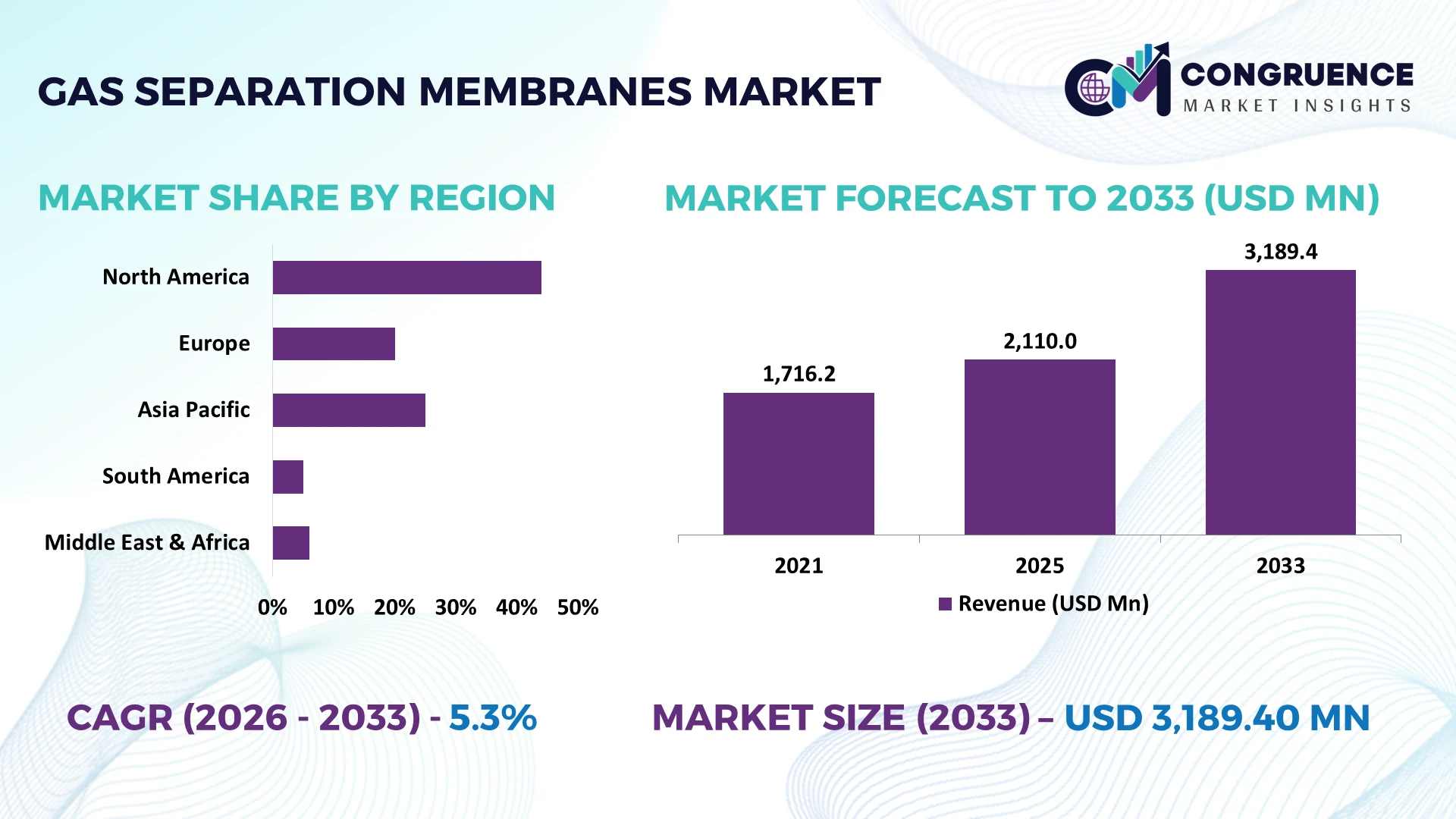
North America accounted for the largest market share at an indicative 34% in 2025 however, Asia-Pacific is expected to register the fastest growth, expanding at a projected CAGR of 6.4% between 2026 and 2033.
North America Gas Separation Membranes Market
Natural Gas Processing and Hydrogen Infrastructure Drive Membrane Deployment
North America holds an indicative 34% share of the global gas separation membranes market, supported by extensive natural gas processing infrastructure, industrial gas production, and hydrogen recovery operations. The United States dominates regional equipment deployment, while Canada contributes through natural gas conditioning and industrial decarbonization initiatives. American natural gas production exceeds 100 billion cubic feet daily, creating substantial requirements for carbon dioxide removal and gas purification. Membrane suppliers are expanding modular separation packages, hydrogen recovery systems, and integrated gas treatment solutions. The US Department of Energy's Regional Clean Hydrogen Hubs program supports seven selected hydrogen hubs, strengthening the development pipeline for associated purification infrastructure. Equipment manufacturers prioritize high-pressure membrane modules, automated gas composition monitoring, and engineering partnerships. Industrial operators increasingly evaluate membrane systems against conventional separation technologies using energy intensity, recovery efficiency, and maintenance requirements.
United States Market Outlook: The United States benefits from established membrane technology suppliers, extensive petrochemical infrastructure, and advanced industrial gas processing capabilities. Texas and Louisiana concentrate major refining, natural gas processing, and chemical manufacturing operations. Federal Section 45Q incentives provide up to USD 85 per metric ton for qualifying geological carbon storage, strengthening investment economics for industrial carbon separation. Manufacturers are integrating membrane purification with compression and downstream gas treatment systems.
Europe Gas Separation Membranes Market
Industrial Decarbonization Accelerates Advanced Membrane Integration
Europe represents an indicative 22% of global gas separation membrane demand, supported by industrial emissions regulation, hydrogen infrastructure development, and biomethane production. Germany, France, the Netherlands, and Italy contribute through chemical processing, industrial gas production, and renewable gas upgrading activities. The European Union's industrial decarbonization framework encourages investment in efficient gas purification and carbon management technologies. European biomethane facilities increasingly deploy multistage membrane systems to separate carbon dioxide while retaining methane. Appropriately engineered configurations can achieve methane recovery exceeding 98%, strengthening operational efficiency and reducing product losses. Evonik and other European technology suppliers are advancing polymeric membrane materials and modular separation solutions. Equipment manufacturers emphasize selective gas permeation, automated process controls, and compatibility with existing industrial infrastructure. Engineering partnerships support integration into refinery, chemical, and renewable gas processing facilities.
Germany Market Outlook: Germany maintains a strong position in advanced polymer membrane development through Evonik and established chemical manufacturing capabilities. Its extensive industrial infrastructure supports hydrogen recovery, nitrogen generation, and biomethane upgrading applications. The country operates thousands of biogas facilities, creating an established base for renewable gas purification investments. Technology developers prioritize high-selectivity membranes, automated module monitoring, and integration with existing energy infrastructure.
Asia-Pacific Gas Separation Membranes Market
Industrial Manufacturing Expansion Strengthens Membrane Production Capabilities
Asia-Pacific accounts for an indicative 32% of global gas separation membrane demand, supported by extensive chemical manufacturing, refinery operations, and industrial gas production. China, Japan, India, and South Korea contribute through membrane manufacturing, natural gas processing, and advanced materials development. China maintains substantial petrochemical production capacity, supporting demand for nitrogen generation, hydrogen recovery, and gas purification technologies. Japan contributes through high-performance polymer manufacturing and specialized membrane engineering, while India is expanding refinery modernization and industrial gas infrastructure. Regional manufacturers are developing hollow fiber modules, advanced polymer formulations, and integrated separation systems. Commercial nitrogen membrane generators commonly deliver 95–99.5% purity, supporting manufacturing and food processing applications. Equipment suppliers prioritize localized production, automated process control, and technical service networks. Competitive differentiation increasingly depends on membrane durability, manufacturing consistency, and application-specific separation performance.
China Market Outlook: China benefits from extensive chemical manufacturing clusters in Shandong, Jiangsu, and Zhejiang, supporting membrane material production and industrial gas separation equipment demand. National industrial efficiency policies encourage process modernization and resource optimization. The country's expanding hydrogen infrastructure and petrochemical operations create opportunities for advanced membrane integration. Domestic suppliers emphasize localized module fabrication, material development, and cost-efficient industrial purification systems.
South America Gas Separation Membranes Market
Natural Gas Development Supports Modular Separation Investment
South America represents an indicative 6% of global gas separation membrane demand, concentrated in Brazil, Argentina, Chile, and Colombia. Natural gas processing, refinery operations, and industrial gas production establish the principal equipment applications. Brazil's offshore hydrocarbon production creates specialized requirements for carbon dioxide separation and gas conditioning, while Argentina's Vaca Muerta formation supports natural gas infrastructure expansion. Membrane systems offer compact configurations suited to remote processing locations and space-constrained industrial facilities. Industrial operators evaluate membrane separation against conventional treatment systems using equipment footprint, gas recovery, and maintenance accessibility. Specialized membrane modules can support methane recovery exceeding 98% in appropriately configured upgrading applications. Equipment suppliers increasingly rely on regional engineering contractors and service partnerships to improve deployment reliability. Imported membrane materials and limited specialized maintenance infrastructure remain important procurement considerations.
Brazil Market Outlook: Brazil maintains substantial offshore oil and gas infrastructure, particularly in the Santos and Campos basins. Offshore production facilities require compact gas treatment equipment capable of operating under demanding conditions. Petrobras continues developing hydrocarbon resources containing varying carbon dioxide concentrations, supporting demand for specialized separation technologies. Membrane suppliers prioritize offshore-compatible modules, integrated compression systems, and local technical support capabilities.
Middle East & Africa Gas Separation Membranes Market
Gas Processing Modernization Strengthens Separation Infrastructure
The Middle East & Africa accounts for an indicative 6% of global gas separation membrane demand, supported by natural gas processing, petrochemical manufacturing, and industrial gas infrastructure. Saudi Arabia, Qatar, the United Arab Emirates, and South Africa represent important markets for specialized purification equipment. Qatar's liquefied natural gas expansion strengthens demand for gas conditioning technologies, while Saudi Arabia's industrial diversification supports hydrogen and petrochemical processing investments. Membrane systems provide modular carbon dioxide removal and hydrogen recovery capabilities across industrial applications. Commercial hydrogen membrane configurations can achieve product concentrations exceeding 90%, depending on feed composition and separation requirements. Equipment suppliers emphasize high-pressure module durability, integrated pretreatment, and reliable maintenance support. Regional engineering partnerships are strengthening project execution capabilities, while imported membrane components create opportunities for localized assembly and technical services.
Saudi Arabia Market Outlook: Saudi Arabia benefits from extensive hydrocarbon processing infrastructure, established petrochemical production, and expanding hydrogen development initiatives. Saudi Aramco and industrial partners are investing in advanced gas processing and energy infrastructure. The country's industrial diversification strategy supports adoption of modular separation equipment and advanced process controls. Membrane suppliers are targeting hydrogen recovery, nitrogen generation, and natural gas purification applications through engineering partnerships.
Market Competition Landscape
The gas separation membranes market features competition between Air Products, Honeywell UOP, Evonik, UBE Corporation, and Air Liquide, alongside specialized membrane manufacturers. An indicative concentration scenario assigns the leading five suppliers 52% combined market share, although independently verified market-wide figures remain limited. Air Products and Honeywell UOP compete through integrated industrial gas purification solutions, while Evonik and UBE emphasize advanced polymer chemistry and membrane performance. Industrial operators evaluate systems against project-specific targets of 10–15% lower energy consumption and methane recovery exceeding 98% in optimized applications. Manufacturers strengthen competitiveness through proprietary membrane formulations, engineering partnerships, modular equipment expansion, and integrated process monitoring. Competition increasingly shifts toward specialized materials, manufacturing consistency, and lifecycle separation performance. High-pressure qualification, contamination resistance, and long-term membrane durability create substantial entry barriers. Winning requires verified separation efficiency, dependable module supply, application-specific engineering, and sustained technical support across industrial operating environments.
Companies Profiled in the Gas Separation Membranes Market Report
-
Air Products and Chemicals, Inc.
-
Honeywell International Inc.
-
Evonik Industries AG
-
UBE Corporation
-
Air Liquide S.A.
-
Parker-Hannifin Corporation
-
Generon IGS, Inc.
-
DIC Corporation
-
Fujifilm Holdings Corporation
-
Asahi Kasei Corporation
-
MTR Corporation
-
Compact Membrane Systems, Inc.
-
Membrane Technology and Research, Inc.
-
Airrane Co., Ltd.
Technology Insights for the Gas Separation Membranes Market
Polyimide, polysulfone, and cellulose acetate membranes underpin industrial nitrogen generation, hydrogen recovery, and natural gas conditioning. Hollow fiber modules provide compact separation surfaces, while multistage arrangements achieve methane recovery exceeding 98% in optimized biogas upgrading applications. Commercial nitrogen generators typically deliver 95–99.5% purity, demonstrating established deployment across manufacturing facilities. Compared with conventional cryogenic separation, membrane nitrogen generation eliminates refrigeration requirements and targets 15–25% lower energy consumption in suitable distributed applications. Suppliers benefit through modular equipment sales, reduced installation complexity, and recurring membrane replacement services.
Emerging mixed-matrix membranes incorporate zeolites, metal-organic frameworks, and selective inorganic fillers to improve gas transport characteristics. Laboratory development targets include 15–20% higher separation productivity, although commercial performance depends on membrane stability. Carbon molecular sieve membranes offer enhanced molecular discrimination for hydrogen and carbon dioxide separation. Automated pressure optimization and digital gas analyzers target 5–10% reductions in process variability. Evonik, UBE, and specialized materials developers compete through proprietary formulations and manufacturing consistency.
Between 2026 and 2028, membrane suppliers will prioritize scalable mixed-matrix fabrication, contamination-resistant coatings, and integrated compression controls. Hybrid membrane systems combining separation stages with adsorption technologies strengthen product purity and recovery. Manufacturers investing in pilot validation and application-specific engineering gain competitive advantages through reliable performance and lower operating complexity.
Recent Developments in the Global Gas Separation Membranes Market
-
May 2024: Air Products launched its PRISM GreenSep LNG membrane separator for bio-LNG production, eliminating 2 intermediate purification methods: amine scrubbing and thermal swing adsorption. The innovation simplifies processing, improves LNG yield, and reduces operational complexity. Source: prnewswire.com
-
December 2024: Toray Industries announced a pilot facility for all-carbon CO2 separation membranes at its Shiga Plant, targeting operation during fiscal 2025. The expansion supports manufacturing scale-up and commercial validation with biogas and natural gas developers. Source: bioenergy-news.com
-
May 2025: Evonik partnered with Gas Malaysia to advance biomethane upgrading using SEPURAN Green membranes at Malaysia's first biomethane injection site. The collaboration supports renewable gas grid integration while eliminating auxiliary chemicals from membrane separation operations. Source: evonik.com
-
December 2024: Membrane Technology and Research began a federally supported hybrid membrane-sorbent carbon capture project for cement manufacturing. The planned demonstration targets 3 tonnes of CO2 captured daily, establishing engineering evidence for industrial decarbonization applications. Source: netl.doe.gov
Scope of the Gas Separation Membranes Market Report
The Gas Separation Membranes Market Report evaluates industrial separation technologies, material innovation, deployment economics, and competitive developments between 2026 and 2033. Technology coverage includes Polyimide, Polysulfone, Cellulose Acetate, Polyaramid, and Mixed-Matrix Membranes. Application analysis examines Nitrogen Generation, Hydrogen Recovery, Carbon Dioxide Removal, Natural Gas Processing, and Oxygen Enrichment. End-user assessment covers Oil and Gas, Chemical and Petrochemical, Power Generation, Food and Beverage, and Industrial Gas Producers.
Geographic analysis encompasses North America, Europe, Asia-Pacific, South America, and the Middle East & Africa. The report assesses hollow fiber technology, advanced membrane materials, hybrid separation systems, and digital process monitoring. Operational benchmarks include nitrogen purity of 95–99.5% and methane recovery exceeding 98% in optimized applications. Competitive evaluation supports technology investment, supplier selection, geographic expansion, and industrial infrastructure planning.
Gas Separation Membranes Market Report Summary
| Report Attribute/Metric | Report Details |
|---|---|
Market Revenue in 2025 | USD 2110 Million |
Market Revenue in 2033 | USD 3189.4 Million |
CAGR (2026 - 2033) | 5.3% |
Base Year | 2025 |
Forecast Period | 2026 - 2033 |
Historic Period | 2021 - 2025 |
Segments Covered | By Type
By Application
By End-User
|
Key Report Deliverable | Revenue Forecast, Growth Trends, Market Dynamics, Segmental Overview, Regional and Country-wise Analysis, Competition Landscape |
Region Covered | North America, Europe, Asia-Pacific, South America, Middle East, Africa |
Key Players Analyzed | Air Products and Chemicals, Inc., Honeywell International Inc., Evonik Industries AG, UBE Corporation, Air Liquide S.A., Parker-Hannifin Corporation, Generon IGS, Inc., DIC Corporation, Fujifilm Holdings Corporation, Asahi Kasei Corporation, MTR Corporation, Compact Membrane Systems, Inc., Membrane Technology and Research, Inc., Airrane Co., Ltd. |
Customization & Pricing | Available on Request (10% Customization is Free) |




