
Reports
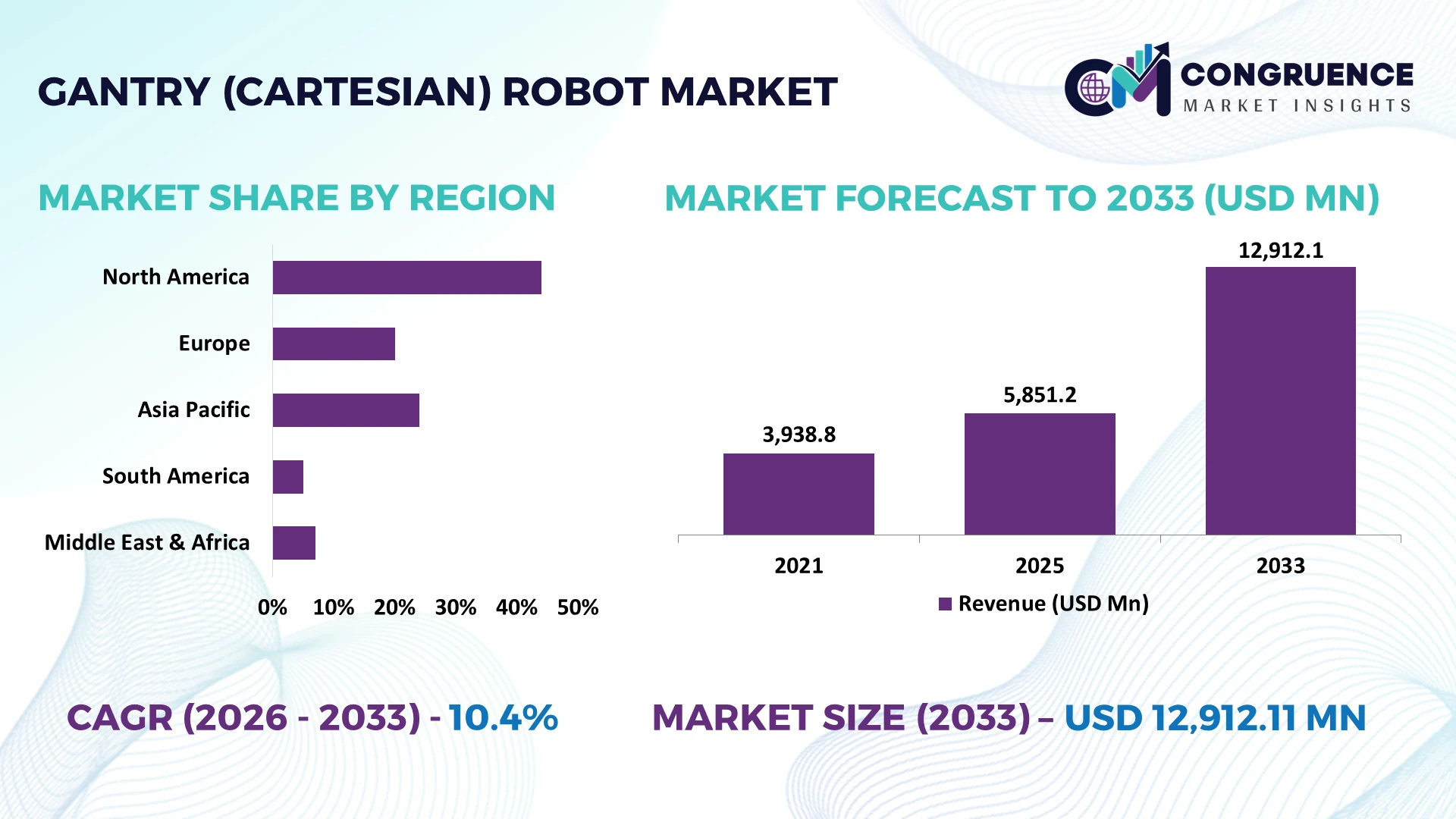
The Global Gantry (Cartesian) Robot Market was valued at USD 5851.2 Million in 2025 and is anticipated to reach a value of USD 12912.11 Million by 2033 expanding at a CAGR of 10.4% between 2026 and 2033. Growth is driven by automated high-speed material handling, precision assembly, palletizing, and machine-tending systems replacing labor-intensive linear-motion operations in automotive, electronics, logistics, and advanced manufacturing.
China remains the dominant manufacturing hub, accounting for about 51% of global industrial robot installations, while Japan and Germany maintain stronger precision-automation capabilities in automotive and electronics production; Chinese manufacturers are also expanding domestic robot and motion-control capacity as U.S.-China supply-chain realignment accelerates. Adoption of connected robotic cells is exceeding 30% across advanced production environments.
Strategic implication: manufacturers prioritizing modular Cartesian platforms, integrated vision, and predictive maintenance gain faster deployment and lower lifecycle costs.
Market Size & Growth: USD 5.85 billion in 2025 to USD 12.91 billion by 2033 at 10.4% CAGR, driven by automated material handling and machine tending.
Top Growth Drivers: Automotive automation contributes ~34%, electronics ~27%, and logistics ~18% of deployment momentum.
Short-Term Forecast: By 2028, integrated Cartesian cells are positioned to reduce handling costs by 12% and improve cycle efficiency by 15%.
Emerging Technologies: AI vision, digital twins, and advanced servo drives are accelerating precision, adaptive control, and predictive maintenance.
Regional Leaders: Asia-Pacific is projected near USD 6.7 billion, North America USD 3.2 billion, and Europe USD 2.5 billion, supported by rising smart-factory adoption.
Consumer/End-User Trends: More than 30% of advanced manufacturing users are integrating connected monitoring with robotic production cells.
Pilot/Case Example: 2025 automotive automation projects using coordinated gantry handling recorded cycle-time reductions of roughly 18%.
Competitive Landscape: Leading suppliers collectively command a substantial share, with Bosch Rexroth, FANUC, Yaskawa, Siemens, and Stäubli strengthening integrated automation portfolios.
Regulatory & ESG Impact: Energy-optimized servo systems can reduce robotic-cell electricity consumption by 8–12%, supporting factory decarbonization targets.
Investment & Funding: Industrial automation investment continues above USD 100 billion annually worldwide, with capital shifting toward AI-enabled robotics and localized supply chains.
Innovation & Future Outlook: Next-generation systems will combine AI vision, digital twins, modular axes, and real-time analytics, shifting competition from hardware capacity toward intelligent automation performance.
The Gantry (Cartesian) Robot Market is gaining traction in high-volume automotive assembly, semiconductor handling, packaging, and warehouse automation, where repeatability and linear-axis precision directly influence throughput. AI-enabled vision and servo synchronization are improving automated handling performance by around 15%, while 2026 supply-chain localization is encouraging manufacturers to source motion components closer to production sites. These shifts strengthen the strategic value of scalable Cartesian automation platforms.
Gantry (Cartesian) robots are becoming strategically important because manufacturers need predictable throughput, repeatable positioning, and scalable automation without redesigning entire production lines. Their modular X-Y-Z architecture fits machine tending, palletizing, semiconductor handling, and precision assembly. Supply-chain restructuring is also pushing manufacturers in China, Germany, and the U.S. toward localized automation capacity, reducing dependence on labor-intensive handling operations.
Compared with conventional manual or fixed mechanical handling, servo-driven Cartesian systems can improve positioning consistency by around 15–20% and reduce changeover time by roughly 10–15% when programmable motion profiles replace mechanical adjustments. Japan emphasizes precision electronics and automotive applications, while China is deploying larger volumes across factory automation and logistics. U.S. adoption is increasingly linked to reshoring projects and automated material movement.
Over the next 2–3 years, connected gantry cells are expected to see wider integration of machine vision, predictive maintenance, and digital-twin monitoring, with automated cells targeting 10–15% higher utilization. A practical deployment involves multi-axis gantries coordinating CNC loading and unloading, allowing one cell to serve several machines. Manufacturers are responding through modular platform investment, motion-control partnerships, and localized component sourcing. Competitive advantage will increasingly depend on integration speed, uptime, and lifecycle efficiency rather than robot hardware alone.
The strongest growth driver is the shift toward modular automation in high-volume manufacturing, where programmable linear motion supports repeatable handling across multiple production stages. Automotive and electronics facilities increasingly target 10–15% higher equipment utilization, while automated machine-tending cells can reduce repetitive handling labor requirements by approximately 20–30%. China’s expansion of automated manufacturing capacity and U.S. reshoring programs are reinforcing this transition. Companies are responding by investing in modular X-Y-Z platforms that can be reconfigured as production volumes change. The non-obvious advantage is asset redeployment: standardized gantry architectures allow manufacturers to transfer automation between product lines instead of replacing complete robotic cells, improving capital utilization.
Component dependency remains a structural constraint, particularly for precision linear guides, servo motors, controllers, and specialized actuators. Imported motion-control components can represent roughly 25–35% of a high-performance gantry system’s equipment cost, while exchange-rate or component-price fluctuations can raise project budgets by 5–10%. European and Asian manufacturers remain exposed to specialized electronics and precision-component supply chains despite increasing localization. Companies are responding through dual sourcing, longer-term procurement agreements, and standardized component architectures. The operational impact is significant: inconsistent component availability can extend commissioning schedules by several weeks and delay production-line integration. Strategic sourcing therefore becomes as important as robot performance when manufacturers scale multi-cell deployments.
The strongest opportunity lies in combining Cartesian motion with machine vision, AI-based inspection, and adaptive process control. Vision-guided handling can improve placement accuracy and reduce manual intervention by approximately 10–15%, while predictive analytics can raise equipment availability by 5–8% in continuously monitored cells. India is emerging as an attractive deployment market as electronics, automotive-component, and semiconductor manufacturing capacity expands. The next opportunity extends beyond robot sales toward integrated automation-as-a-service, where manufacturers pay for uptime or production capacity. Suppliers are increasing R&D investment and forming partnerships with vision, PLC, and industrial-software providers. The strategic advantage is a unified automation stack that converts a conventional gantry from a motion device into a production-intelligence platform.
Long-term deployment is challenged by inconsistent factory infrastructure, legacy PLC architectures, fragmented communication protocols, and shortages of engineers skilled in multi-axis automation. Integration activities can consume 15–25% of project implementation time, while unplanned downtime during commissioning can materially reduce the expected return from automated cells. Germany’s mature factories face interoperability requirements across older and newer equipment, while rapidly modernizing Chinese plants often prioritize faster standardized deployment. Cybersecurity is also becoming more important as connected controllers and remote diagnostics expand the attack surface. Companies must address these pressures through industrial Ethernet standardization, secure controller architecture, digital commissioning, and system-integrator partnerships. Competitive sustainability will depend on reliable integration across mixed-generation production environments, not simply higher robotic speed.
Connected Motion Control Expands: Manufacturers are integrating servo drives, PLCs, industrial Ethernet, and condition monitoring, with connected-cell deployment rising toward 30–35% in advanced factories. Real-time diagnostics are reducing unplanned intervention by roughly 8–12%, prompting suppliers to bundle controllers, software, and service contracts rather than sell standalone gantry hardware.
Compact Cells Reshape Layouts: Electronics and precision-component plants are adopting smaller Cartesian cells that cut installation footprints by 15–20% while shortening material-transfer distances by 10–15%. Japan’s electronics manufacturers are prioritizing compact multi-axis configurations as labor availability tightens, while suppliers redesign frames and cable-management systems for faster line integration.
Localized Components Gain Priority: Supply-chain restructuring is pushing manufacturers to localize motion components, with dual-sourcing programs targeting 20–30% greater procurement coverage from domestic suppliers. China’s domestic robotics ecosystem is expanding rapidly, while European integrators are increasing regional sourcing to reduce lead-time exposure and strengthen service responsiveness.
Software-Led Commissioning Accelerates: Digital commissioning, simulation, and virtual axis programming are increasingly shifting engineering work upstream, reducing physical commissioning requirements by around 15% and shortening changeover preparation by 10%. Companies are pairing gantry platforms with digital twins and standardized software libraries, creating a non-obvious advantage: engineering teams can reuse validated motion sequences across multiple production cells.
Three-Axis gantry robots remain the leading type, estimated at approximately 46% of market deployment, because their X-Y-Z configuration provides sufficient flexibility for material transfer, machine tending, assembly, and packaging without the higher complexity of additional rotational axes. Their modular architecture can reduce integration effort by 10–15% compared with more complex configurations. Two-Axis systems retain relevance in repetitive pick-and-place operations where lower acquisition and maintenance requirements matter, while Single-Axis platforms serve highly linear transfer tasks with limited motion requirements. Four-Axis systems hold a smaller share but provide higher flexibility for applications requiring rotational positioning.
Four-Axis gantry robots represent the fastest-growing type, with adoption expanding by roughly 12–15% as manufacturers seek greater orientation control without moving to more complex robotic architectures. Electronics and precision-assembly producers are increasing investment in these platforms, while suppliers are developing integrated rotary modules and vision interfaces. The shift indicates that buyers increasingly prioritize application flexibility and cell utilization over minimum hardware cost.
Material Handling leads the application segment with an estimated 34% share, reflecting the extensive use of gantry systems for loading, unloading, pallet movement, and repetitive transfer operations. Its dominance comes from standardized workflows that can deliver 15–20% higher handling consistency while reducing manual transfer requirements. Pick & Place follows as a mature application, particularly in electronics and packaging, while Machine Tending is expanding as manufacturers connect gantry systems directly with CNC equipment and automated inspection.
Machine Tending is the fastest-growing application, advancing around 13–16% as factories pursue higher machine utilization and reduced operator intervention. Assembly and Packaging remain strategically important, with packaging deployments increasingly incorporating vision and automated quality checks. Companies are therefore shifting investment toward integrated cells capable of serving multiple machines rather than isolated robotic stations, improving asset utilization by roughly 10%.
Automotive remains the leading end-user, estimated at approximately 32% of gantry robot deployment, supported by high-volume production, machine tending, component handling, and repeatable assembly requirements. Its established automation infrastructure supports large multi-cell installations, while Electronics is the fastest-growing buyer group, expanding at roughly 14–17% as semiconductor, PCB, and precision-component production requires tighter positioning and contamination-controlled handling. Manufacturing remains broadly diversified, while Food & Beverage increasingly emphasizes high-speed packaging and material movement. Pharmaceuticals maintain demand for precise, traceable automation.
Electronics adoption is increasingly reshaping supplier priorities, with buyers seeking compact platforms, vision integration, and programmable motion profiles that can support frequent product changes. Food & Beverage and Pharmaceuticals are emphasizing hygienic configurations and controlled workflows, while automotive companies prioritize throughput and multi-machine synchronization. Suppliers are responding with application-specific packages, system-integrator partnerships, and modular configurations that reduce deployment time by approximately 10–15%.
Asia-Pacific accounted for the largest market share at 46% in 2025 however, South America is expected to register the fastest growth, expanding at a CAGR of 11.1% between 2026 and 2033.

Reshoring and Flexible Automation Strengthen Industrial Deployment
North America held an estimated 22% share in 2025, with deployment concentrated across automotive, aerospace, electronics, food processing, and advanced machinery. The United States recorded 38,000 industrial robot installations in 2025, reflecting an 11% increase and stronger factory-automation investment. Gantry systems are increasingly integrated with CNC machines, machine vision, and automated material-transfer systems. Manufacturers are prioritizing modular cells that can be replicated across reshored production facilities, while system integrators are partnering with motion-control suppliers to shorten commissioning periods by approximately 10–15%. The strategic shift is toward flexible automation capable of supporting shorter production cycles and variable product configurations.
United States Market Outlook: The United States remains the dominant North American market because of its large automotive, aerospace, semiconductor, and advanced-manufacturing base. Robot density reached approximately 307 units per 10,000 manufacturing employees, supporting a mature automation ecosystem. Companies are increasing investment in machine tending, precision handling, and modular Cartesian cells that can be deployed across multiple manufacturing sites.
Precision Modernization Drives High-Value Automation Adoption
Europe accounted for approximately 19% of the global market in 2025, supported by Germany, Italy, France, and the United Kingdom. Germany's automotive, machinery, and electronics industries remain major deployment centers, while European manufacturers increasingly prioritize energy-efficient servo systems and precision linear motion. Western Europe recorded robot density of approximately 267 units per 10,000 manufacturing employees, demonstrating substantial automation penetration. Manufacturers are integrating gantry platforms with CNC equipment, industrial Ethernet, and production-monitoring systems to modernize existing facilities. Regulatory emphasis on energy efficiency is also shifting purchasing criteria toward lifecycle operating costs, encouraging suppliers to develop lower-energy drives and regenerative motion systems.
Germany Market Outlook: Germany remains Europe's most influential automation market, supported by automotive, industrial machinery, electronics, and precision-engineering clusters. Approximately 30% of European industrial robot installations are concentrated in the country, creating strong demand for high-precision Cartesian systems. Manufacturers are favoring flexible automation cells that integrate with established production infrastructure while improving machine utilization and reducing repetitive manual handling.
Manufacturing Scale Accelerates High-Volume Automation
Asia-Pacific accounted for approximately 46% of the global market in 2025, making it the principal deployment center for Gantry (Cartesian) Robot systems. China, Japan, South Korea, and India concentrate electronics, automotive, semiconductor, packaging, and industrial-equipment production. Asia represented approximately 74% of global industrial robot installations in 2024, while China alone accounted for about 54%. Manufacturers are expanding domestic robotics capacity, local service networks, and integrated motion-control portfolios to shorten procurement cycles. China's continued manufacturing modernization is increasing demand for programmable handling and machine-tending systems, while Japanese manufacturers emphasize precision and compact automation. Suppliers are therefore competing through localized production, faster commissioning, and application-specific engineering.
China Market Outlook: China is the dominant Asian market, supported by more than 2 million industrial robots operating across its manufacturing sector. Domestic manufacturers captured approximately 57% of China's industrial robot market in 2024, strengthening local automation supply chains. Gantry suppliers are responding with competitively priced platforms, localized components, integrated controllers, and application-specific solutions for electronics and automotive production.
Selective Automation Targets Productivity-Critical Operations
South America represented approximately 5% of the market in 2025, with Brazil accounting for the largest share of regional deployment. Automotive, food and beverage, packaging, metalworking, and machinery manufacturing remain the principal demand centers. Gantry systems are particularly relevant where manufacturers need repetitive material transfer, palletizing, and machine tending without extensive production-line redesign. Brazil's established industrial clusters provide the strongest installation base, while relatively lower automation penetration creates opportunities for targeted modernization. Companies are increasingly working with local system integrators to combine motion control, safety systems, programming, and mechanical integration. Buyers are emphasizing measurable productivity improvements and shorter payback periods, making operational efficiency more important than advanced features with limited production value.
Brazil Market Outlook: Brazil is the most strategically significant South American market because of its diversified manufacturing infrastructure and established automotive, food-processing, packaging, and machinery industries. Gantry deployment is concentrated in repetitive handling and machine-tending applications. Manufacturers are increasingly using local integrators to adapt Cartesian platforms to legacy production equipment and infrastructure constraints.
Industrial Diversification Creates New Automation Demand
Middle East & Africa accounted for approximately 3% of the market in 2025, with Saudi Arabia and the United Arab Emirates emerging as important automation investment centers. Demand is linked to manufacturing diversification, logistics, food processing, pharmaceuticals, packaging, and new industrial infrastructure. New-build facilities provide an advantage because Cartesian automation can be integrated during plant design rather than retrofitted into constrained production lines. Companies are developing distributor networks and partnerships with local engineering firms to provide turnkey automation solutions. Saudi industrial modernization programs are also increasing demand for digitally connected production equipment. Suppliers with local technical support, application engineering, and integrated controls are better positioned to capture projects where infrastructure coordination and rapid commissioning determine purchasing decisions.
Saudi Arabia Market Outlook: Saudi Arabia represents the region's strongest opportunity because industrial diversification is generating new manufacturing and logistics infrastructure. Automated material handling and production systems are gaining relevance across food processing, pharmaceuticals, packaging, and advanced manufacturing. Suppliers offering local engineering support and turnkey integration can address the requirement for coordinated robotics, controls, safety, and production-management systems.
The Gantry (Cartesian) Robot Market is shaped by global automation leaders including FANUC, Yaskawa, Siemens, Bosch Rexroth, and Beckhoff, alongside specialized motion-control and regional cost-focused manufacturers. The top five players collectively hold an estimated 38% market share, while competition centers on precision, customization, price, supply reliability, and integration speed. Advanced systems can reduce commissioning time by 10–15% and maintenance costs by 8–12% through integrated diagnostics and connected controls. Global suppliers are expanding through system-integrator partnerships, localized engineering, and controller-to-drive integration. Chinese manufacturers are increasing price pressure while improving domestic component content, challenging established suppliers on cost and delivery speed. High entry barriers include multi-axis control expertise, safety certification, application engineering, and service infrastructure. Winning suppliers will combine reliable hardware, software integration, localized support, rapid deployment, and scalable lifecycle services.
FANUC Corporation
Yaskawa Electric Corporation
Siemens AG
Bosch Rexroth AG
Beckhoff Automation GmbH & Co. KG
Stäubli International AG
IAI Corporation
Yamaha Motor Co., Ltd.
Festo SE & Co. KG
Parker Hannifin Corporation
Aerotech, Inc.
HIWIN Technologies Corp.
Güdel Group AG
igus GmbH
Servo-driven linear actuators, high-speed motion controllers, industrial Ethernet, and machine vision currently define advanced Cartesian systems. Compared with legacy pneumatic or mechanically indexed handling, closed-loop servo positioning can improve repeatability and cycle efficiency by 10–15%, while integrated vision reduces alignment intervention by 5–8%. Connected monitoring is moving beyond premium installations, with roughly 30% of advanced manufacturing cells incorporating real-time machine data. This integration gives automotive, electronics, and precision-machining producers better throughput control and faster fault response.
Emerging platforms combine AI-assisted vision, digital twins, predictive maintenance, and edge analytics with multi-axis motion. Digital commissioning can reduce physical setup effort by around 15%, while predictive diagnostics can improve equipment availability by 5–7%. Beckhoff's integrated control architecture demonstrates the direction toward unified robotics, motion, safety, vision, and cloud connectivity. Suppliers with strong software ecosystems and system-integration capabilities benefit most because customers increasingly evaluate complete cell performance rather than standalone robot specifications.
From 2026–2028, disruptive development will center on AI-enabled adaptive motion, simulation-led engineering, and modular robotic architectures. Modular systems can reduce component inventory requirements by approximately 10–15% and accelerate configuration changes. China benefits from scale and localized manufacturing, while Germany and Japan retain advantages in precision engineering and controls. Companies acting now on interoperable controls, predictive analytics, and modular platforms can secure lower commissioning costs, faster product changeovers, and stronger competitive differentiation.
June 2025 Beckhoff introduced ATRO, a modular industrial robot system integrating configurable motor/link modules with TwinCAT control; standardized modules reduce spare-part requirements and support application-specific kinematics. The development strengthens modular automation and expands competition beyond fixed robot architectures. Source: (Beckhoff Automation)
June 2025 Bosch Rexroth introduced a robotics automation package combining hardware, software, and applications through ctrlX AUTOMATION; the platform targets faster robot development and integration. The move reduces engineering fragmentation and strengthens the supplier's position in integrated Cartesian automation. Source: (Bosch Rexroth Global)
September 2025 International Federation of Robotics reported 542,076 industrial robots installed globally during 2024, with operational stock reaching 4.66 million units, an 8.9% increase. The expansion confirms stronger automation infrastructure and broadens the installed base for advanced motion technologies.
June 2026 International Federation of Robotics reported U.S. industrial robot installations reached 38,000 units in 2025, an 11% year-on-year increase, while automotive installations reached 13,500 units. The rebound strengthens automation investment across North American manufacturing. Source: (IFR International Federation of Robotics)
The Gantry (Cartesian) Robot Market Report covers Single-Axis, Two-Axis, Three-Axis, and Four-Axis systems across Material Handling, Pick & Place, Machine Tending, Assembly, and Packaging applications. End-user analysis includes Automotive, Electronics, Food & Beverage, Pharmaceuticals, and Manufacturing, enabling comparison of deployment intensity, automation requirements, and purchasing priorities across mature and emerging use cases.
Geographic coverage spans North America, Europe, Asia-Pacific, South America, and the Middle East & Africa, with country-level assessment of manufacturing concentration, automation infrastructure, and technology adoption. The report evaluates servo systems, machine vision, industrial networking, AI-enabled control, digital twins, predictive maintenance, and modular robotics. With electronics representing 128,899 global industrial-robot installations in 2024 and Asia accounting for 74% of new deployments, the analysis supports investment planning, expansion decisions, technology selection, competitive positioning, and strategic priorities through 2026–2033.
| Report Attribute/Metric | Report Details |
|---|---|
Market Revenue in 2025 | USD 5851.2 Million |
Market Revenue in 2033 | USD 12912.11 Million |
CAGR (2026 - 2033) | 10.4% |
Base Year | 2025 |
Forecast Period | 2026 - 2033 |
Historic Period | 2021 - 2025 |
Segments Covered | By Type
By Application
By End-User
|
Key Report Deliverable | Revenue Forecast, Growth Trends, Market Dynamics, Segmental Overview, Regional and Country-wise Analysis, Competition Landscape |
Region Covered | North America, Europe, Asia-Pacific, South America, Middle East, Africa |
Key Players Analyzed | FANUC Corporation, Yaskawa Electric Corporation, Siemens AG, Bosch Rexroth AG, Beckhoff Automation GmbH & Co. KG, Stäubli International AG, IAI Corporation, Yamaha Motor Co., Ltd., Festo SE & Co. KG, Parker Hannifin Corporation, Aerotech, Inc., HIWIN Technologies Corp., Güdel Group AG, igus GmbH |
Customization & Pricing | Available on Request (10% Customization is Free) |




