
Reports
The Global GaN Power Device Market was valued at USD 500.85 Million in 2025 and is anticipated to reach a value of USD 4715.2 Million by 2033 expanding at a CAGR of 32.35% between 2026 and 2033. Rapid electrification across automotive, AI data centers, fast-charging infrastructure, renewable energy systems, and high-frequency power conversion is accelerating commercial deployment of advanced GaN power devices with higher efficiency and reduced system losses.
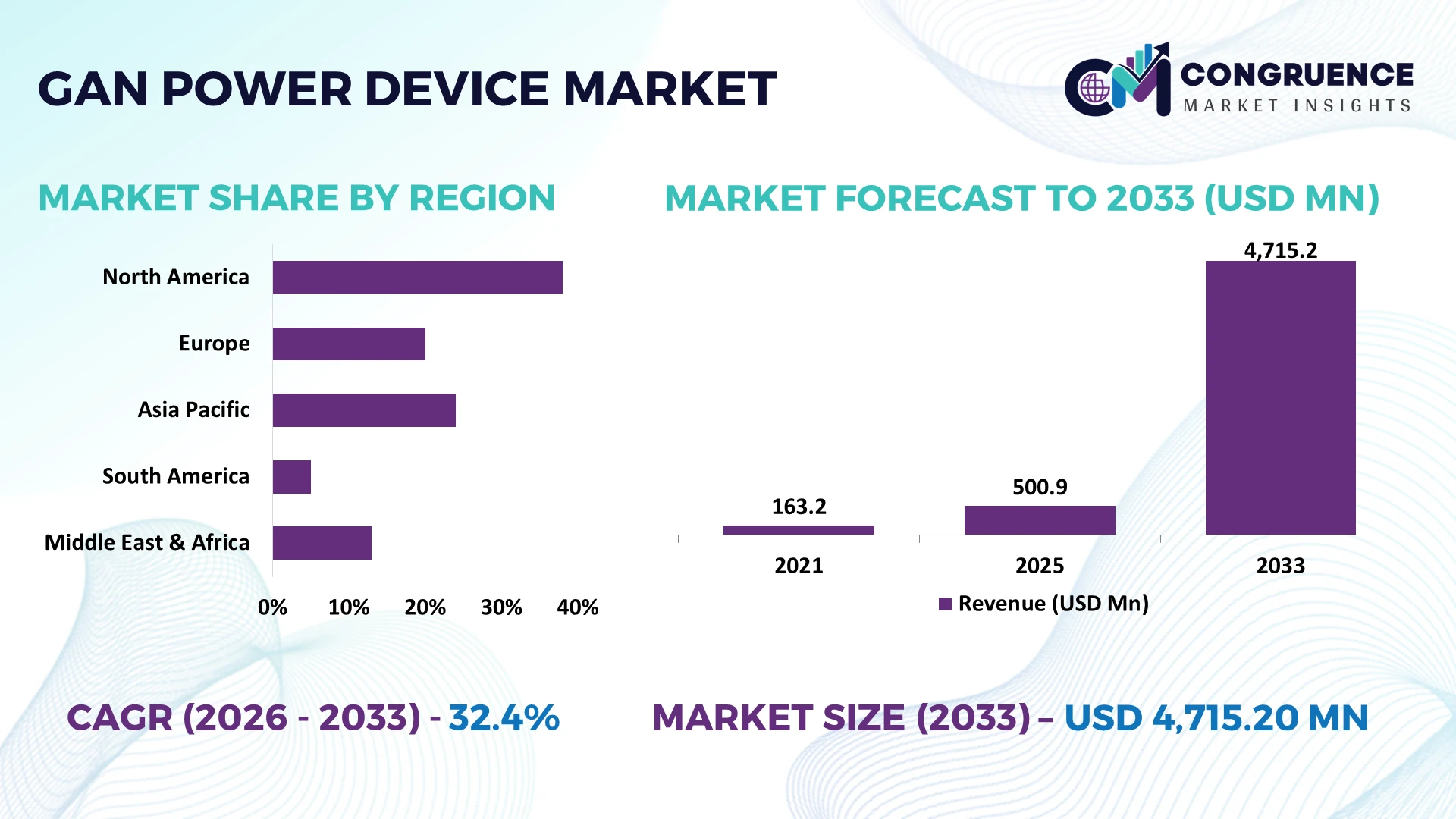
China remains the dominant country, accounting for approximately 38% of global manufacturing capacity, supported by large-scale investments in EV power electronics, telecom infrastructure, and semiconductor fabrication. The United States leads in high-performance GaN innovation with over 30% of advanced design activity focused on defense, aerospace, and AI computing applications, while export control measures continue to reshape semiconductor supply chains and regional production strategies. This leadership gap strengthens Asia's manufacturing scale while North America advances premium technology development.
For market participants, strengthening regional manufacturing partnerships and securing resilient semiconductor supply chains will be essential to capture long-term competitive advantages in the global GaN power device market.
Market Size & Growth: USD 500.85 Million in 2025, reaching USD 4715.2 Million by 2033 at 32.35% CAGR, driven by rapid adoption of high-efficiency power electronics and wide-bandgap semiconductor integration.
Top Growth Drivers: EV power electronics (+34%), AI data center power demand (+29%), and fast-charging infrastructure expansion (+27%) continue to accelerate global deployment.
Short-Term Forecast: By 2028, GaN-based power systems are expected to reduce energy losses by nearly 18% while improving power density by approximately 25%.
Emerging Technologies: AI-assisted power management, advanced GaN-on-silicon manufacturing, and automated wafer inspection improve production efficiency by around 20%.
Regional Leaders: Asia Pacific exceeds USD 2100 Million, North America approaches USD 1250 Million, and Europe surpasses USD 820 Million, supported by regional semiconductor expansion and electrification programs.
Consumer/End-User Trends: More than 42% of premium fast chargers and high-performance industrial power supplies are integrating GaN technology for higher efficiency and compact designs.
Pilot/Case Example: In 2026, advanced GaN server power deployments improved conversion efficiency by approximately 12%, reducing cooling requirements across AI computing facilities.
Competitive Landscape: Infineon holds approximately 16% market share, alongside Navitas Semiconductor, Wolfspeed, STMicroelectronics, EPC, and ROHM driving product innovation.
Regulatory & ESG Impact: Higher-efficiency power devices lower electricity losses by nearly 15%, aligning with global energy-efficiency regulations and regional supply-chain localization initiatives.
Investment & Funding: More than USD 3 Billion in manufacturing expansion, strategic partnerships, and advanced fabrication supports global production capacity growth.
Innovation & Future Outlook: Next-generation integrated GaN modules, intelligent digital power platforms, and advanced packaging technologies strengthen long-term competitiveness across automotive, industrial, and AI infrastructure.
The GaN Power Device Market is expanding across electric vehicles, industrial automation, renewable energy converters, and AI server power systems, where higher switching efficiency delivers measurable operational gains. Advanced integrated packaging and enhanced thermal management improve system performance by approximately 20%, while ongoing semiconductor supply-chain diversification and regional manufacturing expansion reinforce long-term commercialization, setting the foundation for the strategic market assessment that follows.
The GaN Power Device Market has become strategically important as governments and manufacturers prioritize energy-efficient semiconductor technologies for electric mobility, AI infrastructure, industrial automation, and high-performance power conversion. Semiconductor supply-chain restructuring following export restrictions and localization policies is accelerating investment in domestic wafer fabrication, advanced packaging, and resilient sourcing networks. This shift is strengthening competitive positioning while reducing dependence on concentrated manufacturing ecosystems.
Compared with conventional silicon power devices, GaN technology delivers approximately 20% higher power efficiency and reduces switching losses by nearly 40%, enabling smaller system footprints and lower cooling requirements. China continues to lead large-scale manufacturing capacity, while the United States focuses on high-value innovation for aerospace, defense, and AI computing applications. Over the next two to three years, advanced GaN integration is expected to exceed 35% adoption in premium fast-charging platforms and expand steadily across industrial power supplies.
A practical example is the deployment of GaN-based power modules in AI data centers, where higher conversion efficiency lowers energy consumption and cooling requirements while increasing rack-level power density. Companies are expanding strategic partnerships with foundries, investing in advanced packaging technologies, and strengthening regional manufacturing footprints to secure long-term supply resilience. Organizations that combine technology leadership with diversified production capabilities will establish stronger competitive advantages across next-generation power electronics markets.
Electrification across automotive, industrial automation, renewable energy, and AI computing is driving rapid adoption of GaN power devices. High-frequency GaN switching improves energy efficiency by approximately 20% while reducing system size by nearly 35%, supporting compact power architectures. More than 40% of next-generation fast-charging designs now incorporate wide-bandgap semiconductor solutions. China's continued expansion of power semiconductor manufacturing and the United States' investment in domestic semiconductor production are reshaping competitive dynamics. In response, leading companies are increasing wafer capacity, expanding strategic partnerships, and accelerating product development for automotive-grade and industrial applications. The strongest competitive advantage increasingly belongs to manufacturers capable of combining advanced device performance with reliable localized production.
GaN device production remains constrained by complex fabrication processes, limited specialized foundry capacity, and dependence on high-quality epitaxial wafers. Manufacturing costs remain approximately 25% higher than mature silicon technologies, while advanced packaging contributes nearly 18% of overall production expenses. Export controls affecting semiconductor equipment and materials continue to influence cross-border supply availability, particularly for high-performance components. These constraints pressure deployment timelines and reduce pricing flexibility for manufacturers targeting cost-sensitive applications. Companies are responding by localizing production, securing long-term supply agreements, investing in multi-source procurement strategies, and qualifying additional fabrication partners. Diversified manufacturing ecosystems are becoming a critical operational differentiator for sustained competitiveness.
Growing deployment of AI servers, smart factories, and high-voltage charging infrastructure is creating new commercial opportunities for GaN power devices beyond traditional consumer electronics. Digital power management integrated with GaN technology improves conversion efficiency by approximately 15% while reducing thermal losses by nearly 18%. Japan and South Korea continue expanding advanced semiconductor research through collaborative industry programs supporting next-generation packaging and intelligent power modules. Companies are increasing R&D investments, strengthening ecosystem partnerships, and developing integrated power solutions combining GaN devices with intelligent control architectures. A significant strategic opportunity lies in supplying complete power platforms rather than standalone semiconductor components, enabling stronger customer integration and higher long-term value.
Expanding GaN deployment across automotive, aerospace, and industrial sectors requires consistent manufacturing quality, workforce expertise, and robust qualification standards. Automotive-grade reliability testing can extend product validation cycles by over 30%, while advanced packaging defects account for nearly 12% of production yield variation. As power density continues increasing, thermal management and long-term device reliability become more critical for operational consistency. Companies are addressing these execution challenges through automated inspection systems, digital manufacturing analytics, workforce training, and collaborative development with automotive and industrial OEMs. Long-term market leadership will depend not only on technological innovation but also on scalable manufacturing excellence and dependable field performance across mission-critical applications.
AI Infrastructure Power Optimization AI server deployment is accelerating demand for high-efficiency GaN power stages, with power density improving by nearly 25% and conversion efficiency increasing about 12%. Growing rack-level energy requirements and electricity optimization targets are pushing hyperscale operators to redesign power architectures. Semiconductor vendors are expanding partnerships with server manufacturers and adopting automated validation workflows to shorten qualification cycles while improving operational reliability.
Localized Semiconductor Manufacturing Expansion Supply-chain diversification continues as more than 30% of planned semiconductor investments prioritize domestic manufacturing capabilities in countries including the United States, Japan, and India. Export control measures and strategic industrial policies are encouraging localized wafer processing and advanced packaging. Companies are restructuring supplier networks, qualifying multiple fabrication partners, and increasing inventory resilience to reduce procurement risk and improve production continuity.
Integrated Power Module Adoption Demand is shifting from discrete components toward integrated GaN modules, reducing system footprints by approximately 35% while lowering assembly complexity by nearly 20%. Industrial equipment manufacturers are simplifying power system design through higher integration and digital control compatibility. Producers are expanding module portfolios, strengthening OEM collaborations, and investing in advanced packaging technologies that improve thermal performance and manufacturing consistency.
Automotive Qualification Standardization Electric vehicle manufacturers are increasing qualification requirements for high-voltage power electronics, with automated reliability testing improving validation efficiency by roughly 18% and reducing development time by about 15%. Functional safety compliance and long-term durability expectations are reshaping procurement strategies. Companies are strengthening automotive partnerships, expanding dedicated testing facilities, and implementing digital manufacturing analytics to achieve consistent large-scale production quality.
GaN Power Transistors account for approximately 46% of total market demand, making them the leading segment due to superior switching frequency, lower conduction losses, and broad deployment across EVs, industrial converters, and telecommunications infrastructure. Their scalability and compatibility with high-power applications continue to strengthen commercial adoption. GaN Power ICs represent the fastest-growing category as integrated architectures reduce component count by nearly 30% and improve power management efficiency by approximately 18%, making them increasingly attractive for compact electronic systems.
GaN Modules are gaining traction in industrial and automotive applications where simplified integration and improved thermal performance reduce engineering complexity. Meanwhile, GaN Diodes remain strategically relevant for specialized high-frequency rectification and power conversion systems despite a comparatively smaller deployment base. Manufacturers are prioritizing transistor portfolio expansion, integrated IC development, and module-focused partnerships to address evolving customer requirements. Investment priorities increasingly favor highly integrated device platforms that shorten development cycles while improving operational efficiency across multiple end markets.
Electric Vehicles represent the largest application segment with approximately 34% market share, driven by increasing deployment of onboard chargers, traction inverters, and high-efficiency DC-DC converters. Automakers are adopting GaN technology to reduce energy losses by nearly 15% while supporting lighter and more compact power systems. Data Centers are emerging as the fastest-growing application as AI computing infrastructure requires higher power density and improved energy efficiency, accelerating deployment of advanced GaN-based power supplies.
Consumer Electronics continue to maintain strong demand through premium fast chargers and compact adapters, while Telecommunications expands adoption in 5G base stations requiring efficient high-frequency power conversion. Industrial Power Supplies are steadily integrating GaN devices to improve process efficiency and reduce cooling requirements. Companies are increasing manufacturing scale, developing application-specific platforms, and strengthening OEM collaborations to capture expanding demand across transportation and digital infrastructure markets.
Automotive remains the dominant end-user, accounting for approximately 36% of market demand as electric mobility platforms increasingly require efficient onboard charging, traction control, and battery management systems. IT & Telecommunications is the fastest-growing end-user category, supported by expanding AI computing infrastructure, cloud facilities, and high-capacity communication networks where GaN devices improve energy efficiency by approximately 20% while enabling higher power density.
Consumer Electronics continues generating stable demand through compact charging solutions and premium mobile devices, whereas Industrial buyers prioritize automation equipment, renewable energy converters, and intelligent power systems. Aerospace & Defense maintains specialized adoption for mission-critical applications requiring lightweight, high-reliability power electronics. Companies are tailoring product portfolios, expanding automotive qualification programs, strengthening strategic partnerships with hyperscale infrastructure providers, and developing customized solutions for industrial customers to reinforce long-term competitive positioning.
Asia-Pacific accounted for the largest market share at 48.2% in 2025 however, North America is expected to register the fastest growth, expanding at a 34.8% between 2026 and 2033.

AI Infrastructure and Domestic Semiconductor Expansion Drive Market Leadership
North America maintains a strong position through advanced semiconductor innovation, defense electronics, AI data centers, and electric vehicle power systems. The region contributes approximately 27% of global demand, supported by extensive deployment of high-efficiency power conversion technologies. Domestic semiconductor manufacturing initiatives and advanced packaging investments continue strengthening supply resilience while reducing dependence on overseas fabrication. More than 35% of newly deployed hyperscale AI facilities are integrating next-generation GaN-based power architectures to improve energy efficiency and rack density. Leading semiconductor companies continue expanding foundry collaborations, automotive qualification programs, and advanced packaging capabilities, reinforcing the region's technology leadership and accelerating commercialization across industrial and enterprise applications.
United States Market Outlook: The United States leads regional innovation through advanced semiconductor R&D, defense applications, AI infrastructure, and electric vehicle technology development. More than 30% of global high-performance GaN device design activity is concentrated in the country, supported by public and private investments in semiconductor manufacturing. Companies are strengthening domestic fabrication capacity, expanding research partnerships with technology enterprises, and increasing advanced packaging capabilities to improve long-term supply resilience and accelerate commercialization.
Electrification Policies Strengthen High-Efficiency Power Electronics
Europe is reinforcing its position through industrial electrification, automotive innovation, renewable energy integration, and energy-efficiency regulations. The region represents nearly 22% of global deployment, supported by advanced manufacturing ecosystems and strict efficiency standards encouraging wide-bandgap semiconductor adoption. More than 28% of industrial power conversion upgrades now prioritize higher-efficiency semiconductor platforms. Automotive manufacturers and industrial equipment suppliers continue integrating GaN technologies into next-generation platforms while semiconductor producers expand collaborative research and production capabilities. Sustainability objectives and modernization of industrial infrastructure continue supporting long-term deployment across transportation, manufacturing, and energy systems.
Germany Market Outlook: Germany remains the regional leader through its automotive manufacturing strength, industrial automation expertise, and advanced semiconductor engineering ecosystem. Approximately 35% of Europe's automotive power electronics development is associated with German manufacturers and suppliers. Continued investments in EV production, industrial digitalization, and collaborative semiconductor research strengthen domestic demand while encouraging long-term technology partnerships across automotive and industrial sectors.
Manufacturing Scale and Export Leadership Accelerate Adoption
Asia-Pacific dominates the global GaN Power Device Market through large-scale semiconductor manufacturing, electronics production, electric vehicle supply chains, and telecommunications infrastructure. The region accounts for approximately 48.2% of total market activity, supported by integrated manufacturing ecosystems and expanding fabrication capacity. More than 55% of global GaN wafer production is concentrated across major manufacturing hubs, enabling efficient commercialization and competitive production costs. Regional manufacturers continue expanding automated fabrication facilities, advanced packaging operations, and strategic supplier networks to strengthen export competitiveness while supporting growing domestic demand across consumer electronics and industrial power applications.
China Market Outlook: China remains the largest individual market through extensive semiconductor manufacturing capacity, strong electric vehicle production, and expanding industrial automation. Nearly 38% of global GaN manufacturing capacity is located within China, supported by sustained investments in wafer fabrication and advanced packaging. Domestic companies continue expanding production facilities, strengthening local supply chains, and increasing technology collaboration to improve manufacturing efficiency and reduce dependence on imported semiconductor components.
Industrial Modernization Expands Specialized Demand
South America is gradually increasing adoption of GaN power devices through renewable energy projects, industrial modernization, and expanding telecommunications infrastructure. The region contributes approximately 5% of global demand, with deployment centered on industrial power supplies and energy conversion systems. Investments in power grid modernization and EV charging infrastructure continue supporting semiconductor adoption despite limited domestic manufacturing capacity. Several industrial operators are replacing conventional power conversion equipment with higher-efficiency systems, improving operational efficiency by approximately 14%. Companies are strengthening regional distribution partnerships and localized technical support to improve customer adoption while managing infrastructure and supply-chain constraints.
Brazil Market Outlook: Brazil leads regional demand through expanding renewable energy investments, industrial automation, and automotive manufacturing activity. More than 45% of South America's industrial semiconductor demand is concentrated within Brazil, supported by ongoing modernization of manufacturing facilities and energy infrastructure. Technology suppliers continue establishing local partnerships and engineering support capabilities to accelerate deployment across industrial, transportation, and power management applications.
Infrastructure Investment Supports Advanced Power Electronics
The Middle East & Africa market is advancing through digital infrastructure expansion, renewable energy investment, industrial diversification, and smart utility modernization. The region contributes approximately 4% of global market activity while steadily increasing adoption of efficient power conversion technologies. Large-scale digital infrastructure developments and energy modernization programs continue creating demand for high-performance semiconductor solutions. More than 20% of newly commissioned hyperscale digital infrastructure projects are integrating advanced energy-efficient power systems. Global technology suppliers are strengthening regional partnerships, expanding engineering support, and collaborating with infrastructure developers to improve deployment capabilities across strategic sectors.
Saudi Arabia Market Outlook: Saudi Arabia is emerging as the region's leading market through smart infrastructure development, industrial diversification initiatives, and expanding digital economy investments. National infrastructure programs continue accelerating deployment of advanced power electronics across energy, telecommunications, and industrial facilities. Technology companies are expanding strategic alliances, localized engineering services, and enterprise partnerships to support next-generation infrastructure while improving long-term operational efficiency.
Global technology leaders including Infineon Technologies, Navitas Semiconductor, Wolfspeed, STMicroelectronics, EPC, and ROHM compete directly across automotive, industrial, AI infrastructure, and fast-charging applications. Global innovators challenge cost-focused Asian manufacturers, while integrated device suppliers compete with specialized GaN technology developers. The top five players collectively control approximately 58% of the market through advanced device performance, manufacturing capability, and application-specific engineering. Competition increasingly depends on switching efficiency improvements exceeding 20%, production yield gains near 15%, and product qualification speed rather than pricing alone. Companies are expanding wafer capacity, strengthening foundry partnerships, investing in advanced packaging, and pursuing vertical integration to secure supply resilience. Technology differentiation is replacing scale as the primary competitive advantage, particularly in automotive-grade and AI power solutions. High qualification requirements and capital-intensive fabrication remain major entry barriers. Winning requires combining manufacturing reliability, advanced integration, resilient supply networks, and rapid commercialization of high-performance GaN platforms.
Infineon Technologies AG
Navitas Semiconductor
Wolfspeed, Inc.
STMicroelectronics N.V.
Efficient Power Conversion (EPC)
ROHM Co., Ltd.
NXP Semiconductors N.V.
Texas Instruments Incorporated
Renesas Electronics Corporation
Toshiba Electronic Devices & Storage Corporation
Panasonic Industry Co., Ltd.
Innoscience Technology Co., Ltd.
Power Integrations, Inc.
Qorvo, Inc.
GaN-on-silicon technology remains the dominant platform for high-efficiency power conversion across electric vehicles, AI servers, consumer fast chargers, and industrial power supplies. Commercial deployment exceeds 45% in premium fast-charging solutions because GaN devices improve switching efficiency by approximately 20% while reducing power losses by nearly 15%. Digital power management integrated with intelligent controllers enables real-time optimization, improving system reliability and lowering thermal requirements. Manufacturers are increasingly combining GaN devices with advanced packaging technologies to reduce footprint and accelerate product qualification across automotive and enterprise applications.
Emerging technologies include monolithic GaN Power ICs, double-sided cooling, chip-scale packaging, and AI-assisted power optimization. Compared with conventional silicon power devices, integrated GaN platforms reduce component count by nearly 30% while improving power density by approximately 35%. Adoption of automated wafer inspection and digital manufacturing analytics now exceeds 40% across leading semiconductor facilities, improving production consistency and shortening qualification cycles. Companies investing in integrated GaN modules gain stronger differentiation through faster design cycles and lower system-level costs.
Disruptive innovation between 2026 and 2028 will center on 300 mm wafer manufacturing, intelligent power architectures, and advanced heterogeneous integration supporting AI infrastructure and next-generation mobility. Early adopters are expected to improve manufacturing efficiency by approximately 25% while lowering production costs by nearly 18%. Companies scaling advanced fabrication, packaging, and ecosystem partnerships today will secure stronger competitive positioning as high-performance power electronics become increasingly standardized.
September 2024 Infineon Technologies announced the world's first successful 300 mm GaN wafer technology, enabling approximately 2.3× more chips per wafer than conventional 200 mm production, strengthening manufacturing efficiency and long-term cost competitiveness.
July 2025 Infineon Technologies confirmed its scalable 300 mm GaN manufacturing roadmap, with customer samples scheduled for Q4 2025 and production delivering approximately 2.3× higher chip output per wafer, reinforcing high-volume commercial manufacturing capability. Source: (Infineon Technologies)
December 2025 Navitas Semiconductor and Cyient Semiconductors formed a strategic partnership to accelerate GaN adoption across India's AI, mobility, industrial, and energy sectors through joint product development and ecosystem expansion, strengthening regional semiconductor capabilities.
May 2026 Navitas Semiconductor introduced new GaN and SiC platforms for AI data centers, including a 20 kW 800 V-to-6 V power delivery board and a 10 kW DC-DC platform, expanding high-density power infrastructure solutions. Source: (Navitas Semiconductor)
The report provides comprehensive analysis of GaN Power ICs, GaN Power Transistors, GaN Diodes, and GaN Modules across consumer electronics, electric vehicles, telecommunications, data centers, industrial power supplies, and major end-user industries including automotive, industrial, IT & telecommunications, aerospace & defense, and consumer electronics. It evaluates deployment trends, technology integration, manufacturing strategies, and competitive positioning across North America, Europe, Asia-Pacific, South America, and the Middle East & Africa while assessing adoption patterns exceeding 45% in selected high-performance power applications.
The study examines technology evolution, supply-chain developments, advanced packaging innovations, AI-enabled power management, and manufacturing localization strategies shaping industry competitiveness between 2026 and 2033. It profiles major market participants, compares segment performance, highlights emerging application opportunities, and delivers strategic insights supporting investment planning, capacity expansion, partnership evaluation, product portfolio optimization, and long-term competitive positioning across established and emerging GaN power device ecosystems.
| Report Attribute/Metric | Report Details |
|---|---|
Market Revenue in 2025 | USD 500.85 Million |
Market Revenue in 2033 | USD 4715.2 Million |
CAGR (2026 - 2033) | 32.35% |
Base Year | 2025 |
Forecast Period | 2026 - 2033 |
Historic Period | 2021 - 2025 |
Segments Covered | By Type
By Application
By End-User
|
Key Report Deliverable | Revenue Forecast, Growth Trends, Market Dynamics, Segmental Overview, Regional and Country-wise Analysis, Competition Landscape |
Region Covered | North America, Europe, Asia-Pacific, South America, Middle East, Africa |
Key Players Analyzed | Infineon Technologies AG, Navitas Semiconductor, Wolfspeed, Inc., STMicroelectronics N.V., Efficient Power Conversion (EPC), ROHM Co., Ltd., NXP Semiconductors N.V., Texas Instruments Incorporated, Renesas Electronics Corporation, Toshiba Electronic Devices & Storage Corporation, Panasonic Industry Co., Ltd., Innoscience Technology Co., Ltd., Power Integrations, Inc., Qorvo, Inc. |
Customization & Pricing | Available on Request (10% Customization is Free) |




