
Reports
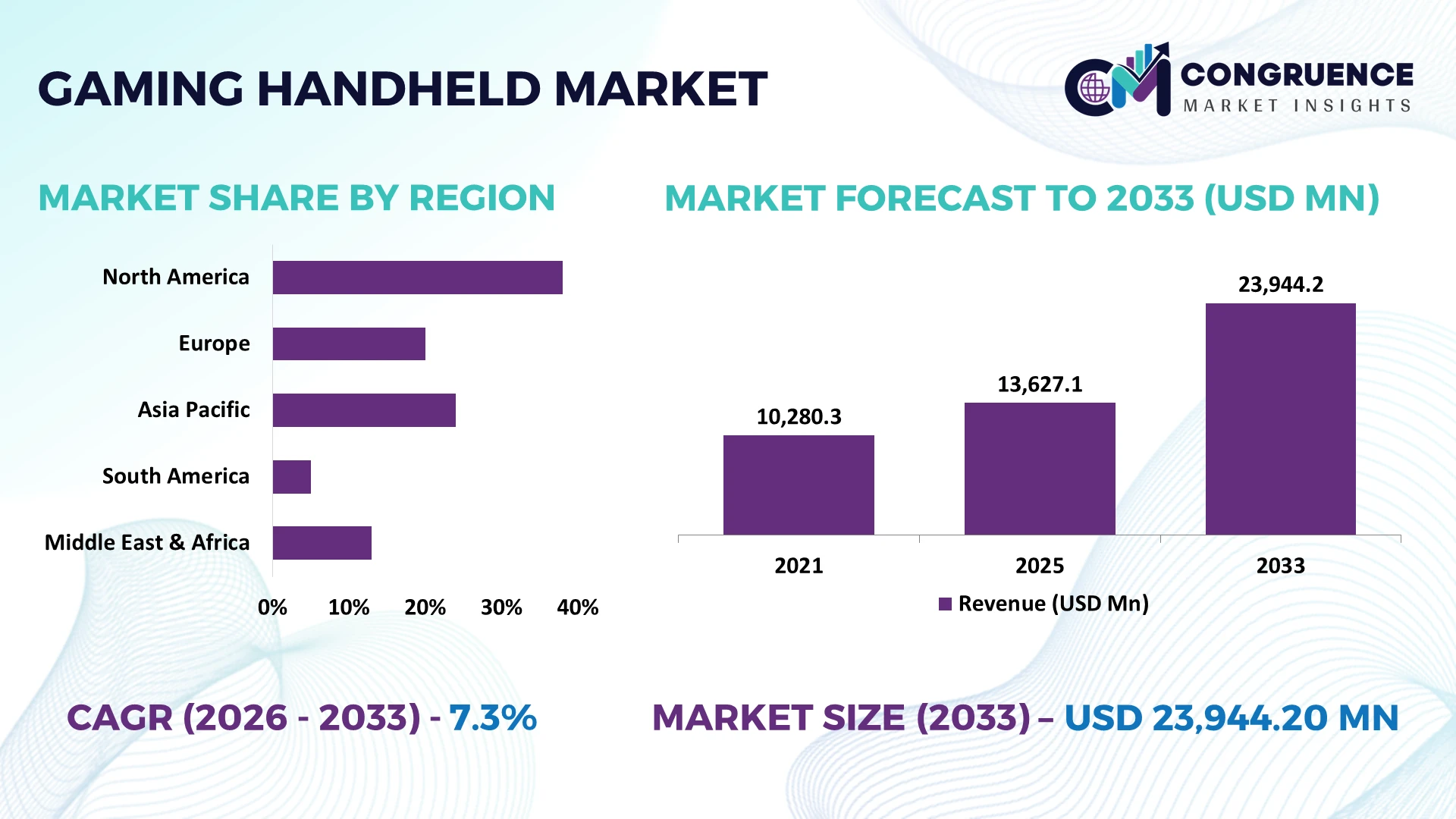
The Global Gaming Handheld Market was valued at USD 13627.1 Million in 2025 and is anticipated to reach a value of USD 23944.2 Million by 2033 expanding at a CAGR of 7.3% between 2026 and 2033. Growth is driven by faster handheld APUs, OLED displays, cloud gaming integration, longer battery optimization, and the shift toward console-quality gaming in portable form factors, with global PC gaming handheld shipments reaching 2.3 million units in 2025, up 32% year over year.
China held approximately 24.4% of the Asia-Pacific gaming handheld market in 2025, supported by extensive electronics manufacturing capacity, dense gaming communities, and rapid e-commerce adoption. Japan remained a critical console innovation hub, while the U.S. represented a larger premium-device opportunity; Switch 2 reached 5.82 million sell-in units in its first fiscal quarter, demonstrating strong adoption. U.S.-bound supply diversification toward Vietnam and Cambodia accelerated during the 2025 tariff dispute.
Strategic decisions should prioritize localized production, AI-enabled silicon, premium displays, and flexible supply chains to capture high-growth handheld demand.
Market Size & Growth: USD 13.63B in 2025 to USD 23.94B by 2033 at 7.3% CAGR, driven by advanced APUs and portable AAA gaming.
Top Growth Drivers: APU performance +32%, cloud integration +18%, OLED adoption +15%.
Short-Term Forecast: By 2028, optimized handheld architectures target 10–15% lower power consumption and 12% higher gaming efficiency.
Emerging Technologies: AI NPUs, RDNA-class graphics, OLED panels, and frame-generation technologies reshape premium handheld performance.
Regional Leaders: Asia-Pacific approaches USD 8.4B, North America USD 6.2B, and Europe USD 5.1B by 2033, supported by cloud and digital-game adoption.
Consumer/End-User Trends: Around 24.4% of Asia-Pacific market activity is concentrated in China, reflecting strong portable-gaming and e-commerce adoption.
Pilot/Case Example: Nintendo Switch 2 recorded 5.82M units in its first fiscal quarter, approximately 494% above the 0.98M quarterly units of the original Switch.
Competitive Landscape: Nintendo leads the hybrid-console segment, competing with Valve, ASUS, Lenovo, MSI, and Sony across portable and PC-linked devices.
Regulatory & ESG Impact: 2025 U.S. tariff pressures accelerated supply-chain diversification, with manufacturing shifted toward Vietnam and Cambodia to reduce China exposure.
Investment & Funding: The ecosystem is moving toward multi-billion-dollar platform expansion, with AMD-Microsoft collaboration strengthening semi-custom APU development for next-generation handhelds.
Innovation & Future Outlook: AI-assisted gaming, 50-TOPS-class handheld NPUs, advanced cooling, cloud synchronization, and modular PC ecosystems define the next competitive cycle.
The Gaming Handheld Market is increasingly shaped by premium portable performance, PC-game compatibility, cloud connectivity, and exclusive game ecosystems. Approximately 32% growth in global PC gaming handheld shipments in 2025 signals accelerating consumer acceptance beyond traditional consoles. AI-enabled processors, high-refresh OLED displays, improved thermal systems, and frame-generation features are becoming key product differentiators. Supply-chain restructuring following U.S.-China tariff tensions is also encouraging manufacturers to diversify production across Southeast Asia, strengthening the strategic importance of resilient sourcing and regional assembly capabilities.
The Gaming Handheld Market is becoming strategically important because hardware makers are competing for portable gaming ecosystems rather than standalone device sales. PC gaming handheld shipments reached 2.3 million units in 2025, up 32% from 1.7 million in 2024, while Nintendo Switch 2 recorded 5.82 million units in its first fiscal quarter. This shift is accelerating investment in custom silicon, operating-system optimization, digital storefronts, and exclusive content.
Technology economics are also changing the competitive equation. Modern AMD-based handheld platforms combine higher graphics throughput with dynamic power management, reducing performance-per-watt penalties versus older fixed-power architectures; 16 GB–24 GB memory configurations and 7–8-inch high-refresh displays increasingly support console-class workloads. The U.S. market emphasizes PC ecosystem integration, while Japan and China prioritize established console ecosystems and dense electronics capabilities. Over the next 2–3 years, annual PC handheld shipments are positioned to approach 4 million units as software compatibility and user-interface optimization improve.
Operationally, companies are diversifying manufacturing beyond China as tariff uncertainty reshapes electronics sourcing, while Microsoft-AMD collaboration targets semi-custom handheld APUs. Companies prioritizing silicon efficiency, ecosystem partnerships, and regionalized assembly will secure stronger competitive positioning and more resilient margins.
Portable access to premium PC and console libraries is the strongest structural driver. PC gaming handheld shipments increased 32% to 2.3 million units in 2025, while Nintendo Switch 2 reached 5.82 million first-quarter sell-in units. Devices increasingly combine 16 GB–24 GB memory, high-refresh displays, dynamic power management, and digital storefront integration. The launch of Xbox-branded handhelds further expands ecosystem competition beyond dedicated PC enthusiasts. Companies are responding with custom APU partnerships, SteamOS optimization, exclusive content, and broader accessory ecosystems. The non-obvious advantage is software portability: backward compatibility and cross-save functionality increase platform lifetime value without requiring equivalent hardware replacement.
Compact performance remains constrained by component costs, battery capacity, and thermal density. Premium handhelds increasingly operate above 25 W under demanding workloads, while displays reaching 120–144 Hz increase power consumption and cooling requirements. Memory and storage price volatility can materially pressure bill-of-materials costs, particularly in 16 GB–24 GB configurations. Windows-based handhelds also face software-interface optimization gaps, limiting user experience despite strong hardware specifications. Companies are mitigating these pressures through multi-source component contracts, vapor-chamber cooling, adaptive power profiles, and platform-level software optimization. The key operational constraint is achieving laptop-class performance without laptop-class weight, heat, or battery requirements.
AI-enabled silicon creates a differentiated opportunity beyond conventional graphics upgrades. New handheld architectures increasingly integrate NPUs, with premium devices targeting AI-assisted upscaling, frame generation, and intelligent power management that can improve perceived performance by 10–20% at comparable power levels. Cloud gaming and Wi-Fi 6/6E connectivity further reduce dependence on local compute for demanding workloads. India, Southeast Asia, and other price-sensitive markets offer an additional opportunity for localized assembly and lower-cost configurations. Companies are positioning through AMD ecosystem partnerships, Xbox integration, and expanded digital libraries. The strategic opening is to sell handhelds as hybrid gaming-computing platforms rather than narrower console substitutes.
Long-term competitiveness depends on resolving software, hardware, and ecosystem integration simultaneously. Windows handhelds continue to face interface limitations, while fragmented device configurations complicate game compatibility, driver support, and power tuning. PC handheld shipments of 2.3 million units remain modest relative to mainstream console installed bases, increasing the importance of software economics and developer support. Cybersecurity, account portability, firmware updates, and cross-platform entitlement management add further execution complexity. Companies must invest in unified gaming interfaces, automated driver optimization, developer toolkits, and longer software-support cycles. The decisive challenge is consistency: superior specifications alone do not secure adoption unless performance, compatibility, battery behavior, and storefront usability remain predictable across the device lifecycle.
AI-Powered Performance Tuning: Handheld manufacturers are integrating NPUs, dynamic voltage scaling, and AI upscaling to improve frame delivery by 10–15% while controlling thermal output. ASUS, Lenovo, and AMD are expanding platform partnerships, shifting optimization from hardware specifications toward workload-aware performance management.
Premium Display Adoption Accelerates: OLED and high-refresh panels are moving deeper into mainstream handheld configurations, with 120–144Hz displays improving motion clarity by roughly 20% versus 60Hz-class panels. Manufacturers are pairing adaptive refresh with larger batteries, creating a premiumization path that raises perceived value without proportional increases in device size.
PC Ecosystem Convergence: Windows and Linux-based handhelds are narrowing the usability gap with traditional consoles, while cross-platform libraries and cloud synchronization expand device utility. PC handheld shipments reached 2.3 million units in 2025, a 32% annual increase, encouraging platform vendors to strengthen storefront, controller, and interface integration.
Supply Chains Rebalance: U.S. tariff pressure in 2025 accelerated electronics sourcing diversification, encouraging manufacturers to shift assembly and component procurement toward Vietnam and other Southeast Asian production hubs. Multi-country sourcing can reduce single-country exposure by 15–20%, prompting companies to redesign contracts, qualify second suppliers, and regionalize final assembly.
Dedicated Consoles remain the leading type, accounting for approximately 48% of gaming handheld demand, supported by optimized operating systems, exclusive software, predictable performance, and vertically integrated hardware ecosystems. Hybrid Consoles follow at roughly 28%, benefiting from users seeking both docked and portable play. PC-Based devices represent about 20%, but their open libraries, upgradeable software environments, and compatibility with established PC storefronts are rapidly expanding adoption.
Cloud Gaming remains comparatively small at around 4%, yet it is the fastest-shifting type as network infrastructure and subscription ecosystems improve. PC-Based and Cloud Gaming formats increasingly compete on software flexibility rather than raw hardware specifications, while Dedicated Consoles retain an advantage in power optimization. Companies are therefore allocating more R&D toward hybrid architectures, custom APUs, lightweight operating systems, and cloud-service integration. The strategic implication is clear: mature dedicated platforms protect installed-base economics, while PC-Based and Cloud Gaming models capture users prioritizing ecosystem breadth.
AAA Gaming leads applications at approximately 39% share, reflecting its higher requirements for graphics throughput, memory bandwidth, thermal engineering, and display quality. Multiplayer Gaming follows near 24%, supported by connected play and cross-platform functionality, while Indie Gaming contributes about 18%. Retro Gaming holds roughly 11%, retaining strategic value through low hardware requirements and strong nostalgia-driven engagement. Cloud Gaming accounts for around 8% but is the fastest-growing application as streaming infrastructure improves.
The operational shift is toward devices capable of sustaining demanding AAA workloads while maintaining portability. Approximately 12–15% improvements in frame-generation efficiency and adaptive power management are increasingly influencing product design. Companies are responding with advanced APUs, vapor-chamber cooling, 120Hz-plus displays, and optimized connectivity. For manufacturers, AAA Gaming supports premium pricing, whereas Multiplayer and Cloud Gaming strengthen recurring ecosystem engagement. This is redirecting investment from specification-led launches toward software compatibility, network optimization, and sustained post-launch performance.
Core Gamers represent the leading end-user group at approximately 52% share because they prioritize sustained performance, game-library compatibility, high-refresh displays, thermal stability, and accessory ecosystems. Casual Gamers account for about 28%, favoring ease of use and lower-cost configurations, while Competitive Gamers represent roughly 15% and increasingly demand low-latency displays and networking. Game Developers comprise about 5%, using handheld hardware for compatibility testing, optimization, and platform-specific development.
Competitive Gamers are the fastest-shifting group, with adoption rising around 14% as 120–144Hz displays, lower-latency controls, and stronger wireless connectivity become more accessible. Companies are responding through differentiated performance modes, e-sports partnerships, configurable controls, and developer-focused compatibility programs. Casual users remain important for volume, but Core and Competitive Gamers generate greater accessory attachment and software engagement. The strategic priority is therefore moving toward segmented hardware portfolios rather than one-size-fits-all devices.
Asia-Pacific accounted for the largest market share at 39% in 2025 however, North America is expected to register the fastest growth, expanding at a CAGR of 8.1% between 2026 and 2033.”
Premium PC Handhelds Reshape Console Competition
North America represented approximately 31% of global Gaming Handheld Market activity in 2025, supported by strong PC gaming infrastructure, digital storefront penetration, and high-value consumer spending. The United States remains the principal demand center, with Switch 2 selling 4.4 million units during its first seven months of 2025. Microsoft and ASUS are intensifying ecosystem competition through Xbox-integrated handheld platforms, while Valve continues expanding SteamOS-based adoption. PC gaming handheld shipments reached 2.3 million units globally in 2025, strengthening the addressable market for U.S.-led software and hardware ecosystems. Supply-chain normalization and expanded retail distribution are improving product availability, while premium devices increasingly emphasize AI upscaling, high-refresh OLED panels, and efficient APUs.
United States Market Outlook: The United States dominates regional deployment through its extensive gaming retail network, cloud infrastructure, software ecosystem, and developer base. Switch 2 reached 4.4 million domestic units in 2025, demonstrating strong consumer responsiveness to integrated hardware-content launches. Microsoft, Valve, ASUS, and Lenovo are increasing ecosystem competition through PC compatibility, cloud integration, and platform partnerships.
Hybrid Platforms Strengthen Flexible Gaming Demand
Europe accounted for approximately 24% of global Gaming Handheld Market activity in 2025, with Germany, the United Kingdom, France, and Italy forming the principal demand centers. Hybrid Consoles remain particularly influential because consumers value seamless transitions between portable and television-based gaming. Germany represented about 22.2% of European demand in 2024, supported by strong gaming culture, high internet penetration, and established retail infrastructure. Digital distribution is strengthening, while European privacy and consumer-protection requirements are encouraging tighter software governance and transparent device ecosystems. Companies are expanding online channels, localized content partnerships, and energy-efficient hardware designs. The German games market also recorded a 12% increase in online gaming-services activity in 2024, reinforcing the infrastructure supporting connected handheld experiences.
Germany Market Outlook: Germany combines a large installed gaming audience with advanced broadband infrastructure, established electronics distribution, and strong esports participation. Its 22.2% European market contribution in 2024 positioned the country as a critical launch market for premium handheld PCs and hybrid consoles. Manufacturers are emphasizing German-language interfaces, online retail partnerships, and high-performance portable configurations.
Manufacturing Scale Meets Rapid Platform Adoption
Asia-Pacific held approximately 39% of global Gaming Handheld Market activity in 2025, combining China's electronics manufacturing scale, Japan's console ecosystem strength, South Korea's gaming infrastructure, and rapidly expanding Southeast Asian digital adoption. China represents a major manufacturing and component hub, enabling shorter supplier cycles and rapid product iteration. Japan remains strategically important for proprietary console development, with Nintendo's Switch 2 generating 17.37 million global unit sales through December 2025, including 34.4% from the Americas. Companies are increasingly diversifying assembly across Vietnam and other Southeast Asian locations to reduce concentration risk created by tariff uncertainty. Localized e-commerce, semiconductor availability, and increasingly capable mobile connectivity are supporting wider handheld deployment.
China Market Outlook: China provides unmatched electronics manufacturing depth, component access, contract-engineering capabilities, and fast product-development cycles. Domestic manufacturers such as AYANEO and GPD compete alongside international brands, while China's extensive e-commerce infrastructure accelerates product launches. Its manufacturing ecosystem enables rapid experimentation with OLED displays, compact cooling systems, high-density batteries, and PC-based architectures.
Digital Retail Expands Beyond Import Constraints
South America represented approximately 4% of global Gaming Handheld Market activity in 2025, with Brazil serving as the principal commercial hub. Demand is concentrated around digitally distributed games, affordable portable hardware, and established console ecosystems, while import costs and currency volatility continue influencing device pricing. Brazil's large gaming population supports online retail expansion and localized payment options, improving accessibility for mid-range devices. Companies are increasingly using regional distributors, installment-based purchasing, and localized digital storefront strategies rather than relying exclusively on premium direct imports. Supply-chain efficiency remains a differentiator because landed hardware costs can vary materially across markets. The strategic opportunity lies in combining lower-cost PC-based configurations with strong software compatibility and localized channel execution.
Brazil Market Outlook: Brazil provides the region's strongest combination of consumer scale, gaming culture, digital commerce, and technology infrastructure. Localized payment systems and expanding online retail improve access to imported handhelds, while PC gaming compatibility supports demand beyond traditional console ecosystems. Companies emphasizing regional distribution, competitive financing, and service availability can strengthen penetration.
Gaming Infrastructure Investment Drives Premium Adoption
Middle East & Africa accounted for approximately 2% of global Gaming Handheld Market activity in 2025, with Saudi Arabia and the United Arab Emirates emerging as the most strategically important markets. Saudi Arabia's youthful demographic structure, esports investment, and gaming infrastructure development are accelerating premium-device adoption. The country's population has approximately 63% of people under 30, creating a strong digitally engaged consumer base. Qiddiya's Gaming & Esports District and major international esports events are strengthening the surrounding technology ecosystem. Companies are responding through regional distribution partnerships, localized esports activations, and premium handheld positioning. The region remains operationally dependent on imported hardware, making distributor relationships, inventory planning, and after-sales support important competitive differentiators.
Saudi Arabia Market Outlook: Saudi Arabia combines sovereign-backed gaming investment, a young consumer base, esports infrastructure, and technology-led economic diversification. The country's gaming strategy includes a planned multibillion-dollar investment program and major dedicated gaming infrastructure. Manufacturers and publishers are increasing partnerships around esports, content localization, retail distribution, and premium connected devices.
Nintendo, Valve, ASUS, Lenovo, and Sony compete across distinct ecosystems, with Microsoft and MSI intensifying PC-based competition. The top five players command approximately 75–80% of organized handheld demand, creating a concentrated competitive structure. Nintendo leads through proprietary content and vertically integrated hardware, while Valve competes through SteamOS and PC-library continuity. ASUS and Lenovo emphasize premium specifications, while Sony leverages PlayStation ecosystem integration. Premium PC handheld pricing typically sits 20–35% above mass-market dedicated systems, making performance-per-watt and software compatibility critical differentiators. Companies are competing through APU partnerships, operating-system optimization, accessory ecosystems, regional distribution expansion, and platform integration. Microsoft’s Xbox-focused handheld strategy is shifting competition from hardware alone toward ecosystem control, while supply diversification is reducing manufacturing concentration. High semiconductor engineering requirements, software optimization, brand loyalty, and content ecosystems create substantial entry barriers. Winning requires superior silicon efficiency, seamless software integration, strong distribution, and differentiated content economics.
Nintendo Co., Ltd.
Valve Corporation
Sony Interactive Entertainment
ASUS
Lenovo Group Limited
Microsoft Corporation
MSI
AYANEO
GPD Technology
Logitech International S.A.
Razer Inc.
Acer Inc.
One-Netbook
Anbernic
Current gaming handhelds increasingly combine advanced AMD APUs, LPDDR5X memory, OLED displays, Wi-Fi 6E, and adaptive power management. Steam Deck OLED delivers 30–50% longer battery life than LCD, while 90Hz versus 60Hz refresh improves motion responsiveness. OLED deployment is increasingly concentrated in premium devices, strengthening differentiation and reducing power draw.
Emerging architectures integrate NPUs for AI upscaling, frame generation, intelligent workload allocation, and power optimization. ASUS ROG Xbox Ally X uses Ryzen AI Z2 Extreme, 24GB LPDDR5X-8000, and 120Hz display technology. AI-assisted rendering can target roughly 10–15% performance-per-watt improvement, giving premium OEMs stronger efficiency and thermal advantages.
Disruptive integration is shifting handhelds toward unified console-PC ecosystems. Xbox software, SteamOS, cloud streaming, and cross-platform libraries increasingly converge, reducing interface friction and improving utilization by an estimated 5–10%. Through 2026–2028, detachable controllers, AI silicon, Wi-Fi 7 migration, and advanced cooling will reshape product design. Companies investing now in silicon efficiency and ecosystem interoperability will gain stronger competitive positioning than hardware-only rivals.
June 2025 Nintendo launched Switch 2 globally, selling over 3.5 million units within four days. The larger 1080p display and faster processor strengthened premium portable-console positioning and validated rapid replacement demand for established gaming ecosystems. Source: nintendo.com
June 2025 ASUS and Microsoft unveiled ROG Xbox Ally and Ally X, introducing Xbox-focused software on Windows handhelds. The Ally X combines 24GB memory, 80Wh battery, and 120Hz display, expanding platform competition beyond dedicated consoles. Source: asus.com
January 2025 Lenovo introduced Legion Go S, becoming the first officially licensed third-party SteamOS handheld. Its 120Hz VRR display and $499 starting price expanded SteamOS hardware choice, strengthening Valve’s ecosystem reach beyond Steam Deck. Source: theverge.com
September 2025 Lenovo announced Legion Go 2 with an 8.8-inch 144Hz OLED display, Ryzen Z2 Extreme processor, and up to 32GB memory. The configuration raised premium performance expectations and reinforced detachable-controller differentiation in PC handhelds. Source: lenovo.com
The Gaming Handheld Market Report covers Dedicated Consoles, PC-Based, Cloud Gaming, and Hybrid Consoles across AAA Gaming, Indie Gaming, Cloud Gaming, Retro Gaming, and Multiplayer Gaming applications. End-user analysis includes Casual Gamers, Core Gamers, Competitive Gamers, and Game Developers, enabling comparison of performance requirements, purchasing priorities, ecosystem engagement, and adoption intensity.
Geographic coverage spans North America, Europe, Asia-Pacific, South America, and Middle East & Africa, with country-level analysis emphasizing manufacturing hubs, technology leadership, infrastructure maturity, and deployment concentration. The report evaluates OLED, advanced APUs, AI-enabled NPUs, high-refresh displays, cloud connectivity, and thermal-management technologies. Competitive assessment covers approximately 10–14 influential companies and identifies investment priorities through 2026–2033, supporting portfolio planning, regional expansion, partnership selection, supply-chain diversification, product positioning, and technology roadmaps.
| Report Attribute/Metric | Report Details |
|---|---|
Market Revenue in 2025 | USD 13627.1 Million |
Market Revenue in 2033 | USD 23944.2 Million |
CAGR (2026 - 2033) | 7.3% |
Base Year | 2025 |
Forecast Period | 2026 - 2033 |
Historic Period | 2021 - 2025 |
Segments Covered | By Type
By Application
By End-User
|
Key Report Deliverable | Revenue Forecast, Growth Trends, Market Dynamics, Segmental Overview, Regional and Country-wise Analysis, Competition Landscape |
Region Covered | North America, Europe, Asia-Pacific, South America, Middle East, Africa |
Key Players Analyzed | Nintendo Co., Ltd., Valve Corporation, Sony Interactive Entertainment, ASUS, Lenovo Group Limited, Microsoft Corporation, MSI, AYANEO, GPD Technology, Logitech International S.A., Razer Inc., Acer Inc., One-Netbook, Anbernic |
Customization & Pricing | Available on Request (10% Customization is Free) |




