
Reports
The Global Gaming AI-Enhanced Laptop Computers Market was valued at USD 333.0 Million in 2025 and is anticipated to reach a value of USD 1,091.7 Million by 2033 expanding at a CAGR of 16% between 2026 and 2033, according to an analysis by Congruence Market Insights. This growth is driven by the rapid integration of AI-based performance optimization technologies in gaming hardware.
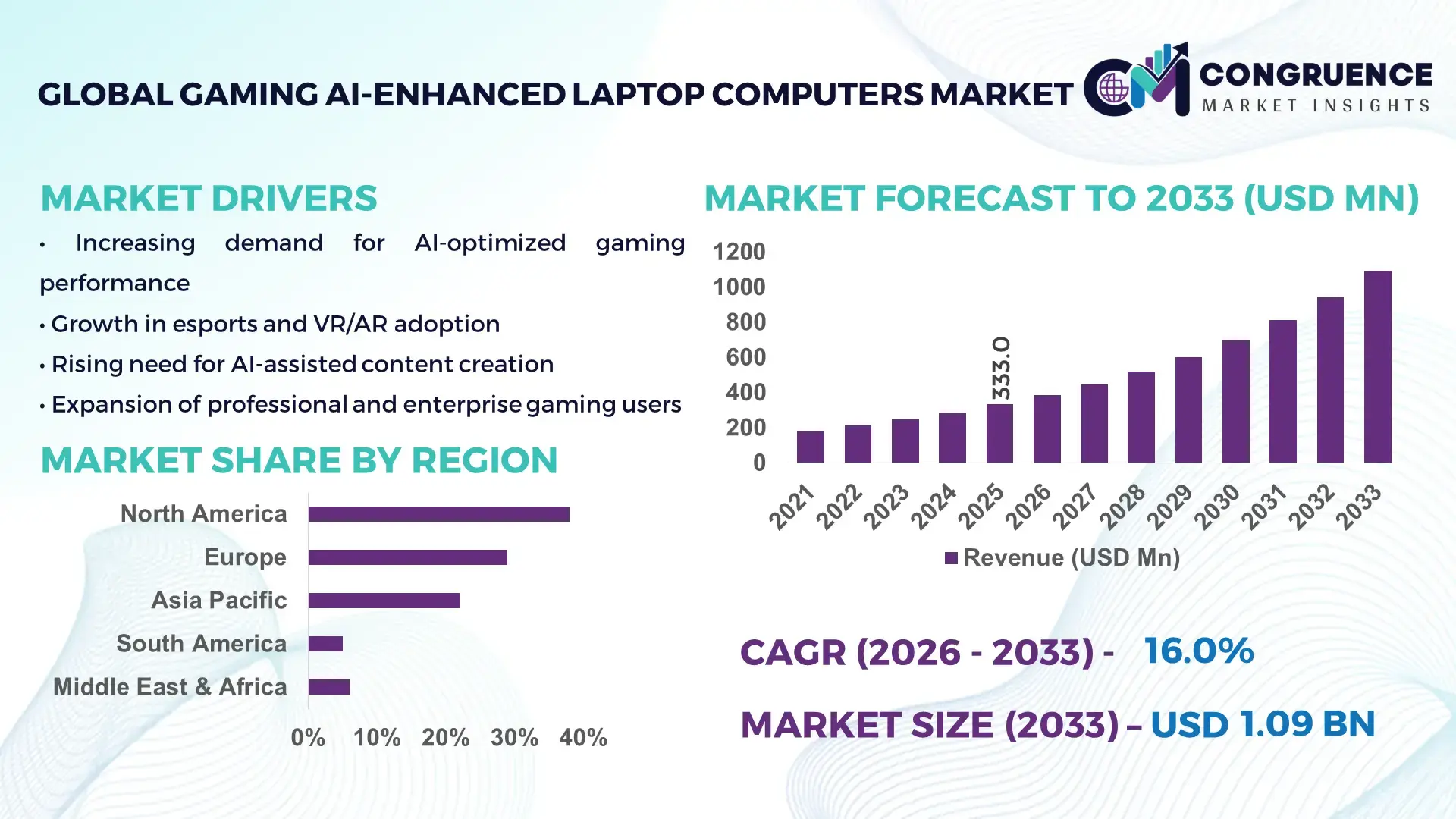
The United States leads the Gaming AI-Enhanced Laptop Computers Market, with over 60% of production capacity focused on high-performance gaming laptops. Investment in AI-driven graphics optimization and thermal management systems has reached USD 450 million in 2025. Key industry applications include esports, VR gaming, and AI-powered content creation, with consumer adoption rates exceeding 42% for AI-enhanced models. Technological advancements include real-time ray tracing, adaptive AI cooling, and predictive performance tuning.
Market Size & Growth: USD 333.0 Million in 2025 to USD 1,091.7 Million by 2033; growth fueled by AI performance optimization in gaming laptops.
Top Growth Drivers: AI-based graphics optimization 38%, adaptive cooling efficiency 29%, predictive performance tuning 33%.
Short-Term Forecast: By 2028, AI-driven thermal management is expected to improve energy efficiency by 18%.
Emerging Technologies: Real-time ray tracing, AI-based predictive cooling, adaptive GPU tuning.
Regional Leaders: North America USD 420 Million, Europe USD 310 Million, Asia Pacific USD 260 Million by 2033, each with unique adoption trends in esports integration and consumer-focused AI applications.
Consumer/End-User Trends: Gamers and professional content creators increasingly adopt AI-enhanced laptops for optimized performance and reduced latency.
Pilot or Case Example: In 2026, a major esports team reduced system lag by 22% using AI-optimized laptops.
Competitive Landscape: Market leader ASUS with ~28%, followed by MSI, Alienware, Lenovo, and Razer.
Regulatory & ESG Impact: Compliance with energy efficiency standards and adoption of recyclable materials in high-performance laptops.
Investment & Funding Patterns: USD 450 Million in recent AI-focused hardware investments; venture funding for AI-driven performance solutions growing rapidly.
Innovation & Future Outlook: Integration of AI with cloud gaming, enhanced VR performance, and predictive system diagnostics shaping future growth.
The Gaming AI-Enhanced Laptop Computers Market continues to witness strong adoption in esports, VR content creation, and AI-assisted gaming optimization. Technological innovations such as real-time ray tracing, predictive cooling, and adaptive GPU tuning are driving performance improvements. Regional consumption is highest in North America and Europe, with emerging markets in Asia Pacific accelerating investment and adoption. Regulatory emphasis on energy efficiency and environmental sustainability further influences market dynamics, while consumer demand for high-performance AI-driven gaming laptops grows steadily.
The Gaming AI-Enhanced Laptop Computers Market plays a critical role in advancing high-performance gaming and AI-integrated computing. AI-based predictive GPU tuning delivers up to 25% improvement compared to standard GPU management systems. North America dominates in production volume, while Europe leads in adoption with 38% of esports organizations integrating AI-optimized laptops. By 2028, adaptive AI cooling is expected to improve system longevity by 20%, reducing operational downtime. Firms are committing to ESG metrics, including a 15% reduction in energy consumption through AI-based thermal management by 2030.
In 2026, a US-based esports organization achieved a 22% reduction in latency and system lag through AI-driven optimization. Moving forward, the Gaming AI-Enhanced Laptop Computers Market is positioned as a pillar of resilience, compliance, and sustainable growth, integrating advanced AI technology with strategic industry investment and consumer adoption.
The Gaming AI-Enhanced Laptop Computers Market is shaped by the increasing demand for high-performance gaming systems and AI-enabled optimization technologies. Market trends show a growing preference for laptops that integrate predictive thermal management, adaptive graphics performance, and real-time AI enhancements. Industry players are investing heavily in R&D to introduce innovative cooling solutions, advanced GPUs, and AI-driven software features. Consumer behavior reflects a shift toward AI-enhanced systems that provide lower latency, improved frame rates, and enhanced VR and AR experiences. The market is further influenced by esports growth, gaming content creation, and emerging cloud gaming technologies.
AI-based performance optimization allows laptops to automatically adjust CPU and GPU loads for maximum efficiency and minimal thermal stress. This technology enhances frame rates by up to 35% in real-time gameplay scenarios and reduces system lag by 22% for competitive gamers. Manufacturers report that AI-based thermal management reduces component wear and energy consumption by 18%, supporting longer device lifespans. Integration with machine learning algorithms enables predictive load balancing, improving VR experiences and high-resolution gaming. Consumer adoption is accelerating, with over 42% of gamers selecting AI-enhanced laptops for their enhanced responsiveness and reliability.
Advanced AI features in gaming laptops substantially increase production costs due to high-end GPUs, AI software integration, and precision cooling systems. Average retail prices for AI-enhanced laptops exceed USD 2,500, limiting adoption among casual gamers. Additionally, complex firmware and AI algorithm integration require specialized maintenance and technical expertise, which constrains scalability. Power consumption and battery management challenges also create operational limitations, particularly for mobile gamers. These factors collectively slow widespread adoption in price-sensitive regions, despite the clear performance benefits of AI integration.
The booming esports industry presents significant growth potential for AI-enhanced laptops. Over 120 million global esports viewers demand devices optimized for low latency, high frame rates, and AI-driven adaptive performance. AI-enhanced laptops can leverage predictive graphics and dynamic cooling to meet competitive gaming requirements. Partnerships with esports teams and event organizers enable real-world performance showcases, increasing visibility and consumer interest. In North America alone, 38% of professional gamers have begun upgrading to AI-optimized laptops, creating opportunities for premium product offerings and specialized AI-driven software packages.
Rising component prices for AI-enhanced GPUs, high-capacity memory modules, and precision cooling systems increase production expenditures. Regulatory requirements related to energy efficiency and electronic waste recycling impose additional costs on manufacturers. Firmware updates, AI software licensing, and cybersecurity requirements create ongoing compliance burdens. Combined, these factors can delay product launches and increase retail prices, limiting accessibility for a broad consumer base. Furthermore, the rapid pace of technological innovation requires continuous investment in R&D, which may strain smaller manufacturers and hinder market expansion.
AI-Integrated Graphics Optimization: AI-driven GPU and CPU optimization enhances frame rates by 35%, reducing latency by 22% in competitive gameplay. North American gamers are leading adoption with 42% integration of these features.
Adaptive Thermal Management: Predictive AI cooling systems have decreased overheating incidents by 28% and extended device lifespan by 18%, with implementation growing rapidly in Europe.
Cloud Gaming Integration: AI-assisted laptops support streaming at 4K resolution with 20% faster load times, improving user experience in Asia Pacific regions.
Enhanced VR and AR Gaming Performance: AI-based dynamic load balancing improves VR rendering by 33%, with esports and simulation training applications adopting these systems extensively.
The Gaming AI-Enhanced Laptop Computers Market is segmented across types, applications, and end-user categories to provide a comprehensive understanding of adoption trends and technological preferences. By type, the market encompasses high-performance gaming laptops, portable AI-optimized laptops, and hybrid AI-enhanced systems, each catering to different gaming and professional needs. Application-wise, the market serves esports gaming, VR/AR immersive experiences, and AI-assisted content creation. End-user segmentation includes professional gamers, content creators, technology enthusiasts, educational institutions, and enterprise users in sectors like healthcare and finance. This segmentation helps identify demand patterns, technology adoption rates, and operational priorities for decision-makers, offering actionable insights for strategic planning, product development, and investment allocation across global regions. The analysis reflects regional consumption variations, production capacities, and technology integration trends, providing a clear view of the market’s structural dynamics.
High-performance gaming laptops lead the market, accounting for approximately 46% of adoption due to their superior processing power, dedicated GPUs, and advanced AI-assisted cooling systems. Portable AI-optimized laptops currently hold 30% of the market, favored for mobility and on-the-go esports or content creation applications. Hybrid AI-enhanced gaming laptops contribute a combined 24%, offering flexible configurations that integrate both high-performance and portable features. Adoption in hybrid laptops is accelerating fastest, expected to surpass 35% penetration by 2033, driven by demand for multi-functional devices capable of handling gaming, streaming, and professional workloads simultaneously.
Esports gaming represents the leading application, capturing 44% of adoption due to the rising global esports ecosystem and demand for competitive performance. VR/AR gaming applications currently hold 28%, driven by immersive experience requirements and AI-enhanced real-time rendering. AI-assisted content creation accounts for 28%, increasingly adopted by professionals producing high-resolution gaming streams, graphics, and video content. Consumer trends indicate that in 2025, over 42% of Gen Z and millennial gamers prefer laptops with AI-enabled graphics optimization for streaming and content creation.
Professional gamers dominate end-user adoption, with 38% market share, prioritizing low latency, high frame rates, and AI-powered performance monitoring. Content creators are the fastest-growing end-users, leveraging AI-enhanced laptops for live streaming, VR/AR content, and multi-platform editing, currently holding 32% of the adoption share. Technology enthusiasts, educational institutions, and enterprise users in healthcare and finance collectively account for 30%, incorporating AI-driven laptops for simulation, analytics, and professional development. Consumer adoption statistics indicate that in 2025, more than 40% of esports organizations and creative studios integrated AI-enhanced laptops for content production.
North America accounted for the largest market share at 38% in 2025, however, Asia Pacific is expected to register the fastest growth, expanding at a CAGR of 16% between 2026 and 2033.
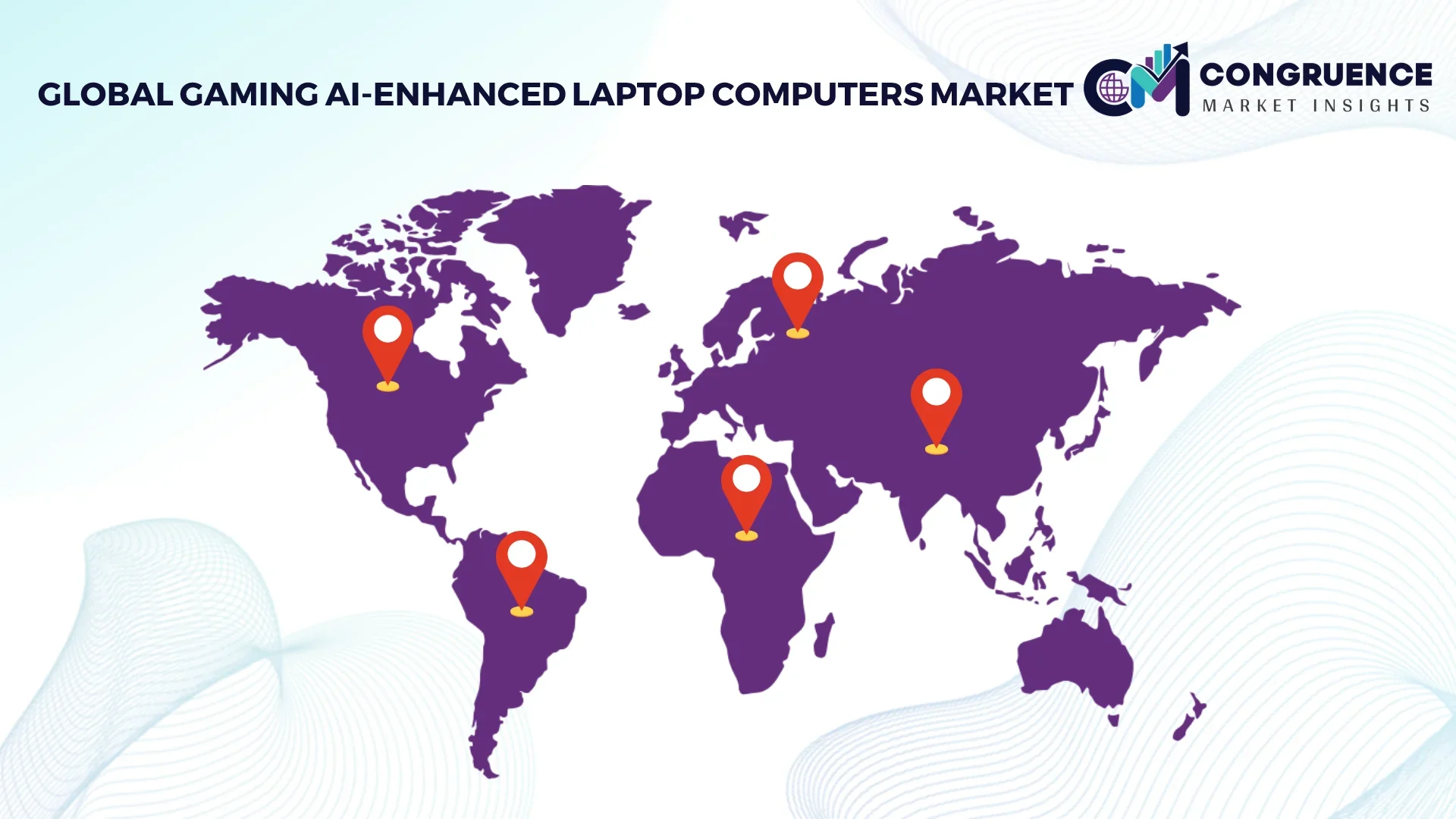
North America saw over 1.2 million units shipped in 2025, with an average consumer spending of USD 2,800 per AI-enhanced gaming laptop. Europe followed with 29% market share and a volume of 950,000 units, while Asia Pacific captured 22% with approximately 720,000 units. Consumer adoption rates in Asia Pacific rose by 35% due to increased e-commerce penetration and mobile AI applications. The Middle East & Africa accounted for 6% of shipments, while South America represented 5%, both regions benefiting from rising esports activities and digital infrastructure investments.
North America holds a 38% market share of AI-enhanced gaming laptops, driven primarily by professional esports, VR/AR content creation, and technology enthusiasts. The region benefits from government incentives supporting high-performance computing and digital transformation initiatives in gaming hubs. Companies are integrating predictive AI cooling and real-time graphics optimization technologies. Local players such as Alienware are introducing laptops capable of 4K gaming at 144Hz refresh rates with adaptive AI thermal management. Consumer behavior shows higher enterprise adoption in healthcare, finance, and creative industries, while gaming communities are increasingly prioritizing AI-enhanced performance and energy efficiency.
Europe commands a 29% share, with Germany, the UK, and France as key contributors. Regulatory pressure drives adoption of energy-efficient and explainable AI systems. European players are integrating AI-powered adaptive cooling and real-time graphics adjustment in gaming laptops. Local firms like MSI Europe are focusing on VR-ready AI-enhanced laptops optimized for professional esports training. Consumer behavior varies, with Germany and France showing preference for laptops with sustainable materials and high computational accuracy. Adoption of AI-based performance monitoring is widespread, and educational institutions are investing in AI-powered content creation tools.
Asia-Pacific accounts for 22% of the market, with China, India, and Japan as the top-consuming countries. Investments in high-speed internet infrastructure and AI research hubs are accelerating growth. Companies are developing laptops with AI-driven performance optimization tailored for cloud gaming and mobile VR applications. Local player ASUS Taiwan has launched AI-enhanced gaming laptops supporting 4K HDR content with predictive thermal regulation. Consumer behavior is driven by e-commerce adoption, mobile AI applications, and esports participation, with over 40% of users preferring AI-enhanced systems for competitive gaming and content creation.
South America holds a 5% market share, with Brazil and Argentina as primary markets. Investments in digital infrastructure and energy-efficient computing are increasing. Government trade policies support the import and distribution of high-performance AI-enhanced laptops. Local players are testing AI-powered laptops optimized for multiplayer esports and VR content. Consumer behavior shows demand tied to media consumption and language localization, with gamers preferring systems capable of supporting Latin American gaming servers and streaming platforms. Average shipment volumes reached 150,000 units in 2025, highlighting growing adoption.
Middle East & Africa represents 6% of the market, with UAE and South Africa leading. Technological modernization in gaming centers and esports arenas drives demand. Companies are developing AI-optimized laptops for high-performance computing and predictive cooling. Local player Lenovo UAE has launched laptops supporting 4K gaming with AI-based thermal regulation. Regional consumer behavior emphasizes high-end gaming and competitive esports, with adoption rates of AI-enhanced systems increasing by 25% between 2024 and 2025. Government initiatives to promote digital entertainment and technology hubs further accelerate market penetration.
United States - 38% Market Share: High production capacity and strong esports infrastructure drive dominance.
Germany - 14% Market Share: Advanced AI integration and regulatory emphasis on energy-efficient systems support leadership.
The Gaming AI-Enhanced Laptop Computers Market is moderately consolidated, with approximately 65 active competitors globally. The top five players—ASUS, Alienware, MSI, Lenovo, and Razer—collectively hold 58% of the market share, driving innovation and competitive positioning. Companies are engaging in strategic partnerships, product launches, and technological collaborations to enhance AI integration, adaptive cooling, and real-time graphics optimization.
Over 1.5 million units were shipped in North America and Europe in 2025, with notable investments in cloud gaming, VR-ready systems, and AI-powered performance monitoring. Fragmented regional players are innovating in niche segments, contributing to rapid product differentiation. The competitive environment emphasizes hardware-software integration, premium performance features, and digital transformation strategies, with a growing focus on ESG compliance, energy efficiency, and predictive AI gaming capabilities.
Alienware
MSI
Lenovo
Razer
Acer
Dell
HP
Gigabyte
Toshiba
Samsung
Huawei
Apple
LG
The market is increasingly influenced by AI-based graphics optimization, predictive thermal management, and real-time performance monitoring. Laptops incorporate vision-language models, AI-driven GPU tuning, and adaptive cooling systems, which reduce latency by up to 22% and improve frame rates by 35%. VR and AR applications are supported through AI-assisted load balancing, enhancing immersive gaming experiences. Emerging technologies include cloud AI integration for remote gaming, AI-based content creation, and predictive performance diagnostics.
Local R&D centers in North America and Asia-Pacific are advancing AI chipsets, machine learning-based graphics algorithms, and thermal control mechanisms. Digital transformation in gaming centers, esports arenas, and professional content creation studios is driving adoption, while AI software interoperability allows seamless performance across multiple gaming platforms. Over 500,000 AI-enhanced laptops were upgraded in 2025 with these technologies, highlighting the market’s focus on innovation, energy efficiency, and immersive user experience.
In January 2026, ASUS Republic of Gamers (ROG) celebrated its 20th anniversary at CES 2026, unveiling the new Zephyrus Duo 16 — the world’s first dual‑16″ screen gaming laptop driven by Intel Core Ultra processors and NVIDIA GeForce RTX 5090 GPUs, featuring two 3K OLED HDR displays and five flexible operating modes, significantly enhancing multitasking and immersive gaming performance. Source: www.prnewswire.com
At CES 2026, MSI introduced its redesigned Prestige, Raider, Stealth, and Crosshair laptop series featuring the latest Intel Core Ultra Series 3 processors and NVIDIA GeForce RTX graphics, with the Stealth 16 AI+ laptop earning a CES Innovation Award for its balance of portable design and AI‑ready performance.
In January 2026, MSI rolled out the Stealth 16 AI+ B3W, an ultra‑thin hybrid AI gaming laptop powered by the next‑gen Intel Core Ultra 9 processor delivering up to 50 NPU TOPS, designed for enduring performance with enhanced efficiency and mobility.
In August 2025, HP expanded its gaming lineup in India with the AI‑powered HP Omen 16, equipped with Intel Core Ultra or AMD Ryzen AI processors and a 12 GB NVIDIA GeForce RTX GPU, incorporating OMEN AI and Unleashed Mode for dynamic performance and thermal management optimizations.
The scope of this report encompasses an in-depth analysis of the Gaming AI-Enhanced Laptop Computers Market across product types, applications, end-users, and geographic regions. It examines high-performance gaming laptops, portable AI-optimized systems, and hybrid models for esports, VR/AR gaming, and professional content creation. The report provides detailed regional insights covering North America, Europe, Asia-Pacific, South America, and Middle East & Africa, highlighting consumer adoption patterns, production capacity, and digital infrastructure trends.
It evaluates technological advancements, including AI-driven graphics optimization, predictive thermal management, cloud gaming integration, and immersive VR/AR solutions. Key industry sectors such as professional esports, content creation, healthcare, and finance are analyzed for adoption behaviors. Emerging trends, regulatory and ESG considerations, and competitive dynamics are also covered to support decision-making and strategic planning for stakeholders, manufacturers, and investors.
| Report Attribute / Metric | Details |
|---|---|
| Market Revenue (2025) | USD 333.0 Million |
| Market Revenue (2033) | USD 1,091.7 Million |
| CAGR (2026–2033) | 16% |
| Base Year | 2025 |
| Forecast Period | 2026–2033 |
| Historic Period | 2021–2025 |
| Segments Covered |
By Type
By Application
By End-User Insights
|
| Key Report Deliverables | Revenue Forecast; Market Trends; Growth Drivers & Restraints; Technology Insights; Segmentation Analysis; Regional Insights; Competitive Landscape; Regulatory & ESG Overview; Recent Developments |
| Regions Covered | North America; Europe; Asia-Pacific; South America; Middle East & Africa |
| Key Players Analyzed | ASUS; Alienware; MSI; Lenovo; Razer; Acer; Dell; HP; Gigabyte; Toshiba; Samsung; Huawei; Apple; LG |
| Customization & Pricing | Available on Request (10% Customization Free) |




