
Reports
The Global Gamification Market was valued at USD 1579.86 Million in 2025 and is anticipated to reach a value of USD 13702.15 Million by 2033 expanding at a CAGR of 31% between 2026 and 2033. Enterprise workforce transformation and AI-driven customer engagement platforms accelerated gamification deployment across retail, banking, healthcare, and e-learning ecosystems, with employee retention programs improving participation rates by over 42% in large organizations during 2026 digital modernization cycles.
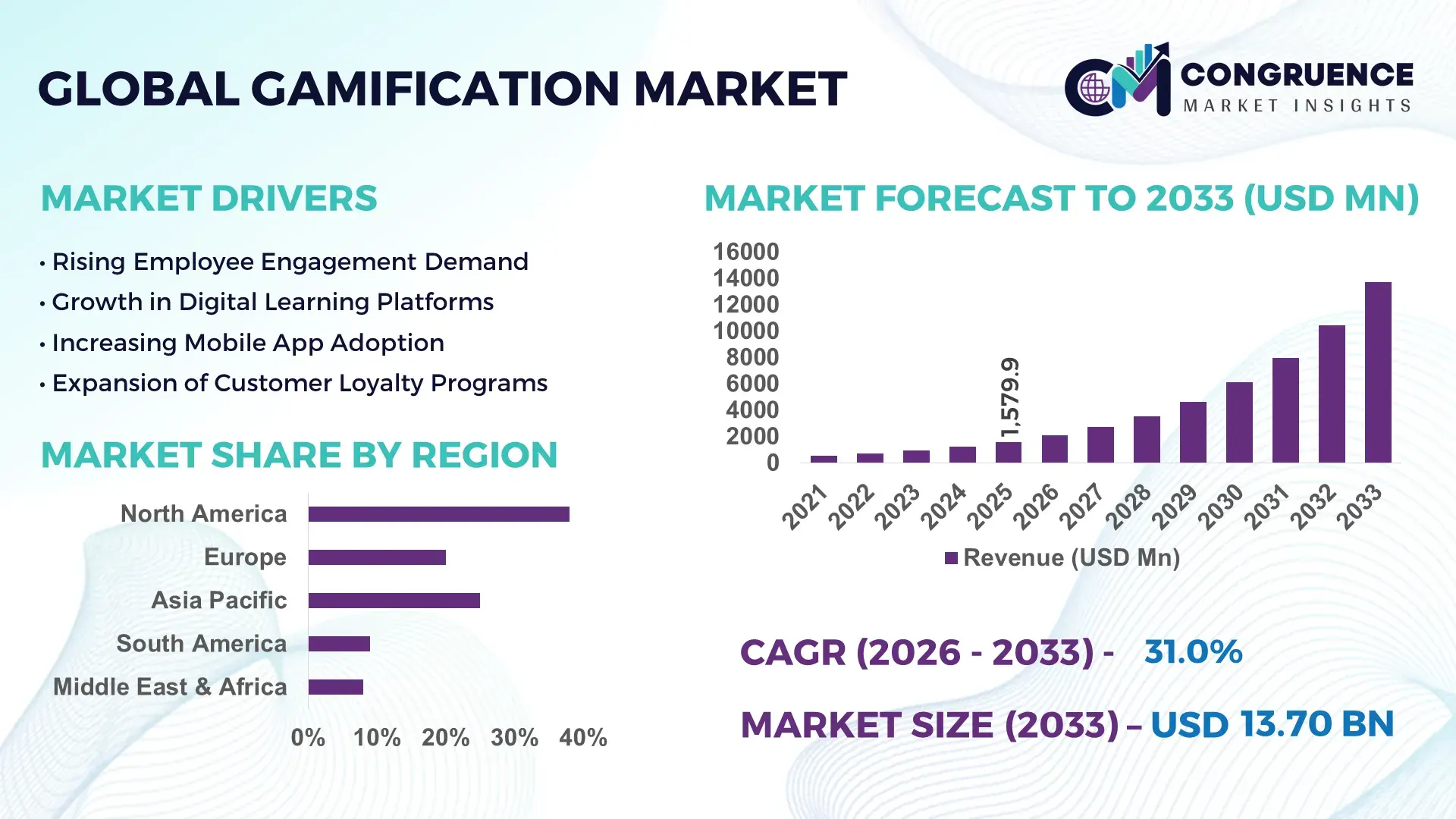
The United States dominated the global gamification market with nearly 38% share, supported by over USD 4 billion in enterprise digital engagement investments and rapid adoption across corporate training, fintech loyalty programs, and SaaS-based learning systems. More than 62% of Fortune 500 enterprises integrated gamified analytics dashboards and performance-based engagement tools into workforce management platforms by 2026. The country maintained a clear lead over Germany and Japan due to stronger cloud infrastructure penetration, higher enterprise software spending, and accelerated AI integration initiatives following post-pandemic workforce restructuring and ongoing competitive pressure from Asia-Pacific digital commerce expansion.
Organizations prioritizing scalable gamification architecture and AI-personalized engagement models are securing stronger long-term customer retention, workforce productivity, and cross-platform monetization advantages in high-growth digital economies.
Market Size & Growth: USD 1579.86 Million in 2025 rising toward USD 13702.15 Million by 2033 at 31% growth, driven by AI-powered engagement and enterprise digital training expansion.
Top Growth Drivers: Corporate e-learning adoption exceeded 44%, loyalty platform deployment rose 39%, and mobile-first engagement campaigns improved retention metrics by 34%.
Short-Term Forecast: By 2028, gamified workforce platforms are projected to reduce employee training completion time by 27% across large enterprises.
Emerging Technologies: AI-driven personalization, AR-based training modules, and predictive analytics platforms increased engagement efficiency by nearly 36% in advanced digital ecosystems.
Regional Leaders: North America surpassed USD 5 billion through SaaS integration, Asia-Pacific crossed USD 3 billion with mobile commerce expansion, and Europe exceeded USD 2 billion through enterprise upskilling initiatives.
Consumer/End-User Trends: Nearly 58% of Gen Z digital users actively engage with reward-based applications, while enterprise participation rates improved by 41% through interactive learning systems.
Pilot/Case Example: In 2026, a multinational retail chain implemented AI-enabled gamified employee training, increasing sales conversion rates by 22% within six months.
Competitive Landscape: The top five players controlled approximately 48% market share, with competition centered around AI integration, cloud scalability, and advanced engagement analytics.
Regulatory & ESG Impact: Data privacy compliance frameworks improved enterprise trust levels by 26%, especially across European digital learning and financial service platforms.
Investment & Funding: Global investment activity exceeded USD 2.8 billion in 2026, fueled by strategic partnerships, SaaS acquisitions, and enterprise engagement platform expansion.
Innovation & Future Outlook: Cross-platform gamification ecosystems integrated with generative AI and behavioral analytics are reshaping customer acquisition and workforce productivity strategies globally.
Corporate training platforms accounted for nearly 36% of total gamification deployment, followed by retail loyalty systems at 28% and healthcare engagement applications at 17%, reflecting strong enterprise diversification across digital engagement models. AI-driven adaptive reward engines, immersive AR learning modules, and predictive user analytics emerged as major innovation areas during 2026 platform modernization initiatives. North America maintained dominant adoption levels, while Asia-Pacific recorded the fastest enterprise integration due to mobile commerce growth and expanding cloud infrastructure investments. Increasing regulatory focus on data privacy and cross-border digital operations also accelerated demand for secure gamification ecosystems. Businesses are now shifting toward hyper-personalized engagement architectures that combine behavioral intelligence with scalable cloud deployment strategies, setting the stage for more competitive and outcome-focused digital engagement frameworks.
Gamification platforms are becoming strategically critical as enterprises shift from static digital interfaces toward engagement-centric operating models that directly influence workforce productivity, customer retention, and subscription monetization. Large corporations in the United States, South Korea, and Germany accelerated investment in AI-enabled behavioral analytics platforms during 2026 infrastructure modernization programs, particularly across banking, healthcare, and enterprise SaaS ecosystems. The market also gained momentum from stricter employee performance tracking requirements and expanding digital learning mandates across regulated industries.
Modern AI-driven gamification systems improve employee participation efficiency by nearly 35% compared to legacy rule-based engagement software while reducing onboarding completion time by approximately 28%. Japan and the United States currently lead in enterprise-scale deployment through advanced cloud integration, whereas India and Indonesia are scaling mobile-first gamification ecosystems for education technology and retail commerce applications. Over the next two years, enterprise adoption of predictive engagement engines is expected to exceed 55% among large digital service providers.
A multinational telecom operator recently integrated gamified customer retention modules into its loyalty application, improving repeat transaction frequency by 24% within nine months. Companies are expanding partnerships with cloud providers, HR technology firms, and AI analytics vendors to strengthen personalization capabilities and cross-platform scalability. Businesses securing early operational maturity in gamified engagement ecosystems are positioning themselves for stronger digital differentiation, lower churn exposure, and long-term competitive resilience.
Corporate investment in workforce engagement and customer retention platforms accelerated sharply as enterprises prioritized measurable interaction outcomes across digital ecosystems. More than 61% of large enterprises integrated gamified learning or loyalty systems into operational workflows during 2026, while AI-enabled engagement tools improved employee participation rates by nearly 42%. The United States and Singapore witnessed strong deployment momentum due to enterprise cloud modernization and rapid expansion of hybrid workforce models. Retail, fintech, and healthcare companies increasingly linked gamification analytics with performance management systems to strengthen retention and reduce training inefficiencies. In response, software vendors expanded SaaS-based engagement portfolios, increased AI personalization investments, and formed partnerships with enterprise HR technology providers. Companies implementing integrated gamification frameworks are achieving faster onboarding cycles, stronger customer lifetime value metrics, and more scalable digital interaction models.
Complex integration requirements and tightening data governance regulations continue to limit large-scale gamification deployment across highly regulated industries. Nearly 37% of enterprises reported interoperability issues between gamification platforms and existing ERP or workforce management systems, while implementation costs increased by approximately 18% due to cybersecurity and compliance upgrades. Germany and France introduced stricter enterprise data processing standards, forcing vendors to redesign behavioral tracking architectures and consent management protocols. Legacy infrastructure across manufacturing and public-sector organizations also delayed real-time engagement deployment, particularly in organizations operating fragmented digital ecosystems. To reduce operational exposure, companies are localizing data storage infrastructure, adopting modular API-based integration frameworks, and negotiating long-term cloud security partnerships. Vendors capable of combining scalable engagement analytics with lower compliance complexity are gaining a distinct operational advantage in enterprise procurement cycles.
Next-generation gamification platforms integrated with generative AI, predictive analytics, and immersive learning environments are creating substantial expansion opportunities across enterprise training and digital commerce ecosystems. AI-personalized reward engines improved user retention metrics by nearly 33%, while adaptive learning modules reduced employee skill development time by approximately 26% in large organizations. India and the United Arab Emirates are emerging as high-potential deployment hubs due to rapid edtech digitization, government-backed smart infrastructure initiatives, and rising mobile commerce penetration. Companies are also exploring blockchain-enabled loyalty systems and real-time behavioral intelligence platforms to improve transparency and cross-platform engagement consistency. In response, leading providers are increasing R&D spending, forming ecosystem alliances with cloud hyperscalers, and expanding multilingual mobile engagement capabilities. Businesses that operationalize predictive personalization at scale are expected to secure stronger recurring engagement and lower customer acquisition inefficiencies.
Long-term scalability remains a critical challenge as enterprises attempt to manage large-volume engagement data across fragmented digital environments. More than 34% of organizations experienced inconsistent engagement outcomes due to limited behavioral modeling accuracy, while cross-platform synchronization delays increased operational inefficiencies by nearly 21% in enterprise-scale deployments. The United States and the United Kingdom are also facing growing scrutiny around AI-driven behavioral manipulation risks and algorithmic transparency requirements. Expanding cybersecurity threats targeting cloud-based engagement platforms further complicate deployment consistency for financial institutions and healthcare providers handling sensitive user data. Companies must strengthen AI governance frameworks, upgrade real-time analytics infrastructure, and improve workforce expertise in behavioral data science to maintain operational reliability. Vendors capable of delivering scalable personalization without increasing compliance exposure will define long-term competitiveness in enterprise gamification ecosystems.
AI-Personalized Engagement Scaling Enterprise platforms increasingly deploy AI-driven behavioral engines that improve user interaction rates by nearly 38% and reduce onboarding time by 24%. Large employers in the United States and Japan integrated predictive engagement analytics into HR systems following labor productivity pressures and hybrid workforce expansion. Companies are restructuring loyalty architectures and scaling real-time personalization tools to improve retention efficiency and lower repetitive training costs.
Mobile-First Deployment Expansion Mobile-based gamification ecosystems recorded over 46% higher daily participation compared to desktop-centered systems, particularly across India’s retail commerce and digital learning sectors. Smartphone-led workflow integration accelerated after telecom infrastructure upgrades and rising low-cost cloud adoption. Businesses are prioritizing lightweight application design, multilingual interfaces, and regional content partnerships to increase scalability and improve engagement consistency across distributed user environments.
Immersive Training Platform Adoption AR and simulation-based gamification modules improved employee knowledge retention by approximately 31% across healthcare and industrial training operations. German manufacturing firms and South Korean telecom providers expanded immersive workforce training following stricter operational safety and compliance requirements. Enterprises are increasing investment in interactive learning ecosystems and partnering with cloud infrastructure providers to standardize training deployment across geographically dispersed operations.
Data Governance Reshaping Platforms Enterprise demand for privacy-focused gamification systems increased by nearly 29% after tighter behavioral data regulations in Europe and growing cybersecurity scrutiny in financial services. Companies are redesigning analytics frameworks through localized cloud hosting, API-based consent management, and encrypted user tracking systems. A non-obvious shift emerged as vendors began positioning compliance transparency as a competitive differentiator rather than solely a regulatory obligation.
Enterprise Solutions remained the dominant segment due to extensive deployment across workforce engagement, digital learning, and customer retention operations within large organizations. Nearly 58% of enterprise-scale deployments in 2026 integrated gamification directly into CRM, HR, and performance management ecosystems to improve operational continuity and engagement analytics. Cloud-Based Platforms emerged as the fastest-growing type, supported by approximately 43% lower infrastructure maintenance costs and faster multi-region scalability compared to On-Premise Platforms. Organizations in the United States and Singapore increasingly shifted toward cloud-native engagement systems to support hybrid workforce models and mobile accessibility requirements. Mobile-Based Platforms also gained momentum across retail commerce and education technology sectors through app-centered loyalty and training ecosystems. Meanwhile, Consumer Solutions continued expanding through AI-personalized reward structures, while On-Premise Platforms retained strategic relevance among regulated industries prioritizing internal data control. Vendors are responding through modular SaaS expansion, low-code integration capabilities, and strategic partnerships with enterprise software providers to strengthen deployment flexibility and recurring platform usage.
Employee Engagement accounted for the largest application share as enterprises increasingly linked gamification frameworks with workforce productivity, retention analytics, and performance optimization initiatives. More than 61% of large organizations integrated engagement-based reward systems into HR operations during 2026 to improve participation consistency and reduce training inefficiencies. Learning and Training emerged as the fastest-growing application due to AI-driven adaptive learning modules and immersive simulation deployment, with employee completion efficiency improving by nearly 27% across digital training programs. Customer Loyalty Programs maintained strong adoption across retail and fintech ecosystems through personalized rewards and behavioral targeting tools. Sales Performance Management platforms expanded steadily within telecom and enterprise software sectors where gamified KPI tracking improved sales activity visibility by approximately 22%. Healthcare Wellness Programs and Marketing Campaigns also gained traction through mobile-first engagement ecosystems and real-time participation analytics. Companies are expanding API-based integrations, automating engagement scoring systems, and scaling omnichannel deployment strategies to strengthen operational effectiveness and long-term user retention.
Retail remained the dominant end-user segment due to extensive deployment of gamified loyalty ecosystems, customer retention applications, and personalized mobile engagement platforms. Nearly 48% of large retail enterprises integrated behavioral reward systems into digital commerce operations during 2026 to improve repeat transaction rates and customer interaction depth. Healthcare emerged as the fastest-growing end-user category as hospitals and wellness providers adopted gamified patient adherence and workforce training systems, improving participation consistency by approximately 26%. BFSI institutions strengthened adoption through fraud-awareness training modules and customer engagement analytics, while IT and Telecom companies expanded gamified onboarding and service retention strategies across subscription ecosystems. Education maintained strong demand through interactive learning deployment, particularly across India and the United States, where digital classroom modernization accelerated. Media and Entertainment platforms increasingly used engagement mechanics to improve streaming interaction and audience retention. Vendors are targeting these sectors through industry-specific customization, AI-driven personalization engines, and long-term enterprise partnership models designed to improve operational scalability and engagement efficiency.
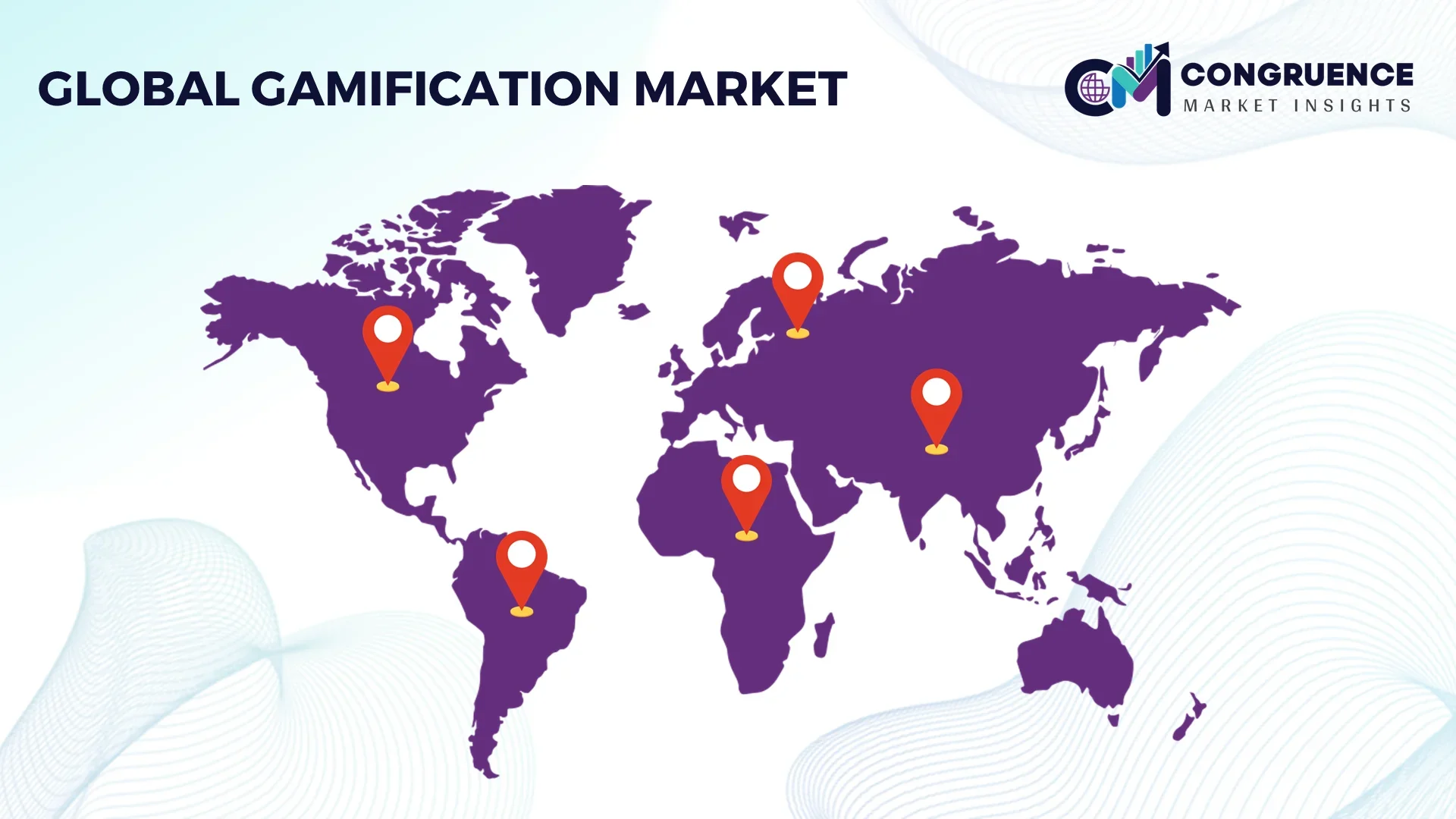
North America accounted for the largest market share at 38% in 2025 however, Asia-Pacific is expected to register the fastest growth, expanding at a CAGR of 34% between 2026 and 2033.
AI-Driven Enterprise Engagement Expansion
North America maintained market leadership through advanced enterprise software infrastructure, large-scale cloud integration, and accelerated deployment of AI-powered engagement ecosystems across BFSI, retail, healthcare, and telecom industries. The region contributed nearly 38% of global deployment activity in 2025, supported by widespread adoption of gamified workforce management and loyalty optimization systems. More than 63% of large enterprises in the United States integrated engagement analytics into employee productivity frameworks during 2026 digital transformation initiatives. Technology providers expanded strategic alliances with cloud hyperscalers and HR software vendors to improve deployment scalability, API interoperability, and predictive behavioral analytics capabilities. Increasing enterprise demand for mobile-first engagement architecture and real-time user intelligence continues strengthening North America’s competitive position across high-value gamification deployment environments.
United States Market Outlook: The United States remains the largest operational hub for gamification deployment due to mature SaaS ecosystems, strong enterprise software spending, and widespread AI integration across customer engagement and workforce productivity systems. More than 62% of Fortune 500 companies implemented gamified employee engagement platforms during 2026, particularly across healthcare, financial services, and retail operations. Domestic technology providers continue expanding AI-enabled personalization tools and behavioral analytics infrastructure through enterprise partnerships and cloud-native deployment strategies.
Privacy-Centric Platform Modernization
Europe strengthened its market position through enterprise digital modernization combined with stricter behavioral data governance frameworks and workforce engagement transformation. Germany, France, and the United Kingdom accelerated adoption of compliance-focused gamification systems across industrial training, fintech engagement, and healthcare learning operations. Nearly 41% of enterprise deployments during 2026 prioritized localized cloud hosting and encrypted behavioral analytics to align with evolving digital compliance standards. Regional software vendors increasingly focused on modular engagement ecosystems capable of integrating with ERP and workforce management platforms without disrupting existing infrastructure. Enterprises also expanded immersive workforce learning systems to improve operational safety, onboarding efficiency, and employee participation consistency across regulated environments.
Germany Market Outlook: Germany leads the European market through advanced industrial digitization, enterprise software integration, and strong Industry 4.0 infrastructure modernization initiatives. Manufacturing and automotive enterprises increasingly deploy gamified workforce learning systems to improve technical training efficiency and compliance management. More than 36% of large industrial organizations expanded immersive employee engagement programs during 2026 to support operational modernization and workforce productivity optimization. German technology firms are also prioritizing localized data processing architecture and AI-governed engagement systems for regulated enterprise environments.
Mobile-First Deployment Acceleration
Asia-Pacific emerged as the fastest-scaling regional market due to rapid smartphone penetration, expanding cloud infrastructure, and increasing adoption of digital learning ecosystems across India, China, Japan, and Southeast Asia. The region accounted for approximately 29% of global deployment activity in 2025, driven by mobile-based engagement applications across retail commerce, education technology, and telecom services. Enterprise adoption of gamified workforce training systems increased by nearly 44% during 2026 as organizations accelerated hybrid work integration and customer engagement modernization. Telecom operators and cloud software providers expanded infrastructure investment to support multilingual engagement platforms and AI-enabled behavioral analytics systems. The region continues benefiting from cost-efficient mobile ecosystems, high digital participation rates, and expanding enterprise software penetration.
India Market Outlook: India is becoming a major enterprise deployment center due to rapid digital commerce growth, expanding edtech ecosystems, and strong mobile-first technology adoption. Mobile-based gamification systems recorded participation growth exceeding 46% across retail and workforce learning applications during 2026. Enterprises increasingly integrated gamified onboarding and employee performance platforms into operational workflows to support hybrid employment models and digital workforce management. Domestic software vendors are also scaling multilingual AI-driven engagement systems targeting BFSI, telecom, and education sectors.
Fintech and Retail Loyalty Expansion
South America experienced rising gamification adoption across digital banking, retail commerce, and workforce engagement operations as enterprises prioritized customer retention and mobile interaction optimization. Brazil and Chile led deployment activity through expanding fintech ecosystems and broader smartphone connectivity. Nearly 33% of enterprise engagement initiatives launched during 2026 focused on loyalty optimization and mobile-first customer interaction frameworks. Infrastructure limitations and uneven enterprise cloud maturity continued restricting large-scale integration across some industries, particularly outside major technology hubs. In response, software providers strengthened partnerships with telecom operators and regional cloud vendors to improve deployment accessibility, scalability, and operational consistency across digital engagement ecosystems.
Brazil Market Outlook: Brazil dominates the South American market through its large digital consumer base, rapidly expanding fintech sector, and increasing enterprise investment in mobile engagement technologies. Retailers and financial institutions accelerated deployment of gamified loyalty and customer interaction systems during 2026 to improve repeat transaction frequency and user retention performance. More than 39% of regional fintech engagement platforms operating in Brazil integrated behavioral analytics into mobile applications. Technology providers continue strengthening local cloud infrastructure partnerships and multilingual platform deployment capabilities to improve scalability.
Smart Infrastructure and Workforce Digitization
The Middle East & Africa market gained momentum through smart city initiatives, enterprise workforce digitization, and expanding cloud-enabled education infrastructure. The United Arab Emirates and Saudi Arabia led deployment activity through government-backed digital transformation strategies and increasing enterprise software investment. Approximately 31% of newly deployed engagement systems during 2026 focused on workforce productivity optimization and digital learning modernization across telecom, BFSI, and public-sector operations. Enterprises increasingly adopted AI-powered engagement analytics to improve operational efficiency and customer interaction quality. Software vendors also expanded alliances with telecom operators and cloud infrastructure providers to strengthen deployment reliability across emerging digital ecosystems and enterprise modernization programs.
United Arab Emirates Market Outlook: The United Arab Emirates remains the leading regional market due to aggressive smart infrastructure investment, strong cloud adoption, and innovation-focused enterprise modernization policies. Large enterprises and government-linked organizations increasingly deploy gamified workforce engagement and digital training systems to improve employee productivity and service efficiency. More than 35% of enterprise HR modernization initiatives launched during 2026 included AI-enabled engagement analytics and digital learning platforms. The country’s advanced digital infrastructure and pro-technology regulatory environment continue attracting global software providers and regional cloud partnerships.
Global enterprise software providers compete directly with AI-focused engagement specialists and mobile-first gamification developers across workforce management, customer loyalty, and digital learning ecosystems. Microsoft, SAP, Salesforce, BI WORLDWIDE, and Gametize collectively controlled nearly 48% of the market, while regional SaaS vendors competed aggressively through lower deployment costs and localized engagement architecture. Competition increasingly centers on predictive analytics accuracy, API integration speed, cloud scalability, and personalization efficiency, with AI-enabled engagement systems improving user retention by more than 30% in enterprise deployments. Established providers are expanding through cloud partnerships, HR technology integration, and vertical-specific platform customization, while emerging vendors target retail and education sectors with mobile-centric engagement frameworks. The competitive shift is rapidly moving toward AI-governed behavioral intelligence and privacy-compliant analytics infrastructure as enterprises demand scalable engagement without increasing compliance exposure. Companies winning market share are those delivering measurable engagement outcomes, enterprise-grade interoperability, and faster deployment scalability.
Microsoft
SAP
Salesforce
BI WORLDWIDE
Gametize
Mambo Solutions
Ambition
Influitive
Bunchball
Cognizant
Centrical
Hoopla Software
LevelEleven
Aon Hewitt
AI-powered behavioral analytics and adaptive engagement engines currently dominate enterprise gamification deployment across workforce management, customer loyalty, and digital learning ecosystems. More than 61% of large enterprises integrated AI-enabled personalization modules into engagement workflows during 2026, improving user participation efficiency by nearly 38% and reducing onboarding time by 24%. Cloud-native gamification platforms also lowered deployment and maintenance costs by approximately 31% compared to legacy on-premise systems. Retail, BFSI, and telecom companies benefit most through faster customer interaction cycles, higher retention consistency, and scalable multi-channel engagement management.
Emerging technologies including AR-based learning environments, predictive engagement analytics, and no-code gamification builders are accelerating operational adoption across enterprise training and digital commerce ecosystems. Immersive simulation modules improved employee knowledge retention by nearly 33% compared to conventional video-based learning platforms, while mobile-first gamification systems generated over 46% higher daily participation rates across India and Southeast Asia. Companies are rapidly integrating gamification APIs with CRM, HR, and workforce productivity software to improve cross-platform operational visibility and real-time engagement optimization.
Disruptive technologies between 2026 and 2028 will center on generative AI orchestration, blockchain-enabled loyalty infrastructure, and autonomous engagement engines capable of adjusting rewards dynamically through behavioral intelligence. AI-governed gamification ecosystems are expected to become a major competitive differentiator for enterprises prioritizing scalable personalization, lower churn exposure, and higher operational efficiency across distributed digital environments.
March 2025 – Optimove acquired gamification provider Adact to strengthen AI-orchestrated engagement capabilities, enabling brands to improve conversion performance by up to 80% through interactive loyalty experiences and personalized mini-games.
August 2025 – Arcade acquired AI coaching platform Upduo and launched Arcade AI Sales Leader, helping retailers scale frontline sales performance while improving manager-led engagement consistency across distributed retail operations.
January 2026 – Eventbase and Komo announced a strategic partnership introducing MagicBadge™ Engage, integrating NFC-enabled gamified event experiences to improve attendee interaction efficiency and strengthen real-time digital participation workflows. Source: eventbase.com
May 2026 – The Hashgraph Group launched BrandBoost, a Web3-enabled gamification platform designed for real-time consumer engagement, enabling enterprises to modernize static loyalty systems through tokenized rewards and AI-powered interaction models.
The report provides comprehensive analysis of enterprise and consumer-focused gamification ecosystems across cloud-based, mobile-based, and on-premise deployment models. It evaluates operational trends across employee engagement, customer loyalty programs, learning and training, healthcare wellness initiatives, sales performance management, and digital marketing applications. The study covers major end-user industries including retail, BFSI, healthcare, IT and telecom, education, and media sectors, with nearly 60% of deployment activity concentrated in enterprise workforce and customer engagement operations during 2026. Regional analysis spans North America, Europe, Asia-Pacific, South America, and the Middle East & Africa with detailed country-level operational insights.
The report also examines AI-driven personalization, immersive engagement technologies, predictive behavioral analytics, blockchain-enabled loyalty ecosystems, and mobile-first deployment strategies shaping market transformation between 2026 and 2033. It highlights deployment patterns, enterprise modernization priorities, strategic partnerships, competitive positioning frameworks, and technology integration trends supporting investment planning, expansion strategy development, and long-term operational decision-making across high-growth digital engagement environments.
| Report Attribute/Metric | Report Details |
|---|---|
|
Market Revenue in 2025 |
USD 1579.86 Million |
|
Market Revenue in 2033 |
USD 13702.15 Million |
|
CAGR (2026 - 2033) |
31% |
|
Base Year |
2025 |
|
Forecast Period |
2026 - 2033 |
|
Historic Period |
2021 - 2025 |
|
Segments Covered |
By Type
By Application
By End-User
|
|
Key Report Deliverable |
Revenue Forecast, Growth Trends, Market Dynamics, Segmental Overview, Regional and Country-wise Analysis, Competition Landscape |
|
Region Covered |
North America, Europe, Asia-Pacific, South America, Middle East, Africa |
|
Key Players Analyzed |
Microsoft, SAP, Salesforce, BI WORLDWIDE, Gametize, Mambo Solutions, Ambition, Influitive, Bunchball, Cognizant, Centrical, Hoopla Software, LevelEleven, Aon Hewitt |
|
Customization & Pricing |
Available on Request (10% Customization is Free) |




