
Reports
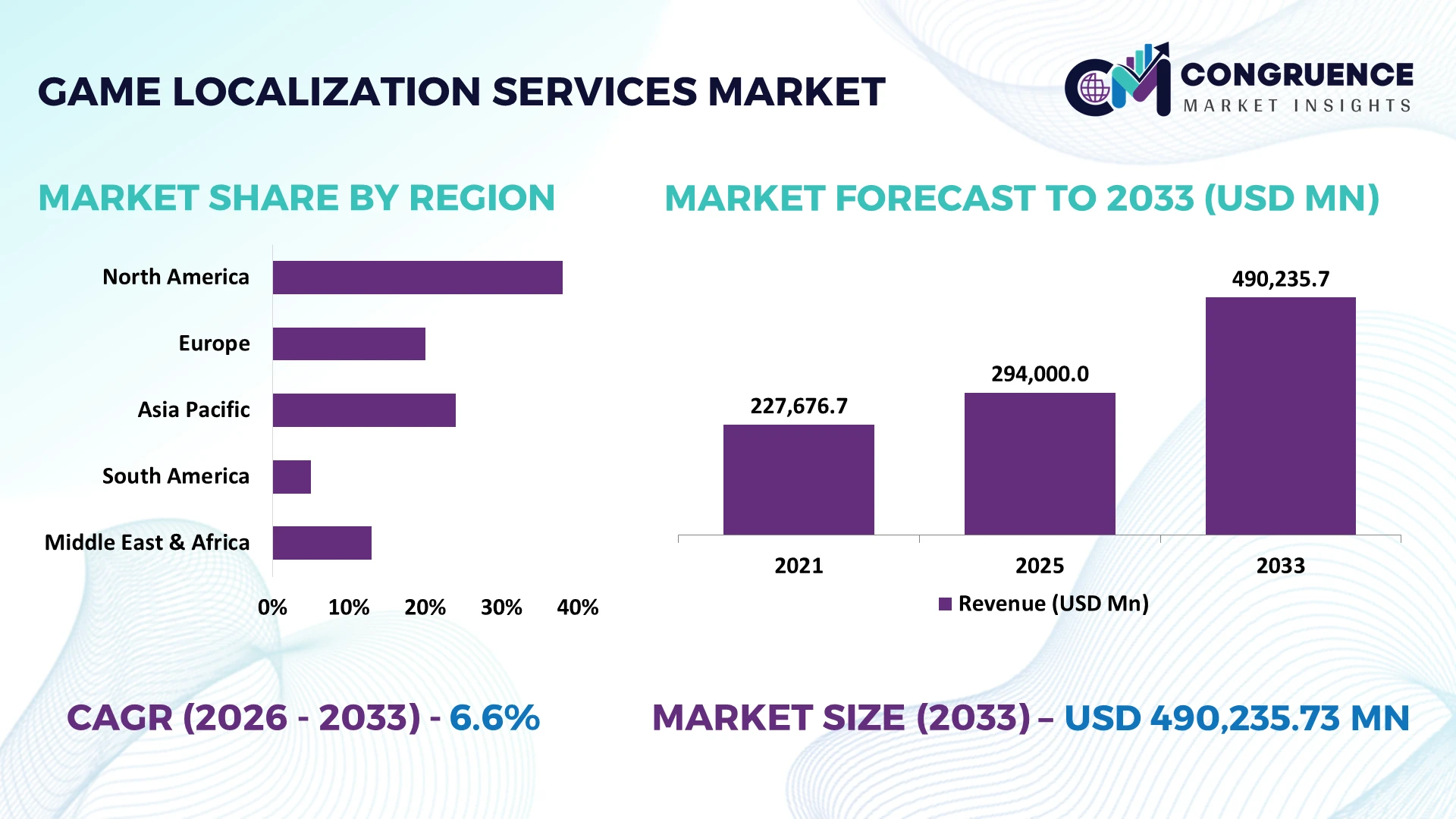
The Global Game Localization Services Market was valued at USD 294000 Million in 2025 and is anticipated to reach a value of USD 490235.73 Million by 2033 expanding at a CAGR of 6.6% between 2026 and 2033. Growth is driven by simultaneous multilingual game launches, recurring live-service updates, AI-assisted translation, and localization QA requirements across mobile, PC, and console ecosystems.
The United States remains the dominant commercial hub, supported by its concentration of AAA publishers, live-service studios, platform companies, and localization vendors serving global releases. Industry estimates place Keywords Studios at roughly 40.5% of the game text localization segment, while its localization network supports 80+ text languages and 50+ audio languages. China provides the strongest scale comparison: Simplified Chinese represents about 22.5% of Steam language usage, versus approximately 39.6% for English, making Chinese localization strategically important despite tighter content-approval requirements. China’s game-approval framework also increases demand for cultural adaptation alongside linguistic translation.
Strategic implication: localization providers should prioritize AI-assisted human workflows, continuous-update capabilities, and Chinese, Japanese, Korean, and major European language capacity to capture high-volume global publishing programs.
Market Size & Growth: USD 294000 million in 2025 is projected to reach USD 490235.73 million by 2033 at 6.6% CAGR, supported by multilingual live-service content and simultaneous global launches.
Top Growth Drivers: AI-assisted workflows deliver 35–50% localization cost savings in demonstrated game-update programs, while specialized game AI reduces human correction effort by 35–45%.
Short-Term Forecast: By 2028, advanced MTPE deployment is positioned to reduce localization expenditure by approximately 30–40% for suitable repetitive update content while preserving mandatory linguistic QA.
Emerging Technologies: Game-trained LLMs, neural machine translation, automated LQA, and AI-enabled audio processing are reshaping workflows; human-reviewed machine translation already operates at 2–3 times manual translation speed.
Regional Leaders: North America remains the primary commercial center, Asia-Pacific gains scale through China, Japan, and South Korea, while Europe benefits from multilingual publishing across more than 20 major language markets.
Consumer/End-User Trends: Simplified Chinese accounts for approximately 22.5% of Steam language usage, demonstrating why publishers increasingly treat Chinese localization as a launch requirement rather than a post-release addition.
Pilot/Case Example: A 2025 MTPE implementation covering 12 languages generated 37% cost savings, maintained 95%+ translation quality, retained 100% of linguists, and delivered four major updates on schedule.
Competitive Landscape: Keywords Studios holds an estimated 40.5% share of game text localization, with TransPerfect, Lionbridge, Alconost, and PTW strengthening competition through multilingual production, AI integration, and localization QA.
Regulatory & ESG Impact: The EU AI Act increases governance requirements for AI-enabled localization, while China’s publishing approvals reinforce human cultural review for localized game content entering regulated distribution channels.
Investment & Funding: EQT’s approximately USD 2.8 billion acquisition of Keywords Studios highlights investor interest in scalable outsourced game services spanning localization, testing, audio, art, and development capabilities.
Innovation & Future Outlook: Specialized AI can cut basic translation correction workloads by 35–45%, shifting competitive advantage toward providers combining proprietary game-trained models with native linguists and continuous localization infrastructure.
The Game Localization Services Market is increasingly shaped by continuous localization rather than one-time translation projects. Demand is strongest across live-service games, mobile titles, RPGs, multiplayer releases, voice localization, and culturally sensitive Asian-language adaptations. Game-specific AI models are reducing human correction workloads by 35–45%, while MTPE enables faster processing of repetitive update strings without eliminating linguistic QA. At the operational level, China’s game-approval environment reinforces the importance of culturalization and compliance alongside translation. These shifts are moving purchasing decisions toward integrated, technology-enabled localization partners with scalable multilingual delivery capabilities.
Game localization is becoming strategically important as publishers shift from sequential country launches toward simultaneous global releases and continuous live-service operations. Steam’s language distribution shows English at roughly 39.6% and Simplified Chinese at 22.5%, making multilingual accessibility commercially material rather than supplementary. China’s content-approval framework further shifts localization toward culturalization, terminology compliance, and pre-launch regulatory review, while subscription gaming and cross-platform distribution increase recurring localization workloads.
Technology is restructuring delivery economics. Game-trained AI and machine-translation post-editing can reduce linguist correction workloads by approximately 35–45%, while suitable repetitive content can be processed two to three times faster than conventional human-only translation. The United States leads through large AAA and live-service publishing pipelines, while China, Japan, and South Korea require deeper linguistic and cultural adaptation. Through 2026–2028, AI-assisted translation, automated linguistic QA, and centralized terminology management will become increasingly embedded in production pipelines.
Operationally, publishers are integrating localization directly with content-management systems so new dialogue, UI strings, and seasonal updates move automatically into translation and QA workflows. Large localization providers are consequently investing in proprietary AI, native-language reviewer networks, audio localization, and production partnerships. Competitive advantage will increasingly depend on combining automation speed with human cultural accuracy, regulatory readiness, and synchronized multilingual release capability.
Live-service gaming is converting localization from a launch-stage activity into a continuous production requirement. English represents approximately 39.6% of Steam language usage, while Simplified Chinese contributes about 22.5%, forcing publishers to support major language communities simultaneously. AI-assisted game localization can reduce human correction effort by 35–45%, while machine-assisted workflows process suitable repetitive strings two to three times faster than traditional translation. The structural shift toward seasonal content, downloadable expansions, multiplayer events, and synchronized patches increases translation frequency without proportionally expanding production schedules. Publishers are responding by embedding localization into content-management pipelines, expanding native-linguist networks, and partnering with specialized vendors. The strategic advantage is release synchronization: localized updates delivered alongside source-language content protect player engagement and reduce geographic monetization delays.
Automation lowers translation workload but does not eliminate expensive cultural and linguistic validation. Specialized game AI can still require approximately 55–65% of previous human correction effort, while Steam’s 22.5% Simplified Chinese user share demonstrates the commercial exposure created by mistranslation in a single major language. China compounds this constraint through publishing approvals and content requirements that demand adaptation beyond literal translation. Humor, character identity, lore consistency, age-sensitive material, UI restrictions, and voiced dialogue remain particularly difficult to automate reliably. Providers therefore face scalability pressure when simultaneous releases require native reviewers across 20–50 languages. Companies are mitigating this through terminology databases, translation memories, dedicated culturalization teams, and human-in-the-loop AI. Operationally, quality-control capacity—not raw translation throughput—is becoming the principal bottleneck for large multilingual releases.
Game-specific generative AI creates an opportunity to localize content previously considered uneconomic, particularly user-generated material, secondary dialogue, live-event text, and frequent mobile-game updates. Specialized models have demonstrated approximately 35–45% reductions in human correction workloads, while machine-assisted workflows can deliver two to three times the throughput of conventional translation for structured content. Simplified Chinese already represents roughly 22.5% of Steam language usage, highlighting the addressable value of extending equivalent localization depth into Korean, Japanese, Brazilian Portuguese, and emerging language communities. Between 2026 and 2028, context-aware LLMs integrated with translation memory and automated LQA will move localization closer to real-time production. Providers are investing in proprietary language models, API-based workflow integration, multilingual datasets, and publisher partnerships. The non-obvious opportunity is monetizing continuous localization as managed infrastructure rather than selling translation primarily by word volume.
The long-term challenge is maintaining narrative consistency and cultural accuracy as localization volumes, languages, and update frequencies expand simultaneously. A provider supporting 50+ audio languages and 80+ text languages potentially manages thousands of language-content combinations across dialogue, UI, subtitles, terminology, and patches. AI can reduce correction workloads by 35–45%, yet remaining human intervention concentrates on the most context-sensitive material, making specialist linguistic talent disproportionately important. Japan and South Korea intensify this challenge because honorifics, character relationships, typography, and culturally specific dialogue require contextual interpretation rather than direct translation. Companies must connect translation memories, terminology systems, LLMs, automated QA, and game-build testing without introducing inconsistent outputs. Investment in centralized linguistic data, native reviewer networks, secure AI infrastructure, and automated regression testing is therefore essential for maintaining quality at global production scale.
Continuous Localization Replaces Release Cycles: Live-service publishing is moving localization into always-on production pipelines as 64% of PC playtime remains concentrated in pre-2019 titles and PC microtransaction spending increased 9.1% in 2025. Publishers are connecting translation management systems directly with development repositories, enabling dialogue, events, patches, and UI updates to enter localization immediately. Vendors are restructuring teams around follow-the-sun delivery, automated string ingestion, and continuous linguistic QA to reduce update latency.
AI Moves Into Production Workflows: Localization providers are deploying game-trained language AI alongside translation memories rather than replacing linguists outright. Leading service platforms now support 80+ text languages and 50+ audio languages, while specialized automation handles high-volume repetitive strings before human review. This transition concentrates linguist time on narrative, humor, terminology, and cultural adaptation. Providers are scaling proprietary models and integrated QA tooling, creating an operational advantage through higher translator productivity rather than unrestricted machine translation.
Multilingual PC Demand Rebalances Capacity: Simplified Chinese represents approximately 23.4% of Steam language usage compared with 36.8% for English, while PC gaming expanded 12% during 2025. Localization capacity is consequently shifting toward Chinese and other Asian-language pipelines instead of English-first sequential deployment. Publishers are increasing native-language testing, terminology management, and culturally adapted UI production. The non-obvious shift is scheduling: localization teams increasingly enter development before content lock because late-stage translation cannot support synchronized international launches.
Audio Pipelines Become More Integrated: Multilingual audio localization is shifting from fragmented studio contracting toward centralized casting, adaptation, recording, processing, and mastering workflows. Large providers now manage 50+ audio languages, while console subscriptions increased 10.2% in 2025 and full-game PC spending rose 25%, supporting premium narrative production. Companies are consolidating recording partners, introducing production automation, and standardizing asset naming and processing. Centralized audio management reduces handoff complexity and improves consistency across character performances, downloadable content, and synchronized multilingual releases.
Text Localization leads the Game Localization Services Market with an estimated 40–45% share, reflecting its universal requirement across dialogue, menus, tutorials, item descriptions, live events, and downloadable content. Its dominance comes from scalable translation-memory integration, centralized terminology management, and AI-assisted processing across large string volumes. Localization Testing represents another established requirement because translated builds require linguistic, functional, truncation, and contextual verification. Subtitling remains strategically important for dialogue-heavy releases and offers lower production complexity than localized voice recording.
Audio Localization is the fastest-expanding type as premium publishers increase multilingual voice coverage and narrative depth. Major localization networks already support 50+ audio languages compared with 80+ text languages, illustrating both growing deployment and remaining expansion headroom. Dubbing commands higher production intensity because casting, script adaptation, recording, editing, synchronization, and mastering must be coordinated language by language. Providers are consequently investing in centralized audio studios, automated processing, remote recording infrastructure, and integrated text-to-audio workflows, shifting capital toward end-to-end localization rather than standalone translation.
Mobile Games lead application demand with an estimated 45–50% localization-services share, reflecting their high release frequency, broad geographic distribution, and dependence on localized events, stores, notifications, UI strings, and monetization content. Mobile accounted for approximately 57% of global games spending in 2026, reinforcing the volume of multilingual content requiring continuous processing. Online Games overlap operationally with this model because persistent content, seasonal events, and community updates require rapid localization rather than one-time launch translation. PC Games remain strategically significant as Asian-language adoption expands across major distribution platforms.
Virtual Reality Games represent the fastest-growing localization application from a smaller installed base because immersive experiences combine spatial interfaces, subtitles, voice, gestures, and contextual instructions. Console Games remain mature but localization-intensive, particularly for premium narrative franchises and synchronized physical/digital launches. PC performance strengthened sharply in 2025, while Simplified Chinese reached approximately 23.4% of Steam language usage. Localization companies are responding with automated string pipelines, platform-specific LQA, multilingual audio capacity, and continuous-delivery integration designed around shorter update cycles.
Game Publishers lead end-user demand with an estimated 40–45% share because they coordinate multilingual launches, certification schedules, marketing assets, downloadable content, voice production, and post-launch updates across multiple studios and territories. Their scale favors centralized localization contracts covering translation, subtitling, dubbing, testing, and terminology management. Game Developers remain substantial buyers, particularly when localization is integrated directly into development repositories and build pipelines. Gaming Platform Providers require localization across storefronts, metadata, user interfaces, support content, and ecosystem communications, creating recurring workloads extending beyond individual titles.
Independent Studios represent the fastest-growing buyer group as AI-assisted workflows and managed localization services reduce the infrastructure previously required for multilingual launches. PC’s 12% expansion in 2025 and a global player population exceeding 3.5 billion strengthen the commercial case for smaller studios to release internationally from launch. Esports Companies generate specialized demand around tournaments, broadcasts, subtitles, commentary, and community content. Providers are targeting these groups with modular pricing, localization-as-a-service, API integrations, shared terminology assets, and bundled LQA, allowing smaller customers to access enterprise-grade multilingual production without building internal departments.
Asia-Pacific accounted for the largest market share at 39.1% in 2025 however, Asia-Pacific is expected to register the fastest growth, expanding at a CAGR of 9.65% between 2026 and 2033.
AAA Publishing Drives Integrated Localization
North America accounted for approximately 27.4% of the Game Localization Services Market in 2025, supported by concentrated AAA development, global publishing operations, console ecosystems, and mature localization procurement. The United States anchors demand through major publishers managing simultaneous international releases across PC, console, mobile, and live-service titles. North America represented approximately 27% of global games spending in 2025, while PC spending increased 12%, expanding localization workloads for premium releases and downloadable content. Providers are integrating translation management, linguistic QA, dubbing, and automated string processing into publisher development pipelines. Canada adds bilingual English-French requirements and a substantial game-development cluster. Operationally, buyers increasingly consolidate multilingual work with fewer vendors capable of managing translation, voice production, testing, and continuous content updates under standardized security and terminology controls.
United States Market Outlook: The United States remains North America’s primary localization demand center, supported by approximately 224.8 million players and globally distributed game franchises. Large publishers increasingly require localization across 15–30 languages at launch, strengthening demand for integrated linguistic testing, culturalization, voice production, and continuous localization rather than standalone translation contracts.
Language Fragmentation Reinforces Localization Depth
Europe represents roughly one-quarter of global game localization demand, reflecting unusually high language fragmentation combined with sophisticated PC, console, and mobile consumption. The underlying games market expanded 10.7% in 2025, while European PC activity increased 15.7% and mobile spending advanced 15.5%, increasing multilingual content throughput across major publishing pipelines. Localization providers must simultaneously address French, German, Spanish, Italian, Polish, Portuguese, and other language communities while aligning workflows with EU privacy and AI governance requirements. This favors vendors offering secure AI-assisted translation, terminology governance, native-language testing, and multilingual voice production. Companies are strengthening distributed linguist networks and automated QA rather than relying on centralized translation alone. Europe’s strategic distinction is localization depth: publishers frequently require full cultural and linguistic adaptation across several commercially meaningful markets within a single coordinated release window.
United Kingdom Market Outlook: The United Kingdom combines major development studios, international publishing functions, specialist voice talent, and established localization operations. London serves as an important coordination hub for European multilingual projects, while UK-developed titles routinely target continental Europe, North America, and Asia. Providers benefit from direct access to publishers requiring centralized project management across 10–20+ launch languages.
Multilingual Scale Reshapes Localization Capacity
Asia-Pacific held approximately 39.1% of the Game Localization Services Market in 2025, establishing the region as both the largest demand base and a major source of internationally distributed game content. The broader games economy accounted for approximately 47% of worldwide activity in 2025, with China, Japan, and South Korea creating substantial two-way localization requirements. China alone had approximately 723 million players, while Japan and South Korea maintained strong PC, console, and mobile ecosystems. Chinese publishers expanding overseas require English, Japanese, Korean, European-language, and LATAM localization, while Western publishers need deeper culturalization for Asian audiences. Providers are scaling native-language testing, game-specific AI models, dubbing, and terminology management. The operational shift is increasingly bidirectional: localization infrastructure must support Asian titles moving globally as efficiently as international titles entering Asian markets.
China Market Outlook: China is the region’s largest individual gaming market, supported by approximately 723 million players and extensive mobile and PC publishing capacity. Domestic content approvals add a compliance layer to localization, while international expansion by Chinese developers increases outbound multilingual workloads. Providers with Simplified Chinese culturalization, regulatory adaptation, native LQA, and global language delivery gain the strongest operational positioning.
Brazilian Portuguese Becomes Launch Priority
South America is gaining strategic importance as mobile distribution, digital payments, competitive gaming, and PC engagement broaden the addressable multilingual player base. Latin American gaming activity expanded faster than the global average in 2025, increasing demand for Brazilian Portuguese and Latin American Spanish localization across free-to-play and online titles. Brazil dominates South American localization requirements because its language profile prevents publishers from relying on Spanish-language assets used elsewhere in Latin America. Publishers are consequently moving Portuguese translation, community content, customer support, and live-event localization earlier into production schedules. Cloud-based workflows allow international vendors to coordinate native linguists without extensive physical infrastructure, although fragmented payment ecosystems and uneven broadband quality still complicate monetization. Localization companies are responding through Brazilian reviewer networks, regional pricing, remote QA, and partnerships with developers targeting mobile-first audiences.
Brazil Market Outlook: Brazil provides South America’s strongest localization case through its large Portuguese-speaking gaming population, established esports culture, and expanding digital distribution. Brazilian Portuguese increasingly receives dedicated launch treatment rather than adaptation from European Portuguese. Vendors are building native terminology, community-management, voice-over, and LQA capabilities to support publishers pursuing sustained player engagement rather than translation-only market entry.
Saudi Investment Accelerates Arabic Localization
Middle East & Africa is shifting from a secondary localization territory toward a strategically funded gaming ecosystem, with the underlying games market recording approximately 15% growth in 2025. Saudi Arabia is central to this transformation through its National Gaming and Esports Strategy, publisher investments, esports infrastructure, and incentives designed to attract international creative businesses. Arabic localization consequently requires greater investment in culturally appropriate terminology, right-to-left interface testing, voice production, and regional content adaptation. In 2025, an USD 80 million gaming fund supported Saudi startup development, while international creative studios announced Riyadh expansion initiatives. Localization providers are building Arabic linguistic capacity and partnerships alongside broader MENA market-entry services. Africa remains more fragmented because connectivity, purchasing power, and language diversity vary sharply, favoring mobile-first localization and selective language deployment rather than uniform regional coverage.
Saudi Arabia Market Outlook: Saudi Arabia is developing the region’s strongest enterprise localization ecosystem through state-backed gaming investment and international partnerships. Riyadh is attracting development, creative-production, and esports operations, while cooperation between Saudi and Japanese gaming organizations specifically emphasizes effective localization for market entry. Arabic culturalization, right-to-left UI testing, and local voice production therefore represent increasingly strategic capabilities.
Keywords Studios, TransPerfect, Lionbridge, PTW, RWS, and Altagram compete across multilingual translation, audio, culturalization, and localization QA, with global integrated providers challenging gaming-specialist vendors on scale and technology. The top five players collectively control an estimated 45–50% of organized localization spending, leaving specialist agencies competitive in language-specific and indie projects. Competition increasingly centers on workflow integration: AI-assisted translation can reduce correction workloads by 35–45%, while automated pipelines deliver repetitive content two to three times faster than conventional processes. Keywords and PTW compete through vertically integrated testing and production capabilities; TransPerfect, Lionbridge, and RWS leverage enterprise language technology and broad linguistic networks. Consolidation is shifting contracts toward end-to-end providers combining translation, dubbing, testing, and automation. Secure access to proprietary game data, native linguists, voice talent, and integration expertise creates substantial entry barriers. Winning requires measurable speed improvements without sacrificing contextual accuracy, cultural adaptation, security, or synchronized global delivery.
Keywords Studios
TransPerfect
Lionbridge
PTW
RWS
Altagram
Testronic
Localsoft
GlobalStep
LocalizeDirect
Andovar
Venga Global
Welocalize
Terra Translations
Current game localization technology combines translation management systems, translation memory, neural machine translation, automated linguistic QA, and continuous-localization connectors. Game-specific machine translation with human post-editing can process suitable repetitive content two to three times faster than conventional human-only workflows while lowering localization costs by approximately 30–35%. Continuous integration automatically routes modified dialogue, UI strings, and live-service content into localization pipelines, reducing manual file handling and accelerating multilingual updates.
Emerging systems increasingly use context-aware LLMs, automated terminology extraction, game-specific language models, and multimodal localization across text, subtitles, and voice. Human-supervised LLM workflows can reduce localization costs by around 30%, while newer AI-assisted processes can approximately double throughput compared with legacy translation workflows. Leading providers deploy integrated localization across 50+ audio and 70+ text languages, demonstrating movement from isolated pilots toward production-scale adoption.
Between 2026 and 2028, contextual AI agents, automated LQA, synthetic voice technology, and API-driven localization will become increasingly embedded in development pipelines. Providers controlling proprietary gaming datasets, secure AI environments, and native-linguist networks gain the strongest competitive advantage. Publishers must prioritize human-supervised automation now because localization is becoming continuous multilingual production infrastructure rather than a post-development translation function.
September 2024 Alconost expanded game-focused machine translation post-editing workflows, demonstrating localization delivery more than 30% faster and costs over 35% lower than conventional processes, strengthening economical multilingual deployment for developers managing frequent content updates and international game launches. Source: alconost.com
February 2025 DIGITAL HEARTS expanded its game-specialized AI translation engine “ella” into French, Italian, German, and Spanish, increasing supported languages to nine and strengthening automated localization capacity for publishers targeting European and Asian markets through scalable game-specific translation workflows. Source: digitalhearts.com
September 2025 Lionbridge Games introduced Samurai, a human-centered LLM localization solution customized around individual game intellectual property, delivering up to 30% cost savings and approximately 2× traditional workflow speed while preserving linguistic review for complex narrative and contextual content. Source: lionbridge.com
September 2026 Keywords Studios expanded operational deployment of specialized game-localization AI supported by human cultural oversight and expertise covering 70+ languages and dialects, strengthening scalable multilingual production while addressing contextual accuracy, cultural adaptation, intellectual-property security, and global publishing requirements. Source: keywordsstudios.com
The report evaluates Game Localization Services across Text Localization, Audio Localization, Subtitling, Dubbing, and Localization Testing, alongside Mobile Games, PC Games, Console Games, Online Games, and Virtual Reality Games. End-user coverage includes Game Developers, Game Publishers, Independent Studios, Esports Companies, and Gaming Platform Providers. Regional analysis spans North America, Europe, Asia-Pacific, South America, and Middle East & Africa, with Asia-Pacific representing approximately 39% of 2025 market activity.
Technology coverage examines game-trained AI, LLM-assisted translation, machine translation post-editing, automated linguistic QA, continuous-localization APIs, translation memory, and multilingual audio workflows. Competitive assessment addresses integrated localization providers, specialist agencies, and AI-enabled delivery models. The report supports 2026–2033 investment and expansion planning by identifying language-capacity requirements, technology transitions, regional deployment priorities, partnership opportunities, operational bottlenecks, and competitive positioning across increasingly continuous global game-publishing ecosystems.
| Report Attribute/Metric | Report Details |
|---|---|
Market Revenue in 2025 | USD 294000 Million |
Market Revenue in 2033 | USD 490235.73 Million |
CAGR (2026 - 2033) | 6.6% |
Base Year | 2025 |
Forecast Period | 2026 - 2033 |
Historic Period | 2021 - 2025 |
Segments Covered | By Type
By Application
By End-User
|
Key Report Deliverable | Revenue Forecast, Growth Trends, Market Dynamics, Segmental Overview, Regional and Country-wise Analysis, Competition Landscape |
Region Covered | North America, Europe, Asia-Pacific, South America, Middle East, Africa |
Key Players Analyzed | Keywords Studios, TransPerfect, Lionbridge, PTW, RWS, Altagram, Testronic, Localsoft, GlobalStep, LocalizeDirect, Andovar, Venga Global, Welocalize, Terra Translations |
Customization & Pricing | Available on Request (10% Customization is Free) |




