
Reports
The Global Gallium Nitride Power Device Market was valued at USD 615.8 Million in 2025 and is anticipated to reach a value of USD 10,237.5 Million by 2033 expanding at a CAGR of 42.1% between 2026 and 2033. Growth is driven by rapid integration of GaN semiconductors in fast-charging consumer electronics, AI data center power architectures, electric vehicle onboard chargers, and high-frequency renewable energy conversion systems.
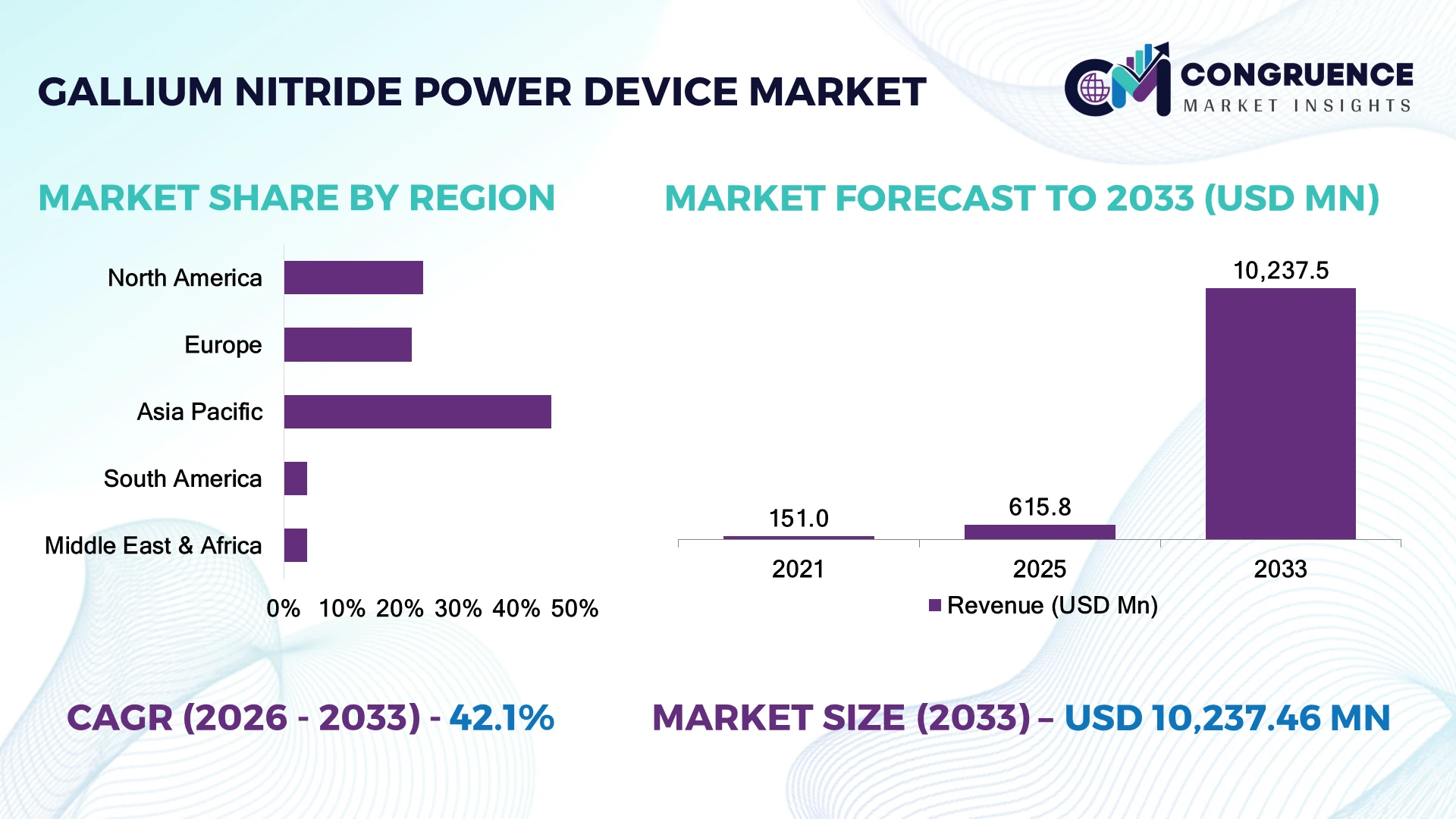
China dominates the global GaN power device ecosystem with approximately 42% of worldwide power semiconductor manufacturing capacity, supported by over USD 15 billion in domestic semiconductor investments and strong deployment across EVs, telecom infrastructure, and industrial automation. The country accounts for more than 55% of global EV production, compared with the United States at roughly 12%, while accelerating GaN adoption in high-power charging systems amid ongoing semiconductor supply-chain realignment linked to U.S.-China technology restrictions.
This leadership positions manufacturers to prioritize localized production, strategic wafer sourcing, and advanced packaging capabilities to secure long-term competitive advantage.
Market Size & Growth: USD 615.8 Million in 2025, reaching USD 10,237.5 Million by 2033, driven by high-efficiency EV charging and AI-powered power management systems.
Top Growth Drivers: EV fast-charger deployment (+35%), data center power demand (+28%), and renewable inverter adoption (+31%) accelerate market expansion.
Short-Term Forecast: By 2028, power conversion losses decline by nearly 20% while charging efficiency improves by over 15%.
Emerging Technologies: AI-enabled power optimization, advanced GaN-on-Si platforms, and intelligent power modules reshape device performance.
Regional Leaders: Asia Pacific exceeds USD 4.8 Billion, North America surpasses USD 2.3 Billion, and Europe approaches USD 1.7 Billion, supported by EV and industrial electrification programs.
Consumer/End-User Trends: More than 60% of premium fast chargers are shifting toward GaN-based architectures for compact design.
Pilot/Case Example: In 2024, next-generation GaN charging platforms delivered up to 40% smaller form factors and 18% higher power density.
Competitive Landscape: Infineon holds roughly 18% share alongside Navitas Semiconductor, Wolfspeed, ROHM, EPC, and Texas Instruments.
Regulatory & ESG Impact: High-efficiency power conversion reduces energy losses by up to 25%, supporting decarbonization targets.
Investment & Funding: Global semiconductor expansion programs exceeded USD 50 Billion, reinforcing supply-chain resilience and regional manufacturing.
Innovation & Future Outlook: Vertical GaN devices, integrated smart power systems, and advanced packaging are redefining performance benchmarks.
Gallium nitride power devices are gaining traction across electric mobility, telecom infrastructure, industrial motor drives, and hyperscale computing environments where efficiency and power density are critical. Recent innovations in 650V and 1200V GaN platforms have improved switching performance by more than 30%, while supply-chain diversification initiatives and semiconductor localization programs are accelerating commercialization across emerging manufacturing hubs, setting the stage for deeper strategic market evaluation.
Gallium nitride power devices have become strategically important because they directly address efficiency, power density, and thermal management challenges across electrification, AI infrastructure, and industrial automation. As governments and manufacturers restructure semiconductor supply chains and invest in domestic production capabilities, GaN technology is increasingly viewed as a critical enabler of next-generation power electronics. Infrastructure modernization programs, particularly in EV charging and renewable energy integration, are accelerating deployment priorities.
Compared with conventional silicon-based devices, GaN solutions can deliver up to 40% lower switching losses and support operating frequencies exceeding 10 times those of legacy architectures, enabling smaller and lighter power systems. China leads large-scale manufacturing deployment, while the United States and Japan remain key centers for advanced device innovation and packaging technologies. Over the next two to three years, adoption of GaN-based fast chargers and power supplies is expected to exceed 65% across several premium electronics categories.
A practical example is the deployment of GaN-enabled ultra-fast charging systems that reduce component count while improving thermal performance. Companies are expanding wafer partnerships, investing in vertical integration, and strengthening ecosystem alliances. Organizations that secure manufacturing capacity, packaging expertise, and application-specific design capabilities will establish stronger competitive positioning as power electronics architectures continue to evolve.
The accelerating shift toward electrification is creating sustained demand for high-performance GaN power devices across transportation, renewable energy, and digital infrastructure. GaN-based systems can reduce switching losses by up to 40% and improve power density by more than 30% compared with conventional silicon alternatives. More than 60% of premium consumer fast chargers now utilize GaN architectures, while EV charging infrastructure deployments continue expanding at double-digit rates. U.S. semiconductor incentive programs and China's investment in advanced power electronics manufacturing are strengthening supply availability. In response, companies are increasing wafer capacity, developing integrated GaN power modules, and forming strategic partnerships with automotive and industrial OEMs. The resulting operational advantage includes smaller system footprints, lower cooling requirements, and improved energy efficiency across high-growth applications.
Despite performance advantages, GaN device adoption remains constrained by manufacturing complexity and supply-chain concentration. More than 70% of advanced semiconductor substrate processing capacity remains concentrated within a limited group of Asian suppliers, creating procurement risks and lead-time volatility. Production costs for high-performance GaN components can remain 20–35% higher than equivalent silicon devices, particularly in automotive-grade applications requiring stringent qualification standards. Export-control measures affecting semiconductor technologies have added complexity to global sourcing strategies. These conditions impact scalability, margin optimization, and deployment economics for manufacturers. To mitigate risks, companies are diversifying supplier networks, expanding localized production initiatives, and investing in larger-diameter wafer technologies aimed at improving manufacturing yields and lowering unit costs over time.
The rapid growth of AI computing infrastructure presents a significant opportunity for GaN power devices. Modern AI data centers can consume 25–40% more power than traditional facilities, increasing demand for highly efficient power conversion technologies. Advanced GaN platforms improve energy efficiency by approximately 15–20% while reducing thermal loads in high-density computing environments. Japan and the United States are accelerating investments in next-generation semiconductor ecosystems, creating favorable conditions for commercialization. Companies are expanding R&D programs around vertical GaN architectures, intelligent power modules, and integrated control systems. A particularly attractive opportunity lies in combining GaN devices with AI-driven power management software, enabling measurable reductions in energy consumption while supporting increasingly demanding computational workloads across industrial and enterprise environments.
Long-term commercialization depends on achieving consistent reliability across automotive, industrial, aerospace, and data center applications. Automotive qualification cycles often exceed 24 months, while failure-rate expectations can be more than 90% stricter than those of consumer electronics. As operating voltages and power densities increase, thermal management, packaging integrity, and lifecycle validation become increasingly complex. Workforce shortages in advanced semiconductor engineering and packaging disciplines are also creating execution bottlenecks in countries such as the United States and Germany. These challenges affect deployment consistency, customer confidence, and competitive differentiation. Companies must invest in advanced testing infrastructure, next-generation packaging technologies, and collaborative development programs with OEMs to ensure reliable large-scale adoption and maintain long-term technological leadership.
AI Data Center Power Redesign AI infrastructure operators are increasingly replacing conventional silicon-based power stages with GaN architectures to support rising rack densities and higher power loads. Power conversion efficiency has improved by 15–20%, while cooling energy requirements have declined by nearly 12% in advanced deployments. The rapid expansion of generative AI workloads is forcing operators to optimize energy utilization and thermal management. In response, semiconductor vendors are expanding server-grade GaN portfolios and forming strategic partnerships with hyperscale cloud providers to accelerate deployment cycles and improve operational efficiency.
Localized Semiconductor Manufacturing Expansion Ongoing technology restrictions and supply-chain restructuring have accelerated domestic semiconductor investments across the United States, Japan, and India. More than 30% of new power semiconductor capacity announcements now include GaN manufacturing capability, while lead-time reduction initiatives have improved supply visibility by approximately 20%. Companies are localizing wafer processing, packaging, and testing operations to reduce sourcing risks. A notable shift is the growing preference for dual-sourcing strategies, enabling manufacturers to strengthen procurement resilience without compromising production flexibility.
Automotive Fast-Charging Integration Electric vehicle manufacturers are integrating GaN devices into onboard chargers and DC fast-charging systems to enhance power density and reduce component footprints. Charging-system efficiency improvements exceeding 18% and weight reductions approaching 25% are being reported in advanced designs. Automakers are responding through supplier alliances, platform standardization, and long-term semiconductor procurement agreements. This transition is improving charging performance while lowering system-level engineering complexity and thermal management requirements.
Advanced Packaging and Integration Focus Device manufacturers are increasingly investing in integrated power modules and advanced packaging technologies to improve reliability and simplify system architecture. Integrated GaN solutions can reduce component counts by more than 20% while shortening design cycles by approximately 15%. As labor shortages affect specialized semiconductor engineering functions, companies are adopting automated packaging workflows and collaborative development programs. This trend is shifting competitive differentiation away from standalone device performance toward complete power-system optimization and faster commercialization timelines.
The market is primarily segmented into Discrete GaN Power Devices, Integrated GaN Power ICs, RF GaN Devices, and GaN Power Modules. Discrete GaN Power Devices account for approximately 42% of total market demand, supported by widespread deployment in fast chargers, industrial power supplies, and renewable energy conversion systems. Their dominance stems from proven scalability, lower integration complexity, and strong compatibility with existing power architectures. Integrated GaN Power ICs represent the fastest-growing segment as manufacturers seek to reduce board space, simplify design workflows, and improve overall system efficiency. Adoption of integrated solutions has increased by nearly 28% across advanced consumer electronics and computing applications. RF GaN Devices maintain strategic importance in telecom infrastructure and defense systems, particularly in high-frequency applications requiring superior power density. Meanwhile, GaN Power Modules are gaining traction in automotive and industrial environments where thermal management and compact system design are operational priorities. More than 35% of new product launches now emphasize integrated packaging and system-level optimization. Companies are expanding product portfolios, strengthening OEM partnerships, and increasing investment in advanced integration technologies to address evolving performance requirements and accelerate commercialization.
The market is segmented by application into Consumer Electronics, Electric Vehicles, Data Centers, Renewable Energy Systems, Industrial Power Supplies, and Telecommunications Infrastructure. Consumer Electronics remains the leading application segment with an estimated 34% share, driven by widespread adoption of compact high-power charging solutions. The segment benefits from strong demand for smartphones, laptops, gaming devices, and portable electronics requiring faster charging and reduced energy losses. Data Centers represent the fastest-growing application area as AI workloads and high-performance computing infrastructure increase power efficiency requirements. Advanced GaN deployment in server power systems has improved energy conversion performance by approximately 15–20%. Electric Vehicles continue to strengthen their market position through the integration of onboard chargers and power conversion systems capable of delivering higher efficiency and reduced thermal loads. Renewable Energy Systems and Industrial Power Supplies are expanding steadily as operators pursue lower operating costs and improved power quality. Telecommunications Infrastructure also remains strategically relevant due to increasing deployment of high-efficiency network equipment. Companies are scaling manufacturing capacity, enhancing application-specific designs, and expanding deployment programs to capture growing demand across these operationally critical sectors.
The market is segmented by end-user into Consumer Electronics Manufacturers, Automotive OEMs, Data Center Operators, Industrial Enterprises, Renewable Energy Developers, and Telecommunications Providers. Consumer Electronics Manufacturers represent the largest buyer group with approximately 38% of total demand, supported by large-scale deployment of GaN-enabled chargers, adapters, and compact power systems. Their purchasing power is reinforced by high production volumes and continuous product refresh cycles. Automotive OEMs are the fastest-growing end-user segment as electric vehicle platforms increasingly incorporate advanced power electronics. Integration rates of GaN-based charging systems have risen by more than 25% in premium EV programs. Data Center Operators are expanding procurement activity to improve power efficiency and manage rising computing loads associated with AI applications. Industrial Enterprises continue adopting GaN solutions to enhance automation systems and improve energy utilization, while Renewable Energy Developers increasingly deploy high-efficiency conversion equipment in solar and storage installations. Telecommunications Providers maintain steady demand through network modernization initiatives. More than 40% of leading suppliers are now tailoring product roadmaps to specific end-user requirements through co-development programs, strategic partnerships, and application-focused engineering support.
Asia-Pacific accounted for the largest market share at 46% in 2025 however, North America is expected to register the fastest growth, expanding at a CAGR of 44.3% between 2026 and 2033.

North America represents approximately 24% of global market activity, supported by advanced semiconductor design capabilities, AI infrastructure deployment, defense electronics demand, and accelerating EV charging investments. The region has become a focal point for high-performance GaN development as enterprises seek greater energy efficiency across data centers, industrial automation systems, and power conversion equipment. AI-driven computing expansion has increased demand for high-density power architectures, encouraging wider deployment of GaN-based solutions. More than 30% of recently announced advanced semiconductor manufacturing projects in the region include power electronics or compound semiconductor capabilities. Strategic collaborations between chip manufacturers, cloud operators, and automotive suppliers are accelerating commercialization. Strong intellectual property portfolios, advanced packaging expertise, and domestic manufacturing incentives continue strengthening the region’s competitive position in next-generation power semiconductor technologies.
United States Market Outlook: The United States serves as the region’s technology and commercialization hub, supported by advanced semiconductor research, defense-sector demand, and large-scale AI infrastructure investments. The country hosts several leading GaN innovators and continues expanding domestic semiconductor capacity through public and private investment initiatives. More than 50% of North American hyperscale data center construction activity is concentrated in the U.S., creating sustained demand for high-efficiency power devices. Strong collaboration among semiconductor firms, cloud providers, and automotive manufacturers is accelerating product qualification, deployment, and ecosystem development across multiple end-use industries.
Europe accounts for approximately 22% of global market demand and benefits from strong industrial automation, renewable energy deployment, and transportation electrification initiatives. Manufacturers across Germany, France, and the Netherlands are increasingly integrating GaN devices into industrial power systems, EV charging networks, and advanced energy infrastructure. The region’s emphasis on energy efficiency and modernization has accelerated adoption of high-performance power semiconductors capable of reducing operational losses. More than 40% of newly installed high-power charging infrastructure in several European markets now incorporates advanced semiconductor architectures to improve system efficiency. Equipment manufacturers are investing in power electronics optimization and next-generation inverter technologies. The region also benefits from strong automotive supply chains and advanced engineering capabilities that support ongoing GaN commercialization across industrial and mobility applications.
Germany Market Outlook: Germany remains the region’s most strategically significant market due to its industrial manufacturing base, automotive leadership, and power electronics expertise. The country hosts a large concentration of automotive OEMs and industrial automation companies integrating advanced semiconductor technologies into next-generation platforms. Industrial electrification projects and smart manufacturing investments continue supporting adoption. Germany accounts for a substantial share of European EV production and charging infrastructure deployment, creating a favorable environment for GaN-based power conversion systems. Local enterprises are also increasing investments in semiconductor R&D and advanced packaging capabilities to strengthen technological competitiveness.
Asia-Pacific leads the global market with approximately 46% share, supported by extensive semiconductor manufacturing capacity, consumer electronics production, EV deployment, and telecom infrastructure investments. The region serves as the primary production center for power semiconductor devices and advanced electronic components. China, Japan, South Korea, and Taiwan collectively account for a significant portion of global semiconductor fabrication activity, creating strong supply-chain advantages. More than 55% of global electric vehicle production originates within the region, accelerating demand for efficient power conversion technologies. Manufacturers continue expanding wafer processing, packaging, and testing capabilities to support rising enterprise requirements. Large-scale industrial ecosystems, strong export networks, and extensive electronics manufacturing clusters reinforce the region’s leadership position across multiple application categories.
China Market Outlook: China remains the largest individual market due to its semiconductor manufacturing scale, electric vehicle leadership, and extensive consumer electronics ecosystem. The country accounts for roughly 55% of global EV production and maintains substantial investments in domestic semiconductor capacity expansion. Industrial policy initiatives continue encouraging localization of advanced power electronics technologies. Major manufacturers are increasing production of GaN-enabled chargers, industrial power supplies, and automotive power systems. The combination of manufacturing scale, infrastructure investment, and strong domestic demand positions China as a critical center for both production and deployment of advanced GaN power devices.
South America represents approximately 4% of global market activity and is gradually increasing adoption of advanced power semiconductor technologies through renewable energy expansion, telecommunications upgrades, and industrial modernization programs. Demand is concentrated within power conversion systems, energy infrastructure, and industrial automation applications where efficiency improvements provide measurable operational benefits. Investments in grid modernization and solar energy integration are creating new deployment opportunities for advanced semiconductor solutions. More than 20% of recently announced renewable power projects in major regional markets include upgraded power management and conversion technologies. While infrastructure limitations and supply-chain dependency remain challenges, enterprises are increasingly adopting efficient power architectures to reduce operating costs and improve system reliability. Strategic partnerships with international technology providers are supporting market development.
Brazil Market Outlook: Brazil is the region’s leading market due to its industrial scale, renewable energy investments, and expanding digital infrastructure. The country maintains one of the largest electricity systems in the region and continues investing in grid modernization and distributed energy projects. Growth in data center construction and telecommunications infrastructure is increasing demand for advanced power conversion technologies. Brazilian enterprises are focusing on energy efficiency improvements to manage operating costs, while industrial operators are evaluating high-performance semiconductor solutions for automation and power management applications across manufacturing and energy sectors.
The Middle East & Africa accounts for approximately 4% of global market demand and is benefiting from expanding digital infrastructure, smart city development, renewable energy deployment, and industrial diversification initiatives. Demand is strongest in telecommunications networks, energy systems, and advanced infrastructure projects requiring efficient power management technologies. Several countries are investing heavily in next-generation data centers and high-capacity digital connectivity platforms, increasing the need for advanced semiconductor-based power systems. More than 25% of recently announced hyperscale and enterprise digital infrastructure projects in key Gulf economies incorporate energy-efficiency performance targets. Technology providers are expanding regional partnerships and strengthening local support capabilities to address evolving enterprise requirements. Ongoing modernization initiatives continue creating long-term opportunities for advanced power electronics deployment.
Saudi Arabia Market Outlook: Saudi Arabia stands as the region’s most influential market due to large-scale infrastructure programs, smart city investments, and digital transformation initiatives. The country is rapidly expanding data center capacity, renewable energy projects, and industrial modernization efforts aligned with long-term economic diversification goals. Significant investment in advanced infrastructure is increasing demand for efficient power conversion technologies. Enterprise adoption of digital platforms and industrial automation systems is also strengthening requirements for reliable semiconductor-based power management solutions. Strong government-backed investment programs and large project pipelines continue supporting sustained deployment opportunities across multiple high-value sectors.
The competitive landscape is led by Infineon Technologies, Navitas Semiconductor, ROHM, Efficient Power Conversion (EPC), Wolfspeed, and Innoscience, with global technology leaders competing against cost-focused Asian manufacturers and specialized GaN innovators. The top five players collectively control approximately 55–60% of market activity. Competition centers on switching efficiency, power density, manufacturing scale, and supply-chain control rather than price alone. Advanced GaN platforms deliver up to 40% lower switching losses, while integrated power solutions reduce component counts by nearly 20%, creating clear differentiation. Global leaders are competing through 300mm wafer development, automotive-grade qualification programs, and vertical integration strategies, while regional manufacturers focus on volume production and localized supply advantages. Partnerships between device designers, foundries, automotive OEMs, and data-center operators are accelerating commercialization. A major competitive shift is occurring toward manufacturing control and intellectual-property ownership as demand expands across AI infrastructure and electrification. High qualification requirements and fabrication expertise remain key entry barriers. Winning requires scalable manufacturing, application-specific innovation, strong ecosystem partnerships, and reliable supply execution.
Navitas Semiconductor Corporation
ROHM Co., Ltd.
Efficient Power Conversion Corporation (EPC)
Wolfspeed, Inc.
Innoscience Technology Holdings Limited
Texas Instruments Incorporated
Nexperia B.V.
Renesas Electronics Corporation
STMicroelectronics N.V.
onsemi
Power Integrations, Inc.
Transphorm, Inc.
Gallium nitride technology is rapidly transitioning from niche power electronics into mainstream high-performance power conversion systems. Current deployment is concentrated around 650V GaN-on-Silicon devices, which improve switching efficiency by 15–20% while reducing thermal losses. Adoption has exceeded 60% in premium fast-charging platforms where compact form factors and higher power density are critical. Manufacturers are increasingly integrating control circuitry and protection functions into single-chip architectures to simplify design complexity and accelerate deployment.
Emerging technologies include integrated GaN power ICs, advanced packaging platforms, and vertical GaN architectures. Compared with traditional silicon MOSFET solutions, advanced GaN devices can reduce switching losses by up to 40% and improve power density by more than 30%. Automotive OEMs, hyperscale data-center operators, and industrial automation providers benefit most because these technologies lower cooling requirements, reduce component counts, and improve overall system efficiency. Integrated power modules are also shortening design cycles by approximately 15%, improving commercialization speed.
Between 2026 and 2028, disruptive developments will center on 300mm wafer manufacturing, AI-optimized power systems, and high-voltage GaN platforms exceeding 1200V. These technologies are expected to improve manufacturing productivity by more than 25% while strengthening supply scalability. Companies investing early in advanced packaging, wafer-scale production, and application-specific integration will gain operational advantages, stronger customer retention, and improved competitive positioning as next-generation power electronics ecosystems mature.
September 2024 – Infineon Technologies achieved the industry’s first successful production of power GaN devices on 300mm wafers, enabling 2.3× more chips per wafer than 200mm platforms. The breakthrough strengthens manufacturing scalability and cost competitiveness for future high-volume applications. Source: www.reuters.com
December 2024 – ROHM and TSMC entered a strategic partnership for the development and volume production of automotive GaN power devices, combining ROHM device expertise with TSMC’s advanced GaN-on-silicon process technology. The collaboration targets next-generation EV power systems and accelerated automotive qualification. Source: www.rohm.com
July 2025 – Infineon advanced its commercial 300mm GaN manufacturing roadmap, highlighting capacity expansion potential with 2.3× higher chip output per wafer and announcing more than 40 new GaN products introduced within the previous year. The move reinforces supply-chain resilience and large-scale deployment readiness. Source: www.infineon.com
February 2026 – ROHM announced an end-to-end GaN production strategy through deeper technology integration with TSMC, supporting future demand from AI servers and electric vehicles. The company confirmed plans to establish an expanded production system by 2027, strengthening long-term supply capability.
This report provides comprehensive analysis of the Gallium Nitride Power Device Market across key technology categories, applications, end-user industries, and major geographic regions. Coverage includes discrete GaN devices, integrated GaN power ICs, RF GaN devices, and power modules deployed across consumer electronics, electric vehicles, data centers, telecommunications infrastructure, industrial power systems, and renewable energy applications. The assessment evaluates deployment trends, manufacturing developments, technology adoption patterns, and competitive positioning across North America, Europe, Asia-Pacific, South America, and the Middle East & Africa.
The study examines operational strategies of leading market participants, technology roadmaps, supply-chain developments, and emerging commercialization opportunities. More than 60% of demand currently originates from electronics, automotive, and computing-related applications, while integrated power architectures continue gaining adoption across advanced systems. The report supports investment planning, market-entry evaluation, expansion prioritization, partnership assessment, and competitive benchmarking by identifying strategic growth areas, technology shifts, deployment dynamics, and future business opportunities expected to shape market direction between 2026 and 2033.
| Report Attribute / Metric | Details |
|---|---|
| Market Revenue (2025) | USD 615.8 Million |
| Market Revenue (2033) | USD 10,237.5 Million |
| CAGR (2026–2033) | 42.1% |
| Base Year | 2025 |
| Forecast Period | 2026–2033 |
| Historic Period | 2021–2025 |
| Segments Covered |
By Type
By Application
By End-User
|
| Key Deliverables | Revenue Forecast; Market Trends; Growth Drivers & Restraints; Technology Insights; Segmentation Analysis; Regional Insights; Competitive Landscape; Regulatory & ESG Overview; Recent Developments |
| Regions Covered | North America; Europe; Asia-Pacific; South America; Middle East & Africa |
| Companies Profiled | Infineon Technologies AG; Navitas Semiconductor Corporation; ROHM Co., Ltd.; Efficient Power Conversion Corporation (EPC); Wolfspeed, Inc.; Innoscience Technology Holdings Limited; Texas Instruments Incorporated; Nexperia B.V.; Renesas Electronics Corporation; STMicroelectronics N.V.; onsemi; Power Integrations, Inc.; Transphorm, Inc.; Qorvo, Inc. |
| Customization & Pricing | Available on Request (10% Customization Free) |




