
Reports
The Global Gallium Nitride (GaN) Power Amplifier Market was valued at USD 1,701.2 Million in 2025 and is anticipated to reach a value of USD 7,217.9 Million by 2033 expanding at a CAGR of 19.8% between 2026 and 2033. Rapid deployment of 5G infrastructure, advanced radar modernization, satellite communications, and high-frequency defense electronics is accelerating commercial adoption of Gallium Nitride (GaN) power amplifiers.
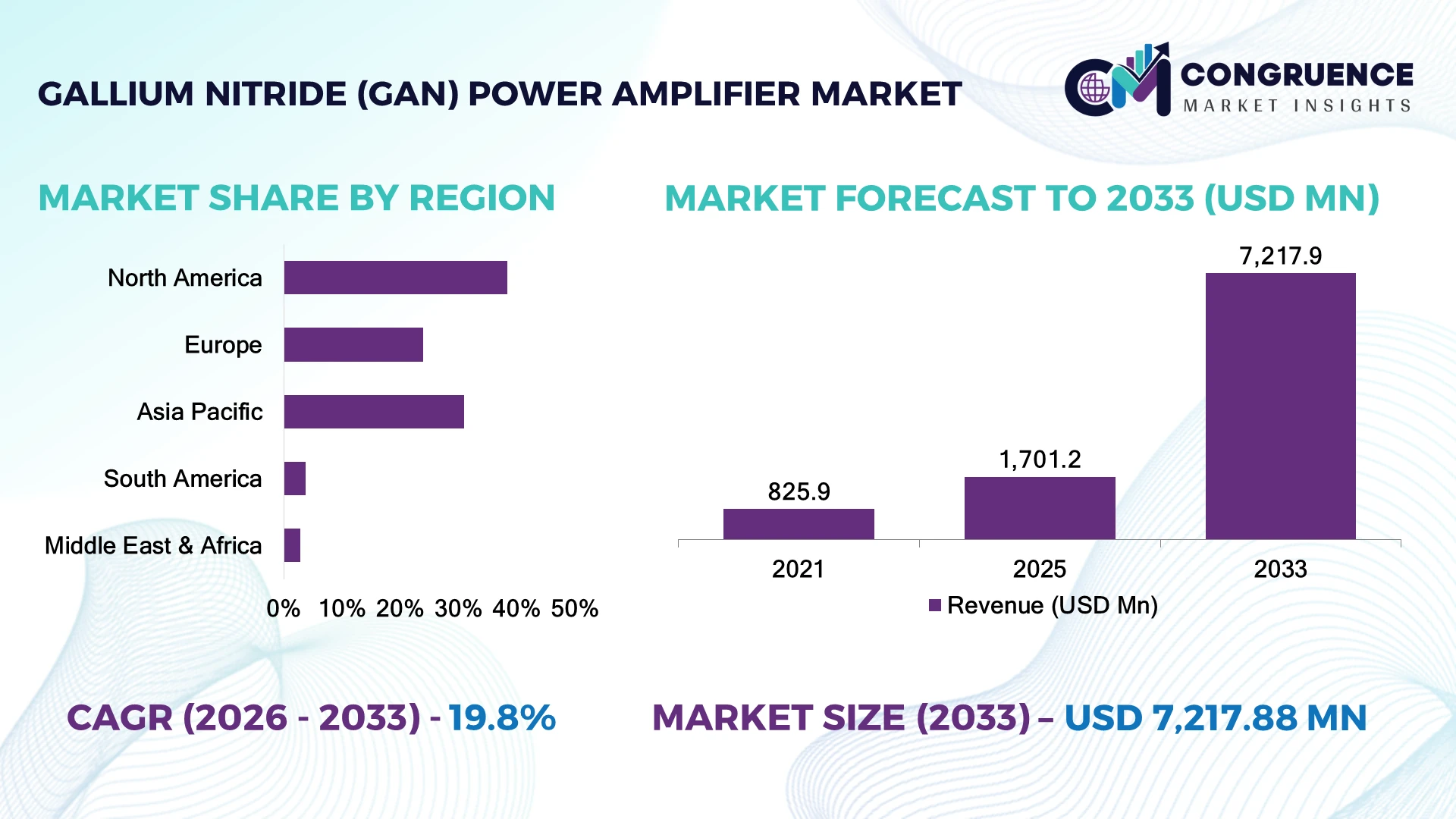
The United States leads the market with approximately 36% global share, supported by substantial defense electronics procurement, over 45% of advanced RF semiconductor design activity, and strong adoption across aerospace, satellite communications, and 5G infrastructure. Japan maintains leadership in GaN wafer manufacturing and high-frequency device innovation, while China continues expanding telecom deployment with more than 4.8 million 5G base stations amid ongoing semiconductor supply-chain realignment driven by geopolitical technology restrictions.
Companies securing advanced GaN fabrication capacity and defense-qualified supply chains will strengthen long-term competitive positioning.
Market Size & Growth: USD 1,701.2 million in 2025 to USD 7,217.9 million by 2033 at 19.8% CAGR, driven by 5G, defense modernization, and satellite communications.
Top Growth Drivers: Defense electronics +34%, 5G infrastructure +28%, satellite communications +24%.
Short-Term Forecast: By 2028, amplifier efficiency improves 18% while power consumption declines 15%.
Emerging Technologies: AI-assisted RF optimization, GaN-on-SiC platforms, and advanced beamforming accelerate deployment.
Regional Leaders: North America, Asia-Pacific, and Europe exceed USD 2.3B, USD 2.1B, and USD 1.5B respectively through telecom and defense investments.
Consumer/End-User Trends: Nearly 62% of telecom infrastructure upgrades prioritize high-efficiency GaN amplifiers.
Pilot/Case Example: 2026 defense communication upgrades improve transmission efficiency by 21% using GaN RF modules.
Competitive Landscape: Top five suppliers control approximately 57%, led by Qorvo, Wolfspeed, MACOM, NXP, and Infineon.
Regulatory & ESG Impact: Higher-efficiency RF systems reduce energy losses by approximately 17%.
Investment & Funding: More than USD 2.8 billion supports wafer capacity expansion, strategic partnerships, and advanced packaging.
Innovation & Future Outlook: Monolithic integration and higher-frequency architectures strengthen next-generation RF performance amid global supply-chain diversification.
Gallium Nitride (GaN) power amplifiers are gaining rapid traction across defense radar, low-Earth-orbit satellites, Open RAN infrastructure, and industrial RF systems. Advanced thermal packaging and GaN-on-SiC innovation improve power density by nearly 25%, while semiconductor supply-chain localization continues influencing procurement strategies. These developments are reshaping product differentiation and set the stage for broader strategic market evolution.
Gallium Nitride (GaN) power amplifiers have become strategically important as governments and telecom operators prioritize resilient communications, electronic warfare capabilities, and next-generation wireless infrastructure. Semiconductor supply-chain restructuring following export-control measures is accelerating regional manufacturing investments, while defense modernization programs increasingly specify high-efficiency RF components. These shifts are transforming GaN from a specialized technology into a core competitive differentiator across commercial and mission-critical applications.
Compared with legacy LDMOS amplifiers, GaN solutions deliver approximately 30% higher power density and nearly 20% greater energy efficiency while supporting wider bandwidths and higher operating frequencies. North America leads in defense-qualified GaN deployment, whereas Asia-Pacific dominates manufacturing scale and wafer production. Over the next two to three years, more than 60% of newly deployed high-power RF systems are expected to integrate GaN-based architectures for enhanced operational performance and reduced cooling requirements.
Telecom equipment manufacturers are integrating GaN amplifiers into massive MIMO base stations to improve signal quality while lowering operating costs. Companies are expanding wafer capacity, strengthening foundry partnerships, and investing in advanced packaging technologies to secure long-term supply. Organizations combining manufacturing resilience, RF innovation, and application-specific optimization will establish durable competitive advantages across the evolving GaN power amplifier ecosystem.
Rising investment in defense electronics and next-generation wireless infrastructure is accelerating GaN power amplifier deployment across high-frequency RF systems. More than 65% of newly designed active electronically scanned array (AESA) radar programs now specify GaN technology, while energy efficiency improves by nearly 20% compared with conventional RF architectures. Japan and the United States continue expanding advanced semiconductor fabrication capabilities following supply-chain security initiatives and export-control policies affecting critical chips. This structural shift enables higher power density, longer operating life, and lower cooling requirements. In response, manufacturers are increasing GaN-on-SiC production, expanding strategic foundry partnerships, and investing in advanced packaging technologies to secure qualified supply. Early capacity expansion now provides a measurable competitive advantage in defense and telecom procurement.
Limited availability of high-quality GaN substrates and specialized fabrication capacity continues to restrict production scalability. GaN-on-SiC wafers typically cost 35–45% more than conventional RF semiconductor substrates, while manufacturing yields remain approximately 10–15% lower during advanced production cycles. Export restrictions affecting semiconductor equipment and compound materials have added procurement complexity for manufacturers in China and Europe. These factors increase qualification timelines, pressure operating margins, and delay commercial deployment across telecom and aerospace applications. Companies are mitigating risk through dual-source wafer procurement, localized manufacturing investments, long-term supply agreements, and expanded GaN-on-silicon development programs that reduce dependence on premium substrate availability while improving supply resilience.
The rapid evolution of Open RAN architecture, low-Earth-orbit satellite networks, and electronically steerable antennas is creating high-value opportunities for GaN power amplifiers. Advanced digital beamforming improves transmission efficiency by approximately 22%, while compact GaN modules reduce thermal management requirements by nearly 18%. India and South Korea are accelerating telecom modernization through domestic semiconductor initiatives supporting RF innovation and localized manufacturing. Companies are expanding R&D into monolithic microwave integrated circuits, heterogeneous packaging, and AI-assisted RF optimization to improve network performance. A non-obvious opportunity lies in replacing multiple discrete RF stages with integrated GaN modules, reducing component count while simplifying system integration for communications, aerospace, and industrial infrastructure developers.
Integrating GaN power amplifiers into next-generation communication, defense, and satellite platforms requires rigorous thermal engineering, electromagnetic compatibility validation, and lengthy certification cycles. More than 40% of development schedules are influenced by system-level integration and qualification rather than semiconductor fabrication itself, while advanced RF packaging increases engineering complexity by roughly 25%. The United States continues tightening performance and security requirements for defense-grade electronics, raising validation standards across suppliers. These pressures affect deployment consistency, interoperability, and product scalability. Companies must strengthen co-design capabilities, invest in automated RF testing platforms, collaborate with system integrators, and expand advanced packaging expertise to sustain long-term competitiveness in high-frequency semiconductor applications.
AI-Driven RF Optimization AI-assisted RF tuning is improving amplifier efficiency by nearly 16% while reducing calibration time by 30%. Telecom equipment manufacturers are embedding machine-learning algorithms into network optimization workflows, enabling faster deployment and lower operational costs as operators automate increasingly complex 5G radio infrastructure.
Advanced Packaging Evolution Heterogeneous integration and advanced thermal packaging improve heat dissipation by approximately 20% and reduce module footprint by nearly 18%. Japan-based manufacturers are scaling wafer-level packaging capabilities to address higher power-density requirements, strengthening product reliability for aerospace, defense, and satellite communication systems.
Open RAN Deployment Expansion Open RAN programs now account for more than 28% of new mobile infrastructure projects in several advanced telecom markets. Operators increasingly deploy GaN amplifiers to improve energy efficiency and signal quality, while equipment vendors establish strategic partnerships to standardize interoperable RF platforms across diverse network ecosystems.
Domestic Semiconductor Localization Supply-chain diversification initiatives have increased regional semiconductor investment activity by over 30%, encouraging localized GaN fabrication and assembly. Manufacturers are expanding qualified production capacity, strengthening foundry collaborations, and diversifying critical material sourcing to improve delivery reliability amid continuing geopolitical technology restrictions and evolving export controls.
High-power GaN power amplifiers account for approximately 54% of the market, supported by widespread deployment in defense radar, satellite communications, and high-capacity telecom infrastructure. Their ability to deliver superior power density, thermal stability, and high-frequency performance makes them the preferred solution for mission-critical RF applications. Medium-power variants remain essential across industrial RF systems and commercial wireless equipment due to balanced performance and lower integration costs. Companies continue investing in advanced GaN-on-SiC architectures, achieving efficiency improvements exceeding 18% while strengthening long-duration operational reliability.
Broadband GaN power amplifiers represent the fastest-growing segment as Open RAN, electronic warfare, and multi-band communication platforms increasingly require wider frequency coverage. Narrowband products continue serving established aerospace and legacy infrastructure applications where application-specific optimization remains critical. Manufacturers are expanding modular product portfolios, strengthening foundry collaborations, and introducing compact amplifier modules that simplify system integration while addressing evolving defense and telecom procurement priorities.
According to findings published by the IEEE Microwave Theory and Technology Society during 2025, next-generation GaN RF amplifier development increasingly prioritizes broadband operation, high-efficiency thermal management, and compact packaging to support advanced radar and 5G communication platforms.
Telecommunications holds approximately 41% of the Gallium Nitride (GaN) power amplifier market, driven by expanding 5G radio infrastructure, massive MIMO deployment, and increasing Open RAN adoption. Network operators favor GaN technology because of higher power efficiency, reduced cooling requirements, and improved signal quality across dense wireless networks. Defense and radar applications remain strategically significant due to sustained modernization programs and increasing demand for electronically scanned array systems requiring high-frequency RF performance.
Satellite communications is the fastest-growing application segment as low-Earth-orbit constellations and broadband connectivity programs accelerate globally. Aerospace, industrial RF, and scientific instrumentation continue expanding through specialized high-frequency applications requiring compact and reliable amplifier designs. Manufacturers are responding through application-specific product optimization, automated RF calibration, and integrated amplifier architectures that improve deployment flexibility while lowering lifecycle operating costs across multiple communication platforms.
A 2026 enterprise assessment by the Global mobile Suppliers Association (GSA) indicated that Open RAN deployments increasingly specify high-efficiency RF architectures, reinforcing demand for advanced GaN-based power amplifier technologies across next-generation wireless infrastructure.
Telecommunication service providers represent approximately 39% of total demand, reflecting continuous investment in 5G network expansion, capacity enhancement, and high-frequency wireless infrastructure. Their large-scale deployment requirements, extensive base station upgrades, and focus on energy-efficient RF systems sustain leadership within the market. Defense organizations remain another major purchasing group, driven by advanced radar, electronic warfare, and secure communication modernization initiatives requiring high-performance GaN amplifier technologies.
Aerospace and satellite operators constitute the fastest-growing end-user segment as commercial space launches and low-Earth-orbit satellite deployments expand. Industrial electronics manufacturers and research institutions continue adopting GaN amplifiers for specialized RF testing, medical, and scientific applications. Suppliers are tailoring product portfolios through application-specific customization, long-term supply agreements, and collaborative development programs to strengthen customer retention while addressing increasingly differentiated performance requirements across strategic end-user segments.
A 2025 enterprise survey released by the Aerospace Industries Association highlighted that high-frequency RF systems remain among the fastest-growing investment priorities for satellite communications and next-generation aerospace electronics, supporting broader deployment of GaN amplifier technologies.
North America accounted for the largest market share at 38.4% in 2025 however, Asia-Pacific is expected to register the fastest growth, expanding at a CAGR of 21.3% between 2026 and 2033.

Defense electronics and advanced RF innovation reinforce regional leadership
North America maintains its leading position through strong defense procurement, advanced semiconductor design capabilities, and large-scale 5G infrastructure modernization. The region contributes nearly 38.4% of global demand, supported by extensive deployment of GaN power amplifiers across radar systems, satellite communications, aerospace electronics, and Open RAN networks. More than 60% of newly developed defense-grade RF systems in the region incorporate GaN technology due to superior power density and thermal efficiency. Continued investment in domestic semiconductor manufacturing and advanced packaging facilities is strengthening supply resilience while accelerating commercialization of next-generation RF devices. Equipment vendors are expanding collaborations with telecom operators, defense contractors, and semiconductor foundries to improve product qualification cycles and manufacturing scalability.
United States Market Outlook: The United States remains the region's strategic center for GaN power amplifier development, driven by world-leading defense programs, advanced RF semiconductor research, and large-scale telecom infrastructure investments. The country accounts for more than 80% of North America's defense-related GaN deployment activity and continues expanding domestic compound semiconductor manufacturing. Strong collaboration between defense agencies, commercial foundries, and wireless equipment manufacturers reinforces technology leadership across aerospace, satellite communications, and next-generation wireless networks.
Semiconductor sovereignty initiatives accelerate RF technology adoption
Europe is strengthening its position through semiconductor localization programs, aerospace modernization, and expanding secure communication infrastructure. The region represents approximately 24% of global demand, with increasing adoption across defense electronics, industrial RF systems, and satellite communications. Public-private semiconductor initiatives are encouraging greater investment in compound semiconductor manufacturing while improving supply-chain resilience. Manufacturers are focusing on GaN-on-SiC technologies, advanced packaging, and high-frequency RF modules to support telecommunications, automotive radar, and space applications with enhanced operational efficiency.
Germany Market Outlook: Germany leads the European market through its advanced semiconductor ecosystem, automotive electronics expertise, and industrial research capabilities. More than 35% of Europe's compound semiconductor manufacturing investment is concentrated in Germany, supporting innovation across RF power electronics, aerospace communication systems, and industrial automation. Continued collaboration between research institutes and semiconductor manufacturers is accelerating commercialization of high-performance GaN technologies.
Manufacturing scale and telecom expansion drive rapid deployment
Asia-Pacific is emerging as the fastest-growing market due to expanding semiconductor fabrication capacity, aggressive 5G infrastructure deployment, and strong investment in consumer electronics and defense manufacturing. The region accounts for approximately 31% of global demand while producing a significant share of GaN wafers and RF semiconductor components. Telecom equipment suppliers continue expanding high-volume production capabilities as governments strengthen domestic semiconductor ecosystems. Investments in advanced wafer fabrication, packaging technologies, and integrated RF module manufacturing are improving supply security and lowering production costs.
China Market Outlook: China leads regional deployment through large-scale telecom infrastructure projects, domestic semiconductor investment, and rapidly expanding compound semiconductor manufacturing. The country operates more than 4.8 million 5G base stations, creating sustained demand for high-frequency RF components. Local manufacturers continue strengthening vertically integrated supply chains while increasing investments in GaN wafer processing and advanced packaging technologies to reduce external technology dependence.
Telecommunications modernization supports emerging demand
South America is witnessing gradual expansion as telecom modernization, satellite connectivity projects, and defense communication upgrades increase demand for advanced RF technologies. Brazil represents the largest regional market, supported by expanding wireless infrastructure and industrial electronics investment. Operators are replacing legacy RF equipment with higher-efficiency semiconductor platforms to improve network performance and energy utilization. Although dependence on imported semiconductor components remains high, partnerships with global technology providers are improving technology transfer and deployment capabilities.
Brazil Market Outlook: Brazil leads regional adoption through nationwide telecom infrastructure expansion, satellite communication projects, and increasing defense modernization initiatives. More than 40% of South America's advanced wireless infrastructure investment is concentrated in Brazil, creating demand for high-performance RF amplifiers. Continued government-backed digital connectivity programs are encouraging equipment upgrades and strengthening long-term opportunities for GaN-based communication technologies.
Strategic communications infrastructure fuels investment momentum
The Middle East & Africa market is expanding through defense modernization, satellite communication projects, and next-generation wireless infrastructure investments. Gulf countries are increasing deployment of secure communication systems while supporting smart city initiatives requiring advanced RF technologies. Infrastructure diversification and digital transformation programs are encouraging adoption of high-efficiency semiconductor solutions for aerospace, telecom, and public security applications. Strategic partnerships with international technology providers continue strengthening regional deployment capabilities and technical expertise.
Saudi Arabia Market Outlook: Saudi Arabia has become the region's leading market through sustained investment in digital infrastructure, defense capability enhancement, and advanced communication networks. National industrial diversification initiatives are encouraging local participation in high-value semiconductor technologies while expanding secure wireless communication infrastructure. Ongoing deployment of next-generation connectivity projects is creating strong demand for reliable, high-performance GaN power amplifier solutions across commercial and government sectors.
Global RF semiconductor leaders including Qorvo, MACOM, Wolfspeed, Infineon Technologies, and NXP Semiconductors compete directly in high-frequency communications and defense applications, while specialized GaN foundries challenge integrated device manufacturers through flexible manufacturing and faster product customization. The top five companies collectively command approximately 58% of the market. Competition centers on power density, thermal efficiency, and supply security, with GaN-on-SiC platforms delivering nearly 20% higher efficiency and advanced packaging reducing module size by approximately 18%. Leading suppliers are expanding internal wafer capacity, forming defense partnerships, strengthening vertically integrated manufacturing, and accelerating qualification of space-grade and telecom RF solutions. The competitive shift increasingly favors companies controlling wafer production, packaging, and RF design under one ecosystem as governments prioritize resilient semiconductor supply chains. High capital investment, stringent defense certification, and complex RF validation remain major entry barriers. Sustainable leadership depends on manufacturing scale, differentiated RF performance, secure supply networks, and rapid commercialization of next-generation GaN technologies.
Qorvo Inc.
MACOM Technology Solutions Holdings, Inc.
Wolfspeed, Inc.
Infineon Technologies AG
NXP Semiconductors N.V.
Mitsubishi Electric Corporation
Sumitomo Electric Device Innovations, Inc.
Ampleon Netherlands B.V.
WIN Semiconductors Corp.
Microchip Technology Inc.
RFHIC Corporation
Teledyne e2v
Analog Devices, Inc.
Gallium Nitride technology is redefining RF power amplification through GaN-on-SiC substrates, advanced monolithic microwave integrated circuits (MMICs), and high-density thermal packaging. More than 60% of new defense and satellite RF designs now prioritize GaN architectures because they deliver higher operating frequencies and lower thermal losses. AI-assisted RF tuning improves amplifier efficiency by approximately 15%, while automated calibration reduces commissioning time by nearly 25%, enabling faster deployment across telecom and aerospace infrastructure.
Compared with conventional LDMOS technology, GaN power amplifiers provide nearly 30% greater power density and around 20% higher energy efficiency while reducing cooling requirements. Advanced wafer-level packaging and heterogeneous integration improve module reliability by approximately 18% while shrinking board space. Integrated device manufacturers with in-house wafer fabrication benefit most by shortening qualification cycles, improving supply security, and accelerating product launches for defense, Open RAN, and satellite communication markets.
Between 2026 and 2028, digital beamforming integration, 300 mm GaN wafer production, and advanced chiplet-based RF architectures will reshape competitive dynamics. Wider adoption of software-defined RF systems and compact multi-band amplifier modules will strengthen operational flexibility while reducing total system complexity. Companies investing early in advanced manufacturing, packaging innovation, and vertically integrated GaN ecosystems will establish lasting technological and commercial leadership.
September 2024 Infineon Technologies announced the world's first scalable 300 mm GaN wafer technology for high-volume manufacturing, enabling significantly higher chip output per wafer and improving long-term manufacturing efficiency. Source: Infineon Technologies (Infineon Technologies)
November 2024 Infineon Technologies launched its CoolGaN 650 V G5 transistor family, delivering improved switching performance and supporting future transition to 12-inch manufacturing for stronger GaN supply capability. Source: Infineon Technologies (Infineon Technologies)
June 2025 Qorvo introduced its QPA1722 GaN-on-SiC K-band power amplifier for LEO satellites, delivering three times greater instantaneous bandwidth, a 38% smaller footprint, and 10% higher efficiency for advanced satellite payloads. Source: Qorvo (Qorvo)
June 2025 Mitsubishi Electric successfully verified the world's first compact 7 GHz GaN power amplifier module for 5G-Advanced base stations, demonstrating industry-leading power efficiency to simplify deployment and support future 6G infrastructure. Source: Mitsubishi Electric press release. (Mitsubishi Electric)
The report provides a comprehensive assessment of the Gallium Nitride (GaN) Power Amplifier market across major product types, RF applications, end-user industries, and key geographic regions. It evaluates deployment trends spanning telecommunications, defense, satellite communications, aerospace, industrial RF, and scientific applications while examining technology adoption, product differentiation, and manufacturing developments. The analysis covers demand distribution, application intensity, semiconductor ecosystem evolution, and competitive participation across more than 13 leading industry participants.
The study delivers strategic insights into regional manufacturing capabilities, supply-chain positioning, advanced GaN technologies, and evolving customer procurement priorities between 2026 and 2033. It supports investment planning, capacity expansion, product portfolio optimization, competitive benchmarking, and market-entry decisions through detailed segmentation analysis, technology assessment, regional opportunity evaluation, and operational intelligence, enabling stakeholders to identify high-value growth areas and strengthen long-term competitive positioning in the global RF semiconductor industry.
| Report Attribute/Metric | Report Details |
|---|---|
|
Market Revenue in 2025 |
USD 1,701.2 Million |
|
Market Revenue in 2033 |
USD 7,217.9 Million |
|
CAGR (2026 - 2033) |
19.8% |
|
Base Year |
2025 |
|
Forecast Period |
2026 - 2033 |
|
Historic Period |
2021 - 2025 |
|
Segments Covered |
By Type
By Application
By End-User
|
|
Key Report Deliverable |
Revenue Forecast, Growth Trends, Market Dynamics, Segmental Overview, Regional and Country-wise Analysis, Competition Landscape |
|
Region Covered |
North America, Europe, Asia-Pacific, South America, Middle East, Africa |
|
Key Players Analyzed |
Qorvo Inc., MACOM Technology Solutions Holdings, Inc., Wolfspeed, Inc., Infineon Technologies AG, NXP Semiconductors N.V., Mitsubishi Electric Corporation, Sumitomo Electric Device Innovations, Inc., Ampleon Netherlands B.V., WIN Semiconductors Corp., Microchip Technology Inc., RFHIC Corporation, Teledyne e2v, Analog Devices, Inc. |
|
Customization & Pricing |
Available on Request (10% Customization is Free) |




