
Reports
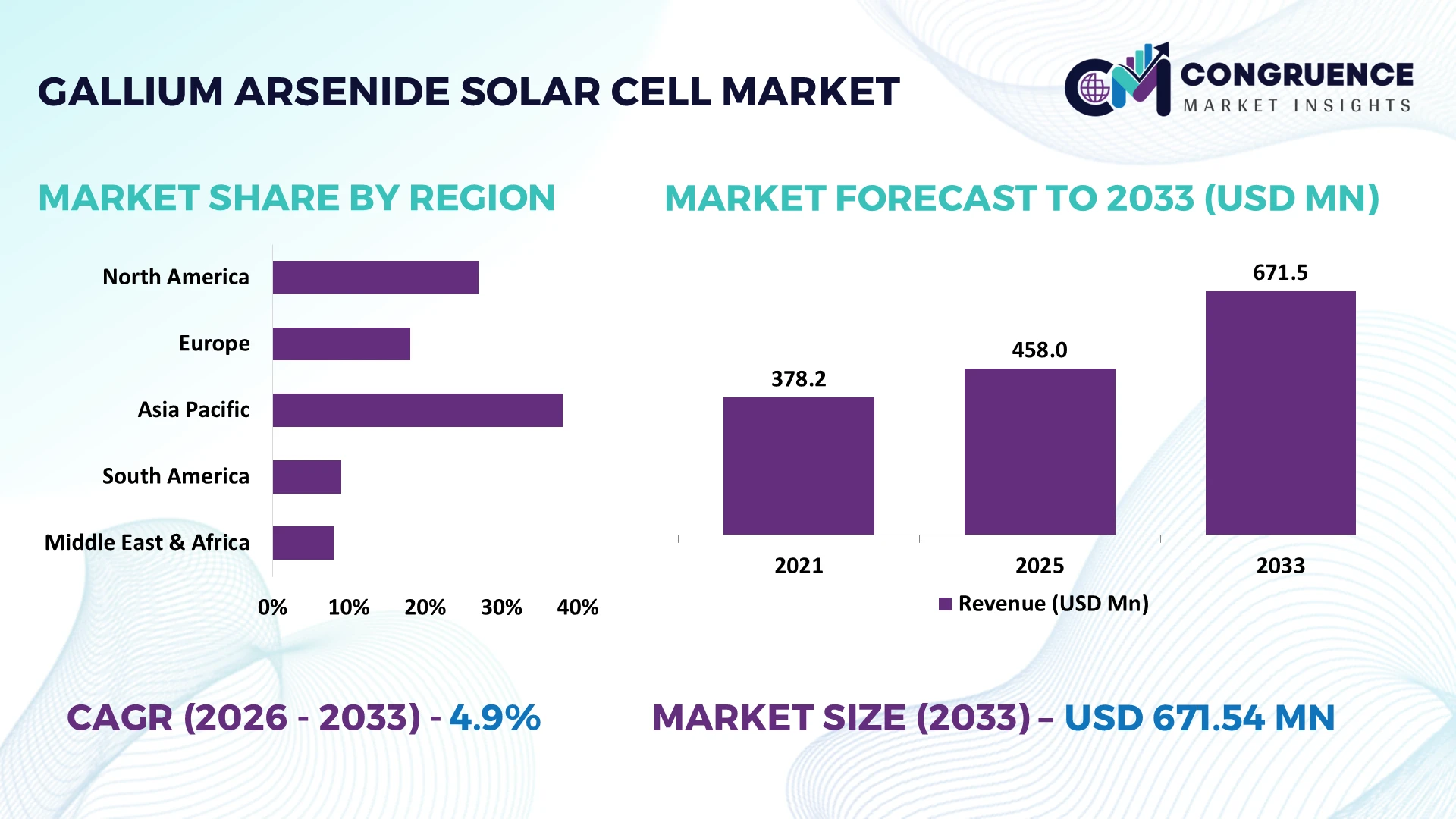
The Global Gallium Arsenide Solar Cell Market was valued at USD 458.0 Million in 2025 and is anticipated to reach a value of USD 671.5 Million by 2033 expanding at a CAGR of 4.9% between 2026 and 2033. Growth is anchored in commercial space constellation deployment and flexible solar wing adoption, where GaAs cells deliver unmatched power-to-weight ratios for low-earth-orbit satellites.
China commands an estimated 45% of global GaAs solar cell production capacity, with Tianjin serving as a critical manufacturing hub hosting over 120 MOCVD reactors dedicated to GaAs epitaxy, supported by sustained provincial investment in compound semiconductor infrastructure. Comparative advantage sits with China's vertically integrated supply chain, where domestic players achieve 33%+ flexible triple-junction conversion efficiency versus 30% for legacy rigid configurations.
Strategic implication, capacity localization and flexible-substrate differentiation now determine competitive positioning across aerospace-grade procurement cycles.
Market Size & Growth: Valued at USD 458.0 Million in 2025, forecast to USD 671.5 Million by 2033 with 4.9% CAGR; commercial satellite constellation expansion drives volume uptake.
Top Growth Drivers: Commercial space investment surge (38%), flexible solar wing adoption (29%), and defense UAV power requirements (18%) collectively anchor near-term expansion.
Short-Term Forecast: By 2027, flexible triple-junction cell weight reduction reaches 67% versus rigid equivalents, cutting satellite launch payload costs proportionally.
Emerging Technologies: Substrate-removal techniques for gallium recovery, four- and five-junction rigid cell architectures reaching 34.5% AM0 efficiency, and automated MOCVD epitaxy scaling.
Regional Leaders: China leads with domestic production capacity exceeding 40,000 kW annually; North America prioritizes satellite-grade procurement; Europe emphasizes supply chain resilience under semiconductor sovereignty initiatives.
Consumer/End-User Trends: Satellite manufacturers increasingly specify flexible GaAs over rigid panels, with flexible configurations capturing an estimated 31% of new commercial satellite solar array designs.
Pilot/Case Example: 2025, Sanan Optoelectronics Tianjin facility, substrate-removal gallium recycling achieved material recovery rates enabling measurable reduction in per-watt substrate costs.
Competitive Landscape: Top five producers—Spectrolab, Rocket Lab, AZUR SPACE, Shanghai Institute of Space Power-Sources, and CETC Lantian—command over 80% combined market share.
Regulatory & ESG Impact: Export controls on gallium critical raw materials since 2023 accelerated non-China supply diversification, with EU semiconductor sovereignty measures targeting reduced import dependency.
Investment & Funding: Compound semiconductor infrastructure investment in China's Tianjin hub exceeds 120 dedicated MOCVD installations, signaling sustained capex commitment to GaAs epitaxy capacity.
Innovation & Future Outlook: Next-generation five-junction architectures and substrate-recycling processes target simultaneous efficiency gains and material cost deflation, shifting competition toward sustainable high-volume manufacturing.
The Gallium Arsenide Solar Cell Market serves space, defense, and concentrated photovoltaic applications where conversion efficiency and radiation tolerance justify premium pricing. Recent product innovations center on flexible triple-junction cells achieving 33%+ AM0 efficiency and substrate-removal processes enabling gallium recovery. An emerging operational trend involves commercial satellite operators procuring flexible solar wings as standard, driven by launch cost economics where cell weight reduction of 67% directly lowers payload expenses. This cost-performance dynamic now shapes procurement strategy across both established aerospace contractors and emerging constellation developers.
Gallium arsenide solar cells have transitioned from niche aerospace components to strategic enablers of commercial space infrastructure, where power-to-weight performance directly determines satellite economics and constellation viability. The supply chain is undergoing active restructuring: China's export controls on gallium since 2023 prompted Western aerospace procurement officers to qualify alternative suppliers across Germany, Japan, and domestic US capacity, extending lead times but reducing single-source exposure.
Technologically, flexible triple-junction GaAs cells at 33%+ AM0 efficiency outperform legacy rigid silicon alternatives by more than 10 percentage points in space environments, while substrate-removal techniques cut cell weight to one-third of rigid equivalents. Regionally, China's Tianjin cluster concentrates over 120 GaAs MOCVD reactors for high-volume epitaxy, whereas US and European production remains oriented toward defense-grade satellite orders with lower volume and higher customization.
Operationally, satellite integrators now specify flexible GaAs arrays at contract signature rather than as post-design upgrades, embedding power-performance assumptions into platform architectures. Companies are responding by co-locating epitaxy, chip fabrication, and testing within single facilities to compress cycle times. Over the next two to three years, qualification of four-junction architectures and substrate-recycling maturity will determine which suppliers capture constellation-scale awards. Competitive positioning hinges on manufacturing yield discipline and material recovery capability—not merely cell efficiency records.
Commercial satellite operators are shifting procurement toward flexible GaAs arrays because weight reduction directly reduces launch costs, with flexible cells weighing under one-third of rigid equivalents. China's Tianjin cluster operates over 120 dedicated GaAs MOCVD reactors, reflecting capacity commitments aligned to constellation demand forecasts. Sanan Optoelectronics now supplies multiple international commercial space customers, with international sales exceeding domestic volumes—a signal that export-grade qualification is achievable at scale. The structural shift is unambiguous: satellite platform designers no longer treat solar array efficiency as a secondary specification but as a primary determinant of payload capacity and orbital lifetime economics. Companies that lock in flexible-substrate yield advantages early will control pricing power across multi-year constellation procurement cycles.
Triple-junction GaAs cells carry production costs several times higher than silicon equivalents, with average unit pricing near USD 300 per watt and industry profit margins around 25%. Gallium and germanium feedstock availability remains geographically concentrated, and export-control measures implemented since 2023 introduced qualification delays for non-China aerospace buyers. The business impact is acute for cost-sensitive constellation operators evaluating high-volume orders: GaAs remains economically defensible only where power-to-weight premiums justify per-watt expenditure. Companies are responding through substrate-removal recycling initiatives that recover gallium from production waste, reducing virgin material dependency, while simultaneously qualifying multi-source epitaxial wafer suppliers to buffer against single-region disruption.
Substrate-removal technology enables gallium recovery from production flows, with the dual benefit of lowering material costs and reducing reliance on primary mining—an operational advantage that aligns with ESG procurement criteria increasingly embedded in aerospace supply contracts. Ground-based concentrated photovoltaic installations represent an underpenetrated demand pool where GaAs efficiency advantages justify system-level economics in high-direct-normal-irradiance regions. Meanwhile, four- and five-junction architectures reaching 34.5% AM0 efficiency create a premium tier for defense and deep-space applications willing to absorb higher per-unit costs. Companies positioning at the intersection of recycling maturity and multi-junction yield leadership will access both volume constellation orders and margin-accretive specialty contracts.
Scaling GaAs cell production from aerospace batch volumes to constellation-scale throughput introduces yield consistency risks across epitaxy, lithography, and testing stages. Industry annual production capacity currently ranges from 40,000 to 50,000 kilowatts, a figure that constrains simultaneous fulfillment of multiple large constellation awards. Flexible cell handling adds further complexity: micron-level dimensional precision requirements and thin-substrate fragility increase inspection and handling costs. Companies must invest in automated optical inspection and statistical process control infrastructure before committing to multi-year supply agreements. The strategic insight is that manufacturing engineering discipline—not cell efficiency records—will separate reliable constellation suppliers from laboratory-oriented producers over the next competitive cycle.
Flexible Substrates Reshape Satellite Procurement Commercial satellite integrators now specify flexible GaAs arrays at contract signature rather than as post-design upgrades, with flexible configurations capturing approximately 31% of new commercial satellite solar array designs. Substrate-removal processes reduce cell weight to one-third of rigid equivalents, directly lowering launch payload costs. Manufacturers including Sanan Optoelectronics are co-locating epitaxy, fabrication, and testing within single Tianjin facilities to compress qualification cycles for constellation-scale orders.
Gallium Recovery Moves From Pilot to Production Substrate-removal recycling has shifted from laboratory validation to operational deployment, with material recovery rates now supporting measurable reductions in virgin gallium consumption per watt produced. This responds directly to China's 2023 gallium export controls, which extended qualification timelines for non-China aerospace buyers by an estimated 6–9 months. Western suppliers are qualifying multi-source epitaxial wafer vendors while integrating in-house recycling loops, reducing single-region feedstock exposure.
Four-Junction Architectures Enter Qualification Four-junction GaAs cells reaching 34.5% AM0 efficiency are moving through aerospace qualification pipelines, creating a premium tier for defense and deep-space missions. Unlike triple-junction workhorses, these architectures demand tighter lattice-matching control, increasing epitaxy yield sensitivity. Companies are responding by investing in automated optical inspection and statistical process control infrastructure before committing to multi-year supply agreements.
Ground-Based CPV Demand Accelerates Concentrated photovoltaic installations represent an underpenetrated demand pool, with GaAs CPV station capacity expanding in high-direct-normal-irradiance regions. System integrators are standardizing receiver modules around triple-junction cells to capture efficiency advantages over silicon in utility-scale deployments. This creates a volume outlet distinct from aerospace batch production, though qualification standards remain less standardized than satellite-grade procurement.
Triple-junction GaAs solar cells command an estimated 90%+ share of total GaAs solar cell demand, reflecting their position as the workhorse architecture for satellite and aerospace power systems . Dominance rests on a mature manufacturing ecosystem, predictable epitaxial yield, and radiation tolerance validated across decades of orbital deployment. Quadruple-junction cells represent the fastest-growing configuration, with adoption accelerating in defense and deep-space missions requiring 34.5% AM0 efficiency thresholds.
Single- and double-junction types retain niche relevance in cost-sensitive terrestrial CPV and miniaturized sensor applications, though their share continues to erode as triple-junction production costs decline. Companies are concentrating R&D investment on four-junction lattice-matching precision while maintaining triple-junction line utilization to fund next-generation qualification.
Aerospace and space applications account for more than 90% of GaAs solar cell consumption, with satellite power systems representing the dominant demand pool . This concentration reflects the technology's unmatched power-to-weight ratio and radiation hardness in orbital environments, where silicon alternatives require significantly larger array footprints. Ground-based concentrated photovoltaic installations represent the fastest-expanding application segment, with GaAs CPV station demand growing as system integrators standardize receivers around triple-junction cells for high-direct-normal-irradiance deployments.
Military applications, including tactical UAVs and remote energy systems, form a smaller but margin-accretive tier requiring customized form factors. Companies are scaling aerospace-grade production while adapting receiver designs for terrestrial CPV cost structures.
Government space agencies and defense organizations constitute the leading end-user group, commanding an estimated 85%+ of GaAs solar cell procurement value through satellite programs, deep-space missions, and tactical energy systems. Demand concentration reflects the operational intensity of mission-critical power requirements, where failure risk justifies premium per-watt expenditure and qualification cycles spanning 18–24 months.
Commercial satellite constellation operators represent the fastest-growing end-user segment, with procurement behavior shifting from bespoke engineering orders toward volume-based supply agreements tied to constellation deployment schedules. This shift pressures suppliers to demonstrate manufacturing yield consistency at scale rather than laboratory efficiency records. Companies are responding by establishing dedicated commercial space business units and restructuring pricing toward multi-year volume commitments, while maintaining government-grade traceability documentation for defense contracts.
Asia-Pacific accounted for the largest market share at 38% in 2025 however, North America is expected to register the fastest growth, expanding at a CAGR of 5.8% between 2026 and 2033.

North America commands approximately 27% of global GaAs solar cell value, anchored by US defense and civil space procurement where satellite-grade qualification standards command premium pricing. The region's production footprint remains oriented toward high-mix, low-volume defense orders rather than constellation-scale throughput, creating a structural gap between domestic capacity and commercial constellation demand. Spectrolab and Rocket Lab maintain dominant positions in government-grade supply chains, with qualification cycles spanning 18–24 months. Investment momentum is shifting toward flexible-substrate qualification and automated inspection infrastructure to compress cycle times for commercial constellation awards.
United States Market Outlook: The US concentrates nearly all regional GaAs cell procurement through NASA, DoD, and commercial satellite integrators, with Spectrolab retaining the dominant position in space-qualified triple-junction supply. Domestic gallium feedstock dependency remains a strategic vulnerability following export-control measures, prompting qualification of alternative epitaxial wafer sources and in-house recycling initiatives.
Europe holds an estimated 18% of global GaAs solar cell value, with AZUR SPACE serving as the region's anchor space-grade supplier from its Heilbronn facility. The region's strategic posture emphasizes supply chain resilience over volume expansion, driven by semiconductor sovereignty initiatives and gallium feedstock concentration risks. European aerospace contractors are extending qualification timelines to include non-China epitaxial wafer sources, a process adding 6–9 months to procurement cycles but reducing single-region exposure. Investment flows target substrate recycling and material recovery capabilities rather than greenfield epitaxy capacity, reflecting the region's emphasis on circular supply chain resilience.
Germany Market Outlook: Germany anchors European GaAs cell production through AZUR SPACE's Heilbronn operations, supplying space-qualified triple-junction cells to European Space Agency programs and commercial satellite integrators. The country's compound semiconductor research infrastructure supports four-junction architecture development, though commercial qualification remains gated by aerospace-grade traceability requirements.
Asia-Pacific dominates global GaAs solar cell production with approximately 38% of market value, concentrated in China's Tianjin cluster where Sanan Optoelectronics operates 124 MOCVD reactors—the world's largest single-site GaAs epitaxy capacity. The region's manufacturing advantage extends beyond volume: flexible copper-substrate cells achieve 33% AM0 efficiency at 95% yield, versus industry averages below 40%, enabling cost structures approaching one-quarter of rigid equivalents at scale. China's domestic satellite constellation programs and defense modernization absorb an increasing share of regional output, while export-grade qualification opens international commercial channels.
China Market Outlook: China controls the dominant share of global GaAs cell production capacity, with Tianjin-based Sanan Optoelectronics supplying both domestic aerospace programs and international commercial satellite integrators. The country's substrate-removal processes enable 90% gallium recovery from production flows, reducing virgin material dependency amid export-control pressures.
South America represents an estimated 9% of global GaAs solar cell value, with Brazil and Chile concentrating over 75% of regional production capacity. Regional demand is anchored by satellite communication programs and high-reliability terrestrial backup power for telecom infrastructure, though deployment scale remains constrained by limited domestic aerospace manufacturing ecosystems. Brazil's semiconductor industrial base supports substrate preparation and epitaxial growth activities, but qualification infrastructure for space-grade cells remains dependent on international certification pathways. Regional capacity expansion targets 150 MW annually, with space applications absorbing approximately 60% of output.
Brazil Market Outlook: Brazil anchors South American GaAs cell production through its semiconductor industrial base, supporting substrate preparation and epitaxial growth for regional satellite and telecom applications. The country's space program procurement and 5G infrastructure rollouts drive demand for high-reliability photovoltaic solutions, though domestic qualification infrastructure remains limited.
Middle East & Africa accounts for an estimated 8% of global GaAs solar cell value, with demand concentrated in concentrated photovoltaic installations across high-direct-normal-irradiance regions and satellite communication infrastructure for Gulf states. The region's operational profile differs from aerospace-dominated markets: terrestrial CPV deployments leverage GaAs efficiency advantages under concentration ratios exceeding 500 suns, creating demand for receiver modules rather than complete satellite arrays. Investment momentum centers on Gulf sovereign renewable energy programs and satellite broadband infrastructure, though regional manufacturing capacity remains negligible, creating import dependency for specialized cells.
Saudi Arabia Market Outlook: Saudi Arabia drives regional GaAs cell demand through concentrated solar power investments under Vision 2030 renewable energy targets and satellite broadband infrastructure expansion. The country's high direct-normal-irradiance profile supports CPV deployment economics, though procurement remains import-dependent with qualification pathways aligned to international aerospace and terrestrial standards.
Competition in the GaAs solar cell market pits vertically integrated Chinese manufacturers against Western aerospace-qualified specialists. San'an Optoelectronics, Spectrolab, Rocket Lab, AZUR SPACE, and Shanghai Institute of Space Power-Sources command over 80% combined share, with San'an leveraging 124 MOCVD reactors for cost leadership while Spectrolab and AZUR compete on mission heritage and qualification depth . Technology and supply-chain control define competitive positioning: flexible copper-substrate cells achieve 33% AM0 efficiency at 95% yield versus rigid alternatives, shifting procurement criteria toward power-to-weight economics . Players are vertically integrating epitaxy through module assembly—Rocket Lab doubling wafer capacity to 35,000 monthly—while AZUR and Schott collaborate on matched cover glass for supply resilience . The decisive competitive shift is substrate-removal recycling enabling 90% gallium recovery, pressuring non-recycling producers on material cost . Entry barriers are formidable: aerospace qualification cycles span 18–24 months, and MOCVD equipment access is constrained by export controls. Winning requires simultaneous mastery of yield consistency at constellation scale and material recovery economics—neither laboratory efficiency records nor legacy heritage alone suffices.
Spectrolab (Boeing)
Rocket Lab
AZUR SPACE Solar Power
San'an Optoelectronics
Shanghai Institute of Space Power-Sources
CETC Blue Sky Technology / Tianjin Lantian Solar Tech
KINGSOON (Nanchang Kingsoon Photoelectric)
Emcore
Xiamen Changelight
CESI
Uniwatt
Dr Technology
Triple-junction GaAs cells remain the production workhorse, with Spectrolab's XTE+ GEO achieving 32.6% AM0 efficiency and over 98% on-time delivery . Flexible copper-substrate architectures now deliver 33% efficiency at 95% yield, with substrate-removal enabling 90% gallium recovery and cost reduction to one-quarter of rigid equivalents post-scale . This represents a greater than 10% efficiency improvement over legacy rigid silicon in space environments.
Quadruple-junction cells are entering qualification, with Spectrolab's large-area QJ test builds averaging 30.1% BOL efficiency, positioning them for defense and deep-space missions requiring higher voltage and radiation tolerance . Concurrently, bandgap-grading research from CETC Blue Sky targets radiation-resistance improvements in low-quality GaAs cells, addressing orbital degradation .
Between 2026 and 2028, substrate recycling maturity and four-junction yield consistency will determine competitive separation. Companies investing now in automated inspection and epitaxy process control—rather than pursuing efficiency records alone—will capture constellation-scale awards. San'an's 124-reactor scale and Rocket Lab's capacity expansion to 35,000 wafers monthly signal that manufacturing discipline, not laboratory performance, is the decisive technology battleground .
August 2025, Rocket Lab Announced expanded U.S. investments to double compound semiconductor and space-grade solar cell capacity from 20,000 to nearly 35,000 wafers monthly, strengthening domestic supply chain resilience for national security spacecraft programs. Source: investors.rocketlabcorp.com
December 2025, AZUR SPACE / Schott Launched cerium-doped space solar cover glass with CTE of 6.9 × 10⁻⁶ K⁻¹ matched to GaAs cells, developed with ESA and DLR backing to establish resilient European supply chain for next-generation satellite power systems. Source: pv-magazine.com
December 2025, KINGSOON Received formal commendation from Shanghai Institute of Space Power-Sources for GaAs solar cells supporting Chang'e lunar, Tianwen Mars, and space station missions, validating aerospace-grade quality and delivery reliability through 2025. Source: kingsoonchina.com
April 2026, Spectrolab Qualified XTE+ triple-junction cells achieving 32.6% AM0 efficiency with over 98% on-time delivery, while advancing quadruple-junction cells and automated coverglass bonding for constellation-scale production. Source: spw.aerospace.org
This report delivers a comprehensive examination of the global GaAs solar cell market, spanning product types from single-junction through quadruple-junction architectures and applications across aerospace, military, and civilian sectors. End-user coverage encompasses government space agencies, defense organizations, and commercial satellite constellation operators, with regional analysis across Asia-Pacific, North America, Europe, South America, and the Middle East & Africa.
The report integrates quantitative indicators including segment distribution, adoption patterns, and manufacturing capacity trends—such as San'an's 124 MOCVD reactors and Rocket Lab's expansion to 35,000 monthly wafers—alongside qualitative assessment of qualification pathways, supply-chain restructuring, and material recovery economics . Company profiles cover twelve key participants, with competitive positioning analyzed through capacity scale, technology maturity, and regional supply resilience.
Strategic coverage supports investment planning through identification of high-growth application niches, expansion strategy via manufacturing footprint assessment, and competitive positioning through yield discipline and substrate recycling capability evaluation. Forward-looking analysis addresses technology transition pathways—including flexible substrates and four-junction qualification—between 2026 and 2033, providing decision-makers with actionable intelligence on market direction and operational priorities.
| Report Attribute / Metric | Details |
|---|---|
| Market Revenue (2025) | USD 458.0 Million |
| Market Revenue (2033) | USD 671.5 Million |
| CAGR (2026–2033) | 4.9% |
| Base Year | 2025 |
| Forecast Period | 2026–2033 |
| Historic Period | 2021–2025 |
| Segments Covered |
By Type
By Application
By End-User
|
| Key Deliverables | Revenue Forecast; Market Trends; Growth Drivers & Restraints; Technology Insights; Segmentation Analysis; Regional Insights; Competitive Landscape; Regulatory & ESG Overview; Recent Developments |
| Regions Covered | North America; Europe; Asia-Pacific; South America; Middle East & Africa |
| Companies Profiled | Spectrolab (Boeing); Rocket Lab; AZUR SPACE Solar Power; San'an Optoelectronics; Shanghai Institute of Space Power-Sources; CETC Blue Sky Technology / Tianjin Lantian Solar Tech; KINGSOON (Nanchang Kingsoon Photoelectric); Emcore; Xiamen Changelight; CESI; Uniwatt; Dr Technology |
| Customization & Pricing | Available on Request (10% Customization Free) |




