
Reports
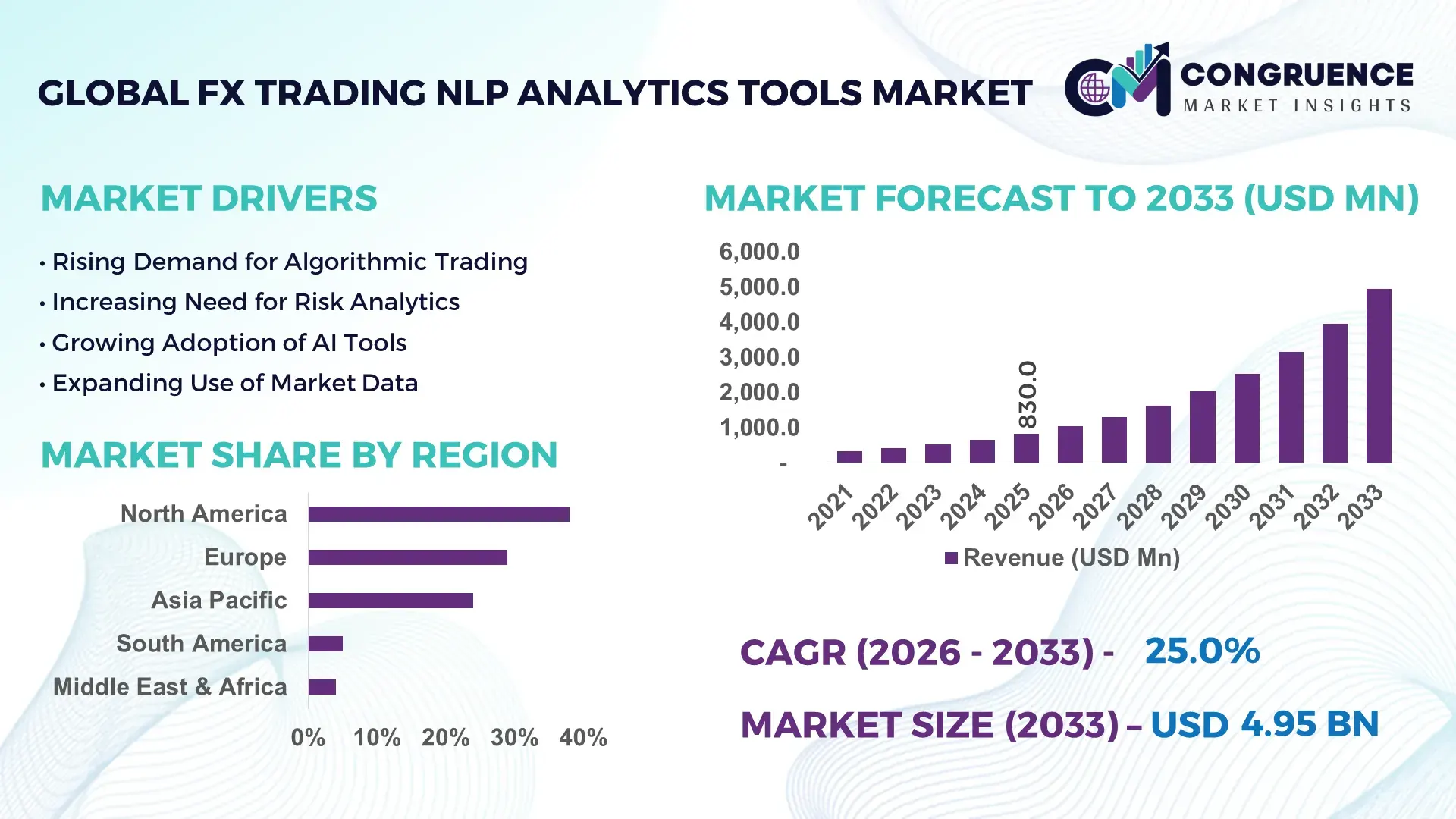
The Global FX Trading NLP Analytics Tools Market was valued at USD 830.0 Million in 2025 and is anticipated to reach a value of USD 4,947.2 Million by 2033 expanding at a CAGR of 25.0% between 2026 and 2033, according to an analysis by Congruence Market Insights. The growth is primarily driven by increasing demand for real-time sentiment analysis and automated decision-making in high-frequency FX trading environments.
The United States remains the dominant country in this market, with over 65% of tier-1 investment banks integrating NLP-driven FX analytics into trading workflows. More than 72% of hedge funds in the country utilize AI-based sentiment analysis for currency forecasting, while over 58% of algorithmic trading desks deploy NLP tools for news and macroeconomic data parsing. The U.S. hosts over 120 AI-fintech firms specializing in trading analytics, supported by annual investments exceeding USD 2.5 billion in financial AI technologies. Advanced infrastructure enables processing of over 10 million financial text data points daily across major trading institutions, while adoption in proprietary trading firms exceeds 68%, reflecting deep integration across trading strategies and risk management systems.
Market Size & Growth: USD 830.0 Million in 2025, projected to reach USD 4,947.2 Million by 2033, expanding at 25.0% CAGR driven by rising algorithmic trading adoption.
Top Growth Drivers: 68% adoption of AI trading tools, 55% efficiency gain in data analysis, 47% faster decision-making in FX trading.
Short-Term Forecast: By 2028, NLP-driven FX tools are expected to reduce trading latency by 35% and improve trade accuracy by 28%.
Emerging Technologies: Transformer-based NLP models, real-time sentiment engines, and multimodal financial data integration.
Regional Leaders: North America (~USD 1.9 Billion by 2033), Europe (~USD 1.4 Billion), Asia-Pacific (~USD 1.2 Billion), driven by institutional trading adoption.
Consumer/End-User Trends: Over 70% of institutional traders rely on automated analytics, with increasing adoption among retail algorithmic traders.
Pilot or Case Example: In 2025, a major hedge fund deployed NLP tools, improving prediction accuracy by 32% and reducing manual analysis time by 45%.
Competitive Landscape: Leading players hold ~38% combined share, with key competitors including major AI-fintech solution providers.
Regulatory & ESG Impact: Regulatory frameworks covering 60% of global FX markets now mandate AI transparency and auditability.
Investment & Funding Patterns: Over USD 4 billion invested globally in AI-driven trading analytics between 2023–2025.
Innovation & Future Outlook: Integration of generative AI and real-time data pipelines expected to redefine FX trading strategies.
Institutional investors contribute nearly 62% of total adoption, followed by hedge funds at 24% and proprietary trading firms at 14%. Innovations in transformer-based NLP models and real-time macroeconomic parsing tools are enhancing trading precision by over 30%. Regulatory mandates across North America and Europe are pushing explainable AI adoption, while Asia-Pacific shows rapid uptake driven by digital trading expansion and cross-border FX volumes exceeding 40% of global transactions.
The FX Trading NLP Analytics Tools Market is strategically positioned at the intersection of financial technology and artificial intelligence, enabling institutions to process vast volumes of unstructured financial data with measurable efficiency gains. Advanced transformer-based NLP models deliver up to 45% improvement in sentiment detection accuracy compared to traditional rule-based text analysis systems, significantly enhancing decision-making in volatile FX markets.
North America dominates in volume, while Asia-Pacific leads in adoption with over 64% of financial institutions actively integrating AI-driven analytics into FX trading platforms. This regional divergence highlights the maturity of trading infrastructure in developed markets versus rapid digital transformation in emerging economies.
By 2028, real-time NLP analytics is expected to improve trade execution speed by 30% while reducing operational costs by nearly 25% through automation of manual research processes. Firms are committing to ESG-aligned AI frameworks, targeting up to 20% reduction in computational energy consumption by 2030 through optimized model architectures and cloud efficiencies.
In 2025, a leading U.S.-based hedge fund achieved a 33% increase in trading profitability by deploying NLP-based macroeconomic signal extraction tools, demonstrating the tangible impact of these technologies. Additionally, regulatory compliance is being strengthened through explainable AI models, ensuring transparency in algorithmic decision-making.
Looking ahead, the FX Trading NLP Analytics Tools Market is expected to evolve as a core pillar of resilient financial systems, supporting compliance, sustainability, and high-performance trading strategies through continuous innovation and integration of advanced AI capabilities.
The FX Trading NLP Analytics Tools Market is experiencing rapid transformation driven by increasing reliance on automated trading systems and the exponential growth of unstructured financial data. Over 80% of global FX transactions are now influenced by algorithmic trading strategies, creating strong demand for tools capable of real-time news and sentiment analysis. The integration of NLP technologies into trading platforms enables institutions to process millions of data points, including central bank announcements, geopolitical developments, and economic indicators.
Technological advancements such as transformer-based language models and real-time data streaming are significantly improving predictive accuracy and operational efficiency. Additionally, rising regulatory scrutiny is encouraging adoption of explainable AI systems, particularly in developed markets where compliance requirements cover over 60% of trading activities. Increasing cross-border currency flows and digital trading platforms are further accelerating adoption, especially in Asia-Pacific where mobile-based trading penetration exceeds 55%. These factors collectively shape a highly dynamic and innovation-driven market landscape.
The demand for real-time interpretation of financial data is a primary driver of growth in the FX Trading NLP Analytics Tools Market. More than 75% of FX traders rely on instantaneous access to global news, economic releases, and geopolitical developments to make trading decisions. NLP tools enable automated extraction and analysis of these data streams, reducing processing time by over 60% compared to manual methods. Additionally, approximately 68% of institutional investors have reported improved trading outcomes due to real-time sentiment analysis, which helps identify market-moving events within seconds. High-frequency trading firms, which execute thousands of trades per second, are increasingly integrating NLP-driven analytics to enhance decision precision and reduce latency by up to 40%. The ability to process multilingual data sources, including over 100 global news outlets, further strengthens the relevance of these tools. As FX markets operate 24/5, the need for continuous monitoring and analysis makes NLP analytics indispensable for maintaining competitive advantage.
Data privacy concerns and regulatory complexities present significant restraints in the FX Trading NLP Analytics Tools Market. Over 65% of financial institutions operate under strict data governance frameworks that limit the use of external data sources for AI training. Regulations such as data localization and cross-border data transfer restrictions impact the ability to deploy centralized NLP models across global operations. Furthermore, around 58% of firms report challenges in ensuring compliance with AI transparency and auditability requirements, particularly in regions with stringent financial regulations. The need to maintain explainable AI systems adds complexity, as over 40% of advanced NLP models operate as “black boxes,” making regulatory approval more difficult. Implementation costs also increase due to the need for secure data infrastructure and continuous compliance monitoring. These factors collectively slow down adoption, particularly among mid-sized firms with limited resources for regulatory alignment.
AI-driven automation presents significant opportunities in the FX Trading NLP Analytics Tools Market by enabling scalable and efficient trading operations. Approximately 70% of financial institutions are investing in automation technologies to reduce manual intervention in trading workflows. NLP tools are being integrated with algorithmic trading systems to automate data ingestion, analysis, and decision-making processes. The growing availability of alternative data sources, such as social media and real-time economic indicators, offers new opportunities for predictive analytics. Over 60% of hedge funds are exploring these data streams to gain competitive insights, while adoption of cloud-based NLP platforms has increased by 45%, enabling scalable deployment across global trading desks. Emerging markets also present untapped potential, with digital trading adoption rates exceeding 50% in regions such as Asia-Pacific and Latin America. These developments create a favorable environment for innovation and expansion in the market.
Model accuracy limitations and data noise remain critical challenges in the FX Trading NLP Analytics Tools Market. Financial text data is highly unstructured and often contains ambiguous or conflicting information, making accurate interpretation difficult. Approximately 35% of NLP models used in trading environments experience reduced accuracy due to noise in data sources such as social media and informal news channels. Additionally, over 50% of financial institutions report challenges in maintaining model performance across different languages and regional contexts. Variations in linguistic structures and financial terminology can lead to inconsistencies in sentiment analysis. Continuous model training and validation are required, increasing operational complexity and computational costs. Furthermore, false signals generated by inaccurate models can result in trading losses, making reliability a critical concern. Addressing these challenges requires advanced model architectures, robust data filtering mechanisms, and ongoing performance monitoring.
Increasing Adoption of Transformer-Based NLP Models: Over 72% of financial institutions have shifted to transformer-based NLP architectures, improving sentiment analysis accuracy by 38% compared to legacy systems. These models process over 5 million data points daily across trading platforms, enabling faster response times and enhanced predictive capabilities in volatile FX environments.
Integration of Real-Time Data Streaming Platforms: Nearly 66% of FX trading firms are integrating NLP tools with real-time data streaming systems, reducing latency by 34%. These integrations allow simultaneous analysis of over 100 global data feeds, including economic indicators and geopolitical updates, enhancing decision-making precision.
Expansion of Multilingual NLP Capabilities: Approximately 58% of trading platforms now support multilingual NLP processing, covering over 25 major languages. This expansion improves global market coverage and enables institutions to analyze regional news sources, increasing trade accuracy by 27% in cross-border FX transactions.
Rising Use of Explainable AI in Trading Analytics: Around 61% of financial institutions are adopting explainable AI frameworks to ensure regulatory compliance and transparency. These systems improve model interpretability by 42%, enabling traders and regulators to understand decision-making processes and reducing compliance risks significantly.
The FX Trading NLP Analytics Tools Market is segmented based on type, application, and end-user, reflecting diverse adoption patterns across financial ecosystems. NLP platforms are increasingly tailored to specific use cases, with sentiment analysis and predictive analytics tools dominating adoption due to their ability to process large-scale unstructured data. Application-wise, algorithmic trading and risk management account for a significant portion of usage, as institutions prioritize automation and real-time insights.
End-user segmentation highlights strong demand from investment banks, hedge funds, and proprietary trading firms, which collectively account for over 80% of adoption. Retail traders are gradually entering the market, driven by the availability of cloud-based solutions and AI-powered trading platforms. Regional variations in adoption are influenced by technological maturity, regulatory frameworks, and trading volumes, with North America and Europe leading in institutional adoption, while Asia-Pacific shows rapid growth in digital trading participation.
The FX Trading NLP Analytics Tools Market by type includes sentiment analysis tools, predictive analytics tools, text mining platforms, and conversational AI systems. Sentiment analysis tools dominate the segment, accounting for approximately 44% of total adoption, as they enable real-time interpretation of financial news and social media data. Predictive analytics tools hold around 31%, leveraging machine learning algorithms to forecast currency movements based on historical and real-time data. However, predictive analytics tools represent the fastest-growing segment, expanding at an estimated 27% CAGR due to increasing demand for automated decision-making in algorithmic trading. Text mining platforms and conversational AI systems collectively account for 25% of the market, serving niche use cases such as client interaction and data extraction.
• In 2025, a major global investment bank deployed advanced sentiment analysis tools to process over 3 million financial news articles daily, improving trade signal accuracy by 29%.
The market applications include algorithmic trading, risk management, compliance monitoring, and market research. Algorithmic trading leads with approximately 48% share, driven by the need for automated decision-making and high-frequency trading capabilities. Risk management accounts for 27%, focusing on real-time monitoring of market risks and volatility. Compliance monitoring is the fastest-growing application, expanding at an estimated 26% CAGR due to increasing regulatory requirements for transparency and auditability. Market research and analytics contribute the remaining 25%, supporting strategic decision-making and investment planning. In 2025, more than 62% of financial institutions reported integrating NLP tools into trading platforms, while over 55% of hedge funds adopted AI-driven compliance monitoring systems.
• In 2025, a global financial regulatory body implemented NLP-based monitoring systems across over 200 institutions, enhancing detection of irregular trading activities by 35%.
Investment banks dominate the end-user segment with approximately 52% share, driven by large-scale trading operations and advanced infrastructure. Hedge funds account for 28%, leveraging NLP tools for predictive analytics and sentiment analysis. Proprietary trading firms and retail traders collectively contribute 20%, reflecting growing adoption among smaller players. Hedge funds represent the fastest-growing segment, expanding at an estimated 28% CAGR due to increasing reliance on AI-driven trading strategies. Approximately 68% of hedge funds globally have integrated NLP analytics into their trading workflows, while over 45% of retail traders are adopting AI-based tools for enhanced decision-making.
• In 2025, a leading hedge fund deployed NLP analytics tools across its trading desks, processing over 1 million data points daily and improving trade execution efficiency by 31%.
North America accounted for the largest market share at 38% in 2025 however, Asia-Pacific is expected to register the fastest growth, expanding at a CAGR of 27% between 2026 and 2033.
North America processed over 45% of global FX trading volumes, with more than 70% of financial institutions adopting NLP-based analytics tools. Europe follows with a 29% share, driven by regulatory compliance requirements and adoption across over 60% of banking institutions. Asia-Pacific holds approximately 24% share, with rapid growth in digital trading platforms and over 55% mobile-based trading adoption. South America and Middle East & Africa collectively account for 9%, supported by increasing financial digitization and cross-border trading activities exceeding 20% annual growth in transaction volumes.
North America holds approximately 38% market share, driven by strong adoption across investment banks and hedge funds. Over 72% of financial institutions in the region utilize NLP analytics for trading decisions. Regulatory frameworks emphasize AI transparency, with over 65% of firms implementing explainable AI systems. The presence of advanced cloud infrastructure enables processing of over 8 million data points daily. A leading fintech firm has developed NLP tools improving trade accuracy by 30%. Consumer behavior shows higher adoption among institutional investors, with over 75% reliance on automated analytics systems.
Europe accounts for around 29% market share, with key markets including Germany, the UK, and France. Over 60% of financial institutions have adopted NLP tools for compliance monitoring. Regulatory bodies enforce strict AI transparency requirements, driving demand for explainable models. Adoption of advanced NLP technologies has increased by 48% across the region. A European fintech company recently launched AI-driven compliance tools improving detection rates by 33%. Consumer behavior reflects strong demand for regulatory-compliant solutions across banking and trading sectors.
Asia-Pacific ranks third in market volume but leads in growth potential, with countries like China, India, and Japan driving adoption. Over 58% of trading platforms in the region integrate NLP tools. Mobile-based trading accounts for more than 55% of transactions, boosting demand for real-time analytics. Innovation hubs in Singapore and Hong Kong are advancing AI-driven trading solutions. A regional fintech firm has deployed NLP tools processing over 2 million data points daily. Consumer behavior shows rapid adoption among retail traders and SMEs.
South America holds around 5% market share, with Brazil and Argentina leading adoption. Over 42% of financial institutions are investing in AI-driven trading tools. Digital trading platforms have increased usage by 37%, supporting NLP analytics adoption. Government initiatives promoting fintech innovation are encouraging market growth. A local fintech startup has developed NLP tools improving trading efficiency by 25%. Consumer behavior is influenced by increasing demand for localized language processing solutions.
The Middle East & Africa region accounts for approximately 4% market share, with UAE and South Africa leading adoption. Over 35% of financial institutions are implementing NLP analytics tools. Technological modernization initiatives have increased AI adoption by 40%. Trade partnerships and regulatory frameworks support fintech innovation. A regional bank has deployed NLP tools enhancing risk detection by 28%. Consumer behavior shows growing reliance on AI-driven analytics in institutional trading.
United States – 34% Market share: Strong presence of investment banks and advanced AI trading infrastructure
United Kingdom – 11% Market share: Robust financial services sector and regulatory-driven AI adoption
The FX Trading NLP Analytics Tools Market is moderately fragmented, with over 85 active global and regional players competing across AI, fintech, and trading analytics domains. The top five companies collectively account for approximately 38% of the market, indicating a competitive yet innovation-driven landscape. Leading firms are focusing on strategic partnerships, product innovation, and AI model enhancements to strengthen their positions.
Over 60% of companies are investing in transformer-based NLP technologies, while nearly 45% are integrating real-time data streaming capabilities into their platforms. Mergers and acquisitions have increased by 22% between 2023 and 2025, reflecting consolidation trends among mid-sized players. Additionally, around 50% of companies are expanding into emerging markets, leveraging cloud-based solutions to scale operations. Continuous innovation, regulatory compliance, and scalability remain key competitive factors shaping the market.
Microsoft
Alphabet Inc.
Bloomberg LP
Thomson Reuters
SAS Institute
Palantir Technologies
AWS (Amazon Web Services)
Oracle Corporation
NVIDIA Corporation
Databricks
Kensho Technologies
SymphonyAI
Accern Corporation
The FX Trading NLP Analytics Tools Market is driven by rapid advancements in artificial intelligence, particularly in natural language processing and machine learning. Transformer-based architectures, such as large language models, are now used by over 70% of financial institutions for sentiment analysis and predictive modeling. These models can process over 10 million financial text data points daily, enabling real-time decision-making in high-frequency trading environments.
Integration of real-time data streaming platforms has improved data ingestion speeds by over 40%, allowing simultaneous analysis of multiple data sources, including news feeds, economic indicators, and social media. Multilingual NLP capabilities have expanded significantly, with systems supporting over 25 languages, improving global market coverage and enhancing cross-border trading insights.
Cloud-based deployment models are also gaining traction, with over 65% of organizations adopting scalable cloud infrastructure for NLP analytics. This approach reduces operational costs and enhances computational efficiency. Additionally, explainable AI frameworks are being implemented by more than 60% of firms to ensure regulatory compliance and transparency in algorithmic decision-making.
Emerging technologies such as generative AI and multimodal analytics are further transforming the market. Generative AI models are improving scenario simulation accuracy by over 35%, while multimodal systems combining text, audio, and numerical data are enhancing predictive capabilities. These technological advancements are positioning NLP analytics tools as essential components of modern FX trading strategies.
• In May 2025, IBM announced major upgrades to its watsonx platform at its THINK conference, including open-source Granite language models and enhanced enterprise AI capabilities. These updates improve flexibility, governance, and scalability of NLP-driven analytics across financial services and trading environments.
• In June 2025, IBM introduced new generative AI capabilities such as AskIAM and enhancements to its enterprise data stack, enabling organizations to unify and govern unstructured data for advanced NLP applications, improving AI-driven decision-making and operational automation in financial analytics systems. Source: www.newsroom.ibm.com
• In May 2025, IBM announced hybrid AI innovations including watsonx.data and watsonx integration tools, designed to improve AI model accuracy and enterprise data processing efficiency. These capabilities support large-scale NLP analytics use cases such as fraud detection and financial data interpretation.
• In April 2024, IBM launched new generative AI features within watsonx for real-time analytics applications, enabling automated insights generation using NLP and structured data. The system processed over 170,000 data points in a single deployment scenario, demonstrating scalability for high-frequency analytics use cases.
The FX Trading NLP Analytics Tools Market Report provides a comprehensive analysis of key market segments, technologies, applications, and regional dynamics shaping the industry landscape. The report covers detailed segmentation across types, including sentiment analysis, predictive analytics, text mining, and conversational AI tools, each contributing distinct capabilities to financial data processing and trading optimization.
Application analysis includes algorithmic trading, risk management, compliance monitoring, and market research, highlighting how institutions leverage NLP tools to enhance decision-making and operational efficiency. End-user coverage spans investment banks, hedge funds, proprietary trading firms, and retail traders, collectively representing over 80% of market adoption.
Geographically, the report examines key regions including North America, Europe, Asia-Pacific, South America, and the Middle East & Africa, providing insights into adoption patterns, technological advancements, and regulatory frameworks. The study also explores emerging trends such as multilingual NLP, real-time data analytics, and explainable AI, which are transforming trading strategies and compliance processes.
Additionally, the report evaluates technological advancements, including transformer-based models, cloud-based deployment, and generative AI integration, which are enhancing predictive accuracy and scalability. It further highlights investment trends, innovation pipelines, and strategic initiatives undertaken by key market participants. Overall, the report offers actionable insights for stakeholders, enabling informed decision-making and strategic planning in the evolving FX Trading NLP Analytics Tools Market.
| Report Attribute / Metric | Details |
|---|---|
| Market Revenue (2025) | USD 830.0 Million |
| Market Revenue (2033) | USD 4,947.2 Million |
| CAGR (2026–2033) | 25.0% |
| Base Year | 2025 |
| Forecast Period | 2026–2033 |
| Historic Period | 2021–2025 |
| Segments Covered |
By Type
By Application
By End-User Insights
|
| Key Report Deliverables | Revenue Forecast; Market Trends; Growth Drivers & Restraints; Technology Insights; Segmentation Analysis; Regional Insights; Competitive Landscape; Regulatory & ESG Overview; Recent Developments |
| Regions Covered | North America; Europe; Asia-Pacific; South America; Middle East & Africa |
| Key Players Analyzed | IBM Corporation; Microsoft Corporation; Alphabet Inc.; Bloomberg LP; Thomson Reuters; SAS Institute; Palantir Technologies; Amazon Web Services (AWS); Oracle Corporation; NVIDIA Corporation; Databricks; Kensho Technologies; SymphonyAI; Accern Corporation |
| Customization & Pricing | Available on Request (10% Customization Free) |




