
Reports
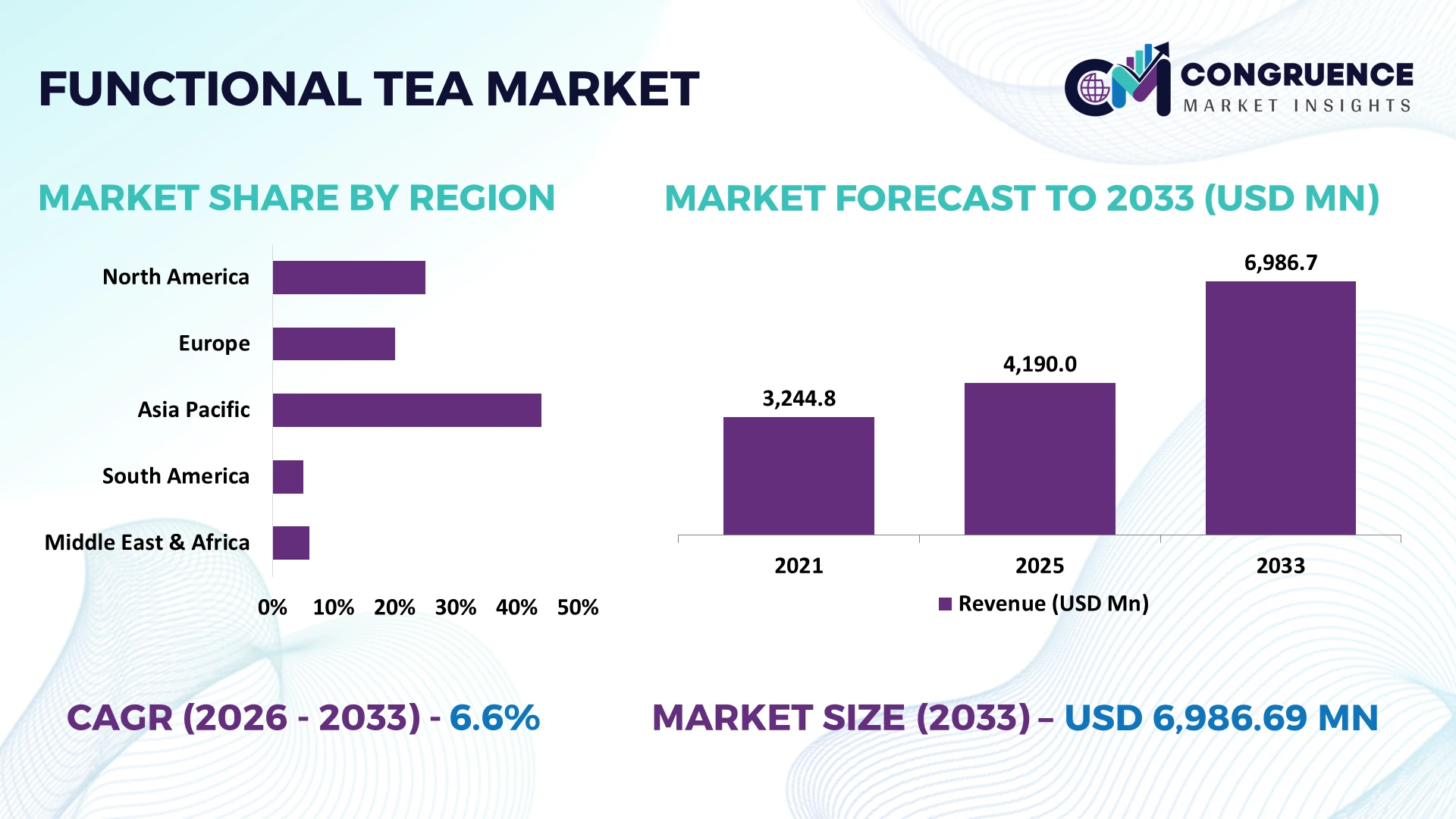
The Global Functional Tea Market was valued at USD 4190 Million in 2025 and is anticipated to reach a value of USD 6986.69 Million by 2033 expanding at a CAGR of 6.6% between 2026 and 2033. Growth is driven by botanical wellness formulations, antioxidant-rich green tea consumption, caffeine-free herbal infusions, and premium functional beverages targeting digestive health, relaxation, and metabolic wellness.
China dominates the functional tea supply ecosystem, producing approximately 3.74 million tonnes of tea in 2024 and accounting for more than 50% of global tea production. Its integrated cultivation, botanical extraction, and beverage processing industries support large-scale functional tea innovation. Compared with India, which produces approximately 1.3 million tonnes annually, China benefits from greater production capacity and established green tea processing infrastructure. Government-supported agricultural modernization and expanding domestic wellness beverage portfolios strengthen its competitive position in premium botanical formulations.
For functional tea manufacturers, China's production scale and India's established sourcing infrastructure create strategic opportunities for diversified botanical procurement, standardized extract quality, and premium product development.
Market Size & Growth: USD 4,190 million in 2025, reaching USD 6,986.69 million by 2033 at 6.6% CAGR, supported by botanical wellness formulations.
Top Growth Drivers: Wellness perceptions influence 51% of surveyed specialty tea consumers; 39% cite social media and 22% influencer recommendations.
Short-Term Forecast: By 2028, manufacturers can target 15% lower botanical processing losses through improved extraction and automated blending.
Emerging Technologies: Three innovations shape production: microencapsulation, precision extraction, and AI-assisted formulation, improving ingredient stability and product consistency.
Regional Leaders: Indicative 2033 allocations place Asia-Pacific at USD 3,144.01 million, Europe at USD 1,746.67 million, and North America at USD 1,397.34 million.
Consumer/End-User Trends: Nearly 73% of surveyed Indian specialty tea consumers report consuming functional teas, with stress-relief products leading preferences.
Pilot/Case Example: A proposed 2027 botanical extraction pilot targets 20% lower processing losses through temperature-controlled extraction and standardized blending.
Competitive Landscape: Unilever's former tea brands compete with Twinings, Yogi Tea, Traditional Medicinals, and Pukka across premium wellness formulations; leadership shares require verification.
Regulatory & ESG Impact: European health-claim rules require scientific substantiation; compliant labeling targets 100% verification of marketed functional claims.
Investment & Funding: VAHDAM India secured USD 3 million in March 2025 to strengthen product innovation, manufacturing, and international distribution.
Innovation & Future Outlook: Adaptogenic blends, probiotic formulations, and low-sugar ready-to-drink teas are reshaping 3 functional beverage categories.
The Functional Tea Market is evolving from traditional herbal infusions toward targeted wellness beverages addressing relaxation, digestive comfort, hydration, and everyday nutritional preferences. Manufacturers are introducing adaptogenic botanical blends, microencapsulated ingredients, and convenient ready-to-drink formulations to differentiate premium product portfolios. A 2025 tea industry survey identified functional and wellness teas as the leading consumer trend among 25.1% of participating businesses. Ingredient traceability and scientifically substantiated health claims are increasingly important under European food labeling regulations. These developments are reshaping sourcing, product innovation, and distribution strategies, establishing the foundation for strategic market evaluation.
Functional tea is becoming strategically important as beverage manufacturers compete through targeted wellness formulations, botanical ingredient quality, and differentiated consumer positioning. China's production of approximately 3.74 million tonnes of tea in 2024 reinforces its manufacturing advantage, while India's substantial cultivation infrastructure supports diversified ingredient procurement. Increasing scrutiny of functional health claims is shifting investment toward standardized botanical extracts, transparent labeling, and traceable agricultural supply chains. Manufacturers are restructuring procurement relationships to secure consistent ingredient specifications and reduce exposure to agricultural supply disruptions.
Precision extraction and automated blending offer measurable operational advantages over conventional batch processing. Well-controlled production programs can target 15% lower botanical processing losses and 20% faster formulation adjustments, although results depend on equipment configuration. Chinese producers emphasize processing scale, while European brands prioritize ingredient certification and premium product differentiation. During 2026–2028, manufacturers are expected to increase adoption of microencapsulation, standardized extraction, and digital quality monitoring to improve shelf stability and formulation consistency.
A practical deployment involves integrating temperature-controlled extraction with automated ingredient dosing for herbal tea concentrates. Producers are investing in analytical testing, contract manufacturing partnerships, and sustainable packaging to support product expansion. Competitive advantage increasingly depends on scientifically credible formulations, reliable botanical sourcing, and efficient production systems that translate wellness preferences into repeat consumer purchases.
Growing consumer interest in targeted wellness beverages is strengthening functional tea product development. Survey findings indicate that 73% of Indian specialty tea consumers report using functional teas, while 51% of surveyed consumers associate specialty tea with wellness benefits. Social media influences approximately 39% of specialty tea purchasing decisions, reinforcing the importance of digital product education. India's established Ayurvedic botanical ecosystem supports product development using tulsi, ginger, turmeric, and ashwagandha. Manufacturers including Organic India and VAHDAM are expanding wellness-focused tea portfolios and strengthening online distribution. The strategic advantage lies in combining familiar botanical ingredients with convenient consumption formats, enabling manufacturers to differentiate products without relying exclusively on premium pricing or conventional tea flavor positioning.
Agricultural supply variability and inconsistent botanical specifications constrain functional tea manufacturing economics. China contributes more than 50% of global tea production, creating substantial sourcing concentration for selected tea ingredients. India accounts for approximately 20% of global tea output, while Kenya contributes around 8%, exposing international buyers to geographically concentrated agricultural conditions. Weather disruptions, harvesting variability, and inconsistent phytochemical concentrations complicate formulation standardization. European food safety requirements further increase testing obligations for pesticide residues and botanical ingredients. Manufacturers face higher procurement uncertainty, batch rejection risks, and additional quality assurance expenditure. Companies are responding through diversified supplier networks, multiseason purchasing agreements, and standardized extract specifications. Strategic sourcing flexibility increasingly determines whether functional tea brands can maintain consistent product quality without sacrificing margins.
Advanced extraction technologies and targeted botanical formulations create opportunities for premium functional tea innovation. India's specialty tea surveys indicate approximately 73% functional tea consumption among respondents, while 39% report social media influence on purchasing decisions. Additionally, 22% identify influencer recommendations as relevant to product discovery, strengthening opportunities for digitally distributed wellness formulations. Manufacturers are developing microencapsulated botanical extracts, caffeine-free adaptogenic blends, and convenient ready-to-drink products. During 2026–2028, controlled extraction systems can target 15% lower ingredient losses through improved processing efficiency. Indian producers are expanding research partnerships and direct-to-consumer distribution to introduce differentiated botanical combinations. The strongest opportunity lies in translating traditional herbal ingredients into standardized, convenient formulations with consistent sensory characteristics and clearly substantiated functional positioning.
Establishing scientifically defensible functional claims while maintaining consistent botanical performance represents a major long-term challenge. Functional tea formulations frequently combine multiple plant ingredients, complicating ingredient interaction assessment and standardized efficacy testing. European regulations require health claims to meet scientific substantiation standards, while approximately 51% of surveyed specialty tea consumers associate products with wellness benefits, increasing the importance of credible communication. China's contribution of more than 50% of global tea production also highlights the need for consistent analytical testing across extensive supply networks. Manufacturers targeting 100% batch traceability must coordinate agricultural records, laboratory verification, and packaging documentation. Companies are investing in phytochemical profiling, clinical research partnerships, and digital traceability systems. Long-term competitiveness depends on converting botanical differentiation into reproducible product quality and regulatory credibility.
Premium Tea Packaging Gains Retail Importance: Functional tea brands are introducing individually sealed sachets, recyclable cartons, and portion-controlled packaging to improve freshness and shelf presentation. India's packaged tea sector benefits from approximately 1.3 million tonnes of annual domestic tea production, while China produces 3.74 million tonnes. Manufacturers are upgrading automated packaging lines and introducing smaller trial packs to improve inventory turnover and reduce product wastage.
Digital Retail Strengthens Product Discovery: Functional tea manufacturers are expanding marketplace listings, subscription services, and personalized product recommendations. Specialty tea consumer surveys indicate that social media influences 39% of purchasing decisions, while influencer recommendations account for 22%. Brands are integrating customer analytics with direct sales platforms, improving promotional targeting and enabling faster identification of high-performing product formulations across Indian metropolitan markets.
Cold Brew Formats Reshape Consumption: Beverage companies are developing functional teas designed for cold extraction, convenient hydration, and refrigerated retail distribution. Traditional hot brewing typically requires water temperatures between 70°C and 100°C, while cold brewing operates at approximately 4°C to 20°C. Manufacturers are optimizing extraction times and microbiological controls, expanding ready-to-drink portfolios to capture consumption occasions beyond conventional hot beverages.
Ingredient Traceability Reshapes Supplier Relationships: European retailers increasingly require documented botanical origins, pesticide testing, and consistent ingredient specifications. The European Union's organic framework establishes certification requirements, while Regulation 1924/2006 governs nutrition and health claims. Manufacturers are integrating digital batch records and supplier verification systems across 2 critical stages: agricultural procurement and finished-product processing, improving recall readiness and reducing compliance-related supply interruptions.
Herbal Functional Tea Leads Wellness Formulation Demand
Herbal Functional Tea represents the leading segment of the Functional Tea Market, with an indicative 38% share in 2025. Its dominance reflects extensive formulation flexibility, caffeine-free positioning, and established consumer familiarity with ginger, peppermint, chamomile, and tulsi infusions. Indian manufacturers benefit from domestic botanical sourcing networks and traditional herbal product expertise. Green Functional Tea maintains substantial demand through catechin-rich formulations and established antioxidant positioning, representing an indicative 27% of segment consumption. Black Functional Tea remains commercially important because of its familiar flavor profile, established supply chains, and compatibility with functional botanical blends.
Herbal Functional Tea also represents the fastest-growing type, supported by expanding relaxation, digestive wellness, and caffeine-free product portfolios. Oolong Functional Tea occupies a premium niche, combining distinctive processing characteristics with specialty wellness positioning. White Functional Tea attracts consumers seeking minimally processed tea varieties and delicate flavor profiles. Manufacturers are strengthening botanical sourcing partnerships, improving extraction consistency, and expanding premium packaging formats. Competitive investment increasingly favors differentiated ingredient combinations, standardized quality controls, and product formulations aligned with specific consumption occasions.
Digestive Wellness Anchors Functional Tea Consumption
Digestive Health represents the leading application in the Functional Tea Market, accounting for an indicative 30% share in 2025. Consumer familiarity with ginger, peppermint, fennel, and other botanical infusions supports regular purchasing across household and specialty retail channels. Manufacturers emphasize ingredient transparency, caffeine-free formulations, and convenient brewing formats to strengthen repeat consumption. Immunity Support represents another established application, supported by botanical combinations incorporating ginger, turmeric, and tulsi. Weight Management remains commercially relevant through green tea formulations and products positioned around balanced lifestyle routines, although health claims require appropriate scientific substantiation.
Stress Relief and Relaxation represents the fastest-growing application, with an indicative 26% market share, reflecting demand for evening consumption and relaxation-oriented herbal blends. Energy and Mental Focus serves consumers seeking alternatives to conventional caffeinated beverages through green and black tea formulations. Manufacturers are developing differentiated product portfolios, improving flavor balance, and introducing targeted packaging. Strategic investment increasingly emphasizes credible functional positioning and repeat-purchase behavior rather than aggressive therapeutic claims.
Individual Consumers Dominate Functional Tea Purchasing
Individual Consumers represent the leading end-user segment of the Functional Tea Market, accounting for an indicative 54% share in 2025. Household purchasing dominates through recurring consumption, convenient preparation, and increasing interest in botanical beverage alternatives. Consumers select products according to flavor preferences, caffeine content, ingredient familiarity, and perceived wellness benefits. Health and Wellness Centers represent a specialized distribution environment, incorporating functional teas into relaxation and lifestyle programs. Fitness and Nutrition Businesses emphasize hydration, balanced consumption, and botanical beverage options compatible with active lifestyles. These institutional channels support product sampling and differentiated premium positioning.
Retail and E-Commerce Businesses represent the fastest-growing end-user segment, with an indicative 24% share, supported by digital marketplaces, subscription purchasing, and broader specialty product availability. Hotels and Restaurants contribute through premium beverage menus and differentiated hospitality experiences. Manufacturers are expanding online product portfolios, introducing bundled wellness collections, and developing institutional packaging. Competitive positioning increasingly depends on consumer retention, accessible distribution, and consistent product quality across direct and intermediary sales channels.
Asia-Pacific accounted for the largest market share at an estimated 45% in 2025 however, Asia-Pacific is expected to register the fastest growth, expanding at an indicative CAGR of 7.8% between 2026 and 2033.
Premium Wellness Beverages Reshape Consumer Purchasing
North America represents an estimated 20% of the global Functional Tea Market, supported by established specialty beverage distribution, premium herbal tea brands, and growing interest in botanical wellness formulations. The United States and Canada demonstrate concentrated demand for digestive health, relaxation, and antioxidant-oriented tea products. Manufacturers including Traditional Medicinals and Celestial Seasonings are expanding differentiated herbal portfolios through grocery chains, specialty retailers, and digital marketplaces. The International Food Information Council's 2025 consumer research found that 70% of Americans consider healthfulness when selecting food and beverages, reinforcing opportunities for functional product positioning. Retailers increasingly prioritize transparent ingredient labeling, convenient packaging, and differentiated botanical combinations. Manufacturers are investing in standardized ingredient procurement and quality verification to maintain product consistency. Premium functional tea brands compete through formulation credibility, consumer loyalty, and accessible omnichannel distribution rather than conventional tea pricing alone.
United States Market Outlook: The United States benefits from established natural products distribution networks and an extensive specialty beverage manufacturing ecosystem. The Food and Drug Administration regulates food labeling and applicable health claims, encouraging manufacturers to substantiate functional product positioning. American consumers increasingly encounter herbal wellness teas through supermarkets, natural food retailers, and online subscription services. Domestic brands are strengthening botanical sourcing partnerships and introducing caffeine-free formulations to serve relaxation and digestive wellness preferences.
Regulatory Compliance Strengthens Premium Botanical Positioning
Europe accounts for an estimated 25% of the global Functional Tea Market, supported by established herbal infusion consumption, premium specialty tea distribution, and stringent food quality requirements. Germany, the United Kingdom, France, and Italy represent important consumer markets for botanical wellness beverages. European manufacturers emphasize ingredient traceability, organic certification, and scientifically defensible functional positioning. Regulation (EC) No. 1924/2006 governs nutrition and health claims, influencing product labeling and promotional strategies. The European Union's organic production framework further supports standardized certification across agricultural supply chains. Companies including Twinings and Teekanne are expanding herbal infusion portfolios and strengthening sustainable sourcing practices. Retailers increasingly require documented botanical origins and consistent product specifications. Manufacturers are investing in laboratory testing, supplier verification, and premium packaging, enabling differentiated positioning while reducing regulatory and quality assurance risks across multinational distribution networks.
Germany Market Outlook: Germany represents a strategically important European functional tea market through its established herbal infusion culture and specialized botanical processing industry. Companies including Teekanne and Bad Heilbrunner maintain extensive herbal tea portfolios. German manufacturers emphasize pharmaceutical-grade botanical expertise, ingredient verification, and consistent blending processes. The country's established organic retail ecosystem supports premium positioning, while European food safety requirements encourage transparent sourcing and controlled production practices.
Large-Scale Tea Production Supports Botanical Innovation
Asia-Pacific dominates the Functional Tea Market with an estimated 45% share, supported by extensive tea cultivation, established botanical traditions, and large-scale beverage processing infrastructure. China, India, Japan, and South Korea represent important production and consumption centers. China produced approximately 3.74 million tonnes of tea in 2024, accounting for more than 50% of global production and providing substantial raw material availability for functional formulations. India contributes extensive black tea cultivation and an established Ayurvedic botanical ecosystem, supporting herbal wellness product development. Japanese manufacturers emphasize green tea processing and catechin-focused beverage innovation. Regional companies are expanding automated blending, standardized extraction, and convenient packaging technologies to improve product consistency. Established agricultural supply chains enable manufacturers to combine traditional ingredients with modern product development, strengthening domestic distribution and international specialty tea export opportunities.
China Market Outlook: China benefits from extensive tea cultivation regions, established processing clusters, and a strong domestic tea consumption culture. Zhejiang, Fujian, and Yunnan support differentiated tea production and botanical ingredient sourcing. Government agricultural modernization initiatives encourage processing efficiency and product quality improvements. Chinese manufacturers are developing premium green tea blends, botanical infusions, and ready-to-drink wellness beverages, supported by established e-commerce platforms and expanding domestic specialty beverage distribution.
Traditional Herbal Consumption Supports Product Diversification
South America represents an estimated 6% of the global Functional Tea Market, supported by established herbal beverage traditions and increasing commercialization of botanical infusions. Brazil, Argentina, Chile, and Peru represent important consumer and ingredient sourcing markets. Regional demand includes digestive herbal teas, relaxation-oriented infusions, and antioxidant-positioned beverages. Brazil's agricultural infrastructure supports botanical cultivation and beverage processing, while Argentina's established yerba mate industry provides expertise in herbal beverage manufacturing and distribution. Manufacturers are introducing convenient packaged infusions and differentiated botanical blends through supermarkets and specialty retailers. However, uneven premium retail penetration, variable botanical quality standards, and distribution costs constrain broader commercialization. Regional producers are strengthening packaging capabilities, supplier relationships, and retail partnerships to improve product availability. Competitive positioning depends on translating familiar herbal consumption practices into standardized, commercially scalable functional tea portfolios.
Brazil Market Outlook: Brazil represents an important functional tea market through its extensive consumer base, botanical diversity, and established beverage distribution infrastructure. The Brazilian Health Regulatory Agency, ANVISA, oversees applicable food safety and labeling requirements. Manufacturers increasingly incorporate locally familiar ingredients into packaged herbal infusions while developing standardized processing and quality controls. Supermarket expansion and digital retail platforms support wider distribution of premium botanical products, particularly across major metropolitan markets.
Botanical Sourcing and Premium Retail Expansion
The Middle East & Africa accounts for an estimated 4% of the global Functional Tea Market, supported by established tea consumption traditions, agricultural production, and expanding premium beverage retail networks. Kenya, South Africa, the United Arab Emirates, and Saudi Arabia represent important production or consumption centers. Kenya remains a major international tea exporter, while South Africa supplies rooibos, a distinctive caffeine-free botanical ingredient used in functional infusions. The South African Rooibos Council identifies approximately 20,000 hectares of rooibos cultivation, supporting specialized agricultural processing and international distribution. Gulf markets emphasize premium imported herbal blends, hospitality consumption, and specialty retail availability. Manufacturers are expanding ingredient traceability, packaging innovation, and distribution partnerships to strengthen product differentiation. Agricultural producers increasingly prioritize consistent botanical quality and export certification to access higher-value international functional beverage markets.
South Africa Market Outlook: South Africa benefits from established rooibos cultivation and specialized herbal tea processing infrastructure. The Cederberg region provides distinctive agricultural conditions supporting commercial rooibos production. Rooibos received European Union protected designation of origin recognition in 2021, strengthening geographical product differentiation. Manufacturers are expanding organic certification, standardized processing, and international distribution partnerships. The country's botanical expertise supports caffeine-free functional tea innovation and premium export positioning across European and North American markets.
The Functional Tea Market features competition between multinational beverage groups, established specialty tea brands, and botanical wellness innovators. Tata Consumer Products, Twinings, Hain Celestial, Traditional Medicinals, and Yogi Tea compete through distribution scale, herbal formulation expertise, and premium positioning. Their combined functional tea market share is indicatively estimated at 35%, reflecting fragmented product categories and regional purchasing preferences. Consumer research indicates 70% prioritize healthfulness in food purchasing, while 39% of surveyed specialty tea consumers respond to social media and 22% to influencer recommendations. These behaviors intensify competition around product credibility and digital engagement. Established brands leverage retail partnerships and agricultural procurement networks, while specialists emphasize ingredient differentiation and targeted wellness formulations. Regulatory scrutiny of botanical claims and inconsistent agricultural quality create entry barriers. Competitive success requires reliable sourcing, substantiated product positioning, efficient processing, and distribution strategies that convert initial consumer interest into repeat purchasing.
Tata Consumer Products Limited
Associated British Foods plc (Twinings)
The Hain Celestial Group, Inc.
Traditional Medicinals, Inc.
Yogi Tea GmbH
Teekanne GmbH & Co. KG
Organic India Private Limited
VAHDAM India
The Republic of Tea
R.C. Bigelow, Inc.
Dilmah Ceylon Tea Company PLC
Numi Organic Tea
Buddha Teas
Harney & Sons Fine Teas
Current functional tea manufacturing relies on controlled drying, automated blending, botanical extraction, and standardized ingredient testing. Temperature-regulated processing preserves sensory characteristics, while high-performance liquid chromatography verifies selected bioactive compounds. Compared with conventional manual blending, automated dosing systems can target 15% lower ingredient losses and 20% improved batch consistency under optimized operating conditions. Manufacturers in China and India increasingly integrate digital quality monitoring with established tea processing infrastructure, improving production reliability and reducing formulation variability across premium herbal portfolios.
Emerging technologies include microencapsulation, ultrasound-assisted extraction, and precision fermentation for specialized botanical ingredients. Microencapsulation protects sensitive compounds during storage, while ultrasound extraction can improve recovery efficiency by 10% to 25% under validated processing conditions. Digital formulation platforms integrate ingredient specifications, sensory testing, and batch records, enabling faster product development. Specialty tea manufacturers benefit from improved ingredient utilization, while established beverage groups gain competitive advantages through scalable processing and consistent functional positioning.
During 2026–2028, disruptive innovation will emphasize AI-assisted formulation, smart packaging, and traceable botanical supply chains. Predictive analytics can target 15% shorter formulation cycles by identifying ingredient compatibility and processing parameters. Producers integrating laboratory verification with digital traceability strengthen regulatory readiness and product differentiation. Investment priorities increasingly favor validated extraction performance, consistent bioactive profiles, and efficient manufacturing systems that support credible functional tea innovation.
July 2025: Traditional Medicinals broke ground on a USD 47 million, 125,000-square-foot manufacturing facility in Franklin County, Virginia. The expansion strengthens domestic herbal tea production capacity, improves distribution infrastructure, and supports the company's long-term operational scalability across American markets. Source: traditionalmedicinals.com
March 2025: VAHDAM India secured USD 3 million from SIDBI Venture Capital to strengthen product innovation, research, and manufacturing expansion. The investment supports international distribution of teas and botanical wellness products while improving the company's operational flexibility and global competitiveness. Source: livemint.com
September 2025: Yogi introduced 2 organic herbal tea concentrates, Elderberry Lemon Balm and Hibiscus Ginger, exclusively through Target stores and online channels. The launch expands convenient functional beverage formats, supporting digestive and immune wellness positioning while strengthening retail differentiation. Source: prnewswire.com
August 2025: Bigelow Tea launched Golden Turmeric Honey Herbal Tea plus Adaptogens, combining 3 botanical ingredients: turmeric, tulsi, and dandelion root. The caffeine-free formulation strengthens its wellness portfolio, broadens consumer choice, and reinforces differentiation within functional herbal beverages. Source: bigelowtea.com
The Functional Tea Market Report evaluates five product types: Green Functional Tea, Black Functional Tea, Herbal Functional Tea, Oolong Functional Tea, and White Functional Tea. Application analysis covers Weight Management, Digestive Health, Immunity Support, Stress Relief and Relaxation, and Energy and Mental Focus. End-user assessment includes Individual Consumers, Health and Wellness Centers, Fitness and Nutrition Businesses, Hotels and Restaurants, and Retail and E-Commerce Businesses. Geographic coverage examines North America, Europe, Asia-Pacific, South America, and the Middle East & Africa, identifying production advantages, consumer preferences, and distribution structures.
The report profiles 14 influential companies and examines precision extraction, microencapsulation, botanical standardization, and digital traceability. Strategic analysis evaluates ingredient procurement, regulatory compliance, premium product differentiation, and emerging wellness formulations, supporting investment planning, geographic expansion, competitive positioning, and product development decisions throughout 2026–2033.
| Report Attribute/Metric | Report Details |
|---|---|
Market Revenue in 2025 | USD 4190 Million |
Market Revenue in 2033 | USD 6986.69 Million |
CAGR (2026 - 2033) | 6.6% |
Base Year | 2025 |
Forecast Period | 2026 - 2033 |
Historic Period | 2021 - 2025 |
Segments Covered | By Type
By Application
By End-User
|
Key Report Deliverable | Revenue Forecast, Growth Trends, Market Dynamics, Segmental Overview, Regional and Country-wise Analysis, Competition Landscape |
Region Covered | North America, Europe, Asia-Pacific, South America, Middle East, Africa |
Key Players Analyzed | Tata Consumer Products Limited, Associated British Foods plc (Twinings), The Hain Celestial Group, Inc., Traditional Medicinals, Inc., Yogi Tea GmbH, Teekanne GmbH & Co. KG, Organic India Private Limited, VAHDAM India, The Republic of Tea, R.C. Bigelow, Inc., Dilmah Ceylon Tea Company PLC, Numi Organic Tea, Buddha Teas, Harney & Sons Fine Teas |
Customization & Pricing | Available on Request (10% Customization is Free) |