
Reports
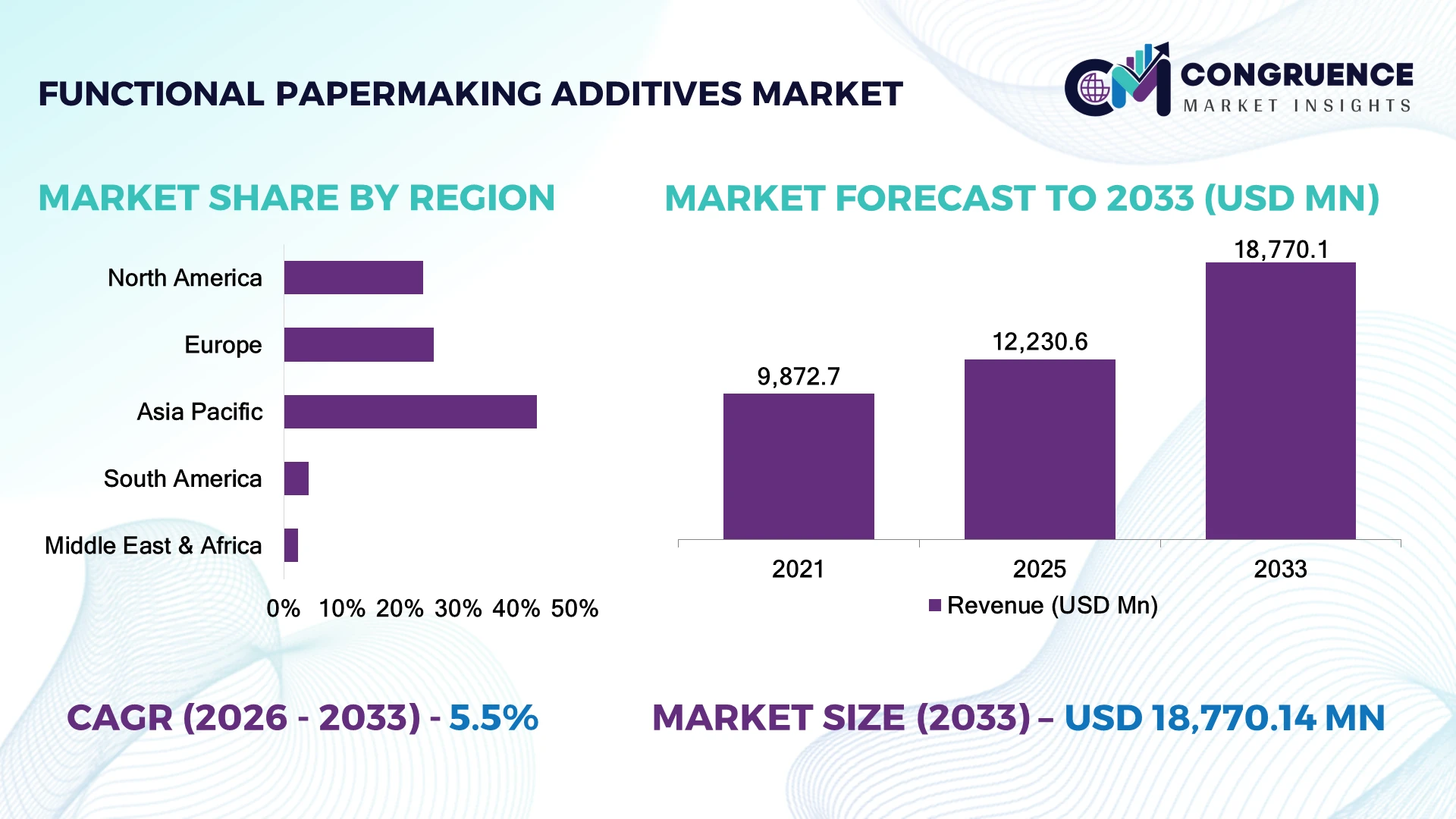
The Global Functional Papermaking Additives Market was valued at USD 12,230.6 Million in 2025 and is anticipated to reach a value of USD 18,770.1 Million by 2033 expanding at a CAGR of 5.5% between 2026 and 2033. Growth is driven by increasing production of sustainable packaging paper, high-performance specialty grades, and advanced wet-end chemical technologies that improve fiber utilization and machine efficiency.
China dominates the market with approximately 31% of global paper production capacity, supported by continuous investment in high-speed paper mills, specialty packaging grades, and digital process automation. More than 68% of newly commissioned paper machines integrate advanced functional additives for strength, retention, and barrier performance. Compared with China, the United States emphasizes premium tissue and packaging chemicals, while China's large-scale manufacturing benefits from ongoing industrial modernization under post-pandemic supply-chain restructuring.
Strategic investment increasingly favors high-value multifunctional additives that improve production efficiency, product performance, and environmental compliance simultaneously.
Market Size & Growth: USD 12,230.6 Million in 2025, reaching USD 18,770.1 Million by 2033 at 5.5%, driven by sustainable packaging paper demand.
Top Growth Drivers: Packaging additives +34%, specialty paper +27%, recycled fiber processing +22%.
Short-Term Forecast: By 2028, chemical consumption per ton declines 11% through optimized dosing technologies.
Emerging Technologies: AI dosing, enzyme-assisted chemistry, and nanocellulose additives improve process stability by 16%.
Regional Leaders: Asia-Pacific leads production, Europe advances circular papermaking, North America strengthens specialty packaging applications.
Consumer/End-User Trends: Nearly 61% of premium packaging grades require multifunctional additive formulations.
Pilot/Case Example: 2026 digital dosing deployment reduced chemical waste by 14% while improving sheet consistency.
Competitive Landscape: Top five suppliers collectively hold approximately 46% share through innovation and integrated chemical portfolios.
Regulatory & ESG Impact: Water consumption declines nearly 12% through optimized wet-end chemistry and process integration.
Investment & Funding: Over USD 900 million supports specialty chemical capacity expansion and mill modernization.
Innovation & Future Outlook: Bio-based additives and smart chemical management redefine high-performance papermaking operations.
Functional Papermaking Additives are becoming indispensable across packaging board, tissue, printing paper, and specialty grades as mills prioritize stronger fiber bonding, improved retention, and lower resource consumption. Nearly 40% of newly upgraded paper machines now incorporate intelligent chemical dosing platforms. Increasing recycled fiber utilization and stricter sustainability targets continue accelerating development of multifunctional additive formulations, setting the stage for broader strategic transformation.
Functional papermaking additives have become a strategic differentiator as paper manufacturers balance production efficiency, recycled fiber utilization, and higher-performance packaging grades. Supply-chain localization, environmental regulations, and growing investment in fiber-based packaging are encouraging mills to adopt advanced chemical programs that simultaneously improve product quality and reduce operating costs. Companies increasingly compete through formulation expertise rather than commodity chemical supply alone.
Modern multifunctional additive systems improve fiber retention by nearly 18% compared with conventional formulations while reducing fresh water demand by approximately 12%. Asia-Pacific continues leading large-scale capacity additions, whereas Europe emphasizes low-emission chemistry and circular manufacturing practices. Over the next two to three years, automated chemical dosing platforms are expected to exceed 50% adoption among newly modernized high-capacity paper mills, improving production consistency and raw-material efficiency.
Packaging paper producers increasingly integrate digital monitoring with retention aids, sizing agents, and strength additives to optimize machine performance in real time. Chemical suppliers are expanding regional manufacturing, investing in bio-based formulations, and partnering directly with paper producers to accelerate customized product development. Long-term competitive advantage will belong to organizations capable of delivering integrated additive technologies that improve machine productivity, product performance, and sustainability without increasing operational complexity.
The rapid shift toward fiber-based packaging and higher recycled fiber utilization is increasing demand for advanced functional papermaking additives. Nearly 64% of newly upgraded packaging paper machines incorporate multifunctional retention, sizing, and strength additives, while optimized wet-end chemistry improves fiber retention by approximately 18% and reduces chemical consumption by nearly 11%. China's continued investment in high-speed packaging paper capacity is accelerating adoption of precision chemical dosing systems. This structural shift enables manufacturers to produce lighter yet stronger paper grades with improved machine efficiency. Chemical suppliers are expanding regional production, investing in bio-based formulations, and collaborating directly with paper mills to develop customized additive solutions that enhance productivity while meeting increasingly stringent environmental performance requirements.
Price fluctuations in specialty monomers, starch derivatives, and performance polymers continue challenging additive manufacturers and paper producers. Raw material procurement costs have fluctuated by nearly 14%, while energy-intensive chemical production raises manufacturing expenses by approximately 10% in several industrial markets. Europe faces persistent pressure from elevated utility costs and environmental compliance obligations, reducing operating flexibility for smaller suppliers. These conditions compress margins, complicate long-term procurement planning, and delay product qualification for specialty paper grades. Companies are responding through diversified sourcing strategies, localized manufacturing, long-term supplier agreements, and greater use of renewable feedstocks to improve supply resilience and stabilize production costs without sacrificing formulation performance.
Digital process optimization and multifunctional additive platforms are creating high-value opportunities beyond conventional papermaking chemistry. AI-assisted dosing systems improve chemical utilization by approximately 15%, while advanced enzyme-assisted formulations enhance recycled fiber performance by nearly 17%. Japan and Finland are expanding smart paper manufacturing through automated process controls integrated with real-time chemical monitoring. Suppliers are investing in predictive analytics, bio-based additives, and modular chemical programs tailored for premium packaging and specialty papers. A significant emerging opportunity lies in combining process automation with customized additive formulations, enabling mills to reduce downtime, improve sheet uniformity, and maximize production efficiency across diverse fiber sources without major equipment modifications.
Integrating advanced additive technologies into existing paper production lines requires precise calibration, skilled operators, and continuous process optimization. More than 42% of paper mills operate mixed-generation equipment, increasing compatibility challenges, while implementation periods can extend production optimization by nearly 20%. India's expanding paper industry illustrates how rapid capacity additions often outpace experienced technical workforce availability. Inconsistent process control affects product quality, machine stability, and resource efficiency when chemical programs are not fully optimized. Companies must strengthen technical service networks, invest in operator training, deploy digital monitoring platforms, and develop integrated automation solutions that simplify implementation while maintaining consistent performance across multiple paper grades.
AI-Based Chemical Optimization Digital chemical dosing platforms are becoming standard across high-capacity paper mills, improving additive utilization by approximately 15% while reducing off-spec production by nearly 10%. Automation minimizes operator intervention and stabilizes wet-end chemistry. Suppliers are expanding digital service offerings and integrating predictive analytics into mill optimization programs.
Bio-Based Additive Expansion Renewable starch derivatives, enzyme-assisted chemistries, and biodegradable functional additives are gaining commercial adoption as sustainability regulations strengthen. Bio-based formulations now represent nearly 28% of new specialty additive developments. Manufacturers are scaling production capacity, forming biotechnology partnerships, and redesigning portfolios to improve environmental performance without compromising paper strength or process efficiency.
Recycled Fiber Performance Enhancement Rising recycled fiber utilization is increasing demand for advanced strength, retention, and drainage additives capable of restoring paper quality. Functional chemical packages improve recycled fiber bonding by approximately 19% while reducing reject rates by nearly 12%. Companies are introducing customized additive systems designed specifically for high-recycled-content packaging and tissue production.
Integrated Mill Digitalization Smart manufacturing platforms increasingly combine online sensors, machine learning, and real-time chemical control to optimize papermaking operations. Mills implementing integrated monitoring report production efficiency improvements approaching 14% and faster grade transitions. Chemical suppliers are strengthening strategic partnerships with automation providers to deliver complete performance optimization solutions rather than standalone additive products.
Strength additives account for approximately 38% of the Functional Papermaking Additives Market, making them the largest product category due to their ability to improve tensile strength, burst resistance, and recycled fiber performance across packaging board, tissue, and specialty papers. Their compatibility with high-speed paper machines and increasing recycled fiber usage has reinforced widespread adoption. Surface sizing additives are emerging as the fastest-growing segment as packaging producers increasingly require enhanced printability, moisture resistance, and barrier functionality for sustainable fiber-based products. Retention and drainage aids remain essential for machine productivity, while sizing agents and wet-strength chemicals continue supporting premium packaging and hygiene paper applications.
Manufacturers are expanding multifunctional additive portfolios that combine strength enhancement with improved process efficiency. Advanced formulations have reduced chemical consumption by nearly 12% while increasing fiber retention by approximately 18%, encouraging greater investment in integrated chemical systems. Strategic collaborations between chemical suppliers and paper manufacturers are accelerating commercialization of customized additive solutions designed for next-generation recyclable packaging grades.
According to a 2025 industry assessment by the Confederation of European Paper Industries (CEPI), improving recycled fiber efficiency and machine productivity remains one of the highest investment priorities for European paper manufacturers, accelerating demand for advanced multifunctional papermaking additives.
Packaging paper represents approximately 42% of total additive demand, supported by rapid expansion of corrugated board, cartonboard, and flexible fiber-based packaging production. High-performance functional additives improve strength, printability, and moisture resistance while enabling lightweight paper structures. Tissue and hygiene paper remain stable high-volume applications, whereas specialty paper is the fastest-growing segment due to increasing demand for barrier coatings, release papers, and technical paper products. Printing and writing paper continues adopting performance additives primarily to improve brightness retention and sheet formation despite relatively mature consumption patterns.
Paper manufacturers are integrating automated chemical dosing systems and optimized additive programs to improve production consistency and reduce operational waste. Mills deploying intelligent chemical management report nearly 15% higher additive utilization and around 10% lower off-spec production. Investment is increasingly concentrated on application-specific formulations that simultaneously enhance product quality, operational efficiency, and sustainability across diverse paper manufacturing processes.
A 2026 enterprise survey conducted through the Paper and Packaging Board found that packaging-focused paper manufacturers continue prioritizing process optimization and performance-enhancing chemical technologies to support growing demand for sustainable fiber-based packaging solutions.
Packaging manufacturers account for approximately 46% of functional papermaking additive consumption due to continuous production of corrugated packaging, folding cartons, and fiber-based consumer packaging. Their large-scale operations require consistent strength development, retention efficiency, and surface performance to maintain productivity and meet evolving sustainability requirements. Tissue and hygiene paper manufacturers remain significant consumers, while specialty paper producers represent the fastest-growing end-user group as demand rises for technical papers, release liners, filtration media, and high-performance industrial grades. Printing paper manufacturers continue emphasizing efficiency improvements through optimized chemical programs rather than capacity expansion.
Chemical suppliers increasingly customize additive systems for individual production environments, offering digital monitoring, technical support, and long-term formulation partnerships. Mills implementing integrated additive management programs have improved machine efficiency by approximately 14% while reducing process variability by nearly 11%. Future investment is shifting toward premium specialty paper producers seeking differentiated product performance through advanced multifunctional chemical technologies.
A 2025 industry study published by TAPPI indicated that paper producers adopting integrated wet-end optimization and advanced additive management achieved measurable improvements in machine stability, fiber utilization, and overall manufacturing efficiency.
Asia-Pacific accounted for the largest market share at 43.5% in 2025 however, Asia-Pacific is expected to register the fastest growth, expanding at a CAGR of 6.2% between 2026 and 2033.
Advanced Mill Modernization Accelerates Specialty Chemical Adoption
North America remains a technologically advanced market driven by high-value packaging paper, tissue production, and continuous modernization of paper mills. The region contributes approximately 24% of global demand, supported by widespread deployment of automated wet-end control systems and specialty chemical programs. Nearly 67% of large integrated paper mills have implemented digital chemical dosing platforms to optimize additive efficiency and improve machine productivity. Chemical suppliers continue expanding application laboratories, technical service capabilities, and customized formulation development to meet evolving packaging performance requirements. Strong collaboration between paper manufacturers and specialty chemical companies is accelerating commercialization of multifunctional additives that improve fiber utilization, production consistency, and sustainability across premium paper grades.
United States Market Outlook: The United States leads regional demand through its extensive packaging, tissue, and specialty paper manufacturing infrastructure. More than 70% of large packaging paper facilities have upgraded process automation and integrated advanced additive management systems. Continued investment in recycled fiber processing, high-speed paper machines, and specialty chemical innovation strengthens operational efficiency while supporting domestic production of high-performance paper products.
Circular Manufacturing Shapes Chemical Innovation
Europe maintains a strong position through advanced paper manufacturing, stringent sustainability regulations, and continuous investment in circular production systems. The region accounts for approximately 26% of global additive consumption, with packaging and specialty paper producers increasingly adopting bio-based and multifunctional formulations. More than 58% of newly modernized mills prioritize chemical optimization technologies that reduce water usage and improve recycled fiber performance. Specialty chemical manufacturers continue expanding sustainable product portfolios and strengthening partnerships with paper producers to enhance process efficiency and regulatory compliance.
Germany Market Outlook: Germany serves as the regional innovation hub through advanced paper engineering, specialty chemical manufacturing, and industrial automation capabilities. Paper producers continue integrating precision dosing technologies and digital process controls into high-capacity facilities. Strong collaboration between chemical developers and paper manufacturers supports commercialization of advanced additive systems designed for premium packaging, technical papers, and environmentally responsible production.
Manufacturing Scale Drives Additive Consumption
Asia-Pacific dominates the market through extensive paper manufacturing capacity, rapid packaging expansion, and continuous investment in modern paper mills. The region represents approximately 44% of global demand, supported by large-scale production of packaging board, tissue, and specialty papers. China, India, Japan, and Indonesia continue expanding high-speed paper manufacturing supported by integrated chemical supply networks. Automated wet-end optimization, multifunctional additive adoption, and digital process monitoring are improving production consistency while increasing operational efficiency across major manufacturing facilities.
China Market Outlook: China leads the regional market through the world's largest paper production capacity and extensive specialty chemical manufacturing ecosystem. More than 60% of newly commissioned paper machines integrate advanced chemical dosing technologies and multifunctional additive systems. Continuous modernization of packaging paper production and expansion of recycled fiber utilization strengthen domestic demand while enhancing China's competitiveness in global paper exports.
Packaging Industry Expansion Supports Market Growth
South America is strengthening demand through expanding packaging paper production, abundant pulp resources, and modernization of integrated paper manufacturing operations. The region contributes nearly 5% of global additive consumption, with Brazil and Chile leading investments in pulp and paper processing. Manufacturers are upgrading chemical application systems and increasing deployment of retention aids and strength additives to improve production efficiency. Infrastructure improvements and growing regional packaging demand continue supporting investment despite periodic raw material and logistics constraints affecting supply consistency.
Brazil Market Outlook: Brazil remains the region's largest market due to its globally competitive pulp industry and expanding packaging paper production. Domestic manufacturers continue modernizing mills with automated chemical dosing and high-efficiency additive programs. Strong eucalyptus pulp availability and growing exports encourage chemical suppliers to establish localized production, strengthening operational resilience and supporting higher-value paper manufacturing.
Industrial Diversification Expands Paper Manufacturing
The Middle East & Africa market is developing through investment in packaging manufacturing, tissue production, and industrial diversification strategies. The region contributes approximately 3% of global demand, with increasing deployment of modern paper production lines supporting domestic packaging requirements. Governments continue encouraging downstream manufacturing, while paper producers invest in efficient chemical management systems and upgraded production infrastructure. Strategic partnerships with international specialty chemical suppliers are improving technical capabilities and expanding access to advanced additive technologies.
Saudi Arabia Market Outlook: Saudi Arabia is emerging as the leading regional market through expanding packaging production, industrial diversification, and investment in modern manufacturing infrastructure. Integrated paper converting facilities increasingly utilize advanced strength additives, sizing agents, and retention technologies to improve product quality. Continued industrial development and growing consumer packaging demand support broader adoption of specialty papermaking chemicals across domestic manufacturing operations.
The market is led by Kemira, Solenis, BASF, Nouryon, and SNF Group, while regional specialty formulators compete aggressively through customized retention aids, sizing agents, and strength additives for local paper mills. The top five suppliers collectively control approximately 57% of global demand, competing on application performance, fiber yield optimization, and integrated technical services rather than commodity pricing. High-performance formulations improve paper machine efficiency by 12–18%, while optimized wet-end chemistry reduces chemical consumption by nearly 15%. Global leaders strengthen positions through production expansion, mill-specific formulation development, digital process optimization, and vertical integration across chemical supply chains, whereas regional suppliers emphasize rapid delivery and lower-cost customization. Competition is shifting toward bio-based chemistries and AI-assisted dosing technologies as sustainability regulations reshape purchasing decisions. Entry pressure stems from stringent qualification cycles, extensive customer trials, and application expertise requirements. Winning requires differentiated chemistry, localized technical support, resilient raw-material sourcing, and measurable productivity gains for paper manufacturers.
Kemira Oyj
Solenis LLC
BASF SE
Nouryon
SNF Group
Buckman Laboratories
Ecolab Inc.
Harima Chemicals Group, Inc.
Seiko PMC Corporation
Arakawa Chemical Industries, Ltd.
Clariant AG
Kurita Water Industries Ltd.
Ashland Inc.
Archroma AG
Digital wet-end optimization, intelligent dosing systems, and multifunctional polymer additives are redefining papermaking operations. Approximately 61% of newly modernized paper mills utilize automated chemical control platforms that improve additive utilization by 12–16% while reducing process variability. Advanced retention systems combined with online sensors enhance fiber recovery, lower wastewater load, and improve sheet uniformity, creating measurable operational advantages for high-speed paper machines.
Bio-based strength additives, biomass-balanced wet-strength resins, and AI-assisted process analytics are replacing conventional chemical programs. Compared with legacy manual dosing, integrated digital chemical management improves retention efficiency by nearly 20% while lowering additive consumption by approximately 14%. Around 46% of premium packaging paper producers have adopted advanced monitoring platforms to optimize dosage in real time. Global suppliers with proprietary formulations, digital platforms, and application laboratories gain stronger customer retention than cost-focused chemical vendors.
Between 2026 and 2028, predictive process control, enzyme-assisted additive systems, and machine-learning-based formulation optimization will accelerate commercialization across packaging and tissue production. Smart manufacturing platforms will enable continuous chemical optimization, shorter grade-change cycles, and higher recycled-fiber utilization. Companies investing in integrated digital services, sustainable chemistry portfolios, and localized technical support will secure stronger competitive differentiation as paper manufacturers prioritize productivity, resource efficiency, and regulatory compliance.
February 2024 Kemira launched ISCC PLUS-certified biomass-balanced wet-strength resins and polyamines for papermaking, delivering drop-in renewable alternatives without process modifications. The innovation strengthens sustainable packaging production while lowering fossil feedstock dependence. Source: kemira.com
March 2025 Kemira announced a multi-million-euro expansion of paper and board strength chemical production in Thailand, with new capacity scheduled for August 2026. The investment strengthens Southeast Asian supply resilience and supports growing packaging demand. Source: kemira.com
June 2025 Kemira and Bluepha formed an exclusive three-year partnership to commercialize fully biobased PHA barrier coatings for paper and molded fiber packaging across Asia-Pacific, accelerating sustainable packaging innovation. Source: kemira.com
March 2025 Nouryon introduced Eka HP Puroxide, a low-carbon hydrogen peroxide solution capable of reducing product carbon footprint by up to 90% for pulp and paper operations, supporting cleaner bleaching processes and lower Scope 3 emissions. Source: industry announcement.
The report delivers comprehensive analysis of functional papermaking additives across major product categories, applications, end-user industries, and key global markets. It evaluates retention aids, sizing agents, strength additives, coating chemicals, drainage aids, and specialty functional chemistries used in packaging paper, tissue, printing paper, specialty grades, and recycled fiber processing. Regional assessment spans North America, Europe, Asia-Pacific, South America, and the Middle East & Africa, covering production patterns, technology adoption, competitive positioning, and evolving regulatory priorities.
The study assesses adoption trends across integrated paper manufacturers, tissue producers, packaging converters, and specialty paper mills, supported by quantitative indicators including segment shares, deployment rates, recycled-fiber utilization trends, and technology penetration. It further examines digital chemical management, bio-based additive innovation, wet-end optimization, and process automation while providing competitive benchmarking, investment intelligence, expansion opportunities, supply-chain assessment, and strategic guidance supporting business planning and long-term market positioning through 2026–2033.
| Report Attribute/Metric | Report Details |
|---|---|
|
Market Revenue in 2025 |
USD 12,230.6 Million |
|
Market Revenue in 2033 |
USD 18,770.1 Million |
|
CAGR (2026 - 2033) |
5.5% |
|
Base Year |
2025 |
|
Forecast Period |
2026 - 2033 |
|
Historic Period |
2021 - 2025 |
|
Segments Covered |
By Type
By Application
By End-User
|
|
Key Report Deliverable |
Revenue Forecast, Growth Trends, Market Dynamics, Segmental Overview, Regional and Country-wise Analysis, Competition Landscape |
|
Region Covered |
North America, Europe, Asia-Pacific, South America, Middle East, Africa |
|
Key Players Analyzed |
Kemira Oyj, Solenis LLC, BASF SE, Nouryon, SNF Group, Buckman Laboratories, Ecolab Inc., Harima Chemicals Group, Inc., Seiko PMC Corporation, Arakawa Chemical Industries, Ltd., Clariant AG, Kurita Water Industries Ltd., Ashland Inc., Archroma AG |
|
Customization & Pricing |
Available on Request (10% Customization is Free) |




