
Reports
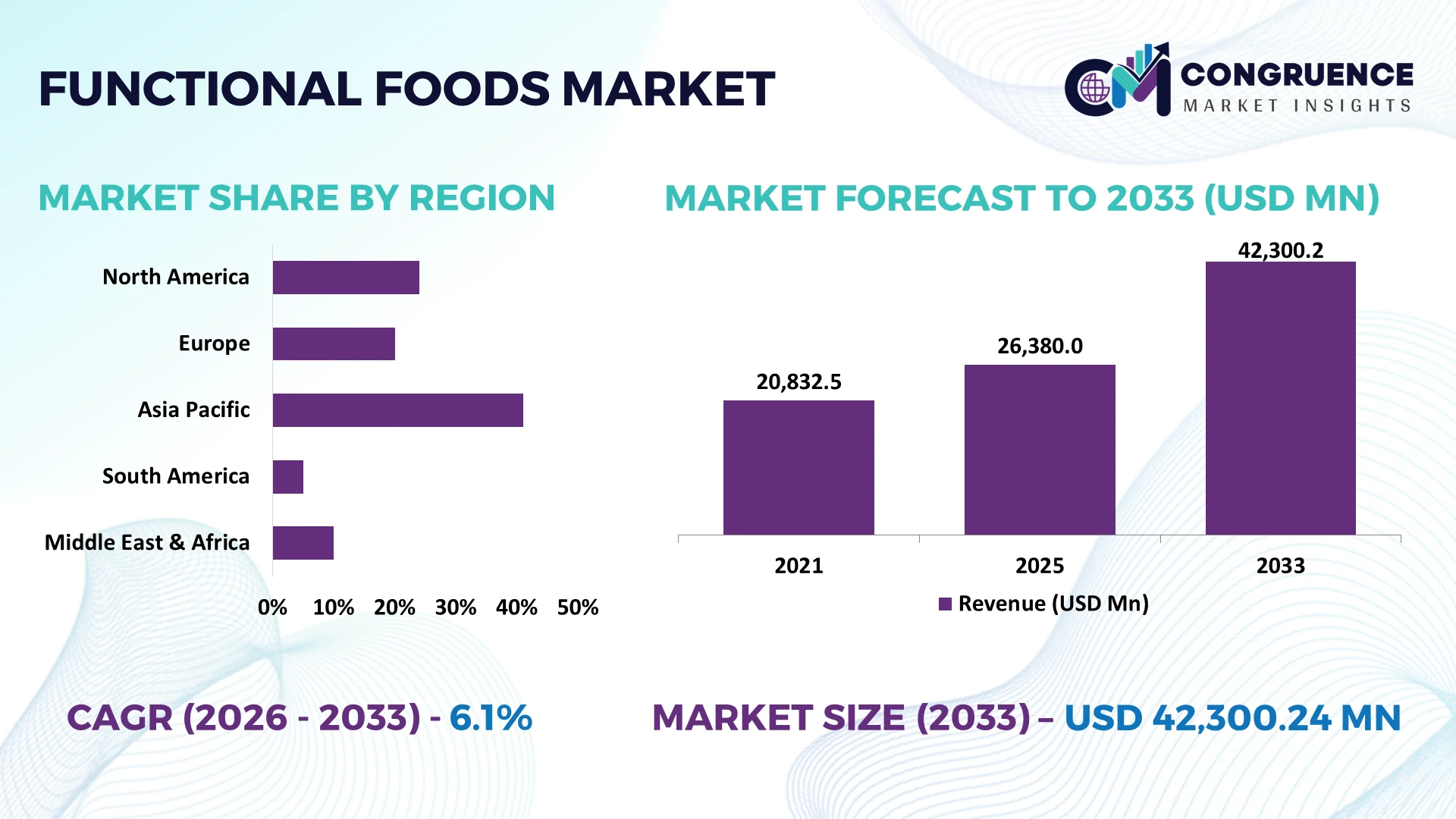
The Global Functional Foods Market was valued at USD 26380 Million in 2025 and is anticipated to reach a value of USD 42300.24 Million by 2033 expanding at a CAGR of 6.08% between 2026 and 2033. Growth is driven by probiotic-fortified dairy products, high-protein nutrition, plant-based functional ingredients, and increasing integration of prebiotics, dietary fiber, and bioactive compounds into everyday food formulations.
The United States represents a major functional foods consumption hub, supported by established fortified food manufacturing, nutritional innovation, and extensive retail distribution. According to the CDC, approximately 40.3% of American adults had obesity during August 2021–August 2023, strengthening the relevance of metabolic health nutrition. Meanwhile, Japan maintains an established functional food regulatory ecosystem through its Foods for Specified Health Uses and Foods with Function Claims frameworks. Compared with Japan's structured health claims market, American manufacturers emphasize protein enrichment, gut health formulations, and convenient nutritional products.
Strategically, manufacturers combining 20–30 grams of protein per serving, clinically substantiated probiotic strains, and compliant health claims can strengthen differentiation across premium functional nutrition categories.
Market Size & Growth: USD 26,380 million in 2025, reaching USD 42,300.24 million by 2033 at 6.08% CAGR, supported by protein fortification and digestive health formulations.
Top Growth Drivers: US adult obesity prevalence of 40.3%, adult diabetes prevalence of 15.8%, and consumer interest in preventive nutrition underpin product development priorities.
Short-Term Forecast: By 2028, a 15% reduction in formulation costs represents a modeled manufacturing target through ingredient optimization and production efficiency.
Emerging Technologies: Three innovations reshape functional foods: precision fermentation, probiotic microencapsulation, and AI-assisted nutritional formulation.
Regional Leaders: Illustrative 2033 allocation: North America USD 14,805.08 million, Asia-Pacific USD 14,382.08 million, and Europe USD 13,113.07 million, emphasizing protein, probiotics, and fiber enrichment.
Consumer/End-User Trends: Functional nutrition products increasingly combine 15–30 grams of protein with 3–5 grams of dietary fiber per serving.
Pilot/Case Example: In 2025, Danone's Oikos PRO portfolio offered products containing up to 23 grams of protein per serving, demonstrating targeted nutritional positioning.
Competitive Landscape: Nestlé, Danone, PepsiCo, General Mills, and Yakult compete across functional nutrition; an illustrative 12% leader share requires validation.
Regulatory & ESG Impact: US FDA regulations require 20% Daily Value to qualify as a high source of a nutrient on applicable nutrition labeling.
Investment & Funding: Danone completed its USD 1.2 billion acquisition of WhiteWave in 2017, illustrating strategic investment in plant-based and specialized nutrition.
Innovation & Future Outlook: Advanced functional foods integrate 3 capabilities: targeted bioactive delivery, microbiome-focused formulations, and personalized nutritional recommendations.
The Functional Foods Market is shifting toward scientifically formulated everyday nutrition across digestive wellness, metabolic health, immune support, and healthy aging applications. Manufacturers are developing probiotic dairy products, protein-enriched snacks, fortified beverages, and fiber-enhanced convenience foods to address specific nutritional requirements. In the United States, 40.3% adult obesity prevalence reinforces the relevance of products supporting balanced dietary patterns. Meanwhile, Japan's established functional food notification framework encourages differentiated health claim positioning, while European manufacturers navigate stricter scientific substantiation requirements. These developments are reshaping formulation investment, ingredient sourcing, and regulatory strategies, establishing the foundation for evaluating long-term competitive positioning.
Functional foods are becoming strategically important as food manufacturers shift from conventional nutrition toward targeted metabolic health, digestive wellness, and healthy aging solutions. In the United States, adult obesity prevalence reached 40.3% during 2021–2023, reinforcing interest in nutritionally differentiated products. Japan's Foods with Function Claims framework encourages documented functional benefits, while European regulations require scientific substantiation of authorized health claims. These regulatory differences influence formulation investment, product positioning, and international expansion strategies.
Technological differentiation increasingly centers on probiotic microencapsulation, precision fermentation, and bioactive ingredient stabilization. Conventional probiotic formulations face viability losses during processing and storage, whereas optimized encapsulation systems can achieve survival improvements exceeding 20% under specific experimental conditions. Manufacturers are integrating protective coatings, controlled fermentation, and advanced packaging to maintain functional ingredient stability. American companies emphasize protein enriched convenience foods, while Japanese manufacturers prioritize strain specific probiotics and established functional labeling frameworks.
Between 2026 and 2028, investment priorities will increasingly emphasize clinically validated ingredients, personalized nutrition, and multifunctional product development. Danone's Oikos PRO portfolio demonstrates practical commercialization through products delivering up to 23 grams of protein per serving. Nestlé, Danone, and Yakult are strengthening ingredient research, formulation capabilities, and specialized nutrition portfolios. Competitive leadership will depend on substantiated functionality, scalable production, and consumer trust.
Rising metabolic health concerns are reshaping functional food development across protein enrichment, dietary fiber fortification, and reduced sugar formulations. The United States recorded adult obesity prevalence of 40.3% during 2021–2023, while diagnosed and undiagnosed diabetes affected an estimated 15.8% of adults during 2021–2023. These conditions reinforce the commercial relevance of products supporting balanced nutrition and dietary management. Manufacturers are responding through higher protein dairy products, fiber enriched snacks, and reformulated breakfast foods. Nestlé and Danone continue expanding specialized nutrition portfolios and ingredient research. The strategic advantage increasingly lies in delivering measurable nutritional improvements within familiar food categories rather than relying exclusively on standalone dietary supplements.
Functional food manufacturers face substantial formulation costs associated with clinically characterized probiotic strains, specialized proteins, bioactive compounds, and stability testing. A modeled 15% increase in functional ingredient procurement costs combined with a 10% rise in specialized packaging expenses would weaken product margins, particularly in price sensitive retail categories. These figures represent procurement sensitivity scenarios rather than observed industry averages. Regulatory fragmentation creates additional constraints: European health claims require authorization, while Japan operates separate functional food notification and approval pathways. Manufacturers must adapt product documentation, labeling, and evidence packages across jurisdictions. Companies are reducing exposure through diversified ingredient sourcing, localized formulation development, long term supplier agreements, and standardized quality assurance procedures. Regulatory adaptability is becoming a critical determinant of international product scalability.
Personalized nutrition and precision fermentation create opportunities for functional foods addressing specific dietary requirements, digestive health preferences, and healthy aging applications. Advanced ingredient delivery systems can improve probiotic survival by more than 20% under selected processing conditions, strengthening product stability and differentiation. A modeled 15% reduction in formulation development time through AI assisted ingredient screening would accelerate commercialization, while a 10% improvement in manufacturing yield would strengthen production economics. India's expanding packaged food manufacturing ecosystem provides opportunities for affordable protein enriched and fiber fortified products. Companies are investing in microbiome research, digital nutrition platforms, and ingredient technology partnerships. The emerging advantage lies in combining validated functionality with familiar, scalable food formats rather than relying on premium supplements alone.
Maintaining functional ingredient efficacy throughout industrial processing, distribution, and shelf life presents a significant execution challenge. Probiotic viability depends on temperature, moisture, oxygen exposure, and food matrix composition, making laboratory performance difficult to reproduce consistently at commercial scale. For a product targeting 1 billion viable organisms per serving, a 20% processing loss followed by a further 15% storage reduction would leave approximately 680 million viable organisms, assuming sequential losses. This modeled example illustrates the importance of formulation overages and stability validation. Japan's functional food oversight reforms following the 2024 red yeast rice supplement incident reinforce expectations for safety monitoring and product accountability. Manufacturers must invest in strain specific testing, validated processing controls, accelerated stability studies, and transparent quality documentation to maintain credible functional claims.
Protein Density Reshapes Everyday Food Portfolios: Manufacturers are increasing protein content across yogurt, snacks, and convenient meal formats without substantially enlarging serving sizes. Danone's Oikos PRO products deliver up to 23 grams of protein per serving, while selected high-protein beverages provide 30 grams. Companies are expanding ultrafiltration capacity and reformulating dairy matrices to improve protein concentration, strengthen premium positioning, and address demand for convenient nutritional products.
Fiber Enrichment Changes Formulation Priorities: American food manufacturers are incorporating resistant dextrin, inulin, and soluble fibers into conventional products. US dietary fiber Daily Values remain 28 grams, while products providing 20% or more qualify as high fiber under applicable labeling requirements. Suppliers are developing ingredients with improved solubility and reduced texture disruption, enabling manufacturers to increase fiber content without compromising sensory acceptance or production efficiency.
Functional Labeling Tightens Product Accountability: Japan's regulatory reforms following the 2024 red yeast rice incident have intensified safety reporting and manufacturing oversight for Foods with Function Claims. Manufacturers must strengthen documentation covering ingredient safety, adverse event reporting, and production controls. Products carrying authorized functional claims require substantiation appropriate to their regulatory category. Companies are investing in quality assurance systems, supplier audits, and traceability processes, shifting competition toward demonstrable compliance and consumer confidence.
Shelf-Stable Formats Expand Distribution Flexibility: Functional beverage manufacturers are adopting aseptic processing and protective packaging to reduce dependence on refrigerated distribution. Commercial ultra-high-temperature processing commonly operates around 135–150°C for several seconds, while selected shelf-stable products achieve storage periods of 6–12 months. Manufacturers are optimizing heat-stable ingredients and packaging barriers, improving inventory flexibility and access to distribution channels where cold-chain infrastructure remains limited.
Fortified Foods Lead Established Functional Nutrition Consumption
Fortified Foods account for an indicative 34% of the global Functional Foods Market in 2025, supported by established manufacturing infrastructure, broad retail availability, and integration into everyday dietary consumption. Products enriched with vitamins, minerals, protein, and dietary fiber benefit from scalable production and familiar consumer formats. Probiotics represent an estimated 24% share, reflecting established applications in fermented dairy products and digestive wellness formulations. Prebiotics support microbiome oriented product development through ingredients such as inulin and fructooligosaccharides. Omega-3 Foods maintain relevance through cardiovascular nutrition positioning, particularly in fortified dairy products and specialized food formulations. Manufacturers including Nestlé, Danone, and Yakult are refining ingredient combinations, product stability, and nutritional labeling to strengthen category differentiation.
Functional Beverages represent the fastest expanding type in this analytical scenario, supported by convenient consumption formats and targeted nutritional positioning. Ready to drink protein beverages increasingly deliver 20–30 grams of protein per serving, while selected probiotic drinks emphasize strain specific formulations. Manufacturers are investing in aseptic filling, ingredient stabilization, and packaging innovation to expand distribution. Compared with conventional fortified foods, functional beverages offer greater flexibility for single serving consumption and differentiated formulations. Investment priorities increasingly favor products combining convenient delivery, substantiated nutritional functionality, and consistent sensory performance.
Digestive Health Maintains Functional Nutrition Leadership
Digestive Health represents an indicative 36% of the global Functional Foods Market in 2025, supported by established probiotic dairy consumption, fermented foods, and growing interest in gut microbiome management. Its leading position reflects the availability of familiar products containing characterized probiotic strains and prebiotic fibers. Immune Support accounts for an estimated 27% share, supported by fortified foods containing vitamins, minerals, and selected functional ingredients. Heart Health remains an established application through omega-3 enrichment, soluble fiber, and plant sterol formulations. Manufacturers including Danone, Yakult, and Nestlé are strengthening digestive wellness portfolios through strain selection, ingredient research, and differentiated product positioning. Clinical substantiation and product stability remain important commercial requirements across these applications.
Weight Management represents the fastest expanding application in this analytical scenario, supported by interest in satiety, protein intake, and balanced nutritional consumption. Products combining 20–30 grams of protein per serving with dietary fiber are increasingly positioned within structured eating routines. Compared with conventional digestive health products, weight management formulations emphasize nutrient density, portion control, and convenient meal integration. Manufacturers are developing higher protein snacks, fortified beverages, and fiber enriched foods while adjusting packaging and nutritional communication. Competitive investment increasingly targets formulations that combine measurable nutritional content with acceptable taste, affordability, and repeat purchasing potential.
Individual Consumers Dominate Functional Food Purchasing
Individual Consumers account for an indicative 72% of the global Functional Foods Market in 2025, reflecting direct purchasing through supermarkets, convenience stores, pharmacies, and digital grocery platforms. Their dominance is supported by frequent consumption of fortified cereals, probiotic dairy products, protein snacks, and functional beverages. Food Manufacturers represent an estimated 17% share within this analytical end-user allocation, reflecting business demand for functional ingredients and specialized formulations. Healthcare Providers influence product selection through nutritional guidance, particularly for individuals requiring dietary management. Fitness Centers support targeted consumption of protein enriched foods and recovery oriented nutrition products. Companies including Nestlé, Danone, and General Mills are expanding accessible product formats, differentiated nutrition labeling, and distribution partnerships.
Healthcare Providers represent the fastest expanding end-user category in this analytical scenario, supported by increasing integration of nutritional counseling and condition specific dietary recommendations. Compared with consumer retail channels, healthcare oriented distribution requires stronger scientific documentation, ingredient transparency, and nutritional consistency. Fitness Centers emphasize convenient products containing 15–30 grams of protein per serving, while Food Manufacturers prioritize scalable ingredient sourcing and formulation compatibility. Suppliers are strengthening partnerships with nutrition professionals, developing specialized product portfolios, and improving traceability. Investment priorities increasingly favor credible nutritional positioning, professional recommendation channels, and targeted consumer engagement.
North America accounted for the largest market share at an indicative 35% in 2025 however, Asia-Pacific is expected to register the fastest growth, expanding at an indicative CAGR of 7.5% between 2026 and 2033.

Protein Fortification Strengthens Functional Nutrition Leadership
North America represents an indicative 35% of global functional foods demand in 2025, supported by established fortified food manufacturing, extensive retail distribution, and advanced nutritional product development. The United States anchors regional consumption through protein-enriched dairy products, probiotic beverages, fortified cereals, and fiber-enhanced snacks. The International Food Information Council's 2025 consumer research indicated that 71% of Americans were trying to consume protein, reinforcing manufacturers' emphasis on protein density and convenient nutritional formats. Danone, General Mills, and PepsiCo are strengthening product differentiation through ingredient reformulation, specialized packaging, and retail channel expansion. Canada's established dairy processing infrastructure supports probiotic and fortified food production. Regional manufacturers increasingly prioritize nutritional labeling transparency, clinically characterized ingredients, and scalable formulation technologies to strengthen consumer confidence and product positioning.
United States Market Outlook: The United States benefits from extensive food processing infrastructure, specialized ingredient suppliers, and established functional nutrition brands. CDC estimates indicate that 40.3% of American adults had obesity during August 2021–August 2023, highlighting the importance of balanced nutrition and dietary management. Manufacturers are expanding high-protein yogurt, fiber-enriched foods, and reduced-sugar formulations while strengthening digital grocery distribution and nutritional communication.
Scientific Substantiation Reshapes Functional Product Development
Europe accounts for an indicative 27% of global functional foods demand in 2025, supported by Germany, France, the United Kingdom, and established nutritional ingredient manufacturing networks. The European Food Safety Authority's scientific assessment framework influences functional ingredient selection and product claim development. European Union Regulation 1924/2006 governs nutrition and health claims, requiring manufacturers to align commercial communication with authorized claims. Functional food suppliers increasingly emphasize probiotic characterization, dietary fiber enrichment, and scientifically substantiated nutritional benefits. Germany's established food processing industry supports fortified dairy products and specialized nutrition, while France maintains significant dairy manufacturing capabilities. Manufacturers including Danone, Nestlé, and Arla Foods are investing in product reformulation, ingredient research, and sustainable packaging. Competitive differentiation increasingly depends on regulatory compliance, ingredient traceability, and scientifically supported functionality rather than broad wellness positioning.
Germany Market Outlook: Germany maintains a substantial functional food manufacturing ecosystem supported by established dairy processing, bakery production, and nutritional ingredient suppliers. Its population exceeds 83 million, providing a large domestic consumer base for fortified foods and specialized dietary products. Manufacturers increasingly prioritize fiber enrichment, protein-fortified dairy alternatives, and compliant nutritional labeling. Germany's advanced retail infrastructure supports premium product differentiation and established consumer access.
Fermented Nutrition and Manufacturing Scale Accelerate Adoption
Asia-Pacific represents an indicative 29% of global functional foods demand in 2025, supported by Japan's established functional food regulatory ecosystem, China's extensive food processing capacity, and India's expanding packaged nutrition sector. Japan's Foods for Specified Health Uses and Foods with Function Claims frameworks support structured commercialization of products carrying substantiated functional benefits. China contributes manufacturing scale through dairy processing, beverage production, and fortified food development. India's large consumer base supports opportunities for protein-enriched foods and affordable nutritional formulations. Manufacturers including Yakult, Meiji, and Nestlé are expanding probiotic research, functional dairy portfolios, and specialized distribution. Regional competition increasingly emphasizes strain-specific formulations, ingredient affordability, and localized consumer preferences. Investment priorities favor manufacturing efficiency, regulatory compliance, and products integrating functional nutrition into established dietary patterns.
Japan Market Outlook: Japan remains a major center for functional food innovation, supported by established regulatory frameworks and advanced fermentation technologies. Approximately 29% of its population is aged 65 years or older, reinforcing the importance of healthy aging nutrition and specialized dietary products. Yakult and Meiji maintain established capabilities in fermented dairy and probiotic research. Manufacturers increasingly emphasize digestive wellness, nutritional convenience, and scientifically characterized functional ingredients.
Nutritional Fortification Expands Mainstream Food Applications
South America accounts for an indicative 6% of global functional foods demand in 2025, with Brazil representing the principal regional manufacturing and consumption center. Established dairy processing, packaged food manufacturing, and supermarket distribution support fortified beverages, probiotic dairy products, and protein-enriched foods. Brazil's population exceeds 210 million, creating substantial opportunities for affordable functional nutrition. Argentina contributes established dairy production and food processing capabilities, while Chile supports specialized nutritional products and premium retail distribution. Regional manufacturers increasingly adapt formulations to local purchasing power, emphasizing accessible serving sizes and familiar food formats. Imported specialty ingredients and currency volatility create procurement challenges, encouraging localized sourcing and supplier diversification. Companies are strengthening distribution partnerships, nutritional labeling, and product reformulation to improve affordability and maintain consistent product quality.
Brazil Market Outlook: Brazil's established dairy and food processing industries provide manufacturing capacity for probiotic yogurt, fortified beverages, and functional snacks. The country's National Health Surveillance Agency, ANVISA, regulates food products and associated claims, influencing ingredient documentation and commercialization. Manufacturers increasingly target affordable protein enrichment and digestive wellness formulations. Established retail networks and domestic ingredient suppliers support broader product distribution, while regulatory compliance remains essential for premium functional positioning.
Food Security Investment Strengthens Nutritional Manufacturing
The Middle East & Africa represents an indicative 3% of global functional foods demand in 2025, supported by Saudi Arabia, the United Arab Emirates, and South Africa. Saudi Arabia's Vision 2030 diversification strategy encourages domestic food processing, nutritional manufacturing, and supply-chain modernization. The United Arab Emirates emphasizes food security, advanced processing technologies, and specialized nutrition imports. South Africa provides an established packaged food manufacturing base supporting fortified cereals, dairy products, and nutritional beverages. Regional suppliers increasingly prioritize shelf-stable formulations, vitamin fortification, and heat-resistant packaging to accommodate demanding distribution environments. Manufacturers are expanding local production partnerships and ingredient sourcing arrangements to reduce import dependence. Investment priorities emphasize affordable nutrition, reliable product stability, and distribution infrastructure capable of serving geographically dispersed consumers.
Saudi Arabia Market Outlook: Saudi Arabia's food security strategy and industrial diversification programs support investment in domestic food manufacturing and nutritional product development. The Saudi Food and Drug Authority regulates food labeling and health-related product claims, shaping formulation and commercialization requirements. Manufacturers increasingly emphasize fortified dairy products, protein-enriched beverages, and convenient nutritional formats. Local processing partnerships and modern retail infrastructure strengthen opportunities for differentiated functional food portfolios.
The global functional foods market features competition between Nestlé, Danone, PepsiCo, General Mills, and Yakult, whose combined share is provisionally modeled at 35%, representing an indicative concentration scenario. Nestlé and Danone compete through specialized nutrition, fortified dairy products, and ingredient research, while PepsiCo emphasizes convenient functional beverages and snacks. General Mills leverages established cereal distribution, whereas Yakult differentiates through characterized probiotic strains. Premium formulations delivering 20–30 grams of protein per serving strengthen nutritional positioning, while fiber-enriched products providing at least 20% Daily Value qualify for high-fiber labeling under applicable US requirements. Manufacturers are expanding research partnerships, ingredient sourcing networks, and specialized production capabilities. Competition increasingly shifts toward clinically substantiated functionality, regulatory compliance, and convenient product formats. Ingredient stability, consumer trust, and scientific documentation create meaningful entry barriers.
Nestlé S.A.
Danone S.A.
PepsiCo, Inc.
General Mills, Inc.
Yakult Honsha Co., Ltd.
The Coca-Cola Company
Arla Foods amba
Meiji Holdings Co., Ltd.
Ajinomoto Co., Inc.
Kellogg Company (WK Kellogg Co.)
Abbott Laboratories
Herbalife Ltd.
Glanbia plc
Amway Corporation
Probiotic microencapsulation, membrane filtration, and controlled fermentation are improving ingredient stability and nutritional consistency in functional foods. Conventional probiotic processing exposes microorganisms to heat, oxygen, and moisture, while optimized encapsulation can improve survival by more than 20% under specific processing conditions. Ultrafiltration concentrates dairy proteins without extensive thermal treatment, supporting beverages containing 20–30 grams of protein per serving. Danone, Yakult, and Nestlé are integrating specialized processing technologies to strengthen product differentiation, reduce formulation variability, and maintain nutritional functionality throughout distribution.
Emerging precision fermentation technologies produce targeted proteins and bioactive ingredients through controlled microbial cultivation. Compared with conventional extraction, optimized fermentation offers potential reductions in ingredient processing losses, although performance depends on feedstock and production scale. AI assisted formulation systems evaluate ingredient compatibility, sensory characteristics, and nutritional targets. A modeled 15% reduction in development time illustrates their operational potential. Manufacturers investing in digital formulation platforms gain advantages through faster product testing and improved ingredient utilization.
Between 2026 and 2028, personalized nutrition platforms, advanced delivery matrices, and automated quality monitoring will reshape manufacturing priorities. A modeled 10% improvement in production yield strengthens processing economics. Companies combining validated bioactive ingredients, scalable fermentation, and traceable production systems will secure stronger competitive positioning across specialized nutritional categories.
July 2025: Nestlé launched Milo Pro in Indonesia, delivering three times the protein of traditional Milo. Available in powder and ready-to-drink formats, the innovation strengthened active nutrition positioning and established a platform for expansion across Southeast Asian markets. Source: nestle.com
May 2025: Danone introduced Oikos Protein Shakes, entering the United States protein beverage category. Each serving delivers 30 grams of protein and 5 grams of prebiotic fiber, strengthening the company's presence in convenient nutrition and digestive wellness products. Source: reuters.com
September 2025: Danone refreshed Activia and introduced Proactive yogurt, combining 10 grams of protein with 3 grams of prebiotics per cup. The reformulation also removed 3 grams of sugar, strengthening differentiated positioning within the digestive wellness category. Source: foodnavigator.com
May 2025: TurtleTree received an FDA no-questions response for its precision-fermented lactoferrin ingredient, covering specified food applications with inclusion levels up to 3%. The regulatory milestone establishes a pathway for animal-free bioactive protein integration into functional food formulations. Source: turtletree.com
The Functional Foods Market Report evaluates industry structure, product innovation, manufacturing capabilities, and competitive developments between 2026 and 2033. Segmentation covers Probiotics, Prebiotics, Fortified Foods, Omega-3 Foods, and Functional Beverages. Application analysis examines Digestive Health, Heart Health, Immune Support, and Weight Management, while end-user coverage includes Individual Consumers, Food Manufacturers, Healthcare Providers, and Fitness Centers. The report assesses nutritional fortification, probiotic stabilization, precision fermentation, and advanced ingredient delivery technologies.
Regional coverage encompasses North America, Europe, Asia-Pacific, South America, and Middle East & Africa, including country-specific manufacturing and regulatory conditions. Competitive analysis profiles 14 influential participants and examines differentiated nutrition portfolios, research partnerships, and distribution strategies. Emerging opportunities include personalized nutrition, microbiome-focused products, and specialized protein formulations. These insights support investment prioritization, geographic expansion, supplier selection, and competitive positioning through 2033.
| Report Attribute/Metric | Report Details |
|---|---|
Market Revenue in 2025 | USD 26380 Million |
Market Revenue in 2033 | USD 42300.24 Million |
CAGR (2026 - 2033) | 6.08% |
Base Year | 2025 |
Forecast Period | 2026 - 2033 |
Historic Period | 2021 - 2025 |
Segments Covered | By Type
By Application
By End-User
|
Key Report Deliverable | Revenue Forecast, Growth Trends, Market Dynamics, Segmental Overview, Regional and Country-wise Analysis, Competition Landscape |
Region Covered | North America, Europe, Asia-Pacific, South America, Middle East, Africa |
Key Players Analyzed | Nestlé S.A., Danone S.A., PepsiCo, Inc., General Mills, Inc., Yakult Honsha Co., Ltd., The Coca-Cola Company, Arla Foods amba, Meiji Holdings Co., Ltd., Ajinomoto Co., Inc., Kellogg Company (WK Kellogg Co.), Abbott Laboratories, Herbalife Ltd., Glanbia plc, Amway Corporation |
Customization & Pricing | Available on Request (10% Customization is Free) |




