
Reports
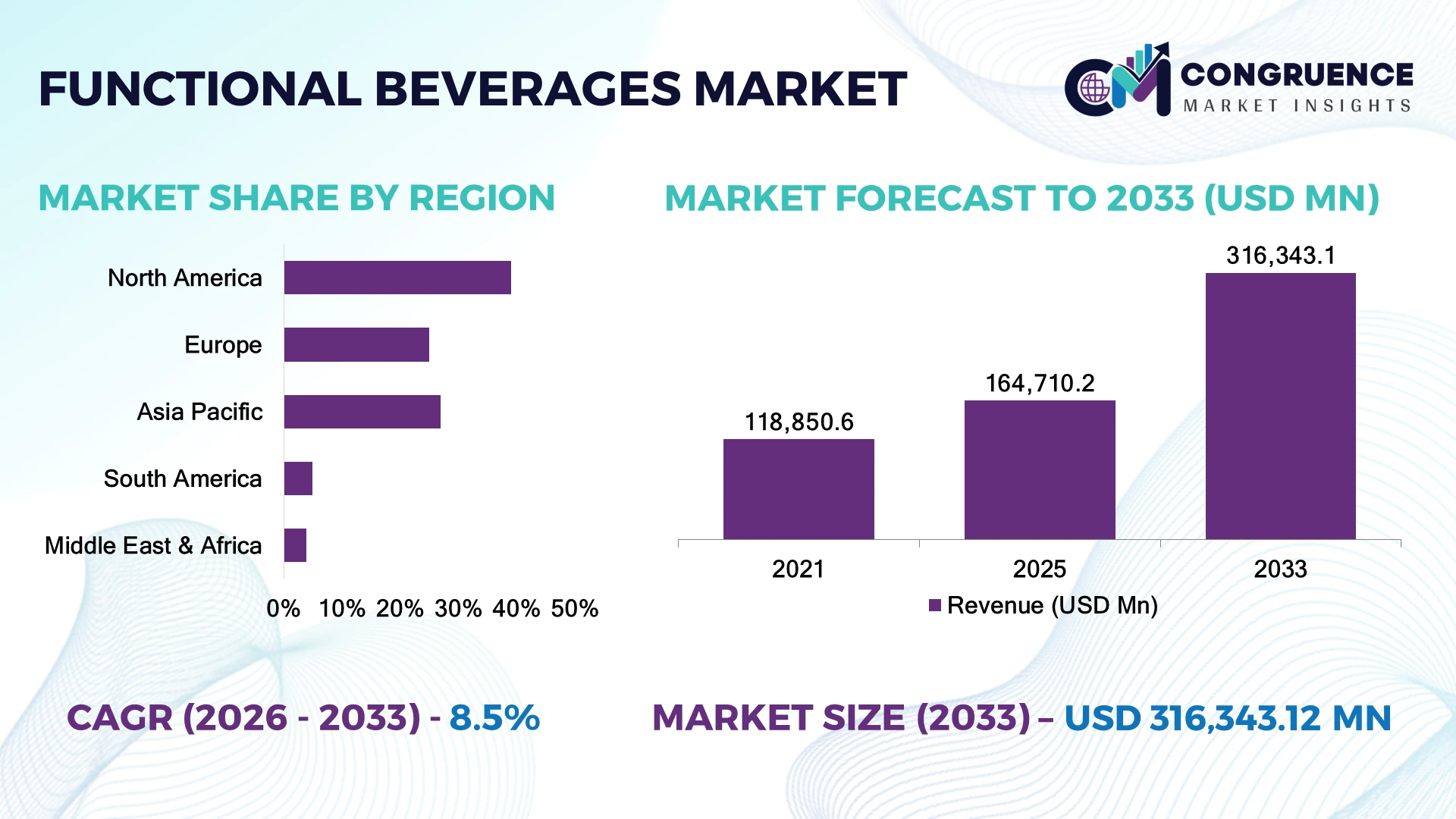
The Global Functional Beverages Market was valued at USD 164,710.2 Million in 2025 and is anticipated to reach a value of USD 316,343.1 Million by 2033 expanding at a CAGR of 8.5% between 2026 and 2033. Growth is being driven by zero-sugar reformulation, energy and hydration innovation, gut-health ingredients, and the rapid shift toward beverages positioned around specific wellness outcomes.
The United States remains the dominant commercial market, supported by high penetration of energy drinks, sports hydration, prebiotic sodas, and wellness beverages. U.S. functional beverage sales reached about USD 31.3 billion in 2026, with annual growth of roughly 11%, while zero-sugar and better-for-you formulations increasingly influence product launches. Japan and South Korea remain technologically advanced in functional formulation, but the U.S. leads in brand investment and retail scale.
The strategic priority is to secure differentiated functional claims, scalable distribution, and high-frequency consumption occasions rather than compete solely on beverage volume.
Market Size & Growth: USD 164.7 billion in 2025 to USD 316.3 billion by 2033, with 8.5% CAGR driven by wellness-led reformulation and functional ingredient innovation.
Top Growth Drivers: Zero-sugar beverages 28%, energy formulations 24%, gut-health products 19%, reflecting increasingly specific consumer benefit preferences.
Short-Term Forecast: By 2028, automated formulation and packaging programs can improve production efficiency by 8%–12% while reducing changeover losses.
Emerging Technologies: AI-assisted flavor optimization, precision fermentation, microencapsulation, and smart packaging are improving ingredient stability and formulation consistency.
Regional Leaders: North America leads commercial scale; Europe emphasizes clean-label formulations; Asia-Pacific advances functional tea, probiotics, and botanical beverages.
Consumer/End-User Trends: Approximately 11% annual growth in U.S. functional beverage sales highlights accelerating adoption of health-positioned alternatives.
Pilot/Case Example: 2025 portfolio expansion around prebiotic soda and zero-sugar energy products demonstrates how established beverage systems are integrating targeted wellness propositions.
Competitive Landscape: Large beverage companies compete with specialized wellness brands across energy, hydration, gut health, and mood-focused formats, with distribution increasingly determining shelf access.
Regulatory & ESG Impact: Lower-sugar formulations and recyclable packaging are becoming strategic priorities, while functional claims require tighter substantiation and labeling discipline.
Investment & Funding: PepsiCo committed USD 1.95 billion to acquire poppi and separately invested USD 585 million in Celsius, signaling aggressive portfolio repositioning toward functional categories.
Innovation & Future Outlook: Next-generation products will combine hydration, cognition, gut health, energy, and mood benefits, shifting competition toward multifunctional formulations and personalized consumption occasions.
Functional beverages are increasingly moving from broad wellness positioning toward precise benefit platforms spanning energy, hydration, gut health, cognition, immunity, and mood. In 2026, prebiotic sodas, zero-sugar energy drinks, electrolyte beverages, and botanical formulations are gaining shelf space as manufacturers refine flavor, ingredient stability, and dosage. Around 11% annual U.S. category growth demonstrates the commercial strength of this shift, while supply-chain discipline and evolving labeling expectations are forcing brands to balance ingredient differentiation with scalable production.
Functional beverages have become a strategic battleground because they allow beverage companies to capture higher-value consumption occasions without relying exclusively on traditional carbonated soft drinks. The 2025–2026 competitive landscape demonstrates this shift: PepsiCo acquired prebiotic soda brand poppi for USD 1.95 billion, while its strengthened Celsius relationship included a USD 585 million investment. These moves show that functional positioning is influencing portfolio architecture, distribution strategy, and acquisition priorities.
Technology is also changing formulation economics. Microencapsulation can improve stability of sensitive vitamins, probiotics, botanicals, and active compounds by roughly 10%–20% compared with less protected formulations, while automated dosing and inline quality control can reduce formulation variability by approximately 15%. North America is characterized by rapid brand commercialization and retail expansion, whereas Japan, South Korea, and parts of Europe emphasize formulation sophistication, clean-label ingredients, and specialized functional claims.
Over the next 2–3 years, manufacturers are expected to prioritize multifunctional beverages, low-sugar formulations, personalized nutrition, and faster product-development cycles. A practical deployment model is the integration of prebiotic ingredients into familiar soda formats, allowing brands to preserve mainstream consumption behavior while adding a wellness proposition. Companies are consequently increasing R&D partnerships, ingredient sourcing capabilities, co-manufacturing capacity, and channel-specific product portfolios. Competitive advantage will increasingly depend on proving functional value while delivering familiar taste, reliable supply, and scalable distribution.
Functional beverage growth is being reshaped by consumers moving from general wellness toward specific benefits such as energy, hydration, gut health, and cognition. Zero-sugar formulations now represent more than 25% of launches in several mature beverage categories, while protein- and electrolyte-positioned products are expanding at double-digit rates in the United States. In Japan, manufacturers are increasingly using microencapsulation to stabilize probiotics and botanical actives, improving shelf-life performance by roughly 10%–15%. This shift is pushing beverage companies toward specialized ingredient partnerships, faster formulation cycles, and benefit-specific portfolios. The strategic insight is that functional differentiation is becoming a formulation and supply-chain capability, not merely a branding exercise.
Functional beverage manufacturers face margin pressure from volatile botanical extracts, probiotics, specialty fibers, vitamins, and natural sweeteners, with premium functional ingredients frequently adding 8%–20% to formulation costs. In the United States and Europe, claim substantiation and labeling requirements can extend product-validation timelines by 10%–15%, particularly for beverages positioned around digestive, cognitive, or metabolic benefits. Supply concentration for specialized ingredients also creates procurement exposure, while cold-chain requirements can add 5%–10% to distribution costs for sensitive formulations. Companies are responding through dual sourcing, longer-term supplier contracts, regional ingredient procurement, and reformulation around more stable actives. The non-obvious constraint is that ingredient availability increasingly determines launch speed as much as consumer demand.
The strongest opportunity is shifting toward multifunctional beverages that combine hydration, energy, gut health, immunity, or cognition within one consumption occasion. Products using electrolytes, prebiotics, adaptogens, and precision-fermented ingredients can address multiple benefit categories while reducing portfolio fragmentation. Personalized nutrition platforms are also creating opportunities for digitally connected beverage recommendations, with health-oriented consumers increasingly willing to engage with customized nutrition programs. Microencapsulation and precision fermentation can improve active stability and formulation efficiency by approximately 15%–25%, expanding the feasible use of sensitive ingredients. Companies are investing in R&D partnerships, functional ingredient ecosystems, and direct-to-consumer testing. A key strategic opening lies in mainstream beverage formats carrying sophisticated benefits without requiring consumers to change established consumption habits.
Scaling functional beverages from pilot batches to high-volume production remains technically demanding because active ingredients can alter flavor, texture, solubility, color, and shelf stability. Reformulation can increase production complexity by 10%–20%, while highly concentrated botanicals and probiotics often require tighter dosing and quality controls than conventional beverage ingredients. In India and Southeast Asia, manufacturers also face uneven cold-chain and specialized ingredient infrastructure, creating consistency risks across distributed production networks. Digital batch monitoring, automated dosing, and standardized premixes can reduce formulation variability by approximately 15%, but implementation requires capital and technical expertise. Companies must therefore integrate sensory science, process engineering, supplier qualification, and automated quality control. The long-term competitive risk is not product innovation itself, but maintaining identical functional performance across every production run and market.
Zero-Sugar Formats Gain Scale Zero-sugar functional launches are expanding as consumers reduce added-sugar intake, with better-for-you formulations accounting for more than 25% of launches across several beverage categories. U.S. brands are reformulating energy, soda, and hydration products, while manufacturers invest in sweetener systems that preserve taste and reduce formulation costs by approximately 5%–10%.
Gut Health Moves Mainstream Prebiotics, probiotics, and postbiotics are moving beyond specialist wellness channels, with gut-health positioning appearing in roughly 15%–20% of new functional beverage concepts. Improved microencapsulation is extending active stability by about 10%–15%, allowing ambient products to replace more complex handling models. Companies are responding through ingredient partnerships and shelf-stable formulations.
Multifunctional Benefits Reshape Portfolios Beverage developers increasingly combine two or more benefits, such as hydration plus cognition or energy plus electrolytes, reducing portfolio fragmentation and increasing consumption occasions. Multifunctional concepts can raise active-ingredient complexity by 10%–20%, prompting companies to use premixed ingredient systems, automated dosing, and tighter quality controls. This shift is making formulation capability a competitive differentiator.
Precision Fermentation Enters Formulation Precision-fermented proteins, specialty nutrients, and bioactive ingredients are moving into commercial formulation pipelines as manufacturers seek scalable alternatives to resource-intensive ingredients. Fermentation-based production can reduce selected ingredient inputs by 15%–30% while improving batch consistency. Companies are forming technology partnerships and integrating fermentation-derived actives into premium functional beverages, particularly in North America and Europe.
Energy drinks lead the functional beverages market with an estimated 31% share in 2025, supported by established distribution, high consumption frequency, and strong brand recognition across convenience, fitness, and workplace channels. Sports drinks follow at approximately 22%, while functional water accounts for about 17%, benefiting from lower-sugar positioning and everyday hydration use. Fortified juices and probiotic beverages remain more specialized, but their premium formulations are gaining shelf space. The mature energy-drink segment retains scale advantages, whereas functional water is expanding as consumers increasingly replace conventional soft drinks with benefit-oriented hydration products.
The fastest-growing shift is toward hybrid formats combining energy, hydration, electrolytes, vitamins, or botanical ingredients. Approximately 71% of energy-drink shoppers also purchase sports drinks, creating a clear cross-category opportunity for multifunctional products. Companies are responding with integrated formulations, zero-sugar variants, and partnerships across ingredient and distribution ecosystems. Investment is therefore moving from single-benefit products toward scalable platforms capable of addressing multiple consumption occasions.
In 2025, Varun Beverages reported that low- and no-sugar products represented 59% of its consolidated volume mix, demonstrating how sugar reduction is becoming a core portfolio-design factor rather than a niche product attribute.
Energy and hydration represent the leading functional beverage applications, together accounting for an estimated 45% of market demand in 2025. Energy beverages retain the largest individual application share at approximately 27%, supported by established consumption among working adults, students, and active consumers. Hydration follows at about 18%, with electrolyte-rich formulations expanding beyond traditional sports settings into everyday wellness. Gut health is the fastest-growing application, supported by prebiotic, probiotic, and postbiotic formulations that are moving into mainstream carbonated and tea-based formats.
Immunity, cognitive wellness, weight management, and mood support remain smaller applications but are becoming increasingly relevant as manufacturers diversify functional claims. Gut-health products are gaining particular strategic importance because they allow brands to differentiate familiar beverage formats without creating entirely new consumption routines. Companies are expanding R&D around stable probiotics, prebiotic fibers, adaptogens, and botanical actives, while retailers are allocating more shelf space to targeted-benefit products. The business implication is a shift from broad wellness positioning toward clearly defined functional occasions.
A 2026 industry analysis identified gut health, energy, hydration, and relaxation as leading functional beverage trends, reflecting the category's shift toward benefit-specific everyday consumption rather than occasional wellness use.
Adults represent the dominant end-user group, accounting for an estimated 58% of functional beverage consumption in 2025. Their broad participation across energy, hydration, gut health, and low-sugar products creates the strongest volume base and supports mainstream retail distribution. Athletes and fitness-focused consumers account for approximately 19%, with higher usage of electrolyte, protein, energy, and recovery-oriented formulations. Children and adolescents remain a smaller segment because formulation, caffeine content, and labeling considerations constrain product positioning, while older consumers increasingly favor beverages supporting hydration, digestive health, and nutritional supplementation.
The fastest-growing buyer shift is occurring among health-conscious adults seeking convenient alternatives to capsules, powders, or multiple supplements. Approximately 30% of India's beverage sales were represented by zero- and low-sugar products in 2025, illustrating how functional attributes are increasingly integrated into mainstream consumption. Companies are responding with smaller packs, direct-to-consumer trials, personalized benefit positioning, and retail partnerships. Competitive investment is therefore shifting toward products that combine convenience, familiar taste, lower sugar, and a clearly communicated health function.
In 2025, 59% of Varun Beverages' consolidated volume mix came from low- or no-sugar products, while India's low/no-sugar beverage consumption expanded sharply, indicating that health-oriented formulation is moving into mainstream purchasing behavior.
North America accounted for the largest market share at 39.1% in 2025 however, Asia-Pacific is expected to register the fastest growth, expanding at a CAGR of 8.3% between 2026 and 2033.
Portfolio diversification shifts competition toward functional mainstreaming
North America remains the largest functional beverages market, supported by mature energy, sports hydration, enhanced water, probiotic, and prebiotic categories. The United States represented approximately 73.7% of North American functional beverage value in 2025, while energy drinks held about 33.2% of regional product share. Online retail is also advancing, with digital channels recording roughly 8.9% growth, forcing brands to optimize subscription, direct-to-consumer, and convenience formats. The strategic shift is visible in major portfolio transactions: PepsiCo completed its USD 1.95 billion poppi acquisition in 2025, strengthening its prebiotic beverage position.
United States Market Outlook:
The United States combines the region's deepest retail infrastructure, advanced beverage formulation ecosystem, and strongest concentration of functional beverage brands. Energy drinks, hydration products, prebiotic sodas, and mood-oriented beverages are rapidly expanding consumption occasions. Celsius held approximately 20% of the U.S. RTD energy category in late 2025, while its distribution coverage reached 94.2% by February 2026.
Evidence-based wellness replaces broad health positioning
Europe is shifting from conventional energy-led functional beverages toward clinically supported benefits, clean-label formulations, digestive health, and lower-sugar products. Energy drinks still accounted for approximately 49.2% of the European market in 2025, but sports drinks and digestive-health products are gaining momentum. PET and glass bottles represented about 74.1% of regional packaging volume, while online retail is expanding as direct-to-consumer wellness brands improve access. Germany held approximately 34.8% of European market value, supported by strong organic-food infrastructure and rigorous product standards.
Germany Market Outlook:
Germany is the most strategically significant European market because of its large grocery distribution base, sophisticated organic-food ecosystem, and strong consumer preference for transparent ingredient sourcing. More than 21% of the population is aged 65 or older, strengthening demand for beverages positioned around bone, joint, cognitive, and nutritional support. Manufacturers are increasingly emphasizing substantiated benefits and compliant formulation to protect premium positioning.
Scale advantage meets traditional wellness innovation
Asia-Pacific combines large consumer populations with rapid adoption of nutraceutical drinks, herbal beverages, probiotics, functional waters, and energy products. China accounted for approximately 66.6% of Asia-Pacific functional beverage value in 2025, while India is emerging as a high-growth market as domestic brands integrate Ayurvedic ingredients with ready-to-drink formats. Energy drinks represented about 40.1% of regional product share, while functional and fortified water is gaining traction through low-sugar positioning. Manufacturers are increasing local formulation, e-commerce distribution, and ingredient partnerships to address country-specific taste and wellness preferences.
China Market Outlook:
China provides the strongest combination of scale, manufacturing depth, digital retail infrastructure, and urban consumption density in Asia-Pacific. Its approximately 66.6% regional share gives multinational and domestic producers a critical platform for product testing and rapid distribution. Companies are increasingly blending conventional beverage formats with probiotics, botanical extracts, and lower-sugar formulations, while online retail enables faster consumer feedback and localized portfolio adjustments.
Sports culture accelerates functional hydration adoption
South America is increasingly shaped by sports nutrition, energy beverages, functional hydration, and nutraceutical formulations. Brazil accounts for approximately 60% of regional functional beverage value, supported by its large consumer base, extensive beverage manufacturing infrastructure, and deeply embedded fitness and football culture. Energy drinks represent roughly 45% of regional volume, while sports drinks are the fastest-growing major category. Manufacturers are expanding convenience-store, gym, pharmacy, and modern grocery distribution while adapting formulations to local taste and price sensitivity.
Brazil Market Outlook:
Brazil is the region's strategic anchor, combining large-scale beverage production, established distribution networks, and strong sports-related consumption. Energy drinks and shots accounted for approximately 70.8% of Brazil's functional drinks value in 2025, while sports drinks are gaining faster adoption. Manufacturers are increasing electrolyte, hydration, and performance-oriented portfolios, creating opportunities for domestic and multinational brands to compete through localized formulations and broader fitness-channel penetration.
Wellness investment expands beyond traditional energy formats
Middle East & Africa combines strong energy-drink consumption with rising interest in protein, hydration, immunity, and wellness beverages. Saudi Arabia represented approximately 23.1% of regional functional beverage value in 2025, while energy drinks held about 42.7% share. Supermarkets and hypermarkets remained the largest distribution channel at roughly 48.1%, but online retail is expanding faster at about 7.6%. Manufacturers are strengthening modern retail partnerships, localized flavors, and protein-based formulations as health and fitness spending increases.
Saudi Arabia Market Outlook:
Saudi Arabia is the region's leading market because of its large urban consumer base, modern retail infrastructure, expanding fitness ecosystem, and investment in lifestyle transformation. Its 23.1% regional share provides manufacturers with a strong commercialization base for energy, hydration, and protein beverages. Companies are increasingly aligning product portfolios with wellness-oriented consumption and modern retail formats, while localized distribution partnerships improve availability across major metropolitan markets.
PepsiCo, Coca-Cola, Red Bull, Monster Beverage, and Danone compete with specialized wellness brands and regional functional-drink producers across energy, hydration, gut health, protein, and botanical formats. The top five branded groups are estimated to hold about 43% of market value. Competition centers on distribution, formulation, price, functional efficacy, and speed of innovation. Large players benefit from 70%+ retail reach advantages, while specialist brands often achieve 15%–25% faster product-launch cycles. Zero-sugar products now influence more than 30% of functional launches, intensifying reformulation competition. PepsiCo is acquiring wellness brands, Coca-Cola is expanding functional hydration, and regional producers are localizing ingredients and flavors. The competitive shift is moving from single-benefit positioning toward multifunctional beverages combining hydration, energy, cognition, and gut health. Entry barriers include cold-chain capability, retailer access, ingredient validation, and marketing scale. Winning requires differentiated benefits, dependable supply, rapid innovation, and distribution powerful enough to convert niche wellness demand into repeat consumption.
PepsiCo, Inc.
The Coca-Cola Company
Red Bull GmbH
Monster Beverage Corporation
Danone S.A.
Keurig Dr Pepper Inc.
Nestlé S.A.
Suntory Holdings Limited
The Hain Celestial Group, Inc.
Celsius Holdings, Inc.
Yakult Honsha Co., Ltd.
Asahi Group Holdings, Ltd.
Kirin Holdings Company, Limited
Ocean Spray Cranberries, Inc.
Functional beverage manufacturing is adopting high-shear mixing, inline dosing, microencapsulation, membrane filtration, and automated quality monitoring across production lines. Microencapsulation can improve stability of probiotics, vitamins, and botanical actives by roughly 10%–20%, while automated dosing can reduce formulation variability by 15%–25%. Adoption is strongest among beverage plants and co-manufacturers handling complex functional formulations, where repeatability directly protects margins and shelf performance.
Emerging precision fermentation, AI-assisted formulation, and digital twin modeling are shortening development cycles and improving ingredient consistency. AI-supported formulation can reduce trial-and-error iterations by about 20%, while fermentation platforms can improve selected ingredient yield by 15%–30%. Competitive advantage increasingly favors manufacturers combining ingredient science with scalable processing, because specialist wellness brands can commercialize differentiated formulas faster while large producers industrialize them. This creates a technology gap between agile innovators and asset-heavy incumbents.
Between 2026 and 2028, real-time sensor networks, smart packaging, personalized formulation, and continuous processing will reshape functional beverage operations. Compared with conventional batch monitoring, connected process control can improve production efficiency by approximately 8%–12% and reduce quality deviations by 10%–18%. Companies investing now in automation, encapsulation, and data-driven formulation will gain faster launches, tighter active-ingredient control, and lower waste while positioning portfolios for multifunctional beverages and wellness occasions.
May 2025 PepsiCo completed its $1.95 billion acquisition of poppi, expanding its prebiotic soda platform and accelerating functional portfolio diversification. The transaction strengthens national distribution, improves access to wellness-focused consumers, and gives PepsiCo a scalable route into mainstream gut-health beverages. Source: pepsico.com
August 2025 PepsiCo and Celsius strengthened their partnership, with PepsiCo investing $585 million in preferred stock while Alani Nu entered PepsiCo distribution. The arrangement broadened energy coverage, consolidated U.S. execution, and expanded functional beverage availability across retail and foodservice channels. Source: pepsico.com
May 2025 Probi partnered with Nomura Dairy Products to launch Japan’s first fermented drink fortified with LP299V, combining carrot juice with a clinically studied probiotic. The launch expanded science-backed gut-health beverages and demonstrated localization of functional formulations through ingredient collaboration. Source: probi.com
June 2026 Hindustan Unilever introduced Liquid I.V. Sugar-Free in India, extending its hydration portfolio with a no-sugar functional format. The launch strengthens hydration positioning, broadens wellness-oriented choice, and demonstrates how multinational beverage platforms are adapting products for India’s health-conscious consumption. Source: newsvoir.com
The Functional Beverages Market Report evaluates product categories, functional ingredients, applications, distribution channels, end-user groups, and geographic markets. Coverage spans energy drinks, sports and electrolyte beverages, functional water, probiotic and prebiotic drinks, fortified juices, protein beverages, botanical formulations, and emerging multifunctional formats. Application analysis addresses energy, hydration, digestive health, immunity, cognition, sports performance, weight management, and general wellness.
The report provides country-level assessment across North America, Europe, Asia-Pacific, South America, and Middle East & Africa, including manufacturing capacity, retail penetration, formulation trends, digital commerce, and investment activity. Technology coverage includes microencapsulation, precision fermentation, AI-assisted formulation, automation, smart packaging, and advanced processing. Adoption indicators, segment shares, competitive positioning, and company strategies support investment planning, portfolio expansion, market-entry decisions, partnership development, capacity allocation, and competitive positioning through 2026–2033.
| Report Attribute/Metric | Report Details |
|---|---|
|
Market Revenue in 2025 |
USD 164,710.2 Million |
|
Market Revenue in 2033 |
USD 316,343.1 Million |
|
CAGR (2026 - 2033) |
8.5% |
|
Base Year |
2025 |
|
Forecast Period |
2026 - 2033 |
|
Historic Period |
2021 - 2025 |
|
Segments Covered |
By Type
By Application
By End-User
|
|
Key Report Deliverable |
Revenue Forecast, Growth Trends, Market Dynamics, Segmental Overview, Regional and Country-wise Analysis, Competition Landscape |
|
Region Covered |
North America, Europe, Asia-Pacific, South America, Middle East, Africa |
|
Key Players Analyzed |
PepsiCo, Inc., The Coca-Cola Company, Red Bull GmbH, Monster Beverage Corporation, Danone S.A., Keurig Dr Pepper Inc., Nestlé S.A., Suntory Holdings Limited, The Hain Celestial Group, Inc., Celsius Holdings, Inc., Yakult Honsha Co., Ltd., Asahi Group Holdings, Ltd., Kirin Holdings Company, Limited, Ocean Spray Cranberries, Inc. |
|
Customization & Pricing |
Available on Request (10% Customization is Free) |




