
Reports
The Global Fully Electric Aircraft Tugs Market was valued at USD 120.0 Million in 2025 and is anticipated to reach a value of USD 225.4 Million by 2033 expanding at a CAGR of 8.2% between 2026 and 2033. Airport net-zero mandates and the proven 65% taxi-phase fuel reduction from electric TaxiBot deployments are forcing ground handlers to accelerate fleet conversion.
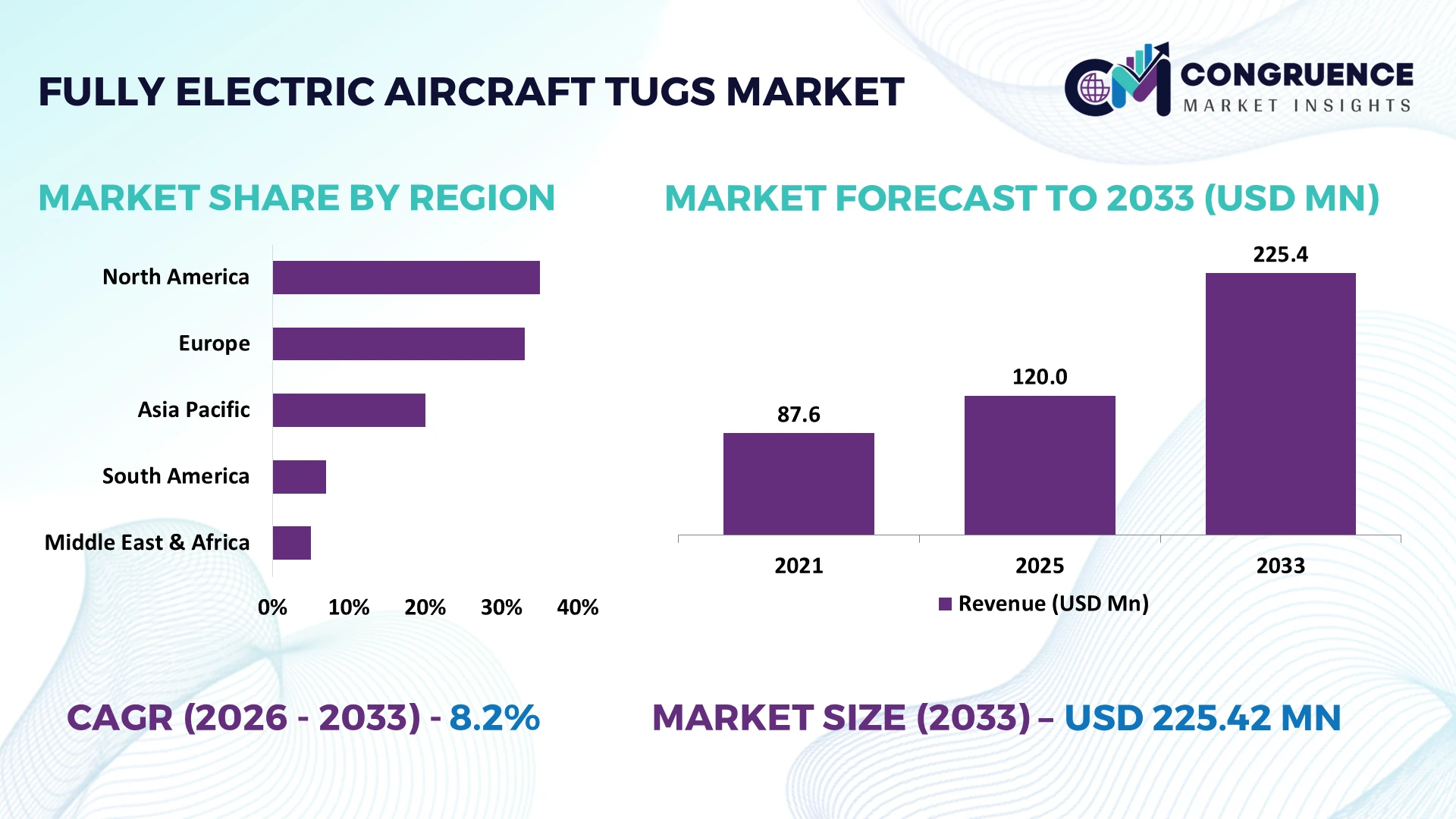
North America anchors the market with a 35% share, led by U.S. hub investment in charger infrastructure and TLD Group’s 26% global manufacturer share . Europe follows at 33%, where Amsterdam Schiphol’s electric TaxiBot trial with easyJet demonstrated 299 kg CO₂ saved per flight, while Asia-Pacific holds 20% with China’s Guangtai expanding towbarless output for domestic airports . Europe’s regulatory pressure outpaces North America in deployment pace, though U.S. federal grant programs close the infrastructure gap.
Strategic implication, Operators that lock in charging infrastructure partnerships and towbarless fleet standardization now will control apron decarbonization timelines and avoid retrofit penalties.
Market Size & Growth: Valued at USD 120.0 Million in 2025, forecast to reach USD 225.4 Million by 2033, expanding at 8.2% CAGR; airport carbon mandates and zero-emission apron targets drive procurement.
Top Growth Drivers: Airport net-zero pledges (65% taxi fuel reduction potential), diesel GSE phase-out regulations (EU/ICAO 2035 targets), and lower maintenance costs from fewer mechanical parts (approximately 30% reduction) .
Short-Term Forecast: By 2028, charging infrastructure investment per major hub rises to USD 2–3 Million, reducing per-unit operational downtime by 15% and total cost of ownership by 12%.
Emerging Technologies: Semi-robotic TaxiBot systems enabling engine-off taxiing, lithium-ion battery packs with 20–30 week lead times, and AI-assisted fleet scheduling for charger load balancing .
Regional Leaders: North America at USD 42 Million (35% share, U.S. federal grant-driven adoption); Europe at USD 39.6 Million (33%, Schiphol TaxiBot expansion); Asia-Pacific at USD 24 Million (20%, China Guangtai towbarless production) .
Consumer/End-User Trends: Civil aviation accounts for 81% of towbarless tractor demand; ground handlers report 48% electric GSE penetration at leading U.S. airports like SFO .
Pilot/Case Example: 2026 Amsterdam Schiphol easyJet A320neo trial; electric TaxiBot saves 95 kg fuel and 299 kg CO₂ per flight, with 65% taxi fuel reduction at scale .
Competitive Landscape: TLD Group leads with approximately 26% share; top five players (JBT Aero, Eagle Tugs, Goldhofer AG, Kalmar Motor AB) hold over 67% combined .
Regulatory & ESG Impact: EU/ICAO 2035 diesel GSE transition mandates affect 100% of European airport ground fleets; Schiphol targets emissions-free operations by 2030 .
Investment & Funding: SFO’s USD 11.2 Billion capital program allocates airside electrification funding; airport-handler charging partnerships rise as battery lead times stretch to 20–30 weeks .
Innovation & Future Outlook: Towbarless configurations at 81% market share drive next-gen designs; strategic shift toward integrated charger-fleet contracts and performance-based GSE procurement.
The Fully Electric Aircraft Tugs market is defined by towbarless configuration dominance at 81% share and civil aviation’s 48% electric penetration at leading U.S. hubs, with Schiphol’s TaxiBot proving 65% taxi-fuel savings per flight . Manufacturers are responding with semi-robotic systems and fast-charge compatibility, while European airports accelerate deployment ahead of 2035 diesel phase-out deadlines. The emerging trend of airport-handler charging infrastructure partnerships is reshaping procurement from unit purchases to fleet-level electrification contracts. These operational and regulatory shifts frame the strategic pathways examined below.
The market has moved from sustainability pilot to operational necessity. European diesel GSE phase-out timelines and airport net-zero commitments mean ground handlers without electric tug transition plans face tender exclusion at major hubs within three years. Schiphol’s electric TaxiBot deployment, saving 299 kg CO₂ per flight, demonstrates that towing electrification delivers measurable Scope 3 reductions rather than nominal offsets .
Electric TaxiBots consume auxiliary power during taxi instead of main engines, cutting fuel burn by up to 65% on the Polderbaan route and reducing noise footprints at surrounding communities . Europe leads in semi-robotic towbarless deployment for commercial Airbus operations; North America prioritizes conventional electric tug replacement cycles backed by federal grants, while Asia-Pacific focuses on domestic manufacturing scale through Guangtai’s towbarless production lines .
Over the next 24–36 months, airport charging infrastructure adequacy becomes the binding constraint—over 70% of surveyed airports report current charging capacity as insufficient . Schiphol’s planned expansion to three additional electric TaxiBots and Transavia 737 trials signals operator confidence in the model . Competitive advantage will accrue to ground handlers that co-invest in charger infrastructure with airports and standardize towbarless fleets, converting apron decarbonization from compliance cost into tender-winning differentiation.
Airport-level decarbonization targets are converting voluntary sustainability goals into procurement prerequisites. Schiphol’s 2030 emissions-free ambition and SFO’s 100% GSE electrification goal by 2040 mean diesel tugs face operational exclusion at leading hubs . The TaxiBot model demonstrates 65% taxi fuel reduction at scale, directly linking electric tug adoption to airline Scope 3 reporting requirements . Ground handlers respond by prioritizing towbarless electric units in fleet replacement cycles and negotiating charger access as a tender condition. TLD Group’s 26% market position reflects first-mover advantage in towbarless electric platforms, while JBT Aero and Goldhofer accelerate semi-robotic system development to capture handler demand for engine-off taxiing capability . The strategic insight: charging infrastructure access, not tug unit price, now determines fleet conversion speed at European hubs.
Over 70% of airports report insufficient charging infrastructure to support planned electric GSE adoption, creating a deployment bottleneck that unit sales cannot overcome . Heavy-duty traction battery lead times stretch to 20–30 weeks, and limited certified supplier pools for airport-grade thermal and vibration standards restrict procurement flexibility . At U.S. hubs pursuing rapid conversion, peak electricity demand from simultaneous charging creates grid constraints requiring battery buffer systems costing up to USD 10 Million for large airports . Ground handlers face a direct business impact: electric tug utilization rates fall when charger availability limits daily operating windows, eroding the total cost of ownership advantage that justifies premium pricing. Companies are mitigating through multi-year charger partnerships, staggered fleet conversion timelines, and battery energy storage integration at apron charging points.
Semi-robotic TaxiBot systems represent an untapped operational model beyond conventional tug replacement, enabling airlines to eliminate main engine taxi fuel burn entirely on long taxi routes. Schiphol’s Polderbaan deployment demonstrates 95 kg fuel and 299 kg CO₂ savings per A320neo flight, with expansion to 737 and Embraer fleets planned . This creates a service-based revenue opportunity for ground handlers: per-tow pricing models rather than capital equipment sales, with airlines capturing fuel savings and carbon credit value. Smart Airport Systems’ TaxiBot platform and Menzies Aviation’s handling integration exemplify the ecosystem partnership model. The non-obvious insight: semi-robotic towing converts the tug from a capital expenditure line item into an operational service with measurable per-flight ROI, opening procurement pathways through airline fuel budgets rather than ground handling equipment budgets.
Electric tug deployment demands more than equipment substitution—it requires apron workforce retraining for high-voltage systems, charger coordination protocols, and semi-robotic TaxiBot cockpit interface procedures. Airports report knowledge and planning gaps at regional operations, with over 70% citing charging infrastructure as inadequate . Schiphol’s phased approach—four aircraft initially, certification expansion to additional types later—reflects the integration complexity of matching electric tug capabilities to mixed-fleet operations . Cybersecurity exposure increases as tugs connect to airport fleet management systems and charger networks. Companies must address workforce certification through OEM training partnerships and invest in interoperable charger management software to prevent apron bottlenecks. The strategic imperative: deployment consistency across mixed-fleet operations determines whether electric tugs deliver promised utilization rates or become apron assets with constrained operating envelopes.
Remote-Controlled Pushback Enters Live Operations TLD’s wireless remote-control panel for the TPX-200-MTX-E completed the industry’s first wide-body electric pushback on an Airbus A350-900 at Hong Kong International Airport in 2026, validating remote operations without an onboard driver . The shift reduces operator exposure on the apron while maintaining full situational awareness through portable controls. Ground handlers gain flexibility in staffing pushback crews across mixed narrow-body and wide-body stands, though full autonomy remains a next step rather than current deployment.
Semi-Robotic Taxiing Scales at Schiphol Menzies Aviation expanded TaxiBot integration to three additional easyJet A320neo aircraft at Amsterdam Schiphol following a March 2026 trial, with each flight saving 95 kg of fuel and 299 kg of CO₂ . The semi-robotic tractor enables engine-off taxiing using only the APU, cutting taxi-phase fuel burn by up to 65% at scale. This moves electric towing from pushback-only duty into the taxiway workflow, creating a per-flight operational savings model that airlines can budget against directly.
Charging Infrastructure Becomes Procurement Gate Over 70% of airports report insufficient charging capacity to support planned electric GSE adoption, pushing handlers to negotiate charger access as a tender condition rather than an afterthought . Battery lead times of 20–30 weeks compound the constraint, forcing staggered fleet conversion timelines at U.S. and European hubs. Companies respond by co-investing in apron charging points with airport operators and prioritizing towbarless units compatible with existing electrical infrastructure.
Towbarless Configuration Locks in Dominance Towbarless tractors hold 81% of the fully electric tug market, reflecting handler preference for single-platform versatility across Airbus and Boeing narrow-body fleets . The configuration eliminates towbar inventory and aircraft-type-specific hardware, reducing turnaround setup time and apron clutter. TLD’s 26% share and the top five manufacturers’ 67% combined position confirm that scale and towbarless specialization now determine competitive standing.
Towbarless tractors command approximately 81% of the fully electric aircraft tug market, driven by their ability to service mixed narrow-body fleets without towbar changeovers . The configuration lifts the nose gear directly, reducing setup time per turnaround and eliminating towbar inventory costs across handler operations. Conventional tractors retain relevance for legacy military and regional aircraft where towbar interfaces remain standard, but their share continues to erode as airports standardize on towbarless platforms for civil aviation.
The fastest-growing type is the semi-robotic towbarless variant, exemplified by TaxiBot deployments at Schiphol, which adds engine-off taxiing capability beyond pushback . This shifts the tug from a pushback-only asset into a taxi-phase fuel reduction tool, opening airline fuel-budget procurement pathways. Companies including TLD and Smart Airport Systems are prioritizing semi-robotic development, while conventional electric tractors see replacement-cycle demand rather than expansion investment.
Civil aviation accounts for approximately 81% of fully electric aircraft tug demand, concentrated at commercial passenger hubs where turnaround frequency and net-zero mandates intersect . The operational intensity of narrow-body short-haul schedules at European and North American airports drives towbarless electric adoption, with handlers prioritizing units that service A320 and 737 families without configuration changes. Military applications remain a smaller, slower-converting segment, constrained by legacy towbar infrastructure and procurement cycles that prioritize interoperability over electrification.
The fastest-growing application sub-segment is commercial wide-body pushback, validated by TLD’s 2026 A350-900 remote-controlled demonstration at Hong Kong International . This extends electric tug relevance beyond narrow-body dominance into long-haul operations where per-pushback fuel and emission savings carry larger absolute value. Companies are responding by developing higher-capacity towbarless platforms and remote-control interfaces that reduce crew exposure on wide-body stands, while military demand remains stable but non-expansionary.
Ground handling service providers represent the leading end-user group at approximately 55% of fully electric tug purchases, reflecting their role as the operational interface for pushback and towing across multiple airline customers . Menzies Aviation’s TaxiBot integration at Schiphol exemplifies handler-led adoption, where the ground service provider absorbs capital costs and operates the equipment under service contracts with airlines . This model concentrates demand among a small number of global handlers with the scale to negotiate charger access and standardize fleets across stations.
The fastest-growing end-user group is airlines pursuing direct procurement for semi-robotic taxiing assets, driven by fuel-budget accountability and Scope 3 reporting requirements. easyJet’s anchor role at Schiphol demonstrates airline willingness to co-invest in TaxiBot capability that delivers measurable per-flight fuel savings . Companies are responding by offering per-tow service pricing alongside equipment sales, while handlers strengthen their position through multi-year airport charging partnerships that lock in infrastructure access before fleet expansion.
North America accounted for the largest market share at 35% in 2025 however, Asia-Pacific is expected to register the fastest growth, expanding at a CAGR of 10.1% between 2026 and 2033.

North America commands 35% of the global fully electric aircraft tug market, anchored by the United States’ dense commercial airport network and accelerated diesel-to-electric replacement cycles. Federal sustainability grants have positioned U.S. hubs as leading adopters of towbarless electric platforms, with ground handlers at Van Nuys and other business aviation centers deploying Eagle ETT-12X and TLD JET-16 units for mixed fleet operations. Production remains import-dependent, with TLD’s North American factories in Connecticut and Idaho supplying regional demand rather than domestic OEM competition. The region’s competitive intensity centers on charger infrastructure co-investment between airports and handlers, not unit pricing.
United States Market Outlook: The U.S. drives North American demand through airport electrification mandates and federal grant programs that underwrite charger installation alongside fleet purchases. TLD Group maintains North American manufacturing at Windsor, Connecticut and Boise, Idaho, shortening lead times for domestic handlers. Van Nuys Airport tenants Jet Aviation and StandardAero have deployed TLD JET-16 and Eagle ETT-12X electric tractors, demonstrating business aviation’s parallel adoption path beyond commercial hubs. With approximately 30–35% electric penetration in new tug sales, the U.S. remains the single largest country market for towbarless electric configurations.
Europe holds 33% of the global market, distinguished by regulatory pressure that converts sustainability targets into procurement prerequisites rather than voluntary goals. Amsterdam Schiphol’s electric TaxiBot deployment with easyJet and Menzies represents the region’s most advanced operational model, saving 95 kg fuel and 299 kg CO₂ per A320neo flight while cutting taxi fuel burn by up to 65% at scale. Fraport’s first two electric wide-body tugs at Frankfurt, supported by €213,000 in Hessian state funding, signal Germany’s entry into heavy-capacity electrification beyond trial phases. Europe’s competitive landscape is shaped by airport-level emissions deadlines that exclude diesel tugs from tender eligibility.
Netherlands Market Outlook: The Netherlands leads Europe through Schiphol’s integrated airport-handler-airline model, where Menzies Aviation operates TaxiBot under live ramp conditions and easyJet absorbs fuel-budget accountability for per-flight savings. Three additional electric TaxiBots are scheduled for 2026 delivery, with certification expansion to Boeing 737 and Embraer fleets planned. Schiphol’s Polderbaan runway, the airport’s longest taxi route, maximizes the operational case for semi-robotic towing. The Dutch model demonstrates how airport-level coordination compresses adoption timelines that elsewhere stall at infrastructure negotiation stages.
Asia-Pacific accounts for 20% of the global market, with China’s airport construction pipeline and domestic manufacturing capacity driving deployment volume. Guangtai’s towbarless electric tractors feature an industry-first battery swap system operational at Chongqing Jiangbei International Airport, achieving five-minute exchanges and 83% efficiency improvement over conventional charging. China’s commitment to dozens of new airports by 2035 creates sustained purchase demand that domestic production largely satisfies, while India and Southeast Asia represent smaller but accelerating import-driven markets. The region’s competitive dynamic differs from Europe and North America: manufacturing scale and battery-swap innovation substitute for charger infrastructure density.
China Market Outlook: China anchors Asia-Pacific demand through state-directed airport electrification and Guangtai’s vertically integrated production, with the company’s electric towbarless tractors deployed at Chongqing Jiangbei featuring 180° rotating driver platforms and laser-assisted nose gear alignment. Battery-swap capability addresses the charging infrastructure deficit that constrains adoption elsewhere, enabling continuous operation without fixed charger dependency. Beijing Daxing International Airport’s opening established the electrification template that subsequent hub construction follows. China’s domestic OEM capacity positions it as the only region where local manufacturers challenge TLD and JBT on towbarless electric platforms.
South America represents 7% of the global market, with Brazil’s Confins International Airport emerging as the region’s most advanced electrification deployment. Real Aviation Services has incorporated 20 BYD Green-Tug Q250LS electric tugs, achieving 90% fleet electrification since 2022 and eliminating an estimated 720 tons of CO₂ annually compared with diesel operations. The region’s adoption pattern is handler-driven rather than airport-mandated, with operational cost savings and maintenance reduction providing the primary business case in the absence of stringent emissions regulation. Infrastructure limitations and import dependency constrain deployment pace outside Brazil’s major hubs.
Brazil Market Outlook: Brazil leads South America through Real Aviation’s Confins deployment, where 27 electric tugs now operate and each conventional diesel unit’s 36-ton annual emissions are avoided. BYD’s Green-Tug platform benefits from the manufacturer’s regional battery supply chain and service network, reducing import-related downtime that affects European and American OEMs. The Confins model demonstrates that handler-led electrification can achieve 90% penetration without airport-level mandates when total cost of ownership favors electric. Brazil’s Embraer manufacturing presence does not extend to GSE production, leaving the market import-reliant for towbarless electric platforms.
Middle East & Africa accounts for 5% of the global market, concentrated in Gulf Cooperation Council hubs where airport investment prioritizes high-specification equipment for wide-body operations. Dnata has introduced autonomous electric baggage tractors at Dubai World Central and committed to over 800 new electric and hybrid GSE units across 10 markets in 2025, including TLD TPX-100-E electric towbarless tractors displayed at the Dubai Airshow. Qatar Aviation Services reports 20% of its GSE fleet electrified with lithium batteries, operating under a government-aligned procurement model that eliminates airport-airline-handler friction. African markets remain nascent, with modernization limited to select hubs.
United Arab Emirates Market Outlook: The UAE leads Middle East adoption through dnata’s Dubai operations, where autonomous electric tractors and TLD electric towbarless units support both Dubai International and Dubai World Central hub operations. The 2025 Dubai Airshow deployment of 14 dedicated sustainability assets, including the TLD TPX-100-E, signals operator commitment to electric pushback under high-temperature operating conditions. Dnata’s pledge to reduce carbon footprint by 50% by 2030 drives fleet transition timelines, with biodiesel bridging non-electric equipment until charger infrastructure expands. The UAE’s centralized airport-airline-handler structure compresses decision cycles that elsewhere require multi-party coordination.
The market pits global OEM leaders—TLD Group, JBT AeroTech, Goldhofer, Eagle Tugs, and Guangtai—against regional specialists and emerging battery-swap innovators. The top five players command approximately 67% combined share, with TLD alone holding 26%. Competition hinges on towbarless engineering depth (81% of demand), charging ecosystem integration, and battery-swap capability that cuts turnaround time by 83%. Players are expanding through airport-level partnerships—Menzies embedding TaxiBot at Schiphol, Guangtai deploying swap stations at Chongqing—rather than pure unit sales. The competitive shift is toward service-based towing models and charger co-investment, making infrastructure access the decisive barrier. Regional OEMs face pressure to localize battery supply or cede tender eligibility. Winning requires charger partnership leverage and semi-robotic platform readiness, not price leadership alone.
TLD Group
JBT AeroTech (LEKTRO)
Goldhofer AG
Eagle Tugs
Weihai Guangtai Airport Equipment
Kalmar Motor AB
Smart Airport Systems (TaxiBot)
Cavotec SA
Trepel Airport Equipment
Bliss-Fox Panus GSE
TowFLEXX
Mototok International
Aero Specialties
NMC-Wollard
Current towbarless electric platforms deliver 20–30% lower maintenance costs than diesel equivalents by eliminating hydraulic transmissions and fuel systems. TLD’s TPX-200-MTX-E employs dual wheel-hub motors for direct-drive efficiency, while Guangtai’s swappable battery system achieves five-minute exchanges—83% faster than conventional charging—addressing apron infrastructure constraints. Over 70% of European hub tenders now specify towbarless electric configuration, signaling mainstream adoption.
The disruptive trajectory belongs to semi-robotic towing. Schiphol’s TaxiBot deployment cuts taxi fuel burn by up to 65% and saves 299 kg CO₂ per A320neo flight, converting the tug from pushback asset to engine-off taxiing system. Hydrogen towbarless prototypes, including TLD’s TPX-200-MTX-E H₂ at Schiphol, signal the next powertrain transition beyond battery-electric for high-utilization wide-body operations.
Between 2026 and 2028, charger interoperability and remote-controlled pushback will separate competitive winners. TLD’s 2026 Hong Kong A350 remote pushback demonstration proves the technical pathway exists. Operators that lock charger partnerships and semi-robotic fleet standards now will control apron decarbonization economics; those delaying face retrofit penalties and tender exclusion at European hubs.
August 2025 — TLD Group Deployed China’s first large electric towbarless tractor, TPX-200-MTX-E, with China Eastern Airlines, completing 25 days of continuous technical support and four-day operator training. The deployment establishes TLD’s wide-body electric capability in the Chinese market.
May 2026 — Menzies Aviation / easyJet Commenced live TaxiBot operations at Amsterdam Schiphol, towing four easyJet A320neo aircraft with 95 kg fuel and 299 kg CO₂ saved per flight. Menzies handles vehicle operation and ramp integration under a multi-party airport-airline-handler model. Source: menziesaviation.com
May 2025 — Guangtai (Weihai Guangtai) Delivered the world’s first airside electric vehicle battery-swap station at Chongqing Jiangbei International Airport, achieving five-minute swap times and 83% efficiency improvement over conventional charging. The system reduces charger infrastructure investment and apron land requirements.
November 2025 — dnata Committed over USD 100 million for GSE upgrades across 10 markets in 2025, including electric towbarless tractors and autonomous baggage tractors. The programme introduces more than 800 new units, with 14 sustainability assets showcased at Dubai Airshow including TLD’s TPX-100-E. Source: dnata.com
The report delivers full-spectrum coverage of the global fully electric aircraft tugs market, segmented by type (towbarless and conventional), application (civil aviation and military), and end-user (ground handlers, airlines, and airport operators). Regional analysis spans North America, Europe, Asia-Pacific, South America, and Middle East & Africa, with country-level insights for the United States, Netherlands, China, Brazil, and the UAE. Towbarless configurations account for 81% of demand, while semi-robotic systems represent the fastest-evolving technology tier.
Quantitative indicators include segment distribution, adoption rates, deployment counts, and infrastructure investment patterns, supported by 2025–2026 enterprise developments from TLD, Guangtai, Menzies, and dnata. The report equips investment planners and expansion strategists with competitive positioning data, charger infrastructure constraint analysis, and fleet conversion timelines. Strategic coverage extends to service-based towing models, battery-swap innovations, and airport-handler partnership structures shaping procurement through 2033.
| Report Attribute / Metric | Details |
|---|---|
| Market Revenue (2025) | USD 120.0 Million |
| Market Revenue (2033) | USD 225.4 Million |
| CAGR (2026–2033) | 8.2% |
| Base Year | 2025 |
| Forecast Period | 2026–2033 |
| Historic Period | 2021–2025 |
| Segments Covered |
By Type
By Application
By End-User
|
| Key Deliverables | Revenue Forecast; Market Trends; Growth Drivers & Restraints; Technology Insights; Segmentation Analysis; Regional Insights; Competitive Landscape; Regulatory & ESG Overview; Recent Developments |
| Regions Covered | North America; Europe; Asia-Pacific; South America; Middle East & Africa |
| Companies Profiled | TLD Group; JBT AeroTech (LEKTRO); Goldhofer AG; Eagle Tugs; Weihai Guangtai Airport Equipment; Kalmar Motor AB; Smart Airport Systems (TaxiBot); Cavotec SA; Trepel Airport Equipment; Bliss-Fox Panus GSE; TowFLEXX; Mototok International; Aero Specialties; NMC-Wollard |
| Customization & Pricing | Available on Request (10% Customization Free) |




