
Reports
The Global Fully Automatic Dishwasher Market was valued at USD 1,512.0 Million in 2025 and is anticipated to reach a value of USD 1,885.8 Million by 2033 expanding at a CAGR of 2.8% between 2026 and 2033. Growth is driven by smart sensor integration, water-saving wash technologies, and rising adoption of connected kitchen appliances in premium residential and hospitality applications.
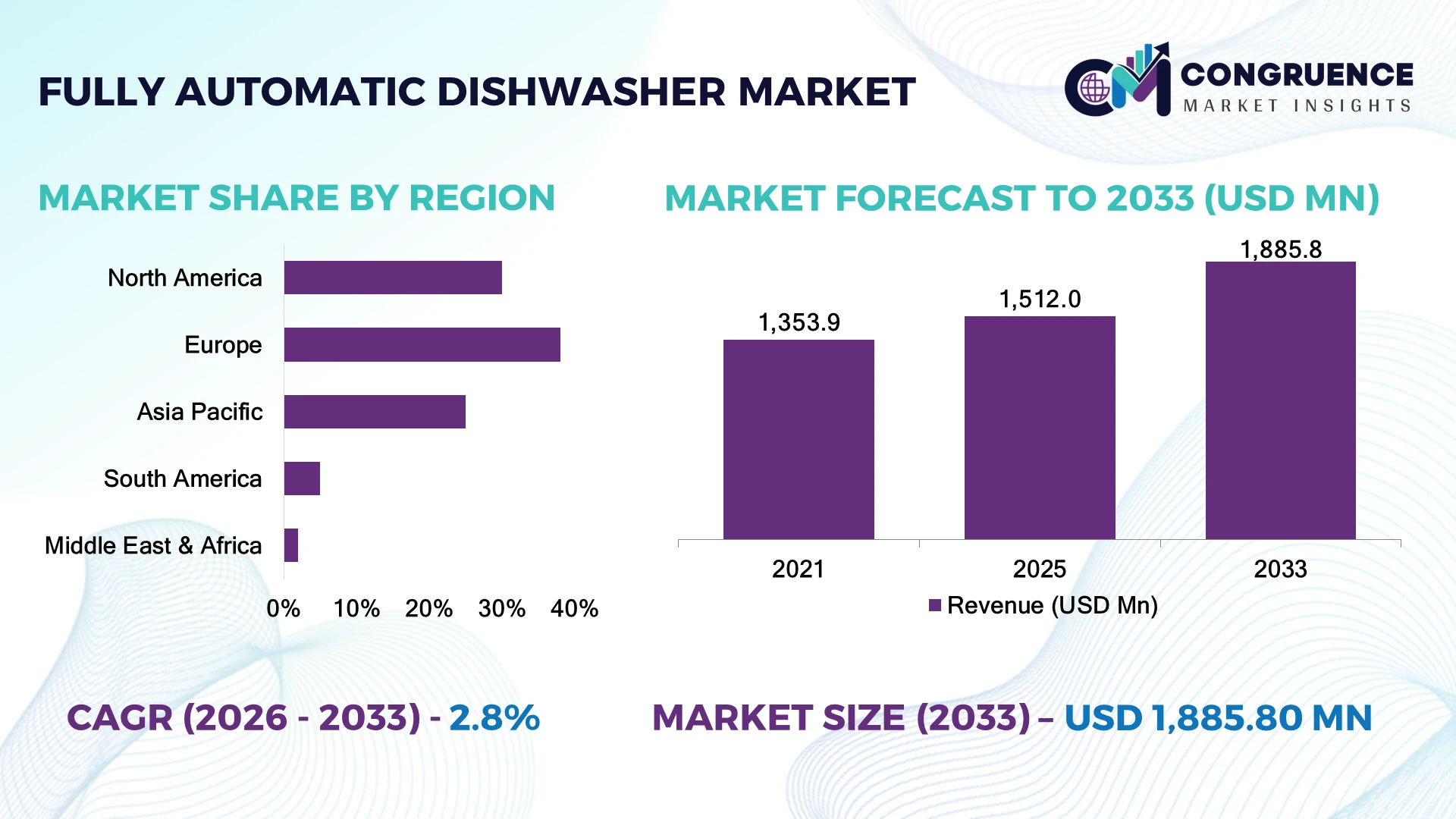
Germany holds a dominant position in Europe with nearly 35% household dishwasher penetration, supported by energy-efficiency regulations and advanced appliance manufacturing investments, while China is expanding rapidly through automated kitchen appliance production, with smart home appliance adoption exceeding 30% in urban households. The European Union’s energy-label framework has accelerated demand for efficient models, creating a 20%+ efficiency advantage for newer units compared with older systems. Japan’s compact automated appliance innovation contrasts with India’s emerging urban adoption, highlighting diverse market priorities.
Strategic implication: manufacturers prioritizing energy efficiency, localization, and connected ecosystems will gain stronger competitive positioning.
Market Size & Growth: USD 1.51 Billion market in 2025 expanding toward USD 1.89 Billion by 2033 at 2.8% CAGR, driven by smart automation and energy-efficient appliance upgrades.
Top Growth Drivers: Smart connectivity adoption (+35%), water-efficient technology demand (+25%), and premium kitchen automation preference (+20%) are accelerating market expansion.
Short-Term Forecast: By 2028, connected dishwasher adoption is projected to increase by 30%, while advanced models reduce water consumption by 15–25%.
Emerging Technologies: AI-based load sensing, IoT-enabled monitoring, and advanced filtration systems are reshaping next-generation dishwasher designs.
Regional Leaders: Europe is projected near USD 700 Million with high energy-label adoption; Asia-Pacific approaches USD 600 Million through smart home expansion; North America exceeds USD 400 Million through premium appliance upgrades.
Consumer/End-User Trends: Over 40% of urban consumers prioritize automated kitchen appliances, with demand shifting toward app-controlled and low-maintenance products.
Pilot/Case Example: In 2024, smart appliance deployments in European residential projects achieved approximately 20% water-use reduction through sensor-based washing optimization.
Competitive Landscape: Bosch leads the premium segment with an estimated 15% share, alongside Whirlpool, Electrolux, Samsung, and LG competing through connected appliance portfolios.
Regulatory & ESG Impact: Energy efficiency standards in Europe have improved appliance efficiency benchmarks by more than 20%, encouraging manufacturers to redesign motors and heating systems.
Investment & Funding: More than USD 1 Billion has been directed into smart appliance ecosystems, manufacturing upgrades, and connected-home partnerships globally.
Innovation & Future Outlook: Next-generation dishwashers are shifting toward AI-driven operation, predictive maintenance, and integrated smart kitchens, strengthening long-term brand differentiation.
Fully automatic dishwashers are increasingly positioned as essential components of modern connected kitchens, driven by demand from residential complexes, hotels, and premium housing projects. Recent innovations include AI-based cleaning optimization, quieter inverter motors, and compact designs, with more than 30% of new premium models incorporating smart connectivity features. Supply-chain diversification across Asia and Europe is reshaping appliance manufacturing strategies and accelerating localized production capabilities.
The Fully Automatic Dishwasher Market is becoming strategically important as appliance manufacturers compete through automation, energy efficiency, and connected-home integration rather than basic cleaning functionality. Rising urbanization, labor shortages in developed economies, and smart kitchen adoption are shifting consumer expectations toward appliances that deliver convenience with measurable resource savings. Global manufacturers are restructuring supply chains by expanding regional production hubs in Europe and Asia to reduce component dependency.
Modern sensor-controlled dishwashers achieve approximately 20–30% lower water usage compared with older conventional models, while inverter-based motors reduce operating noise by nearly 40%, creating clear efficiency advantages. European markets emphasize sustainability compliance and premium automation, whereas India and Southeast Asian markets focus on affordability, compact designs, and expanding urban adoption.
Hospitality operators and residential developers are increasingly integrating fully automatic dishwashers into premium projects, with companies forming partnerships around smart home platforms and appliance ecosystems. Over the next 2–3 years, manufacturers are expected to prioritize AI-enabled controls, localized manufacturing, and energy-efficient product lines. Strategic positioning will depend on combining technology leadership, supply resilience, and consumer-focused innovation.
Growing preference for connected kitchen ecosystems is accelerating demand for fully automatic dishwashers, particularly in Germany, the United States, and South Korea. Smart-enabled models with sensors and adaptive wash cycles improve water efficiency by 20–30% and reduce energy consumption by nearly 15% compared with older appliances. The European Union’s appliance efficiency regulations are pushing manufacturers toward advanced motor systems and low-resource technologies. Companies including Bosch, Samsung, and LG are expanding smart appliance portfolios through IoT partnerships and automated production investments. The key strategic shift is that dishwasher manufacturers are competing on lifecycle efficiency and digital integration rather than only cleaning performance.
Premium pricing remains a major barrier, with fully automatic dishwashers often costing 25–40% more than semi-automatic alternatives in emerging markets. Imported electronic components, semiconductor shortages, and logistics fluctuations continue to affect production costs, particularly across Asian supply chains. Countries such as India face affordability constraints due to lower penetration of built-in kitchen infrastructure compared with Europe. Manufacturers are reducing exposure through localized sourcing, supplier diversification, and regional assembly facilities. The operational challenge is balancing advanced features with cost competitiveness, as excessive technology integration can limit adoption among price-sensitive households.
The expansion of smart homes creates new opportunities for fully automatic dishwasher manufacturers through AI controls, voice integration, and predictive maintenance features. Urban households in China and India are increasing adoption of connected appliances, with smart home penetration rising above 30% in major cities. Compact dishwasher formats and subscription-based maintenance models are opening new customer segments. Companies are investing in R&D partnerships, digital ecosystems, and localized product development to capture emerging demand. A key opportunity lies in combining automation with water-saving technology, enabling manufacturers to address both convenience requirements and sustainability expectations.
Long-term adoption faces challenges from installation requirements, water infrastructure limitations, and smart-device compatibility issues. Approximately 20% of households in developing markets lack optimized kitchen layouts for built-in automated appliances, restricting deployment scalability. Cybersecurity concerns are also increasing as connected appliances become integrated with broader smart-home networks. Manufacturers must invest in secure software platforms, installer networks, and consumer education programs. Companies are addressing these barriers through modular designs, simplified installation systems, and ecosystem partnerships. The ability to deliver reliable connectivity and consistent performance across diverse markets will determine competitive advantage.
Smart Kitchen Integration Shift Connected dishwasher adoption is accelerating as households and hospitality operators integrate appliances with smart home platforms. More than 30% of premium dishwasher models now include Wi-Fi connectivity, app-based controls, and remote diagnostics, while AI-enabled load detection improves resource utilization by 15–20%. Companies are expanding partnerships with smart home ecosystem providers to strengthen automation capabilities and improve customer retention.
Energy Optimization Advances Manufacturers are prioritizing low-water and low-energy dishwasher technologies as efficiency regulations tighten in countries such as Germany and Japan. New-generation models deliver approximately 20–30% water savings compared with older systems, while inverter motors reduce operating noise by nearly 40%. Appliance brands are redesigning product lines around sustainability standards and investing in advanced filtration and heat recovery systems.
Localized Manufacturing Expansion Supply-chain restructuring is driving appliance production closer to demand centers, particularly in India and Southeast Asia. Companies are increasing regional sourcing by 20%–25% to reduce component dependency and improve delivery reliability. This shift is enabling faster product customization, lower logistics exposure, and stronger market penetration through localized assembly and supplier networks.
Premium Hospitality Adoption Growth Hotels, restaurants, and commercial kitchens are increasing automated dishwasher deployment to address labor shortages and operational efficiency requirements. Commercial users report workflow improvements of 25% or more through automated cleaning cycles and reduced manual handling. Companies are developing compact, high-capacity solutions and forming partnerships with hospitality operators to expand enterprise adoption.
The fully automatic dishwasher market is increasingly segmented by smart, standard, and compact fully automatic models, with smart fully automatic dishwashers emerging as the leading category, accounting for approximately 40% market share. Their dominance is supported by IoT connectivity, AI-based cleaning adjustments, and compatibility with smart home platforms. Standard fully automatic models maintain strong demand due to affordability and reliability, holding around 35% share among price-sensitive consumers. Smart models represent the fastest-growing type as urban households and premium housing projects prioritize connected appliances. Adoption is rising by nearly 25% in developed markets due to remote monitoring and energy optimization features. Compact fully automatic dishwashers are gaining traction in smaller urban apartments, particularly in Japan, India, and South Korea. Companies are increasing investments in sensor technology, modular designs, and localized product development to balance premium innovation with cost efficiency.
Residential applications represent the dominant segment of the fully automatic dishwasher market, accounting for approximately 65% market share due to rising urban housing development and demand for household automation. Premium apartments and smart homes are increasing dishwasher installations as consumers prioritize convenience and reduced kitchen workload. Commercial applications represent around 35% share but are expanding steadily through hotels, restaurants, and institutional kitchens. The fastest-growing application is commercial hospitality usage, where automated dishwashing systems support labor optimization and hygiene consistency. Adoption in hospitality facilities is increasing by nearly 20% as operators invest in efficient kitchen infrastructure. Residential users are shifting toward connected models, while commercial buyers focus on high-capacity systems and operational reliability. Companies are responding through customized product ranges, enterprise partnerships, and service-based maintenance models to address different application requirements.
Households remain the leading end-user segment, contributing approximately 60% market share due to increasing urbanization, rising disposable income, and greater acceptance of automated kitchen appliances. Residential buyers are driving demand for compact and smart dishwasher models, especially in countries such as China, Japan, and India. Hospitality and food service operators represent nearly 30% share and are becoming the fastest-growing user group. Commercial kitchens are expanding dishwasher adoption by approximately 20% as businesses address labor constraints and improve hygiene standards. Hotels and restaurants increasingly prefer high-capacity automated systems with faster cleaning cycles and lower resource consumption. Institutional users, including healthcare and education facilities, are also adopting automated solutions for standardized sanitation processes. Companies are targeting these segments through tailored product configurations, financing options, installation services, and long-term maintenance partnerships.
Europe accounted for the largest market share at 38% in 2025 however, Asia-Pacific is expected to register the fastest growth, expanding at a CAGR of 4.1% between 2026 and 2033.
North America represents a highly developed market for fully automatic dishwashers, supported by strong residential appliance penetration, premium housing development, and smart-home integration. The region contributes approximately 30% of global demand, with the United States accounting for the majority of installations through replacement cycles and advanced kitchen remodeling projects. Over 45% of newly purchased premium dishwashers in major urban markets include smart connectivity features, reflecting rising consumer preference for remote monitoring and automated cleaning programs. Manufacturers are strengthening distribution networks, expanding energy-efficient product portfolios, and partnering with smart-home platforms to capture technology-driven demand. Growing focus on appliance lifecycle efficiency is encouraging upgrades from conventional systems toward sensor-enabled models.
United States Market Outlook: The United States remains the key North American market due to established appliance infrastructure, high household ownership, and strong demand for connected kitchen solutions. Nearly 60% of premium appliance buyers prioritize energy-efficient and automated features, encouraging brands to expand smart dishwasher offerings. Major manufacturers are increasing investments in digital controls, retail partnerships, and localized service networks to support replacement-driven demand.
Europe maintains the leading position in the fully automatic dishwasher market due to high household penetration, strict energy regulations, and strong appliance manufacturing capabilities. Countries such as Germany, Italy, and France represent major deployment centers, supported by mature residential infrastructure and sustainability-focused purchasing behavior. Approximately 35% of European households use dishwashers regularly, while energy-label requirements continue pushing manufacturers toward low-water and low-power technologies. Companies are redesigning product lines with advanced motors, improved filtration systems, and recyclable materials to meet evolving environmental expectations. The region’s established manufacturing ecosystem enables faster innovation cycles and premium product adoption, strengthening Europe’s position in high-efficiency appliance development.
Germany Market Outlook: Germany is the strategic hub for fully automatic dishwasher innovation, supported by leading appliance manufacturers, engineering expertise, and strong consumer acceptance of efficient technologies. More than 50% of households have dishwasher access, creating a mature replacement market focused on smart features and sustainability. Manufacturers are prioritizing automated diagnostics, energy optimization, and premium integrated designs to maintain competitiveness.
Asia-Pacific is emerging as the fastest-developing market due to expanding urban households, rising middle-class purchasing power, and large-scale appliance manufacturing capabilities. China, Japan, South Korea, and India are driving adoption through smart home ecosystems and localized production strategies. The region contributes nearly 25% of global demand while accounting for a significant share of dishwasher component manufacturing. China’s appliance manufacturing network supports rapid product scaling, with smart appliance adoption exceeding 30% in major urban markets. Companies are increasing regional production, developing compact models, and forming digital ecosystem partnerships to address diverse consumer requirements. Rising apartment construction and premium housing projects are creating new installation opportunities across metropolitan areas.
China Market Outlook: China represents the strongest Asia-Pacific market due to its extensive appliance manufacturing base, export capabilities, and rapidly expanding smart-home sector. Urban smart appliance adoption has surpassed 30%, encouraging manufacturers to integrate AI controls, connectivity features, and energy-saving functions. Companies are leveraging domestic supply chains and technology partnerships to improve production efficiency and accelerate market penetration.
Urban Lifestyle Transformation Supports Gradual Adoption
South America is experiencing steady adoption of fully automatic dishwashers as urban households, premium residential developments, and hospitality projects increase demand for automated kitchen equipment. Brazil and Argentina represent the primary markets due to larger consumer bases and expanding modern housing infrastructure. The region contributes around 5% of global demand, with adoption concentrated in higher-income urban segments. Import dependency and limited built-in kitchen infrastructure remain operational challenges, but manufacturers are addressing these barriers through compact models and flexible installation solutions. Retail expansion and digital commerce growth are improving product accessibility, with online appliance sales increasing by more than 20% in major urban markets. Companies are adapting pricing strategies and strengthening regional partnerships to improve penetration.
Brazil Market Outlook: Brazil is the largest South American market due to its population scale, expanding residential construction, and growing premium appliance segment. Urban households are increasingly adopting automated kitchen solutions, with smart appliance demand rising by approximately 15% annually in major cities. Manufacturers are focusing on localized distribution, after-sales support, and affordable product configurations.
The Middle East & Africa market is expanding through luxury hospitality development, premium residential projects, and infrastructure modernization initiatives. Gulf countries, particularly the United Arab Emirates and Saudi Arabia, are driving demand through hotel expansions, smart city programs, and high-end housing developments. The region represents nearly 2% of global demand but shows strong concentration in commercial and premium residential applications. Hospitality operators are increasingly adopting automated dishwashing systems to improve hygiene consistency and reduce labor dependency, with commercial kitchen automation improving workflow efficiency by more than 20%. Manufacturers are building partnerships with hospitality groups and expanding service networks to support deployment in emerging markets.
United Arab Emirates Market Outlook: The UAE is the leading Middle East market due to its advanced hospitality infrastructure, luxury residential projects, and rapid smart-building adoption. More than 70% of new premium hotels incorporate automated kitchen technologies, increasing demand for efficient dishwasher systems. Companies are targeting the UAE through commercial partnerships, customized solutions, and integration with smart building platforms.
The Fully Automatic Dishwasher Market features competition between global appliance leaders such as Bosch, Whirlpool, Electrolux, Samsung, and LG, while regional manufacturers compete through affordability and localized distribution. The top five players collectively account for approximately 55% of market presence, creating a moderately consolidated structure. Global brands compete through smart technology, premium designs, and supply-chain efficiency, while regional players target price-sensitive households with simplified models. Connected appliance integration has improved operational efficiency by 15–25%, and energy-efficient models reduce water usage by nearly 30%, becoming key differentiators. Companies are expanding through retail partnerships, smart-home collaborations, localized manufacturing, and vertical integration of components. The competitive landscape is shifting toward AI-enabled automation, sustainability compliance, and digital ecosystems. High technology investment requirements, brand loyalty, and manufacturing expertise create strong entry barriers. Winning players must combine innovation, cost control, reliable supply networks, and customer-focused product customization.
Whirlpool Corporation
Electrolux AB
Samsung Electronics
LG Electronics
Haier Group
Panasonic Corporation
Miele & Cie. KG
Arçelik A.Ş.
IFB Industries
Beko
Asko Appliances
SMEG S.p.A.
Fisher & Paykel Appliances
Fully automatic dishwasher technology is shifting from basic washing systems toward connected, intelligent, and resource-efficient platforms. AI-powered sensors analyze load size, soil levels, and water requirements, improving cleaning efficiency by approximately 20% compared with traditional fixed-cycle machines. IoT-enabled models now represent more than 30% of premium dishwasher launches, allowing remote monitoring, maintenance alerts, and smart-home integration.
Advanced inverter motors, heat recovery systems, and improved filtration technologies are improving operational performance. New-generation inverter-based dishwashers reduce noise levels by nearly 40% compared with older motor technologies while lowering energy consumption by around 15%. Manufacturers including Bosch, Samsung, and LG benefit from integrating software capabilities with appliance hardware, strengthening customer engagement and product differentiation.
Between 2026 and 2028, predictive maintenance, AI-based cycle optimization, and connected kitchen ecosystems will become major competitive factors. Companies investing in digital platforms and automation capabilities will gain advantages through lower service costs, improved reliability, and stronger brand positioning. The transition from mechanical appliances to intelligent home systems is redefining competition, making technology integration essential for long-term market relevance.
February 2025 Samsung Electronics launched its 2025 Bespoke AI Dishwasher lineup with upgraded AI Wash+ technology, using sensors and algorithms to automatically adjust cleaning conditions based on soil levels. The company expanded AI-driven appliance capabilities, strengthening its connected kitchen ecosystem and premium appliance positioning. Source: www.news.samsung.com
September 2025 Electrolux Group (AEG brand) introduced its new premium dishwasher range at IFA 2025, highlighting improved silence and efficiency features. The launch focused on advanced dishwasher performance and sustainability-driven design, supporting Electrolux’s strategy to strengthen premium appliance adoption in European markets. Source: www.electroluxgroup.com
May 2025 Whirlpool Corporation launched the Whirlpool Spin&Load Dishwasher Rack, an inclusive dishwasher innovation featuring a 360-degree rotating lower rack design. The product was developed with accessibility-focused partners and expanded Whirlpool’s human-centered appliance strategy, improving usability for diverse consumer groups. Source: www.investors.whirlpoolcorp.com
April 2026 LG Electronics announced its new dishwasher lineup for EuroCucina 2026 featuring AI SenseClean, QuadWash Pro, Dynamic Heat Dry+, and a one-hour wash-and-dry cycle. The launch targeted European premium kitchens with enhanced automation, faster operation, and energy-efficient performance.
The Fully Automatic Dishwasher Market Report covers comprehensive segmentation analysis across product types, including smart, standard, and compact models, applications such as residential and commercial usage, and end-users including households, hospitality operators, and institutional buyers. The report evaluates major markets across North America, Europe, Asia-Pacific, South America, and Middle East & Africa, highlighting adoption patterns, manufacturing trends, and technology shifts.
The study analyzes emerging technologies such as AI-based washing systems, IoT connectivity, inverter motors, and energy-efficient filtration solutions. It provides strategic insights into competitive positioning, supplier dynamics, investment priorities, and expansion opportunities. With analysis of more than 10 leading market participants and evolving consumer adoption patterns, the report supports companies in identifying growth opportunities, optimizing product strategies, and strengthening competitive decisions from 2026 to 2033.
| Report Attribute / Metric | Details |
|---|---|
| Market Revenue (2025) | USD 1,512.0 Million |
| Market Revenue (2033) | USD 1,885.8 Million |
| CAGR (2026–2033) | 2.8% |
| Base Year | 2025 |
| Forecast Period | 2026–2033 |
| Historic Period | 2021–2025 |
| Segments Covered |
By Type
By Application
By End-User
|
| Key Deliverables | Revenue Forecast; Market Trends; Growth Drivers & Restraints; Technology Insights; Segmentation Analysis; Regional Insights; Competitive Landscape; Regulatory & ESG Overview; Recent Developments |
| Regions Covered | North America; Europe; Asia-Pacific; South America; Middle East & Africa |
| Companies Profiled | Bosch; Whirlpool Corporation; Electrolux AB; Samsung Electronics; LG Electronics; Haier Group; Panasonic Corporation; Miele & Cie. KG; Arçelik A.Ş.; IFB Industries; Beko; Asko Appliances; SMEG S.p.A.; Fisher & Paykel Appliances |
| Customization & Pricing | Available on Request (10% Customization Free) |




