
Reports
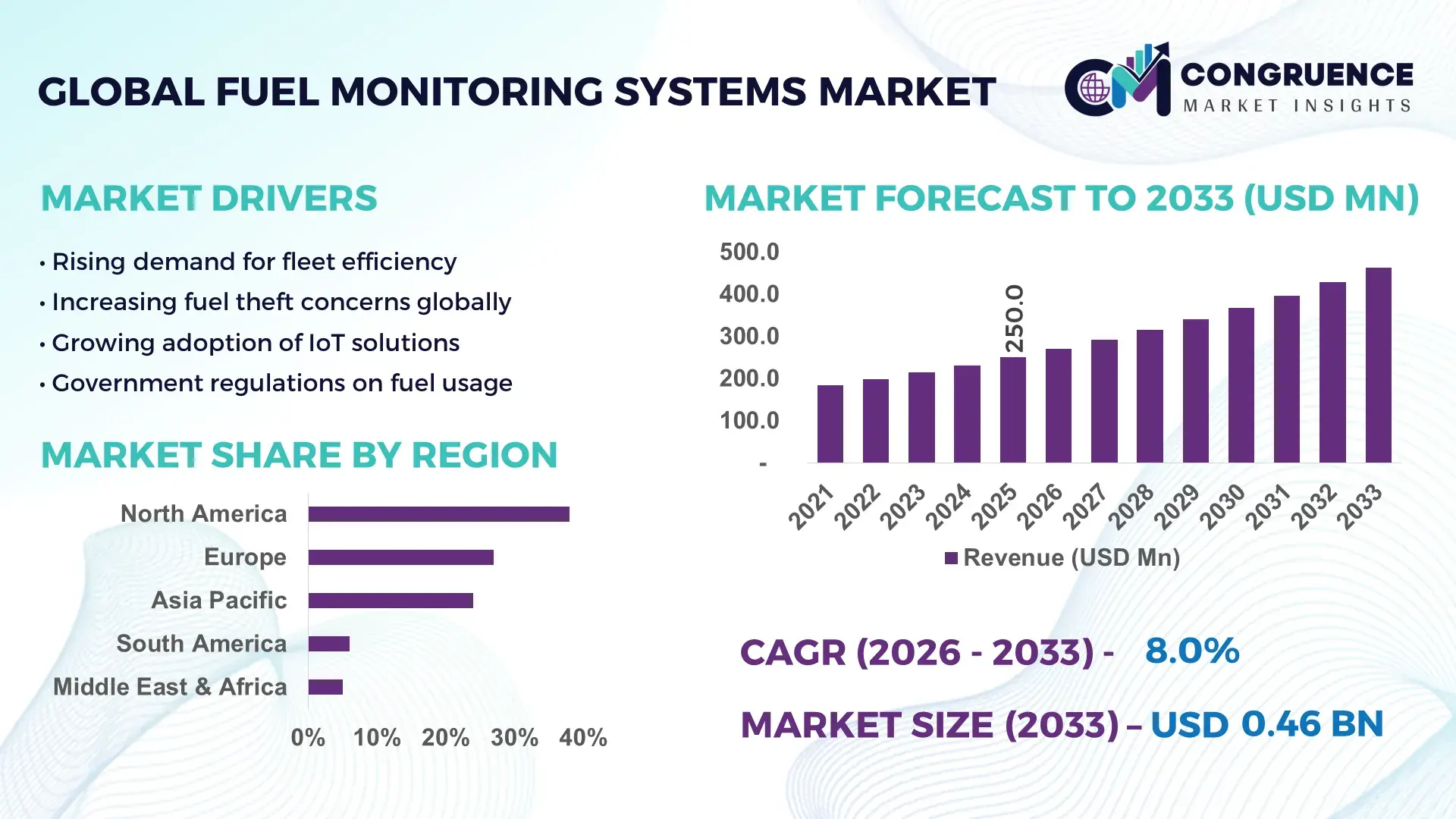
The Global Fuel Monitoring Systems Market was valued at USD 250.0 Million in 2025 and is anticipated to reach a value of USD 462.7 Million by 2033 expanding at a CAGR of 8.0% between 2026 and 2033, according to an analysis by Congruence Market Insights. Growth is primarily driven by increasing demand for fuel efficiency optimization and real-time asset monitoring across transportation and industrial sectors.
The United States remains a dominant country in the Fuel Monitoring Systems Market, supported by extensive deployment across transportation, defense, and logistics sectors. Over 68% of commercial fleet operators in the country have adopted telematics-integrated fuel monitoring systems, while approximately 52% of logistics firms utilize real-time fuel analytics platforms. The country also accounts for over 35% of global advanced telematics infrastructure installations, with annual investments exceeding USD 1.2 billion in fleet optimization technologies. Key applications include aviation fuel tracking, maritime logistics, and large-scale trucking operations, where precision monitoring has reduced fuel wastage by up to 18%. Additionally, AI-enabled predictive fuel analytics systems have seen adoption rates of over 40% among enterprise fleet operators, supported by rapid advancements in IoT sensors and cloud-based monitoring platforms.
Market Size & Growth: USD 250.0 Million in 2025, projected to reach USD 462.7 Million by 2033 at 8.0% CAGR, driven by increasing fleet digitization and fuel cost optimization needs.
Top Growth Drivers: Fleet telematics adoption (65%), fuel efficiency improvement demand (58%), regulatory compliance monitoring (47%).
Short-Term Forecast: By 2028, operational fuel costs are expected to reduce by up to 15% through real-time monitoring and analytics integration.
Emerging Technologies: IoT-enabled sensors, AI-based predictive analytics, and cloud-integrated fuel management platforms.
Regional Leaders: North America (~USD 160 Million by 2033) driven by fleet digitization; Europe (~USD 130 Million) driven by emission compliance; Asia-Pacific (~USD 120 Million) driven by logistics expansion.
Consumer/End-User Trends: Logistics and transportation account for over 55% usage, with increasing adoption among mining and construction sectors.
Pilot or Case Example: In 2025, a large fleet operator reduced fuel theft by 22% using IoT-enabled monitoring systems.
Competitive Landscape: Market leader holds ~18% share, followed by 4–5 key players focusing on AI-integrated monitoring solutions.
Regulatory & ESG Impact: Emission monitoring mandates and fuel efficiency regulations influencing over 45% of enterprise adoption decisions.
Investment & Funding Patterns: Over USD 900 Million invested in telematics and fuel monitoring innovations globally between 2023–2025.
Innovation & Future Outlook: Integration with autonomous fleet systems and digital twin technologies shaping next-generation fuel monitoring solutions.
Fuel monitoring systems are increasingly integrated across transportation (55%), industrial machinery (20%), and energy sectors (15%), with emerging applications in smart cities. Advanced IoT sensors and AI analytics have improved fuel tracking accuracy by over 30%. Regulatory mandates on emissions and fuel usage transparency are influencing adoption, while Asia-Pacific shows over 40% growth in system installations, indicating strong future expansion potential.
The Fuel Monitoring Systems Market holds significant strategic relevance as industries increasingly prioritize operational efficiency, regulatory compliance, and cost optimization. These systems enable real-time tracking of fuel consumption, helping enterprises reduce inefficiencies by up to 18% while improving asset utilization by approximately 22%. The integration of AI-powered predictive analytics with IoT-enabled fuel sensors is transforming decision-making processes, enabling proactive maintenance and fuel optimization strategies across fleets and industrial operations.
From a technological benchmark perspective, AI-enabled fuel monitoring systems deliver nearly 25% improvement in fuel consumption accuracy compared to traditional manual logging systems. North America dominates in volume due to extensive fleet infrastructure, while Asia-Pacific leads in adoption with over 48% of logistics enterprises implementing digital fuel monitoring solutions. This contrast highlights the evolving dynamics between mature and emerging markets.
In the short term, by 2028, predictive analytics integrated with fuel monitoring systems is expected to reduce fuel wastage by 20% while improving operational uptime by approximately 15%. ESG considerations are also shaping the market, with firms committing to fuel consumption reduction targets of up to 30% by 2030 through advanced monitoring technologies.
A micro-scenario example includes a 2025 initiative in Germany where a logistics company achieved a 17% reduction in fuel consumption through AI-integrated monitoring systems combined with route optimization tools. Such measurable outcomes underscore the market’s role in enhancing sustainability and operational efficiency.
Overall, the Fuel Monitoring Systems Market is evolving into a critical pillar supporting digital transformation, environmental compliance, and long-term operational resilience, positioning it as a key enabler of sustainable industrial growth.
The Fuel Monitoring Systems Market is characterized by strong technological integration, regulatory influence, and rising demand for operational efficiency across industries. Increasing digitization of fleet operations, combined with the expansion of logistics and transportation sectors, is significantly driving system adoption. Approximately 60% of large-scale fleet operators globally are shifting toward automated fuel tracking systems to reduce pilferage and improve accountability.
The growing deployment of IoT-based sensors and cloud-based monitoring platforms has improved real-time fuel tracking accuracy by over 30%, enabling companies to optimize fuel usage and reduce operational inefficiencies. Additionally, stringent environmental regulations are pushing organizations to monitor and control fuel consumption more effectively, particularly in developed economies.
Industrial sectors such as mining, construction, and oil & gas are also contributing to demand, accounting for nearly 35% of system installations. Emerging economies are witnessing rapid adoption due to infrastructure expansion and increasing fuel costs. However, integration challenges and cybersecurity concerns remain critical considerations influencing market dynamics. Overall, the market continues to evolve with advancements in AI-driven analytics, offering improved forecasting and decision-making capabilities.
The increasing demand for fleet efficiency is a primary driver for the Fuel Monitoring Systems Market, particularly in logistics and transportation sectors. Fuel expenses account for approximately 30–40% of total fleet operating costs, making efficient monitoring essential. Real-time tracking systems have demonstrated the ability to reduce fuel wastage by up to 18% and improve route efficiency by nearly 20%. Fleet operators are increasingly adopting telematics-integrated fuel monitoring systems, with over 65% of large logistics firms implementing such technologies. These systems enable accurate fuel consumption tracking, idle time monitoring, and theft detection, which can reduce unauthorized fuel usage by over 25%. Additionally, integration with GPS and route optimization tools enhances operational efficiency and minimizes downtime. The growth of e-commerce has further accelerated fleet expansion, with delivery vehicles increasing by over 35% in major urban markets. This expansion has amplified the need for efficient fuel management systems to maintain profitability and sustainability. As industries continue to prioritize cost reduction and efficiency, the demand for advanced fuel monitoring systems is expected to remain strong.
High implementation costs remain a significant restraint in the Fuel Monitoring Systems Market, particularly for small and medium-sized enterprises. The initial investment required for hardware components such as sensors, telematics devices, and software platforms can range significantly, creating financial barriers. Approximately 40% of SMEs report cost concerns as a primary reason for delayed adoption of fuel monitoring technologies. Additionally, integration with existing fleet management systems often requires customization, increasing deployment complexity and associated expenses. Maintenance costs, including calibration and system updates, further add to the financial burden, with annual maintenance expenses accounting for up to 12% of total system costs. Another challenge is the requirement for skilled personnel to manage and interpret data generated by these systems. Around 30% of companies cite a lack of technical expertise as a barrier to effective implementation. These factors collectively limit adoption, particularly in cost-sensitive markets, slowing overall market penetration despite the long-term benefits offered by fuel monitoring systems.
The integration of IoT and AI technologies presents substantial growth opportunities for the Fuel Monitoring Systems Market. IoT-enabled fuel sensors can provide real-time data with accuracy levels exceeding 95%, enabling precise monitoring and control of fuel consumption. Approximately 55% of new system deployments now incorporate IoT-based tracking capabilities, highlighting the rapid shift toward connected solutions. AI-driven analytics further enhance system capabilities by enabling predictive maintenance and anomaly detection. These technologies can identify inefficiencies and potential fuel leaks, reducing losses by up to 20%. Additionally, AI algorithms can optimize fuel usage patterns, improving operational efficiency by approximately 15%. The expansion of smart cities and connected infrastructure is also creating new application areas, particularly in public transportation and municipal services. Governments are increasingly investing in digital infrastructure, with over 50 smart city projects globally integrating fuel monitoring systems into their operations. This trend is expected to open new avenues for market growth, particularly in emerging economies.
Data security and system integration challenges are significant obstacles in the Fuel Monitoring Systems Market. With over 60% of systems now connected to cloud platforms, the risk of cyberattacks and data breaches has increased considerably. Approximately 28% of enterprises report concerns related to data security as a major barrier to adoption. Integration with legacy systems also poses challenges, as many organizations operate with outdated infrastructure that is not compatible with modern fuel monitoring technologies. This results in additional costs and extended implementation timelines, affecting overall efficiency. Furthermore, data accuracy and reliability remain critical concerns, particularly in harsh industrial environments where sensor performance can be affected by temperature and pressure variations. Around 20% of users report discrepancies in fuel data due to environmental factors. Addressing these challenges requires continuous investment in cybersecurity measures and system upgrades, which can be resource-intensive for organizations.
• Rapid adoption of IoT-enabled fuel sensors improving tracking accuracy by over 30%: IoT-based monitoring devices are now deployed in more than 58% of new fleet systems globally, enabling real-time fuel consumption tracking. These sensors reduce manual errors by nearly 25% and enhance operational visibility, particularly in logistics and transportation sectors where efficiency is critical.
• Integration of AI-based predictive analytics reducing fuel wastage by up to 20%: Around 45% of enterprises have integrated AI analytics into fuel monitoring systems to identify consumption patterns and anomalies. These solutions enable predictive maintenance, reducing equipment downtime by approximately 18% and improving fuel efficiency across industrial operations.
• Growing deployment in construction and mining sectors accounting for over 35% installations: Heavy machinery operations are increasingly adopting fuel monitoring systems to optimize consumption. Studies indicate that fuel usage in construction equipment has been reduced by nearly 15% through real-time monitoring and automated reporting systems.
• Expansion of cloud-based platforms with over 50% enterprise adoption: Cloud-integrated fuel monitoring solutions are gaining traction due to scalability and remote accessibility. More than 52% of large enterprises now rely on cloud-based platforms, enabling centralized data management and improving decision-making efficiency by approximately 22%.
The Fuel Monitoring Systems Market is segmented based on type, application, and end-user, reflecting diverse deployment scenarios across industries. System types primarily include hardware-based monitoring devices, software analytics platforms, and integrated solutions combining both components. Hardware systems remain essential for real-time data capture, while software platforms provide actionable insights through advanced analytics.
In terms of applications, transportation and logistics dominate due to high fuel consumption and the need for cost optimization. Industrial applications such as mining, construction, and oil & gas also contribute significantly, driven by heavy equipment usage. End-user segmentation highlights strong adoption among fleet operators, industrial enterprises, and government organizations. Increasing digital transformation initiatives and regulatory requirements are further shaping segmentation trends, with growing demand for integrated solutions that offer both monitoring and analytics capabilities.
Hardware-based fuel monitoring systems currently dominate the market, accounting for approximately 48% of total adoption due to their essential role in real-time fuel measurement and data collection. These systems include sensors, flow meters, and telematics devices that provide accurate fuel usage data across fleets and industrial equipment. Software-based platforms hold around 32% share, driven by increasing demand for analytics and reporting capabilities. Integrated systems, combining hardware and software, are the fastest-growing segment with an estimated CAGR of 9.2%, expected to surpass 35% adoption by 2033. Growth is driven by the need for end-to-end solutions that offer both monitoring and predictive analytics. Other niche types, including portable monitoring devices and standalone systems, collectively account for approximately 20% of the market, serving specialized applications.
• In 2025, a national transportation authority implemented integrated fuel monitoring systems across over 15,000 vehicles, reducing fuel consumption discrepancies by 19% and improving operational efficiency significantly.
Transportation and logistics lead the application segment, accounting for approximately 55% of total adoption due to high fuel consumption and the need for cost optimization. Industrial applications such as mining and construction hold around 30% share, driven by heavy equipment usage and operational efficiency requirements. Smart city and public transportation applications are the fastest-growing segment, with an estimated CAGR of 8.7%, supported by increasing urbanization and digital infrastructure investments. Other applications, including aviation and marine sectors, collectively contribute around 15% of the market. In 2025, over 42% of global logistics companies reported implementing fuel monitoring systems to optimize fleet operations, while more than 35% of construction firms adopted these systems for equipment efficiency.
• In 2025, a government-led smart transport project deployed fuel monitoring systems across 8 major cities, improving fuel efficiency by 16% and reducing emissions significantly.
Fleet operators represent the leading end-user segment, accounting for approximately 50% of total market adoption due to extensive use in logistics and transportation. Industrial enterprises, including mining and construction companies, hold around 30% share, driven by the need for efficient fuel management in heavy machinery. Government and public sector organizations are the fastest-growing end-user segment, with an estimated CAGR of 8.5%, supported by smart city initiatives and public transportation modernization. Other end-users, including energy and utilities sectors, collectively account for approximately 20% of the market. In 2025, more than 45% of enterprises globally reported integrating fuel monitoring systems into their operations, highlighting increasing adoption across industries. Additionally, over 38% of organizations indicated plans to expand system deployment within the next two years.
• In 2025, a public transportation authority implemented fuel monitoring systems across its fleet, achieving a 14% reduction in fuel consumption and improving operational efficiency.
North America accounted for the largest market share at 38% in 2025 however, Asia-Pacific is expected to register the fastest growth, expanding at a CAGR of 9.1% between 2026 and 2033.
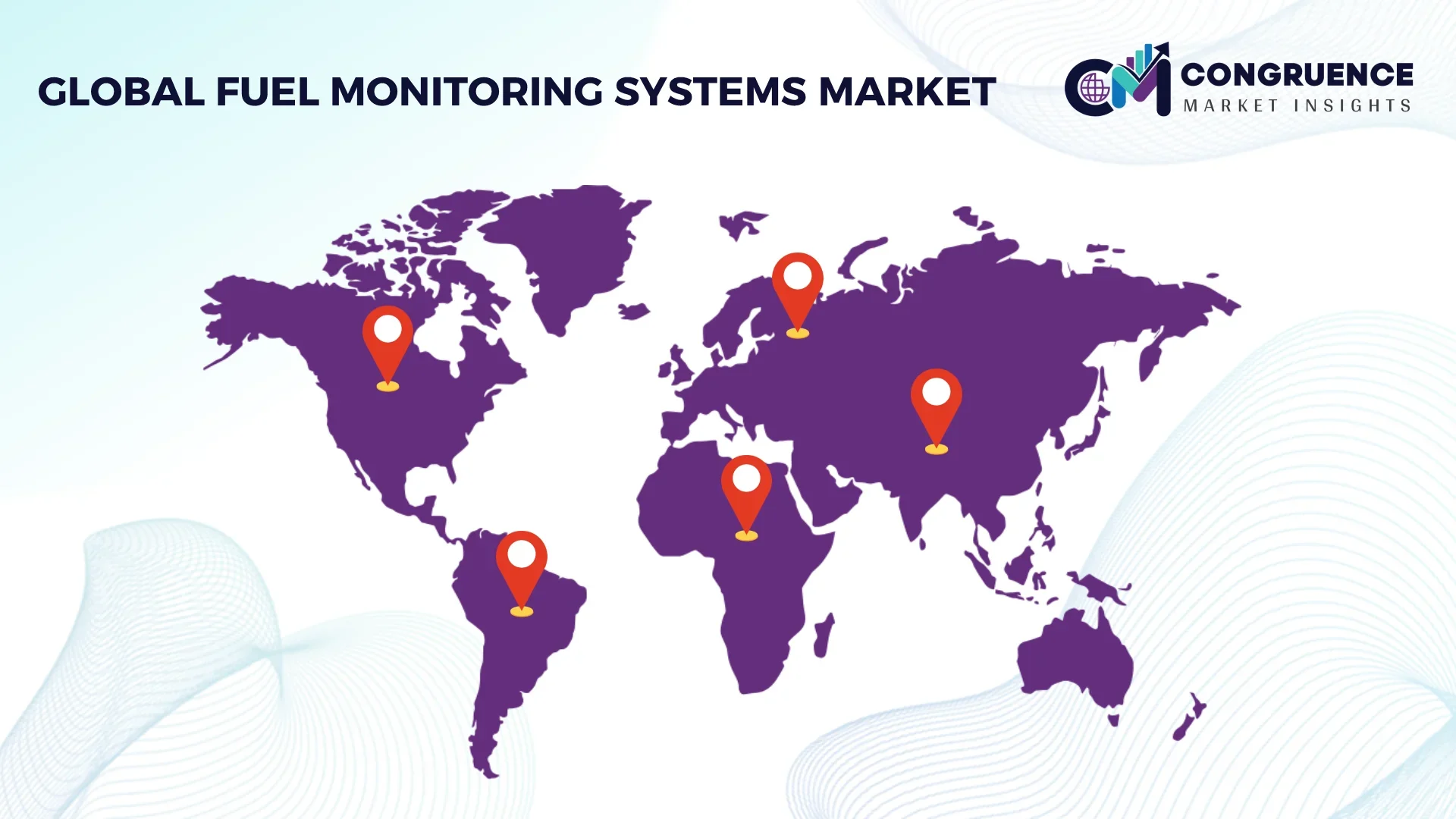
North America’s dominance is supported by high adoption of telematics and fleet management technologies, with over 65% of commercial fleets utilizing fuel monitoring systems. Europe follows with approximately 27% share, driven by stringent emission regulations and sustainability initiatives across Germany, France, and the UK. Asia-Pacific accounts for nearly 24% of the market, with rapid adoption in China, India, and Japan due to expanding logistics and infrastructure sectors. Latin America and the Middle East & Africa collectively contribute around 11%, with increasing investments in energy and transportation sectors. The region-wise analysis highlights strong growth potential in emerging economies, supported by rising fuel costs and digital transformation initiatives.
North America holds approximately 38% of the global Fuel Monitoring Systems Market, driven by strong demand from logistics, transportation, and defense sectors. The region has over 70% adoption of telematics-enabled fleet systems, enabling real-time fuel tracking and analytics. Regulatory frameworks focusing on emission reduction and fuel efficiency are influencing system deployment across industries. Technological advancements such as AI-based analytics and IoT integration are widely adopted, improving fuel efficiency by up to 20%. A key example includes a regional fleet solutions provider implementing predictive fuel monitoring across over 50,000 vehicles, significantly reducing fuel theft incidents. Consumer behavior indicates higher enterprise adoption in logistics and healthcare sectors, where operational efficiency is critical.
Europe accounts for approximately 27% of the global market, with strong demand from Germany, the UK, and France. The region is heavily influenced by regulatory frameworks promoting emission reduction and energy efficiency, leading to widespread adoption of fuel monitoring systems. Over 60% of enterprises in the region have implemented digital fuel management solutions, supported by government incentives and sustainability initiatives. Advanced technologies such as AI and cloud-based platforms are increasingly integrated, enhancing operational efficiency. A notable example includes a European logistics firm deploying IoT-enabled monitoring systems across its fleet, achieving a 15% improvement in fuel efficiency. Consumer behavior reflects a strong preference for sustainable and compliant solutions.
Asia-Pacific represents approximately 24% of the global market, with China, India, and Japan leading consumption. The region is experiencing rapid infrastructure development, with over 40% increase in logistics fleet size over recent years, driving demand for fuel monitoring systems. Technological advancements, including IoT and cloud-based platforms, are being widely adopted, particularly in urban and industrial sectors. A regional technology provider has implemented fuel monitoring solutions across large-scale construction projects, improving fuel efficiency by 18%. Consumer behavior indicates strong growth driven by e-commerce expansion and increasing adoption of digital solutions in transportation.
South America holds around 6% of the global market, with Brazil and Argentina as key contributors. The region is witnessing increasing investments in energy and transportation sectors, driving demand for fuel monitoring systems. Government initiatives promoting efficient fuel usage and infrastructure development are supporting market growth. A local fleet management company has introduced advanced monitoring systems, improving fuel tracking accuracy by 20%. Consumer behavior indicates growing demand for cost-effective solutions, particularly in logistics and transportation sectors.
The Middle East & Africa account for approximately 5% of the global market, driven by strong demand from oil & gas and construction sectors. Countries such as the UAE and South Africa are leading adoption due to infrastructure modernization and energy sector investments. Technological advancements, including IoT-based monitoring systems, are being implemented to optimize fuel usage in large-scale operations. A regional energy company has deployed advanced fuel monitoring systems, reducing fuel wastage by 16%. Consumer behavior reflects increasing adoption in industrial sectors, driven by the need for efficiency and cost control.
United States – 38% Market share: It is driven by high fleet digitization and advanced telematics adoption
Germany – 14% Market share: It is supported by strong industrial base and regulatory compliance requirements
The Fuel Monitoring Systems Market is moderately fragmented, with over 40 active global and regional players competing across hardware, software, and integrated solution segments. The top five companies collectively account for approximately 45% of the market, indicating a competitive yet partially consolidated landscape.
Key players are focusing on strategic initiatives such as partnerships, mergers, and product innovations to strengthen their market position. For instance, companies are increasingly investing in AI-integrated monitoring platforms and IoT-enabled sensors to enhance system capabilities. Over 60% of leading firms have introduced advanced analytics features in their offerings, improving fuel tracking accuracy and operational efficiency.
The competitive environment is also characterized by increasing collaborations between technology providers and fleet operators, enabling customized solutions for specific industry needs. Additionally, regional players are gaining traction by offering cost-effective solutions tailored to local markets. Continuous innovation, combined with growing demand for fuel efficiency and regulatory compliance, is expected to intensify competition in the coming years.
Honeywell International Inc.
Schneider Electric SE
Bosch Global
Trimble Inc.
Garmin Ltd.
Dover Corporation
Veeder-Root
Gilbarco Veeder-Root
ORBCOMM Inc.
Teletrac Navman
Fleet Complete
Samsara Inc.
Geotab Inc.
The Fuel Monitoring Systems Market is undergoing significant technological transformation driven by advancements in IoT, AI, and cloud computing. IoT-enabled sensors are now capable of delivering real-time fuel data with accuracy levels exceeding 95%, enabling precise monitoring across fleets and industrial equipment. Approximately 60% of new deployments incorporate IoT technology, highlighting its growing importance.
AI-based analytics are enhancing system capabilities by enabling predictive maintenance and anomaly detection. These technologies can identify inefficiencies and potential fuel leaks, reducing fuel losses by up to 20%. Machine learning algorithms are also being used to optimize fuel consumption patterns, improving operational efficiency by approximately 15%.
Cloud-based platforms are becoming increasingly popular, with over 50% of enterprises adopting these solutions for centralized data management and remote accessibility. Integration with GPS and telematics systems further enhances functionality, enabling route optimization and real-time tracking.
Emerging technologies such as blockchain are being explored for secure data management, while digital twin technology is enabling simulation-based optimization of fuel usage. These advancements are expected to drive innovation and improve system performance, positioning fuel monitoring systems as a critical component of modern fleet and industrial management.
• In January 2026, Samsara Inc. released its 2025 Year in Review report, highlighting that its connected operations platform helped customers collectively save 261.7 million gallons of fuel and improve fuel efficiency by 4% year-over-year, driven by AI-powered monitoring and analytics. Source: www.samsara.com
• In October 2025, Samsara Inc. published its 2025 Impact Report, revealing that its platform enabled customers to reduce over 3 billion pounds of CO₂ emissions through fuel optimization, route planning, and AI-driven operational insights, reinforcing the role of fuel monitoring in sustainability initiatives.
• In March 2026, Geotab Inc. announced in its press room that fleets using its platform reduced vehicle idling by up to 30%, significantly lowering fuel waste and improving efficiency through advanced telematics and fuel monitoring analytics.
• In March 2026, Samsara Inc. introduced new product updates including real-time fuel price visibility and preferred fuel location navigation, enabling fleets to optimize fuel purchasing decisions and reduce operational costs through integrated fuel management tools.
The Fuel Monitoring Systems Market Report provides a comprehensive analysis of the industry, covering a wide range of segments, technologies, and geographic regions. The report examines key system types, including hardware-based monitoring devices, software analytics platforms, and integrated solutions, offering detailed insights into their adoption and application across various industries.
Applications analyzed in the report include transportation and logistics, industrial operations such as mining and construction, aviation, marine, and emerging smart city initiatives. Transportation and logistics remain the dominant application segment, accounting for over 50% of system deployment, while industrial sectors contribute significantly due to high fuel consumption requirements.
The report also provides extensive regional analysis, covering North America, Europe, Asia-Pacific, South America, and the Middle East & Africa. Each region is evaluated based on adoption rates, technological advancements, and industry-specific demand drivers.
Technological insights focus on advancements in IoT, AI, cloud computing, and emerging innovations such as blockchain and digital twin technology. The report highlights how these technologies are transforming fuel monitoring systems, improving accuracy, efficiency, and decision-making capabilities.
Additionally, the report explores competitive dynamics, profiling key market players and analyzing their strategies, product offerings, and innovation initiatives. Overall, the report offers valuable insights into market trends, segmentation, and future opportunities, supporting informed decision-making for industry stakeholders.
| Report Attribute / Metric | Details |
|---|---|
| Market Revenue (2025) | USD 250.0 Million |
| Market Revenue (2033) | USD 462.7 Million |
| CAGR (2026–2033) | 8.0% |
| Base Year | 2025 |
| Forecast Period | 2026–2033 |
| Historic Period | 2021–2025 |
| Segments Covered |
By Type
By Application
By End-User Insights
|
| Key Report Deliverables | Revenue Forecast; Market Trends; Growth Drivers & Restraints; Technology Insights; Segmentation Analysis; Regional Insights; Competitive Landscape; Regulatory & ESG Overview; Recent Developments |
| Regions Covered | North America; Europe; Asia-Pacific; South America; Middle East & Africa |
| Key Players Analyzed | Siemens AG; Honeywell International Inc.; Schneider Electric SE; Bosch Global; Trimble Inc.; Garmin Ltd.; Dover Corporation; Veeder-Root; Gilbarco Veeder-Root; ORBCOMM Inc.; Teletrac Navman; Fleet Complete; Samsara Inc.; Geotab Inc. |
| Customization & Pricing | Available on Request (10% Customization Free) |




