
Reports
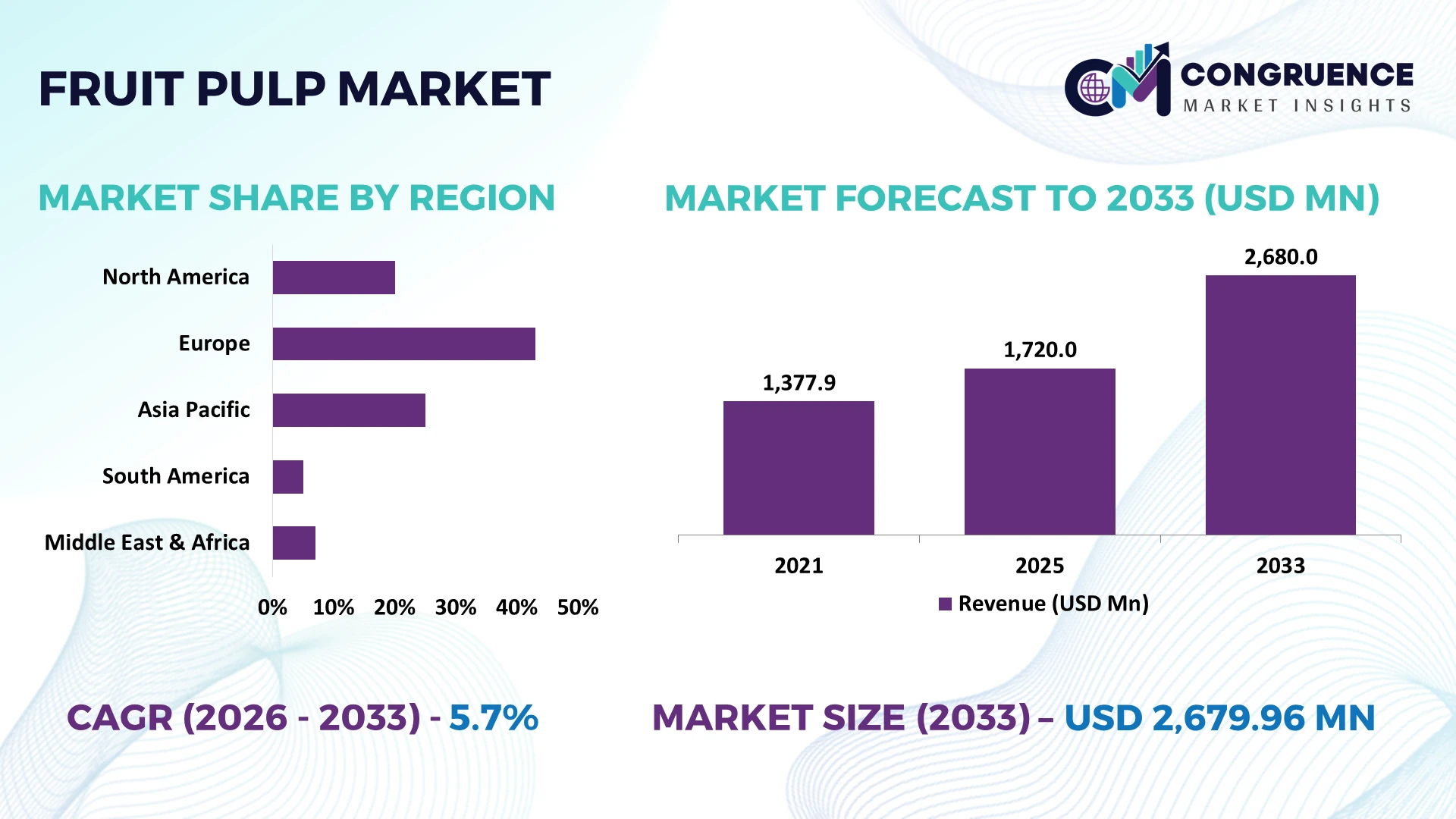
The Global Fruit Pulp Market was valued at USD 1720 Million in 2025 and is anticipated to reach a value of USD 2679.96 Million by 2033 expanding at a CAGR of 5.7% between 2026 and 2033. Growth is driven by wider adoption of aseptic processing, cold-chain integration, and high-pulp formulations that reduce seasonal raw-material losses while improving shelf stability for beverage, dairy, bakery, and confectionery manufacturers.
India dominates tropical fruit-pulp processing, with approximately 50% of global mango-pulp production historically concentrated in its processing ecosystem; the country exported 62,864 metric tons of mango pulp in FY2025-26. India’s roughly 65-unit Chittoor–Krishnagiri processing cluster contrasts with Brazil’s large fruit-processing base, where about 47% of commercial fruit production has historically entered domestic food processing. India’s scale and export orientation strengthen its strategic sourcing position.
Strategic decisions should prioritize aseptic capacity, diversified fruit sourcing, and export-ready cold-chain infrastructure in Asia-Pacific, while targeting premium clean-label applications in Europe and North America.
Market Size & Growth: USD 1.72 billion in 2025 is projected to reach USD 2.68 billion by 2033 at 5.7% CAGR, supported by aseptic processing and longer shelf-life formulations.
Top Growth Drivers: Aseptic processing adoption +18%, cold-chain expansion +15%, and clean-label formulation demand +12% are strengthening high-growth pulp applications.
Short-Term Forecast: By 2028, automated sorting and processing are positioned to deliver approximately 8–12% lower processing losses and 10% higher throughput across modern plants.
Emerging Technologies: AI vision sorting, automated pulping, and advanced aseptic filling are reshaping quality control, with technology integration increasingly focused on yield consistency and shelf-life extension.
Regional Leaders: Asia-Pacific represented 37.8% of the market in 2025, while Europe held 25.4% and North America 21.0%; APAC leads through expanding fruit-processing capacity and export-oriented production.
Consumer/End-User Trends: More than 65% of processed fruit-based beverages use pulp as a primary ingredient, reinforcing demand from beverage, dairy, dessert, and functional-food manufacturers.
Pilot/Case Example: India’s mango-pulp ecosystem processed through aseptic filling and controlled thermal treatment demonstrates industrial-scale shelf-life management, while FY2025-26 exports reached 62,864 metric tons.
Competitive Landscape: Leading suppliers include Agrana, Döhler, Iprona, Kiril Mischeff, and Tree Top; Asia-Pacific’s 37.8% regional share gives producers located near tropical fruit supply a structural advantage.
Regulatory & ESG Impact: India’s export-oriented processing increasingly emphasizes controlled processing and traceability; mango-pulp processing can generate 10–12 tons of peel and stone residues daily at a 40-ton-per-day plant, intensifying pressure for waste valorization.
Investment & Funding: A new fruit-pulp processing unit planned by Mother Dairy in Kuppam is linked to a broader processing initiative expected to generate approximately 8,000 jobs, signaling continued rural-processing investment in India.
Innovation & Future Outlook: Next-generation growth is shifting toward AI-enabled optical sorting, aseptic packaging, exotic fruit blends, functional formulations, and circular utilization of fruit residues, making yield optimization a core competitive priority.
The global Fruit Pulp Market is increasingly concentrated around beverage-grade mango, guava, berry, citrus, and tropical formulations, with demand strongest where processors require consistent flavor, texture, and year-round availability. Aseptic filling and cold-chain improvements are extending cross-border supply windows, while India’s mango-pulp export ecosystem and Brazil’s processing depth reinforce Asia-Pacific and Latin America as critical sourcing hubs.
Fruit pulp is becoming strategically important because food manufacturers are shifting from seasonal fresh-fruit procurement toward standardized, shelf-stable ingredient systems. This strengthens production planning, reduces formulation variability, and supports year-round beverage, dairy, bakery, and dessert manufacturing. In India, mango-pulp processing is increasingly linked with export-oriented infrastructure, while stricter traceability and food-safety requirements are accelerating investment in controlled processing and packaging.
Technology is reshaping plant economics. Automated optical sorting and digitally controlled pulping can reduce manual inspection and processing losses by approximately 8–12% versus conventional lines, while aseptic filling extends ambient storage and reduces dependence on refrigerated distribution. India emphasizes scale and export processing, particularly around Andhra Pradesh and Maharashtra, whereas European processors prioritize precision formulation, traceability, and premium fruit blends. Over the next 2–3 years, automated quality inspection and traceability deployment across larger plants is expected to move toward 30–40%.
Operationally, processors are expanding aseptic capacity, securing contract farming arrangements, and partnering with beverage manufacturers to stabilize raw-material utilization. Fruit-residue valorization is also gaining importance as processors convert peels and seeds into fiber, extracts, and other higher-value inputs. Companies that integrate sourcing, processing automation, packaging, and waste recovery will secure stronger margins and more resilient supply positions, making vertical integration a decisive competitive advantage.
Aseptic processing is strengthening fruit-pulp economics by improving shelf stability while reducing refrigerated logistics requirements. Modern automated lines can lower processing losses by approximately 8–12% and increase throughput by 10–15% compared with labor-intensive handling. India’s mango-processing hubs are responding to export demand by upgrading pulping, sterilization, and filling systems, while food manufacturers increasingly require consistent Brix, color, viscosity, and microbiological specifications. Traceability requirements are also pushing processors toward digitally monitored batches. Companies are investing in automated sorting, aseptic filling, and supplier contracts to secure consistent fruit quality. The non-obvious advantage is improved capacity utilization: processors can convert seasonal procurement into more predictable year-round ingredient inventories.
Fruit availability remains a structural constraint because processors depend heavily on seasonal harvest cycles, weather conditions, and localized crop yields. Procurement costs can fluctuate by 15–25% between weak and strong harvest periods for major tropical fruits, while inadequate cold-chain coverage can increase post-harvest losses by more than 10% in vulnerable supply areas. India’s mango-processing clusters therefore face sharper exposure to monsoon variability and farm-gate price movements than diversified sourcing networks. These fluctuations directly pressure gross margins and plant utilization. Companies are responding through multi-country sourcing, contract farming, inventory buffering, and investments in pre-cooling infrastructure. A critical strategic insight is that securing fruit supply can protect profitability more effectively than relying solely on downstream price increases.
AI-enabled optical sorting creates an underexploited opportunity by improving fruit grading before pulping and reducing inconsistent batches. Automated inspection can improve sorting productivity by approximately 15–20%, while advanced process controls can reduce material losses by 5–10%. India’s expanding food-processing infrastructure provides a strong deployment base, particularly where mango, guava, and other tropical fruits are processed at scale. Simultaneously, peels, seeds, and pomace are moving from waste streams toward fiber, nutraceutical extracts, pectin, and animal-feed applications. Companies are increasing R&D partnerships with ingredient producers and packaging specialists to monetize secondary outputs. This circular-processing model offers a distinctive margin opportunity because processors can generate additional value without proportionally increasing fruit procurement.
Scaling advanced processing remains difficult because fruit-pulp production spans highly automated exporters and smaller regional facilities with uneven infrastructure. Automation deployment can require 10–20% higher upfront capital than conventional equipment, while skilled technicians remain essential for calibration, microbiological controls, and digital monitoring. In India, fragmented supplier networks and inconsistent farm-level grading complicate standardized input quality, limiting the performance benefits of sophisticated equipment. Long-term competitiveness therefore depends on integrating digital traceability, automated inspection, predictive maintenance, and standardized supplier protocols rather than installing isolated machines. Companies must strengthen technical training, develop equipment-service partnerships, and modernize utilities and wastewater systems. The strategic priority is scalable automation architecture that remains reliable across variable fruit quality and seasonal operating conditions.
Aseptic Capacity Is Expanding: Indian processors are increasing aseptic filling deployment, with automated lines targeting 10–15% higher throughput and 8–12% lower product losses than conventional handling. Export-oriented plants are restructuring workflows around longer ambient shelf life, reducing refrigerated-storage dependence and improving shipment flexibility.
Traceability Is Moving Upstream: Food manufacturers are integrating digital batch tracking from fruit reception through pulping, sterilization, and filling, with larger facilities targeting 20–30% faster quality-data retrieval. Stricter traceability expectations and retailer audits are accelerating adoption, prompting processors to connect supplier databases with production-control systems.
Premium Blends Gain Traction: Product developers are increasing use of passion fruit, guava, and mixed-fruit formulations, with premium blends achieving approximately 10–15% higher formulation value than conventional single-fruit products. Beverage and dairy companies are partnering with pulp suppliers to secure standardized flavor profiles and reduce formulation variability.
Waste Streams Become Inputs: Processors are increasingly converting peel, seed, and pomace into fiber, extracts, and feed ingredients, potentially diverting 15–25% of processing residues from disposal. This shift is driven by input-cost pressure and circular-production requirements, encouraging companies to establish residue partnerships and redesign plant-level recovery workflows.
Mango remains the leading fruit-pulp type, accounting for an estimated 35–40% share, supported by abundant cultivation, established processing infrastructure, strong beverage integration, and scalable aseptic production. Indian processors benefit from mature mango-pulp supply chains, while guava holds a solid secondary position through beverages, desserts, and dairy formulations. Mango’s established procurement networks and processing yields give it a cost advantage, with mature facilities targeting 8–12% lower material losses through automated sorting and pulping.
Passion fruit is emerging as the fastest-growing type, driven by premium beverage formulations, distinctive flavor profiles, and functional-product development. Adoption is expanding roughly 10–15% faster than mature fruit-pulp categories in selected premium applications. Papaya and peach remain strategically relevant for specialized beverages, baby food, and dessert formulations, while guava benefits from broad formulation compatibility. Companies are prioritizing passion-fruit sourcing partnerships and blended-product R&D while maintaining mango capacity as the core volume platform.
Beverages represent the dominant application, estimated at approximately 40–45% of fruit-pulp consumption, because juice, nectar, smoothie, and functional-drink producers require consistent pulp texture, flavor, and year-round availability. Beverage manufacturers increasingly use aseptic pulp to simplify inventory management and reduce refrigerated logistics. Automated formulation and quality-control systems can improve batch consistency by approximately 8–12%, strengthening the commercial advantage of standardized pulp inputs.
Baby food is emerging as a faster-expanding application, supported by demand for fruit-based formulations with controlled texture and ingredient consistency, with adoption increasing approximately 10–15% in targeted product categories. Dairy products and bakery & confectionery remain important users, while sauces & desserts are expanding through premium fruit formulations. Companies are responding with application-specific pulp grades, tighter microbiological specifications, and co-development agreements, shifting investment toward customized ingredients rather than undifferentiated bulk supply.
Beverage manufacturers remain the dominant end-user group, estimated at approximately 45–50% of total fruit-pulp utilization, reflecting high production volumes, continuous formulation requirements, and extensive dependence on standardized fruit inputs. Large beverage plants increasingly integrate automated dosing, aseptic handling, and digital quality controls, reducing processing variability by roughly 8–12%. Dairy companies and food processors represent established secondary buyers, prioritizing customized viscosity, acidity, and flavor specifications.
Bakery manufacturers and foodservice operators are becoming more important as premium desserts, fillings, smoothies, and fruit-based menu items expand. Foodservice demand is developing faster in selected urban markets, with adoption in specialized fruit-based applications increasing approximately 10–15%. Companies are responding through smaller pack formats, flexible minimum-order structures, and distributor partnerships, while major beverage producers secure long-term procurement agreements. The competitive shift favors suppliers capable of serving both high-volume contracts and application-specific requirements.
Asia-Pacific accounted for the largest market share at 37.8% in 2025 however, Asia-Pacific is expected to register the fastest growth, expanding at a CAGR of 4.1% between 2026 and 2033.

Premium formulations and processing automation strengthen demand
North America represents approximately 21% of global fruit-pulp demand, supported by sophisticated beverage manufacturing, established cold-chain infrastructure, and strong adoption of processed fruit ingredients. The United States accounts for the majority of regional consumption, with beverage producers increasingly integrating mango, berry, guava, and tropical pulp into smoothies, juices, functional drinks, dairy products, and desserts. Automated dosing, aseptic filling, and digital quality-control systems are increasingly concentrated in larger processing facilities, improving batch consistency and reducing material losses by approximately 8–12%. Supply-chain disruptions and higher refrigerated-logistics costs are also encouraging manufacturers to shift toward ambient-stable aseptic pulp. Companies are strengthening multi-season procurement contracts, expanding customized ingredient portfolios, and partnering with processors in Latin America and Asia to diversify sourcing. The key operational advantage is faster formulation changeover without sacrificing standardized pulp quality.
United States Market Outlook: The United States is the dominant North American market because of its extensive beverage, dairy, bakery, and foodservice manufacturing infrastructure. Large processors increasingly require standardized Brix, viscosity, acidity, and microbiological specifications, supporting higher-value customized pulp supply. Aseptic formats are gaining importance because they reduce refrigerated-storage dependence and simplify inventory planning. Companies are strengthening supplier partnerships and regional distribution networks to secure year-round availability, while premium beverage launches are increasing demand for tropical and mixed-fruit formulations.
Traceability and sustainable processing reshape procurement
Europe accounts for approximately 25.4% of global fruit-pulp demand, with Germany, France, Italy, Spain, and the United Kingdom forming important processing and consumption centers. Demand is increasingly shaped by traceability, clean-label positioning, ingredient transparency, and stricter sustainability expectations across food manufacturing. European processors are upgrading digital batch documentation and automated quality monitoring to improve production consistency and meet retailer requirements. Advanced processing can reduce handling losses by approximately 8–10%, while optimized filling and packaging systems improve production efficiency by around 10–15%. Supply-chain restructuring is also encouraging European buyers to diversify sourcing beyond single-country suppliers, particularly for tropical fruits. Companies are responding through certified sourcing partnerships, application-specific pulp formulations, and investments in energy-efficient processing. The strategic shift is toward verified supply quality rather than simple bulk-volume procurement.
Germany Market Outlook: Germany represents a strategically significant European market because of its advanced food-processing base, sophisticated ingredient distribution, and stringent quality requirements. Beverage, dairy, bakery, and prepared-food manufacturers increasingly demand traceable pulp with standardized specifications. Automated inspection and digital batch management are becoming important differentiators for suppliers serving large processors. Companies are strengthening long-term sourcing agreements and investing in sustainable packaging and efficient logistics to reduce supply volatility while meeting retailer and regulatory expectations.
Processing scale and export capacity reinforce market leadership
Asia-Pacific holds approximately 37.8% of global fruit-pulp demand and remains the largest production and consumption base because of extensive tropical-fruit cultivation, expanding food-processing capacity, and strong beverage manufacturing. India, China, Thailand, Indonesia, and the Philippines provide significant raw-material and processing capabilities. India’s mango-pulp ecosystem includes around 65 processing units across major Chittoor and Krishnagiri clusters, while mango-pulp exports reached 62,864 metric tons in FY2025-26. Automated pulping, aseptic filling, and improved cold-chain infrastructure are expanding across export-oriented facilities. Processing automation can reduce product losses by approximately 8–12% while increasing throughput by roughly 10–15%. Companies are strengthening farmer contracts, expanding aseptic capacity, and establishing export partnerships. The region’s non-obvious advantage is the ability to combine low-cost fruit sourcing with increasingly sophisticated industrial processing.
India Market Outlook: India is the region’s leading strategic production hub, supported by extensive mango cultivation, established processing clusters, export infrastructure, and strong agricultural linkages. Chittoor and Krishnagiri remain important mango-pulp processing centers, with approximately 65 units collectively supporting industrial-scale production. Export-oriented processors are upgrading aseptic filling, automated grading, and quality-control systems to meet international specifications. Companies are also developing direct farmer procurement and contract-processing models to improve raw-material consistency and reduce seasonal supply disruptions. The combination of agricultural depth and processing specialization gives India a strong cost-to-scale advantage.
Brazilian processing scale drives tropical-fruit integration
South America contributes approximately 11.3% of global fruit-pulp demand, with Brazil serving as the region’s principal production, processing, and consumption hub. Brazil benefits from extensive fruit cultivation and a mature food-processing ecosystem supporting mango, passion fruit, guava, papaya, and other tropical varieties. Industrial processors are increasingly integrating pulping, concentration, aseptic filling, and cold-chain operations to improve product stability and export readiness. Modern processing systems can reduce handling and material losses by approximately 8–12%, while automated sorting improves throughput by around 10%. Supply-chain pressure is encouraging companies to develop closer farm-level procurement relationships and diversify processing locations. However, transport distances and infrastructure variability remain important cost considerations. Companies are therefore prioritizing strategically located plants, efficient logistics partnerships, and higher-value pulp formulations to improve margins and reduce dependence on commodity-volume competition.
Brazil Market Outlook: Brazil holds the strongest operational position in South America because its agricultural base and food-processing infrastructure support large-scale tropical-fruit conversion. The country’s fruit-puree market was estimated at approximately USD 107.8 million in 2025, highlighting a substantial adjacent processing ecosystem. Manufacturers are increasingly investing in aseptic processing, automated grading, and improved transport coordination to limit spoilage and stabilize exports. Passion-fruit and mango applications offer particular opportunities for beverage and dessert manufacturers. Companies with integrated sourcing and processing capabilities are positioned to capture stronger margins than fragmented suppliers.
Aseptic infrastructure improves supply reliability
Middle East & Africa accounts for approximately 4.5% of global fruit-pulp demand, with consumption concentrated around beverage producers, dairy companies, food processors, hospitality operators, and import-dependent markets. Saudi Arabia, the United Arab Emirates, South Africa, Egypt, and Morocco represent important commercial centers. The region’s key operational constraint is uneven cold-chain and processing infrastructure, making ambient-stable aseptic pulp increasingly attractive. Aseptic systems can reduce refrigerated-storage requirements and support inventory cycles extending several months, improving logistics flexibility. Importers are also diversifying supplier networks to reduce exposure to shipping disruptions and seasonal shortages. Companies are establishing distributor partnerships, localized warehousing, and application-specific product portfolios. Investment priorities increasingly favor storage modernization and dependable delivery rather than simply expanding processing volume, giving suppliers with reliable logistics and standardized quality a measurable competitive advantage.
Saudi Arabia Market Outlook: Saudi Arabia is the most strategically significant Middle Eastern market because of its large beverage, dairy, hospitality, foodservice, and processed-food sectors. High dependence on imported fruit ingredients increases the value of reliable aseptic supply, predictable delivery schedules, and long-duration storage. Suppliers increasingly use regional distributors and long-term procurement agreements to reduce logistics volatility. Modern food-processing facilities are also adopting automated filling and quality-control systems, strengthening demand for standardized mango, passion-fruit, guava, and mixed-fruit pulp specifications.
The Fruit Pulp Market features global ingredient specialists such as Döhler, AGRANA, SVZ, and Iprona competing with regional processors including Kiril Mischeff, Capricorn Food Products, and specialized Indian suppliers. The top five players collectively hold an estimated 20–25% share, indicating a fragmented structure where regional sourcing strength remains important. Competition centers on raw-material security, processing efficiency, customization, pricing, and delivery reliability. Automated sorting can reduce material losses by approximately 8–12%, while aseptic processing can increase throughput by 10–15% compared with conventional workflows. Leading players are expanding processing capacity, strengthening farmer partnerships, developing application-specific pulp grades, and integrating sourcing with manufacturing. The competitive shift is moving toward vertical integration as climate variability, freight disruption, and seasonal procurement increase supply-control requirements. Entry barriers include food-safety certification, processing infrastructure, export compliance, and established agricultural networks. Winning requires secure fruit sourcing, consistent quality, efficient processing, flexible formulations, and reliable year-round delivery.
Döhler GmbH
AGRANA Beteiligungs-AG
SVZ International B.V.
Iprona S.p.A.
Kiril Mischeff
Tree Top, Inc.
Capricorn Food Products India Ltd.
Shimla Hills Offerings Pvt. Ltd.
ABC Fruits
Jain Farm Fresh Foods Ltd.
Aditi Foods
Louis Dreyfus Company
Aseptic processing, automated pulping, optical sorting, PLC-controlled sterilization, and high-barrier packaging define current fruit-pulp technology. Modern lines improve throughput by 10–15% and reduce processing losses by 8–12% versus labor-intensive workflows. Adoption is concentrated in export-oriented plants, with major Indian facilities operating aseptic capacities of 10–16 tonnes per hour, strengthening shelf stability and reducing refrigerated-logistics dependence.
Emerging systems integrate machine vision, automated grading, digital batch traceability, predictive process controls, and advanced cold-chain monitoring. Automated inspection can improve sorting productivity by approximately 10–15%, while digitally monitored production reduces quality-control response times by around 20%. Farm-to-factory integration is also gaining traction, including mobile aseptic processing that reduces transportation of highly perishable fruit and supports localized value capture.
From 2026–2028, competitive advantage will increasingly favor processors combining automation with supply-chain intelligence. Compared with conventional processing, integrated automated lines deliver approximately 10% higher operational efficiency while reducing manual intervention. Large exporters and vertically integrated processors benefit most because they can justify capital-intensive systems through higher utilization, standardized quality, and export compliance. Companies investing now in aseptic capacity, machine vision, traceability, and energy-efficient processing will secure stronger cost and quality positions as customer specifications become more demanding.
May 2025 Mother Dairy announced a fruit pulp processing unit in Kuppam, Andhra Pradesh, with direct horticultural sourcing and projects expected to generate 8,000 jobs, strengthening localized processing and farmer-linked supply chains. Source: timesofindia.indiatimes.com
July 2026 CSIR-NIIST signed an MoU with 3CousinLabs for pilot-scale feasibility studies converting fruit pulp and juices into ethanol, expanding residue valorization and creating a measurable pathway toward circular processing. Source: pib.gov.in
June 2024 Allana highlighted 50,000 MT annual production capacity and 20,000 MT storage capacity for fruit-pulp products, reinforcing large-scale aseptic and frozen infrastructure for domestic and export customers. Source: allana.com
2024 ABC Fruits operated combined fruit-pulp capacity of 30 tonnes per hour and annual single-strength production of 50,000 MT, demonstrating continued investment in large-scale aseptic processing and export-oriented manufacturing. Source: abcfruits.com
The Fruit Pulp Market report covers Mango, Guava, Passion Fruit, Papaya, and Peach across Beverages, Dairy Products, Bakery & Confectionery, Baby Food, and Sauces & Desserts. End-user analysis includes Beverage Manufacturers, Dairy Companies, Food Processors, Bakery Manufacturers, and Foodservice Operators. Regional coverage spans North America, Europe, Asia-Pacific, South America, and Middle East & Africa, with country-level analysis focused on major production, processing, and consumption centers.
The study evaluates aseptic processing, automated pulping, optical sorting, digital traceability, advanced packaging, cold-chain systems, and residue-valorization technologies. It examines deployment patterns, supply-chain integration, processing capacity, sourcing strategies, and application-specific demand. Coverage of established mango-processing clusters alongside emerging passion-fruit, premium-blend, and circular-processing opportunities supports investment planning, capacity expansion, supplier selection, competitive positioning, and technology prioritization through 2026–2033.
| Report Attribute/Metric | Report Details |
|---|---|
Market Revenue in 2025 | USD 1720 Million |
Market Revenue in 2033 | USD 2679.96 Million |
CAGR (2026 - 2033) | 5.7% |
Base Year | 2025 |
Forecast Period | 2026 - 2033 |
Historic Period | 2021 - 2025 |
Segments Covered | By Type
By Application
By End-User
|
Key Report Deliverable | Revenue Forecast, Growth Trends, Market Dynamics, Segmental Overview, Regional and Country-wise Analysis, Competition Landscape |
Region Covered | North America, Europe, Asia-Pacific, South America, Middle East, Africa |
Key Players Analyzed | Döhler GmbH, AGRANA Beteiligungs-AG, SVZ International B.V., Iprona S.p.A., Kiril Mischeff, Tree Top, Inc., Capricorn Food Products India Ltd., Shimla Hills Offerings Pvt. Ltd., ABC Fruits, Jain Farm Fresh Foods Ltd., Aditi Foods, Louis Dreyfus Company |
Customization & Pricing | Available on Request (10% Customization is Free) |




