
Reports
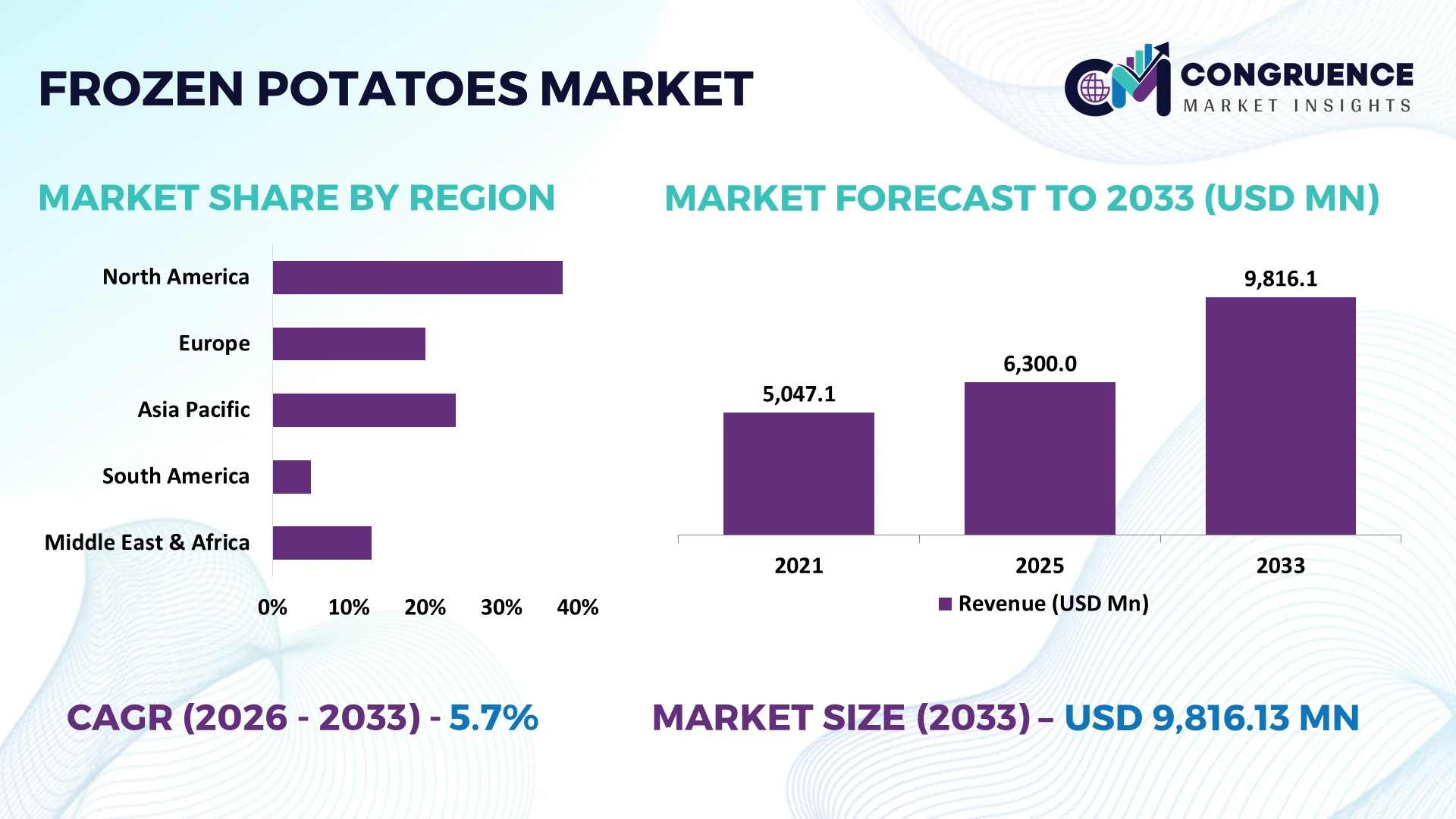
The Global Frozen Potatoes Market was valued at USD 6300 Million in 2025 and is anticipated to reach a value of USD 9816.13 Million by 2033 expanding at a CAGR of 5.7% between 2026 and 2033. Market expansion is driven by quick service restaurant penetration, automated potato processing, expanding refrigerated distribution networks, and increasing consumption of convenient frozen food products.
The United States represents a major frozen potato production and consumption hub, supported by established potato farming infrastructure, automated processing facilities, and extensive restaurant distribution networks. North America accounted for an estimated 35% of global frozen potato consumption in 2024. American processing operations benefit from integrated agricultural procurement and advanced freezing technologies. Meanwhile, the Netherlands continues strengthening European export capacity, demonstrated by Lamb Weston's November 2024 expansion, which added 195 million kilograms of annual production capacity. These developments reinforce the competitive importance of processing efficiency and international distribution.
Strategically, manufacturers should prioritize automated processing, agricultural supply agreements, and refrigerated logistics infrastructure to capture expanding global foodservice demand.
Market Size & Growth: The global market reached USD 6300 million in 2025 and is projected to reach USD 9816.13 million by 2033, registering 5.7% CAGR, supported by restaurant expansion and convenient food consumption.
Top Growth Drivers: Three principal demand drivers are restaurant penetration, frozen food convenience, and refrigerated distribution expansion. Their individual percentage contributions remain unestablished.
Short Term Forecast: By fiscal 2027, Lamb Weston targets approximately USD 200 million in annualized cost savings, highlighting the importance of operational restructuring and manufacturing efficiency.
Emerging Technologies: Three technologies are reshaping production: artificial intelligence, automated optical sorting, and advanced freezing systems that improve product consistency and processing control.
Regional Leaders: North America, Europe, and Asia Pacific represent major consumption regions. Historical regional shares provide market context, although independently established regional revenue projections for 2033 remain unavailable.
Consumer & End User Trends: India's frozen potato market demonstrates strong institutional demand, with foodservice accounting for an estimated 61% of domestic consumption value.
Pilot & Case Example: In 2025, McCain expanded its regenerative agriculture initiatives, establishing 3 Farms of the Future to test commercially applicable farming technologies across different agricultural environments.
Competitive Landscape: McCain Foods accounts for an estimated 25% of worldwide French fries production. Other prominent manufacturers include Lamb Weston, J.R. Simplot, Aviko, and Farm Frites.
Regulatory & ESG Impact: McCain reported a 28% reduction in absolute operational emissions against its 2017 baseline, demonstrating measurable progress in sustainable food manufacturing.
Investment & Funding: McCain participated in a USD 3.75 million digital agriculture investment initiative, including its USD 2.76 million commitment toward agricultural simulation and regenerative farming research.
Innovation & Future Outlook: Advanced agricultural technologies, energy efficient processing, and intelligent cold storage are shaping industry development, with McCain targeting regenerative agriculture implementation across 100% of its potato acreage by 2030.
The global frozen potatoes market serves quick service restaurants, institutional catering operations, supermarkets, and convenience food manufacturers. French fries remain a central product category, while potato wedges, hash browns, and specialty frozen potato products support portfolio diversification. Technological innovation increasingly focuses on automated grading, intelligent freezing systems, and agricultural resource optimization. McCain reported a 19% improvement in water use efficiency in water stressed regions against its 2017 baseline, demonstrating the operational significance of sustainable agricultural practices. Expanding foodservice infrastructure across emerging economies reinforces the strategic importance of reliable agricultural sourcing, processing efficiency, and refrigerated distribution networks.
The frozen potatoes market is becoming strategically important as food manufacturers restructure agricultural procurement, modernize processing infrastructure, and strengthen refrigerated distribution. Competition increasingly depends on processing efficiency, consistent potato quality, and dependable restaurant supply agreements. In the United States, potato utilization for frozen French fries and other frozen products declined 7% in 2024, highlighting the importance of flexible procurement and inventory management. Manufacturers are consequently prioritizing integrated agricultural sourcing and production planning.
Technological modernization is creating measurable operational advantages. Advanced water management and automated processing improve resource utilization compared with conventional production infrastructure. McCain demonstrated a 20% improvement in water use efficiency at priority manufacturing facilities during 2024 against its 2017 baseline. European manufacturers emphasize export capacity and processing automation, while Indian producers prioritize domestic agricultural integration and expanding foodservice distribution.
Between 2026 and 2028, investment priorities will increasingly concentrate on intelligent processing, agricultural traceability, and energy efficient refrigeration. McCain's Mehsana facility illustrates practical deployment, with renewable sources supplying 28% of its electricity during fiscal 2024. Manufacturers are strengthening agricultural partnerships and integrating resource monitoring technologies to improve production reliability. Competitive positioning will increasingly depend on combining agricultural resilience, manufacturing productivity, and efficient distribution.
Industrial potato processing remains a central demand driver as restaurant chains require consistent product specifications, reliable delivery schedules, and standardized preparation. In the United States, potatoes used for processing represented approximately 65% of total potato production in 2024, demonstrating the importance of industrial applications. However, total domestic potato production declined 4%, while raw potato sales to processors decreased 5%. These developments reinforce the importance of agricultural integration and dependable procurement. Manufacturers are responding through contracted farming, improved potato storage, and automated processing investments. The strategic advantage lies in securing suitable processing varieties while maintaining consistent product quality and minimizing production interruptions across established restaurant distribution networks.
Agricultural supply variability constrains frozen potato manufacturing because processing facilities require specific potato varieties, consistent starch characteristics, and predictable harvest volumes. American potato production recorded an average yield of 454 hundredweight per acre in 2024, while harvested acreage declined 4% from the previous year. The average selling price decreased by approximately 5%, illustrating simultaneous production and pricing pressures. In the Netherlands, agricultural producers face additional challenges involving environmental compliance, energy requirements, and changing fertilizer regulations. These conditions complicate procurement planning and agricultural investment decisions. Manufacturers are reducing exposure through diversified sourcing regions, contractual procurement arrangements, improved storage infrastructure, and closer coordination between agricultural suppliers and industrial processing facilities.
Precision agriculture creates opportunities to improve raw material consistency while reducing agricultural input requirements. McCain's 2024 sustainability assessment identified fertilizer production and application as contributors to 35% of its agricultural carbon footprint. Meanwhile, 22% of its global potato portfolio incorporated varieties tolerant to water stress, demonstrating progress in agricultural adaptation. In India, McCain reported a 25% improvement in agricultural water use efficiency against its fiscal 2017 baseline. These developments establish opportunities for precision irrigation, intelligent crop monitoring, and improved potato breeding. Manufacturers can strengthen their competitive positioning through agricultural research partnerships, digital farming platforms, and investment in processing varieties that deliver dependable yields with lower resource requirements.
Scaling sustainable potato processing requires manufacturers to coordinate agricultural transformation, industrial energy modernization, and consistent product quality across geographically dispersed operations. McCain's 2024 assessment identified transportation, storage, and irrigation as contributors to 40% of its agricultural carbon footprint. Despite sustainability investments, agricultural emissions intensity increased 3.1% against its 2017 baseline, illustrating the difficulty of achieving consistent environmental improvements. The company also reported that 24% of its farming partners had reached the engaged stage of its regenerative agriculture framework. These indicators highlight the operational complexity of implementing sustainable practices across independent agricultural suppliers. Manufacturers must strengthen farmer training, develop location specific agricultural technologies, and establish measurable performance standards throughout their procurement networks.
Manufacturing Networks Undergoing Strategic Restructuring: Frozen potato manufacturers are adjusting production capacity to changing restaurant demand. Lamb Weston reported a 5% increase in sales volume during fiscal 2026, alongside an 8% decline in net selling prices. The company is optimizing manufacturing utilization, rationalizing production assets, and prioritizing customer retention. This transition highlights the increasing importance of matching processing capacity with contracted demand rather than pursuing production expansion independently.
International Processing Capacity Expands Rapidly: Brazil is emerging as an important frozen potato manufacturing destination. In October 2025, McCain announced an expansion of its Araxá manufacturing facility, designed to increase production capacity by more than 50%. The project is expected to generate approximately 350 direct jobs. Manufacturers are increasingly positioning processing infrastructure closer to developing restaurant markets, reducing dependence on distant production centers and strengthening regional supply availability.
Circular Packaging Adoption Gains Momentum: Packaging modernization is becoming an operational priority as manufacturers respond to waste reduction requirements and changing retailer procurement standards. McCain's 2025 sustainability assessment reported that 98% of its packaging was designed to be recyclable, while 97% of its product portfolio complied with its global nutrition policy. Companies are integrating packaging redesign with product reformulation to strengthen retail acceptance and meet institutional procurement requirements.
Agricultural Partnerships Strengthen Supply Security: British potato processors are introducing structured financial support to protect agricultural supply relationships. McCain purchases around 20% of the British potato crop from approximately 250 farmers. Its recently announced grower support package addresses agricultural infrastructure investment and payment conditions. This approach shifts supplier management toward coordinated agricultural investment, helping manufacturers maintain dependable processing volumes while reducing exposure to disruptions in contracted potato production.
French Fries represent the leading product category within the global frozen potatoes market. Published market estimates place their 2025 share between 46.8% and 72%, reflecting differences in product classification and market coverage. Their dominance reflects standardized processing requirements, established restaurant procurement agreements, and compatibility with automated frying equipment. Uniform cutting specifications and predictable preparation times allow manufacturers to produce substantial volumes while maintaining consistent product quality. Companies including McCain Foods and Lamb Weston prioritize French Fries through dedicated processing facilities, restaurant partnerships, and specialized product formulations.
Hash Browns represent an important emerging category, supported by expanding breakfast menus and demand for convenient prepared potato products. One published forecast estimates segment growth at 7.8% annually through 2033, although this figure is not directly comparable with estimates using broader product classifications. Potato Wedges support differentiated restaurant menus through seasoned and specialty preparations. Potato Cubes address institutional meal preparation requirements, while Potato Patties provide standardized portions for breakfast applications. Mashed Potato Products serve catering operations requiring consistent preparation and reduced kitchen labor. Manufacturers are diversifying product portfolios to capture these distinct consumption occasions.
Quick Service Restaurants represent the principal commercial application for frozen potatoes, supported by standardized menus, centralized procurement, and substantial daily transaction volumes. Their exact global market share cannot be established consistently from the available application classifications. Restaurant operators prioritize products offering uniform cooking characteristics, predictable portion sizes, and compatibility with automated kitchen equipment. Frozen French Fries remain particularly important because they integrate directly into established restaurant preparation workflows. Suppliers are responding through customized cutting specifications, specialized coatings, and dedicated distribution agreements.
Household Consumption represents an important expansion opportunity as consumers increasingly adopt convenient frozen meal components and air fryer compatible products. However, available evidence does not establish that it is the fastest growing application across the specified categories. Full Service Restaurants maintain demand for premium potato preparations and differentiated menu offerings. Retail Foodservice supports convenient prepared meals, while Institutional Catering requires standardized products suitable for substantial meal volumes. Manufacturers are adjusting packaging formats, cooking instructions, and product specifications to address differences in preparation equipment and purchasing behavior. Investment priorities increasingly reflect channel specific product development rather than uniform portfolio expansion.
Restaurants constitute a major purchasing group within the frozen potatoes market because their operations require consistent product specifications, dependable supply schedules, and efficient kitchen preparation. Available industry disclosures establish their commercial importance but do not provide a verified global percentage for the specified end user classification. Restaurant chains particularly favor standardized frozen potato products that support centralized purchasing and consistent preparation across multiple locations. Manufacturers consequently emphasize customized product specifications, contractual supply relationships, and dependable distribution infrastructure.
Supermarkets represent an important developing customer group as manufacturers expand branded and private label frozen potato portfolios. Their comparative growth ranking remains unverified under the requested segmentation structure. Hotels purchase frozen potato products for breakfast services, banquets, and restaurant operations, while Catering Companies prioritize portion control and preparation efficiency. Foodservice Operators require dependable bulk distribution and flexible product assortments. Food Manufacturers incorporate prepared potatoes into composite meals and convenience products. Suppliers are strengthening retail partnerships, developing specialized packaging, and expanding customer specific production capabilities. Competitive differentiation increasingly depends on adapting product formats and commercial agreements to distinct purchasing requirements.
North America accounted for the largest market share at 37% in 2025 however, Asia Pacific is expected to register the fastest growth, expanding at a CAGR of 6.0% between 2026 and 2033.
Established Processing Infrastructure and Foodservice Integration
North America accounted for an estimated 37% of the global frozen potatoes market in 2025, supported by established processing infrastructure, extensive restaurant networks, and integrated refrigerated distribution. The United States dominates regional consumption, while Canada maintains substantial agricultural production and international processing operations. Mexico contributes through expanding restaurant demand and commercial food distribution. Manufacturers are increasingly emphasizing production efficiency, specialized potato varieties, and premium product differentiation. Automated cutting equipment, advanced freezing systems, and integrated inventory management support consistent processing performance. Established agricultural procurement networks also provide manufacturers with access to processing potatoes that meet demanding restaurant specifications. Investment priorities increasingly favor production optimization, differentiated product development, and stronger relationships with major restaurant operators. The region's established manufacturing infrastructure reinforces its position as an important international supplier of processed potato products.
United States Market Outlook: The United States represented an estimated 76.9% of North American frozen potato market value in 2025. Idaho, Washington, and Oregon provide important agricultural and processing infrastructure. Manufacturers benefit from established transportation networks, specialized potato cultivation, and extensive institutional purchasing arrangements. Increasing demand for premium coated fries and customized restaurant products encourages investment in processing flexibility and product innovation.
Export Oriented Manufacturing and Processing Modernization
Europe represents an estimated 30% of global frozen potato consumption, based on historical regional market estimates. Belgium, the Netherlands, France, and Germany form an important agricultural and industrial processing network. Established international trading relationships support substantial frozen potato exports to overseas restaurant operators and food distributors. European manufacturers are modernizing production facilities to improve energy efficiency, processing consistency, and product differentiation. Environmental regulations are encouraging investment in wastewater treatment, resource recovery, and more efficient industrial refrigeration. Agricultural supply arrangements remain important because manufacturers require potatoes with suitable dry matter content and consistent processing characteristics. Belgium and the Netherlands maintain substantial export infrastructure, supported by specialized agricultural equipment suppliers and refrigerated logistics networks. Competition increasingly centers on manufacturing productivity, dependable agricultural sourcing, and access to international foodservice distribution channels.
Belgium Market Outlook: Belgium maintains a prominent position in international frozen potato processing. Its industrial infrastructure supports manufacturers including Agristo, Clarebout Potatoes, and Lutosa. Established agricultural relationships and access to European transportation corridors strengthen export operations. Manufacturers are investing in production modernization, specialty potato products, and efficient packaging systems to maintain international competitiveness.
Accelerating Industrialization and Domestic Processing Expansion
Asia Pacific represents an estimated 21% of global frozen potato consumption based on historical regional estimates. The region is projected to register a CAGR of 6.0% between 2026 and 2033. China, India, Japan, and Australia contribute through established foodservice demand, agricultural processing capabilities, and modern retail distribution. China represents an estimated 43.3% of regional frozen potato market value in 2025. International restaurant chains and domestic foodservice operators are strengthening demand for standardized potato products. India is simultaneously developing processing infrastructure supported by agricultural partnerships and expanding export opportunities. Manufacturers are establishing production facilities closer to agricultural sourcing locations while strengthening refrigerated distribution networks. Investment in automated processing, contract farming, and specialized potato cultivation is reducing dependence on imported finished products. Regional competitiveness increasingly depends on combining agricultural productivity with reliable domestic manufacturing infrastructure.
India Market Outlook: India is emerging as an important frozen potato manufacturing and export destination. In 2025, Agristo announced an investment of EUR 80 million to expand its Bijnor processing facility in Uttar Pradesh. The project is designed to increase processing capacity fivefold and double employment from 150 to 300 workers. Local manufacturing also addresses India's 30% import duty on finished frozen potato products.
Domestic Manufacturing Expansion and Import Substitution
South America represents an estimated 8% of global frozen potato consumption based on historical regional estimates. Brazil and Argentina anchor the regional processing industry, supported by agricultural production, established restaurant networks, and expanding commercial food distribution. Regional manufacturers are increasing domestic processing capacity to reduce dependence on imported frozen potato products. Brazil's restaurant industry provides an important demand base, particularly in major metropolitan markets. Argentina contributes through agricultural production and established processing operations serving domestic and international customers. Refrigerated transportation costs and uneven distribution infrastructure remain important operational considerations. Manufacturers are prioritizing production facilities near agricultural regions and major consumption centers. Investments in specialized potato cultivation, industrial freezing equipment, and distribution partnerships are improving supply chain integration. Domestic manufacturing expansion also strengthens procurement flexibility for restaurant operators.
Brazil Market Outlook: Brazil is strengthening its frozen potato manufacturing infrastructure through substantial industrial investment. In October 2025, McCain announced an expansion of its Araxá production facility in Minas Gerais. The project is designed to increase manufacturing capacity by more than 50% and create approximately 350 direct employment opportunities. This investment supports domestic production and strengthens supply availability for commercial foodservice customers.
Foodservice Modernization and Refrigerated Infrastructure Development
The Middle East and Africa represent an estimated 6% of global frozen potato consumption based on historical regional estimates. Saudi Arabia, the United Arab Emirates, Egypt, and South Africa are important markets supported by restaurant operations, hospitality infrastructure, and commercial food distribution. Demand is concentrated in major urban centers where international restaurant brands and institutional catering companies require standardized frozen potato products. Refrigerated storage capacity and dependable import logistics remain essential because several markets depend substantially on international suppliers. Saudi Arabia is strengthening domestic food manufacturing under its economic diversification initiatives, while the United Arab Emirates maintains established international food distribution infrastructure. Egypt and South Africa offer agricultural processing opportunities supported by domestic potato cultivation. Manufacturers are developing regional distribution partnerships and evaluating localized production to improve supply reliability and reduce exposure to international transportation disruptions.
Saudi Arabia Market Outlook: Saudi Arabia represents an important frozen potato consumption market, supported by restaurant expansion, tourism investment, and institutional catering requirements. Its Vision 2030 development program encourages domestic food manufacturing and logistics modernization. Investments in refrigerated warehousing, agricultural processing, and integrated distribution infrastructure support opportunities for manufacturers seeking to establish local production and strengthen commercial customer relationships.
The global frozen potatoes market is concentrated, with McCain Foods, Lamb Weston, J.R. Simplot, Aviko, and Farm Frites collectively holding an estimated 60.4% share in 2025. Global processors compete against European specialists and emerging Asian manufacturers through production scale, agricultural integration, pricing, and product customization. McCain holds an estimated 20.3% share, while J.R. Simplot accounts for 8.8%, demonstrating substantial differences in competitive positioning. North American market concentration is particularly pronounced, with established processors controlling around 98% of domestic frozen potato supply.
Competition increasingly emphasizes automated processing, specialized product formulations, and dependable agricultural procurement. Manufacturers are expanding production capacity, establishing farming partnerships, and optimizing international distribution networks. Regional processors emphasize localized sourcing and flexible manufacturing to challenge established suppliers. Consolidation and agricultural supply control are reshaping competitive dynamics, while substantial processing investments and refrigerated infrastructure requirements restrict market entry. Sustainable competitive positioning requires manufacturing efficiency, secure agricultural sourcing, differentiated products, and reliable customer distribution relationships.
McCain Foods
Lamb Weston
J.R. Simplot Company
Aviko
Farm Frites
Agristo
Cavendish Farms
Agrarfrost
Pizzoli
Bem Brasil Alimentos
HyFun Foods
Iscon Balaji Foods
Ardo
Nomad Foods
Automated optical sorting, intelligent cutting systems, and advanced freezing technologies are transforming industrial frozen potato production. Modern optical sorting equipment identifies defects through digital imaging and automated rejection, reducing dependence on manual inspection. McCain reported a 9% reduction in operational food waste intensity against its 2020 baseline, demonstrating measurable progress in manufacturing resource efficiency. Integrated production monitoring improves cutting consistency, reduces unnecessary material losses, and strengthens product standardization. Manufacturers increasingly prioritize automated inspection systems that integrate directly with industrial processing lines.
Emerging technologies include artificial intelligence, predictive maintenance, intelligent refrigeration, and advanced agricultural monitoring. Compared with conventional irrigation practices, modern precision irrigation enables more efficient resource allocation through soil monitoring and automated water delivery. McCain documented a 16.1% improvement in agricultural water use efficiency across water stressed regions against its 2017 baseline. Digital integration strengthens agricultural procurement planning while supporting consistent raw material quality and processing schedules.
Between 2026 and 2028, manufacturers will increasingly integrate predictive analytics with processing automation and intelligent refrigerated storage. Advanced freezing equipment and connected monitoring platforms will strengthen temperature control, inventory visibility, and operational reliability. Large processors benefit from established infrastructure, while regional manufacturers gain opportunities through modular automation. Competitive differentiation increasingly depends on integrating agricultural intelligence, manufacturing technology, and distribution performance into coordinated production systems.
October 2025: Lamb Weston inaugurated its frozen potato processing facility in Mar del Plata, Argentina, with annual processing capacity of 200 million pounds. The facility strengthens manufacturing capabilities and supports frozen potato exports to Brazil and other Latin American markets.
June 2026: Nomad Foods announced manufacturing modernization at its Lowestoft facility in Suffolk, investing £2.2 million in a new potato waffle production line. The expansion targets annual production capacity of 18,250 tonnes, strengthening manufacturing productivity and specialized product availability.
February 2026: McCain Foods announced its third Farm of the Future in partnership with the University of Leeds. The 202 hectare British research facility will test regenerative agricultural practices, strengthen potato farming resilience, and accelerate commercially applicable agricultural innovation.
September 2025: Agristo began site preparation for its first American processing facility in Grand Forks, North Dakota. The USD 450 million investment establishes domestic manufacturing infrastructure, strengthens agricultural procurement relationships, and expands its competitive presence in North American markets.
The Frozen Potatoes Market Report examines industry developments, competitive positioning, manufacturing technologies, and commercial opportunities between 2026 and 2033. Product segmentation covers French Fries, Potato Wedges, Hash Browns, Potato Cubes, Potato Patties, and Mashed Potato Products. Application analysis examines Quick Service Restaurants, Full Service Restaurants, Retail Foodservice, Institutional Catering, and Household Consumption. End user coverage includes Restaurants, Hotels, Catering Companies, Foodservice Operators, Supermarkets, and Food Manufacturers.
Geographical coverage encompasses North America, Europe, Asia Pacific, South America, and the Middle East and Africa, with country specific assessments of manufacturing concentration, agricultural infrastructure, and consumption patterns. Technology analysis evaluates automated processing, intelligent sorting, advanced freezing, precision agriculture, and refrigerated distribution. Competitive assessments examine manufacturing expansion, agricultural partnerships, product differentiation, and sustainability investments, supporting strategic investment planning, geographic expansion, procurement optimization, and competitive positioning.
| Report Attribute/Metric | Report Details |
|---|---|
Market Revenue in 2025 | USD 6300 Million |
Market Revenue in 2033 | USD 9816.13 Million |
CAGR (2026 - 2033) | 5.7% |
Base Year | 2025 |
Forecast Period | 2026 - 2033 |
Historic Period | 2021 - 2025 |
Segments Covered | By Type
By Application
By End-User
|
Key Report Deliverable | Revenue Forecast, Growth Trends, Market Dynamics, Segmental Overview, Regional and Country-wise Analysis, Competition Landscape |
Region Covered | North America, Europe, Asia-Pacific, South America, Middle East, Africa |
Key Players Analyzed | McCain Foods, Lamb Weston, J.R. Simplot Company, Aviko, Farm Frites, Agristo, Cavendish Farms, Agrarfrost, Pizzoli, Bem Brasil Alimentos, HyFun Foods, Iscon Balaji Foods, Ardo, Nomad Foods |
Customization & Pricing | Available on Request (10% Customization is Free) |




