
Reports
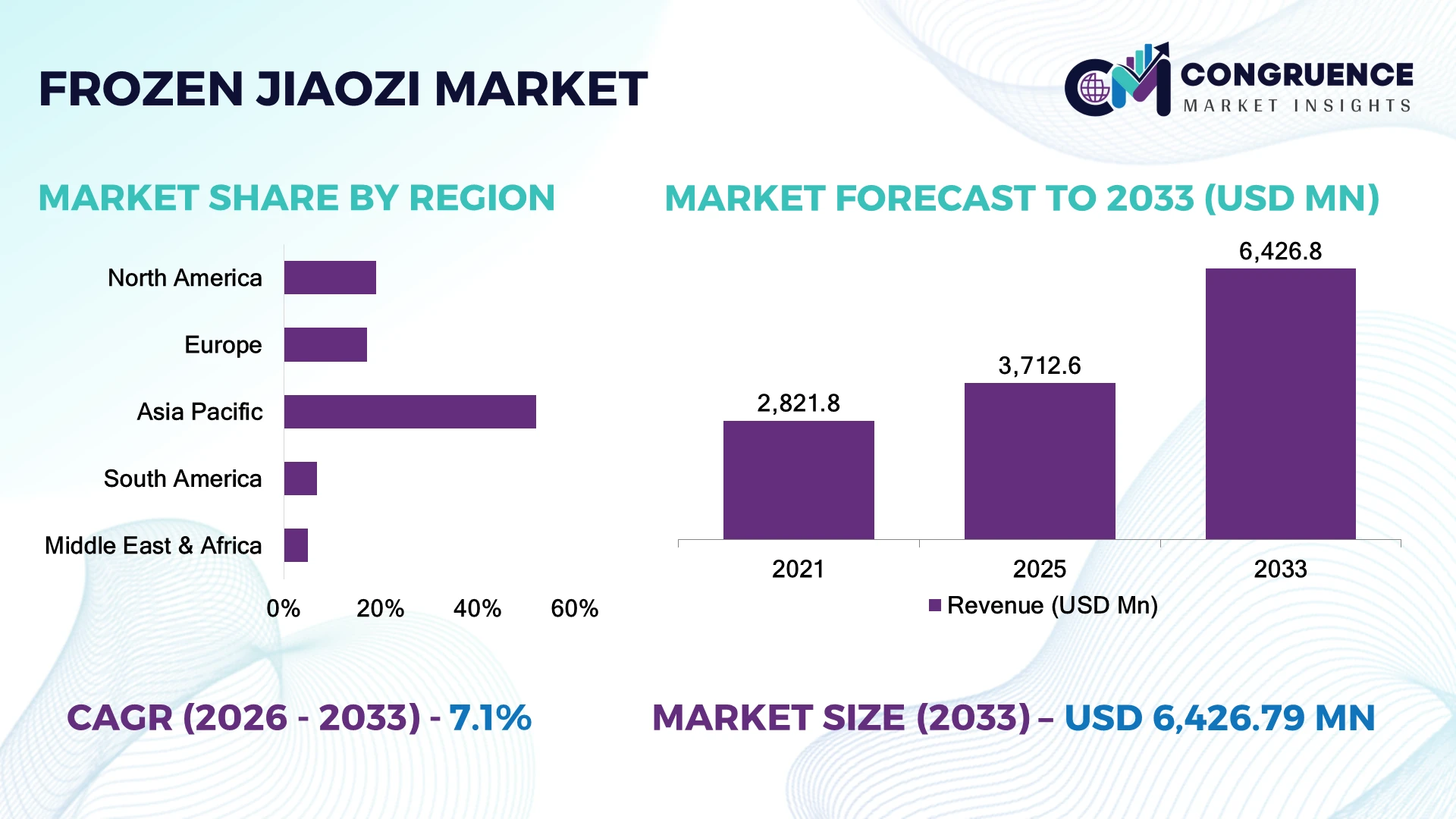
The Global Frozen Jiaozi Market was valued at USD 3,712.6 Million in 2025 and is anticipated to reach a value of USD 6,426.8 Million by 2033 expanding at a CAGR of 7.1% between 2026 and 2033. Growth is being driven by automated filling and pleating, expanding cold-chain retail, premium ingredient formulations, and rising demand for portion-controlled Chinese convenience foods.
China remains the dominant production and consumption base, accounting for an estimated 58% of global Frozen Jiaozi volume, supported by large-scale automated food-processing clusters and extensive frozen-food distribution. Japan represents a smaller but highly automated market, with approximately 35% of manufacturers using advanced forming or packaging equipment. China's production scale exceeds Japan's by more than 3×, while export-oriented producers are strengthening overseas capacity amid continuing China-plus-one supply-chain strategies.
Strategically, manufacturers with scalable automation, cold-chain reach, and differentiated fillings are best positioned to capture premium and export demand.
Market Size & Growth: USD 3,712.6 million in 2025 to USD 6,426.8 million by 2033 at 7.1% CAGR, supported by automated production and frozen-food retail expansion.
Top Growth Drivers: Convenience-led consumption 31%, foodservice expansion 24%, and e-commerce penetration 18% underpin high-growth demand.
Short-Term Forecast: By 2028, automated forming can reduce labor requirements by 15–20% while improving production consistency by approximately 12%.
Emerging Technologies: AI-assisted inspection, robotic pleating, and modified-atmosphere packaging are advancing, with automated quality-control deployment approaching 25% among larger processors.
Regional Leaders: Asia-Pacific leads with approximately USD 4.1 billion projected value, North America reaches USD 1.0 billion, and Europe approaches USD 0.8 billion, supported by expanding Asian-food retail.
Consumer/End-User Trends: Nearly 42% of urban frozen-dumpling buyers increasingly prioritize filling variety, portion convenience, and shorter preparation times.
Pilot/Case Example: A 2025 automated dumpling-line deployment delivered approximately 18% higher throughput and 14% lower manual handling requirements.
Competitive Landscape: Leading producers collectively control roughly 35% of organized-market sales, with Synear, Sanquan, Wanchai Ferry, General Mill's Asian-food operations, and regional private labels competing through scale and localization.
Regulatory & ESG Impact: Packaging optimization can reduce material consumption by approximately 10–15%, while stricter cold-chain controls are increasing investment in temperature monitoring.
Investment & Funding: Approximately USD 420 million is being directed toward processing, freezing, packaging, and cold-chain capacity, emphasizing automation and export-oriented partnerships.
Innovation & Future Outlook: Smart filling systems, premium seafood and plant-based fillings, recyclable packaging, and regional manufacturing will reshape competitive positioning through 2026–2028.
Frozen Jiaozi is increasingly moving beyond traditional Chinese grocery channels into mainstream frozen-food retail, foodservice, and digital grocery platforms. Premium fillings, cleaner-label formulations, and individually quick-frozen formats are strengthening differentiation, while approximately 28% of newer product launches emphasize portion convenience or premium ingredients. Exporters are simultaneously adapting packaging, labeling, and cold-chain specifications to meet destination-market requirements, creating a stronger transition toward standardized, scalable international product platforms.
Frozen Jiaozi is becoming strategically important because manufacturers can convert traditional food preparation into a scalable, standardized, exportable frozen-food platform. Competitive advantage increasingly depends on filling consistency, automated pleating, freezing speed, cold-chain reliability, and SKU localization rather than production volume alone. Supply-chain restructuring is also encouraging producers to diversify ingredient sourcing and establish regional packing or distribution capabilities closer to major consumer markets.
Automation is creating a measurable advantage. Modern robotic forming and inspection systems can reduce manual processing requirements by approximately 15–20% compared with labor-intensive production while improving dimensional consistency by around 10–15%. China retains the largest production ecosystem, whereas Japan emphasizes automation and quality precision; North American operators increasingly prioritize foodservice-ready packaging and localized flavor profiles.
Through 2026–2028, processors are expected to increase automated inspection, high-speed pleating, digital traceability, and recyclable packaging deployment. A practical commercial model involves combining centralized dough and filling preparation with regional freezing and distribution hubs, reducing transport exposure while preserving formulation consistency. Companies investing in flexible production lines and regional partnerships will gain faster SKU turnover and stronger export readiness, making operational standardization the decisive competitive advantage.
Rising automation in dumpling forming, filling, inspection, and packaging is strengthening production economics, particularly in China, where large processors are replacing labor-intensive workflows. Automated forming can reduce manual handling by 15–20%, while machine-vision inspection improves shape and filling consistency by approximately 10–15%. Labor-cost pressure and tighter food-safety controls are accelerating this transition. Producers are responding with integrated forming-freezing lines, robotic palletizing, and digital quality monitoring. The strategic advantage is not simply lower labor intensity: standardized automation enables manufacturers to replicate recipes and product specifications across plants, supporting export contracts and private-label production without proportional increases in skilled labor requirements.
Frozen Jiaozi producers remain exposed to refrigeration, logistics, and ingredient-cost volatility. Cold-chain operations can represent roughly 12–18% of delivered product costs, while energy-intensive freezing and storage can increase processing expenses by 8–12% during periods of elevated electricity prices. In China and Southeast Asia, uneven cold-storage infrastructure creates additional distribution constraints outside major urban corridors. Exporters also face temperature-control requirements that increase handling complexity and spoilage exposure. Companies are reducing pressure through regional distribution hubs, longer-term logistics contracts, supplier diversification, and higher-efficiency freezing equipment. The non-obvious constraint is route economics: expanding geographic coverage without sufficient shipment density can erode margins even when retail demand is strong.
Premium seafood, plant-based, low-sodium, and functional-ingredient fillings are creating higher-value niches beyond conventional pork and vegetable Jiaozi. Premium variants can command approximately 15–25% higher retail prices, while clean-label formulations are gaining attention among urban consumers. Automated dosing and flexible filling systems allow manufacturers to increase SKU variety without rebuilding complete production lines. In Japan and South Korea, precision portioning and premium packaging provide strong differentiation, while Chinese exporters are adapting recipes for overseas tastes. Companies are investing in modular processing equipment, co-development partnerships, and localized flavor portfolios. A particularly attractive opportunity lies in smaller premium packs for e-commerce, where portion control reduces household waste and improves shipping economics.
Scaling Frozen Jiaozi production across diverse recipes creates integration challenges between dough preparation, filling deposition, pleating, freezing, inspection, and packaging systems. Product-format changes can increase line changeover requirements by 10–20%, while smaller manufacturers often operate below the utilization levels needed to justify advanced robotics. Workforce shortages further complicate maintenance and automation programming, particularly outside China's major food-processing hubs. Companies must therefore invest in modular equipment, interoperable controls, predictive maintenance, and technical training. The strategic challenge is maintaining high utilization while supporting frequent SKU changes. Producers that standardize machine interfaces and digital production records can reduce downtime by approximately 8–12% and preserve consistency as product portfolios expand.
Smart Forming Lines Gain Ground Automated pleating, filling, and inspection systems are increasingly replacing manual operations in large Chinese plants. Adoption among major processors is estimated at 25–30%, with integrated lines improving throughput by roughly 15% and reducing repetitive labor requirements. Companies are pairing robotic handling with machine vision to stabilize product geometry and filling weights.
Premium Filling Mix Expands Manufacturers are shifting beyond traditional pork and vegetable recipes toward shrimp, seafood, mushroom, plant-based, and reduced-sodium formulations. Premium SKUs now represent approximately 20% of launches in higher-value urban channels, supporting 15–25% price premiums. Producers are using modular filling systems to introduce localized recipes without major line redesigns.
Cold-Chain Networks Localize Rising energy and transportation costs are encouraging producers to place freezing and distribution closer to consumption centers. Regional hubs can reduce long-distance frozen transport requirements by approximately 10–15%, improving inventory responsiveness. Companies are restructuring logistics partnerships and expanding temperature-monitored storage around major metropolitan markets.
Digital Quality Controls Expand Food-safety requirements and labor constraints are accelerating machine-vision inspection, digital batch records, and automated weight verification. Deployment across advanced facilities is approaching 20%, with automated inspection reducing manual quality checks by approximately 30%. Producers are integrating traceability systems with production equipment to strengthen recall readiness and improve consistency across multi-site operations.
Pork-Based Jiaozi Leads, Premium Fillings Gain Ground
Pork-based jiaozi is estimated to account for approximately 46% of the global Frozen Jiaozi Market in 2025, supported by established recipes, broad consumer familiarity, efficient ingredient sourcing, and high-volume manufacturing. Chicken-based varieties represent nearly 21%, benefiting from lighter-protein positioning and wider acceptance among health-conscious consumers. Beef-based jiaozi contributes around 14%, while vegetable and seafood variants collectively capture the remaining share through niche dietary preferences and premium positioning. Manufacturers are increasingly optimizing filling-to-wrapper ratios and automated forming processes to protect margins while maintaining consistency.
Vegetable-based jiaozi is emerging as the fastest-growing type, with adoption expanding by roughly 9–11% across urban retail and foodservice channels as plant-forward eating and meat diversification gain traction. Premium seafood and mixed-protein formulations are also expanding product differentiation, although their higher input costs limit mass penetration. Companies are directing approximately 15% of new-product activity toward differentiated fillings, smaller portion formats, and cleaner-label formulations, shifting investment from standardized pork products toward higher-margin specialty SKUs.
Industry-backed insight: iiMedia Research reported in 2025 that 60.99% of surveyed Chinese consumers frequently purchased frozen foods, while frozen rice-and-noodle products, including frozen dumplings, accounted for 43.24% of stated product preferences, reinforcing the commercial strength of traditional frozen dumpling formats.
Retail Consumption Drives Scale, Foodservice Accelerates Innovation
Household retail consumption is estimated to represent approximately 58% of global Frozen Jiaozi demand in 2025, reflecting freezer penetration, batch purchasing, and the convenience of short cooking cycles. Foodservice accounts for roughly 31%, supported by restaurants, quick-service operators, and specialty Chinese dining concepts that require consistent portioning and preparation speed. Institutional catering represents about 11%, remaining more price-sensitive but strategically relevant for large-volume procurement. Retail remains the mature application, whereas foodservice is expanding faster as operators standardize menus and reduce kitchen preparation requirements.
Foodservice is estimated to grow at approximately 9–10% in adoption intensity as restaurants increasingly use frozen jiaozi to reduce labor-intensive dough preparation and filling operations. Retailers are responding with multipacks, premium fillings, air-fryer-compatible formats, and private-label products, while foodservice suppliers are prioritizing bulk packs and consistent cooking performance. Around 20% of new product positioning is increasingly oriented toward convenience-led preparation or differentiated meal occasions, making operational consistency a stronger purchasing criterion than product variety alone.
Industry-backed insight: A 2025 Chinese frozen-food consumer study found that 60.99% of consumers frequently purchased frozen foods, demonstrating the strong household consumption base supporting retail-oriented frozen jiaozi demand.
Households Dominate While Commercial Buyers Scale Faster
Households are estimated to represent approximately 61% of Frozen Jiaozi consumption in 2025, making them the dominant end-user group because of repeat purchasing, freezer storage, and low preparation requirements. Restaurants and foodservice operators account for nearly 27%, with demand concentrated among Chinese restaurants, quick-service outlets, and multi-location catering businesses. Institutional buyers, including schools, hospitals, and workplace catering providers, contribute roughly 12% and prioritize procurement consistency, food safety, and cost control. Household demand remains the volume anchor, while commercial buyers increasingly influence formulation, packaging, and portion specifications.
Foodservice operators are the fastest-growing end-user group, with purchasing intensity increasing by approximately 9% as labor costs and standardized preparation requirements encourage greater reliance on ready-to-cook products. Manufacturers are responding through bulk packaging, contract supply arrangements, customized fillings, and private-label production. Institutional procurement is also shifting toward traceability and standardized cold-chain handling, while household-focused brands emphasize smaller packs and premium ingredients. Companies allocating roughly 10–15% of product-development resources toward foodservice customization are better positioned to capture the transition from household-only consumption toward diversified commercial demand.
Industry-backed insight: China’s quick-frozen food industry had entered a structural upgrading phase by 2025, with industry analysis highlighting supply-chain integration, category innovation, and refined channel development as increasingly important competitive factors for leading manufacturers.
Asia-Pacific accounted for the largest market share at 52% in 2025 however, Europe is expected to register the fastest growth, expanding at a CAGR of 8.4% between 2026 and 2033.

Mainstream Retail Expansion Is Repositioning Frozen Jiaozi
North America represented approximately 19% of global frozen dumpling demand in 2025, with the United States accounting for the dominant portion through supermarkets, Asian grocery chains, foodservice distributors, and online grocery platforms. Urban markets such as California, New York, and Texas are particularly important as Asian cuisine moves beyond specialty retail. Frozen Asian food demand is also benefiting from broader multicultural consumption, while manufacturers increasingly tailor fillings, pack sizes, and cooking formats for mainstream consumers. In 2024, demand for bao buns and steamed dumplings in the U.S. increased 44.8%, demonstrating strong momentum within adjacent frozen Asian categories. Companies are responding through retail expansion, private-label manufacturing, premium fillings, and restaurant supply agreements, making localized production and cold-chain reliability increasingly important competitive factors.
United States Market Outlook: The United States remains North America's principal commercial hub, supported by extensive frozen-food distribution and high penetration of Asian grocery retail. The broader U.S. Asian food market reached USD 37.2 billion in 2024, creating a substantial platform for frozen jiaozi expansion. Retailers are increasingly integrating dumplings into mainstream freezer assortments, while foodservice operators prioritize consistent portioning and preparation speed.
Premiumization and Multicultural Retail Are Accelerating Adoption
Europe is shifting from niche Asian-food consumption toward broader frozen international cuisine adoption, with Germany, the United Kingdom, and France forming the principal demand centers. Supermarket freezer expansion and growing acceptance of vegetable, seafood, and premium dumpling formats are widening the addressable consumer base. Germany provides a strong operational foundation: total frozen-food sales volume increased 2.5% in 2025 to 4.238 million metric tons, while per-capita consumption reached 51.6 kg. This established freezer infrastructure supports easier integration of jiaozi into mainstream retail. Manufacturers are responding with localized flavors, private-label partnerships, and packaging adapted to European labeling requirements.
Germany Market Outlook: Germany offers the strongest combination of frozen-food infrastructure, supermarket penetration, and established consumer familiarity with convenient frozen meals. Household frozen-food consumption reached 103.8 kg in 2025, providing an attractive platform for expanding Asian-inspired products. Manufacturers can leverage existing cold-chain networks while differentiating jiaozi through vegetable fillings, premium proteins, and smaller meal-oriented packs.
China’s Manufacturing Scale Reinforces Regional Supply Leadership
Asia-Pacific accounted for approximately 52% of global frozen dumpling demand in 2025, anchored by China, Japan, and South Korea. China remains the principal manufacturing and consumption center, supported by extensive quick-frozen food infrastructure and high household familiarity with jiaozi. China accounted for approximately 46% of global frozen dumpling production volume in 2025, while major urban markets continue to support frequent household purchases. Manufacturers are increasingly combining automated forming, digital commerce, modern retail, and cold-chain distribution to improve throughput and geographic coverage. Investment is shifting toward premium fillings, product innovation, and efficient distribution rather than capacity alone as established markets become increasingly competitive.
China Market Outlook: China remains the strategic center of the global Frozen Jiaozi Market because of its integrated ingredient supply, manufacturing base, retail infrastructure, and deep consumer familiarity. Zhengzhou remains an important quick-frozen food manufacturing hub, while major producers increasingly use automated processing and diversified digital channels. China's quick-frozen food industry reached RMB 56.5 billion in 2024, demonstrating the scale of the surrounding industrial ecosystem supporting jiaozi production and distribution.
Urban Asian Cuisine Adoption Is Opening Selective Distribution Gaps
South America remains a developing Frozen Jiaozi market, with Brazil representing the strongest commercial opportunity because of its population scale, established Asian-food consumption, and concentrated modern grocery infrastructure. Demand is increasingly concentrated in São Paulo and other metropolitan areas where Asian restaurants, specialty retailers, and international food distributors provide established routes to consumers. The region's principal constraint is uneven frozen distribution outside major cities, increasing logistics costs and limiting assortment depth. Manufacturers are therefore prioritizing distributor partnerships, compact packaging, and localized flavor profiles rather than broad national launches. Brazil's large urban consumer base gives companies an opportunity to build scale through targeted retail clusters before expanding cold-chain coverage into secondary cities.
Brazil Market Outlook: Brazil offers the strongest entry platform in South America because São Paulo combines a large consumer market with a well-developed Asian restaurant and specialty-food ecosystem. Commercial adoption is increasingly supported by supermarket and foodservice channels rather than traditional specialty retail alone. Companies entering the market are best positioned through local distributors, localized packaging, and frozen formats designed for smaller household purchasing patterns, reducing the cost of nationwide cold-chain expansion.
Premium Foodservice and Cold-Chain Modernization Drive Market Entry
Middle East & Africa remains a smaller but strategically selective market, with the United Arab Emirates and Saudi Arabia emerging as the most relevant demand centers. Premium hospitality, international restaurant chains, expatriate populations, and modern supermarket networks are creating stronger channels for frozen Asian foods. Dubai and Abu Dhabi provide particularly attractive entry points because established cold-chain logistics and high international-food penetration support premium imported products. Manufacturers are increasingly targeting foodservice distributors and upscale retail rather than attempting immediate mass-market penetration. The main operational priority is maintaining frozen integrity across long-distance logistics, encouraging regional warehousing and distributor partnerships. Companies with flexible pack sizes and foodservice-oriented formats are gaining a stronger route to commercial adoption.
United Arab Emirates Market Outlook: The UAE provides the region's strongest platform for Frozen Jiaozi adoption because of its concentrated hospitality sector, international consumer base, and sophisticated refrigerated distribution infrastructure. Dubai's high density of hotels, restaurants, and premium supermarkets creates multiple demand channels for imported and locally distributed frozen Asian foods. Manufacturers can use the UAE as a regional distribution hub, with foodservice partnerships providing a practical route to scale before entering more fragmented markets.
The market is led by Chinese scale producers such as Sanquan Food and Synear Foods, competing against global Asian-food specialists including CJ Foods, Ajinomoto, and Wei-Chuan. The top five players are estimated to control about 32% collectively, leaving meaningful space for regional challengers. Competition centers on price, filling quality, cold-chain reliability, and localization: automated production can reduce labor intensity by 15–20%, while localized sourcing can lower logistics costs by 8–12%. Sanquan and Synear defend scale through integrated manufacturing and distribution, while CJ Foods is pursuing regional plants, localization, and premium product innovation. Private-label suppliers compete primarily on cost and retailer customization, intensifying pressure on branded producers. The competitive shift is moving from export-led distribution toward localized manufacturing, automated forming, and differentiated fillings. High capital requirements, food-safety compliance, cold-chain infrastructure, and retailer access remain significant entry barriers. Winning requires manufacturing scale, reliable cold-chain execution, localized product development, and strong retail partnerships.
Sanquan Food Co., Ltd.
Synear Food Holdings Limited
CJ Foods
Ajinomoto Co., Inc.
Wei-Chuan U.S.A., Inc.
General Mills, Inc.
Wanchai Ferry
Anjoy Food Co., Ltd.
Hai Pa Wang International Group
Hsu Fu Chi International
Dayou Foods
Long Fong Food Products
Tazaki Foods
Automated forming, filling, weighing, and visual inspection are becoming core production technologies for large-scale frozen jiaozi manufacturers. Automated lines can improve throughput by approximately 15–20% and reduce manual handling by 10–15% compared with labor-intensive processes. Digital quality-control systems increasingly monitor wrapper thickness, filling weight, sealing integrity, and shape consistency, supporting lower rejection rates and more uniform retail products.
AI-enabled demand forecasting and production scheduling are emerging across larger manufacturers, particularly where retailers require frequent replenishment and multiple localized SKUs. Predictive systems can improve forecast accuracy by roughly 10–15%, while machine-vision inspection can reduce quality-related rejects by 8–12%. Automated cold-chain monitoring is also expanding, using connected sensors to identify temperature deviations before they affect product integrity. These capabilities benefit vertically integrated producers with substantial manufacturing and distribution networks.
From 2026 to 2028, the strongest competitive advantage will shift toward integrated smart factories combining robotics, machine vision, digital traceability, and demand analytics. New automated forming systems can deliver approximately 20% higher production efficiency than older semi-manual configurations while reducing labor dependency. Regional manufacturers gain through lower unit costs and faster SKU localization, while premium brands benefit from tighter quality control. Investment priorities are therefore moving from standalone machinery toward connected production ecosystems.
November 2024 CJ Foods began construction of automated dumpling facilities in Hungary and South Dakota, committing KRW 800 billion across both projects. The expansion targets supply localization, reducing export dependence and strengthening manufacturing resilience. Source: newsroom.cj.net
May 2025 CJ CheilJedang announced a KRW 100 billion Japanese dumpling plant as first-half frozen-dumpling sales rose 28%. The investment strengthens domestic production, accelerates localized products, and supports expansion across Japan. Source: yna.co.kr
September 2025 CJ CheilJedang began operations at its fifth Japanese dumpling plant in Chiba following a KRW 100 billion investment. Frozen-dumpling sales increased 28% year-on-year in the first half, supporting localized production and distribution. Source: en.yna.co.kr
June 2025 CJ Foods advanced construction of its 14,000-square-meter Dunavarsány facility in Hungary, designed with automated production lines for frozen mandu and ready-to-cook products. The project strengthens Central European manufacturing and creates a scalable supply base. Source: cjfoodshungary.hu (CJ Foods Hungary)
The Frozen Jiaozi Market Report evaluates the industry across product types including meat, vegetable, seafood, and mixed-fillings, applications spanning household consumption, foodservice, and institutional catering, and end-users covering households, restaurants, retailers, and commercial food operators. The analysis covers North America, Europe, Asia-Pacific, South America, and Middle East & Africa, with additional attention to emerging premium, plant-based, private-label, and foodservice-oriented formats.
The report assesses approximately 10–14 major market participants, manufacturing localization, automated forming, machine-vision inspection, cold-chain monitoring, digital traceability, packaging innovation, and product customization. Segment-level analysis identifies leading categories, adoption patterns, operational constraints, and investment priorities. Competitive assessment supports market-entry planning, regional manufacturing decisions, partnership evaluation, capacity expansion, product positioning, and channel strategy, while the 2026–2033 outlook highlights changing consumer preferences, technology adoption, supply-chain localization, and emerging opportunities across developed and developing markets.
| Report Attribute/Metric | Report Details |
|---|---|
|
Market Revenue in 2025 |
USD 3,712.6 Million |
|
Market Revenue in 2033 |
USD 6,426.8 Million |
|
CAGR (2026 - 2033) |
7.1% |
|
Base Year |
2025 |
|
Forecast Period |
2026 - 2033 |
|
Historic Period |
2021 - 2025 |
|
Segments Covered |
By Type
By Application
By End-User
|
|
Key Report Deliverable |
Revenue Forecast, Growth Trends, Market Dynamics, Segmental Overview, Regional and Country-wise Analysis, Competition Landscape |
|
Region Covered |
North America, Europe, Asia-Pacific, South America, Middle East, Africa |
|
Key Players Analyzed |
Sanquan Food Co., Ltd., Synear Food Holdings Limited, CJ Foods, Ajinomoto Co., Inc., Wei-Chuan U.S.A., Inc., General Mills, Inc., Wanchai Ferry, Anjoy Food Co., Ltd., Hai Pa Wang International Group, Hsu Fu Chi International, Dayou Foods, Long Fong Food Products, Tazaki Foods |
|
Customization & Pricing |
Available on Request (10% Customization is Free) |




