
Reports
The Global Frozen Fruits and Vegetables Market was valued at USD 28,210.4 Million in 2025 and is anticipated to reach a value of USD 35,736.1 Million by 2033 expanding at a CAGR of 3.0% between 2026 and 2033. Growth is being driven by expanded cold-chain capacity, retail private-label penetration, foodservice standardization, and rapid freezing technologies that preserve quality while extending seasonal availability.
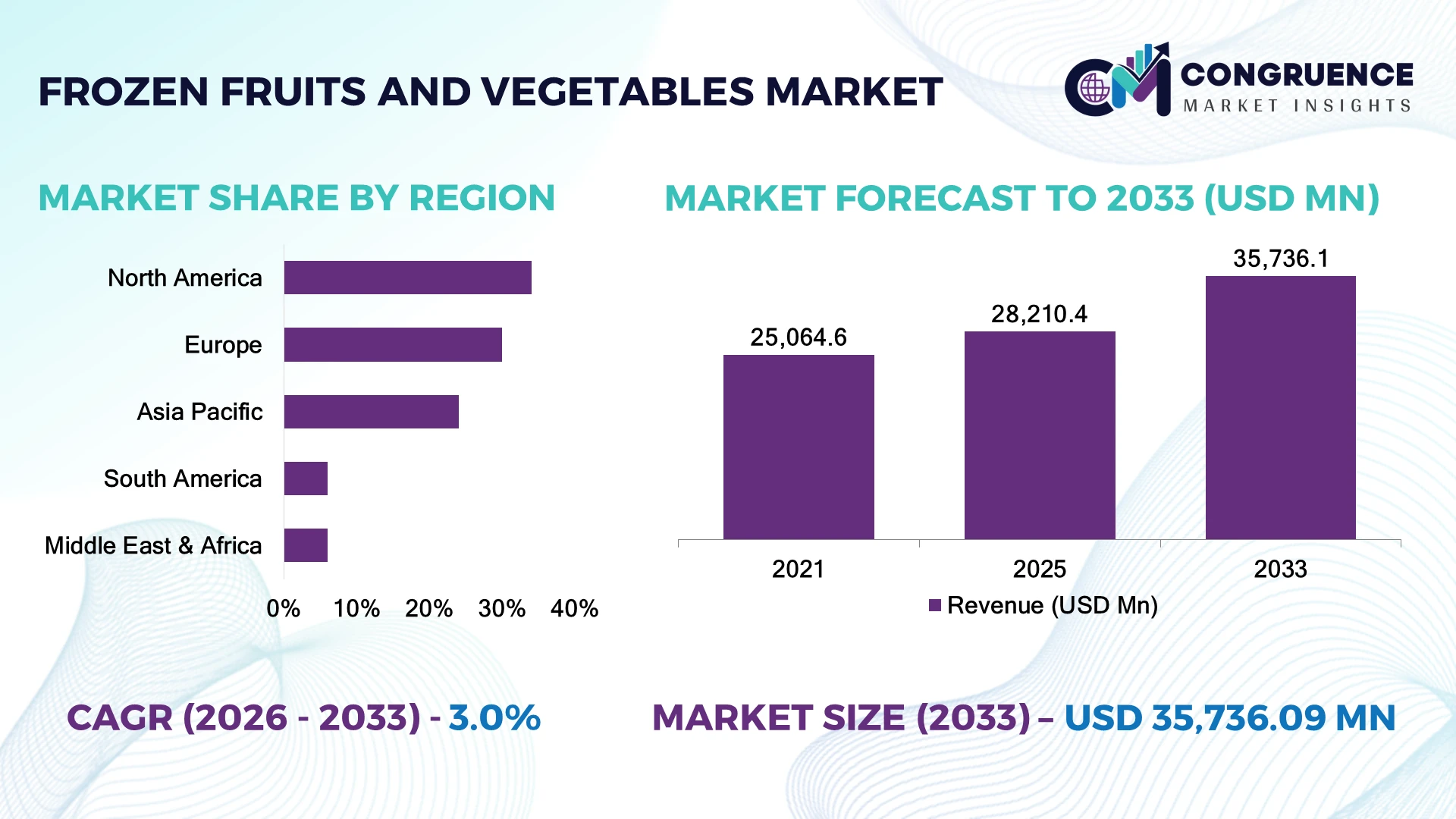
The United States remains the dominant national market, representing approximately 19% of global consumption, supported by mature supermarket distribution, foodservice procurement, and advanced cold-storage infrastructure. China follows at roughly 14%, with stronger processing capacity and export-oriented supply chains. In 2026, disruptions affecting maritime logistics are encouraging buyers to diversify sourcing and increase regional inventories, with automated freezing adoption exceeding 30% among large processors.
Strategically, suppliers with integrated processing, cold-chain control, and diversified sourcing are best positioned to capture premium and institutional demand.
Market Size & Growth: USD 28,210.4 million in 2025 to USD 35,736.1 million by 2033 at 3.0% CAGR, supported by cold-chain expansion and foodservice demand.
Top Growth Drivers: Foodservice penetration 31%, retail private labels 27%, and cold-chain modernization 22% are the leading demand catalysts.
Short-Term Forecast: By 2028, automated sorting and freezing can reduce processing losses by 8–12% while improving throughput by 10%.
Emerging Technologies: Optical sorting, AI-based grading, and IQF freezing are gaining deployment, with advanced processors reporting automation penetration above 30%.
Regional Leaders: North America is projected near USD 10 billion, Europe above USD 9 billion, and Asia-Pacific above USD 8 billion, with digital cold-chain monitoring accelerating adoption.
Consumer/End-User Trends: Retail-ready frozen products account for more than 55% of consumer-oriented demand, while convenience-focused purchasing continues expanding.
Pilot/Case Example: 2025 automated IQF processing deployments demonstrated approximately 10% lower product handling losses and faster batch changeovers.
Competitive Landscape: Large integrated processors lead alongside regional specialists and private-label suppliers, with top players emphasizing sourcing control, processing scale, and retailer partnerships.
Regulatory & ESG Impact: Food-safety traceability requirements are increasing digital batch monitoring, while waste-reduction initiatives target 10–15% lower processing and distribution losses.
Investment & Funding: Processing and cold-storage investments exceeding USD 1 billion globally are increasingly directed toward automation, energy efficiency, and vertically integrated supply chains.
Innovation & Future Outlook: AI quality inspection, high-efficiency refrigeration, recyclable packaging, and regional sourcing will shift competition toward consistency, traceability, and delivered cost.
The global frozen fruits and vegetables market is strengthening around retail-ready vegetables, berries, tropical fruits, ready-to-cook blends, and foodservice ingredients. IQF technology is gaining importance because it limits clumping while preserving product separation and portion flexibility. More than 30% adoption among large processors signals a shift toward automated quality control and higher line utilization. In 2026, processors are also redesigning sourcing networks around shorter cold-chain routes and greater supplier redundancy, making operational resilience increasingly important to procurement strategy.
The frozen fruits and vegetables market is becoming strategically important because processing technology now connects agricultural supply with year-round retail and foodservice availability. Companies are using freezing as a supply-chain control mechanism rather than simply a preservation method. This is particularly relevant as climate variability and logistics disruptions increase procurement uncertainty across agricultural commodities.
Modern IQF systems can improve line throughput by roughly 10–15% compared with older batch-freezing configurations while reducing product handling and separation losses. North America benefits from sophisticated retail and foodservice distribution, whereas Asia-Pacific combines expanding processing capacity with lower-cost agricultural sourcing. Over the next two to three years, automated grading, digital temperature monitoring, and warehouse controls are expected to push advanced automation adoption beyond 40% among larger processors.
A practical operating model combines centralized processing with regional cold-storage hubs, enabling companies to balance scale economies against delivery speed. Leading processors are therefore increasing investments in automated freezing, renewable-powered refrigeration, contract farming, and retailer partnerships. The strategic winners will be companies that control quality from farm sourcing through cold-chain distribution while maintaining flexible product formats and dependable year-round availability.
Expansion of organized retail and foodservice procurement is strengthening frozen-food infrastructure, particularly in the United States, China, and India. IQF processing can reduce product separation and handling losses by approximately 8–12%, while automated optical sorting improves grading throughput by roughly 10–15%. Retail-ready formats now represent more than half of consumer-oriented frozen produce demand in mature markets. In 2026, processors are responding to higher logistics uncertainty by integrating blast-freezing, cold storage, and distribution planning rather than treating them as separate operations. Companies are investing in automated lines, regional cold-storage hubs, contract farming, and retailer partnerships. The non-obvious advantage is procurement stability: vertically coordinated processors can redirect volumes between suppliers faster when harvest quality or transportation availability changes.
Refrigeration remains a structural cost pressure because freezing and storage require continuous energy-intensive operations. Electricity and refrigeration-related expenses can represent approximately 15–25% of processing and cold-storage operating costs, while temperature deviations above controlled thresholds can increase quality losses by 5–10% in sensitive products. In India and other emerging markets, fragmented cold-chain infrastructure further increases transit exposure and inventory requirements. Food-safety compliance also raises monitoring and traceability costs as retailers demand tighter batch documentation. Companies are mitigating exposure through energy-efficient compressors, thermal storage, renewable electricity contracts, and geographically diversified processing. The strategic pressure point is not freezing capacity alone; it is maintaining consistent temperature integrity across fragmented farm-to-retail networks without eroding margins through excessive safety inventory.
Premium frozen berries, tropical fruits, organic vegetables, ready-to-cook blends, and portion-controlled foodservice formats are creating higher-value opportunities beyond commodity vegetables. Advanced IQF systems combined with AI vision inspection can improve sorting accuracy by approximately 10–15% while reducing manual inspection requirements by 15–20%. India, Vietnam, Poland, and Mexico offer attractive expansion opportunities because agricultural production can be connected to export-oriented processing clusters. Companies are developing direct farmer networks, specialized freezing lines, and retailer-exclusive formats to capture differentiated margins. A particularly important opportunity is mixed-product processing: flexible lines capable of switching between vegetables, berries, and prepared blends can improve equipment utilization by 8–12%. By 2028, intelligent quality inspection and automated grading will increasingly separate scalable processors from low-cost commodity suppliers.
Climate variability, inconsistent harvest quality, workforce shortages, and fragmented supplier data create execution complexity even when processing capacity is available. Seasonal yield deviations of 10–20% can disrupt planned utilization, while manual quality inspection and fragmented farm records slow traceability and production scheduling. Cybersecurity is also becoming relevant as processors connect industrial control systems, warehouse management, supplier platforms, and temperature-monitoring networks. Companies must integrate agricultural forecasting, digital procurement, automated grading, and cold-chain telemetry to maintain production consistency. Leading processors are responding through multi-origin sourcing, supplier qualification programs, predictive inventory models, and technology partnerships. The strategic challenge is synchronizing volatile agricultural inputs with highly standardized industrial processing; excess flexibility raises cost, while rigid production schedules increase utilization and quality risks.
AI-Based Quality Inspection: Optical sorting and machine-vision systems are moving deeper into frozen produce lines, with advanced processors targeting 10–15% faster grading and 5–10% lower manual inspection requirements. Companies are integrating vision systems with automated reject mechanisms, improving consistency while addressing skilled-labor shortages and tightening food-safety controls.
Flexible IQF Line Deployment: Processors are shifting from dedicated commodity lines toward flexible IQF equipment capable of handling multiple vegetables, berries, and prepared blends. Changeover improvements of 8–12% are increasing asset utilization, while multi-format production helps manufacturers respond faster to retailer private-label orders and seasonal supply fluctuations.
Cold-Chain Digitization Accelerates: Real-time temperature monitoring, GPS telemetry, and warehouse sensors are becoming standard across larger distribution networks, with digital monitoring penetration approaching 40% among advanced operators. Companies are using exception alerts to reduce temperature excursions by 5–10%, lowering spoilage exposure and strengthening traceability during longer international shipments.
Private-Label Portfolio Expansion: Retailers are increasing private-label frozen produce ranges, pushing manufacturers toward smaller pack sizes, organic variants, ready-to-cook blends, and portion-controlled formats. Private-label products now represent more than 30% of frozen produce sales in several mature retail channels, prompting processors to expand flexible packaging, co-manufacturing, and retailer-specific production capabilities.
Frozen vegetables represent the leading type, estimated at approximately 62% of global market demand, supported by broad household penetration, foodservice utilization, and standardized processing formats. Their dominance reflects easier portioning, year-round availability, and strong integration into retail and institutional meal preparation. Frozen fruits account for roughly 38% but represent the faster-growing type, driven by berries, mangoes, pineapple, smoothie ingredients, and premium snack applications. Fruit-focused formats are gaining from IQF processing, which improves piece separation and supports flexible portion sizes. Companies are expanding fruit-processing capacity and developing mixed berry, tropical, and no-added-sugar portfolios to capture higher-value demand.
The mature vegetable segment still commands investment because of predictable volumes and established procurement contracts, while fruit processors are directing more capital toward flexible IQF lines and cold storage. Frozen fruit applications are estimated to expand their market mix by 2–3 percentage points through premiumization and foodservice innovation. This shift favors companies with diversified agricultural sourcing and multi-product processing capabilities.
A 2026 University of Idaho-led study of 421 participants found that 38% cited long shelf life as a leading reason for purchasing frozen fruits and vegetables, while 36% cited ease of preparation, reinforcing the operational value of frozen formats.
Retail is the leading application, representing approximately 55% of global frozen fruits and vegetables demand, because supermarkets, hypermarkets, discount chains, and e-commerce channels provide broad household access and established freezer infrastructure. Foodservice follows at roughly 28%, while food processing and ingredient applications account for about 17%. Retail remains the mature volume base, but foodservice is the faster-growing application as restaurants, institutional kitchens, and convenience operators prioritize predictable portioning, labor efficiency, and year-round availability.
Foodservice demand is becoming operationally critical because frozen ingredients reduce preparation requirements and exposure to seasonal sourcing disruptions. Companies are expanding foodservice-specific pack sizes, pre-cut vegetables, fruit blends, and contract-processing arrangements. Foodservice applications are expected to increase their share by approximately 2 percentage points as operators strengthen frozen procurement. Retail suppliers are simultaneously investing in private-label formats, flexible packaging, and automated replenishment. The competitive advantage increasingly rests on dependable cold-chain execution rather than product availability alone.
The American Frozen Food Institute’s 2026 retail research reports that 40% of consumers use frozen foods every few days or daily, up from 35% in 2019, strengthening the case for retailers to expand frozen assortment and freezer capacity.
Households represent the dominant end-user group, accounting for approximately 54% of global frozen fruits and vegetables consumption, supported by supermarket penetration, meal preparation convenience, portion control, and extended shelf life. Foodservice operators contribute around 27%, while food manufacturers represent approximately 19%. Household purchasing remains the mature demand base, but foodservice is the fastest-growing end-user because operators increasingly value consistent specifications, reduced preparation labor, and predictable year-round supply.
Food manufacturers maintain strategic importance through use of frozen produce in ready meals, sauces, bakery products, smoothies, and processed foods. Their procurement emphasizes standardized particle size, moisture control, microbiological compliance, and contract supply. Foodservice buyers increasingly seek customized pack formats and pre-processed ingredients, while household-focused suppliers prioritize private-label positioning and smaller portions. Companies are therefore reallocating investment toward flexible processing lines, dedicated institutional packaging, and direct procurement partnerships. Foodservice demand is expected to gain approximately 2–3 percentage points in market mix as labor constraints and menu standardization strengthen reliance on frozen ingredients.
A 2026 multistate study found that roughly one-third of surveyed participants consumed frozen foods every few days or almost daily, while 59% considered using nutrition-assistance benefits to purchase frozen foods very or extremely important, highlighting affordability-driven household demand.
North America accounted for the largest market share at 34.0% in 2025 however, Asia-Pacific is expected to register the fastest growth, expanding at a CAGR of 4.2% between 2026 and 2033.
Retail freezer expansion and foodservice standardization strengthen demand concentration
North America remains the largest frozen fruits and vegetables market, supported by mature supermarket networks, high foodservice penetration, established cold-storage infrastructure, and strong private-label distribution. The region represented approximately 34% of global demand in 2025, with the United States contributing the majority through household and institutional consumption. IQF processing, automated optical sorting, and digitally monitored cold chains are increasingly integrated across large processing facilities. Frozen vegetables retain the strongest volume base, while berries and tropical fruit formats are gaining premium shelf space. Companies are expanding regional cold-storage capacity, investing in automated processing, and developing retailer-specific products. The strategic advantage increasingly lies in synchronized farm procurement, processing, and distribution, allowing suppliers to maintain service levels despite seasonal harvest fluctuations and transportation disruptions.
United States Market Outlook: The United States is the region’s dominant market, supported by extensive supermarket freezer infrastructure, institutional foodservice demand, and sophisticated food distribution. Household consumption accounts for more than half of domestic frozen produce demand, while foodservice is strengthening through labor-saving pre-cut and portion-controlled formats. Large processors are prioritizing automated IQF lines, private-label partnerships, and regional cold-storage networks to improve throughput and supply reliability.
Private-label penetration and sustainability reshape frozen-food procurement
Europe accounted for approximately 30% of global frozen fruits and vegetables demand in 2025, supported by strong supermarket penetration, private-label purchasing, established cold-chain logistics, and high adoption of convenience-oriented foods. Germany, the United Kingdom, France, Italy, and Poland represent major demand and processing centers. Private-label products account for a substantial share of frozen retail sales, encouraging processors to optimize cost, packaging, and production flexibility. European food companies are also increasing traceability and energy-efficiency investments across freezing and warehousing operations. Poland is strengthening its role as a processing and export hub, while Western European retailers emphasize premium vegetables, berries, organic formats, and ready-to-cook blends.
Germany Market Outlook: Germany represents a strategically important European market because of its advanced grocery infrastructure, strong discount-retail presence, and sophisticated frozen-food distribution. Frozen vegetables and fruit are widely integrated into household and foodservice purchasing. Automated warehouses, energy-efficient refrigeration, and private-label manufacturing are becoming important competitive tools, while processors increasingly use standardized IQF specifications to serve retailers across neighboring European markets.
Processing capacity and export-oriented agriculture accelerate adoption
Asia-Pacific represented approximately 24% of global frozen fruits and vegetables demand in 2025 and is developing the strongest expansion trajectory as urbanization, modern retail, foodservice, and export processing converge. China, Japan, India, South Korea, Thailand, and Vietnam are key markets, with Thailand and China particularly important for processed fruit and vegetable supply. India is strengthening frozen-food consumption through organized retail and quick-service foodservice expansion, while Southeast Asian processors benefit from agricultural availability and export infrastructure. Companies are investing in IQF facilities, cold-storage hubs, automated grading, and contract-farming networks. The strategic shift is toward processing agricultural surpluses into standardized exportable products, reducing seasonal waste and improving utilization of regional crop production.
China Market Outlook: China combines extensive agricultural production with expanding modern retail, foodservice, and industrial processing capacity. Frozen vegetables and fruits are increasingly integrated into urban food distribution, while processors are improving IQF capability and automated sorting. Export-oriented facilities are also strengthening quality standardization, enabling Chinese suppliers to compete on processing scale, product variety, and delivered cost across Asian and international markets.
Agricultural supply depth creates export-led processing opportunities
South America accounted for approximately 6% of global frozen fruits and vegetables demand in 2025, with Brazil representing the principal market through its large agricultural base, food-processing industry, and expanding organized retail network. Brazil and Argentina provide strong raw-material availability, while Chile and Peru contribute export-oriented fruit-processing capabilities. Frozen fruit demand is particularly relevant for berries, tropical fruit, and smoothie ingredients, whereas frozen vegetables remain concentrated in retail and foodservice channels. Processing companies are investing in cold-storage capacity, IQF equipment, and producer partnerships to reduce post-harvest losses. However, infrastructure variability and long inland logistics routes remain operational pressure points, making strategically located processing facilities increasingly valuable for export competitiveness.
Brazil Market Outlook: Brazil holds the strongest domestic opportunity because of its agricultural scale, food-processing infrastructure, and broad retail distribution. Frozen produce processors benefit from proximity to major fruit and vegetable production zones, while foodservice expansion supports demand for standardized ingredients. Companies are increasingly combining contract farming, local processing, and refrigerated distribution to improve consistency. Multi-product facilities capable of processing both fruits and vegetables provide additional capacity-utilization advantages.
Cold-chain modernization and import substitution drive strategic investment
The Middle East & Africa market represented approximately 6% of global demand in 2025, with Gulf countries, South Africa, Egypt, and Morocco serving as major consumption or processing centers. The United Arab Emirates and Saudi Arabia are strengthening cold-storage infrastructure to support retail, hospitality, catering, and foodservice demand, while Egypt and Morocco provide agricultural and processing advantages. Frozen vegetables and fruit are gaining relevance where water scarcity, seasonality, and import dependence make year-round availability strategically valuable. Companies are expanding refrigerated warehouses, localized processing, and distributor partnerships. The region’s non-obvious opportunity lies in combining imported raw materials with local processing and portioning, reducing finished-product logistics exposure while supporting hospitality and institutional procurement.
Saudi Arabia Market Outlook: Saudi Arabia is the most strategically significant market because of its large food-import requirement, expanding hospitality sector, and substantial investment in food-security infrastructure. Frozen produce is increasingly relevant to supermarkets, restaurants, catering operators, and institutional kitchens seeking year-round availability. Modern cold-storage facilities and localized food-processing investments are improving distribution reliability, while suppliers are targeting smaller pack formats and foodservice-specific products to align with changing procurement patterns.
Dole, Greenyard, Bonduelle, Ardo, and Conagra compete with regional processors, private-label suppliers, and specialized IQF producers, creating a fragmented structure where the top five players hold roughly 30% share. Dole leads through global sourcing, while Greenyard and Bonduelle emphasize integrated processing and retailer relationships. Ardo competes through product breadth and foodservice specialization; Conagra combines branded innovation with scale. Price remains decisive for commodity vegetables, with roughly 10–15% purchasing sensitivity across private-label contracts, while premium value-added products command 15–20% higher positioning. Automation and IQF processing increasingly improve throughput by 8–12%, shifting competition toward processing consistency and labor productivity. Players are expanding cold-storage capacity, forming grower partnerships, and integrating procurement with processing. The competitive shift is moving from simple volume scale toward supply-chain control, traceability, and customized formats. Entry barriers remain high because cold-chain infrastructure and retailer qualification require substantial capital. Winning requires integrated sourcing, efficient freezing, dependable logistics, and differentiated product innovation.
Dole plc
Greenyard NV
Bonduelle Group
Ardo Group
Conagra Brands, Inc.
General Mills, Inc.
McCain Foods Limited
J.R. Simplot Company
SunOpta Inc.
Nomad Foods Ltd.
Nichirei Corporation
Nature's Touch Frozen Foods Inc.
Capricorn Food Products India Ltd.
Individual Quick Freezing (IQF) remains the core processing technology because it freezes individual pieces rapidly, preserving texture and reducing clumping. Advanced IQF lines with automated feeding and airflow control can improve throughput by approximately 8–12% versus conventional batch freezing. Optical sorting and machine-vision inspection are increasingly integrated before freezing, reducing manual quality checks by roughly 20–30%. Large processors benefit through higher line utilization, lower labor intensity, and more consistent product specifications.
Digital cold-chain monitoring is becoming a competitive requirement rather than an optional feature. IoT temperature sensors, automated alarms, and cloud-based traceability can reduce temperature-excursion losses by approximately 10–15% in well-managed distribution networks. Automated pallet handling and warehouse management systems further improve loading accuracy and inventory visibility by 15–20%. Adoption is strongest among multinational processors and organized retailers managing multi-country supply networks, where traceability directly supports food-safety compliance and inventory control.
Between 2026 and 2028, AI-assisted demand forecasting, predictive refrigeration maintenance, robotic packing, and energy-optimized freezing will reshape processing economics. AI forecasting can reduce inventory mismatches by 10–15%, while predictive maintenance cuts unplanned downtime by approximately 8–12%. Companies combining IQF, machine vision, robotics, and digital cold-chain platforms will gain the strongest advantage through faster throughput, lower waste, tighter quality control, and scalable multi-site operations.
December 2024 Sahyadri Farms raised ₹390 crore to expand horticulture processing, including IQF and value-added fruit and vegetable capacity. The investment strengthens integrated farm-to-processing infrastructure and export readiness. Source: sahyadrifarms.com
February 2025 Conagra reported frozen-vegetable consumption growth nearly doubled year-on-year, creating inventory shortages and prompting increased surge capacity investment. The shift strengthens Birds Eye supply resilience and production flexibility. Source: conagrabrands.com
June 2025 Greenyard expanded its Frozen division with new spinach lines in France and automated packing capacity in Poland. The investments improve processing flexibility and throughput while supporting higher-value convenience formats. Source: greenyard.group
February 2026 Ayekart RISE Foundation partnered with cKinetics to scale renewable-powered micro cold-storage solutions in Maharashtra, connecting farmers with processors, retailers, quick-commerce platforms, and exporters to improve asset utilization and market access. Source: ayekart.com
The Global Frozen Fruits and Vegetables Market Report evaluates the industry across frozen fruits and frozen vegetables, processing technologies including IQF, blast freezing, and cryogenic systems, and distribution channels spanning supermarkets, hypermarkets, convenience stores, online retail, foodservice, and industrial buyers. The analysis also examines organic versus conventional products and value-added formats such as ready-to-cook blends, smoothie ingredients, and portion-controlled offerings.
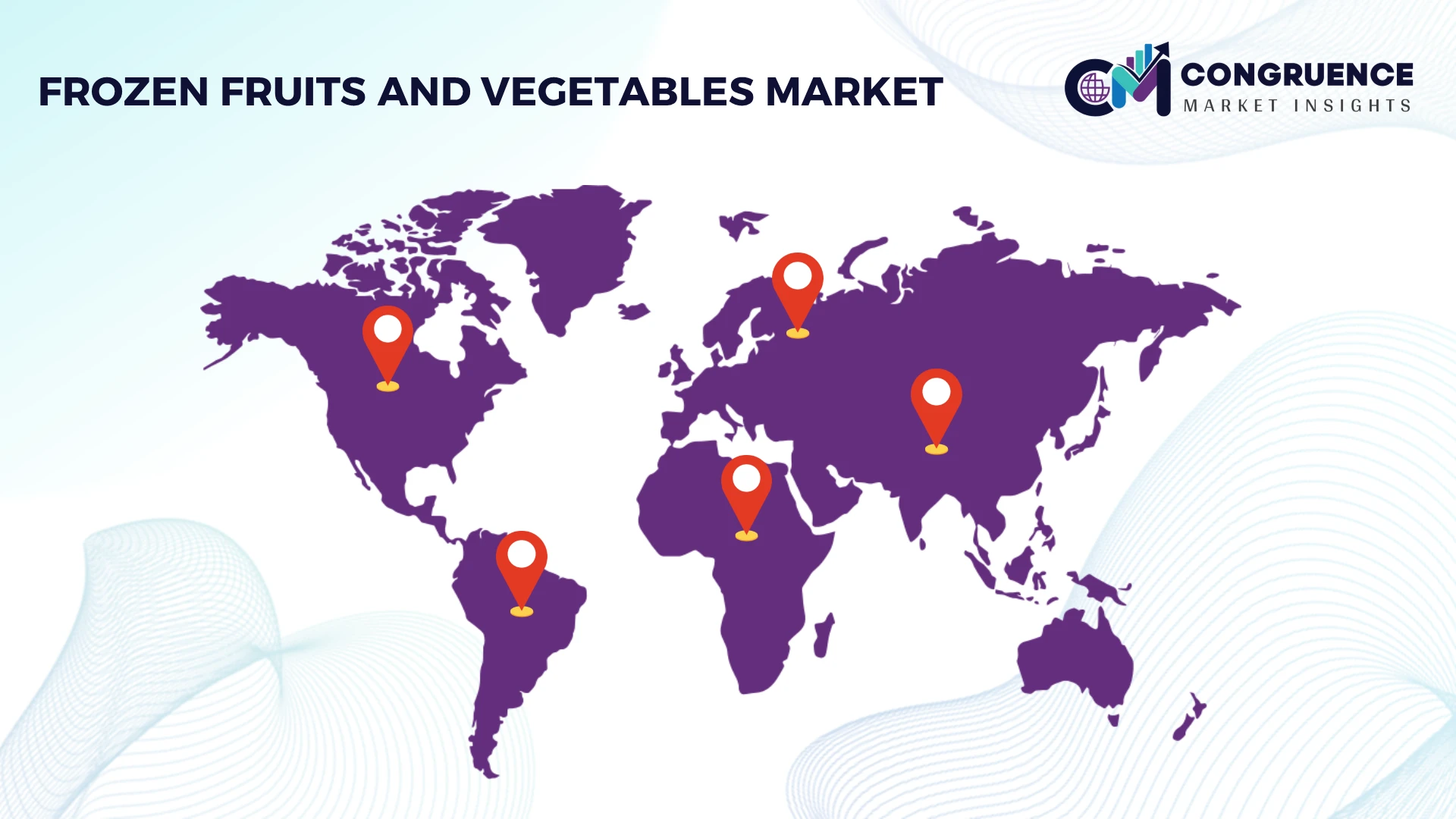
Geographic coverage includes North America, Europe, Asia-Pacific, South America, and the Middle East & Africa, with detailed country-level assessment of production, imports, exports, cold-chain infrastructure, processing capacity, and consumption patterns. Technology analysis covers automated sorting, machine vision, IoT-enabled temperature monitoring, robotic packaging, and energy-efficient refrigeration. Competitive assessment profiles 10+ major participants and evaluates expansion, partnerships, product innovation, sourcing strategies, and vertical integration to support investment planning, market entry, capacity expansion, and competitive positioning through 2026–2033.
| Report Attribute/Metric | Report Details |
|---|---|
|
Market Revenue in 2025 |
USD 28,210.4 Million |
|
Market Revenue in 2033 |
USD 35,736.1 Million |
|
CAGR (2026 - 2033) |
3% |
|
Base Year |
2025 |
|
Forecast Period |
2026 - 2033 |
|
Historic Period |
2021 - 2025 |
|
Segments Covered |
By Type
By Application
By End-User
|
|
Key Report Deliverable |
Revenue Forecast, Growth Trends, Market Dynamics, Segmental Overview, Regional and Country-wise Analysis, Competition Landscape |
|
Region Covered |
North America, Europe, Asia-Pacific, South America, Middle East, Africa |
|
Key Players Analyzed |
Dole plc, Greenyard NV, Bonduelle Group, Ardo Group, Conagra Brands, Inc., General Mills, Inc., McCain Foods Limited, J.R. Simplot Company, SunOpta Inc., Nomad Foods Ltd., Nichirei Corporation, Nature's Touch Frozen Foods Inc., Capricorn Food Products India Ltd. |
|
Customization & Pricing |
Available on Request (10% Customization is Free) |




