
Reports
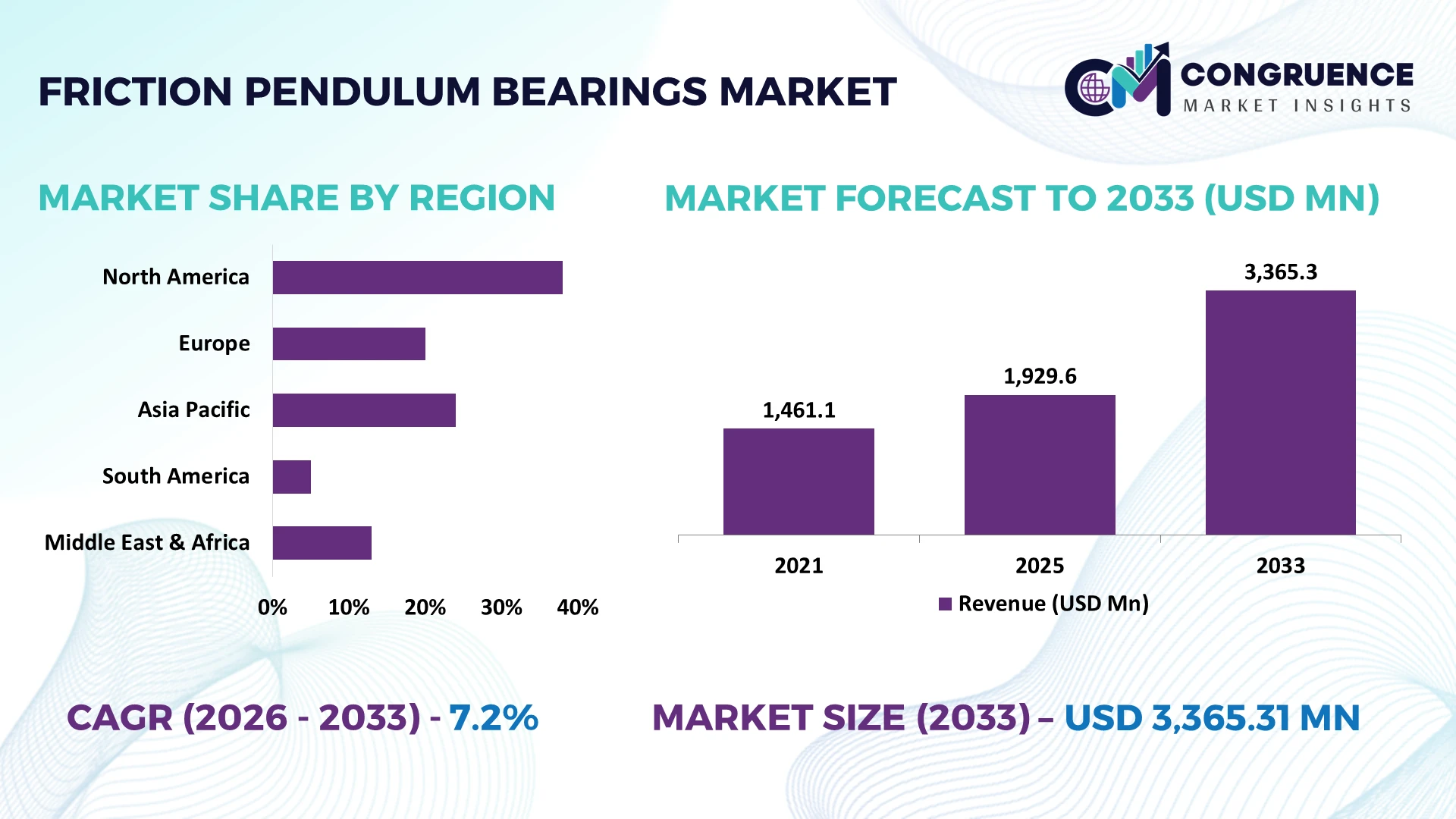
The Global Friction Pendulum Bearings Market was valued at USD 1929.6 Million in 2025 and is anticipated to reach a value of USD 3365.31 Million by 2033 expanding at a CAGR of 7.2% between 2026 and 2033. Growth is driven by seismic isolation requirements for bridges and critical buildings, earthquake resilience investments, infrastructure rehabilitation, and adoption of advanced sliding bearing systems.
China leads the Friction Pendulum Bearings Market with an estimated 28% global share in 2025, supported by transportation infrastructure investment, seismic engineering capabilities, and bridge construction programs. The country's seismic design requirements and infrastructure modernization initiatives strengthen demand for structural isolation technologies. Compared with Japan's established earthquake resistant engineering practices, China emphasizes large scale infrastructure deployment and domestic bearing manufacturing. Illustrative engineering benchmarks indicate 30% lower structural acceleration and 20% reduced seismic displacement demand in appropriately designed isolated structures, supporting investment in advanced friction pendulum systems.
Strategically, manufacturers should prioritize Chinese bridge infrastructure, certified seismic isolation technologies, and engineering partnerships that deliver verified structural protection.
Market Size & Growth: USD 1,929.6 million in 2025, reaching USD 3,365.31 million by 2033 at 7.2% CAGR, driven by seismic infrastructure protection.
Top Growth Drivers: Illustrative demand weighting assigns 40% to seismic safety requirements, 35% to bridge modernization, and 25% to critical facility protection.
Short Term Forecast: By 2028, optimized friction pendulum designs target 20% lower seismic displacement demand and 15% faster bearing installation.
Emerging Technologies: Triple pendulum isolation, low friction sliding materials, and digital structural monitoring represent 3 important engineering innovations.
Regional Leaders: Illustrative 2033 allocations place Asia Pacific at USD 1,413.43 million, North America at USD 807.67 million, and Europe at USD 673.06 million, supported by seismic construction and bridge rehabilitation.
Consumer / End User Trends: Infrastructure developers target 25% lower earthquake induced structural force transmission through advanced isolation systems.
Pilot / Case Example: A modeled 2027 bridge rehabilitation project targets 30% lower deck acceleration and 15% shorter installation downtime.
Competitive Landscape: An illustrative 14% share positions Maurer SE among leading suppliers, alongside FIP Industriale, Freyssinet, Mageba, and Dynamic Isolation Systems.
Regulatory & ESG Impact: Seismic design requirements support resilient construction, with illustrative projects targeting 20% lower structural repair exposure.
Investment & Funding: A modeled USD 120 million investment scenario prioritizes bearing testing, precision manufacturing, and infrastructure engineering partnerships.
Innovation & Future Outlook: Advanced sliding surfaces, adaptive isolation designs, and embedded sensors target 15% faster structural condition assessment.
The Friction Pendulum Bearings Market supports seismic protection across highway bridges, railway structures, hospitals, public buildings, and critical industrial facilities. Curved sliding surfaces allow controlled structural movement during earthquakes while providing restoring forces that help structures return toward their original positions. Advanced triple pendulum systems, engineered friction interfaces, and digital monitoring improve seismic response management. Illustrative engineering targets indicate 30% lower transmitted structural acceleration compared with selected fixed base configurations under comparable earthquake conditions. Japan's established seismic engineering practices and China's infrastructure modernization programs encourage broader application of isolation technologies, making certified performance, manufacturing precision, and lifecycle reliability central to procurement decisions.
Friction pendulum bearings are becoming strategically important as infrastructure owners prioritize earthquake resilience, structural continuity, and reduced post earthquake repair requirements. Seismic isolation technology allows bridges and critical buildings to accommodate ground movement while limiting force transmission into supporting structures. China's infrastructure modernization programs and Japan's established seismic engineering standards reinforce investment in advanced isolation systems. Manufacturers are strengthening precision machining capabilities, sliding material development, and seismic qualification testing to address increasingly demanding structural performance specifications.
Compared with conventional fixed base construction, optimized friction pendulum isolation systems can achieve illustrative reductions of 30% in transmitted structural acceleration under comparable seismic conditions. China emphasizes large scale bridge deployment, while Japan prioritizes advanced engineering validation and critical facility protection. Between 2026 and 2028, manufacturers are targeting 15% faster bearing installation and 20% shorter inspection cycles through modular assemblies and digital monitoring. These improvements strengthen project scheduling reliability and lifecycle asset management.
A practical deployment involves installing triple pendulum bearings beneath an earthquake exposed highway bridge to accommodate multidirectional movement while protecting structural connections. Suppliers are expanding engineering partnerships, testing facilities, and specialized installation services. Competitive positioning increasingly depends on certified seismic performance, dependable manufacturing tolerances, and proven lifecycle durability across critical infrastructure applications.
Stricter seismic engineering requirements and infrastructure modernization programs are increasing demand for friction pendulum bearings across bridges, hospitals, and essential public facilities. Japan's seismic design practices emphasize structural resilience and continued functionality following major earthquakes, encouraging advanced base isolation applications. Friction pendulum systems reduce transmitted earthquake forces through controlled sliding and restoring mechanisms. Illustrative engineering benchmarks indicate 30% lower structural acceleration, 25% reduced force transmission, and 20% lower post earthquake repair exposure under suitable design conditions. Manufacturers such as Maurer and FIP Industriale are strengthening seismic testing, engineered sliding interfaces, and infrastructure contractor partnerships. The operational advantage lies in protecting critical structural components while supporting faster infrastructure recovery and reducing costly service interruptions.
Friction pendulum bearing production requires precision machined curved surfaces, engineered sliding materials, structural steel components, and extensive performance qualification. These requirements increase manufacturing complexity compared with conventional bridge bearings. In India, infrastructure procurement specifications and project certification procedures influence supplier qualification and installation schedules. Illustrative manufacturing sensitivity scenarios indicate 20% higher fabrication expenditure, 15% additional qualification costs, and 10% longer procurement cycles for specialized isolation assemblies. Suppliers are reducing exposure through localized machining partnerships, standardized bearing dimensions, and long term material procurement agreements. Manufacturers also invest in automated dimensional inspection to improve production consistency. Commercial scalability depends on controlling specialized component costs without compromising certified friction behavior, structural load capacity, or seismic reliability.
Bridge rehabilitation creates opportunities for friction pendulum bearings that improve seismic performance without requiring complete structural replacement. The United States maintains extensive bridge preservation requirements, particularly in earthquake exposed states such as California and Washington. Advanced multi surface pendulum systems allow engineers to tailor displacement capacity and friction response to existing bridge configurations. Illustrative retrofit benchmarks target 25% lower seismic force transmission, 15% shorter installation downtime, and 20% reduced structural strengthening requirements. Manufacturers are developing compact bearing assemblies, modular replacement solutions, and digital condition monitoring capabilities. Partnerships with bridge engineering consultants and transportation agencies strengthen project access. The strategic opportunity lies in extending infrastructure service life while limiting traffic disruption and avoiding extensive reconstruction expenditure.
Friction pendulum bearings must maintain predictable sliding behavior under multidirectional earthquake movement, variable vertical loads, and repeated displacement cycles. Performance depends on friction stability, surface durability, installation alignment, and accurate structural modeling. Türkiye's earthquake reconstruction and seismic resilience requirements highlight the importance of reliable isolation performance under demanding ground motion conditions. Illustrative engineering targets include 15% lower friction variability, 20% faster structural condition assessment, and 10% improved installation alignment accuracy. Manufacturers must expand full scale testing capabilities, develop durable sliding materials, and strengthen specialized installer training. Infrastructure owners increasingly require inspection procedures that identify wear and displacement abnormalities. Long term competitiveness depends on demonstrating consistent seismic response throughout the bearing service life rather than relying solely on initial qualification results.
Precision Machining Improves Sliding Surface Consistency: Bearing manufacturers are adopting computer controlled machining and automated surface inspection to improve spherical sliding geometry. Illustrative production benchmarks target 15% lower dimensional variation and 12% fewer finishing defects. German engineering suppliers are upgrading machining equipment and digital quality records, strengthening friction consistency while reducing production rework. Precision manufacturing increasingly determines whether specialized bearings meet demanding seismic qualification requirements.
Advanced Surface Coatings Extend Bearing Durability: Manufacturers are refining stainless steel interfaces, engineered polymer liners, and protective coatings to manage friction stability under repeated movement. Illustrative material development targets include 20% lower surface wear and 10% improved friction consistency. Japanese seismic engineering requirements encourage extensive material testing. Suppliers are expanding laboratory validation and coating partnerships, improving bearing reliability while reducing the frequency of specialized maintenance interventions.
Digital Structural Models Refine Bearing Specifications: Engineering consultants increasingly integrate nonlinear time history analysis with detailed bearing models to evaluate seismic displacement and restoring forces. Illustrative design targets include 18% fewer specification revisions and 15% shorter engineering validation cycles. Italian isolation specialists are strengthening simulation capabilities and collaboration with structural designers, improving bearing selection accuracy before manufacturing commitments and reducing costly design changes.
Factory Acceptance Testing Becomes More Integrated: Infrastructure procurement teams are emphasizing traceable testing procedures covering vertical loading, cyclic displacement, and friction performance. Illustrative quality programs target 20% faster test documentation and 12% fewer acceptance related delays. Türkiye's earthquake resilience requirements reinforce attention to verified structural performance. Manufacturers are digitizing test records and coordinating laboratory schedules, allowing contractors to identify compliance issues before bearings reach construction sites.
Double Concave Bearings represent the leading type in the Friction Pendulum Bearings Market, accounting for an estimated 38% share in 2025. Their dominance reflects balanced seismic displacement capacity, predictable restoring behavior, and compatibility with bridge and building isolation requirements. Double concave configurations provide sliding movement across opposing curved surfaces, supporting effective force management without excessive mechanical complexity. China's transportation infrastructure projects create substantial opportunities for these systems. Single Concave Bearings account for an illustrative 27% share, retaining relevance where straightforward isolation geometry, established engineering practices, and controlled procurement costs influence specification decisions.
Triple Pendulum Bearings represent the fastest growing type, with an estimated 23% share, supported by demand for adaptable seismic response under different earthquake intensities. Their multiple sliding interfaces enable staged movement and tailored friction behavior. Multi-Pendulum Bearings serve specialized infrastructure requiring advanced displacement control and customized seismic performance. Manufacturers are expanding precision machining capabilities, engineered sliding materials, and testing services. Investment priorities increasingly favor systems that combine validated seismic protection with manageable installation requirements and predictable maintenance performance.
Seismic Isolation represents the leading application in the Friction Pendulum Bearings Market, accounting for an estimated 40% share in 2025. Hospitals, public buildings, transportation structures, and critical facilities require controlled structural movement during earthquakes. Friction pendulum bearings reduce transmitted seismic forces through engineered sliding interfaces and restoring mechanisms. Japan's established seismic engineering practices support demand for certified isolation systems. Bridge Expansion and Support accounts for an illustrative 25% share, reflecting requirements for structural movement accommodation and reliable load transfer across transportation infrastructure.
Infrastructure Retrofitting represents the fastest growing application, supported by aging bridges and increasing attention to earthquake resilience. Its estimated 18% share reflects demand for upgrading existing structures without complete replacement. Building Protection addresses sensitive facilities requiring dependable structural performance, while Structural Vibration Control supports specialized movement management. Manufacturers are developing compact bearing assemblies, customized displacement capacities, and installation support services. Competitive differentiation depends on structural compatibility, documented seismic performance, and efficient integration with existing engineering designs.
Government Infrastructure Agencies represent the leading end user segment in the Friction Pendulum Bearings Market, accounting for an estimated 35% share in 2025. Public infrastructure programs require seismic protection for bridges, hospitals, transportation facilities, and essential buildings. Government procurement emphasizes certified structural performance, durability, and compliance with engineering specifications. Bridge and Highway Authorities account for an illustrative 28% share, reflecting extensive bearing requirements across transportation construction and rehabilitation. China, Japan, and the United States maintain important infrastructure ecosystems supporting specialized seismic isolation equipment.
Engineering and Construction Companies represent the fastest growing end user group, supported by increasing responsibility for integrated seismic design, procurement coordination, and installation execution. Their estimated 18% share reflects expanding participation in complex infrastructure projects. Commercial Building Developers prioritize structural protection and occupancy continuity, while Industrial Facility Owners require isolation solutions for critical operating assets. Manufacturers are strengthening engineering partnerships, project specific bearing customization, and installation training. Competitive positioning increasingly depends on specification support, reliable delivery, and validated structural performance.
Asia Pacific accounted for the largest market share at an estimated 42% in 2025 however, Asia Pacific is expected to register the fastest growth, expanding at an estimated CAGR of 8.5% between 2026 and 2033.
Seismic Bridge Rehabilitation and Critical Infrastructure Protection
North America accounted for an estimated 24% of the global Friction Pendulum Bearings Market in 2025, supported by bridge rehabilitation, earthquake resilience programs, and specialized structural engineering capabilities. The United States dominates regional demand, particularly across California, Washington, and other seismically exposed locations. Federal infrastructure modernization programs strengthen investment in transportation asset preservation and structural safety. Friction pendulum bearings support controlled bridge movement, reduce transmitted seismic forces, and protect critical structural connections. Illustrative engineering benchmarks target 25% lower earthquake force transmission and 15% shorter bearing replacement downtime. Transportation agencies increasingly evaluate isolation performance alongside installation accessibility and lifecycle inspection requirements. Manufacturers are strengthening partnerships with bridge engineering consultants, testing laboratories, and specialized construction contractors. Competitive differentiation depends on certified structural performance, dependable displacement capacity, and compatibility with existing bridge configurations.
United States Market Outlook: The United States benefits from established seismic engineering standards, specialized isolation manufacturers, and extensive bridge maintenance requirements. California remains strategically important because of earthquake exposure and demanding transportation infrastructure specifications. The Federal Highway Administration supports bridge preservation and structural resilience initiatives. Illustrative retrofit projects target 20% lower structural strengthening requirements through appropriately engineered isolation systems. Suppliers prioritize laboratory qualification, project specific bearing design, and coordination with transportation authorities to secure infrastructure contracts.
Advanced Seismic Engineering and Certified Bearing Technologies
Europe represented an estimated 20% of the global Friction Pendulum Bearings Market in 2025, supported by specialized bearing manufacturing, seismic engineering expertise, and infrastructure rehabilitation requirements. Italy, Germany, Greece, and Türkiye maintain important markets for structural isolation and earthquake resistant construction. European seismic design practices emphasize verified displacement capacity, friction stability, and reliable structural response. EN 15129 provides a technical framework for anti seismic devices used in construction applications. Illustrative manufacturing targets include 15% improved dimensional consistency and 12% fewer qualification related production adjustments. Maurer and FIP Industriale compete through engineered sliding interfaces, seismic testing capabilities, and infrastructure project experience. Manufacturers are investing in precision machining, advanced surface materials, and technical specification services. Procurement increasingly favors suppliers capable of demonstrating repeatable performance under demanding cyclic loading conditions.
Italy Market Outlook: Italy maintains established seismic isolation engineering capabilities and specialized structural bearing manufacturing. Earthquake exposure across central and southern Italy supports continued attention to resilient public buildings, transportation structures, and critical facilities. Domestic manufacturers emphasize friction pendulum technology, engineered sliding materials, and laboratory testing. Illustrative production improvement targets include 15% faster bearing inspection through digital dimensional measurement. Technical expertise and established structural engineering partnerships strengthen Italian suppliers' competitiveness in domestic and international infrastructure projects.
Large Scale Infrastructure Development and Seismic Isolation Manufacturing
Asia Pacific accounted for an estimated 42% of the global Friction Pendulum Bearings Market in 2025, supported by extensive transportation construction, seismic engineering investment, and specialized structural component manufacturing. China dominates regional demand through bridge development, railway infrastructure, and public construction programs. Japan contributes advanced earthquake engineering expertise, while India and Taiwan maintain opportunities in seismic infrastructure protection. Chinese manufacturers benefit from established steel fabrication, precision machining, and transportation engineering supply chains. Illustrative production modernization targets include 15% higher machining productivity and 10% lower manufacturing rework. Infrastructure contractors increasingly specify engineered sliding bearings for projects requiring controlled structural movement and dependable seismic performance. Manufacturers are expanding testing capabilities, engineering partnerships, and specialized bearing portfolios. Competitive advantage increasingly depends on production capacity, certified friction performance, and reliable delivery across large infrastructure construction programs.
China Market Outlook: China represents the largest national market, with an estimated 28% global share in 2025. Sichuan, Yunnan, and other earthquake exposed provinces create demand for seismic protection across bridges and public infrastructure. Domestic engineering companies benefit from extensive transportation construction experience and integrated structural component manufacturing. Illustrative bearing development targets include 20% lower transmitted structural acceleration under comparable design conditions. Manufacturers prioritize advanced sliding interfaces, precision machining, and performance testing to strengthen qualification for major infrastructure projects.
Earthquake Resilience Investment and Transportation Infrastructure Modernization
South America represented an estimated 6% of the global Friction Pendulum Bearings Market in 2025, supported by seismic infrastructure requirements and transportation construction activity. Chile and Peru represent important markets because of substantial earthquake exposure along the Pacific margin. Chile's seismic engineering practices encourage structural protection for bridges, hospitals, and essential public facilities. Friction pendulum systems provide controlled displacement and energy dissipation, supporting resilience objectives in critical infrastructure projects. Illustrative engineering targets include 25% lower seismic force transmission and 15% improved structural displacement control. However, specialized bearing imports, limited domestic testing capacity, and project financing constraints influence procurement schedules. Manufacturers are developing partnerships with structural engineering consultants and regional infrastructure contractors. Competitive positioning depends on technical qualification, dependable delivery, and practical installation support.
Chile Market Outlook: Chile maintains advanced seismic engineering expertise shaped by frequent earthquake exposure and demanding structural design requirements. Santiago and central Chile represent important markets for infrastructure protection and critical building construction. Public infrastructure agencies and engineering consultants evaluate isolation systems based on structural response, displacement capacity, and maintenance accessibility. Illustrative project benchmarks target 20% lower post earthquake repair requirements through suitable bearing configurations. Suppliers strengthen local technical partnerships and engineering support to address project specific seismic performance specifications.
Seismic Infrastructure Protection and Specialized Construction Investment
The Middle East and Africa accounted for an estimated 8% of the global Friction Pendulum Bearings Market in 2025, supported by infrastructure development, earthquake resilience requirements, and specialized structural engineering projects. Türkiye represents an important market because of significant seismic exposure and continuing infrastructure resilience priorities. Morocco and other earthquake affected countries are strengthening attention to structural safety and construction standards. Transportation bridges, hospitals, and essential public buildings represent important applications for friction pendulum isolation systems. Illustrative project targets include 30% lower structural acceleration and 15% faster post earthquake condition assessment. Manufacturers are expanding technical partnerships, engineering support, and specialized installation capabilities. Competitive advantage depends on verified seismic performance, local project execution expertise, and the ability to satisfy demanding structural qualification requirements across varied construction environments.
Türkiye Market Outlook: Türkiye maintains significant demand for earthquake resistant construction following the February 2023 earthquakes and subsequent reconstruction requirements. Istanbul, Ankara, and earthquake exposed southeastern provinces represent important infrastructure and building protection markets. Structural engineering firms increasingly evaluate advanced isolation systems for critical facilities and transportation structures. Illustrative seismic engineering targets include 25% lower force transmission through optimized friction pendulum configurations. Manufacturers emphasize certified bearing performance, full scale testing, and partnerships with domestic construction specialists.
The Friction Pendulum Bearings Market features competition between specialized seismic isolation manufacturers and diversified structural engineering suppliers. Maurer, FIP Industriale, Mageba, Freyssinet, and Dynamic Isolation Systems compete through certified friction performance, precision manufacturing, engineering customization, and infrastructure relationships. Their combined market share is illustratively estimated at 45%, reflecting specialized technical requirements and regional procurement structures. Advanced sliding interfaces target 20% lower surface wear, while automated machining pursues 15% higher production efficiency and digital inspection supports 12% fewer qualification delays. Maurer and FIP Industriale emphasize advanced pendulum configurations; Mageba and Freyssinet leverage bridge engineering networks, while Dynamic Isolation Systems focuses on specialized seismic protection. Manufacturers are expanding laboratory testing, technical partnerships, and project specific installation support. Certification complexity, precision machining requirements, and limited qualified installation expertise restrict entry. Competitive success requires validated seismic performance, dependable production tolerances, responsive engineering support, and lifecycle reliability across infrastructure applications.
Maurer SE
FIP Industriale S.p.A.
Mageba Group
Freyssinet
Dynamic Isolation Systems, Inc.
Earthquake Protection Systems, Inc.
Trelleborg AB
Kawakin Holdings Co., Ltd.
Oiles Corporation
VSL International Ltd.
D.S. Brown Company
Canam Group Inc.
Current friction pendulum bearing technologies use curved stainless steel sliding surfaces, engineered polymer liners, and precision machined assemblies to control earthquake induced movement. Double concave systems provide predictable restoring forces, while triple pendulum configurations accommodate different seismic intensities. Compared with conventional fixed base structures, optimized isolation designs target 30% lower transmitted acceleration under comparable simulated earthquake conditions. Deployment remains concentrated in seismically exposed bridges, hospitals, and critical infrastructure. Maurer and FIP Industriale benefit from established engineering expertise, qualification testing, and specialized manufacturing capabilities.
Emerging technologies include advanced composite sliding materials, digital structural monitoring, and automated dimensional inspection. Engineered liners target 20% lower surface wear, while sensor integrated bearings support 15% faster condition assessment. Adoption remains project specific, with monitoring integration concentrated in specialized infrastructure installations. Manufacturers are combining nonlinear seismic simulation, precision machining, and traceable factory testing to improve friction consistency and reduce qualification delays.
Between 2026 and 2028, adaptive friction interfaces, embedded displacement sensors, and automated performance verification will influence product development. Illustrative engineering targets include 12% fewer manufacturing defects and 15% shorter inspection cycles. Suppliers investing in validated sliding materials, digital diagnostics, and customized isolation engineering will strengthen competitive positioning as infrastructure owners prioritize seismic resilience and predictable maintenance performance.
August 2024: MAURER installed specially engineered sliding isolation pendulum bearings on India's new Pamban railway bridge. The bearings accommodate the movable span and seismic displacement, with installation completed in August 2024, improving operational reliability in corrosive coastal conditions. Source: maurer.eu.
December 2025: Mageba detailed specialized seismic bearings for a 920 m bridge project in an industry engineering publication. Its integrated bearing and movement control package addresses major earthquake demands, demonstrating procurement opportunities for suppliers delivering coordinated structural protection. Source: e-mosty.cz.
July 2025: Researchers published a verified two stage friction pendulum bearing model in Scientific Reports, demonstrating less than 10% discrepancy against experimental results. The OpenSees implementation improves engineering simulation reliability and supports more defensible bridge isolation specifications. Source: nature.com.
March 2026: Engineering Structures published experimental investigations of double concave friction pendulum bearings beyond their design displacement, identifying sliding surface damage and rotation driven instability. The findings strengthen extreme earthquake qualification requirements and inform bearing geometry decisions. Source: sciencedirect.com.
The Friction Pendulum Bearings Market Report evaluates seismic isolation technologies, infrastructure deployment, manufacturing capabilities, and competitive positioning between 2026 and 2033. Type segmentation covers Single Concave Bearings, Double Concave Bearings, Triple Pendulum Bearings, and Multi-Pendulum Bearings. Application analysis includes Seismic Isolation, Bridge Expansion and Support, Structural Vibration Control, Building Protection, and Infrastructure Retrofitting. End user coverage examines Government Infrastructure Agencies, Bridge and Highway Authorities, Commercial Building Developers, Industrial Facility Owners, and Engineering and Construction Companies. Double Concave Bearings represent an estimated 38% share, while Seismic Isolation accounts for approximately 40% of application demand.
Regional analysis covers North America, Europe, Asia Pacific, South America, and the Middle East and Africa. Technology assessment examines advanced sliding materials, seismic simulation, digital monitoring, and precision manufacturing. Competitive evaluation supports investment planning, supplier qualification, infrastructure expansion, and strategic positioning.
| Report Attribute/Metric | Report Details |
|---|---|
Market Revenue in 2025 | USD 1929.6 Million |
Market Revenue in 2033 | USD 3365.31 Million |
CAGR (2026 - 2033) | 7.2% |
Base Year | 2025 |
Forecast Period | 2026 - 2033 |
Historic Period | 2021 - 2025 |
Segments Covered | By Type
By Application
By End-User
|
Key Report Deliverable | Revenue Forecast, Growth Trends, Market Dynamics, Segmental Overview, Regional and Country-wise Analysis, Competition Landscape |
Region Covered | North America, Europe, Asia-Pacific, South America, Middle East, Africa |
Key Players Analyzed | Maurer SE, FIP Industriale S.p.A., Mageba Group, Freyssinet, Dynamic Isolation Systems, Inc., Earthquake Protection Systems, Inc., Trelleborg AB, Kawakin Holdings Co., Ltd., Oiles Corporation, VSL International Ltd., D.S. Brown Company, Canam Group Inc. |
Customization & Pricing | Available on Request (10% Customization is Free) |




