
Reports
The Global Franchise Management Software Market was valued at USD 2156.67 Million in 2025 and is anticipated to reach a value of USD 3500.16 Million by 2033 expanding at a CAGR of 6.24% between 2026 and 2033. Growth is primarily driven by AI-enabled franchise operations, centralized multi-location management, cloud deployment, and rising demand for standardized compliance, workforce coordination, and performance analytics across expanding franchise networks.
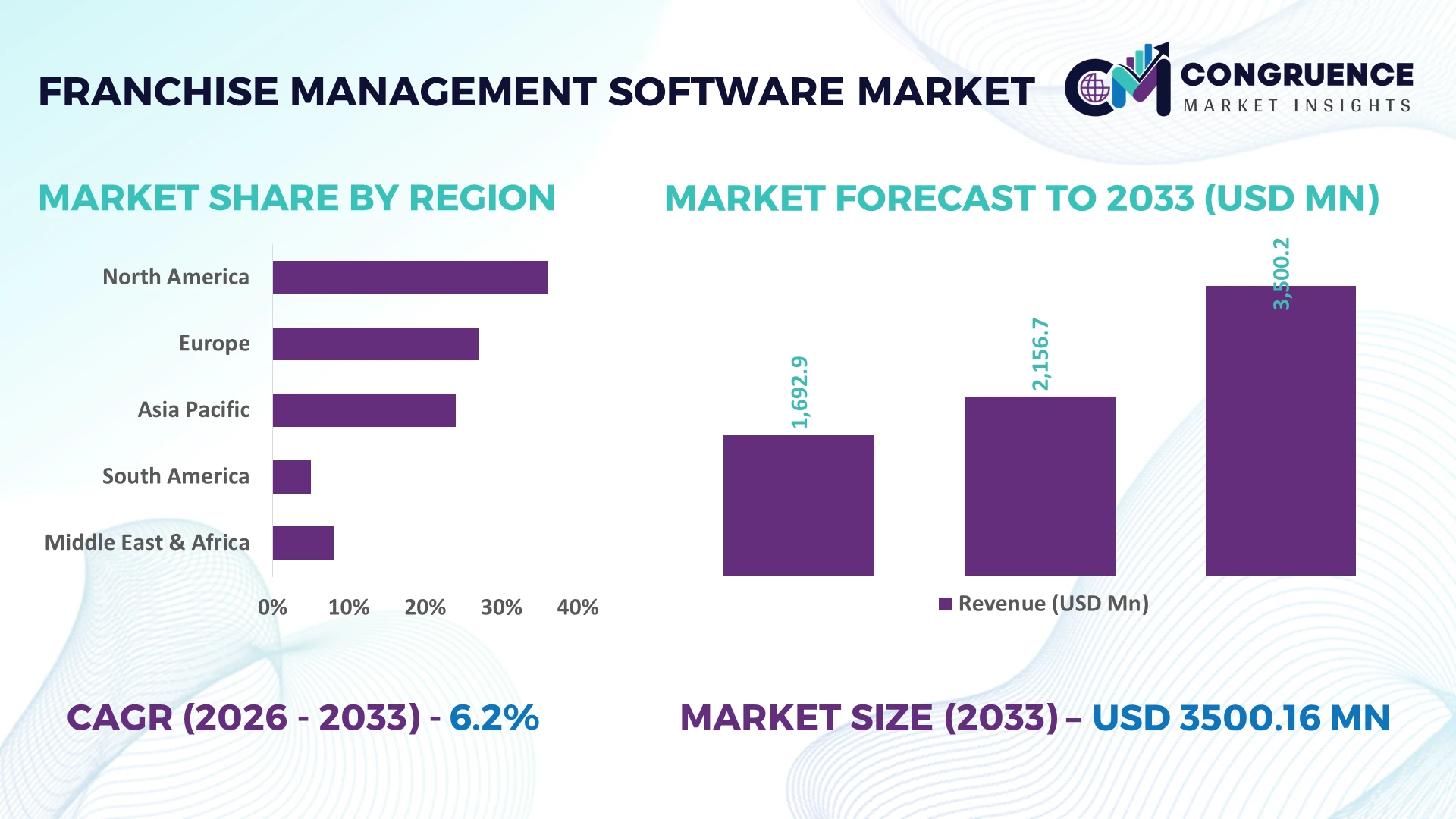
The United States leads the global Franchise Management Software Market with approximately 39% of worldwide adoption, supported by more than 830,000 franchise establishments, strong enterprise cloud integration, and sustained digital transformation investments across food service, retail, healthcare, and fitness sectors. Compared with the United Kingdom, where adoption is accelerating through mid-sized franchise operators, U.S. implementations demonstrate over 30% higher AI-enabled workflow utilization. Cross-border franchise expansion, reinforced by resilient North American economic activity despite evolving global trade policies in 2026, continues to strengthen enterprise software deployment.
Organizations prioritizing scalable, data-driven franchise management platforms are better positioned to improve operational consistency, accelerate expansion, and maintain competitive advantage across geographically distributed franchise networks.
Market Size & Growth: USD 2,156.67 million in 2025, reaching USD 3,500.16 million by 2033 at 6.24% CAGR, supported by enterprise AI integration and cloud-based franchise operations.
Top Growth Drivers: AI-enabled automation contributes nearly 34% of new deployments, cloud migration exceeds 68%, and multi-unit franchise expansion supports over 41% of software demand.
Short-Term Forecast: By 2027, automated franchise workflows improve operational efficiency by approximately 24% while reducing administrative processing time by nearly 18%.
Emerging Technologies: AI, predictive analytics, and workflow automation enable over 45% faster reporting cycles and stronger operational visibility across distributed franchise networks.
Regional Leaders: North America exceeds USD 1.45 billion, Europe approaches USD 760 million, and Asia-Pacific surpasses USD 690 million, driven by accelerated regional franchise expansion and digital adoption.
Consumer/End-User Trends: Around 72% of franchise operators prioritize unified cloud platforms offering real-time compliance monitoring, mobile access, and centralized performance dashboards.
Pilot/Case Example: During 2026, an enterprise franchise digital transformation program improved outlet compliance by 27% while reducing onboarding time by 21% through automated workflows.
Competitive Landscape: Leading vendors collectively account for approximately 46% market share, with competition centered on AI capabilities, analytics, scalability, and enterprise integration.
Regulatory & ESG Impact: Digital compliance automation reduces documentation workloads by nearly 30%, supporting evolving labor, privacy, and sustainability reporting requirements across international franchise networks.
Investment & Funding: More than USD 900 million supports platform modernization, strategic partnerships, and AI-driven product expansion amid ongoing regional digital transformation initiatives.
Innovation & Future Outlook: Generative AI, predictive business intelligence, and low-code automation accelerate next-generation franchise ecosystems, strengthening decision-making and operational resilience across global expansion strategies.
Franchise Management Software Market demand continues to strengthen across food service, retail, healthcare, education, and fitness franchises seeking unified operational visibility and automated compliance. AI-powered analytics, mobile workforce management, and API-based integrations are accelerating platform innovation, with cloud-native deployments surpassing 70% of new implementations. Increasing digital governance requirements and standardized cross-border operations are reinforcing enterprise adoption, setting the stage for deeper strategic market evaluation.
Franchise Management Software has become a strategic enterprise platform as franchise brands compete on operational consistency, real-time decision-making, and multi-location scalability rather than store count alone. Accelerated digital adoption and stricter labor, data privacy, and compliance requirements are driving centralized software deployment across franchise ecosystems. More than 70% of large franchise networks now prioritize cloud-native management platforms to standardize training, reporting, royalty tracking, and outlet performance while supporting faster expansion into new markets.
Compared with legacy on-premise systems, AI-enabled cloud platforms reduce administrative processing time by nearly 30% and lower software maintenance costs by approximately 22% through automated updates and integrated analytics. The United States leads in enterprise-scale deployments across restaurant and retail franchises, while India is expanding rapidly through cloud-first implementations among emerging franchise brands seeking lower deployment costs and faster onboarding. Over the next two to three years, mobile-first franchise management and predictive analytics adoption are expected to exceed 60% among newly deployed enterprise platforms.
A practical example is the deployment of unified franchise management platforms that integrate POS, CRM, workforce scheduling, and compliance monitoring into a single operational environment, reducing onboarding time by over 20%. Software vendors are strengthening competitive positioning through AI investments, strategic partnerships with payment and ERP providers, and expansion of configurable SaaS ecosystems. Organizations adopting integrated, intelligence-driven franchise platforms will achieve stronger operational resilience, higher franchisee engagement, and sustainable competitive differentiation.
Enterprise franchise operators are accelerating investments in unified digital platforms to improve operational consistency across geographically distributed outlets. Nearly 68% of large franchise organizations are prioritizing cloud-based management environments, while AI-assisted workflow automation reduces manual administrative effort by approximately 28% and improves compliance reporting accuracy by over 25%. In the United States, expanding labor compliance requirements and digital record-keeping expectations are encouraging centralized franchise operations. This structural shift is driving software vendors to expand AI capabilities, integrate financial and workforce management modules, and establish technology partnerships. The result is faster franchise onboarding, standardized operating procedures, and stronger visibility into network-wide performance, enabling scalable expansion without proportionally increasing operational complexity.
Integration with legacy ERP, accounting, POS, and CRM infrastructure remains a significant structural limitation for franchise operators. Around 42% of established franchise networks continue to rely on fragmented software environments, while integration projects typically extend implementation timelines by nearly 30%. In Japan and several mature franchise markets, older technology infrastructure complicates cloud migration and interoperability between multiple business applications. These deployment barriers increase implementation costs, delay operational standardization, and reduce technology utilization across franchise locations. To minimize disruption, software providers are investing in API-driven architectures, localized implementation services, and phased migration strategies that enable organizations to modernize operations while maintaining business continuity and minimizing operational downtime.
The strongest opportunity lies in combining artificial intelligence with predictive business intelligence to optimize franchise performance at scale. More than 65% of newly evaluated enterprise platforms include AI-enabled forecasting, while automated performance analytics improve outlet-level decision accuracy by approximately 24%. India and Southeast Asia present attractive expansion opportunities as organized franchise ecosystems continue digital transformation supported by expanding cloud infrastructure and government-backed digital initiatives. Vendors are increasing investment in low-code customization, multilingual interfaces, and partner ecosystems that simplify deployment for growing franchise brands. Organizations leveraging predictive analytics, automated benchmarking, and intelligent workforce planning gain measurable operational efficiency while strengthening long-term franchise scalability beyond traditional management capabilities.
Long-term market competitiveness depends on secure, scalable execution across increasingly interconnected franchise ecosystems. More than 58% of enterprise franchise platforms now exchange data across multiple third-party applications, while cyber incidents targeting cloud business systems have increased by over 20% in recent years. In the United States, evolving data privacy requirements are adding complexity to multi-location software governance and cross-platform integration. Companies must simultaneously strengthen cybersecurity, identity management, and API security without reducing user productivity. Leading vendors are responding through zero-trust architectures, continuous security monitoring, cloud-native infrastructure modernization, and specialized cybersecurity partnerships, ensuring reliable deployment consistency while protecting franchise operations from evolving digital threats.
AI-Powered Operational Intelligence Enterprise franchise systems are embedding AI into scheduling, royalty validation, and demand forecasting, with AI-enabled deployments increasing by nearly 42% and reporting accuracy improving by approximately 27%. Labor shortages in the United States are accelerating automation, prompting software providers to expand predictive analytics, workflow orchestration, and intelligent recommendation engines that reduce administrative effort while improving decision speed across multi-unit franchise networks.
Cloud-Native Platform Consolidation Organizations are replacing fragmented applications with unified cloud ecosystems, as over 69% of new enterprise implementations combine franchise operations, finance, and compliance into a single platform. Average deployment times have declined by about 24%, while integration costs have fallen nearly 18%. Vendors are responding through API-first architectures, strategic ERP partnerships, and modular SaaS offerings that simplify large-scale digital transformation.
Mobile Franchise Workforce Management Mobile-first operations are becoming standard across distributed franchise networks, with more than 63% of field managers relying on mobile dashboards and digital approvals. Store response times have improved by roughly 21%, supporting faster issue resolution and standardized execution. Companies are expanding mobile functionality through offline synchronization, multilingual interfaces, and real-time collaboration tools to improve operational consistency across geographically dispersed locations.
Compliance-Centric Digital Governance Tightening privacy regulations and standardized operating requirements are increasing investment in automated compliance management. Around 57% of enterprise franchise brands have introduced digital audit workflows, reducing documentation effort by approximately 29%. Rather than expanding compliance teams, organizations are restructuring operational processes through automated record management, digital policy tracking, and continuous monitoring platforms that strengthen governance while lowering administrative overhead.
Cloud-Based software represents the leading segment because it delivers scalable deployment, centralized management, and seamless integration across geographically dispersed franchise networks. Approximately 68% of new enterprise implementations now favor cloud architecture, supported by lower infrastructure requirements and real-time operational visibility. On-Premise solutions remain relevant for organizations with strict data governance requirements but continue to lose share as businesses prioritize flexibility. CRM Software maintains strong adoption through customer engagement and franchisee relationship management, while ERP Software strengthens financial standardization and procurement coordination across expanding franchise operations.
Analytics Software is the fastest-growing type as franchise operators increasingly rely on predictive intelligence and performance benchmarking to improve outlet profitability and operational consistency. AI-powered analytics improve reporting efficiency by nearly 30%, encouraging vendors to expand embedded business intelligence capabilities and strategic technology partnerships. Product innovation increasingly focuses on modular cloud ecosystems that integrate CRM, ERP, and advanced analytics, enabling franchise brands to accelerate expansion while maintaining standardized governance and operational transparency.
Franchise Operations remains the dominant application because centralized outlet management, compliance monitoring, workforce coordination, and standardized operating procedures directly influence network performance. Nearly 64% of enterprise software deployments prioritize operational management capabilities before expanding into adjacent functions. Financial Management continues gaining importance through automated royalty calculations, budgeting, and centralized reporting, while Marketing Management supports localized campaigns using integrated customer and performance insights across multiple franchise locations.
Performance Tracking is the fastest-growing application as organizations increasingly monitor outlet productivity through AI-assisted dashboards and predictive benchmarking. Around 48% of franchise enterprises have expanded automated KPI monitoring, improving operational responsiveness by approximately 23%. Training Management is also evolving through digital learning platforms that shorten employee onboarding and standardize operational practices. Software providers are expanding integrated application suites, strengthening automation capabilities, and enhancing interoperability to support scalable franchise ecosystems with consistent operational execution.
Restaurants represent the largest end-user segment due to extensive franchise networks, high transaction volumes, workforce complexity, and continuous compliance requirements. Nearly 46% of enterprise franchise software deployments support restaurant operations, where centralized scheduling, inventory coordination, and outlet performance monitoring are operational priorities. Retail Chains maintain strong adoption through multi-store merchandising and customer management integration, while Hospitality organizations increasingly deploy digital franchise platforms to standardize guest experience and operational governance.
Healthcare is the fastest-growing end-user segment as franchise-based clinics and wellness providers strengthen regulatory compliance, appointment coordination, and operational reporting through digital platforms. More than 33% of new healthcare franchise technology projects include centralized management capabilities, while Education franchises continue expanding cloud-based administrative systems and standardized learning operations. Vendors are responding through industry-specific product customization, subscription-based pricing, and strategic ecosystem partnerships that address specialized compliance and workflow requirements while strengthening long-term customer retention.
North America accounted for the largest market share at 38.8% in 2025 however, Asia-Pacific is expected to register the fastest growth, expanding at a CAGR of 7.6% between 2026 and 2033.
Enterprise AI Integration Strengthens Multi-Location Operations
North America maintains the leading position due to its extensive franchise ecosystem, advanced cloud infrastructure, and early adoption of AI-enabled enterprise software. Large restaurant, retail, healthcare, and fitness franchise operators continue replacing fragmented legacy platforms with integrated franchise management ecosystems. Nearly 71% of enterprise deployments across the region now include cloud-native operational management and analytics capabilities, while automated compliance workflows have reduced administrative effort by approximately 28%. Technology providers are strengthening strategic alliances with ERP, payment, and workforce management vendors, enabling faster deployment across expanding franchise networks and improving operational standardization at scale.
United States Market Outlook: The United States remains the region's technology leader, supported by one of the world's largest franchise ecosystems and strong enterprise software investment. More than 830,000 franchise establishments generate sustained demand for centralized operational platforms integrating POS, CRM, workforce scheduling, and financial management. AI-enabled workflow adoption has surpassed 40% among large franchise organizations, while continuous investment in enterprise cloud modernization supports faster implementation cycles and stronger operational visibility across geographically distributed franchise brands.
Compliance-Driven Digital Modernization Accelerates Adoption
Europe is advancing through regulatory alignment, digital governance initiatives, and increasing enterprise modernization across franchise businesses. Retail, hospitality, and food service operators are deploying integrated software platforms to improve operational transparency and standardized reporting across multiple countries. Approximately 61% of newly implemented franchise platforms include automated compliance management, reducing documentation processing by nearly 24%. Software vendors are expanding localized language support, tax configuration, and regulatory automation capabilities, helping franchise organizations improve cross-border operational consistency while simplifying administration within diverse business environments.
Germany Market Outlook: Germany leads the European market through advanced enterprise digitization, strong industrial software expertise, and highly structured franchise operations. Retail and food service organizations increasingly deploy integrated franchise management platforms supporting financial control, workforce coordination, and compliance automation. Nearly 58% of medium and large franchise enterprises have expanded cloud-based operational systems, while domestic software innovation and enterprise integration capabilities continue strengthening long-term market competitiveness.
Cloud-First Expansion Reshapes Franchise Ecosystems
Asia-Pacific is becoming the fastest-expanding market as organized franchise businesses rapidly digitize operations through cloud-first deployment strategies. Growing retail networks, quick-service restaurants, education providers, and healthcare franchises are investing in centralized management platforms to improve scalability and operational efficiency. More than 66% of newly deployed enterprise franchise systems in major economies utilize SaaS architecture, while implementation timelines have shortened by approximately 25% through standardized cloud deployment models. Technology companies are increasing regional partnerships and localized product development to address rapidly expanding franchise ecosystems.
India Market Outlook: India represents the region's strongest growth engine, supported by expanding organized retail, food service, healthcare, and education franchise networks. Rapid enterprise cloud adoption, competitive SaaS deployment models, and nationwide digital transformation initiatives are accelerating software implementation across both established and emerging franchise brands. Around 62% of newly established multi-location franchise businesses now prioritize cloud-based management platforms, creating significant opportunities for AI-enabled operational automation and localized enterprise software providers.
Retail Digitalization Expands Enterprise Deployment
South America is experiencing increasing adoption as organized retail, restaurant, and consumer service franchises modernize operational infrastructure. Businesses are replacing manual reporting with centralized digital management systems to improve franchise oversight and financial transparency. Approximately 48% of enterprise software upgrades now prioritize integrated franchise management capabilities, while automated reporting has improved operational efficiency by nearly 20%. Technology providers are expanding regional implementation partnerships and subscription-based deployment models to improve affordability despite varying digital infrastructure maturity across individual markets.
Brazil Market Outlook: Brazil dominates the regional market through its large franchise industry, expanding digital economy, and growing enterprise technology investments. National restaurant, retail, and education franchise brands continue modernizing multi-location operations through cloud-enabled management platforms integrating finance, compliance, and performance analytics. More than half of enterprise franchise software implementations now emphasize mobile accessibility and centralized operational dashboards, supporting stronger scalability across geographically dispersed franchise networks.
Digital Infrastructure Investment Supports Franchise Modernization
The Middle East & Africa market is advancing through infrastructure modernization, smart city investments, and expanding organized franchise sectors. Hospitality, retail, and healthcare organizations are adopting integrated management platforms to improve operational control, regulatory compliance, and customer engagement. Around 46% of enterprise franchise technology projects now incorporate cloud-based operational management, while digital workflow automation has shortened administrative processing by approximately 18%. Software providers are strengthening regional partnerships and localized deployment capabilities to support long-term franchise ecosystem development.
United Arab Emirates Market Outlook: The United Arab Emirates leads regional adoption through advanced digital infrastructure, business-friendly regulatory policies, and a rapidly expanding franchise economy. International restaurant, retail, hospitality, and healthcare brands continue investing in enterprise management platforms supporting multilingual operations, automated compliance, and integrated analytics. Nearly 60% of large franchise operators have adopted centralized cloud management environments, reinforcing the country's position as a regional technology hub for franchise digital transformation.
Global software providers including FranConnect, Zenoti, GoFrugal Technologies, FranchiseSoft, and Naranga compete directly with specialized franchise platform vendors and regional SaaS providers for enterprise multi-location deployments. The top five participants collectively control approximately 47% of the market, while regional vendors differentiate through localized compliance capabilities and industry-specific customization. Competition centers on AI functionality, deployment speed, integration depth, and subscription flexibility rather than pricing alone. AI-enabled workflow automation improves operational productivity by nearly 28%, API-driven implementations shorten deployment cycles by approximately 24%, and cloud-native platforms reduce infrastructure management effort by around 30%. Leading vendors strengthen market position through ERP partnerships, payment ecosystem integration, product expansion, and acquisitions that broaden enterprise capabilities. The competitive landscape is shifting toward intelligent automation and unified operational ecosystems, increasing pressure on providers relying on standalone applications. High integration complexity and enterprise security expectations remain major entry barriers. Sustained success depends on delivering scalable AI-driven platforms, seamless interoperability, rapid implementation, and measurable operational outcomes across expanding franchise networks.
FranConnect
FranchiseSoft
Naranga
Zenoti
GoFrugal Technologies
Servicenow
Salesforce
Zoho Corporation
Oracle
Microsoft
SAP
Mindbody
Erply
OpenJanela
Cloud-native architecture, artificial intelligence, and API-first integration are redefining franchise management platforms. More than 70% of newly deployed enterprise solutions now operate on cloud infrastructure, enabling centralized administration and continuous software updates. AI-powered forecasting and workflow automation improve scheduling accuracy by approximately 26% while reducing manual administrative effort by nearly 30%. Integrated APIs connect POS, CRM, ERP, payroll, and payment ecosystems, creating unified operational visibility that accelerates decision-making across distributed franchise networks.
Predictive analytics, generative AI assistants, and low-code configuration tools represent the next technology wave. Compared with legacy on-premise platforms, modern AI-enabled cloud environments reduce deployment time by roughly 25% and improve reporting efficiency by over 32%. Large restaurant, retail, and healthcare franchise operators benefit most because configurable automation supports standardized compliance, workforce coordination, and multi-location performance management without increasing administrative complexity. Mobile-first dashboards and embedded analytics are becoming standard across enterprise implementations.
Between 2026 and 2028, intelligent orchestration, autonomous business workflows, and digital compliance engines will become core competitive differentiators. Around 60% of enterprise franchise software evaluations already prioritize embedded AI and advanced analytics. Vendors investing in cybersecurity, real-time data synchronization, and composable software architecture will strengthen customer retention, accelerate deployment scalability, and establish long-term competitive advantage as enterprise buyers increasingly demand integrated, intelligence-driven franchise ecosystems.
January 2025, FranConnect launched Frannie AI, a generative AI agent suite integrated into its franchise platform to automate sales, operations, finance, and training workflows. The solution supports more than 1,500 brands and one million locations globally, strengthening productivity through intelligent automation. Source: https://www.franconnect.com
August 2025, FranConnect introduced FranConnect GO, a pre-configured platform designed for emerging franchise brands seeking faster operational scaling. The solution combines AI-powered coaching and automation capabilities, helping smaller franchise operators replace fragmented processes and accelerate deployment efficiency through standardized workflows.
December 2024, Salesforce expanded AI-driven enterprise automation through Agentforce enhancements, supporting intelligent workflow execution across customer operations. The platform secured more than 200 deals shortly after launch, improving automation capabilities for organizations managing complex partner and franchise-style ecosystems.
August 2025, FranConnect upgraded its AI operational support capabilities with a Franchise Support Agent that provides conversational access to SOPs, training materials, and compliance documentation. The update improved frontline knowledge access and strengthened consistency across multi-location franchise operations through automated information retrieval.
The Franchise Management Software Market Report evaluates industry dynamics across major software types, including Cloud-Based, On-Premise, CRM Software, ERP Software, and Analytics Software. It analyzes applications such as franchise operations, financial management, marketing management, training management, and performance tracking across restaurants, retail chains, hospitality, healthcare, and education sectors. The report examines adoption patterns, deployment models, regional performance, and technology shifts influencing franchise digitization.
The study provides strategic insights into AI integration, cloud transformation, automation adoption, cybersecurity requirements, and ecosystem partnerships shaping market direction from 2026 to 2033. Coverage includes North America, Europe, Asia-Pacific, South America, and Middle East & Africa, supporting investment decisions, competitive positioning, expansion planning, and technology prioritization for software providers and franchise enterprises.
| Report Attribute/Metric | Report Details |
|---|---|
Market Revenue in 2025 | USD 2156.67 Million |
Market Revenue in 2033 | USD 3500.16 Million |
CAGR (2026 - 2033) | 6.24% |
Base Year | 2025 |
Forecast Period | 2026 - 2033 |
Historic Period | 2021 - 2025 |
Segments Covered | By Type
By Application
By End-User
|
Key Report Deliverable | Revenue Forecast, Growth Trends, Market Dynamics, Segmental Overview, Regional and Country-wise Analysis, Competition Landscape |
Region Covered | North America, Europe, Asia-Pacific, South America, Middle East, Africa |
Key Players Analyzed | FranConnect, FranchiseSoft, Naranga, Zenoti, GoFrugal Technologies, Servicenow, Salesforce, Zoho Corporation, Oracle, Microsoft, SAP, Mindbody, Erply, OpenJanela |
Customization & Pricing | Available on Request (10% Customization is Free) |




