
Reports
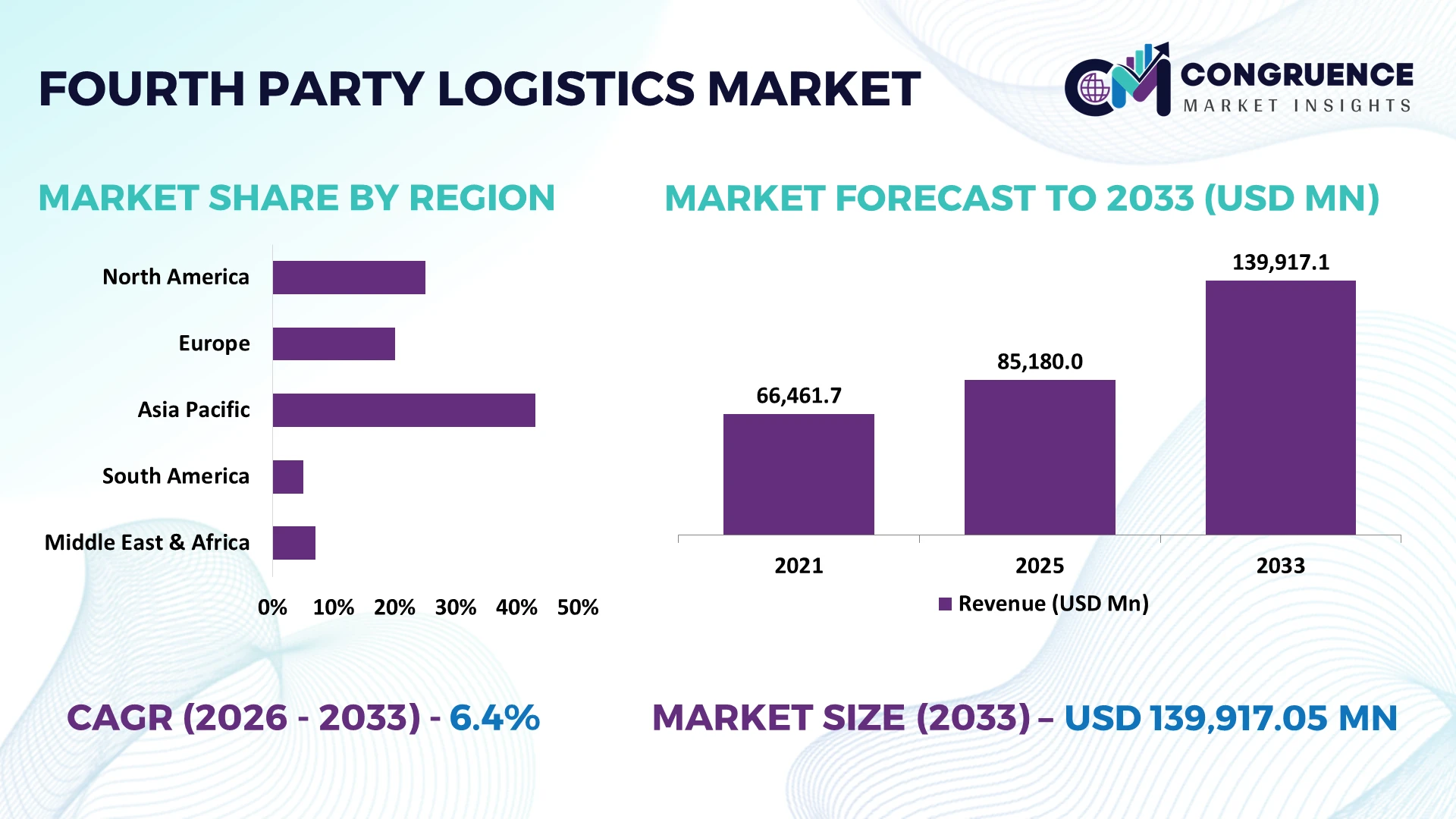
The Global Fourth Party Logistics Market was valued at USD 85180 Million in 2025 and is anticipated to reach a value of USD 139917.05 Million by 2033 expanding at a CAGR of 6.4% between 2026 and 2033. Growth is driven by multi-carrier supply chain orchestration, AI-powered transport optimization, nearshoring, and enterprise outsourcing of end-to-end logistics management.
The United States represents a major fourth party logistics market, supported by extensive freight infrastructure, multinational manufacturing, and sophisticated supply chain management platforms. Annual domestic freight movements exceed 20 billion tons, while transportation and warehousing account for approximately 9% of national economic activity. Compared with China, which leads global manufacturing output and operates more than 40% of worldwide container port throughput, the United States emphasizes integrated logistics control towers and cross-border network optimization. USMCA-driven nearshoring is strengthening coordinated freight management across American and Mexican manufacturing corridors.
Fourth party logistics providers combining multimodal visibility, carrier-neutral procurement, and predictive analytics are positioned to capture complex enterprise outsourcing contracts.
Market Size & Growth: Valued at USD 85180 Million in 2025, projected to USD 139917.05 Million by 2033 at 6.4% CAGR, driven by supply chain complexity and integrated logistics demand.
Top Growth Drivers: E-commerce expansion, manufacturing supply chain complexity at 32.4% application share, and AI-enabled control tower adoption across logistics networks .
Short-Term Forecast: By 2027, AI-driven route optimization and predictive analytics reduce logistics operational costs by 15–20% as 4PL providers shift from reactive to predictive orchestration .
Emerging Technologies: Cloud-based control towers, machine learning for demand forecasting, and blockchain-backed documentation enabling secure data exchange across multi-provider ecosystems .
Regional Leaders: North America at USD 25.66 billion and 37.2% share, Europe at USD 19.04 billion and 27.6% share, and Asia-Pacific expanding as the largest logistics services market at 40% share .
Consumer/End-User Trends: Manufacturing commands 32.4% application share; healthcare represents fastest-growing vertical at 8.74% CAGR driven by cold chain and regulatory compliance requirements .
Pilot/Case Example: C.H. Robinson launched Managed Solutions in November 2024, combining 4PL services, managed transportation, and TMS technology in one platform, signaling convergence between execution oversight and technology-led orchestration .
Competitive Landscape: UPS Supply Chain leads with over 8% market share; CEVA Logistics, DB Schenker, DHL, and Nippon Express comprise top five at 28.1% combined share .
Regulatory & ESG Impact: EU digitalization and sustainability mandates for freight transport encourage 4PL adoption; green logistics initiatives with EV fleets and carbon credit programs reshape procurement criteria .
Investment & Funding: DSV completed EUR 14.3 billion acquisition of DB Schenker on April 30, 2025, expanding global scale across more than 90 countries .
Innovation & Future Outlook: 4PL providers evolve from transactional freight coordinators to value-driven supply chain orchestrators through AI, blockchain, and IoT integration .
The Fourth Party Logistics Market is shifting toward centralized supply chain orchestration as multinational enterprises seek coordinated control over transportation, warehousing, procurement, and distribution networks. Unlike conventional third party logistics providers, 4PL operators manage multiple service partners through integrated technology platforms and performance-based governance. Advanced transportation management systems, digital control towers, and AI-powered exception monitoring improve operational transparency across complex networks. Transportation accounts for approximately 70–80% of total logistics expenditure in many freight-intensive supply chains, making carrier optimization commercially significant. Increasing cross-border manufacturing diversification is accelerating demand for independent logistics integrators capable of coordinating fragmented supplier and distribution ecosystems.
Fourth party logistics is becoming a strategic operating model as multinational manufacturers shift from fragmented outsourcing toward centralized supply chain governance. Trade diversification, geopolitical disruptions, and inventory volatility are increasing the importance of carrier-neutral orchestration. Mexico's growing role in North American manufacturing networks illustrates this restructuring, requiring coordinated customs management, transportation procurement, and supplier visibility across multiple logistics providers.
AI-enabled transportation management systems strengthen network planning through automated carrier selection, predictive arrival estimates, and exception prioritization. Optimized freight consolidation can reduce transportation costs by 5–10% compared with fragmented shipment procurement under suitable operating conditions. The United States emphasizes integrated logistics control towers, while Germany prioritizes multimodal coordination and regulatory compliance. China's manufacturing networks increasingly require cross-border shipment visibility. Between 2026 and 2028, enterprises will prioritize automated freight allocation, standardized data interfaces, and performance-based logistics contracts to improve delivery reliability.
Automotive manufacturers provide a practical deployment example, coordinating component movements from suppliers through assembly plants using centralized transport management platforms. DHL Supply Chain, Kuehne+Nagel, and CEVA Logistics are expanding digital orchestration capabilities and strategic carrier partnerships. Competitive advantage increasingly depends on measurable logistics savings, network transparency, and the ability to manage complex supply chains without sacrificing operational flexibility.
Manufacturers are consolidating fragmented logistics operations under fourth party logistics providers to improve carrier coordination, procurement efficiency, and network visibility. Transportation frequently represents 50–70% of logistics expenditure in freight-intensive operations, making centralized freight management financially significant. Optimized carrier allocation and shipment consolidation can deliver 5–10% transportation cost reductions, depending on network density and contractual arrangements. Mexico's expanding automotive manufacturing integration with the United States is strengthening requirements for coordinated cross-border freight execution. Enterprises increasingly require unified control towers capable of managing multiple transportation providers and distribution facilities. Logistics integrators are expanding managed transportation services, investing in AI-assisted planning, and developing partnerships with regional carriers. The strategic advantage lies in optimizing entire logistics networks rather than individual shipments.
Fourth party logistics implementation faces structural limitations from incompatible enterprise systems, inconsistent carrier data, and costly technology integration. Legacy transportation management platforms frequently operate across multiple enterprise resource planning environments, requiring customized interfaces and data normalization. In the United States, trucking accounts for approximately 72% of domestic freight transportation tonnage, increasing dependency on fragmented carrier networks and operational data quality. Manual shipment documentation and inconsistent milestone reporting complicate end-to-end visibility. Integration projects involving multiple service providers can absorb 10–20% of initial transformation budgets, depending on system complexity. Logistics companies are addressing these constraints through standardized APIs, cloud-based orchestration platforms, and phased implementation contracts. Controlling integration costs is essential for maintaining outsourcing economics and achieving scalable customer onboarding.
AI-powered logistics control towers are creating opportunities for fourth party logistics providers to monetize predictive planning, dynamic carrier allocation, and cross-border supply chain coordination. Advanced route optimization can reduce empty mileage by 5–15% in suitable transport networks, while automated exception management can shorten manual planning workloads by 20–30%. India's National Logistics Policy and digital infrastructure initiatives are strengthening opportunities for integrated freight coordination across manufacturing clusters and multimodal transport corridors. Emerging trade relationships between India, Southeast Asia, and Middle Eastern distribution hubs are increasing requirements for independent logistics orchestration. Providers are investing in predictive analytics, digital freight platforms, and regional carrier partnerships. Competitive differentiation increasingly depends on converting network intelligence into measurable operating savings and faster disruption response.
Managing interconnected logistics networks introduces significant execution challenges involving cybersecurity, service accountability, and operational continuity. Fourth party logistics platforms exchange shipment, inventory, customer, and commercial information across numerous external systems, expanding potential attack surfaces. IBM's 2024 cybersecurity research identified an average global data breach cost increase of approximately 10%, highlighting the financial implications of inadequate information security. Simultaneously, logistics orchestration requires consistent service standards across carriers operating under different regulatory and technological environments. Europe's evolving cybersecurity requirements are increasing expectations for supplier risk management and digital operational resilience. Providers must invest in zero-trust architecture, standardized carrier onboarding, incident response capabilities, and contractual performance governance. Sustainable competitiveness depends on securing interconnected data while maintaining reliable execution across geographically dispersed logistics partners.
• Real-Time Carbon Accounting Integration: European logistics operators are embedding shipment-level emissions calculations into freight procurement and carrier scorecards. Under the EU's 2025 sustainability reporting framework, transport emissions measurement increasingly supports Scope 3 disclosure. Providers are incorporating ISO 14083 methodologies and tracking carbon intensity in grams of CO₂ equivalent per tonne-kilometre. Road-to-rail substitution can reduce freight emissions by approximately 70–80% on suitable routes. DHL and Kuehne+Nagel are integrating emissions visibility with transport purchasing, enabling customers to evaluate cost and environmental performance together.
• Dynamic Inventory Repositioning Across Networks: Retailers are coordinating stock transfers between fulfillment centers using demand forecasts and shared inventory data. Inventory carrying costs commonly represent 20–30% of inventory value annually, making placement decisions financially significant. Repositioning 5–10% of selected stock closer to demand centers can reduce expedited replenishment exposure, depending on order concentration. Logistics integrators are linking warehouse management systems with order management platforms to coordinate interfacility transfers. This shifts fourth party logistics contracts toward inventory governance rather than transportation execution alone.
• Carrier Performance Contracts Become Granular: Enterprise logistics buyers are replacing aggregate delivery targets with lane-specific service-level agreements covering on-time delivery, claims, and milestone accuracy. Performance dashboards increasingly monitor 95–98% on-time delivery targets alongside exception frequency and tender acceptance. Logistics providers are integrating electronic proof of delivery and automated carrier scorecards, reducing dependence on retrospective monthly reporting. CEVA Logistics and DHL Supply Chain emphasize digitally managed transport execution, while shippers gain stronger contractual leverage over underperforming routes and service partners.
• Customs Compliance Enters Centralized Workflows: Trade policy changes are pushing manufacturers to integrate customs classification, origin documentation, and shipment release milestones into fourth party logistics platforms. USMCA preferential treatment depends on product-specific origin requirements, including a 75% regional value-content threshold for qualifying passenger vehicles. Digital document validation and customs milestone tracking help reduce border-related scheduling uncertainty. Providers are strengthening brokerage partnerships and compliance data integration, enabling manufacturers to coordinate production schedules with cross-border clearance requirements rather than treating customs as a separate administrative function.
Integrated Supply Chain Management holds an estimated 32% share of the global Fourth Party Logistics Market in 2025, reflecting enterprise preference for consolidated oversight of transportation, warehousing, supplier coordination, and distribution. Its leadership stems from the ability to standardize procurement decisions across multiple logistics partners while maintaining centralized operational accountability. Supply Chain Optimization represents an established service category, particularly among manufacturers seeking measurable improvements in freight utilization and inventory positioning. Logistics Network Design remains important for facility location decisions, transport corridor restructuring, and distribution footprint planning. Network redesign projects commonly evaluate transportation cost differences of 5–15% between alternative operating configurations, depending on shipment density and service requirements.
Control Tower Services represent the fastest-growing type as enterprises prioritize continuous shipment monitoring and automated operational intervention. Technology Integration supports this transition by connecting enterprise resource planning systems, carrier platforms, and warehouse applications. Supply Chain Consulting remains relevant during outsourcing transitions and operating-model redesign. DHL Supply Chain and Kuehne+Nagel are strengthening digital service portfolios, while technology specialists compete through interoperability and analytics. Investment priorities increasingly favor recurring orchestration contracts over isolated advisory engagements.
Transportation Management accounts for an estimated 29% of the Fourth Party Logistics Market in 2025, supported by extensive carrier procurement requirements, multimodal scheduling, and freight execution complexity. Large manufacturers require centralized management of contracted capacity, shipment tendering, routing instructions, and delivery performance. Freight Management remains closely linked to this segment but focuses more specifically on rate negotiations, shipment consolidation, and freight settlement. Warehouse Management addresses storage operations and facility coordination, while Order Fulfillment supports synchronized distribution and customer delivery commitments. Transportation optimization initiatives commonly target 5–10% reductions in controllable freight expenditure, establishing a measurable basis for outsourcing decisions.
Supply Chain Visibility is the fastest-growing application as buyers expand monitoring beyond vehicle location to inventory milestones, estimated arrival times, and disruption alerts. Inventory Optimization is becoming increasingly important for companies balancing service availability against working capital requirements. Reverse Logistics addresses product returns, recovery routing, and disposition management, particularly within retail distribution networks. CEVA Logistics and DHL Supply Chain are integrating shipment tracking, warehouse information, and performance analytics. Providers offering consistent cross-platform visibility gain stronger positions in enterprise contracts where operational accountability extends across independent service partners.
Retail and E-commerce represents an estimated 27% of global Fourth Party Logistics Market demand in 2025, supported by high shipment frequency, distributed fulfillment operations, and complex delivery service requirements. Large retailers coordinate inventory movements across stores, distribution centers, and online fulfillment facilities, creating substantial demand for centralized logistics governance. Automotive remains a major established buyer group because component sequencing, supplier coordination, and production continuity require precise transport execution. Manufacturing companies prioritize procurement integration and multimodal distribution planning, while Consumer Electronics buyers emphasize product launch scheduling and inventory control. Retail supply chains commonly evaluate fulfillment accuracy targets above 98%, making standardized performance monitoring commercially important.
Healthcare and Pharmaceuticals is the fastest-growing end-user category as temperature-controlled distribution, product traceability, and regulatory compliance increase logistics management complexity. Food and Beverages companies prioritize shelf-life management and temperature monitoring, whereas Aerospace and Defense customers require secure transportation and specialized handling. DHL Supply Chain and CEVA Logistics are developing sector-specific service capabilities, including healthcare logistics and specialized contract management. Providers increasingly differentiate through industry-specific compliance expertise, integrated inventory visibility, and service agreements aligned with operational risk.
North America accounted for the largest market share at an estimated 36% in 2025; however, Asia-Pacific is expected to register the fastest growth, expanding at an estimated CAGR of 8.2% between 2026 and 2033.
Enterprise Logistics Consolidation and Cross-Border Freight Orchestration
North America accounts for an estimated 36% of the global Fourth Party Logistics Market, supported by extensive contract logistics operations, integrated transportation management systems, and multinational distribution networks. The United States, Canada, and Mexico form an interconnected manufacturing and distribution ecosystem requiring centralized freight procurement, customs coordination, and inventory visibility. USMCA trade integration strengthens demand for independent logistics orchestration across automotive, electronics, and industrial equipment supply chains. The United States operates approximately 4.2 million miles of public roads, supporting large-scale trucking and distribution activities. Logistics providers increasingly combine carrier management, warehouse coordination, and digital shipment monitoring within enterprise control towers. DHL Supply Chain, GXO Logistics, and CEVA Logistics are strengthening integrated logistics capabilities, while nearshoring encourages manufacturers to redesign supplier networks and consolidate cross-border transportation contracts.
United States Market Outlook: The United States benefits from sophisticated transportation technology adoption and substantial domestic freight activity. Trucking moves approximately 72% of domestic freight tonnage, creating opportunities for centralized carrier procurement and shipment optimization. Chicago, Dallas–Fort Worth, and Southern California serve as important distribution and freight coordination hubs. Enterprise buyers increasingly prioritize transportation management integration, carrier performance analytics, and standardized logistics service agreements.
Multimodal Logistics Integration and Regulatory Compliance Modernization
Europe represents an estimated 28% of the Fourth Party Logistics Market, driven by cross-border freight coordination, sophisticated manufacturing networks, and increasing requirements for transport emissions visibility. Germany, France, the Netherlands, and the United Kingdom maintain extensive contract logistics and freight forwarding infrastructure. European Union transport policy encourages greater interoperability between road, rail, and inland waterway networks, creating demand for centralized multimodal planning. The Trans-European Transport Network framework establishes infrastructure development priorities through 2030, 2040, and 2050. Logistics integrators are incorporating shipment-level carbon measurement, electronic documentation, and coordinated carrier procurement into enterprise service contracts. DHL Supply Chain and Kuehne+Nagel are expanding digitally managed logistics services, while manufacturers seek better synchronization between production schedules, customs processes, and distribution operations across national borders.
Germany Market Outlook: Germany's automotive, machinery, and chemical industries generate substantial demand for coordinated inbound and outbound logistics. The country maintains approximately 39,000 kilometres of railway infrastructure, supporting multimodal freight planning. Industrial clusters in Bavaria, Baden-Württemberg, and North Rhine-Westphalia increasingly require integrated supplier scheduling, transport visibility, and specialized logistics coordination to protect manufacturing continuity and improve distribution efficiency.
Manufacturing Network Expansion and Integrated Trade Logistics
Asia-Pacific holds an estimated 25% market share, supported by China's manufacturing scale, Japan's advanced industrial supply chains, and India's expanding logistics infrastructure. Regional enterprises increasingly coordinate sourcing, production, warehousing, and international distribution across multiple countries. China's container ports provide substantial infrastructure capacity, while Southeast Asian manufacturing diversification increases requirements for cross-border shipment planning. Singapore remains a strategic logistics coordination center, combining advanced port infrastructure with multinational supply chain management operations. In 2024, Singapore handled approximately 41.1 million twenty-foot equivalent units, demonstrating its importance in international container flows. Logistics providers are strengthening digital freight management, customs integration, and regional carrier partnerships. Fourth party logistics adoption is particularly relevant for electronics, automotive components, and industrial manufacturing networks requiring synchronized production and international transport execution.
China Market Outlook: China combines extensive manufacturing capacity with sophisticated port and rail infrastructure. Shanghai Port handled approximately 51.5 million TEUs in 2024, supporting large-scale international freight movements. Manufacturing centers in Guangdong, Jiangsu, and Zhejiang generate complex supplier coordination requirements. Integrated logistics platforms increasingly connect factory dispatch schedules, domestic distribution operations, and international shipping arrangements to improve shipment visibility and reduce coordination delays.
Industrial Distribution Optimization and Fragmented Transport Network Consolidation
South America represents an estimated 6% of the global Fourth Party Logistics Market, with Brazil accounting for the largest regional concentration of manufacturing, retail distribution, and agricultural freight activity. Chile, Colombia, and Argentina contribute demand from mining, food exports, industrial equipment, and consumer distribution. Road transportation remains central to regional logistics operations, creating opportunities for coordinated carrier procurement and route planning. Brazil's road network extends approximately 1.7 million kilometres, although infrastructure quality varies substantially across transport corridors. Logistics providers increasingly focus on centralized freight management, shipment tracking, and warehouse coordination to address fragmented distribution networks. International logistics companies and domestic transport operators are developing partnerships to improve service coverage, particularly across industrial centers, export terminals, and major metropolitan consumption markets.
Brazil Market Outlook: Brazil's São Paulo industrial region provides a substantial customer base for integrated logistics outsourcing. The Port of Santos handled approximately 5.4 million TEUs in 2024, reinforcing its role in international trade. Automotive production, agricultural exports, and consumer goods distribution generate demand for coordinated inland transport, port scheduling, and inventory management. Providers combining local carrier relationships with enterprise-level visibility platforms hold operational advantages.
Port-Led Logistics Modernization and Trade Corridor Integration
The Middle East & Africa accounts for an estimated 5% of the global Fourth Party Logistics Market, supported by port infrastructure expansion, industrial diversification, and international trade corridor development. The United Arab Emirates and Saudi Arabia are strengthening logistics capabilities through integrated port, airport, and industrial zone investments. South Africa remains an important distribution center for manufacturing, mining, and regional trade. Saudi Arabia's National Transport and Logistics Strategy targets positioning the country among the world's leading logistics hubs, encouraging investment in freight infrastructure and digital logistics services. DP World and international contract logistics providers are expanding integrated supply chain capabilities, including warehousing, freight forwarding, and inland distribution. These developments support demand for centralized logistics coordination across maritime gateways, industrial zones, and international distribution networks.
United Arab Emirates Market Outlook: The UAE benefits from established international logistics infrastructure and strong multimodal connectivity. Jebel Ali Port has an annual container handling capacity exceeding 19 million TEUs, supporting large-scale international distribution operations. Dubai's free zones and Abu Dhabi's industrial development programs attract multinational logistics customers. Integrated port, warehouse, customs, and inland transportation management creates opportunities for fourth party logistics providers serving regional redistribution and international supply chains.
UPS Supply Chain Solutions, CEVA Logistics, DB Schenker, DHL Supply Chain, and Nippon Express anchor the fourth party logistics market, with the top five players commanding approximately 28.1% combined share through integrated orchestration platforms and multi-provider coordination capabilities. Competition bifurcates between asset-light 4PL orchestrators including C.H. Robinson and Flexport that compete on visibility technology and data analytics, and asset-heavy logistics integrators that leverage owned transportation and warehousing networks for execution control. The basis of competition centers on control tower technology depth and vertical specialization rather than freight rates: healthcare 4PL services command premium pricing at 8.74% growth due to cold chain validation and regulatory compliance requirements. Players compete through consolidation—DSV's EUR 14.3 billion acquisition of DB Schenker closed April 2025—and technology partnerships for AI-driven demand forecasting. Entry barriers center on multi-provider network integration and proprietary data assets.
UPS Supply Chain Solutions
CEVA Logistics
DB Schenker
DHL Supply Chain
Nippon Express
C.H. Robinson
Expeditors International
XPO Logistics
J.B. Hunt Transport Services
DSV
Kuehne + Nagel
SF Express
GEFCO
Yusen Logistics
Current fourth party logistics platforms combine transportation management systems, warehouse integration, electronic data interchange, and cloud control towers. API connectivity synchronizes carrier milestones, inventory positions, and delivery schedules across independent providers. Route optimization can reduce transport distance by 5–10% in suitable networks, while automated freight auditing reduces manual invoice processing. Compared with spreadsheet-based dispatching, integrated planning platforms target 15–25% faster scheduling cycles. Large manufacturers increasingly deploy centralized dashboards across multiple distribution facilities, strengthening procurement discipline and shipment accountability.
Emerging technologies include predictive artificial intelligence, digital twins, and automated carrier procurement. Machine learning models combine shipment histories, weather conditions, and capacity signals to forecast delivery exceptions. Digital twins simulate warehouse allocation and transport scenarios before operational changes. Optimization initiatives target 10–15% reductions in empty mileage, depending on network density. Providers integrating these capabilities with enterprise resource planning systems gain advantages over fragmented freight intermediaries through faster decision execution and improved asset utilization.
Between 2026 and 2028, autonomous logistics agents will increasingly manage routine tendering, appointment scheduling, and exception escalation under human supervision. Blockchain-based documentation and standardized shipment identities will strengthen cross-border traceability. Enterprises prioritizing interoperable architectures, cybersecurity, and measurable service outcomes will secure greater operational resilience and stronger supplier negotiating positions.
November 2024: C.H. Robinson launched Managed Solutions, integrating TMS technology, 3PL managed transportation, and 4PL services into a single AI-enhanced platform. The company reports delivered savings of up to 25% on addressable supply chain costs, addressing the market gap for seamless multi-service access. Source: chrobinson.com
April 2025: DSV completed its EUR 14.3 billion acquisition of DB Schenker, creating a combined company with approximately EUR 41.6 billion in revenue and 160,000 employees across more than 90 countries. Annual synergies are estimated at DKK 9 billion by end-2028. Source: dsv.com
November 2025: CEVA Logistics closed its $383 million acquisition of Borusan Lojistik in Turkey, gaining control of 1.19 million square meters of warehouse space and approximately 1 million domestic FTL transports annually. Turkey becomes CEVA's third-largest country by gross revenue. Source: cevalogistics.com
November 2025: UPS announced the acquisition of Andlauer Healthcare Group for approximately EUR 1.4 billion, expanding its cold chain network for temperature-sensitive healthcare logistics. The deal strengthens UPS Healthcare's end-to-end visibility and reduced transit times for global pharmaceutical supply chains. Source: supplychainmagazine.pt
The Fourth Party Logistics Market Report evaluates industry development, competitive positioning, and outsourcing strategies between 2026 and 2033. Service coverage includes Supply Chain Consulting, Logistics Network Design, Integrated Supply Chain Management, Technology Integration, Supply Chain Optimization, and Control Tower Services. Application analysis examines Transportation Management, Warehouse Management, Inventory Optimization, Order Fulfillment, Freight Management, Supply Chain Visibility, and Reverse Logistics. End-user assessment covers Retail and E-commerce, Automotive, Healthcare and Pharmaceuticals, Food and Beverages, Consumer Electronics, Manufacturing, and Aerospace and Defense.
Geographic coverage spans North America, Europe, Asia-Pacific, South America, and the Middle East & Africa. The report examines AI-enabled orchestration, digital twins, predictive analytics, and interoperable logistics platforms. Competitive assessment considers enterprise contracts, strategic partnerships, and service integration capabilities. Operational benchmarks, including transportation cost optimization and network visibility, support investment planning, geographic expansion, supplier selection, and differentiated service development.
| Report Attribute/Metric | Report Details |
|---|---|
Market Revenue in 2025 | USD 85180 Million |
Market Revenue in 2033 | USD 139917.05 Million |
CAGR (2026 - 2033) | 6.4% |
Base Year | 2025 |
Forecast Period | 2026 - 2033 |
Historic Period | 2021 - 2025 |
Segments Covered | By Type
By Application
By End-User
|
Key Report Deliverable | Revenue Forecast, Growth Trends, Market Dynamics, Segmental Overview, Regional and Country-wise Analysis, Competition Landscape |
Region Covered | North America, Europe, Asia-Pacific, South America, Middle East, Africa |
Key Players Analyzed | UPS Supply Chain Solutions, CEVA Logistics, DB Schenker, DHL Supply Chain, Nippon Express, C.H. Robinson, Expeditors International, XPO Logistics, J.B. Hunt Transport Services, DSV, Kuehne + Nagel, SF Express, GEFCO, Yusen Logistics |
Customization & Pricing | Available on Request (10% Customization is Free) |




