
Reports
The Global Foundation Drilling Machine Market was valued at USD 1240 Million in 2025 and is anticipated to reach a value of USD 2174.53 Million by 2033 expanding at a CAGR of 6.44% between 2026 and 2033. Growth is being driven by automated rotary drilling, transport infrastructure expansion, high-rise construction, and rising deployment of digitally monitored rigs.
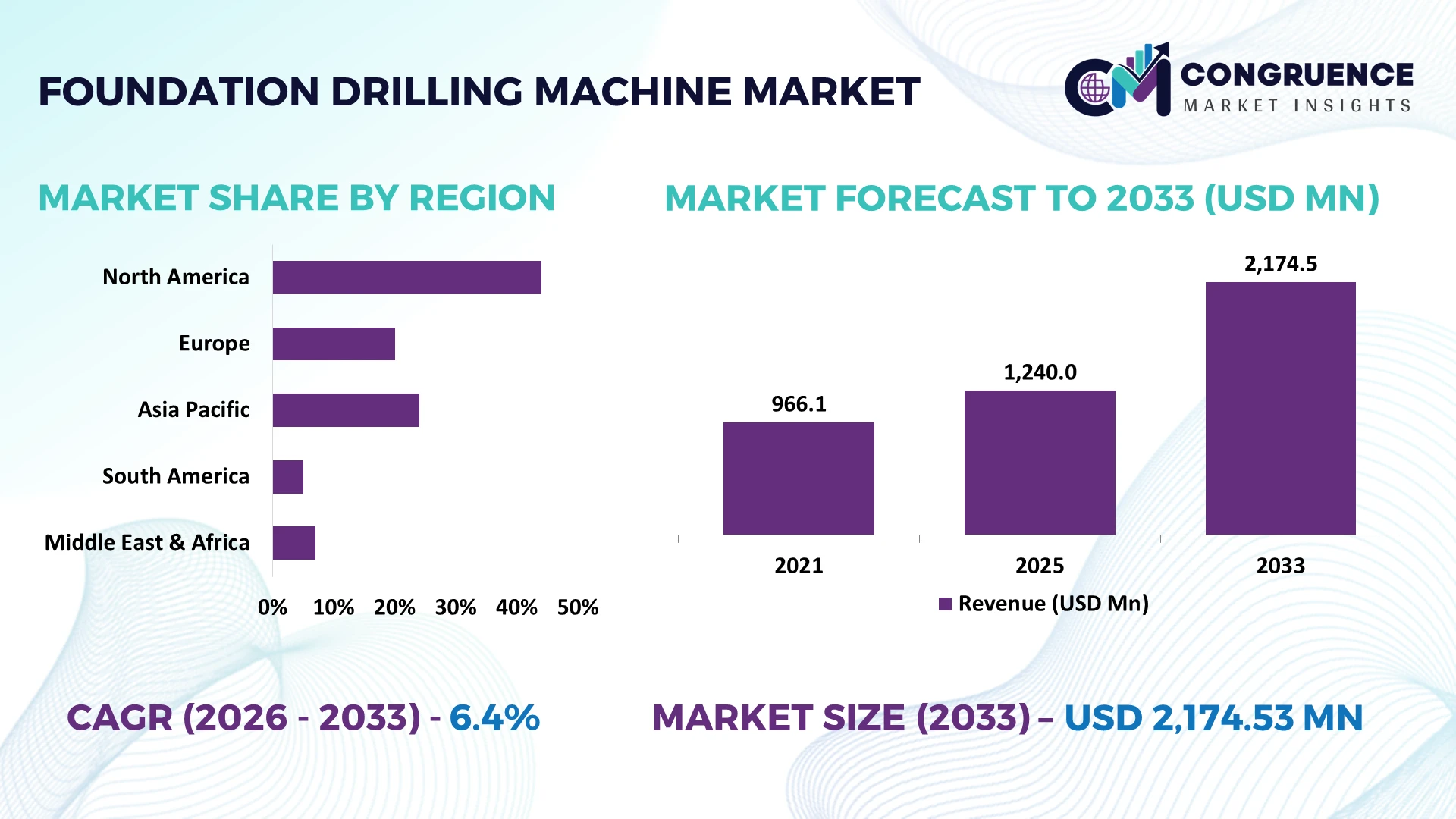
Asia-Pacific remains the dominant operating base, accounting for about 43.5% of the broader foundation drilling equipment market in 2025, supported by China, India, and Southeast Asia. India’s infrastructure allocation reached ₹12.2 trillion for FY2026–27, while construction-equipment exports increased 31.5% in FY2025–26. China benefits from large-scale Belt and Road infrastructure activity, while India is accelerating domestic manufacturing and equipment adoption.
Strategically, manufacturers should prioritize Asia-Pacific capacity, low-emission rigs, automated controls, and localized service networks to capture infrastructure-led equipment replacement and expansion cycles.
Market Size & Growth: USD 1,240 million in 2025 to USD 2,174.53 million by 2033 at 6.44% CAGR, supported by automated drilling and infrastructure modernization.
Top Growth Drivers: Infrastructure investment 31.5%, equipment mechanization 11.4%, digital adoption 10%.
Short-Term Forecast: By 2028, automated controls target drilling productivity gains of 5–8% through faster parameter adjustment and reduced idle time.
Emerging Technologies: AI-assisted drilling, IoT telematics, automated pile positioning, and hybrid-electric powertrains are reshaping high-performance rigs.
Regional Leaders: Asia-Pacific held 43.5% in 2025; Europe remains technology-intensive, while North America emphasizes high-capacity automated rigs and replacement demand.
Consumer/End-User Trends: Contractors account for approximately 58.3% of drilling and foundation equipment demand, reinforcing fleet ownership and uptime priorities.
Pilot/Case Example: In 2026 Indian infrastructure projects exceeding ₹3 billion, automated intelligent machine-aided construction is being deployed alongside digital surveying and monitoring systems.
Competitive Landscape: Bauer leads with approximately 14.2% share, followed by Liebherr, Soilmec, Casagrande, and XCMG, while regional manufacturers strengthen localized supply.
Regulatory & ESG Impact: Low-emission and lower-noise equipment is gaining priority as environmental compliance becomes a procurement criterion across major projects.
Investment & Funding: India’s FY2026–27 infrastructure allocation reached ₹12.2 trillion, strengthening equipment demand across roads, railways, urban infrastructure, energy, and logistics.
Innovation & Future Outlook: Next-generation rigs will combine AI, remote diagnostics, automated drilling control, hybrid power, and real-time quality tracking, shifting competition toward productivity and lifecycle economics.
The Foundation Drilling Machine Market is increasingly concentrated around transport infrastructure, high-rise construction, industrial facilities, energy projects, and complex deep-foundation work. Rotary drilling rigs represented 58.6% of the broader equipment market in 2025, reflecting their versatility across large-diameter piling applications. In 2026, automated controls, telematics, lower-emission hydraulics, and localized manufacturing are strengthening fleet economics as supply-chain resilience becomes a procurement priority. These shifts position technology-enabled equipment as the next strategic growth layer.
Foundation drilling machines are becoming strategically important as infrastructure developers prioritize faster foundation cycles, tighter construction tolerances, and equipment capable of operating across complex urban and industrial sites. India’s infrastructure capital expenditure is budgeted at ₹12.2 trillion for FY2026–27, while the national highway network has expanded about 60% since FY2014, strengthening demand for high-capacity piling and foundation equipment.
The market is shifting from conventional hydraulic equipment toward electronically controlled, telematics-enabled and hybrid systems. Hybrid drilling technology has demonstrated about 15.9% fuel-economy improvement in typical operating conditions, providing a measurable operating-cost advantage over conventional systems. India is emerging as a high-volume deployment market driven by highways, railways and metros, while Germany and other advanced European markets emphasize low-emission, precision-controlled equipment and electrification.
Over the next 2–3 years, adoption should increasingly track project execution rather than equipment availability, with contractors favoring machines that reduce idle time, fuel consumption and operator dependency. For example, large Indian rail and highway projects require repetitive deep-pile operations across multiple work fronts, encouraging contractors to expand fleets, use equipment-leasing models and form OEM service partnerships. The strategic winners will be manufacturers combining drilling performance with digital monitoring, energy efficiency and dependable field support, strengthening lifecycle economics and competitive positioning.
India’s highway network reached 146,572 km by December 2025, about 60% above FY2014 levels, while high-speed corridors expanded nearly tenfold to 5,364 km. This scale is increasing requirements for bored piles, diaphragm-wall foundations and high-torque drilling systems. Stricter project-quality requirements and automated machine-aided construction are also accelerating equipment modernization. Contractors responding to tighter schedules are prioritizing higher-capacity rigs, telematics and multi-shift utilization. The non-obvious advantage is asset productivity: a digitally monitored rig can support better maintenance scheduling and reduce avoidable idle hours, improving equipment utilization without proportionally expanding fleet size.
Foundation drilling demand remains exposed to infrastructure execution delays, equipment utilization volatility and imported component dependencies. India’s construction-equipment sales declined 2% in FY2026, while domestic demand fell 7%, highlighting how project timing can temporarily weaken fleet utilization even when underlying infrastructure pipelines remain substantial. Hydraulic systems, electronic controls and specialized drilling components can also increase procurement exposure when supply chains tighten. Companies are mitigating these pressures through localized manufacturing, longer-term component contracts and regional service inventories. The sharper operational issue is not equipment scarcity but utilization: underused high-capacity rigs can materially dilute returns, encouraging contractors to favor flexible leasing, shared fleets and equipment redeployment across projects.
Automation, electrification and predictive maintenance create opportunities to improve drilling economics beyond conventional capacity expansion. Hybrid drilling systems have demonstrated 15.9% fuel-economy improvement and 18.8% energy-saving efficiency under tested operating conditions. Electrified drilling platforms are also demonstrating the ability to maintain high torque while improving energy efficiency. Over the next several years, contractors in India, Germany and Japan can increasingly deploy sensor-rich rigs where drilling parameters, machine health and fuel consumption are monitored centrally. OEMs are positioning through R&D partnerships, digital service platforms and modular powertrain architectures. A particularly attractive opportunity is retrofit technology, allowing existing fleets to gain telematics and energy-management capabilities without full machine replacement.
Advanced foundation rigs increasingly combine hydraulic actuation, GNSS positioning, sensors, automation software and remote diagnostics, creating integration demands that conventional operators may not be prepared to manage. Construction automation research indicates potential productivity gains of 10–25% in drilling operations, alongside reductions in non-productive time of 20–50% under automated operating models. However, these gains depend on calibrated sensors, reliable connectivity and skilled technicians. In India, inconsistent site infrastructure and uneven digital capabilities can limit deployment consistency, while European projects face stricter emissions and data requirements. Manufacturers must therefore invest in operator training, cybersecurity, standardized interfaces and regional service networks. Competitive advantage will increasingly depend on delivering an integrated machine-and-service ecosystem rather than hardware alone.
Digital Fleet Monitoring Accelerates Foundation contractors are increasingly integrating telematics, GNSS positioning and remote diagnostics, with digital monitoring capable of cutting avoidable idle periods by 10–20% and improving maintenance scheduling. Indian contractors are shifting toward connected fleets as project controls become more data-driven, while OEMs are expanding service partnerships and predictive-maintenance platforms. The non-obvious shift is that utilization data is increasingly influencing replacement decisions as much as machine age.
Low-Emission Equipment Gains Ground Electrification and hybridization are moving from pilot deployments toward selected urban and infrastructure projects, with hybrid systems demonstrating roughly 15–19% energy or fuel-efficiency improvements in tested applications. Stricter emissions expectations and urban construction constraints are accelerating adoption in Germany and Japan. Manufacturers are responding with hybrid powertrains, energy-management controls and lower-noise configurations, improving operating economics where machines face long duty cycles.
Flexible Ownership Models Expand Equipment-as-a-Service and rental arrangements are gaining traction as contractors seek to limit capital exposure during uneven project cycles. India’s construction-equipment industry grew only 3% in FY2024–25, encouraging more selective fleet procurement, while exports increased 10%, supporting broader utilization strategies. OEMs and dealers are responding through rental partnerships, certified used equipment and service-linked contracts, shifting competition toward lifecycle availability rather than initial machine price.
Localized Manufacturing Strengthens Supply Component localization is becoming more important as manufacturers seek greater resilience against imported hydraulic, electronic and structural-component dependencies. India’s proposed ₹16,000-crore construction-equipment incentive framework reflects the push toward domestic production and reduced import exposure. Companies are expanding local sourcing and supplier partnerships, which can shorten lead times by several weeks and reduce inventory buffers. This creates a strategic advantage for OEMs able to localize critical assemblies without sacrificing drilling precision or reliability.
Rotary Drilling Rigs remain the leading type, estimated at approximately 55–60% of foundation drilling machine demand, supported by their ability to handle large-diameter bored piles, deep foundations and varied geological conditions. Their scalability and attachment flexibility make them the preferred platform for major infrastructure contractors, particularly in India, China and the United States. CFA Drilling Rigs hold a smaller but strategically important position, with demand concentrated in repetitive piling where rapid continuous-flight operations can improve cycle productivity by roughly 15–25% versus slower conventional sequences. Companies are therefore prioritizing automated auger controls and quick-change tooling.
Diaphragm Wall Machines serve specialized urban excavation and underground-structure projects, while Micro-Piling Rigs represent the fastest-growing niche, supported by constrained sites, retrofit foundations and limited-access construction. Micro-piling adoption can expand 10–15% faster than mature drilling categories where urban land availability restricts conventional rig deployment. Manufacturers are responding with compact platforms, remote controls and modular configurations. The investment priority is shifting from maximum machine size toward application-specific versatility, especially where transport, access and setup time determine project economics.
Deep Foundation Drilling is the leading application, estimated at approximately 40–45% of market demand, reflecting its critical role in high-rise buildings, bridges, metro systems and industrial structures requiring high load-bearing capacity. Piling follows as a major recurring application, while Ground Improvement remains more specialized and closely linked to weak-soil conditions. Infrastructure Construction is emerging as the fastest-expanding application, supported by highway, railway, airport and urban-transit development. In India, road-sector activity remains a major equipment-demand catalyst, with earthmoving machinery representing about 70% of construction-equipment sales volume.
Infrastructure Construction could increase its share by roughly 5–8 percentage points in active project portfolios where multi-site deployment and tighter completion schedules favor high-productivity rigs. Ground Improvement is gaining relevance where soil stabilization reduces foundation redesign and remediation requirements. Contractors are increasingly combining drilling, piling and ground-treatment workflows rather than treating them as isolated activities. OEMs are responding with multifunctional machines, digital drilling records and integrated attachments. The strategic implication is that application boundaries are becoming less rigid: suppliers able to support complete foundation workflows can capture more equipment utilization per project.
Infrastructure Contractors represent the dominant end-user group, estimated at approximately 45–50% of foundation drilling machine demand, because highway, metro, railway, bridge and industrial projects require repeated high-capacity foundation operations across multiple work fronts. Commercial Construction remains a substantial buyer, particularly for high-rise and mixed-use developments, while Residential Construction generally favors smaller, access-efficient machines. Mining and Marine Construction have narrower demand bases but require specialized configurations, reinforcing the importance of application engineering over standardized fleet deployment.
Mining is emerging as the fastest-growing end-user niche, with equipment demand supported by deeper excavation, resource-development projects and increased emphasis on mechanized operations. Indian coal production increased 6.11% to 726.29 million tonnes during April–December 2024 compared with the corresponding prior period, indicating stronger activity in a foundation-intensive industrial environment. Mining-related demand can therefore expand roughly 8–12% faster than mature commercial applications in selected project cycles. Manufacturers are responding with reinforced rigs, specialized tooling, service contracts and dealer networks. The competitive advantage is shifting toward customized uptime guarantees rather than lowest acquisition cost.
Asia-Pacific accounted for the largest market share at 44% in 2025 however, Middle East & Africa is expected to register the fastest growth, expanding at a CAGR of 7.8% between 2026 and 2033.
High-Precision Equipment Reshapes Fleet Deployment
North America accounted for approximately 22% of global foundation drilling machine demand in 2025, supported by transportation rehabilitation, commercial construction, data-center development, and energy infrastructure. The United States represents the primary deployment market, with contractors increasingly selecting high-torque rotary rigs, automated drilling controls, and telematics-enabled equipment. Large foundation projects increasingly require tighter drilling tolerances and higher equipment utilization across multiple work fronts. Digital fleet monitoring can reduce avoidable idle time by approximately 10–15%, strengthening the business case for connected equipment. Manufacturers are responding through regional service expansion, financing programs, attachment standardization, and predictive-maintenance capabilities. Canada adds specialized demand from mining and infrastructure projects. The key competitive shift is toward machines that combine drilling capacity, operator assistance, and measurable lifecycle productivity rather than simply maximizing installed power.
United States Market Outlook: The United States remains the most strategically important North American market because of its large transportation, commercial, industrial, and data-center construction pipeline. Contractors are increasingly prioritizing deep-foundation equipment capable of repetitive operation, rapid setup, and high drilling accuracy. OEMs are strengthening dealer networks, digital diagnostics, and aftermarket support to protect uptime on large multi-site projects.
Low-Emission Modernization Changes Equipment Selection
Europe accounted for approximately 18% of global foundation drilling machine demand in 2025, with Germany, Italy, France, and the United Kingdom representing major equipment and deployment centers. Equipment selection is increasingly influenced by urban construction constraints, emissions requirements, noise limitations, and machine precision. European construction-equipment sales increased 4.6% in 2025, indicating renewed investment activity across major equipment categories. Manufacturers are integrating energy-efficient hydraulic systems, operator-assistance functions, and remote diagnostics into foundation drilling platforms. Germany remains particularly important because of its machinery manufacturing base and engineering capabilities, while France and Italy contribute through infrastructure modernization and specialized equipment production. Contractors are increasingly evaluating lifecycle economics rather than acquisition price alone. This favors suppliers with established engineering capabilities, compliant equipment architectures, localized service networks, and strong component availability.
Germany Market Outlook: Germany combines advanced construction-equipment manufacturing with technically demanding infrastructure projects. Its equipment industry benefits from established engineering capabilities, specialized component suppliers, and strong contractor expertise. Foundation drilling demand is increasingly influenced by urban rail, underground construction, industrial facilities, and rehabilitation projects, encouraging manufacturers to prioritize low-emission operation, precision controls, compact configurations, and digital machine monitoring.
Manufacturing Scale Accelerates Equipment Localization
Asia-Pacific accounted for approximately 44% of global foundation drilling machine demand in 2025, making it the largest market through extensive infrastructure construction, dense urban development, and strong equipment manufacturing capacity. China and India represent the principal deployment centers, while Japan and South Korea contribute advanced automation and high-precision machinery. India’s construction-equipment industry recorded 140,191 unit sales in FY2024–25, while exports increased 10%, highlighting strengthening manufacturing and distribution capabilities. Equipment localization is reducing dependence on imported components and improving aftermarket responsiveness. Chinese manufacturers increasingly compete through production scale, pricing, and expanding export networks, whereas Japanese suppliers emphasize precision, reliability, and technology integration. Contractors are favoring versatile drilling platforms capable of serving highway, metro, bridge, industrial, and commercial projects. The strategic advantage increasingly lies in combining localized manufacturing with flexible attachments, rapid service response, and competitive lifecycle costs.
China Market Outlook: China is the region’s most influential manufacturing and deployment base, supported by extensive urban infrastructure, transportation networks, industrial development, and domestic equipment production. Local manufacturers increasingly combine high-volume production with competitive pricing and increasingly sophisticated electronic controls. Their expanding export capabilities are also strengthening competition in developing infrastructure markets.
Mining and Infrastructure Sustain Selective Demand
South America accounted for approximately 7% of global foundation drilling machine demand in 2025, with Brazil representing the dominant deployment market through transportation, mining, energy, industrial, and urban-development projects. Demand remains more project-dependent than in China or the United States, making utilization rates and local service coverage important purchasing considerations. Brazilian contractors increasingly deploy rotary drilling equipment across variable geological conditions, while mining and energy developments require specialized foundation configurations. Operators are also combining equipment rental, used-machine procurement, and OEM service contracts to control capital expenditure. Productivity improvements of approximately 10–15% can strengthen replacement economics for aging fleets. Manufacturers are responding through localized service partnerships, financing arrangements, and application-specific configurations. The principal strategic opportunity lies in improving equipment utilization across fragmented project cycles rather than simply increasing fleet size.
Brazil Market Outlook: Brazil has the strongest combination of infrastructure, mining, energy, and industrial foundation demand in South America. Contractors increasingly require adaptable drilling systems capable of operating across diverse geological conditions. Manufacturers are strengthening local dealerships, parts availability, financing options, and technical support to improve fleet uptime and reduce the operational risks associated with geographically dispersed projects.
Megaprojects Increase High-Capacity Equipment Demand
Middle East & Africa accounted for approximately 9% of global foundation drilling machine demand in 2025, with Saudi Arabia and the United Arab Emirates serving as major deployment centers. Large-scale urban development, tourism projects, transportation infrastructure, industrial diversification, and energy investment are increasing requirements for high-capacity rotary rigs and specialized piling equipment. Harsh climatic conditions are also increasing demand for reinforced components, improved cooling systems, and stronger field-service capabilities. Standardized drilling workflows combined with digital monitoring can improve equipment productivity by approximately 10–20% across multi-work-front projects. Manufacturers are responding through local dealer partnerships, regional spare-parts inventories, financing packages, and project-specific technical support. African markets remain more fragmented, with mining, energy, transport, and urban projects generating concentrated equipment demand. Competitive positioning therefore depends heavily on service availability and machine reliability in addition to technical specifications.
Saudi Arabia Market Outlook: Saudi Arabia represents the region’s strongest investment-led market, supported by large-scale urban, tourism, transportation, and industrial developments. Foundation contractors increasingly require equipment capable of sustained multi-shift operation under demanding environmental conditions. OEMs are therefore strengthening local service capabilities, spare-parts availability, technical training, and project-based equipment packages to improve uptime across major construction programs.
The Foundation Drilling Machine Market pits global specialists such as BAUER, Liebherr, Soilmec, and Casagrande against cost-focused Chinese manufacturers including SANY and XCMG, while regional players compete through service coverage and customization. The top five players collectively hold an estimated 45–50% market share, leaving meaningful space for regional challengers. Competition centers on drilling productivity, precision, lifecycle cost, component availability, and customization. Advanced equipment can deliver approximately 10–20% lower operating consumption, while digital diagnostics can reduce unplanned maintenance exposure by roughly 10–15%. Chinese manufacturers are leveraging scale and pricing to expand in emerging markets, while European and Japanese-linked suppliers emphasize automation, engineering, and aftermarket support. Vertical integration across equipment, tooling, electronics, and service networks is becoming increasingly important as supply-chain disruptions expose component dependencies. High engineering complexity, certification requirements, and established dealer networks remain significant entry barriers. Winning requires technology, uptime, localized support, and competitive lifecycle economics.
BAUER AG
Liebherr Group
Soilmec S.p.A.
Casagrande S.p.A.
SANY Heavy Industry Co., Ltd.
XCMG Group
Zoomlion Heavy Industry Science & Technology Co., Ltd.
Junttan Oy
Mait S.p.A.
ABI Maschinenfabrik und Vertriebsgesellschaft mbH
PVE Equipment
Comacchio S.p.A.
Connected drilling systems are becoming the current technology baseline, combining GNSS, machine sensors, drilling assistants, telematics, and automated data capture. Liebherr’s assistance systems provide Kelly visualization, ground-pressure monitoring and process-data integration, while automated CFA concreting reduces operator intervention. Compared with conventional manually controlled workflows, these systems can improve operational efficiency by roughly 5–10% and reduce avoidable process variation by 1–2%. Adoption is strongest among large infrastructure contractors operating multi-rig fleets. From 2026–2028, integration with fleet-management platforms will increasingly turn drilling data into maintenance, productivity, and bidding intelligence.
Electrification and hybrid powertrains represent the leading emerging transition. BAUER’s eBG 33 H combines electrified main consumers with battery operation, while Liebherr’s LB 25 unplugged provides battery-powered, zero-local-emission operation without sacrificing stated drilling performance. Compared with diesel-only configurations, advanced electric systems can reduce energy consumption by up to 20–30% in suitable duty cycles and cut local emissions by 1–2% of total project impact. Urban contractors and environmentally constrained projects benefit most, particularly where noise and emissions restrictions influence equipment selection.
Disruptive development is moving toward autonomous assistance, modular drives, and predictive control. Research-backed drilling automation can achieve accuracy levels exceeding 90% in selected data-driven applications, while intelligent control can improve drilling consistency by 5–10%. From 2026–2028, OEMs such as BAUER and Liebherr will gain competitive advantage by integrating automation, electrification, and digital services into unified platforms. Companies acting now can secure lower operating costs, higher machine utilization, and stronger differentiation.
January 2024 Liebherr launched the LRB 23 piling and drilling rig with a 600 kW engine, Kelly drilling capability, visualization, and automated CFA concreting. Its compact design enables one-piece transportation, improving mobilization efficiency and expanding multi-application deployment. Source: liebherr.com
June 2024 Liebherr reported that German contractor Kurt Motz ordered 7 new machines, including 6 drilling rigs and 1 LRB 23. Its fleet reached approximately 65 Liebherr machines, demonstrating substantial fleet expansion driven by service quality and digital solutions. Source: liebherr.com
April 2025 BAUER showcased the eBG 33 H all-electric drilling rig at bauma 2025, featuring electrified main consumers and battery operation designed for an entire workday. The shift strengthens zero-local-emission and low-noise deployment in constrained construction sites. Source: bauer.de
January 2026 Junttan launched the PM5 pile-driving rig within its Evolution Series, following the DR5 drilling rig introduced in 2025. The new platform emphasizes productivity, precision, and operator experience, strengthening Junttan’s technology position in advanced piling equipment. Source: junttan.com
The Foundation Drilling Machine Market Report covers Rotary Drilling Rigs, CFA Drilling Rigs, Diaphragm Wall Machines, and Micro-Piling Rigs across Deep Foundation Drilling, Piling, Ground Improvement, and Infrastructure Construction applications. End-user analysis includes Commercial Construction, Infrastructure Contractors, Residential Construction, Mining, and Marine Construction. The study evaluates deployment intensity, equipment specialization, automation adoption, fleet modernization, and application-specific purchasing patterns.
Geographic coverage spans North America, Europe, Asia-Pacific, South America, and Middle East & Africa, with country-level assessment of major deployment and manufacturing centers. Technology analysis includes automated drilling assistance, telematics, predictive maintenance, hybrid powertrains, electrification, modular equipment, and digital workflow integration. The report supports investment planning by identifying equipment priorities, technology adoption gaps, and emerging application pockets. It also helps manufacturers and contractors evaluate expansion, localization, partnerships, competitive positioning, and operational priorities through 2026–2033.
| Report Attribute/Metric | Report Details |
|---|---|
Market Revenue in 2025 | USD 1240 Million |
Market Revenue in 2033 | USD 2174.53 Million |
CAGR (2026 - 2033) | 6.44% |
Base Year | 2025 |
Forecast Period | 2026 - 2033 |
Historic Period | 2021 - 2025 |
Segments Covered | By Type
By Application
By End-User
|
Key Report Deliverable | Revenue Forecast, Growth Trends, Market Dynamics, Segmental Overview, Regional and Country-wise Analysis, Competition Landscape |
Region Covered | North America, Europe, Asia-Pacific, South America, Middle East, Africa |
Key Players Analyzed | BAUER AG, Liebherr Group, Soilmec S.p.A., Casagrande S.p.A., SANY Heavy Industry Co., Ltd., XCMG Group, Zoomlion Heavy Industry Science & Technology Co., Ltd., Junttan Oy, Mait S.p.A., ABI Maschinenfabrik und Vertriebsgesellschaft mbH, PVE Equipment, Comacchio S.p.A. |
Customization & Pricing | Available on Request (10% Customization is Free) |




