
Reports
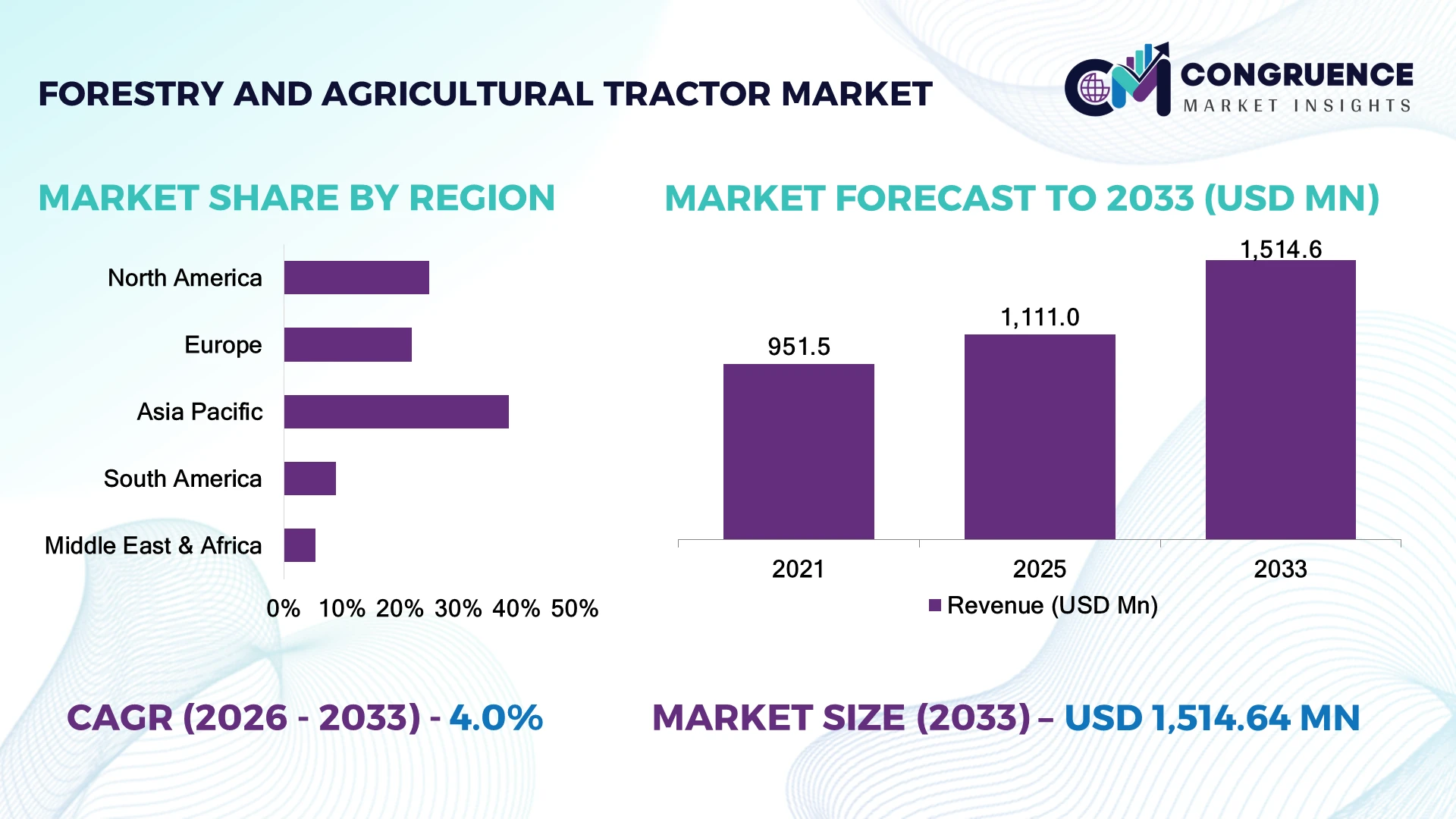
The Global Forestry and Agricultural Tractor Market was valued at USD 1,111.0 Million in 2025 and is anticipated to reach a value of USD 1,514.6 Million by 2033 expanding at a CAGR of 3.95% between 2026 and 2033. Growth is driven by precision agriculture, autonomous field operations, labor shortages, and government-backed farm mechanization programs that accelerate replacement of conventional tractors with connected, high-efficiency equipment.
India represents a dominant adoption hub, with overall agricultural mechanization at about 45% and annual tractor sales exceeding 1.2 million units, while government programs provide 40–50% machinery assistance for eligible farmers. China and Brazil operate at higher mechanization intensity, generally above 60%, creating a measurable technology-adoption gap. EU Farm to Fork policies are also accelerating cleaner machinery investment.
Strategically, manufacturers with localized production, connected platforms, and affordable automation are best positioned to capture the next equipment-replacement cycle.
Market Size & Growth: USD 1,111.0 Million in 2025 is projected to reach USD 1,514.6 Million by 2033 at a 3.95% CAGR, supported by precision farming and autonomous machinery.
Top Growth Drivers: Mechanization programs contribute 40–50% of eligible equipment costs; precision automation improves productivity by up to 20%; labor shortages intensify technology adoption.
Short-Term Forecast: By 2028, connected and automated tractor deployment is positioned to improve field productivity by 10–20% while reducing energy consumption by about 10%.
Emerging Technologies: AI-based perception, GPS/RTK guidance, autonomous tillage, electric drivetrains, ISOBUS connectivity, and predictive maintenance are reshaping advanced tractor platforms.
Regional Leaders: Asia Pacific is projected near USD 578.6 Million by 2033, North America near USD 368.0 Million, and Europe near USD 401.4 Million, with automation strongest in developed fleets.
Consumer/End-User Trends: India’s overall farm mechanization is approximately 45%, while more than 63% of farmers increasingly rely on rented machinery, strengthening custom-hiring models.
Pilot/Case Example: India’s mechanization program supported 21.61 lakh machines through 2025–26 and conducted 40,928 drone demonstrations, expanding precision-equipment access beyond conventional tractor ownership.
Competitive Landscape: Deere, New Holland, Kubota, Mahindra, and CNH Industrial lead a fragmented global field, with the leading manufacturers competing through automation, dealer reach, financing, and localized products.
Regulatory & ESG Impact: Mechanization incentives covering 40–50% of eligible machinery costs are accelerating cleaner and precision-enabled equipment, while electric platforms target up to 100% operational CO₂ reduction.
Investment & Funding: India committed ₹9,404.47 crore to mechanization programs through 2025–26, supporting equipment distribution, custom-hiring infrastructure, high-tech hubs, and precision-agriculture deployment.
Innovation & Future Outlook: Next-generation tractors will combine AI, autonomy, electrification, remote diagnostics, and digital farm-management systems, shifting competition from horsepower toward measurable productivity and lifecycle efficiency.
The Forestry and Agricultural Tractor Market is increasingly shaped by precision implements, compact multifunctional platforms, autonomous guidance, and electric powertrains. Demand is particularly strong where labor availability and operating costs pressure farm economics; India’s 45% mechanization level leaves substantial room for equipment upgrading. Supply-chain localization and stricter environmental requirements are pushing manufacturers toward modular, connected platforms, creating a transition from equipment sales toward technology-enabled productivity solutions.
Forestry and agricultural tractors are becoming strategic assets because equipment productivity increasingly determines how efficiently farms and forestry operators manage labor, fuel, land, and narrow operating windows. The shift from conventional mechanical equipment toward connected and autonomous fleets is changing purchasing criteria from horsepower and durability alone to automation capability, data integration, and lifecycle economics.
Technology adoption is already producing measurable operational advantages. Field research indicates that automated systems can reduce energy costs by about 10% and time consumption by roughly 13% compared with manual operating scenarios. Electric tractor assessments also show operating-cost reductions of more than 30% in selected applications. India remains a scale-driven market, while Germany, France, and the United States emphasize precision upgrades and high-horsepower replacement cycles.
Over the next 2–3 years, manufacturers are expected to prioritize retrofit autonomy, remote diagnostics, AI-based guidance, and shared-equipment models. India’s custom-hiring infrastructure provides a practical deployment route for smaller farms, while European manufacturers are integrating sustainability requirements into product development. Companies combining localized service networks with interoperable digital ecosystems will secure stronger competitive positioning and recurring technology revenue opportunities.
Precision mechanization is becoming the strongest structural driver as labor constraints and uneven farm productivity push operators toward automated equipment. India’s overall mechanization level remains around 45%, while seed-bed preparation reaches approximately 70%, exposing substantial gaps in sowing, weeding, and harvesting operations. Automated tractor systems can deliver productivity gains of up to 20% in selected field applications. The European Farm to Fork transition is reinforcing demand for resource-efficient machinery. Manufacturers are responding with AI-enabled guidance, autonomous tillage, connected implements, and retrofit kits. The non-obvious advantage is higher machine utilization: automation extends operating windows beyond conventional labor availability, allowing fleets to complete time-sensitive work without proportionally increasing workforce requirements.
High acquisition and lifecycle costs remain a structural restraint, particularly for small farms where tractor utilization is uneven. Individual machinery ownership can require substantial capital, while advanced automation increases equipment complexity and service requirements. India’s 40–50% machinery assistance reduces the upfront burden for eligible users, but affordability remains a constraint outside subsidized channels. Interoperability also creates operational friction, with cross-brand implement compatibility failures reported at approximately 38% in European testing environments. Manufacturers are mitigating these pressures through localized assembly, financing programs, modular technology upgrades, and custom-hiring partnerships. The key operational issue is utilization: shared fleets can improve asset economics, but manufacturers must build stronger dealer servicing and parts availability to prevent downtime from eroding the benefits of higher equipment productivity.
Connected tractors create an opportunity to monetize productivity rather than equipment horsepower alone. Automation systems can reduce energy costs by about 10% and operating time by roughly 13% in optimized agricultural workflows, strengthening the business case for digital upgrades. India’s custom-hiring model is particularly attractive because more than 63% of farmers rely on rented machinery, creating a scalable route for advanced equipment access without individual ownership. AI-based fleet monitoring, predictive maintenance, RTK guidance, autonomous implements, and electric drivetrains are emerging as high-value additions. Manufacturers are positioning through software partnerships, dealer-led retrofits, and integrated farm-management platforms. A strategic opportunity lies in selling modular autonomy to existing tractor fleets, enabling customers to upgrade productivity without replacing entire machines.
Scaling autonomous tractors requires reliable connectivity, standardized implements, operator training, and infrastructure capable of supporting machine-to-machine coordination. European testing has identified interoperability problems affecting about 38% of supposedly ISOBUS-ready implements, demonstrating the difficulty of integrating mixed-brand fleets. Workforce capability is another pressure point as technicians must manage AI perception systems, sensors, telematics, and high-voltage electric components alongside conventional powertrains. Connectivity-dependent autonomous systems also face inconsistent rural network coverage, particularly across fragmented agricultural holdings. Manufacturers must therefore invest in open interfaces, technician training, edge-processing capabilities, and regional service infrastructure. The strategic challenge is not simply achieving autonomous operation; it is delivering consistent performance across varying terrain, implements, weather conditions, and farm-management systems without creating unacceptable downtime or maintenance complexity.
Autonomous Fleet Integration Accelerates: AI guidance, RTK navigation, telematics, and autonomous implement control are moving from pilot programs toward commercial fleets, with precision systems delivering 10–20% productivity gains and reducing overlapping field passes by roughly 5–15%. Labor shortages are accelerating adoption in the United States and Germany, while manufacturers are expanding software partnerships and retrofit automation.
Compact Machinery Gains Ground: Compact and multifunctional tractors are gaining traction as fragmented farms and specialty-crop operations prioritize lower ownership costs and maneuverability. More than 35% of farmers in developing markets are shifting toward compact equipment, while sub-40 HP models represent about 31% of global demand. Manufacturers are increasing localized production and financing options for India and Southeast Asia.
Low-Emission Powertrains Expand: Hybrid-electric and alternative-fuel tractors are progressing beyond demonstrations as emissions regulations tighten and fuel costs pressure fleet economics. Electric drivetrains can eliminate direct operating emissions and reduce energy expenditure by approximately 20–30% in suitable duty cycles. European manufacturers are prioritizing battery-electric prototypes, biomethane systems, and modular powertrains to meet increasingly stringent equipment standards.
Digital Service Models Reshape Ownership: Telematics, predictive maintenance, remote diagnostics, and machinery-sharing platforms are changing tractor utilization, particularly where equipment ownership remains capital-intensive. Rental and custom-hiring models already influence more than 60% of machinery access among some smallholder groups in India. OEMs are responding by combining connected-service subscriptions, dealer networks, financing, and fleet-management partnerships rather than relying exclusively on conventional equipment sales.
Agricultural Tractors, Forestry Tractors & Skidders, Combined Utility Tractors, and Specialty Orchard & Vineyard Tractors define the principal type landscape. Agricultural Tractors lead with an estimated 68–73% share because their broad compatibility with tillage, planting, spraying, hauling, and harvesting implements supports year-round utilization. Forestry Tractors & Skidders retain a specialized position of roughly 15–20%, particularly across timber-intensive operations in the United States, Canada, Sweden, and Finland. Combined Utility Tractors are gaining relevance where operators require one platform for agricultural and light-duty applications.
Specialty Orchard & Vineyard Tractors represent the fastest-changing niche, with adoption rising around 7–9% annually in high-value horticulture because narrow-track dimensions and low-profile configurations improve maneuverability. Manufacturers are responding with electro-hydraulic controls, telematics, automated steering, and specialized attachments. The strategic implication is clear: mainstream manufacturers are protecting volume through utility platforms while directing incremental R&D toward compact specialty configurations and higher-value forestry equipment.
Plowing & Tillage, Planting & Seeding, Harvesting Operations, Hauling, Landscaping, and Other applications form the principal demand base. Plowing & Tillage remains the leading application at approximately 35–40% of utilization because it represents a recurring requirement across cereal, oilseed, sugarcane, and mixed-farming systems. Planting & Seeding follows as mechanized precision placement expands, while Harvesting Operations are becoming increasingly technology-intensive as operators seek faster turnaround during narrow seasonal windows.
Planting & Seeding is the fastest-growing application, with adoption advancing roughly 7–9% annually as GPS-guided implements, variable-rate systems, and automated depth control become more accessible. Hauling and Landscaping remain important secondary applications, particularly for multipurpose tractors, while specialized forestry operations create additional demand for high-traction configurations. Companies are integrating implement communication, automated steering, and hydraulic controls to increase machine utilization.
Large Scale Farms, Small Scale Farms, Forestry Services, Government Bodies, and Other users represent the principal buyer groups. Large Scale Farms lead with an estimated 35–40% share because extensive landholdings justify high-horsepower tractors, precision implements, fleet telematics, and specialized attachments. Small Scale Farms remain highly significant at approximately 30–35%, particularly in India, China, and Southeast Asia, where affordability and financing determine equipment access. Forestry Services maintain a specialized demand base tied to timber extraction and land-management activity.
Commercial-scale operations and Forestry Services represent the fastest-shifting buyers, with technology-enabled equipment adoption increasing roughly 8–10% as operators prioritize machine utilization, labor substitution, and predictive maintenance. Government Bodies also influence purchasing through mechanization subsidies and institutional fleets. Manufacturers are responding with tiered pricing, leasing, custom-hiring partnerships, localized assembly, and simplified digital platforms. The non-obvious competitive advantage is fleet utilization rather than ownership volume: shared equipment models allow smaller operators to access higher-specification machinery while giving manufacturers a larger installed base for connected services.
Asia-Pacific accounted for the largest market share at 38.6% in 2025 however, Middle East & Africa is expected to register the fastest growth, expanding at a CAGR of 5.8% between 2026 and 2033.
North America represents approximately 25.0% of global agricultural tractor activity, supported by large commercial farms, high machinery utilization, and extensive dealer-service infrastructure. The United States remains the principal market, although 2025 registrations declined 9.9% to 195,857 units, the lowest level in a decade. This contraction is pushing manufacturers toward higher-value replacement rather than volume-led expansion, with precision guidance, telematics, autonomous functions, and high-horsepower configurations receiving greater investment. The region’s large-scale farming structure favors equipment capable of covering substantial acreage with fewer operating passes. Supply-chain restructuring and tighter farm margins are also encouraging OEMs to localize parts inventories and strengthen financing programs.
United States Market Outlook: The United States remains the region’s technology and manufacturing anchor, with 195,857 tractor registrations in 2025 despite a 9.9% annual decline. Large-scale grain, cotton, and specialty-crop operations continue to support high-horsepower equipment, while autonomous guidance, remote diagnostics, and precision implements increasingly determine replacement decisions. Manufacturers are prioritizing connected fleets and dealer-based service ecosystems to protect margins during softer unit demand.
Europe represents roughly 22.0% of the global large and medium tractor market, with Germany, France, Italy, Spain, and the United Kingdom forming major equipment centers. The market is undergoing a replacement-cycle reset: European agricultural tractor registrations reached only 144,400 units in 2024, down 8.1% year over year and 20% below the 2021 peak. At the same time, 82% of registered agricultural tractors were above 50 hp, reinforcing demand for productive, digitally integrated equipment rather than basic entry-level platforms. Environmental requirements are accelerating interest in lower-emission drivetrains, precision application, and fuel-efficient power management. Manufacturers are responding through connected implements, electric and alternative-fuel prototypes, and upgraded engine platforms.
Germany Market Outlook: Germany remains one of Europe’s most important manufacturing and technology hubs for agricultural machinery, with sophisticated dealer networks and strong engineering capabilities. Tractor registrations reached 25,711 units in 2025, down 12.2% from 2024, creating pressure for manufacturers to differentiate through automation, precision control, and lifecycle efficiency rather than unit expansion alone. German OEMs are also well positioned to commercialize low-emission and autonomous tractor technologies.
Asia-Pacific held approximately 38.6% of the agricultural tractor market in 2025, making it the dominant demand center. India and China account for the region’s largest operating base, while Japan and South Korea contribute advanced compact and precision-oriented equipment. India’s tractor industry reached 1,090,281 domestic sales in 2025, increasing 19.8% and establishing a record annual volume. China, by contrast, recorded approximately 400,000 agricultural tractor registrations, down 11.1%, illustrating the region’s sharply differentiated replacement cycles. Manufacturers are expanding localized production, financing, compact tractor portfolios, and connected equipment to address fragmented farms and rapidly mechanizing agricultural enterprises.
India Market Outlook: India is the region’s most strategically significant tractor market, combining high production scale with expanding mechanization across small and medium-sized farms. Total 2025 production reached approximately 1.15 million units, while exports exceeded 105,000 units. The market’s scale is encouraging manufacturers to deepen domestic component sourcing, expand dealer networks, and introduce higher-technology tractors without losing affordability.
South America represents approximately 9.0% of global tractor demand, with Brazil accounting for the overwhelming majority of regional activity. The market is closely linked to soybean, corn, sugarcane, livestock, and forestry operations, where high-horsepower tractors and mechanized field systems support extensive acreage. Brazil recorded approximately 42,300 tractor sales in 2025, a 3.4% decline, showing that financing conditions and farm profitability remain important purchasing constraints. At the same time, replacement demand is increasingly concentrated around precision guidance, four-wheel drive, and equipment capable of operating across large farms. Manufacturers are strengthening local dealer networks, financing packages, and agricultural partnerships while emphasizing fuel efficiency and machine uptime.
Brazil Market Outlook: Brazil remains South America’s critical production and deployment hub because of its extensive commercial farming base and globally important soybean, corn, sugarcane, and forestry industries. Tractor sales of approximately 42,300 units in 2025 remained close to the country’s historical operating range despite a third consecutive annual decline. Manufacturers are therefore emphasizing precision agriculture, financing flexibility, and high-utilization equipment rather than relying solely on volume expansion.
Middle East & Africa represents roughly 5.4% of the global tractor market but offers a structurally important mechanization opportunity as commercial agriculture expands and governments strengthen equipment-access programs. South Africa, Saudi Arabia, Turkey-linked supply chains, Egypt, and Morocco remain important deployment centers, with demand concentrated in irrigation-intensive farming, grain production, horticulture, landscaping, and public-sector land management. Equipment purchasing remains highly sensitive to financing and service availability, making durable, easily maintained tractors particularly competitive. Manufacturers are responding through distributor partnerships, localized assembly initiatives, leasing structures, and compact tractor portfolios. The region’s opportunity is increasingly tied to mechanization intensity rather than simple replacement, with organized agricultural projects creating demand for higher-utilization equipment and integrated implements.
South Africa Market Outlook: South Africa provides the region’s strongest combination of commercial farming scale, established agricultural machinery distribution, and mechanized field operations. Large grain, sugarcane, fruit, and forestry enterprises create demand for durable tractors with high traction and reliable service support. Manufacturers are emphasizing dealer coverage, precision guidance, and financing solutions to improve equipment accessibility, while commercial farms increasingly prioritize machinery utilization and fuel efficiency when replacing aging fleets.
The market pits John Deere, CNH Industrial, AGCO, Kubota, and Mahindra against regional OEMs and autonomy suppliers. Global leaders compete through premium technology, dealer reach, integrated platforms, while regional manufacturers compete on affordability, localization, and service. The top five players collectively command an estimated 40–45% of global tractor sales, the remainder fragmented. Competition centers on technology, price, supply chain, customization, and deployment speed. Precision and connectivity can improve field efficiency by 5–15%, while localized manufacturing can lower delivered equipment costs by roughly 5–10%. Autonomous retrofits and modular systems are reducing adoption barriers across existing fleets. Players are expanding production, strengthening dealer networks, acquiring technology capabilities, and partnering with autonomy specialists. The competitive shift is moving from horsepower-led differentiation toward software-enabled productivity, interoperability, and lifecycle services. Capital requirements, certification, dealer coverage, and integration remain entry barriers. Winning requires scalable platforms, localized economics, reliable service, and measurable productivity gains.
John Deere
CNH Industrial N.V.
AGCO Corporation
Kubota Corporation
Mahindra & Mahindra Ltd.
CLAAS KGaA GmbH
SDF Group
Yanmar Holdings Co., Ltd.
TAFE – Tractors and Farm Equipment Limited
Argo Tractors S.p.A.
LS Mtron Ltd.
Zetor Tractors a.s.
AI-enabled autonomy is moving from assisted steering toward decision capability. John Deere’s second-generation autonomy combines computer vision, AI and cameras, while Kubota’s autonomous platforms integrate sensing and automated implement changes. Precision guidance and variable-rate control typically improve field efficiency by 5–15%, while reducing overlap and operator workload. By 2028, mixed-fleet automation will increasingly become a baseline competitive differentiator across large fleets.
Electrification is advancing alongside conventional diesel optimization. Battery-electric tractors eliminate direct tailpipe emissions and can reduce energy costs by roughly 20–30% in suitable short-cycle operations, while modern continuously variable transmissions and optimized drivetrains improve fuel efficiency by around 5–10%. AGCO expanded availability of its fully electric Fendt e100 Vario in 2025, while Kubota demonstrated hydrogen fuel-cell technology. These platforms benefit specialty crops, municipal work and other predictable duty cycles first.
Connectivity is becoming the layer linking tractors, implements, farms and service networks. Satellite-enabled telematics, digital twins, predictive diagnostics and mixed-fleet platforms can reduce unplanned downtime by approximately 10–20% when maintenance decisions become data-driven. John Deere, AGCO, CNH and Kubota are integrating software with hardware and partnerships. From 2026–2028, OEMs that combine retrofit compatibility, autonomous capability and service ecosystems will gain the strongest competitive advantage.
January 2025 John Deere revealed second-generation autonomous machines using AI, computer vision and cameras at CES 2025. The technology targets labor shortages and autonomous field operations, strengthening Deere’s technology-led differentiation and accelerating software-enabled equipment adoption across commercial agriculture operations today. Source: deere.com
June 2025 Kubota expanded collaboration with Agtonomy on specialty-crop automation, integrating tractor sensors, AI cameras and data platforms. The partnership targets California, Oregon and Washington growers, supporting commercialization and reducing labor requirements while strengthening Kubota’s automated agriculture position in crops. Source: kubota.com
August 2025 Mahindra reported 26,201 domestic tractor sales in India, up 28% year on year, while exports reached 1,916 units, up 37%. The volume increase reinforces manufacturing scale and strengthens competitive reach across India markets and destinations. Source: mahindra.com
September 2025 Kubota unveiled an autonomous hydrogen fuel-cell tractor concept at Expo 2025 Osaka, delivering 100-horsepower-equivalent output with remote-operation capability. The demonstration expands alternative-power capabilities and positions hydrogen for longer-duration agricultural applications where battery capacity remains constrained for duty cycles. Source: kubota.com
The report evaluates the Forestry and Agricultural Tractor Market across Agricultural Tractors, Forestry Tractors & Skidders, Combined Utility Tractors, and Specialty Orchard & Vineyard Tractors. Application coverage spans Plowing & Tillage, Planting & Seeding, Harvesting Operations, Hauling, Landscaping, and Other uses, while end-user analysis covers Large Scale Farms, Small Scale Farms, Forestry Services, Government Bodies, and Other users. The study distinguishes mainstream equipment from specialized and emerging configurations.
Geographic coverage includes North America, Europe, Asia-Pacific, South America, and Middle East & Africa, with country-level assessment of manufacturing, mechanization, fleet replacement, and deployment intensity. Technology coverage includes precision guidance, telematics, AI-enabled autonomy, electric and alternative-fuel powertrains, predictive maintenance, and connected implements. The analysis supports investment planning, market-entry decisions, product localization, partnership development, capacity expansion, competitive positioning, and technology prioritization through 2026–2033.
| Report Attribute / Metric Details | Details |
|---|---|
| Market Revenue (2025) | USD 1,111.0 Million |
| Market Revenue (2033) | USD 1,514.6 Million |
| CAGR (2026–2033) | 3.95% |
| Base Year | 2025 |
| Forecast Period | 2026–2033 |
| Historic Period | 2021–2025 |
| Segments Covered |
By Type
By Application
By End-User
|
| Key Deliverables | Revenue Forecast; Market Trends; Growth Drivers & Restraints; Technology Insights; Segmentation Analysis; Regional Insights; Competitive Landscape; Regulatory & ESG Overview; Recent Developments |
| Regions Covered | North America; Europe; Asia-Pacific; South America; Middle East & Africa |
| Companies Profiled | John Deere; CNH Industrial N.V.; AGCO Corporation; Kubota Corporation; Mahindra & Mahindra Ltd.; CLAAS KGaA GmbH; SDF Group; Yanmar Holdings Co., Ltd.; TAFE – Tractors and Farm Equipment Limited; Argo Tractors S.p.A.; LS Mtron Ltd.; Zetor Tractors a.s. |
| Customization & Pricing | Available on Request (10% Customization Free) |




