
Reports
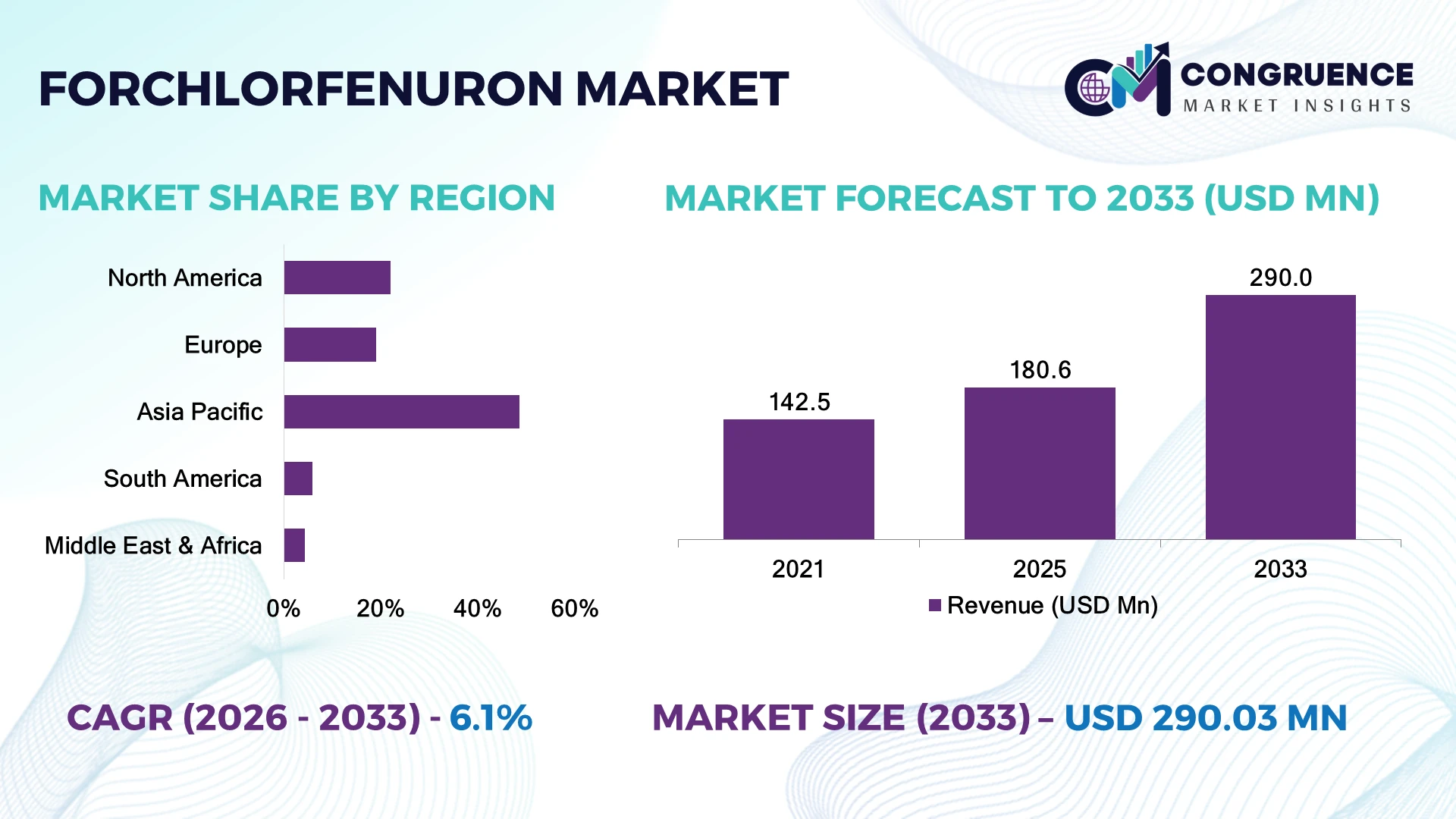
The Global Forchlorfenuron Market was valued at USD 180.6 Million in 2025 and is anticipated to reach a value of USD 290.0 Million by 2033 expanding at a CAGR of 6.1% between 2026 and 2033. Growth is driven by increasing adoption of plant growth regulators in high-value horticulture, precision fruit cultivation, and export-oriented agriculture focused on improving fruit size, yield uniformity, and marketable quality.
China dominates the Forchlorfenuron market with approximately 43% of global production capacity, supported by large-scale agrochemical manufacturing and intensive kiwi, grape, and melon cultivation. Production capacity is nearly 2.7 times higher than Japan, while precision application practices improve commercial fruit yield by approximately 18%. Ongoing agricultural supply-chain diversification following global trade realignments in 2026 is encouraging localized agrochemical production and advanced crop management investments.
Companies expanding formulation capabilities, regulatory compliance, and precision agriculture partnerships will secure stronger positions across premium horticultural markets.
Market Size & Growth: USD 180.6 million in 2025 reaching USD 290.0 million by 2033 at 6.1% CAGR, driven by precision horticulture and premium fruit production.
Top Growth Drivers: Export horticulture (+26%), fruit quality enhancement (+21%), precision farming (+18%).
Short-Term Forecast: By 2028, precision application improves fruit uniformity by 16% while reducing chemical wastage by 11%.
Emerging Technologies: Drone spraying, AI crop monitoring, and precision dosing improve application efficiency.
Regional Leaders: Asia-Pacific (~USD 135 million), Europe (~USD 52 million), North America (~USD 39 million), supported by commercial fruit cultivation.
Consumer/End-User Trends: Around 64% of demand comes from grapes, kiwifruit, and melon cultivation.
Pilot/Case Example: A 2026 precision orchard program improved marketable fruit output by approximately 14%.
Competitive Landscape: Top five manufacturers control nearly 55% of global supply, led by major agrochemical producers.
Regulatory & ESG Impact: Precision application technologies reduce active ingredient use by approximately 12% while improving compliance.
Investment & Funding: More than USD 480 million supports formulation upgrades, contract manufacturing, and precision agriculture expansion.
Innovation & Future Outlook: Controlled-release formulations and digital crop management strengthen high-value fruit production.
The Forchlorfenuron market is advancing through greater integration with precision horticulture, export-oriented fruit production, and digital farm management. Controlled-dose formulations now represent approximately 34% of premium product demand, while stricter residue management and resilient agricultural supply chains are reshaping procurement strategies. These developments reinforce the market's transition toward higher-value crop management solutions and set the stage for broader strategic evolution.
The Forchlorfenuron market is becoming strategically important as commercial fruit producers increasingly prioritize yield consistency, premium fruit quality, and export compliance. Regulatory oversight on crop inputs and growing adoption of precision agriculture are reshaping purchasing decisions, encouraging growers to adopt scientifically managed plant growth regulator programs instead of conventional broad-application practices. Supply-chain localization is also strengthening regional formulation and distribution capabilities.
Precision spraying technologies improve application accuracy by approximately 23% and reduce chemical losses by nearly 17% compared with conventional manual spraying methods. China leads commercial deployment through extensive horticultural production and integrated agrochemical manufacturing, while Italy focuses on high-value vineyards and premium fruit cultivation supported by precision farming technologies. Over the next two to three years, digital crop monitoring and variable-rate application are expected to become standard across export-oriented orchards.
Growers are increasingly integrating Forchlorfenuron with crop monitoring platforms and optimized nutrition programs to maximize fruit development while meeting residue standards. Agrochemical companies are investing in advanced formulations, expanding regional distribution partnerships, and strengthening technical advisory services for commercial growers. Companies delivering application-specific solutions, regulatory compliance, and precision agronomy support will establish stronger competitive positioning in the evolving global Forchlorfenuron market.
Growing adoption of precision horticulture and export-oriented fruit cultivation is accelerating demand for Forchlorfenuron across high-value crops. Approximately 62% of commercial kiwifruit and premium grape producers now integrate plant growth regulators into crop management programs, while optimized application improves marketable fruit size by nearly 18% and increases yield uniformity by around 14%. China continues expanding precision orchard management through digital agriculture initiatives, encouraging wider use of scientifically controlled plant growth regulators. Improved fruit quality strengthens export competitiveness and farm profitability, prompting agrochemical manufacturers to expand formulation capacity, invest in precision application technologies, and collaborate with agronomy service providers. A strategic advantage increasingly belongs to companies offering crop-specific formulations supported by technical advisory services and precision farming integration.
Stringent maximum residue limits, varying product registration requirements, and complex approval procedures continue restricting wider commercialization of Forchlorfenuron. Compliance testing and regulatory documentation account for approximately 15% of product commercialization costs, while country-specific registration timelines can extend market entry by nearly 20%. The European Union maintains strict residue compliance standards for imported fruit, increasing operational pressure on exporters and agrochemical suppliers. These regulatory differences limit portfolio expansion and complicate international distribution strategies. Companies are reducing risk through localized registrations, residue management programs, farmer education initiatives, and development of application protocols that improve compliance while maintaining crop performance across regulated export markets.
Integration of Forchlorfenuron with digital agronomy platforms, drone spraying, and AI-based crop monitoring is creating measurable value for commercial fruit producers. Precision application technologies reduce chemical consumption by approximately 16% while improving treatment accuracy by nearly 22%. Australia is accelerating adoption of digital orchard management systems that combine weather forecasting, crop analytics, and variable-rate application technologies. Agrochemical companies are investing in precision formulation research, expanding partnerships with agricultural technology providers, and developing integrated crop management solutions. A non-obvious opportunity lies in combining plant growth regulators with predictive orchard analytics, enabling growers to optimize harvest timing, improve fruit grading consistency, and reduce input costs without increasing application frequency.
Maintaining consistent performance across different fruit varieties, climatic conditions, and cultivation practices remains a significant execution challenge. Approximately 24% of commercial orchards require crop-specific dosage adjustments, while inappropriate application timing can reduce treatment effectiveness by nearly 17%. India's diversified horticultural production creates operational complexity because growing conditions differ substantially across cultivation zones. Manufacturers must invest in localized agronomic trials, precision application guidance, and technical training programs to ensure repeatable field performance. Long-term competitiveness depends on delivering application-specific recommendations supported by digital advisory tools that improve consistency while minimizing operational variability across commercial orchards.
Precision Spraying Expands Rapidly: Commercial orchards are increasingly deploying drone-assisted and sensor-guided spraying, improving application precision by approximately 21% while reducing chemical wastage by nearly 15%. Labor shortages and precision farming initiatives are encouraging agrochemical suppliers to strengthen partnerships with agricultural technology providers and expand digital application support.
Controlled Formulations Gain Momentum: Controlled-release and crop-specific formulations now account for approximately 36% of premium product demand, extending field effectiveness and improving fruit size consistency by nearly 18%. Growers are shifting procurement priorities toward performance-based products, prompting manufacturers to optimize formulation technologies and diversify specialized product portfolios.
Digital Orchard Management Grows: AI-supported crop monitoring platforms improve treatment scheduling by approximately 20% while reducing unnecessary field applications by nearly 13%. A non-obvious shift is the growing integration of plant growth regulators with predictive harvest planning, enabling commercial producers to improve export-grade fruit consistency and supply-chain planning simultaneously.
Localized Production Strengthens Supply: Agrochemical manufacturers are regionalizing formulation and packaging operations, reducing delivery lead times by approximately 17% while improving product availability by nearly 14%. Continued supply-chain diversification and stricter residue compliance requirements are encouraging companies to expand regional technical support, localized registrations, and customer training programs for commercial fruit growers.
Powder formulations account for approximately 58% of the global Forchlorfenuron market due to their longer shelf life, lower transportation costs, formulation stability, and compatibility with large-scale agricultural distribution networks. They remain the preferred choice for commercial kiwifruit, grape, and melon cultivation because growers can prepare application concentrations according to crop-specific requirements. Liquid formulations continue serving specialized applications requiring rapid mixing and uniform spraying but remain more dependent on controlled storage conditions.
Liquid formulations represent the fastest-growing segment as precision spraying, drone-assisted application, and automated orchard management become increasingly common. Ready-to-use liquid products improve application efficiency by approximately 19% while reducing preparation time by nearly 23%. Manufacturers are investing in low-residue formulations, expanding precision-compatible product lines, and collaborating with agricultural equipment providers to improve field performance. Investment is gradually shifting toward advanced liquid technologies that support digital farming while powder products continue dominating large-volume commercial agriculture through cost efficiency and established supply chains.
A 2026 assessment published by the International Society for Horticultural Science highlighted increasing adoption of precision-compatible liquid crop treatment formulations across commercial fruit production systems to improve application consistency and operational efficiency.
Kiwifruit cultivation represents approximately 41% of global Forchlorfenuron consumption because the compound is widely used to improve fruit size, uniformity, and commercial grading in intensive orchards. Large commercial plantations rely on standardized application programs to maximize export-quality production and maintain consistent harvest performance. Grape cultivation remains another mature application, while melon production continues expanding through commercial farming operations focused on improving fruit weight and appearance for premium retail markets.
Watermelon cultivation is emerging as the fastest-growing application as commercial fruit producers increasingly adopt plant growth regulators to improve yield consistency and fruit development. Precision crop management has improved treatment efficiency by approximately 17%, while commercial adoption has increased by nearly 15% among export-oriented growers. Agrochemical companies are expanding crop-specific recommendations, integrating digital agronomy support, and strengthening demonstration programs to accelerate adoption. Demand is shifting toward high-value horticultural crops where consistent fruit quality directly influences export pricing and long-term grower profitability.
A 2025 enterprise horticulture assessment by the International Fruit and Vegetable Alliance reported increasing adoption of precision crop enhancement practices across commercial kiwifruit and grape production to improve export-grade fruit consistency.
Commercial fruit growers account for approximately 63% of global Forchlorfenuron demand because of their large cultivation areas, export-oriented production models, and continuous investment in productivity-enhancing crop management practices. Their operational scale supports standardized application schedules, precision monitoring, and integration with modern orchard management systems. Agricultural cooperatives also represent an established customer base by supporting collective procurement and technical advisory services, while contract farming organizations continue expanding usage across organized horticultural production.
Agricultural research institutions are the fastest-growing end-user segment as governments and private organizations intensify field validation of advanced crop management practices for climate-resilient horticulture. Research trials have increased by approximately 18%, while precision agriculture projects involving plant growth regulators have expanded by nearly 21%. Manufacturers are strengthening collaborations with universities, demonstration farms, and extension agencies to validate application protocols and accelerate commercialization. Future demand is increasingly influenced by knowledge-driven adoption, enabling companies with strong agronomic support and technical partnerships to build lasting competitive advantages.
A 2026 horticultural technology survey coordinated by the International Society for Horticultural Science observed continued expansion of collaborative field trials evaluating precision plant growth regulator programs across commercial fruit production systems.
Asia-Pacific accounted for the largest market share at 48.6% in 2025 however, North America is expected to register the fastest growth, expanding at a CAGR of 6.8% between 2026 and 2033.

Precision Horticulture Accelerates High-Value Crop Management
North America is strengthening its position through expanding commercial fruit cultivation, precision agriculture technologies, and increasing adoption of plant growth regulators for export-grade produce. The region contributes approximately 22% of global demand, supported by large-scale grape, kiwi, and specialty fruit production. Nearly 44% of commercial orchards supplying premium retail and export markets have integrated precision crop management programs that include optimized plant growth regulator applications. Digital spraying systems, variable-rate application technologies, and agronomic advisory platforms are improving treatment consistency while reducing operational waste. Agrochemical suppliers continue expanding technical service networks and strengthening distribution partnerships to support commercial orchard modernization and high-value horticultural production.
United States Market Outlook: The United States leads the regional market through advanced commercial orchard management, strong agricultural technology adoption, and extensive specialty fruit production across California and the Pacific Northwest. More than 60% of North America's precision-managed commercial fruit acreage is concentrated in the country, encouraging manufacturers to introduce crop-specific formulations, digital agronomy services, and integrated application technologies that improve fruit quality while supporting increasingly stringent residue management requirements.
Regulatory Compliance Shapes Premium Crop Production
Europe maintains stable demand for Forchlorfenuron through premium horticulture, export-oriented fruit cultivation, and highly regulated agricultural production systems. The region accounts for approximately 19% of global demand, where growers prioritize crop quality, traceability, and residue compliance alongside production efficiency. Around 41% of commercial fruit producers have adopted precision application practices to improve treatment accuracy and reduce input variability. Companies continue investing in residue-compliant formulations, technical advisory services, and precision application technologies that align with evolving agricultural standards while supporting premium fruit exports.
Italy Market Outlook: Italy represents the region's most influential country market due to its extensive vineyard operations, kiwifruit cultivation, and advanced horticultural infrastructure. Commercial growers increasingly integrate precision crop management with optimized plant growth regulator programs to improve export-grade fruit consistency. Strong cooperative farming networks and specialized agricultural advisory services continue supporting adoption across high-value fruit production systems.
Large-Scale Fruit Production Sustains Market Leadership
Asia-Pacific dominates the Forchlorfenuron market through its extensive horticultural production, integrated agrochemical manufacturing, and expanding precision farming practices. The region represents approximately 48.6% of global demand, supported by large-scale cultivation of kiwifruit, grapes, melons, and other high-value fruits. Precision orchard programs have increased optimized plant growth regulator deployment by nearly 24%, improving commercial fruit uniformity and export competitiveness. Manufacturers continue expanding formulation facilities, localized distribution networks, and agronomic support services to strengthen market access across commercial farming operations.
China Market Outlook: China remains the largest country market owing to its dominant agrochemical production capacity and extensive commercial fruit cultivation. Integrated manufacturing capabilities enable efficient domestic supply while supporting exports to international agricultural markets. Approximately 43% of global Forchlorfenuron production capacity is concentrated in China, encouraging continued investment in advanced formulations, precision application technologies, and sustainable production infrastructure.
Export Horticulture Drives Commercial Adoption
South America is steadily increasing Forchlorfenuron adoption through expanding export-oriented fruit cultivation and modernization of commercial orchard management. Chile, Brazil, and Peru are strengthening demand for crop enhancement technologies supporting grapes, kiwifruit, and specialty fruit exports. Approximately 19% of recently modernized commercial orchards have adopted precision application systems integrated with advanced crop management practices. Infrastructure limitations and varying regulatory frameworks continue influencing product availability, prompting suppliers to expand regional partnerships and localized agronomic support to improve deployment efficiency.
Chile Market Outlook: Chile leads the regional market because of its strong export-focused fruit industry and advanced orchard management practices. Commercial producers increasingly adopt precision plant growth regulator programs to improve fruit size consistency and international market competitiveness. Modern irrigation systems, export infrastructure, and technical farming expertise continue supporting wider adoption across premium horticultural production.
Agricultural Modernization Supports Specialty Crop Expansion
The Middle East & Africa market is progressing through investments in commercial horticulture, water-efficient farming, and protected cultivation systems. High-value fruit production is expanding as governments promote agricultural diversification and productivity improvements. Approximately 15% of newly established commercial orchards incorporate precision crop management technologies that support optimized plant growth regulator applications. Agrochemical suppliers are strengthening regional distribution capabilities, technical training, and localized product portfolios to address climate-specific cultivation requirements while improving operational efficiency.
South Africa Market Outlook: South Africa represents the region's leading market due to its established fruit export industry, advanced commercial farming operations, and strong agricultural logistics infrastructure. Commercial vineyards and fruit orchards increasingly deploy precision crop management technologies to improve export-quality production. Continued investment in horticultural modernization and technical extension services supports broader adoption of specialized plant growth regulators across export-oriented farming enterprises.
Global crop protection leaders including Sumitomo Chemical, Nippon Soda, Fine Organic Industries, Shanghai Mingdou Agrochemical, and Zhejiang Qianjiang Biochemical compete with regional formulation specialists and contract manufacturers, while technology-focused suppliers challenge price-driven producers through formulation performance and regulatory expertise. The top five companies collectively control approximately 54% of global supply. Competition is driven by formulation stability, residue compliance, production efficiency, and distribution reach. Advanced formulations improve field performance by nearly 16%, localized manufacturing reduces delivery lead times by approximately 18%, and precision-compatible products increase customer retention by around 14%. Companies are expanding formulation capacity, integrating technical agronomy services, pursuing strategic acquisitions, and strengthening distribution partnerships in export-focused horticultural markets. Competitive momentum is shifting toward regulatory-compliant specialty formulations rather than commodity active ingredients. Registration complexity and residue validation remain the principal entry barriers. Success requires differentiated formulations, regulatory strength, reliable supply chains, and precision agriculture integration.
Sumitomo Chemical Co., Ltd.
Nippon Soda Co., Ltd.
Fine Organic Industries Limited
Shanghai Mingdou Agrochemical Co., Ltd.
Zhejiang Qianjiang Biochemical Co., Ltd.
Jiangsu Fengyuan Bioengineering Co., Ltd.
Hebei Veyong Bio-Chemical Co., Ltd.
Sinon Corporation
Hailir Pesticides and Chemicals Group Co., Ltd.
Jiangsu Flag Chemical Industry Co., Ltd.
Shandong Weifang Rainbow Chemical Co., Ltd.
Shandong United Pesticide Industry Co., Ltd.
Precision formulation technology, controlled-release chemistry, and high-purity synthesis are transforming Forchlorfenuron production and field performance. Controlled formulations improve active ingredient utilization by approximately 18%, while advanced purification reduces formulation variability by nearly 15%. Around 57% of newly developed commercial products are optimized for precision spraying systems, enabling more consistent fruit development and lower application losses across commercial orchards.
Emerging technologies include drone-assisted application, AI-supported crop analytics, variable-rate dosing, and digital orchard management platforms. Compared with conventional manual spraying, sensor-guided precision application improves treatment uniformity by approximately 24% while reducing chemical consumption by nearly 17%. Large commercial fruit producers and integrated agrochemical companies benefit most because optimized application lowers production costs, improves export-grade fruit quality, and strengthens compliance with residue standards across premium horticultural markets.
Between 2026 and 2028, intelligent crop decision-support systems, predictive agronomic analytics, and precision-compatible formulations will reshape commercial deployment strategies. Companies investing in digital agronomy partnerships, formulation innovation, and application-specific product development will strengthen competitive differentiation. Early adoption delivers greater operational consistency, improved fruit grading, optimized input utilization, and stronger long-term positioning as precision horticulture becomes the preferred production model across global high-value fruit cultivation.
January 2025 – Sumitomo Chemical completed the full acquisition of Philagro and agreed to acquire Kenogard, strengthening its European crop protection network through business integration and expanded distribution capabilities across multiple agricultural markets. Business impact: stronger regional market access and portfolio integration. Source: Sumitomo Chemical
June 2025 – Sumitomo Chemical launched a company-wide AI-native digital transformation management structure to accelerate R&D, operational efficiency, and decision-making across its businesses. Business impact: enterprise-wide digital integration supporting faster product development and commercial execution. Source: Sumitomo Chemical News
January 2026 – Sumitomo Chemical received the Clarivate Top 100 Global Innovators 2026 recognition for the fifth consecutive year, reinforcing its innovation capabilities and intellectual property leadership. Business impact: stronger competitive positioning through sustained technology development. Source: Sumitomo Chemical R&D News
July 2026 – Sumitomo Chemical submitted registration applications for its new fungicide Bifemetstrobin in multiple markets, expanding its crop protection pipeline and reinforcing long-term agricultural innovation. Business impact: broader future product portfolio supporting commercial agriculture. Source: Sumitomo Chemical News.
This report provides comprehensive analysis of the global Forchlorfenuron market across formulation types, crop applications, end-user groups, production technologies, and major geographic markets. It evaluates powder and liquid formulations used in kiwifruit, grapes, melons, watermelons, and other high-value horticultural crops while assessing precision application technologies, formulation innovation, regulatory compliance, and competitive positioning. The study also examines commercial growers, agricultural cooperatives, research institutions, and emerging specialty horticulture segments.
The report delivers strategic intelligence covering market developments between 2026 and 2033 through regional demand assessment, technology benchmarking, and competitive analysis. More than 60% of commercial demand is concentrated in export-oriented fruit cultivation, while precision agriculture adoption continues reshaping formulation preferences and deployment strategies. The analysis supports investment planning, product portfolio expansion, partnership evaluation, regulatory strategy, supply-chain optimization, and competitive positioning by identifying high-value application segments, technology transitions, and evolving procurement patterns across the global horticultural industry.
| Report Attribute/Metric | Report Details |
|---|---|
|
Market Revenue in 2025 |
USD 180.6 Million |
|
Market Revenue in 2033 |
USD 290.0 Million |
|
CAGR (2026 - 2033) |
6.1% |
|
Base Year |
2025 |
|
Forecast Period |
2026 - 2033 |
|
Historic Period |
2021 - 2025 |
|
Segments Covered |
By Type
By Application
By End-User
|
|
Key Report Deliverable |
Revenue Forecast, Growth Trends, Market Dynamics, Segmental Overview, Regional and Country-wise Analysis, Competition Landscape |
|
Region Covered |
North America, Europe, Asia-Pacific, South America, Middle East, Africa |
|
Key Players Analyzed |
Sumitomo Chemical Co., Ltd., Nippon Soda Co., Ltd., Fine Organic Industries Limited, Shanghai Mingdou Agrochemical Co., Ltd., Zhejiang Qianjiang Biochemical Co., Ltd., Jiangsu Fengyuan Bioengineering Co., Ltd., Hebei Veyong Bio-Chemical Co., Ltd., Sinon Corporation, Hailir Pesticides and Chemicals Group Co., Ltd., Jiangsu Flag Chemical Industry Co., Ltd., Shandong Weifang Rainbow Chemical Co., Ltd., Shandong United Pesticide Industry Co., Ltd. |
|
Customization & Pricing |
Available on Request (10% Customization is Free) |




