
Reports
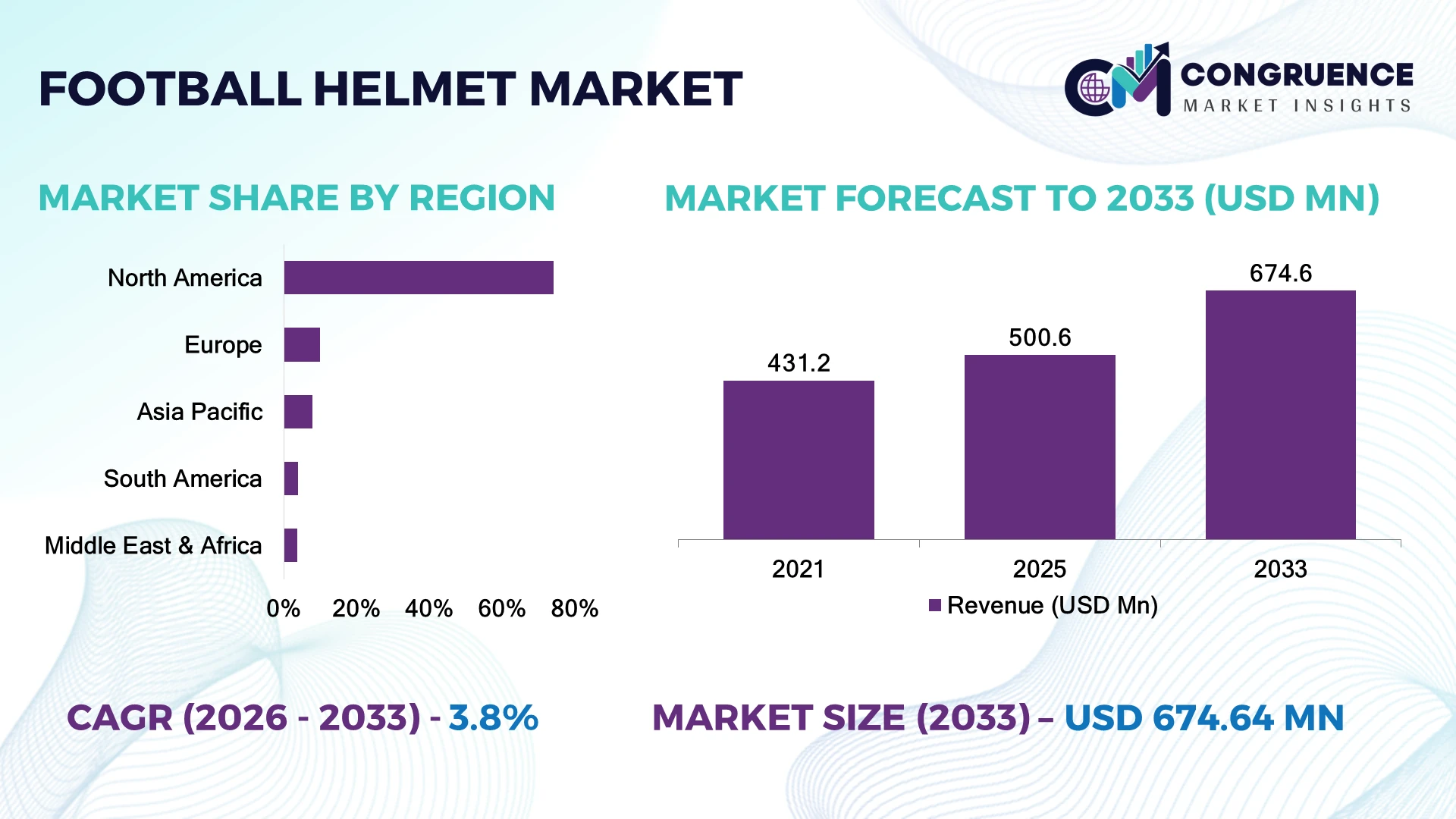
The Global Football Helmet Market was valued at USD 500.6 Million in 2025 and is anticipated to reach a value of USD 674.6 Million by 2033 expanding at a CAGR of 3.8% between 2026 and 2033. Growth is driven by stricter helmet-performance testing, replacement of lower-rated equipment, customized fit technologies, and rising adoption of impact-reduction systems across professional, collegiate, high-school, and youth football.
The United States represents an estimated 70% of global football-helmet demand, supported by NFL, NCAA, high-school, and youth programs. U.S. 11-player high-school football reached 1.04 million participants in 2025–26, while total high-school football exceeded 1.08 million. Nearly 60% of returning NFL players switched to higher-performing helmets for 2025, compared with materially lower adoption historically. NFL safety rules and evolving equipment testing are accelerating replacement cycles.
Strategically, manufacturers should prioritize independently validated protection, customized fit, scalable replacement programs, and differentiated impact-management technologies.
Market Size & Growth: USD 500.6 million in 2025 to USD 674.6 million by 2033 at 3.8% CAGR, supported by safety-driven helmet replacement and advanced fit systems.
Top Growth Drivers: Safety upgrades 10–15%; customized-fit adoption 15–20%; equipment replacement 5–8%.
Short-Term Forecast: By 2028, digital head-scanning and precision fitting can reduce fit-related adjustments 10–15% while improving sizing consistency.
Emerging Technologies: 3D head scanning, adjustable padding, advanced thermoplastics, impact-dispersing liners, and soft-shell helmet covers are reshaping protection.
Regional Leaders: North America approaches USD 400 million; Europe exceeds USD 100 million; Asia-Pacific approaches USD 90 million, with organized football infrastructure expanding.
Consumer/End-User Trends: Nearly 60% of returning NFL players switched to higher-performing helmets for the 2025 season, creating stronger technology pull-through.
Pilot/Case Example: 2025 NFL testing introduced seven new top-performing helmet models, while 30% of players gained access to better-performing upgrade options.
Competitive Landscape: Riddell holds an estimated 60–70% U.S. professional and collegiate position, competing with Schutt, Xenith, VICIS, and helmet-technology specialists.
Regulatory & ESG Impact: Guardian Cap adoption has reduced practice concussion rates by approximately 50% across two preseason periods, strengthening impact-reduction procurement.
Investment & Funding: More than USD 50 million is being directed across helmet R&D, testing infrastructure, manufacturing automation, and advanced materials programs.
Innovation & Future Outlook: Custom-fit shells, rotational-impact management, sensor-enabled diagnostics, and integrated protective systems are shifting competition from shell design toward measurable protection performance.
The Football Helmet Market is increasingly defined by advanced impact attenuation, customized fit, rotational-motion management, and independently validated performance. The NFL's 2026 testing cycle recorded nearly 60% of returning players moving into higher-performing helmets, demonstrating that safety rankings are influencing real procurement behavior. The expansion of organized football and equipment standards creates a strong transition toward technology-led replacement and specification-driven purchasing.
Football helmets are becoming a strategic sports-equipment category because safety performance increasingly influences athlete retention, institutional procurement, insurance exposure, and brand positioning. The United States remains the core commercial market, while high-school participation reached 1,081,241 football participants in 2025–26, creating a substantial recurring replacement base. At professional level, helmet selection is increasingly guided by annual laboratory testing and on-field performance data rather than brand familiarity alone.
Technology is widening the gap between conventional shells and customized protection. More than 70% of NFL players selected custom-fit helmets in 2024, using head scans and individualized fitting, while nearly 60% of returning players moved into higher-performing models for 2025. Compared with standardized sizing, customized fitting can reduce adjustment requirements by approximately 10–15% and improve retention during play.
During 2026–2028, manufacturers will prioritize advanced liners, rotational-impact management, head-scanning, adjustable padding, and helmet-plus-cover protection systems. A practical deployment involves schools replacing lower-rated helmets with top-performing models during scheduled equipment refreshes rather than waiting for physical failure. Companies are therefore increasing R&D, laboratory testing, material partnerships, and direct institutional sales. Competitive advantage will increasingly depend on independently validated protection, scalable customization, reliable fit, and demonstrable performance improvement rather than aesthetics or brand recognition alone.
Annual helmet testing and stronger institutional safety requirements are shifting procurement toward independently validated protection. Nearly 60% of returning NFL players moved to higher-performing helmets for the 2025 season, while more than 70% had selected custom-fit helmets previously. High-school football participation exceeded 1.08 million in 2025–26, sustaining a large replacement base. U.S. manufacturers are responding with rotational-impact management, individualized fit systems, and expanded high-performance portfolios. The non-obvious growth mechanism is specification-driven replacement: schools and professional teams increasingly refresh equipment based on comparative performance rankings rather than physical wear alone. This shortens product cycles and rewards manufacturers that continuously invest in laboratory validation, materials engineering, and customized fitting infrastructure.
Advanced football helmets carry substantially higher acquisition costs than conventional models because of specialized liners, composite shells, adjustable fit systems, and rotational-impact technologies. Premium configurations can cost approximately 20–40% more than basic helmets, while customized fitting and replacement components add another 5–10% to institutional procurement budgets. U.S. schools with constrained athletic budgets therefore face slower fleet-wide replacement despite stronger safety requirements. Supply concentration in specialized foams, thermoplastics, and protective components can further expose manufacturers to input volatility. Companies are reducing pressure through modular padding, standardized replacement parts, volume contracts, and tiered product portfolios. The key commercial constraint is not technology availability but affordability: a superior helmet delivers limited market impact when schools cannot deploy it across entire rosters.
Digital head scanning and individualized helmet fitting create a high-value opportunity across professional, collegiate, and youth programs. More than 70% of NFL players selected custom-fit helmets in recent adoption cycles, establishing a strong technology benchmark for broader institutional markets. Precision fitting can reduce sizing adjustments by approximately 10–15% and improve helmet retention during movement. Manufacturers are extending 3D scanning, adjustable liner architectures, and personalized shell configurations into collegiate and school channels. The less obvious opportunity is recurring fit-service revenue: digital player profiles can support replacement helmets, liner changes, and roster transfers without repeating the entire fitting process. Companies that combine hardware with fitting platforms, data management, and institutional service contracts can create stronger customer retention than standalone helmet suppliers.
Next-generation helmets require increasingly sophisticated validation across linear acceleration, rotational motion, fit retention, impact locations, and environmental conditions. Advanced development programs can involve 10–20% more testing variables than conventional shell-focused designs, increasing certification workload and engineering costs. The 2026 testing environment is also raising competitive pressure as professional leagues publish comparative performance results and players respond directly to rankings. Manufacturers must balance protective performance with weight, ventilation, field visibility, durability, and manufacturing consistency. Companies are investing in computational modeling, instrumented testing, advanced materials, and athlete partnerships to shorten development cycles. The strategic challenge is reproducibility: achieving excellent laboratory performance is insufficient unless the same protection level is maintained across different head shapes, temperatures, production batches, and extended field use.
Player Adoption Favors Higher Ratings: Nearly 60% of returning NFL players shifted to higher-performing helmets for the 2025 season, making laboratory rankings an increasingly direct purchasing signal. Manufacturers are accelerating product refreshes and expanding premium models, while teams are incorporating performance ratings into equipment-selection workflows rather than relying primarily on historical brand preference.
Custom Fitting Becomes Standard Practice: More than 70% of NFL players previously selected custom-fit helmets using individualized head measurements. Digital scanning and adjustable padding are moving into collegiate and elite youth programs, reducing fit-related adjustments by approximately 10–15%. Suppliers are building fitting services around helmet sales, creating recurring value through replacement liners and player-specific equipment records.
Protective Covers Enter Routine Use: Guardian-style helmet covers are becoming more visible in organized football as teams seek additional impact attenuation during practices. Field programs using protective covers have reported concussion-rate reductions approaching 50% in selected preseason comparisons. Manufacturers and equipment departments are treating covers as complementary protection rather than substitutes for high-performing helmets.
Material Engineering Targets Weight: Advanced foams, composite structures, and variable-density liners are being engineered to improve energy absorption without excessive helmet mass. New constructions can reduce selected shell or liner weight by approximately 5–10% while maintaining protection targets. U.S. manufacturers are prioritizing material optimization because lighter designs improve athlete comfort and strengthen adoption without requiring major changes to existing equipment programs.
Varsity football helmets account for approximately 58% of global demand, reflecting their use across professional, collegiate, and high-school programs where impact performance, certification, durability, and customization are procurement priorities. Youth helmets contribute around 27%, while specialty and position-specific designs represent approximately 15%. Varsity models command higher specification requirements and replacement values than youth products, with premium configurations typically incorporating advanced multi-density liners, adjustable fit systems, and improved rotational-impact management.
Youth helmets are the fastest-growing type, supported by expanded youth participation and stronger parental and league attention to protective equipment. Adoption of advanced youth designs is increasing approximately 8–12%, while customized fitting is gaining 10–15% penetration in organized programs. Manufacturers are responding with lighter shells, adjustable padding, youth-specific geometries, and scalable fitting programs. The strategic shift is toward age-specific engineering rather than simply reducing adult helmet dimensions, creating investment opportunities in dedicated materials, fit databases, and certification programs.
In 2025–26, U.S. high-school football participation reached 1,081,241 athletes, reinforcing the scale of the certified youth and varsity equipment replacement market.
Professional football represents approximately 24% of football-helmet demand by value, supported by high equipment specifications, frequent technology evaluation, and premium helmet pricing. Collegiate football accounts for around 31%, high-school football approximately 35%, and youth/recreational programs about 10%. High-school demand is therefore the largest volume pool, while professional football has disproportionate influence over product development because annual testing and player adoption rapidly establish technology benchmarks.
Professional football is the fastest-changing application, with approximately 10–15% annual movement in adoption toward higher-performing helmet models and customized fitting. Collegiate programs increasingly follow professional equipment-selection practices, while high-school programs balance safety improvements against constrained athletic budgets. Manufacturers are responding through tiered portfolios, institutional purchasing agreements, digital fitting services, and helmet-lifecycle programs. The commercial implication is significant: professional innovation creates technology pull-through, but scalable pricing and durability determine whether those technologies penetrate the much larger school market.
For the 2025 NFL season, nearly 60% of returning players changed to a helmet that performed better in laboratory testing, demonstrating the direct influence of performance data on equipment selection.
High-school programs represent approximately 35% of global football-helmet demand, supported by large participant numbers, annual equipment inspections, and recurring fleet replacement. Collegiate programs contribute about 31%, professional teams approximately 24%, and youth/recreational organizations around 10%. School buyers prioritize certified protection, durability, fleet compatibility, and budget control, whereas professional organizations place greater emphasis on customized fit, advanced materials, and incremental performance improvements.
Professional teams are the fastest-moving end-user group, with higher-performing helmet adoption increasing approximately 10–15% as annual testing results influence player choices. Collegiate programs increasingly adopt professional-grade technologies, creating a bridge between premium innovation and broader institutional purchasing. Manufacturers are targeting schools through volume contracts and tiered products while serving professional teams with custom-fit programs, athlete testing, and direct technical support. The strategic opportunity lies in transferring premium technologies into cost-controlled school models without compromising certification or durability, expanding addressable demand while protecting the premium positioning of advanced helmets.
More than 70% of NFL players selected custom-fit helmets in recent equipment cycles, demonstrating that individualized fitting has moved from specialist practice toward a mainstream professional procurement requirement.
North America accounted for the largest market share at 74.2% in 2025 however, Asia-Pacific is expected to register the fastest growth, expanding at a CAGR of 5.6% between 2026 and 2033.

Safety-Driven Replacement Reshapes Institutional Procurement
North America represents approximately 74.2% of global football-helmet demand, reflecting the concentration of professional, collegiate, high-school, and organized youth football in the United States. Annual helmet-performance testing is increasingly influencing procurement, with nearly 60% of returning NFL players moving to higher-performing models for the 2025 season. Schools are also expanding use of custom-fit systems, advanced liners, and rotational-impact technologies. Manufacturers are responding through continuous product refreshes, direct relationships with athletic programs, and expanded fitting infrastructure. The region's commercial advantage is its specification-intensive procurement environment: equipment decisions increasingly consider laboratory performance, fit retention, durability, and lifecycle cost rather than shell design alone. This supports premium pricing for independently validated protection and creates recurring replacement opportunities across large institutional fleets.
United States Market Outlook: The United States is the global center of football-helmet demand, supported by more than 1.08 million high-school football participants in 2025–26 alongside collegiate and professional programs. Annual testing and player adoption create a rapid technology-transfer mechanism from professional football into school equipment. Manufacturers are therefore prioritizing high-performance models, customized fitting, institutional contracts, and replacement programs tailored to constrained school budgets.
Participation Expansion Supports Selective Safety Upgrades
Europe represents a smaller but increasingly structured football-helmet market, led by the United Kingdom and Germany, where American football leagues, university programs, and youth participation support recurring equipment demand. The market is more fragmented than the U.S., but clubs increasingly emphasize certified helmets, impact attenuation, and proper fitting. The United Kingdom's established domestic league structure provides a platform for organized equipment procurement, while Germany's larger American-football participation base supports greater demand for advanced protective equipment. Manufacturers are using distributor partnerships and direct club relationships to introduce premium models without requiring U.S.-scale infrastructure. The strategic opportunity is selective premiumization: advanced helmets can command higher value among competitive clubs, while durable mid-tier products remain important for developing youth programs.
United Kingdom Market Outlook: The United Kingdom is strategically important because it has one of Europe's longest-established American-football ecosystems and a broad network of organized clubs. The country's structured league system supports recurring team-level equipment procurement, while university and youth programs provide additional replacement demand. Suppliers with local distribution and fitting support can reduce lead times and strengthen penetration among clubs operating with tighter equipment budgets.
Participation Growth Creates New Equipment Demand
Asia-Pacific is emerging from a relatively small installed base, with Japan, Australia, China, and South Korea providing the strongest organized American-football and contact-sports ecosystems. Japan combines established collegiate and corporate football with sophisticated sports-equipment purchasing, while Australia benefits from expanding gridiron participation and established sporting-goods distribution. Advanced helmet adoption remains concentrated among organized competitive programs, but youth participation and school-level development are widening the addressable market. Manufacturers are using distributors, league partnerships, and localized fitting programs to introduce premium equipment. The strategic shift is toward market education: unlike the mature U.S. market, suppliers must establish the value of certified impact protection and correct fitting alongside simply expanding product availability.
Japan Market Outlook: Japan is the region's most developed American-football market, supported by university, corporate, and organized league structures. The country also has strong consumer familiarity with advanced protective sports equipment and precision manufacturing. Suppliers can leverage this environment for premium helmet adoption, particularly products offering adjustable fit, advanced impact attenuation, and lightweight construction. Local partnerships with clubs and institutional programs remain important for technology validation.
Brazil Leads Organized Football Equipment Adoption
South America remains a developing football-helmet market, with Brazil providing the strongest commercial base because of its large population, established American-football leagues, and growing youth participation. The region's procurement remains more price-sensitive than North America, creating demand for durable mid-tier helmets alongside premium products used by competitive teams. Import dependence can extend delivery cycles and expose buyers to currency fluctuations, encouraging distributors to hold larger inventories of core helmet sizes. Manufacturers are responding through regional distributors, league partnerships, and tiered product portfolios. The key commercial opportunity is to introduce advanced protection without U.S.-level pricing structures, particularly through lighter composite shells and modular liners that can be replaced separately rather than replacing complete helmets.
Brazil Market Outlook: Brazil is the region's principal market, supported by organized leagues and a comparatively broad American-football participation base. Local distributors are central to product availability because specialized helmet manufacturing remains limited. Suppliers offering multiple price tiers, certified protection, and replacement liner programs can improve adoption among clubs while reducing the total ownership cost of premium equipment.
Sports Infrastructure Investment Opens Premium Niches
Middle East & Africa demand is concentrated in the United Arab Emirates, Saudi Arabia, South Africa, and selected expatriate-driven football programs. The market remains small, but investment in sports infrastructure, international sporting events, private academies, and school athletics is increasing opportunities for specialized protective equipment. Saudi Arabia and the UAE are particularly relevant because new sports facilities and youth-development programs support broader participation in organized contact sports. Manufacturers are approaching the market through distributors, academies, sports retailers, and institutional partnerships rather than building local helmet production. Premium helmets have greater relevance in professional and academy environments, while entry-level products remain important for developing programs. The strategic opportunity is controlled expansion through local distribution and fitting support rather than capital-intensive manufacturing.
Saudi Arabia Market Outlook: Saudi Arabia is emerging as a strategically relevant market because sports-sector investment is expanding organized athletic infrastructure and youth participation. The country's broader sports-development agenda is increasing demand for professionally specified equipment across academies and institutional programs. Suppliers with local distribution, fitting expertise, and differentiated safety portfolios can establish early positions as organized football participation develops.
Riddell, Schutt, VICIS, Xenith, and LIGHT compete across premium impact-protection and institutional football-equipment segments, with established brands confronting technology-led specialists. The top five are estimated to control about 80% combined share. Competition centers on protection ratings, fit, durability, price, and customization; nearly 60% of returning NFL players switched to higher-performing helmets in 2025, while more than 70% selected custom-fit helmets in 2024. Riddell is accelerating youth-standard products, Schutt and VICIS emphasize high-ranking impact performance, and Xenith differentiates through adaptive fit and lightweight construction. Players are investing in advanced liners, flexible shells, custom scanning, and institutional partnerships. The competitive shift is toward independently validated protection and personalized fit rather than traditional shell branding. Entry barriers include NOCSAE certification, laboratory testing, material engineering, tooling, and athlete qualification. Winners will combine proven impact performance, scalable customization, competitive pricing, dependable supply, rapid compliance, and institutional relationships to secure replacement contracts and defend premium positioning.
Riddell
Schutt Sports
VICIS
Xenith
LIGHT Helmets
Rawlings Sporting Goods
Helmet Hut
Adams USA
Green Gridiron
Unequal Technologies
Guardian Sports
SG Helmets
ProTechT
KOLLIDE
Football helmet technology is shifting from rigid single-density shells toward flexible shells, multi-density liners, rate-dependent materials, and adjustable fit systems. Advanced liner architectures can improve selected impact attenuation metrics by 10–20%, while digital fitting reduces sizing adjustments approximately 10–15%. More than 70% of NFL players chose custom-fit helmets in 2024, establishing professional adoption as a strong commercialization signal.
Emerging systems combine 3D head scanning, interchangeable padding, rotational-impact management, and position-specific designs. Compared with conventional standardized helmets, customized fit can improve retention and reduce movement-related fit issues by roughly 10–15%. Xenith benefits from adaptive fit and lightweight polymer engineering, while Riddell, Schutt, and VICIS gain from established testing, institutional relationships, and premium product platforms.
During 2026–2028, AI-assisted design, computational impact modeling, advanced energy-absorbing materials, and digital helmet-selection workflows will become more important. In 2026, the NFL shifted all helmets outside its top-performing group to “Not Recommended,” strengthening the commercial value of validated performance. Manufacturers that integrate laboratory data with athlete scanning and modular liners can shorten development cycles, personalize equipment, and defend premium pricing. The technology race is moving from shell redesign toward measurable, position-specific protection and scalable customization across professional, collegiate, and youth programs, improving procurement confidence across institutions globally.
March 2026 Riddell launched the ND6 youth helmet line ahead of the 2027 ND006 standard, offering three models and a 3.5-pound maximum weight requirement. The early rollout gives leagues time to transition, strengthening youth compliance readiness and accelerating adoption nationwide. Source: riddell.com
March 2025 VICIS partnered with St. Augustine High School to equip its entire football roster with ZERO2 helmets, creating an exclusive school partnership under VICIS’s Ambassador Program. The deployment strengthens institutional adoption and demonstrates advanced safety technology at school level. Source: vicis.com
April 2026 NFL and NFLPA released 2026 helmet testing results, marking helmets outside the top-performing group as “Not Recommended” for the 2026 season. The revised classification increases pressure on manufacturers to improve performance and encourages teams to replace lower-rated equipment. Source: nfl.com
February 2025 NFL data showed a 17% decline in reported concussions, alongside broader advanced-helmet adoption and revised kickoff rules. The result strengthened investment in protective equipment, accelerated player migration toward higher-performing models, and increased overall importance of validated helmet technology. Source: Reuters
The Football Helmet Market Report evaluates varsity, youth, specialty, and position-specific helmets across professional, collegiate, high-school, and youth/recreational football. Regional coverage spans North America, Europe, Asia-Pacific, South America, and Middle East & Africa, with country-level assessment of participation, institutional procurement, replacement cycles, certification requirements, distribution networks, and safety-technology adoption.
The report examines advanced liners, flexible shells, rotational-impact management, custom fitting, 3D head scanning, adjustable padding, lightweight materials, and supplemental protective covers. Coverage reflects high-school programs at approximately 35% of demand and collegiate programs near 31%, alongside professional teams' disproportionate influence on technology adoption. Competitive analysis evaluates major manufacturers, institutional partnerships, product launches, testing performance, and customization capabilities. Findings support investment planning, product development, geographic expansion, institutional sales strategy, competitive positioning, and market direction through 2033.
| Report Attribute/Metric | Report Details |
|---|---|
|
Market Revenue in 2025 |
USD 500.6 Million |
|
Market Revenue in 2033 |
USD 674.6 Million |
|
CAGR (2026 - 2033) |
3.8% |
|
Base Year |
2025 |
|
Forecast Period |
2026 - 2033 |
|
Historic Period |
2021 - 2025 |
|
Segments Covered |
By Type
By Application
By End-User
|
|
Key Report Deliverable |
Revenue Forecast, Growth Trends, Market Dynamics, Segmental Overview, Regional and Country-wise Analysis, Competition Landscape |
|
Region Covered |
North America, Europe, Asia-Pacific, South America, Middle East, Africa |
|
Key Players Analyzed |
Riddell, Schutt Sports, VICIS, Xenith, LIGHT Helmets, Rawlings Sporting Goods, Helmet Hut, Adams USA, Green Gridiron, Unequal Technologies, Guardian Sports, SG Helmets, ProTechT, KOLLIDE |
|
Customization & Pricing |
Available on Request (10% Customization is Free) |




