
Reports
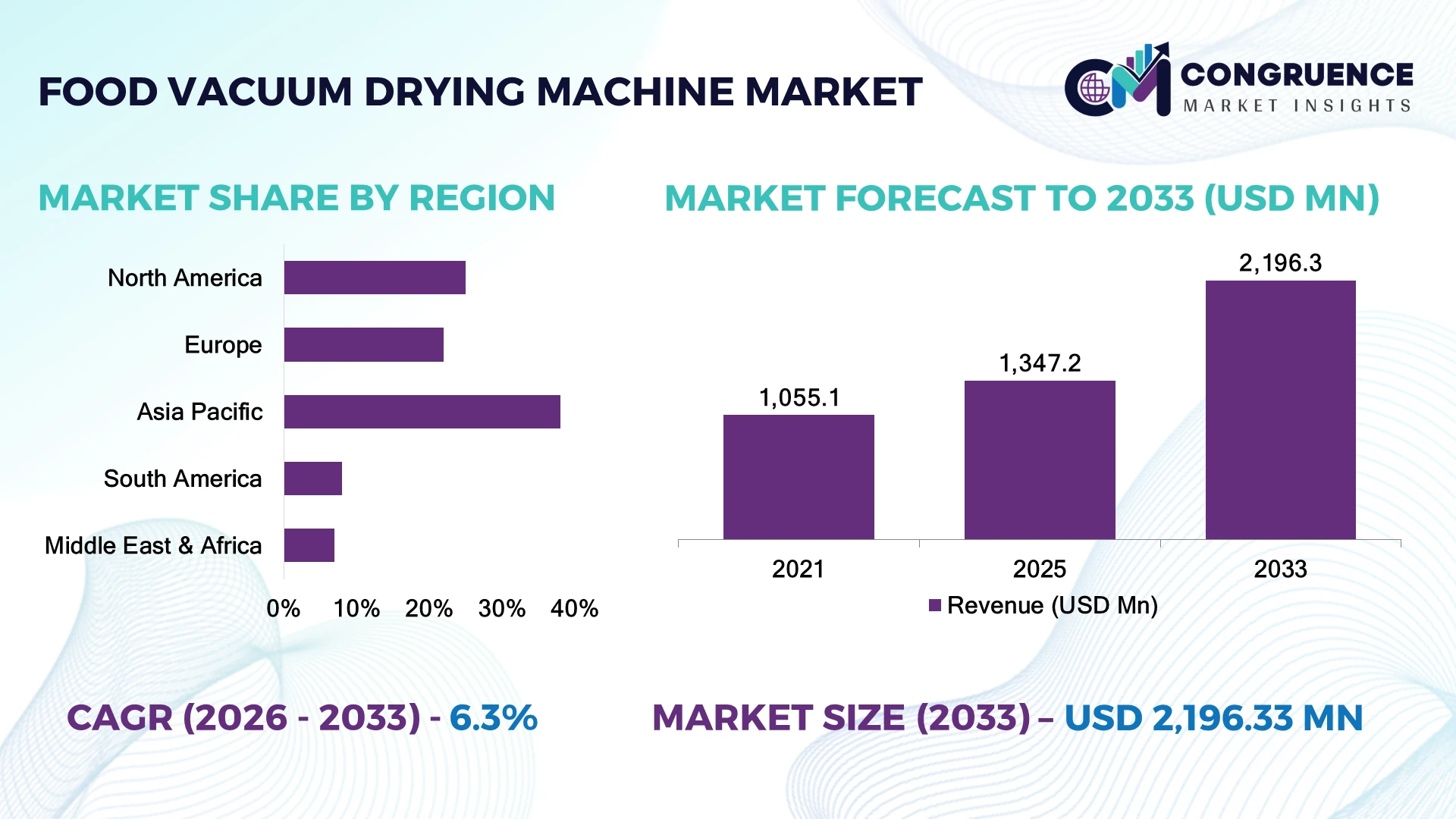
The Global Food Vacuum Drying Machine Market was valued at USD 1,347.2 Million in 2025 and is anticipated to reach a value of USD 2,196.3 Million by 2033 expanding at a CAGR of 6.3% between 2026 and 2033. Growth is driven by investment in low-temperature processing, premium shelf-stable fruit and vegetable ingredients, and industrial drying systems that protect heat-sensitive product characteristics.
China remains a strategically important food-processing and equipment-manufacturing market, while India offers modernization opportunities through its ₹10,900-crore Production Linked Incentive programme for food processing. Commercial applications range from fruit and vegetable snacks to concentrated ingredients and pectin processing. In a 2026 lemon-slice study, vacuum-microwave drying reduced drying time by approximately 53% compared with hot-air drying under the tested conditions. This result demonstrates the technology's potential but requires product-specific validation before industrial investment.
Strategic implication: Equipment suppliers should compete on validated product quality, energy performance, hygienic design and dependable service rather than nominal drying capacity alone.
Market Size & Growth: The market is valued at USD 1,347.2 million in 2025 and is projected to reach USD 2,196.3 million by 2033, supported by low-temperature processing and premium dried-food production.
Top Growth Drivers: Quality-sensitive food processing, shelf-stable ingredient production and automation are the key demand drivers; their commercial value depends on product yield, energy consumption and throughput.
Short-Term Forecast: Through 2028, buyers will increasingly evaluate energy consumed per kilogram, drying-cycle consistency, cleanability and saleable product yield before expanding capacity.
Emerging Technologies: Vacuum-microwave drying, programmable vacuum controls and integrated heating systems are improving process control and reducing drying time for selected products.
Regional Leaders: Asia-Pacific benefits from large food-processing operations; Europe has established process-equipment expertise; and North America supports premium dried ingredients and technology-led food manufacturing.
Consumer/End-User Trends: Fruit, vegetable, herb, dairy and specialty-ingredient processors increasingly prioritize color, flavor, texture and rehydration performance alongside shelf stability.
Pilot/Case Example: In 2026, a lemon-slice study recorded vacuum-microwave drying times of 81–144 minutes, compared with 156–360 minutes for hot-air drying at the tested temperatures.
Competitive Landscape: Bühler, GEA, BHS-Sonthofen, EnWave and specialist equipment manufacturers compete through process expertise, machine configuration, product quality and service; comparable global market shares are not consistently disclosed.
Regulatory & ESG Impact: Hygienic equipment design, cleanability and energy performance influence procurement, particularly for export-oriented processors and manufacturers operating under strict food-safety requirements.
Investment & Funding: India's ₹10,900-crore food-processing PLI programme supports broader industry modernization, although it is not a dedicated allocation for vacuum-drying equipment.
Innovation & Future Outlook: Equipment purchasing is shifting toward application-specific drying lines integrating preparation, drying, process monitoring and hygienic discharge to improve production consistency.
The food vacuum drying machine market serves processors seeking controlled moisture removal while preserving product characteristics that influence selling price and customer acceptance. Fruit and vegetable snacks, herbs, dairy ingredients and specialty food components are important applications. Vacuum-microwave systems are expanding the available processing options, while energy costs and hygiene requirements are raising the importance of lifecycle performance. An emerging trend is investment in validated, modular drying lines rather than a single machine configuration for every product.
Food vacuum drying is becoming strategically important where product appearance, flavor, texture and nutrient retention affect commercial value. Reduced pressure enables moisture removal at lower temperatures than many conventional hot-air processes, helping processors manage quality deterioration in sensitive ingredients. As manufacturers seek longer shelf life and more consistent production from seasonal raw materials, drying equipment increasingly influences product differentiation, waste reduction and supply-chain planning. The investment case depends on saleable yield and operating cost, not simply the ability to remove moisture.
Technology selection requires a product-level comparison. Conventional hot-air drying can offer simpler equipment and lower initial complexity, while vacuum systems provide a controlled processing environment. Vacuum-microwave systems can shorten cycles for suitable products but introduce additional capital, process-control and validation requirements. In a 2026 lemon-slice study, vacuum-microwave drying took 81–144 minutes compared with 156–360 minutes for hot-air drying across the tested temperatures. These results demonstrate technical potential, not guaranteed savings for every food or industrial installation.
Over 2026–2028, buyers will increasingly assess energy consumption per kilogram, batch consistency, cleanability and product quality during procurement. A processor producing premium fruit ingredients, for example, can justify a more sophisticated dryer when validated improvements support customer specifications and reduce rejected batches. Equipment manufacturers are responding with customized chambers, programmable controls and integrated process lines. Suppliers that demonstrate application-specific results, provide commissioning support and document lifecycle economics will be better positioned than competitors relying on advertised capacity alone.
Food processors are investing in vacuum drying when heat exposure threatens the color, flavor, texture or functional properties of high-value ingredients. Fruit and vegetable snacks, herbs, dairy components and specialty extracts offer application opportunities where product consistency influences selling price. A 2026 lemon-slice study found vacuum-microwave drying reduced drying time by approximately 53% compared with hot-air drying under the tested conditions, illustrating the potential for faster processing. The result remains product-specific and requires industrial validation. Manufacturers are responding with recipe-controlled systems, improved heating arrangements and application testing. The less obvious commercial advantage is improved production planning: predictable moisture endpoints and repeatable quality can reduce batch variability and help processors meet demanding customer specifications.
Vacuum dryers require sealed chambers, vacuum pumps, heating systems, condensers and process controls, making them more technically complex than basic hot-air equipment. Energy consumption and cycle duration vary with product composition, initial moisture, loading density and operating pressure, preventing a reliable universal savings estimate. Small processors face particular difficulty when production is seasonal or equipment utilization remains low. Imported components and specialist maintenance can further increase ownership costs where local support is limited. Buyers are responding through pilot batches, staged capacity additions and lifecycle-cost comparisons. Suppliers can reduce purchasing barriers by offering right-sized systems, accessible service contracts and measured performance data for the customer's actual product rather than relying on theoretical capacity claims.
Vacuum-microwave technology offers opportunities to shorten drying cycles for selected foods while maintaining quality attributes that conventional heat-intensive methods can compromise. In a 2026 lemon-slice study, vacuum-microwave processing reduced drying time by approximately 53% across the tested temperatures compared with hot-air drying. This provides a measurable technical signal, although industrial outcomes depend on product geometry, loading and target moisture. Equipment manufacturers can convert such potential into commercial value through pilot testing, validated recipes and integrated preparation and packaging lines. Fruit processors, ingredient suppliers and producers of specialty snacks are promising application groups. Investment in application laboratories and customer trials allows suppliers to prove throughput, texture, rehydration and energy performance before customers commit to full-scale equipment.
Scaling a vacuum-drying recipe from laboratory trials to production is difficult because product thickness, loading density, initial moisture and heat transfer influence uniformity. A successful small-batch process can produce uneven moisture levels in a larger chamber, increasing rework and quality risk. Automated controls improve repeatability, but sensors and operating recipes must be validated for each product and equipment configuration. Food manufacturers also need hygienic contact surfaces, cleanable discharge mechanisms and documented process controls. Equipment suppliers must address these demands through pilot-scale trials, data logging, hygienic design and commissioning support. The decisive challenge is maintaining consistent product quality across changing raw-material conditions and production loads, not simply increasing chamber volume or nominal throughput.
Hybrid Drying Shortens Selected Cycles — A 2026 lemon-slice study recorded vacuum-microwave drying times of 81, 108 and 144 minutes at 70°C, 60°C and 50°C, respectively, versus 156, 204 and 360 minutes for hot-air drying. The results indicate a cycle-time reduction of approximately 53% across tested temperatures. Manufacturers are using application trials to assess whether comparable gains translate to commercial batches without compromising texture, color or energy economics.
Hygienic Design Drives Industrial Specifications — In October 2024, BHS-Sonthofen delivered a customer-specific horizontal vacuum dryer designed for three-shift operation and batches of up to 7,500 litres. Its food-grade design combines processing flexibility with residue reduction and easier cleaning. The installation illustrates how industrial buyers assess cleanability and continuous operating capability alongside drying performance. Suppliers are differentiating through suitable seals, hygienic discharge systems and designs that simplify batch changeovers.
Commercial Capacity Follows Proven Demand — In September 2025, EnWave announced a 120 kW Radiant Energy Vacuum machine sale to BranchOut Foods, its fourth large-scale REV machine for the company's Peru facility. The agreement also expanded product rights for dragon fruit. The development connects equipment expansion with specific product portfolios and commercial demand. Suppliers are increasingly using application partnerships and staged installations to link capital spending to defined production requirements.
Integrated Lines Improve Process Control — Industrial food processors are seeking systems that combine drying with controlled heating, mixing, discharge and downstream handling. In October 2024, BHS-Sonthofen reported a horizontal vacuum dryer for pectin production that reduced alcohol content to below 0.1% and water content to below 10%, with drying taking around three hours under the described process. The case demonstrates the value of product-specific engineering. Equipment suppliers are focusing on integrated process steps and measurable final-product specifications rather than standalone drying capacity.
Batch vacuum drying machines are estimated to account for approximately 58% of the market, supported by their flexibility, controlled processing conditions and suitability for diverse food formulations. They are particularly relevant to specialty ingredient manufacturers and processors handling seasonal raw materials, frequent product changeovers or smaller production runs. Continuous vacuum drying systems represent an estimated 42% and are gaining relevance among high-volume producers seeking consistent throughput, reduced manual handling and integration with upstream preparation and downstream packaging. The choice increasingly depends on batch economics, product sensitivity and utilization rather than equipment capacity alone.
Continuous systems are positioned for faster adoption in large-scale fruit processing, ingredient production and standardized manufacturing lines, while batch configurations retain an advantage in product variety and process flexibility. Vacuum-microwave technology is an emerging performance option across suitable applications, targeting shorter drying cycles and improved quality retention. The 2026–2028 investment priority is therefore shifting toward automation, programmable recipes, hygienic discharge and energy monitoring. These market-share figures are indicative analytical estimates, not audited industry measurements; equipment suppliers should validate demand by application and production scale before expanding capacity.
Fruit and vegetable processing is estimated to represent approximately 34% of food vacuum drying machine demand, reflecting the importance of color, flavor, texture and rehydration performance in dried produce and premium ingredients. Meat and seafood applications account for an estimated 23%, supported by specialized dried ingredients and products requiring controlled moisture removal. Dairy products represent approximately 18%, with vacuum drying serving selected sensitive ingredients and specialty formulations. These shares are indicative estimates rather than independently verified market measurements. Conventional high-volume drying remains important where price and throughput dominate, whereas vacuum-based processes are most compelling when quality preservation supports product differentiation.
Prepared foods and specialty ingredients provide additional opportunities as manufacturers seek stable components for meal formulations, instant products and convenient foods. Prepared-food applications are positioned for faster adoption where reduced cycle time, consistent moisture endpoints and integration with automated production lines improve operating economics. The investment priority is shifting toward application-specific recipes and hybrid systems rather than one drying method for every product. Suppliers are strengthening pilot testing and process integration to demonstrate quality and throughput before installation. Demand is becoming operationally critical where drying performance directly affects final-product specifications, rejected batches and the reliability of downstream packaging.
Industrial food processing companies are estimated to account for approximately 60% of food vacuum drying machine demand because they operate production lines where moisture control, batch consistency, hygiene and throughput directly affect product quality and commercial output. Ingredient manufacturers represent an estimated 25%, supported by applications involving fruit concentrates, plant-derived ingredients, proteins and functional food components. Contract and specialty processors account for an indicative 10%, while pilot plants, research facilities and other users represent the remaining 5%. These estimates reflect an analytical segmentation framework rather than published, audited market shares. Larger operators generally assess integrated line performance and lifecycle costs, while smaller processors prioritize flexibility, manageable investment and accessible maintenance.
Ingredient manufacturers are positioned for faster adoption where customers demand tailored functional properties, repeatable moisture levels and specialized product formats. Established processors are more likely to invest in higher-capacity equipment and automation, whereas contract processors value multipurpose systems and faster changeovers. Suppliers are responding through configurable chambers, application trials, service agreements and integration with preparation and packaging equipment. During 2026–2028, purchasing decisions are likely to place greater weight on energy consumed per kilogram, saleable yield and validated cleaning procedures. Competitive advantage will accrue to manufacturers that tailor equipment and support to actual production economics instead of offering standardized capacity alone.
Asia-Pacific accounted for the largest market share at approximately 38% in 2025 however, North America is expected to register the fastest growth, expanding at an estimated CAGR of 7.1% between 2026 and 2033.

Premium Ingredients and Process Automation Shape Equipment Investment
North America represents a technology-oriented market for food vacuum drying machines, supported by specialty food production, ingredient manufacturing and demand for consistent processing of heat-sensitive products. The United States anchors regional demand through established food-processing infrastructure and investment in automated production lines. Vacuum drying is particularly relevant for premium fruit ingredients, dairy components, nutraceutical food ingredients and products requiring controlled moisture levels. Compared with conventional hot-air systems, vacuum equipment offers greater control over processing conditions, although higher capital requirements make application-level validation essential. Manufacturers are emphasizing programmable controls, hygienic construction and integrated material handling to reduce batch variability. Investment is strongest where product quality and saleable yield justify equipment costs, rather than in applications driven exclusively by lowest-cost drying.
United States Market Outlook: The United States benefits from advanced food manufacturing, established equipment-service networks and demand for specialty ingredients used in snacks, prepared foods and nutritional products. USDA data show that U.S. food and beverage manufacturing shipments exceed $900 billion annually, reflecting the scale of the processing base. Vacuum-drying suppliers can target processors seeking improved product consistency, automated batch control and specialized ingredient production. Adoption decisions depend on demonstrated operating economics, cleaning requirements and reliable maintenance support.
Energy Management and Product Quality Drive Process Modernization
Europe's market is shaped by sophisticated food-processing operations, established machinery engineering and stringent expectations for food hygiene and production consistency. Germany, Italy, France and the Netherlands provide important industrial and food-manufacturing bases. Vacuum drying serves specialty ingredients, fruit preparations, herbs and sensitive food formulations where quality retention can support higher-value positioning. Energy efficiency and equipment cleanability increasingly influence purchasing decisions as manufacturers manage operating costs and compliance obligations. Compared with price-led equipment procurement, European buyers often assess lifecycle performance, process documentation and service availability. Suppliers are responding with modular systems, recipe controls and improved heat-management designs. Opportunities are strongest in applications where reduced product degradation and repeatable output compensate for higher initial investment.
Germany Market Outlook: Germany combines a large food-processing industry with strong capabilities in industrial machinery, automation and process engineering. Its manufacturers and equipment integrators are well positioned to develop vacuum-drying solutions with precise controls, hygienic construction and reliable performance monitoring. Germany's food and beverage industry comprises thousands of processing companies, creating demand across large plants and specialist producers. Suppliers can differentiate through engineering customization, energy measurement and dependable technical support, particularly for export-oriented manufacturers with demanding product specifications.
Processing Scale and Food-Manufacturing Expansion Support Adoption
Asia-Pacific leads the market through its extensive fruit, vegetable, seafood, herb and ingredient-processing industries. China contributes through large-scale food manufacturing and equipment production, while India, Japan, South Korea and Southeast Asian economies offer distinct opportunities in processed foods and specialty ingredients. Conventional drying remains commercially important because of its lower complexity, but vacuum systems gain traction where color, aroma, texture and product consistency influence selling prices. China's scale supports equipment sourcing and manufacturing, whereas Japanese buyers place strong emphasis on precision and quality control. India's food-processing modernization is widening the addressable market for industrial equipment. Suppliers are increasingly tailoring capacity, automation and service models to local production volumes and operating budgets.
China Market Outlook: China benefits from a broad food-processing ecosystem, domestic machinery suppliers and extensive production of fruits, vegetables, mushrooms and specialty ingredients. Its manufacturing scale supports both local equipment supply and investment in automated processing. Vacuum-drying adoption is most compelling for premium ingredients and products where conventional drying compromises quality. Suppliers can strengthen their position through local technical support, application-specific trials and systems designed for varied batch sizes. Competition will depend on balancing machine performance, energy use, maintenance access and purchase price.
Export-Oriented Agriculture Creates Selective Processing Opportunities
South America's opportunity is linked to its agricultural production, fruit processing, coffee, dairy and specialty food industries. Brazil is the principal industrial and agricultural market, while Chile, Peru and Argentina contribute through export-oriented food production. Vacuum drying is relevant where processors need to preserve quality in higher-value ingredients and reduce dependence on selling raw or minimally processed commodities. However, conventional drying remains competitive where equipment budgets and energy economics dominate purchasing decisions. Financing, access to specialist maintenance and inconsistent availability of technical support can slow investment in advanced systems. Equipment providers can address these constraints through regional service partnerships, pilot installations and modular configurations. Export-focused processors offer the clearest opportunity when quality specifications and product differentiation justify the investment.
Brazil Market Outlook: Brazil's large food-processing base and diversified agricultural output create opportunities for vacuum-drying equipment in fruit ingredients, coffee-related products, dairy and specialty foods. The country is a major global producer and exporter of agricultural commodities, supporting demand for processing technologies that improve product value and consistency. Investment decisions remain sensitive to financing costs, electricity expenses and maintenance availability. Suppliers that provide local commissioning, operator training and validated product trials can reduce adoption barriers and help processors move into higher-value product categories.
Food-Security Investment Supports Local Processing Modernization
The Middle East and Africa market is shaped by food-import dependence in Gulf economies, expanding food manufacturing and efforts to improve storage resilience. Saudi Arabia and the United Arab Emirates are important investment centres, while South Africa, Egypt and Morocco provide established agricultural and processing bases. Vacuum drying can support shelf-stable ingredients and selected fruit, vegetable and specialty-food applications, but equipment adoption depends on product economics, technical skills and reliable maintenance. Compared with mature machinery markets, some buyers require greater assistance with installation, process validation and operator training. Suppliers are positioning through turnkey lines, regional distribution and service partnerships. The strongest opportunities involve products with clear value-addition potential and measurable benefits in quality retention or storage stability.
Saudi Arabia Market Outlook: Saudi Arabia is investing in domestic food production, processing capacity and supply-chain resilience as part of broader food-security priorities. Its industrial development programmes create opportunities for equipment suppliers serving fruit and vegetable processing, specialty ingredients and packaged-food manufacturing. Vacuum-drying projects must demonstrate clear operating economics under local energy, water and maintenance conditions. Suppliers that combine hygienic design with training, technical support and integration into complete processing lines can improve project viability. Local partnerships and product-specific trials will be important for converting investment ambitions into sustained equipment demand.
Bühler and GEA compete through broad food-processing portfolios; BHS-Sonthofen targets batch applications, while EnWave differentiates through Radiant Energy Vacuum technology. Asian manufacturers challenge global OEMs on price and delivery. The top five players’ combined share is estimated at 35–40%, an indicative figure because audited shares are not publicly established.
Competition centres on price, drying performance, hygiene, service and customization. Studies report approximately 47% shorter drying time for optimized microwave-vacuum pineapple drying, while ultrasonic pretreatment reduced energy use by up to 30% in a tested vacuum freeze-drying process; neither result guarantees universal savings. Suppliers compete through trials, modular designs, installations and line integration. EnWave expands through equipment sales and licensing; BHS combines drying, mixing and wash-in-place features. Competition is shifting toward hybrid technologies and lifecycle performance. Capital intensity, validation requirements and servicing constrain entry. Winning requires proven product quality, credible operating-cost data, responsive service and performance validated reliably at commercial scale.
Vacuum drying uses reduced pressure to remove moisture at lower temperatures than many conventional hot-air systems, protecting color, aroma and texture. Hybrid vacuum-microwave systems add volumetric heating and can shorten processing: a 2025 pineapple study reported a 47.06% drying-time reduction when microwave power increased from 5 to 11 W/g. Results remain product-specific, so pilot validation is essential before extrapolating performance to industrial lines.
Pretreatment and process monitoring are emerging differentiators. A 2025 study of microwave-assisted vacuum freeze-drying found ultrasonic pretreatment reduced drying time and energy consumption by up to 30.02% under tested conditions. Sensors, recipe controls and endpoint management can improve batch repeatability, but no reliable market-wide adoption percentage is established; deployment remains selective in premium ingredients and specialized production. Integrated hygienic discharge and clean-in-place features also reduce changeover burdens.
For 2026–2028, advantage will favour suppliers integrating vacuum, microwave or hybrid heating with product-specific controls and lifecycle data. EnWave benefits from its proprietary Radiant Energy Vacuum platform and licensing model; established OEMs compete through line integration, service networks and customization. Compared with hot-air drying, optimized hybrid processes can deliver double-digit cycle-time or energy improvements in specific trials, but buyers should demand validated measurements before scaling installations for each specific product.
The report evaluates the food vacuum drying machine market across batch and continuous configurations, vacuum systems and emerging vacuum-microwave or hybrid technologies. Application coverage includes fruit and vegetable processing, meat and seafood, dairy products, prepared foods and specialty ingredients. End-user analysis distinguishes industrial food processors, ingredient manufacturers, contract processors and research facilities, examining equipment selection through throughput, quality, hygiene, energy use and service requirements.
Regional coverage spans North America, Europe, Asia-Pacific, South America, and the Middle East and Africa, assessing manufacturing capacity, processing specialization and investment conditions. Competitive analysis profiles equipment suppliers and regional manufacturers, comparing application engineering, automation, modularity and lifecycle support. The report assesses performance evidence, including research reporting up to 47.06% shorter drying time in optimized microwave-vacuum pineapple trials. These insights support investment screening, market-entry decisions, product positioning and expansion priorities for 2026–2033.
| Report Attribute/Metric | Report Details |
|---|---|
|
Market Revenue in 2025 |
USD 1,347.2 Million |
|
Market Revenue in 2033 |
USD 2,196.3 Million |
|
CAGR (2026 - 2033) |
6.3% |
|
Base Year |
2025 |
|
Forecast Period |
2026 - 2033 |
|
Historic Period |
2021 - 2025 |
|
Segments Covered |
By Type
By Application
By End-User
|
|
Key Report Deliverable |
Revenue Forecast, Growth Trends, Market Dynamics, Segmental Overview, Regional and Country-wise Analysis, Competition Landscape |
|
Region Covered |
North America, Europe, Asia-Pacific, South America, Middle East, Africa |
|
Key Players Analyzed |
Bühler Group, GEA Group, BHS-Sonthofen, EnWave Corporation, Bucher Unipektin, Hosokawa Micron Group, OKAWARA MFG. CO., LTD., SPX FLOW, ANDRITZ AG, Püschner GmbH, Shandong Tianli Energy, Zhejiang Sanshon Machinery, Fenco Food Machinery, Turatti Group |
|
Customization & Pricing |
Available on Request (10% Customization is Free) |




