
Reports
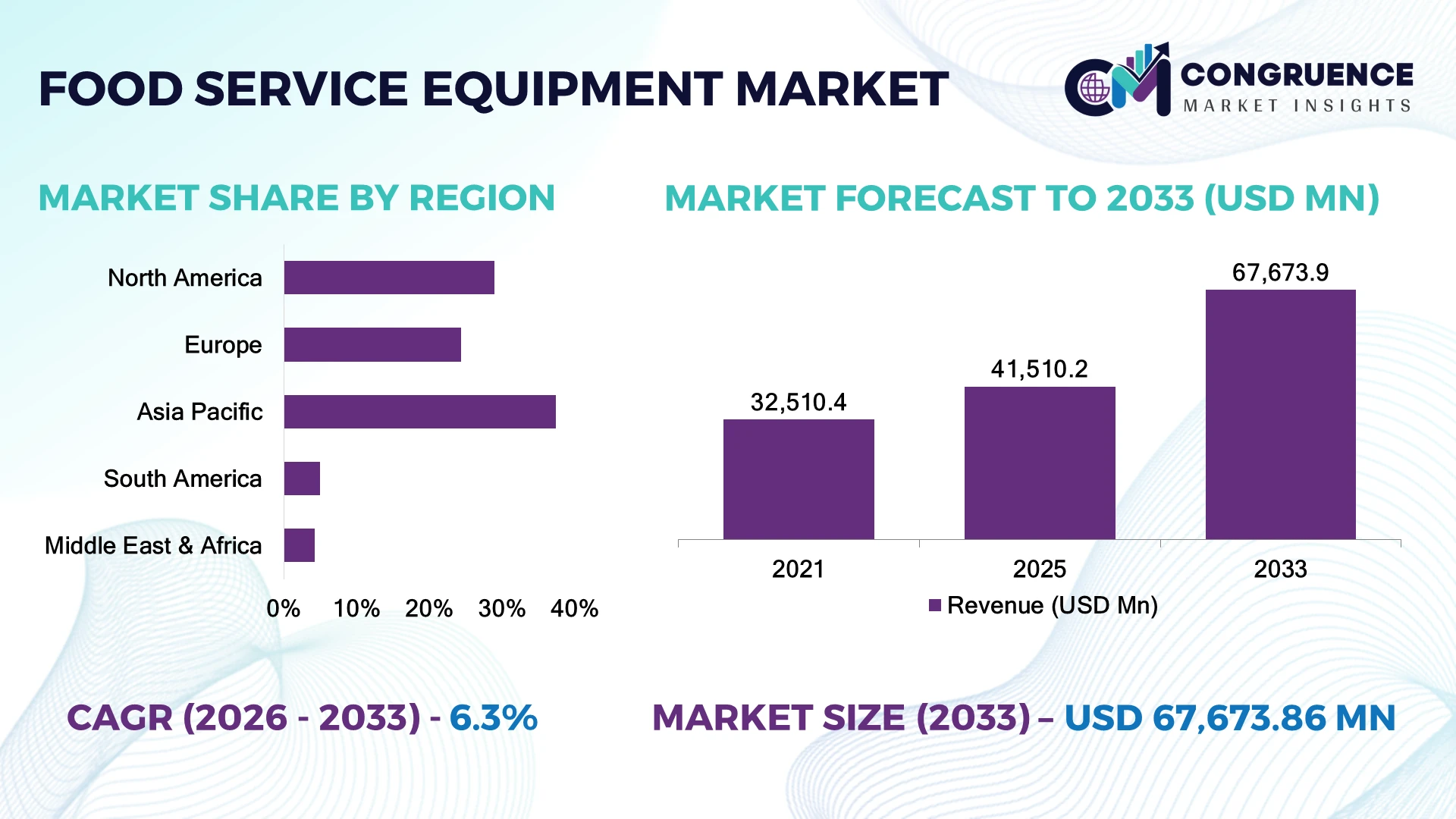
The Global Food Service Equipment Market was valued at USD 41,510.2 Million in 2025 and is anticipated to reach a value of USD 67,673.9 Million by 2033 expanding at a CAGR of 6.3% between 2026 and 2033. Growth is driven by commercial kitchen modernization, labor-saving cooking systems, energy-efficient refrigeration, automated warewashing, and rising investment in quick-service restaurants and institutional kitchens.
The United States remains a major foodservice equipment market, supported by a restaurant industry projected to generate USD 1.5 trillion in sales in 2025 and employ 15.9 million people. Approximately 70% of U.S. restaurants are single-unit operations, creating demand for compact, reliable, easy-to-service equipment. Compared with fragmented independent operators, large restaurant chains can standardize purchases across multiple sites, strengthening their negotiating power and accelerating equipment rollouts. Labor costs, utility expenses, and sustainability requirements are encouraging investment in programmable cooking systems and efficient refrigeration.
Manufacturers should prioritize equipment that combines lower lifecycle costs, dependable service support, space efficiency, and scalable digital controls for both independent kitchens and multi-site operators.
Market Size & Growth: The market is valued at USD 41,510.2 million in 2025 and is projected to reach USD 67,673.9 million by 2033, supported by kitchen modernization and energy-efficient equipment replacement.
Top Growth Drivers: Energy savings, labor productivity, and outlet expansion are key purchase drivers; qualifying commercial refrigerators can use approximately 20% less energy than standard models.
Short-Term Forecast: By 2028, operators replacing standard equipment with efficient models can target category-specific energy reductions of around 17%–30% for eligible fryers and ovens.
Emerging Technologies: AI-assisted cooking, connected kitchen platforms, and automated cleaning are improving process consistency and equipment monitoring.
Regional Leaders: Asia-Pacific accounts for an estimated 37.4% of the global market in one published market assessment, reflecting restaurant expansion and commercial kitchen investment.
Consumer/End-User Trends: Around 70% of U.S. restaurants operate as single-unit businesses, increasing the importance of affordable equipment, straightforward installation, and local servicing.
Pilot/Case Example: An ENERGY STAR-certified commercial kitchen equipment suite can save approximately 350 MMBtu of energy annually, illustrating the operational value of coordinated equipment upgrades.
Competitive Landscape: Middleby, Ali Group, Rational, Hoshizaki, and ITW Food Equipment compete through specialized brands, cooking technology, refrigeration, and broad commercial-kitchen portfolios; consistent global company-level share data are not publicly established.
Regulatory & ESG Impact: Efficient commercial steam cookers can use up to 90% less water than standard models, strengthening the business case for water-conscious equipment upgrades.
Investment & Funding: Welbilt announced a 130,000-square-foot customer experience center in Texas in 2025, underscoring investment in product demonstration, training, and channel support.
Innovation & Future Outlook: Competition is shifting toward connected, space-efficient equipment that combines cooking performance, maintenance visibility, and lower resource consumption.
The food service equipment market spans cooking and food preparation, refrigeration, warewashing, storage, beverage systems, and serving equipment. Commercial kitchens are increasingly prioritizing equipment that reduces operating costs without compromising throughput or food quality. ENERGY STAR-qualified models demonstrate measurable category-specific energy and water savings, while connected systems help operators monitor equipment performance across multiple locations. With labor availability, utility costs, and food-safety controls influencing procurement, equipment selection is becoming a lifecycle-cost decision rather than a purchase based solely on upfront price.
Food service equipment is becoming a strategic investment because kitchen productivity, labor availability, food safety, and utility costs directly affect restaurant margins. Operators are replacing isolated appliances with coordinated cooking, refrigeration, holding, and warewashing systems that support consistent output during peak periods. This shift is especially important for quick-service chains, hotels, institutional kitchens, and delivery-oriented operations where throughput and repeatability influence service performance.
Energy efficiency offers a measurable purchase rationale. ENERGY STAR-certified commercial refrigerators are approximately 20% more energy-efficient than standard models, while qualifying commercial ovens can be around 30% more efficient. These gains strengthen the business case for replacement when equipment runs for long hours, although savings depend on usage, model specifications, and local energy prices. North American operators emphasize lifecycle cost and service availability, while Asia-Pacific demand benefits from new restaurant openings, hospitality projects, and kitchen fit-outs.
During 2026–2028, suppliers are positioned to expand connected equipment, compact high-speed cooking, automated cleaning, and remote service diagnostics. A multi-site restaurant group can standardize cooking programs and maintenance schedules across outlets, reducing variation between kitchens. Manufacturers are investing in digital platforms, demonstration centers, and distributor training to help buyers evaluate equipment under realistic operating conditions. Competitive advantage will depend on measurable operating savings, uptime, easy maintenance, and reliable service—not equipment specifications alone.
Foodservice operators are investing in programmable ovens, automated fryers, high-speed cooking systems, and integrated preparation equipment to sustain output with constrained staffing. In the United States, the restaurant industry was projected to employ 15.9 million people in 2025, highlighting the scale of workforce requirements across the sector. Equipment that standardizes cooking cycles and reduces manual intervention can improve consistency during peak demand. ENERGY STAR-certified commercial ovens can be approximately 30% more energy-efficient than standard models, aligning productivity investments with utility-cost control. Manufacturers are responding with compact multifunctional appliances, automated controls, and operator training. A key commercial advantage is the ability to reproduce standardized results across locations without requiring every kitchen to depend on highly specialized labor.
Commercial kitchen upgrades require significant upfront spending across cooking, refrigeration, extraction, storage, and warewashing systems. Independent operators often face tighter capital constraints than national chains, while installation can require electrical upgrades, ventilation modifications, plumbing changes, and temporary kitchen closures. A more efficient appliance does not guarantee attractive payback when utilization is low or energy prices are modest. Imported components, stainless steel, compressors, and electronic controls also expose manufacturers to material and logistics volatility. Operators reduce these pressures by phasing replacements, standardizing equipment specifications, comparing lifecycle costs, and negotiating service-inclusive contracts. Suppliers that offer modular configurations, dependable warranties, and accessible financing can reach smaller buyers without relying exclusively on premium equipment sales.
Connected cooking systems, remote equipment monitoring, and high-efficiency refrigeration create opportunities to improve performance across multi-site foodservice operations. ENERGY STAR-certified commercial steam cookers can use up to 90% less water than standard models, making resource efficiency a measurable purchasing criterion for high-volume kitchens. Connected platforms can also centralize equipment status, maintenance alerts, and selected cooking or quality-control records. In India, expanding restaurant chains, hotel projects, and institutional catering create opportunities for compact and serviceable kitchen systems. Manufacturers are developing cloud-connected products, lower-impact refrigerant options, and integrated equipment packages. An underdeveloped opportunity is retrofit-led modernization: operators can prioritize high-utilization appliances first rather than replace every kitchen asset simultaneously.
Scaling modern foodservice equipment across restaurant networks requires compatibility with existing electrical, ventilation, water, refrigeration, and kitchen-management infrastructure. Differences in site layouts, staff capability, menu requirements, and maintenance practices can undermine the benefits of standardized equipment. Connected appliances also introduce network security, software support, and data-interoperability requirements. Operators need dependable service coverage because even a short equipment outage during a peak period can disrupt production and waste ingredients. Manufacturers must validate equipment under varied operating conditions, simplify controls, and ensure spare-parts availability. Partnerships with kitchen designers, installers, and service providers are becoming essential. The strategic challenge is to deliver repeatable performance across different sites, not simply to install advanced equipment at flagship locations.
AI-Guided Cooking Workflows: Manufacturers are integrating optical sensing and programmable cooking logic to identify food loads and select suitable cooking programs. Welbilt's Convotherm mini pro, introduced in 2025, combines compact design with AI-powered ConvoSense. Automated settings reduce dependence on manual program selection and support more consistent output. For operators, the value depends on menu compatibility, staff training, and repeatable results during busy service periods.
Energy-Efficient Refrigeration Upgrades: Commercial kitchens are prioritizing high-efficiency compressors, fan motors, improved insulation, and lower-impact refrigerants. ENERGY STAR-certified commercial refrigerators and freezers are approximately 20% more energy-efficient than standard models. Manufacturers are also transitioning selected product lines toward R290 refrigerant. These changes help reduce electricity use and refrigerant-related environmental impact, while buyers increasingly assess serviceability and long-term compliance alongside initial cost.
Automated Warewashing and Water Control: Commercial dishwashing systems are incorporating more efficient wash cycles, water management, and compact layouts to control utility use in high-volume kitchens. ENERGY STAR-certified commercial dishwashers are about 50% more water-efficient than standard models. In 2025, Welbilt highlighted Moyer Diebel's DF Revolution glasswashing technology with AI water management. Such systems help operators manage water consumption and cleaning consistency where dishwashing demand is continuous.
Digital Procurement and Service Integration: Equipment manufacturers are simplifying selection and after-sales support through online product guidance, transparent pricing, and connected service channels. Middleby introduced a digital B2B platform to streamline product discovery and quoting while retaining dealer involvement in delivery, installation, and training. This approach addresses a non-obvious purchase barrier: equipment selection is only one step in a process that also requires site planning, commissioning, and reliable local support.
Cooking equipment is estimated to represent approximately 35% of the global food service equipment market, reflecting its central role in menu execution, service speed, and kitchen throughput. Commercial ovens, fryers, grills, ranges, and combination ovens are essential across restaurants, hotels, and institutional kitchens. Their replacement decisions depend on cooking consistency, labor productivity, energy consumption, and menu requirements. Refrigeration equipment, including commercial refrigerators, freezers, ice machines, and refrigerated preparation counters, remains critical for food safety and inventory management. Food preparation equipment, warewashing systems, storage and handling equipment, and serving equipment complete the commercial kitchen workflow, with purchasing priorities varying by kitchen format and service volume.
Refrigeration and warewashing are positioned for faster adoption of resource-efficient technologies as operators focus on electricity, water, and maintenance costs. ENERGY STAR-certified commercial refrigerators are approximately 20% more energy-efficient than standard models, while qualifying commercial dishwashers can use around 50% less water. Manufacturers are responding with efficient compressors, heat recovery, automated controls, and connected maintenance features. Cooking equipment remains the core volume category, but investment decisions increasingly assess lifecycle costs across the entire kitchen. Suppliers offering integrated equipment packages, installation support, and dependable servicing are better positioned to secure multi-category orders.
Cooking and food preparation are estimated to account for approximately 38% of food service equipment application demand, reflecting their direct connection to menu production, order completion, and service capacity. This application includes cooking, mixing, slicing, portioning, blending, and other preparation activities across commercial kitchens. Food storage and temperature management represent another essential application, supporting ingredient preservation, inventory rotation, and food-safety procedures. Cleaning and sanitation applications rely on dishwashers, glasswashers, and related systems to maintain hygiene while processing high volumes of utensils and cookware. Food holding, serving, and beverage preparation support buffet operations, takeaway counters, catering, and front-of-house service. The mix varies by menu complexity, customer turnover, and the proportion of food prepared on-site.
Cleaning and sanitation equipment is gaining strategic importance as operators seek to maintain hygiene while controlling labor and water consumption. ENERGY STAR-certified commercial dishwashers can use approximately 50% less water than standard models, creating an operating incentive for replacement. Quick-service restaurants prioritize standardized preparation and rapid cooking, whereas hotels and full-service restaurants require greater menu flexibility and varied holding and serving equipment. Suppliers are responding with application-specific configurations, automated wash cycles, programmable cooking, and modular kitchen layouts. For operators, the strongest investment case comes from matching equipment capacity to actual service patterns: oversized systems increase capital and utility costs, while undersized systems create bottlenecks during peak periods.
Restaurants are estimated to account for approximately 55% of global food service equipment demand, supported by the number of operating outlets, frequent equipment utilization, and recurring replacement requirements. Full-service restaurants typically need broader cooking, preparation, refrigeration, and serving configurations, while quick-service restaurants emphasize throughput, standardized menus, compact layouts, and equipment uptime. Hotels and hospitality venues require flexible kitchens that support restaurants, banqueting, room service, and events. Institutional buyers, including hospitals, schools, universities, and workplace cafeterias, prioritize consistent output, food safety, durability, and predictable maintenance. Catering operators require transportable or modular equipment for off-site service. These purchasing differences create distinct opportunities for manufacturers rather than a single standardized product strategy.
Institutional kitchens and multi-site quick-service chains are positioned to expand equipment investment as they standardize workflows and manage operating costs. U.S. restaurant operating data for 2024 show that salaries and wages, including benefits, represented median shares of sales of 36.5% at full-service restaurants and 31.7% at limited-service restaurants. These cost pressures strengthen the case for programmable cooking and labor-saving systems. Independent restaurants, by contrast, often prioritize upfront affordability, compact equipment, and accessible repair services. Manufacturers are responding with tiered product ranges, financing and leasing options, chain-wide equipment specifications, and partnerships with kitchen designers and service networks. Competitive advantage increasingly depends on matching lifecycle economics and after-sales support to each buyer group.
Asia-Pacific accounted for the largest market share at 37.4% in 2025 however, Asia-Pacific is expected to register the fastest growth, expanding at a CAGR of 8.1% between 2026 and 2033.
Kitchen Modernization and Labor Productivity Shape Equipment Investment
North America is estimated to account for approximately 28.9% of the global food service equipment market in 2025, supported by a mature restaurant network, institutional catering, and recurring replacement demand. The United States anchors regional procurement, with operators investing in programmable cooking systems, efficient refrigeration, automated warewashing, and compact equipment for high-throughput kitchens. Canada's hotel, restaurant, and institutional foodservice sectors provide additional demand, particularly for durable equipment suited to intensive daily use. In 2025, the U.S. restaurant industry was projected to generate USD 1.5 trillion in sales and employ 15.9 million people. Persistent labor and utility costs are encouraging operators to evaluate equipment through lifecycle economics. Manufacturers are strengthening dealer networks, equipment demonstrations, financing options, and after-sales support to secure chain-wide contracts.
United States Market Outlook: The United States is the region's primary market because of its extensive restaurant base, large institutional catering sector, and established commercial kitchen equipment distribution network. Quick-service chains prioritize standardized cooking systems and rapid order preparation, while hospitals, universities, and hotels require high-capacity refrigeration and warewashing. With restaurant employment projected at 15.9 million in 2025, labor productivity remains an important equipment-selection criterion. Suppliers that offer programmable controls, dependable spare-parts availability, and consistent service across multiple locations are positioned to win replacement and expansion contracts.
Energy Efficiency and Refrigerant Transition Reshape Purchasing
Europe is estimated to represent approximately 24.4% of global food service equipment demand in 2025, supported by established hospitality markets, industrial catering, and commercial kitchen manufacturing. Germany, France, Italy, and the United Kingdom contribute through restaurants, hotels, bakeries, and institutional kitchens. Equipment selection increasingly reflects operating efficiency, food safety, and refrigerant compliance alongside purchase price. EU Regulation 2024/573 introduced restrictions effective from January 2025 on placing certain self-contained refrigeration equipment containing fluorinated greenhouse gases with a global warming potential of 150 or more on the market, subject to specified exceptions. This is accelerating supplier attention to compliant refrigeration designs and alternative refrigerants. Manufacturers with adaptable product portfolios and strong technical service are better positioned to serve replacement demand.
Germany Market Outlook: Germany is a strategically important market because of its foodservice infrastructure, industrial catering requirements, hospitality sector, and engineering capabilities. Commercial kitchens increasingly evaluate equipment for energy consumption, operational reliability, and compatibility with existing facilities. Demand spans combination ovens, refrigeration, bakery equipment, and warewashing systems. Germany's manufacturing base also supports access to specialist kitchen equipment and technical servicing. Suppliers that combine efficient product engineering with installation support and compliance expertise can differentiate themselves in both new kitchen projects and modernization contracts.
Restaurant Expansion and Manufacturing Scale Drive Regional Demand
Asia-Pacific is estimated to account for approximately 37.4% of the global food service equipment market in 2025, supported by restaurant expansion, hospitality development, institutional catering, and a strong equipment manufacturing ecosystem. China and India provide substantial demand through urban foodservice networks, while Japan, South Korea, and Australia contribute through advanced kitchens, tourism, and established commercial foodservice operations. Regional buyers span large chains seeking standardized systems and independent operators prioritizing affordability and serviceability. Manufacturing scale in China supports broad product availability, while higher labor and space constraints in mature markets encourage automation and compact layouts. Suppliers are expanding local distribution, tailoring equipment to regional menus, and combining entry-level models with premium connected systems to serve diverse procurement budgets.
China Market Outlook: China is a leading national market because of its large restaurant sector, commercial kitchen manufacturing capacity, and extensive hospitality and institutional foodservice activity. Demand includes commercial refrigeration, cooking appliances, food preparation systems, and automated warewashing. Domestic manufacturers compete through broad product ranges and price flexibility, while premium suppliers focus on energy efficiency, automation, and advanced controls. China's large-scale manufacturing ecosystem supports product availability and export potential. Companies seeking growth should balance competitive pricing with certification, consistent product quality, spare-parts access, and support for multi-location restaurant operators.
Restaurant Investment Favors Affordable and Serviceable Equipment
South America is estimated to account for approximately 7.0% of global food service equipment demand in 2025, with Brazil serving as the principal market and Argentina, Chile, Colombia, and Peru contributing through restaurant, hospitality, and institutional foodservice activity. Regional buyers require cooking, refrigeration, preparation, and warewashing equipment suited to varied outlet sizes and operating budgets. Brazil's bars and restaurants recorded approximately BRL 495 billion in sector turnover in 2025, reflecting the scale of its foodservice ecosystem rather than equipment sales. Currency fluctuations, imported-component costs, and uneven access to financing can delay major kitchen upgrades. Suppliers are responding with distributor partnerships, locally available spare parts, modular equipment, and tiered product portfolios that reduce procurement and maintenance barriers.
Brazil Market Outlook: Brazil offers the strongest foodservice equipment opportunity in South America because of its extensive restaurant network, hospitality activity, and large domestic foodservice economy. Demand spans cooking appliances, commercial refrigeration, beverage equipment, and warewashing systems across independent restaurants and organized chains. The country's foodservice sector generated approximately BRL 495 billion in turnover in 2025, underscoring the operational scale of the customer base. However, operators remain sensitive to equipment financing, import costs, and repair availability. Manufacturers with local distributors, flexible equipment configurations, and reliable maintenance support are better positioned to convert outlet expansion into sustainable equipment demand.
Hospitality Development and Large-Scale Catering Support Modernization
The Middle East & Africa region is estimated to represent approximately 3.5% of global food service equipment demand in 2025. Saudi Arabia and the United Arab Emirates support procurement through hospitality projects, tourism infrastructure, commercial dining, and large-scale catering, while South Africa and selected African markets generate demand from hotels, restaurants, mining camps, hospitals, and workplace cafeterias. High ambient temperatures increase the importance of refrigeration performance and equipment durability. Saudi Arabia's tourism strategy targets 150 million annual visitors by 2030, creating a substantial planning horizon for hotels, restaurants, and catering infrastructure. Nevertheless, project timing, imported equipment costs, and local service coverage influence procurement. Suppliers are building regional distributor relationships and offering robust systems suited to intensive use and demanding climates.
Saudi Arabia Market Outlook: Saudi Arabia is a strategically significant market because of hospitality expansion, tourism infrastructure, large commercial developments, and demand for institutional catering. The national target of 150 million annual visitors by 2030 supports long-term planning for hotel kitchens, restaurants, food courts, and catering operations, although it is a tourism target rather than a direct equipment procurement forecast. Buyers require high-capacity cooking systems, commercial refrigeration, and durable warewashing equipment capable of operating in demanding conditions. Manufacturers can strengthen their position through local installation partners, reliable maintenance contracts, energy-efficient refrigeration, and equipment packages tailored to large hospitality projects.
The market pits manufacturers against regional specialists and value-focused producers. Middleby competes with Ali Group across cooking, refrigeration, and turnkey kitchen solutions; Hoshizaki leads in ice and refrigeration, while ITW Food Equipment Group and RATIONAL target warewashing and premium cooking. The top five players are estimated to hold a combined 29% share, indicating fragmentation with category-specific leaders. Buyers compare purchase price, energy use, cooking consistency, service coverage, and installation speed. ENERGY STAR-certified commercial refrigerators use about 20% less energy than standard models, while certified dishwashers can use around 50% less water, sharpening lifecycle-cost competition. Manufacturers respond with product-tier expansion, connected controls, dealer training, and integrated equipment packages. Middleby’s portfolio restructuring and acquisitions illustrate the shift toward category focus and broader solutions. Regional manufacturers challenge incumbents through lower prices and customization, but certification, engineering capability, spare-parts access, and service networks remain barriers. Winning requires operating savings, dependable uptime, and responsive support.
Food service equipment is shifting from standalone appliances toward connected, programmable systems. Smart combi ovens, induction cooking, automated warewashing, and refrigeration monitoring help standardize output while tracking resource use. ENERGY STAR-certified commercial refrigerators use about 20% less energy than standard models, while certified commercial dishwashers can use around 50% less water. These benchmarks strengthen the case for lifecycle-cost evaluation rather than purchase-price comparisons alone.
Induction technology offers precise heat control and transfers energy directly to compatible cookware. Vollrath states its latest InductIQ technology is 93% more efficient than gas cooking; real-world savings depend on menu, cookware, ventilation, and operating patterns. Connected platforms such as KitchenConnect link equipment status and operational data, supporting remote oversight across multi-site kitchens.
Between 2026 and 2028, competitive advantage will increasingly depend on integrating equipment, service, and data rather than adding connectivity in isolation. Global manufacturers benefit from broad portfolios and dealer networks, while specialist brands can win through focused cooking or refrigeration performance. Operators should prioritize systems that integrate with existing kitchen layouts, deliver verifiable utility savings, simplify cleaning, and support rapid repairs. Retrofit-friendly controls and modular upgrades will help budget-constrained restaurants modernize selectively without replacing every appliance, especially where labor and utility costs remain elevated.
May 2025 — Hoshizaki introduced Valiance, a value-focused refrigeration line spanning reach-in units, undercounters, and prep tables. It also extended selected Steelheart warranties to seven years for parts, labor, and compressors, giving budget-conscious independent operators more options worldwide. Source: Hoshizaki.com
December 2025 — Middleby agreed to sell a 51% stake in its residential kitchen business to 26North in a transaction valuing the business at USD 885 million. The move sharpens Middleby’s commercial foodservice portfolio strategy and capital allocation. Source: Middleby.com
January 2026 — Vollrath introduced induction cooking and warming products powered by InductIQ technology, including four-quart rethermalizers. The company states its induction circuitry is 93% more efficient than gas cooking, supporting lower-energy, flameless workflows for commercial kitchens today. Source: VollrathFoodservice.com
June 2026 — Trufrost & Butler opened an integrated manufacturing facility in Bhiwandi, India, spanning 106,000 square feet with eight production lines and capacity for 400 machines per shift. The investment expands domestic supply, quality assurance, and testing capacity. Source: ThermalControlMagazine.com
The report assesses the global food service equipment market across cooking equipment, refrigeration, food preparation, warewashing, storage and handling, and serving equipment. Application coverage includes food preparation, cooking, temperature-controlled storage, cleaning and sanitation, food holding, and beverage service. End-user analysis examines restaurants, hotels, institutional kitchens, catering companies, and other commercial foodservice operators. Regional coverage spans North America, Europe, Asia-Pacific, South America, and the Middle East and Africa, with country-level analysis of major purchasing and manufacturing markets.
Technology coverage includes induction cooking, programmable combi ovens, automated warewashing, energy-efficient refrigeration, connected kitchen platforms, and remote equipment monitoring. Competitive analysis evaluates global manufacturers, specialist suppliers, and regional producers by product positioning, operating efficiency, service networks, and integration capabilities. The report supports investment planning, product portfolio development, market-entry decisions, distributor partnerships, and regional expansion priorities for 2026–2033. It also assesses how labor costs, utility efficiency, food-safety requirements, and equipment modernization are influencing purchasing decisions and competitive positioning.
| Report Attribute/Metric | Report Details |
|---|---|
|
Market Revenue in 2025 |
USD 41,510.2 Million |
|
Market Revenue in 2033 |
USD 67,673.9 Million |
|
CAGR (2026 - 2033) |
6.3% |
|
Base Year |
2025 |
|
Forecast Period |
2026 - 2033 |
|
Historic Period |
2021 - 2025 |
|
Segments Covered |
By Type
By Application
By End-User
|
|
Key Report Deliverable |
Revenue Forecast, Growth Trends, Market Dynamics, Segmental Overview, Regional and Country-wise Analysis, Competition Landscape |
|
Region Covered |
North America, Europe, Asia-Pacific, South America, Middle East, Africa |
|
Key Players Analyzed |
The Middleby Corporation, Ali Group, Hoshizaki Corporation, Illinois Tool Works (ITW) Food Equipment Group, RATIONAL AG, Electrolux Professional, Dover Corporation, MEIKO Maschinenbau GmbH & Co. KG, Winterhalter Gastronom GmbH, The Vollrath Company, Alto-Shaam, Inc., Hatco Corporation, BUNN-O-Matic Corporation, Cambro Manufacturing Company |
|
Customization & Pricing |
Available on Request (10% Customization is Free) |




