
Reports
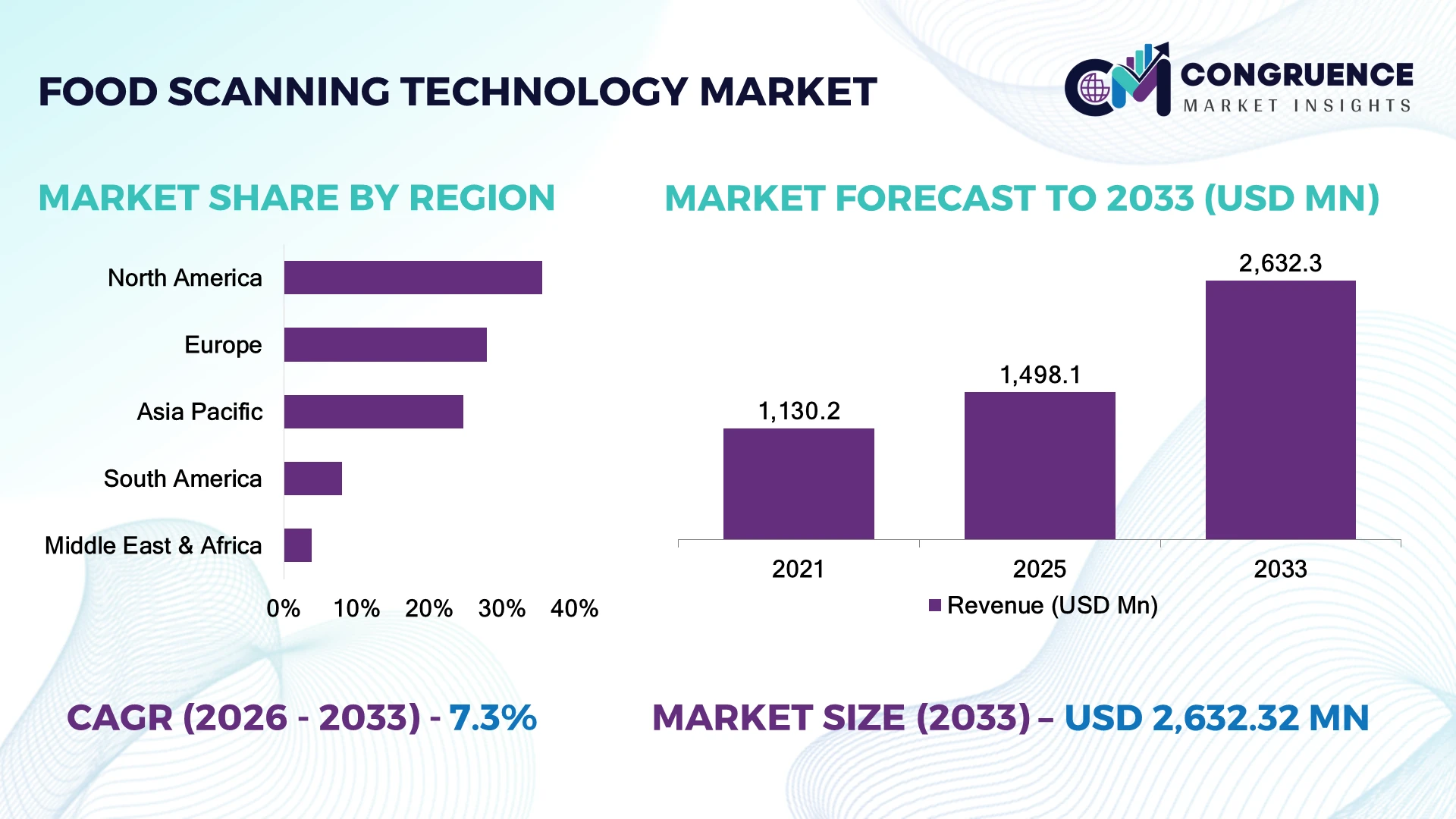
The Global Food Scanning Technology Market was valued at USD 1,498.1 Million in 2025 and is anticipated to reach a value of USD 2,632.3 Million by 2033 expanding at a CAGR of 7.3% between 2026 and 2033. Growth is driven by automated food inspection, hyperspectral imaging, AI-based contaminant detection, stricter traceability requirements, and processors replacing destructive laboratory sampling with high-speed inline scanning.
The United States accounts for approximately 30% of global food scanning technology deployment, supported by large meat, dairy, packaged-food, and fresh-produce industries investing in X-ray, near-infrared, machine-vision, and hyperspectral systems. Advanced scanners increasingly inspect hundreds of products per minute while enabling near-100% inline screening. China has greater food-processing volume, but U.S. facilities maintain higher penetration of integrated optical inspection and digital quality-control systems.
Ongoing U.S.–China supply-chain diversification in 2026 reinforces demand for localized quality verification and traceability, making scanner accuracy, integration capability, and processing speed critical procurement criteria.
The strategic priority is shifting from isolated contamination checks toward continuous, data-connected food inspection capable of protecting throughput, compliance, and brand quality simultaneously.
Market Size & Growth: USD 1,498.1 million in 2025 is projected to reach USD 2,632.3 million by 2033 at 7.3% CAGR, driven by inline automated inspection.
Top Growth Drivers: Food-safety automation contributes approximately 35% of demand momentum, traceability 25%, and labor-saving quality control 20%.
Short-Term Forecast: By 2028, advanced inline scanning can reduce manual inspection requirements by 15–25% across high-throughput processing lines.
Emerging Technologies: AI vision, hyperspectral imaging, and portable spectroscopy are pushing automated detection accuracy toward 95%+ for selected defects and composition parameters.
Regional Leaders: By 2033, North America approaches USD 850 million, Europe USD 700 million, and Asia-Pacific USD 800 million, with inline deployment expanding fastest in automated plants.
Consumer/End-User Trends: Large food processors represent approximately 55–60% of commercial scanner deployment as continuous quality verification replaces periodic sampling.
Pilot/Case Example: In 2025, AI-assisted optical inspection deployments demonstrated approximately 20–30% reductions in manual sorting requirements in selected high-volume food-processing applications.
Competitive Landscape: TOMRA holds an estimated 15–18% position in relevant food sorting and scanning systems, competing with Bühler, Key Technology, Sesotec, and Eagle Product Inspection.
Regulatory & ESG Impact: Automated foreign-material detection can reduce avoidable product rejection and processing waste by approximately 5–10% in optimized applications.
Investment & Funding: More than USD 1 billion in cumulative technology investment and capacity expansion is supporting AI inspection, spectroscopy, automation, and intelligent sorting ecosystems.
Innovation & Future Outlook: Next-generation multimodal scanners combining spectral and visual data can improve defect classification performance by 10–20% over conventional single-sensor inspection.
Food scanning technology is increasingly concentrated in meat, seafood, dairy, bakery, fruit, vegetable, and packaged-food processing, where contamination control and composition verification directly affect operating economics. AI-enabled vision and hyperspectral systems are moving inspection inline, with advanced installations reducing manual quality-control intervention by approximately 20%. In 2026, tighter traceability expectations are accelerating the transition toward connected inspection architectures and continuous process intelligence.
Food scanning technology is becoming strategic infrastructure for processors seeking tighter food-safety control without sacrificing production speed. Labor constraints, stricter traceability expectations, retailer quality specifications, and increasingly automated factories are moving inspection from periodic laboratory testing toward continuous digital verification. Large processors are integrating scanner outputs with manufacturing execution and quality-management systems, turning inspection data into actionable production intelligence rather than standalone rejection signals.
Hyperspectral and AI-enabled optical systems provide a significant operational advantage over conventional manual or sample-based inspection. In suitable applications, automated scanning can reduce manual inspection requirements by 15–25% while screening virtually 100% of line throughput instead of testing small samples. North America and Western Europe emphasize advanced integrated inspection and traceability, while China and Southeast Asia increasingly prioritize scalable automation for high-volume processing and export compliance.
Through 2028, multimodal systems combining X-ray, optical, spectral, and AI analytics will gain deployment across high-throughput plants. For example, processors can automatically identify foreign material, classify defects, and redirect rejected products without stopping production. Suppliers are consequently investing in software analytics, sensor integration, service networks, and processor partnerships. Competitive advantage will increasingly depend on converting inspection accuracy into measurable yield, compliance, and throughput improvements.
AI-enabled machine vision and hyperspectral inspection are accelerating food-scanning adoption as processors move from sample-based testing toward continuous quality control. Automated systems can reduce manual inspection requirements by 15–25% and increase inspection coverage from periodic sampling to virtually 100% of production flow. U.S. meat and packaged-food processors are integrating optical, X-ray, and spectral sensors with production lines to identify foreign material and quality deviations earlier. Labor shortages are reinforcing this shift, particularly in high-throughput facilities. Scanner manufacturers are responding with AI classification, edge analytics, and modular inspection platforms. The non-obvious advantage is improved process intelligence: inspection data increasingly supports upstream process correction, reducing repeated defects rather than simply rejecting finished products.
Integration complexity remains a significant constraint because advanced food scanning systems must interface with conveyors, PLCs, manufacturing execution systems, and existing quality-control infrastructure. Retrofit projects can increase installation costs by 10–20%, while specialized hyperspectral and X-ray equipment typically requires 5–15% higher maintenance expenditure than conventional visual inspection. Smaller processors in India and Southeast Asia face greater capital constraints than multinational food manufacturers. Compatibility between legacy control systems and newer AI-enabled platforms also creates commissioning delays. Companies are mitigating these pressures through modular scanners, leasing models, standardized interfaces, and multi-year service contracts. A key operational issue is that scanner economics depend on throughput: underutilized equipment can materially weaken return on investment even when detection performance is technically superior.
Multimodal scanning creates an emerging opportunity by combining RGB vision, hyperspectral imaging, X-ray, and AI analytics within coordinated inspection workflows. Combining sensor outputs can improve selected defect-classification performance by 10–20% and reduce manual quality-control intervention by approximately 15–25%. China and India offer particularly attractive opportunities as food-processing plants modernize export-oriented production lines. The expansion of private-label packaged foods is also increasing requirements for standardized inspection across multiple facilities. Companies are developing software-defined inspection platforms that allow algorithms to be upgraded without replacing hardware. This creates a non-obvious revenue opportunity around recurring analytics, remote calibration, predictive maintenance, and application-specific AI models rather than one-time scanner sales. Strategic partnerships with processors can accelerate algorithm training and deployment.
The next challenge is converting isolated scanner outputs into reliable plant-wide intelligence without creating cybersecurity and interoperability vulnerabilities. Connected inspection systems can generate thousands of image or spectral records per production shift, increasing data-management requirements by an estimated 20–30% in highly automated facilities. Integration with MES, ERP, and cloud platforms can add 10–15% to implementation complexity when legacy equipment lacks standardized interfaces. U.S. and European processors increasingly require controlled access, audit trails, and secure remote diagnostics as scanners become networked assets. Companies must therefore invest in edge processing, encrypted communications, standardized APIs, and workforce training. The strategic pressure is shifting from detection accuracy alone toward dependable data architecture, because inconsistent connectivity can undermine otherwise high-performing automated inspection systems.
AI Classification Moves Inline: AI-enabled inspection is shifting from pilot systems toward continuous production deployment, with selected applications achieving 95%+ classification accuracy and reducing manual sorting requirements by 20–30%. U.S. processors are integrating edge AI directly into conveyors, allowing faster rejection decisions without sending every anomaly to laboratory review.
Hyperspectral Inspection Broadens: Hyperspectral systems are expanding beyond contamination detection into moisture, composition, freshness, and adulteration screening. Adoption in advanced processing environments is estimated at 10–15%, while combined spectral-vision architectures can improve selected detection performance by 10–20%. Equipment suppliers are increasingly pairing sensors with application-specific software rather than selling hardware independently.
Compact Scanners Reach Plants: Lower-footprint optical and X-ray systems are entering medium-sized processing facilities as modular architectures reduce integration requirements by approximately 15–20%. This is particularly relevant in India and Southeast Asia, where processors are modernizing individual production lines instead of undertaking full-factory automation. Vendors are responding with scalable configurations and subscription-based analytics.
Inspection Data Becomes Operational: Connected scanners are increasingly feeding production and quality-management systems, converting inspection records into process-control signals. Automated data capture can reduce manual documentation workloads by 20–25% and accelerate defect-response workflows by 10–15%. Traceability expectations and retailer quality requirements are pushing companies to retain machine-generated inspection records as part of digital batch histories.
X-ray food scanning systems represent the leading technology type, accounting for approximately 32–36% of the global market, supported by strong foreign-material detection, compatibility with packaged products, and reliable inline integration. Metal detection follows at around 25–30%, benefiting from lower acquisition costs and established deployment across bakery, meat, and packaged-food lines. Optical and machine-vision systems contribute approximately 20–25%, while hyperspectral and near-infrared systems represent roughly 10–15% but are the fastest-growing category as processors seek non-destructive composition and quality analysis.
The investment shift is moving toward multimodal inspection, where X-ray, optical, and spectral sensors operate within connected quality-control architectures. Advanced installations can reduce manual inspection requirements by 15–25%, while AI-assisted classification improves selected defect-recognition performance by 10–20%. Larger processors are prioritizing integrated platforms, whereas smaller plants favor modular metal-detection and vision systems. Suppliers are responding through sensor integration, software upgrades, and processor-specific algorithms, making interoperability and upgradeability increasingly important purchasing criteria.
A 2025 food-manufacturing survey found that 21% of respondents were already pursuing AI or machine-learning initiatives, indicating that intelligent inspection is moving into active industrial adoption while conventional equipment remains dominant.
Packaged food inspection accounts for approximately 35–40% of food scanning technology demand, reflecting extensive use of X-ray, metal detection, and machine vision for foreign-material detection, seal verification, fill-level control, and label inspection. Meat and poultry inspection represents around 25–30%, while fruits and vegetables contribute approximately 15–20%. Bakery, dairy, beverages, and other applications account for the remainder. Processed and packaged foods remain the most mature deployment environment because standardized packaging and continuous conveyor production simplify scanner integration.
Meat, seafood, and fresh-produce inspection represent faster-shifting applications as processors combine imaging with AI-based grading and defect classification. Automated inspection can reduce manual quality-control intervention by approximately 20–30% in suitable high-throughput workflows. U.S. processors are increasingly integrating inspection with sorting and rejection systems, while Indian and Southeast Asian plants are adopting modular equipment as production lines modernize. Companies are therefore expanding application-specific software, remote diagnostics, and integrated inspection packages rather than selling standalone scanning hardware.
PMMI's 2026 processing-industry assessment identifies AI-assisted inspection, inspection-linked quality controls, and turnkey integration as active investment priorities for U.S. food and beverage processors.
Large food-processing companies account for approximately 55–60% of food scanning technology deployment because high production throughput provides the strongest economic case for continuous inspection. Contract manufacturers and co-packers contribute approximately 20–25%, while small and medium-sized processors represent roughly 15–20%. Large processors favor integrated X-ray, vision, and spectral platforms connected to manufacturing execution systems, while smaller facilities remain more price-sensitive and typically prioritize modular metal detection or basic optical inspection.
Contract manufacturers and co-packers represent the fastest-shifting end-user group as customers increasingly impose standardized food-safety and traceability requirements across outsourced production. Automated inspection can reduce manual quality-control workloads by approximately 15–25%, improving consistency across multiple product runs. Suppliers are responding with scalable configurations, leasing and service models, and standardized interfaces that reduce deployment complexity. The commercial opportunity is increasingly tied to lifecycle support, software, calibration, and analytics rather than equipment sales alone. Smaller processors remain an important expansion pool as compact systems lower the capital threshold for automation.
A 2025 food-manufacturing survey reported that 23% of respondents ranked automation as their top manufacturing priority, while workforce constraints continued influencing investment decisions across processing facilities.
North America accounted for the largest market share at 35.5% in 2025 however, Asia-Pacific is expected to register the fastest growth, expanding at a CAGR of 8.7% between 2026 and 2033.

Automated inspection is shifting from standalone detection toward connected quality control
North America represents approximately 35.5% of the global food scanning technology market, supported by highly automated meat, dairy, bakery, beverage, and packaged-food processing. The United States accounts for more than 80% of regional demand, with large processors increasingly integrating X-ray, machine vision, metal detection, and hyperspectral systems into continuous production lines. Approximately 60–65% of advanced installations are concentrated in large-scale processing facilities where throughput justifies multimodal inspection. Demand is also being strengthened by workforce shortages and stricter traceability expectations. Suppliers are increasingly combining scanners with AI analytics, remote diagnostics, and manufacturing-execution integration. The strategic shift is from detecting finished-product defects toward identifying process deviations earlier, allowing processors to protect yield while reducing manual inspection dependency.
United States Market Outlook: The United States is the region's dominant market, supported by its large packaged-food, meat, dairy, and beverage processing base. Approximately 30% of global food scanning technology demand is concentrated in the country. High-throughput facilities increasingly deploy connected inspection systems capable of screening virtually every production unit, strengthening demand for X-ray, vision, and AI-enabled quality-control platforms.
Regulatory intensity is accelerating intelligent inspection modernization
Europe represents approximately 27.9% of global food scanning technology demand, supported by stringent food-safety requirements, sophisticated food-processing infrastructure, and high automation penetration. Germany, France, Italy, the Netherlands, and the United Kingdom account for a substantial portion of regional deployments. Approximately 55–60% of European demand is concentrated in large and medium-sized automated processing facilities, where traceability and consistent product specifications are critical. Manufacturers are increasingly integrating machine vision with robotics and digital quality-management systems. The region is also moving toward lower-waste production, making non-destructive inspection strategically important for reducing unnecessary product rejection. European equipment suppliers are strengthening modular platforms and system-integration partnerships to retrofit existing production lines without extensive plant redesign.
Germany Market Outlook: Germany is Europe's leading industrial hub for food scanning technology, supported by advanced machinery manufacturing, automated food-processing facilities, and strong engineering capabilities. Approximately 20–25% of European advanced inspection-system deployments are concentrated in German industrial operations. Demand is shifting toward integrated vision, robotics, and sensor-based quality monitoring, creating opportunities for suppliers offering interoperable inspection platforms and lifecycle service support.
High-volume food manufacturing is accelerating scanner automation
Asia-Pacific accounts for approximately 24.7% of the global food scanning technology market, with China, Japan, South Korea, India, and Australia representing major deployment centers. China and India together account for more than 55% of regional demand, supported by expanding packaged-food production, export-oriented processing, and modernization of manufacturing lines. Approximately 40–45% of new installations increasingly incorporate automated inspection or digital quality-control functionality. Cost-sensitive processors continue adopting modular metal detection and vision systems, while larger exporters are moving toward X-ray, hyperspectral, and AI-enabled inspection. Suppliers are expanding local service networks and partnering with equipment integrators to reduce installation complexity. The region's strongest opportunity lies in upgrading high-volume facilities where automation can simultaneously address labor constraints and export-quality requirements.
China Market Outlook: China is the region's largest deployment base because of its enormous processed-food manufacturing capacity and increasingly automated production infrastructure. Approximately one-third of Asia-Pacific food scanning technology demand is concentrated in China. Large meat, seafood, packaged-food, and beverage producers are adopting inline inspection to strengthen consistency, foreign-material detection, and export compliance.
Export-oriented food processing is driving selective automation
South America represents approximately 8.0% of global food scanning technology demand, with Brazil accounting for nearly 65–70% of regional deployment. The country's meat, poultry, dairy, grain, fruit, and packaged-food industries provide the strongest application base, particularly among export-oriented processors. Approximately 45–50% of regional scanner demand is associated with large processing facilities requiring continuous inspection for foreign material, packaging integrity, and product consistency. Investment remains more selective than in North America or Europe because capital budgets and technical-service availability vary substantially between facilities. Companies are therefore favoring modular systems that can be integrated into existing conveyors and upgraded later with analytics. Export requirements are an important catalyst, pushing Brazilian processors toward validated inspection systems capable of supporting consistent quality across high-volume production.
Brazil Market Outlook: Brazil is the region's principal market, supported by its globally significant meat, poultry, agricultural-processing, and food-export industries. Large exporters increasingly require automated inspection to maintain consistent product specifications across high-throughput facilities. Approximately 70% of South America's large-scale food-processing scanner deployments are concentrated in Brazil, creating a strong market for X-ray, metal detection, machine vision, and checkweighing integration.
Food-security investment is creating new demand for automated inspection
Middle East & Africa accounts for approximately 3.9% of global food scanning technology demand, with Saudi Arabia, the UAE, South Africa, Egypt, and Israel representing key deployment centers. Saudi Arabia and the UAE are investing in food-processing modernization, smart logistics, and digital food-safety infrastructure as part of broader food-security strategies. Approximately 50–55% of regional demand is concentrated in large processors, distribution operations, and government-linked food-control environments. Adoption is increasingly moving beyond conventional metal detection toward optical inspection, spectroscopy, and AI-assisted risk assessment. Companies are responding through local partnerships, regional service networks, and compact inspection systems suited to newer processing facilities. The strategic opportunity is strongest where domestic food production and imported-food verification require rapid, digitally documented inspection.
Saudi Arabia Market Outlook: Saudi Arabia represents the region's strongest emerging market because food-security programs are encouraging domestic processing capacity and technology modernization. Food manufacturers and regulatory operations are increasingly adopting AI, digital inspection, and rapid analytical technologies. The country's emphasis on smart infrastructure creates opportunities for integrated scanning platforms that connect factory inspection, traceability, and food-safety monitoring rather than operating as isolated devices.
TOMRA, Bühler, Eagle Product Inspection, Mettler Toledo, and Sesotec compete across optical sorting, X-ray inspection, metal detection, and AI-enabled quality control, while Fortress targets integrated inspection and mid-market processors. The top five players hold an estimated 45–50% combined share, leaving room for specialized regional suppliers. Competition centers on detection performance, throughput, integration, and lifecycle cost: AI platforms can improve selected classification performance 10–20%, advanced X-ray systems operate above 1,000 products per minute, and automated inspection can reduce manual intervention 15–25%. Bühler and TOMRA are strengthening AI-driven optical sorting, while Eagle and Mettler Toledo emphasize X-ray and integrated inspection. Fortress competes through modular systems, digital reporting, and easier retrofit deployment. The competitive shift is toward multimodal inspection, software connectivity, and recurring analytics rather than standalone hardware. Entry barriers include application data, validation, service networks, and food-safety compliance. Winning requires superior detection, high throughput, interoperability, and measurable yield or waste reduction consistently.
TOMRA Food
Bühler Group
Eagle Product Inspection
Mettler Toledo
Sesotec
Fortress Technology
Key Technology
Minebea Intec
Thermo Fisher Scientific
Ishida
JBT Marel
Satake Corporation
Raytec Vision
Heat and Control
AI-powered optical sorting is moving from basic defect recognition toward deep-learning classification, while hyperspectral, laser, and multisensor platforms expand detection beyond visible defects. AI can improve selected classification performance by 10–20%, while laser sensing strengthens detection of fine or invisible defects. Advanced optical systems now represent an estimated 25–30% of new high-end sorting deployments, particularly in produce, nuts, grains, and processed foods.
Photon-counting and dual-energy X-ray systems are improving contaminant visibility in dense and packaged products. Modern platforms can detect contaminants below 1 mm in selected applications and operate at more than 1,000 products per minute. Compared with conventional single-energy inspection, dual-energy architectures can improve detection performance by approximately 10–15% while reducing false rejects by 5–10%. Integration with checkweighers, vision systems, reject mechanisms, and manufacturing data platforms is becoming standard.
Between 2026 and 2028, multimodal inspection will gain competitive importance as processors seek one connected architecture for safety, quality, traceability, and yield optimization. Edge AI can reduce response latency by 10–20%, while automated data capture cuts manual documentation by 15–25%. TOMRA and Bühler benefit strongly from AI-enabled sorting expertise, while Eagle, Mettler Toledo, Sesotec, and Fortress gain from connected X-ray, metal detection, and inspection ecosystems across high-throughput food production environments.
May 2025 Bühler launched SORTEX AI700, using deep learning to improve impurity detection in oats. The platform targets higher yield and purity while reducing operator dependence, strengthening AI-based optical sorting for processors seeking measurable quality and yield gains. Source: buhlergroup.com
April 2025 Eagle Product Inspection redesigned its Pipeline X-ray system with photon-counting dual-energy technology for pumped foods. The system improves bone and metal detection while supporting variable-speed operation, helping meat and poultry processors strengthen safety without disrupting throughput. Source: eaglepi.com
July 2025 Fortress Technology launched Vyper Vision automated label inspection, examining every pack at 200ppm for labels, allergens, dates, ingredients, and barcodes. The system targets costly labeling errors and integrates digital rejection records, strengthening end-of-line regulatory compliance controls. Source: fortresstechnology.com
June 2025 TOMRA Food highlighted AI-powered sorting and grading, using machine learning and deep learning to classify defects and optimize pack-out. The shift strengthens operator decision-making and supports consistent quality as processors manage variable seasonal production conditions efficiently. Source: tomra.com (TOMRA)
The Food Scanning Technology Market Report covers X-ray systems, metal detectors, optical and machine-vision systems, hyperspectral and near-infrared technologies, and emerging multimodal inspection platforms. Application analysis spans packaged foods, meat and poultry, seafood, fruits and vegetables, dairy, bakery, beverages, grains, nuts, and processed foods, while end-user coverage includes large processors, contract manufacturers, co-packers, and smaller processing facilities.
The study evaluates AI-enabled inspection, photon-counting X-ray, laser sensing, spectral imaging, automated rejection, digital traceability, and manufacturing-system integration. Regional coverage includes North America, Europe, Asia-Pacific, South America, and Middle East & Africa, with country-level analysis of major processing hubs. Quantitative assessment incorporates segment shares, deployment penetration, throughput levels, technology adoption, and company participation. The report supports investment planning, plant modernization, technology selection, partnerships, expansion strategy, and competitive positioning through 2033.
| Report Attribute/Metric | Report Details |
|---|---|
|
Market Revenue in 2025 |
USD 1,498.1 Million |
|
Market Revenue in 2033 |
USD 2,632.3 Million |
|
CAGR (2026 - 2033) |
7.3% |
|
Base Year |
2025 |
|
Forecast Period |
2026 - 2033 |
|
Historic Period |
2021 - 2025 |
|
Segments Covered |
By Type
By Application
By End-User
|
|
Key Report Deliverable |
Revenue Forecast, Growth Trends, Market Dynamics, Segmental Overview, Regional and Country-wise Analysis, Competition Landscape |
|
Region Covered |
North America, Europe, Asia-Pacific, South America, Middle East, Africa |
|
Key Players Analyzed |
TOMRA Food, Bühler Group, Eagle Product Inspection, Mettler Toledo, Sesotec, Fortress Technology, Key Technology, Minebea Intec, Thermo Fisher Scientific, Ishida, JBT Marel, Satake Corporation, Raytec Vision, Heat and Control |
|
Customization & Pricing |
Available on Request (10% Customization is Free) |




