
Reports
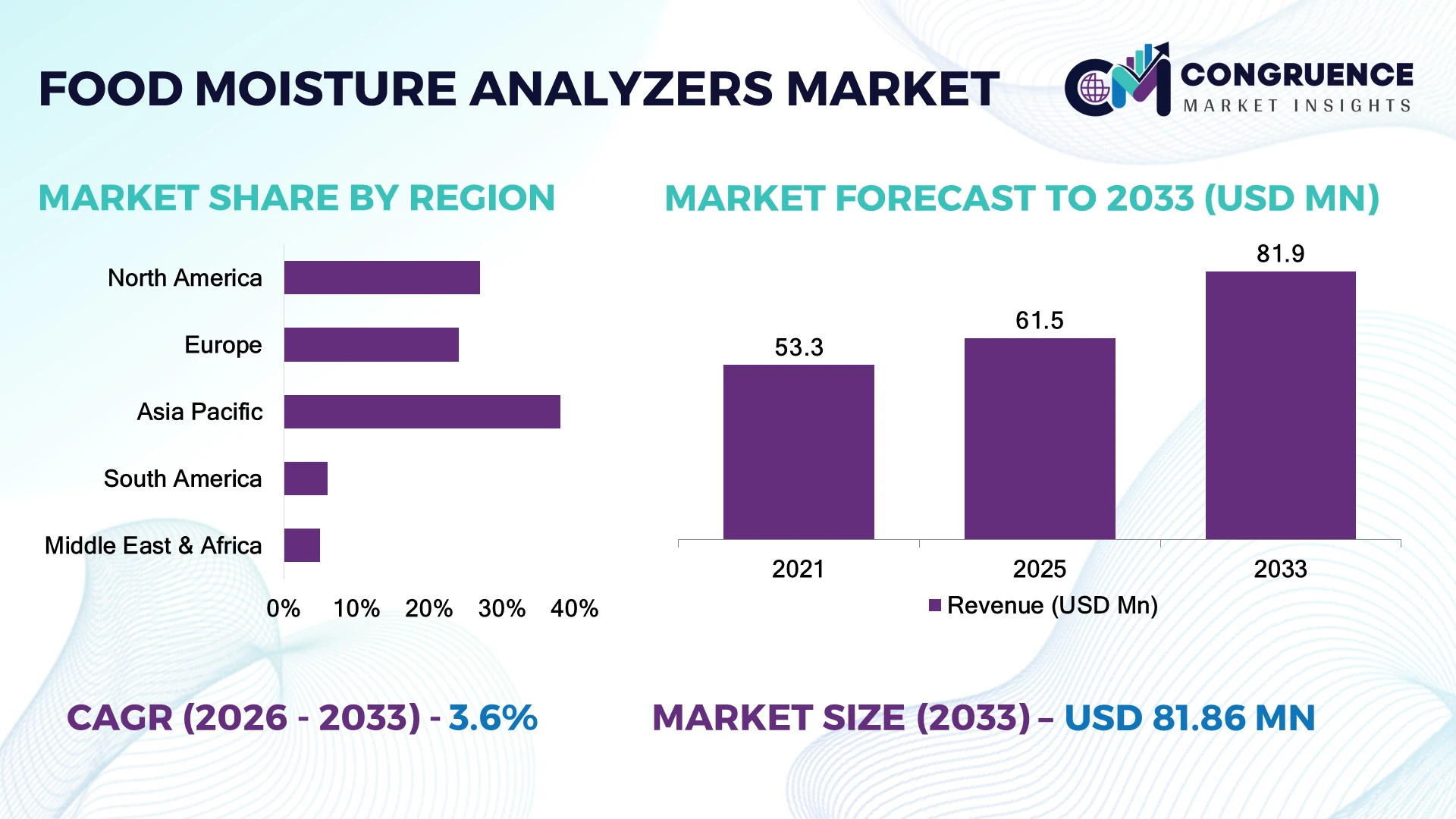
The Global Food Moisture Analyzers Market was valued at USD 61.5 Million in 2025 and is anticipated to reach a value of USD 81.9 Million by 2033 expanding at a CAGR of 3.64% between 2026 and 2033. Growth is driven by tighter food quality compliance requirements, rising in-line moisture testing across processed food production, and increasing automation in quality assurance laboratories.
China dominates the market with an estimated 29% share of global food moisture analyzer installations, supported by over USD 1.5 billion in annual food processing modernization investments and a food manufacturing sector exceeding 40,000 large-scale enterprises. Moisture testing adoption in industrial food plants surpasses 65%, compared with nearly 48% in India, while Germany maintains higher laboratory-grade analyzer penetration due to stringent quality standards. Continued manufacturing upgrades and export-focused food safety programs reinforce China’s leadership in advanced moisture measurement technologies.
Strategic implication Companies that align analyzer portfolios with automated quality control workflows and regulatory compliance requirements are positioned to secure stronger penetration across high-volume food processing facilities.
Market Size & Growth: USD 61.5 Million in 2025 reaching USD 81.9 Million by 2033, supported by wider adoption of automated food quality testing systems.
Top Growth Drivers: Automated quality inspection adoption (+22%), processed food output expansion (+18%), and food safety compliance spending (+15%).
Short-Term Forecast: By 2028, moisture testing cycle times are projected to decline by 20% through advanced digital instrumentation.
Emerging Technologies: AI-assisted calibration, infrared moisture sensing, and cloud-connected laboratory automation improve testing precision.
Regional Leaders: Asia Pacific (~USD 31 Million), North America (~USD 20 Million), and Europe (~USD 18 Million) supported by food safety digitization initiatives.
Consumer/End-User Trends: More than 60% of large food manufacturers prioritize real-time moisture monitoring for production consistency.
Pilot/Case Example: In 2024, automated moisture monitoring deployment reduced batch testing errors by approximately 25% in industrial food processing operations.
Competitive Landscape: Leading suppliers collectively control nearly 45% of market activity, including Sartorius, Mettler Toledo, A&D Company, PCE Instruments, and Shimadzu.
Regulatory & ESG Impact: Food waste reduction programs improve raw material utilization by up to 12% through precise moisture control.
Investment & Funding: More than USD 250 Million has been directed toward food testing automation, digital laboratories, and analytical instrumentation upgrades.
Innovation & Future Outlook: Smart analyzers with predictive diagnostics and connected quality-management platforms are strengthening operational decision-making.
Food Moisture Analyzers are becoming increasingly important across bakery, dairy, meat, grain, and packaged food applications where precise moisture control directly affects product quality and shelf stability. Advanced infrared and halogen-based systems are replacing slower manual methods, while connected testing platforms improve production visibility. Nearly 30% of newly installed systems now support digital data integration, reflecting stronger traceability requirements and growing pressure to optimize raw-material utilization across global food supply chains, creating a foundation for broader strategic adoption.
Food moisture analyzers are becoming strategically important because product consistency, regulatory compliance, and production efficiency increasingly depend on accurate moisture measurement. Food manufacturers are modernizing quality-control infrastructure to reduce waste, improve yield management, and strengthen export readiness. The shift toward automated processing environments has elevated moisture analysis from a laboratory function to a critical production-control activity.
Modern halogen moisture analyzers complete measurements up to 60% faster than traditional oven-drying techniques while reducing manual intervention requirements. Germany and Japan emphasize high-precision laboratory validation systems, whereas China focuses on large-scale deployment across food manufacturing plants. More than 55% of newly commissioned food production lines now integrate digital quality-monitoring technologies, reinforcing the role of moisture analytics in operational performance.
A practical example is the integration of moisture analyzers into cereal and grain processing facilities, where continuous monitoring improves batch consistency and minimizes raw-material losses. Companies are expanding partnerships with automation providers and software vendors to strengthen connected testing capabilities. Over the next two to three years, increased deployment of smart analytical instruments and digital quality ecosystems will enhance competitive positioning, operational resilience, and long-term relevance across food manufacturing value chains.
Food manufacturers are accelerating investments in automated quality-control infrastructure to improve consistency and regulatory compliance. More than 60% of large-scale food processing facilities now utilize digital testing systems, while automated production lines have expanded by nearly 20% over the past five years. Rising export-oriented food production in China and Southeast Asia is increasing demand for rapid moisture verification technologies. This transition improves batch uniformity, reduces product rejection rates, and supports production optimization. In response, analyzer manufacturers are introducing faster halogen-based systems, cloud-enabled monitoring platforms, and integrated laboratory solutions. A notable operational insight is that real-time moisture verification helps processors reduce raw-material variability before downstream manufacturing stages, improving overall production efficiency.
Advanced food moisture analyzers remain capital-intensive for small and medium-sized food manufacturers. Equipment acquisition and calibration expenses can account for 15–25% of annual laboratory instrumentation budgets in developing markets. Nearly 40% of smaller processors still rely on conventional drying methods because of infrastructure limitations and skilled workforce shortages. Supply-chain disruptions affecting electronic components and precision sensors have also increased procurement lead times by approximately 12%. These constraints slow deployment and reduce operational scalability. To mitigate risk, manufacturers are expanding localized production, strengthening supplier agreements, and introducing modular analyzer configurations. A key strategic insight is that affordability and service accessibility remain critical factors influencing adoption beyond major industrial hubs.
The convergence of digital manufacturing and analytical instrumentation is creating new opportunities for food moisture analyzers. Approximately 30% of new installations now feature connectivity functions that support centralized quality monitoring and production analytics. AI-assisted calibration technologies improve testing consistency by more than 15%, while predictive maintenance tools can reduce equipment downtime by nearly 20%. India’s expanding packaged food sector and Indonesia’s food processing modernization initiatives present significant deployment potential. Companies are increasing R&D investment, software integration partnerships, and digital service offerings to capitalize on these trends. A non-obvious opportunity lies in combining moisture analysis with broader process-control systems to generate actionable production intelligence rather than isolated quality measurements.
As food manufacturing facilities become increasingly digitalized, integrating moisture analyzers into existing production architectures presents a significant challenge. Nearly 35% of industrial operators report compatibility issues between analytical instruments and legacy manufacturing systems. Workforce shortages in industrial automation and data management create additional implementation barriers, while software validation requirements can extend deployment timelines by over 20%. These issues affect operational consistency and limit the full value of connected quality-control programs. Companies must invest in interoperability standards, workforce training, and scalable software platforms to overcome these challenges. A critical strategic insight is that long-term competitiveness will depend not only on measurement accuracy but also on seamless integration within broader digital manufacturing ecosystems.
Smart Factory Quality Integration Food manufacturers are increasingly integrating moisture analyzers directly into digital production environments. More than 32% of newly installed systems now support centralized quality dashboards, while automated data capture has reduced manual recordkeeping by nearly 25%. Rising traceability requirements and stricter audit processes are accelerating deployment across large processing facilities in China and Germany. Companies are responding through software integration, connected instrumentation, and factory-wide monitoring architectures that improve batch consistency and operational visibility.
Faster Testing Workflow Adoption Production facilities are replacing conventional drying methods with rapid halogen-based analysis systems capable of reducing testing cycles by 50–70%. Nearly 45% of quality-control upgrades completed during the last two years prioritized testing speed and throughput improvements. Labor shortages in industrial laboratories have further accelerated workflow automation. Manufacturers are expanding analyzer portfolios with touchscreen interfaces, automated calibration functions, and simplified operating protocols to increase testing capacity without proportional workforce expansion.
Portable Analyzer Deployment Growth Portable moisture analyzers are gaining traction across grain storage, agricultural processing, and raw-material inspection activities. Field-based testing adoption has increased by approximately 28%, while pre-processing moisture verification has reduced material rejection rates by nearly 15%. Supply-chain disruptions and raw-material variability are driving greater emphasis on incoming quality validation. Companies are introducing compact, battery-powered systems and strengthening distributor networks to support decentralized testing requirements closer to procurement and storage operations.
Predictive Quality Management Expansion Food processors are increasingly combining moisture measurement with predictive quality analytics. Nearly 30% of advanced installations now integrate production data with quality-control software, while process deviations can be identified up to 20% faster than traditional review methods. A less obvious shift is the use of moisture trends to optimize energy consumption during drying operations. Companies are investing in analytics platforms, industrial connectivity partnerships, and machine-learning-enabled monitoring tools to strengthen operational decision-making.
The market is segmented into Halogen Moisture Analyzers, Infrared Moisture Analyzers, Microwave Moisture Analyzers, Karl Fischer Moisture Analyzers, and Others. Halogen Moisture Analyzers lead the market with an estimated 42% share due to rapid testing cycles, operational simplicity, and broad compatibility across food processing environments. Their ability to deliver accurate measurements within minutes supports high-throughput quality-control workflows, making them the preferred choice for large food manufacturers. Companies continue expanding halogen-based product portfolios with digital interfaces and automated calibration features to strengthen deployment across industrial laboratories. Microwave Moisture Analyzers represent the fastest-growing segment as processors increasingly seek real-time and non-destructive moisture measurement capabilities. Adoption rates within continuous production environments have increased by nearly 18%, while automated processing facilities report up to 20% faster process adjustments through in-line moisture monitoring. Infrared Moisture Analyzers remain strategically important for routine testing applications, while Karl Fischer systems retain relevance in specialized low-moisture food products requiring high analytical precision. Manufacturers are increasing investment in advanced sensing technologies and integrated software capabilities to address evolving operational requirements.
The market is segmented into Bakery & Confectionery, Dairy Products, Meat & Poultry Products, Grains & Cereals, Processed Foods, and Others. Processed Foods account for approximately 31% of total demand due to extensive quality-control requirements, high production volumes, and increasing emphasis on product consistency. Moisture verification has become operationally critical as manufacturers seek to reduce waste, improve shelf stability, and maintain compliance across large-scale production facilities. More than 55% of advanced processed food production lines now incorporate automated moisture testing during critical manufacturing stages. Grains & Cereals represent the fastest-growing application segment, supported by growing focus on storage optimization and raw-material quality management. Moisture-related losses in grain supply chains can exceed 10%, encouraging wider deployment of rapid testing technologies. Bakery & Confectionery applications continue to rely heavily on moisture control for texture and product uniformity, while Dairy Products and Meat & Poultry Products increasingly adopt advanced analytical systems to improve production precision. Companies are expanding deployment capabilities and integrating testing systems directly into quality-management workflows to strengthen operational performance.
The market is segmented into Food Processing Companies, Food Testing Laboratories, Research Institutes, Quality Inspection Agencies, and Others. Food Processing Companies dominate the market with an estimated 48% share, supported by extensive production infrastructure, continuous testing requirements, and large-scale quality assurance programs. Moisture analysis directly influences production efficiency, product stability, and raw-material utilization, making these organizations the largest purchasers of analytical systems. More than 65% of large food production facilities now perform routine moisture verification at multiple processing stages. Food Testing Laboratories represent the fastest-growing end-user segment as compliance requirements, product validation activities, and third-party testing services continue expanding. Laboratory testing volumes have increased by nearly 19% over recent years, driving investment in higher-throughput analytical platforms. Research Institutes remain important for technology validation and method development, while Quality Inspection Agencies are strengthening deployment to support regulatory oversight and export certification programs. Suppliers are responding through customized solutions, service contracts, and application-specific configurations designed for different testing environments.
Asia-Pacific accounted for the largest market share at 38% in 2025 however, Asia-Pacific is expected to register the fastest growth, expanding at a CAGR of 4.8% between 2026 and 2033.

North America represented approximately 27% of global market activity in 2025, supported by highly automated food manufacturing operations and widespread adoption of analytical quality-control systems. Food producers increasingly integrate moisture analyzers with digital production management platforms to improve product consistency and reduce waste. The region benefits from extensive deployment across bakery, dairy, grain, and packaged food facilities where real-time testing has become operationally critical. More than 60% of large food manufacturing sites utilize automated quality-monitoring infrastructure. Companies are prioritizing software-connected analytical instruments and expanding service partnerships to improve testing efficiency. Continued modernization of food production facilities and increasing emphasis on traceability are strengthening demand for advanced moisture measurement technologies.
United States Market Outlook: The United States remains the largest market within North America due to its extensive food processing infrastructure, advanced laboratory ecosystem, and strong quality assurance requirements. Large-scale manufacturers continue expanding automated testing capabilities across production facilities to improve operational precision. More than 70% of major food manufacturers operate centralized quality-control programs incorporating analytical testing technologies. Investments in digital manufacturing platforms, industrial automation, and compliance-focused quality systems continue supporting broader deployment of advanced moisture analyzers across diverse food production segments.
Europe accounted for nearly 24% of global market activity, supported by stringent food quality requirements and advanced manufacturing standards. Food producers across the region increasingly deploy high-precision moisture measurement technologies to improve consistency, traceability, and process optimization. Automated laboratory workflows have expanded significantly as manufacturers seek to reduce testing variability and strengthen production efficiency. More than 55% of food quality laboratories now utilize digitally enabled analytical systems. Companies are enhancing product portfolios through improved calibration technologies, automation features, and integrated data-management capabilities. Strong emphasis on food safety and production standardization continues to accelerate equipment modernization across industrial processing environments.
Germany Market Outlook: Germany serves as the region’s most influential market due to its advanced food manufacturing base, engineering expertise, and extensive analytical instrumentation adoption. Industrial processors prioritize precision testing and integrated quality-management systems to support domestic production and export activities. Nearly 65% of large food manufacturers employ advanced laboratory automation technologies. Continued investment in smart manufacturing initiatives and production optimization programs strengthens the country's position as a leading adopter of sophisticated moisture analysis solutions.
Asia-Pacific led the global market with approximately 38% share in 2025, supported by rapid expansion of food processing industries, growing packaged food production, and increasing quality-control investments. Large-scale manufacturing growth across China, India, and Southeast Asia is accelerating deployment of moisture analysis technologies throughout processing facilities and testing laboratories. More than 40% of newly established food production facilities in key industrial hubs incorporate advanced analytical testing infrastructure. Companies are expanding distribution networks, localized manufacturing capabilities, and technical support services to capture rising demand. Strong export-oriented food production and modernization initiatives continue reinforcing the region’s dominant position.
China Market Outlook: China represents the largest country market due to its vast food manufacturing sector, extensive industrial modernization efforts, and large-scale quality assurance programs. Food processors are increasingly adopting automated testing technologies to improve production consistency and support export requirements. More than 65% of large industrial food facilities utilize structured moisture-control procedures within quality-management frameworks. Continuous investment in manufacturing upgrades, smart factory initiatives, and food safety compliance programs strengthens long-term demand for advanced moisture analyzers across multiple processing categories.
South America accounted for approximately 6% of global market activity, supported by expanding grain processing, food exports, and agricultural value-addition initiatives. Moisture measurement plays an important role in grain storage management, product quality assurance, and export compliance. Food processors increasingly invest in analytical testing equipment to reduce spoilage risks and improve production consistency. Deployment activity has increased by nearly 15% across major agricultural processing clusters during recent years. However, infrastructure disparities and uneven technology penetration continue influencing adoption rates. Companies are strengthening local partnerships and expanding technical support capabilities to improve market accessibility and operational effectiveness.
Brazil Market Outlook: Brazil dominates the regional market due to its extensive agricultural production, grain-processing capacity, and export-oriented food industry. Moisture testing is widely utilized across cereal handling, food processing, and storage operations to improve quality management and reduce post-harvest losses. Large processors continue investing in laboratory modernization and analytical testing infrastructure. Growing emphasis on export competitiveness and product standardization is encouraging wider deployment of advanced moisture measurement technologies throughout the country's food supply chain.
The Middle East & Africa accounted for nearly 5% of global market activity, supported by food security initiatives, manufacturing modernization programs, and increasing investment in food processing infrastructure. Governments and private enterprises are expanding processing capacity to strengthen domestic food production and reduce supply-chain dependence. Quality-control requirements are becoming more rigorous, encouraging broader deployment of analytical testing technologies. More than 20% of newly commissioned food processing projects incorporate upgraded laboratory and quality-management infrastructure. Companies are responding through regional partnerships, distributor expansion, and localized service networks. Continued industrial development and food sector diversification support steady market advancement.
Saudi Arabia Market Outlook: Saudi Arabia represents the most strategically significant market in the region due to ongoing food manufacturing investments, industrial diversification programs, and modernization of processing facilities. Food producers increasingly prioritize analytical quality-control systems to improve operational efficiency and strengthen product consistency. Several large-scale processing projects have incorporated advanced laboratory infrastructure as part of broader manufacturing upgrades. Expansion of domestic food production capabilities and increasing adoption of automation technologies continue reinforcing demand for sophisticated moisture analysis equipment across the kingdom’s food industry.
The Food Moisture Analyzers Market is characterized by competition between global analytical instrumentation leaders such as Mettler Toledo, Sartorius, Shimadzu, A&D Company, and Kett Electric Laboratory, and regional value-focused suppliers competing on pricing and localized service. The top five players collectively account for approximately 52% of market activity, creating a moderately consolidated structure. Global leaders compete through measurement accuracy, digital integration, and application expertise, while regional manufacturers emphasize cost efficiency and shorter delivery cycles. Advanced halogen and infrared platforms deliver testing speeds up to 60% faster than conventional methods, while connected quality-control systems improve laboratory productivity by nearly 25%. Companies are expanding application-specific product portfolios, strengthening distributor networks, and integrating cloud-enabled data management capabilities. Competition is shifting toward software-enabled quality assurance and workflow automation rather than standalone hardware performance. Strong calibration requirements, regulatory validation standards, and technical support expectations create significant entry barriers. Winning requires precision, automation compatibility, service reliability, and deep integration within modern food quality-management ecosystems.
Sartorius AG
Shimadzu Corporation
A&D Company, Limited
Kett Electric Laboratory
PCE Instruments
Precisa Gravimetrics AG
Adam Equipment
Kern & Sohn GmbH
OHAUS Corporation
Radwag Balances and Scales
Metrohm AG
Torbal Scales
Arizona Instrument LLC
Food moisture analysis technology is shifting from conventional oven-drying procedures toward advanced halogen, infrared, and microwave measurement platforms. Modern halogen systems reduce testing times by 50–70% compared with traditional laboratory methods while improving workflow consistency. More than 60% of newly installed laboratory analyzers now utilize halogen-based heating technologies because of faster turnaround and lower operator dependency. Food manufacturers benefit through reduced batch delays, improved throughput, and more responsive process control.
Emerging technologies focus on automation, digital connectivity, and intelligent calibration. Approximately 30% of newly deployed systems support centralized quality-management integration, enabling automatic data transfer and audit-ready documentation. AI-assisted calibration functions improve measurement consistency by nearly 15%, while predictive diagnostics reduce unplanned downtime by approximately 20%. Large food processors and contract testing laboratories gain a competitive advantage through faster compliance verification and improved operational visibility.
Between 2026 and 2028, microwave sensing, in-line moisture monitoring, and cloud-connected analytical ecosystems are expected to accelerate deployment across continuous production environments. Real-time monitoring can improve process adjustment speed by nearly 25% compared with laboratory-only testing. Companies investing early in integrated analytical platforms, automated reporting systems, and digital quality-control infrastructure will strengthen productivity, traceability, and manufacturing efficiency while reducing quality-related operational risks.
February 2026 – Sartorius reported continued expansion of its equipment and instruments business while maintaining strong investment in laboratory technologies supporting analytical testing applications. The company recorded a 7.6% increase in group sales, reinforcing its capacity to support advanced moisture analysis deployments and product development initiatives. Source: www.sartorius.com
December 2024 – Shimadzu Corporation inaugurated a new analytical and measuring instruments manufacturing facility in Suzhou, China, to address growing domestic demand. The expansion strengthens regional production capabilities and improves supply responsiveness for analytical instrumentation markets across Asia. Source: www.shimadzu.co.jp
September 2024 – Shimadzu launched the ALTRACE analytical platform featuring redesigned optical and signal-processing architecture for higher measurement sensitivity. The system enhances analytical performance and supports faster laboratory workflows, strengthening the company’s advanced instrumentation portfolio. Source: www.shimadzu.co.jp
2025 – Mettler Toledo continued expanding its laboratory instrumentation portfolio and digital laboratory ecosystem, with laboratory products representing approximately 56% of company product mix. The strategy strengthens integration between analytical instruments and automated quality-control environments, supporting broader deployment across food testing operations.
This report provides comprehensive analysis of the Food Moisture Analyzers Market across major technology platforms, applications, end-user categories, and regional markets. Coverage includes Halogen Moisture Analyzers, Infrared Moisture Analyzers, Microwave Moisture Analyzers, Karl Fischer Moisture Analyzers, and other specialized technologies. The study evaluates demand across bakery and confectionery products, dairy products, meat and poultry products, grains and cereals, processed foods, and related applications. More than 60% of current deployments are concentrated within industrial food processing environments where quality assurance and process optimization remain operational priorities.
The report further examines purchasing behavior across food processing companies, testing laboratories, research institutes, and inspection agencies while assessing deployment trends across North America, Europe, Asia-Pacific, South America, and the Middle East & Africa. Strategic insights include technology adoption patterns, automation integration trends, competitive positioning, operational benchmarks, and emerging opportunities linked to digital quality management. The analysis supports expansion planning, investment prioritization, partnership evaluation, and long-term market positioning between 2026 and 2033.
| Report Attribute / Metric | Details |
|---|---|
| Market Revenue (2025) | USD 61.5 Million |
| Market Revenue (2033) | USD 81.9 Million |
| CAGR (2026–2033) | 3.64% |
| Base Year | 2025 |
| Forecast Period | 2026–2033 |
| Historic Period | 2021–2025 |
| Segments Covered |
By Type
By Application
By End-User
|
| Key Deliverables | Revenue Forecast; Market Trends; Growth Drivers & Restraints; Technology Insights; Segmentation Analysis; Regional Insights; Competitive Landscape; Regulatory & ESG Overview; Recent Developments |
| Regions Covered | North America; Europe; Asia-Pacific; South America; Middle East & Africa |
| Companies Profiled | Mettler Toledo; Sartorius AG; Shimadzu Corporation; A&D Company, Limited; Kett Electric Laboratory; PCE Instruments; Precisa Gravimetrics AG; Adam Equipment; Kern & Sohn GmbH; OHAUS Corporation; Radwag Balances and Scales; Metrohm AG; Torbal Scales; Arizona Instrument LLC |
| Customization & Pricing | Available on Request (10% Customization Free) |




