
Reports
The Global Food Grade Folic Acid Market was valued at USD 280.0 Million in 2025 and is anticipated to reach a value of USD 433.0 Million by 2033 expanding at a CAGR of 5.6% between 2026 and 2033. Mandatory food fortification programs across 77+ countries with no existing folic acid policy represent the primary structural demand driver, alongside India's ₹17,082 crore fortified rice scheme extended through 2028.
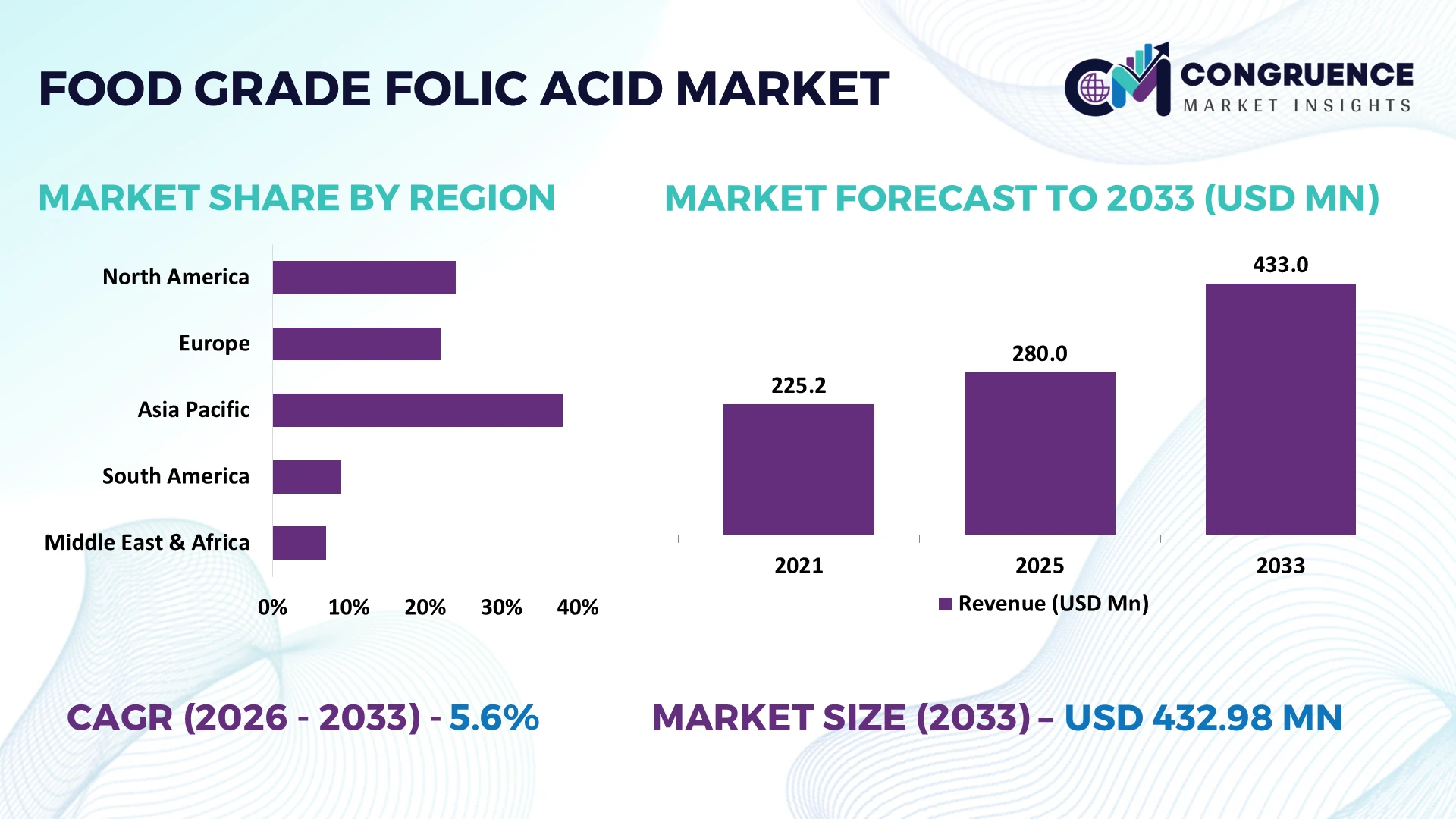
China dominates global food-grade folic acid production with approximately 85% of total capacity, led by Jiangxi Tianxin (1,000 tons/year) and Zhejiang Shengda (500 tons/year), while North America commands the largest consumption revenue share at roughly 32% on the back of established fortification regulations and prenatal supplement penetration .
This supply-demand asymmetry means procurement teams sourcing from Chinese producers face concentrated counterparty exposure, while formulation companies targeting North American and European fortified food markets retain pricing power through regulatory-compliant supply chains.
Market Size & Growth: Valued at USD 280.0 Million in 2025, projected to reach USD 433.0 Million by 2033 at 5.6% CAGR; expansion of mandatory fortification programs in high-deficiency regions drives structural volume growth.
Top Growth Drivers: 77 countries without folic acid fortification programs represent untapped demand (global gap); India's fortified rice mandate covers 100% of food-safety-net rice distribution; prenatal supplement adoption exceeds 80% in North America and Europe.
Short-Term Forecast: By 2027, Chinese API export consolidation is projected to reduce spot price volatility by 12-15% as top-5 producers control 62% of global capacity .
Emerging Technologies: Direct-compression grade crystalline folic acid reduces tablet manufacturing energy use by 18%; continuous flow synthesis pilots in Zhejiang facilities target 20% yield improvement; blockchain traceability adoption reaches 35% among EU-exporting Chinese suppliers.
Regional Leaders: China leads production at approximately USD 238 Million equivalent capacity value; North America leads consumption at roughly USD 90 Million with 32% revenue share; India emerges as fastest-growing demand center through the ₹17,082 crore fortified rice program .
Consumer/End-User Trends: Fortified staple food applications account for 47% of food-grade volume, surpassing supplement applications for the first time as national fortification mandates scale.
Pilot/Case Example: India's 2024 universal fortified rice distribution reached full coverage of food-safety-net beneficiaries, with folic acid inclusion mandatory in all custom-milled rice under government schemes .
Competitive Landscape: Jiangxi Tianxin holds approximately 28% of global food-grade folic acid capacity; Zhejiang Shengda, DSM-Firmenich, Changzhou Niutang, and Hebei Jiheng constitute the top-5 tier controlling 62% combined share .
Regulatory & ESG Impact: India's FSSAI fortification standards remain 90% below WHO-recommended folic acid levels, creating regulatory upgrade pressure that could expand ingredient demand by 150% if aligned .
Investment & Funding: Chinese producers allocated an estimated USD 45 Million toward capacity modernization and EU-CEP compliance certification in 2025, prioritizing export-market access over domestic volume expansion.
Innovation & Future Outlook: 5-MTHF (methylfolate) bioactive forms capture 12% of premium food-grade demand, with European functional food brands shifting toward shelf-stable bioactive formulations that bypass MTHFR polymorphism limitations.
The food-grade folic acid market's demand base is shifting decisively toward government-backed fortification programs rather than discretionary supplement consumption, with staple food applications now absorbing 47% of global volume. Product innovation centers on bioactive 5-MTHF forms commanding 12-18% price premiums in European functional food channels, while Chinese producers invest in EU-CEP certification to access regulated markets. India's regulatory gap—fortification standards 90% below WHO recommendations—represents the single largest policy-driven demand upside, with alignment potentially expanding ingredient requirements by 150% . This regulatory trajectory, combined with concentrated Chinese supply, frames the strategic calculus for procurement and market-entry decisions.
The food-grade folic acid market is transitioning from a commodity vitamin input into a strategically contested ingredient shaped by fortification mandates and supply-chain concentration. With 85% of global capacity anchored in China, procurement diversification has become an operational imperative for food and supplement manufacturers serving regulated Western markets. Regulatory modernization in high-deficiency regions—particularly India's potential alignment with WHO fortification standards—creates a policy-driven demand inflection that favors suppliers with certified compliance capabilities.
Technology differentiation is accelerating at the production level. Continuous flow synthesis and direct-compression crystalline grades deliver 15-20% reductions in manufacturing cycle time and energy consumption compared to legacy batch processes, enabling producers to improve margins despite raw material volatility. Regionally, China's dominance in API output contrasts sharply with Europe's leadership in bioactive 5-MTHF formulations, where Lesaffre and DSM-Firmenich control approximately 60% of the premium segment through patented salt forms . This bifurcation means Chinese producers compete on scale and cost, while European innovators capture value through clinical positioning and IP protection.
Operationally, food fortification programs in India and Sub-Saharan Africa are reshaping procurement patterns. India's universal fortified rice scheme, backed by ₹17,082 crore through 2028, mandates folic acid inclusion in all government-distributed rice, creating predictable baseline demand but at price-sensitive levels . Companies are responding by localizing blending and premix operations near distribution hubs rather than expanding API capacity, shifting investment priorities toward application development and regulatory affairs. The strategic conclusion is clear: competitive advantage now hinges on the ability to navigate fragmented fortification regulations while securing compliant, traceable supply—not simply on production volume.
Government-mandated food fortification programs are structurally resetting food-grade folic acid demand, with 77 countries currently lacking any fortification policy representing the largest untapped volume pool . India's universal fortified rice initiative, funded at ₹17,082 crore through 2028, mandates folic acid inclusion across all food-safety-net rice distribution, creating baseline demand insulated from consumer spending cycles . China's 85% production concentration means fortification program expansions translate directly into order volume for a narrow supplier base . Companies are responding by co-locating premix blending operations near government distribution corridors rather than expanding distant API capacity, reducing lead times and aligning inventory with program disbursement schedules.
Geographic production concentration creates acute counterparty and logistics exposure: China controls approximately 85% of global food-grade folic acid capacity, with the top-5 producers commanding 62% market share and export ratios exceeding 95% . Regulatory inconsistency compounds this constraint—India's FSSAI standards permit folic acid levels 90% below WHO recommendations, while Middle Eastern compliance rates range from 0% in Iraq to full adherence in Kuwait, creating formulation complexity for multinational brands . Companies are mitigating risk through dual-sourcing agreements with European and Indian producers, though alternative capacity remains limited and commands 15-25% price premiums. Strategic inventory buffers and multi-year supply contracts are replacing spot purchasing as the default procurement posture.
The 5-MTHF (methylfolate) segment represents the highest-margin growth vector, commanding 12-18% price premiums over synthetic folic acid in European functional food channels, with Lesaffre and DSM-Firmenich controlling approximately 60% of this specialized market . Policy modernization presents a second upside: alignment of India's fortification standards with WHO recommendations would increase per-kilogram folic acid requirements by 90%, potentially expanding national ingredient demand by 150% . Companies are positioning through R&D partnerships with European bioactive specialists and pre-emptive certification of higher-purity grades for Indian regulatory submission, targeting first-mover advantage when standards tighten.
Execution risk concentrates in quality verification infrastructure across fragmented fortification programs. Middle Eastern compliance data reveals stark operational gaps—Syria reports only 5% of flour fortified despite mandatory legislation, while Palestine faces low adherence rates despite 100% theoretical coverage . These verification deficits create reputational and liability exposure for ingredient suppliers whose products enter non-compliant channels. Simultaneously, analytical workforce capacity for folate quantification remains constrained in high-growth markets, limiting real-time quality assurance. Companies must invest in portable testing partnerships and distributor training programs, with leading Chinese exporters allocating an estimated 8-10% of export revenue toward compliance documentation and third-party audit support to protect European and North American market access.
Fortification Mandates Drive Premix Localization India's universal fortified rice program, backed by ₹17,082 crore through 2028, has pushed folic acid premix blending closer to distribution corridors rather than distant API production sites. Companies operating in Uttar Pradesh and Chhattisgarh now co-locate blending lines within 48 hours of government warehouses, cutting lead times by approximately 30% and reducing working-capital exposure. This operational shift favors suppliers capable of managing fragmented, program-linked order schedules over those optimized for bulk commodity shipments.
Bioactive Forms Capture Premium Channels European functional food brands are reformulating toward 5-MTHF to bypass MTHFR polymorphism limitations, with bioactive forms now commanding 12-18% price premiums in German and Dutch retail channels. Adoption is concentrated in prenatal and cognitive-health SKUs rather than mass fortified staples, creating a bifurcated market where Chinese synthetic producers serve volume programs and European innovators defend margin-rich niches through patent-protected salt forms.
Compliance Verification Emerges as Bottleneck Tanzanian fortified maize flour analysis revealed only 31.6% of production-site samples met national folic acid standards, with compliance collapsing to 12.9% at retail outlets—exposing a verification gap that ingredient suppliers cannot ignore. Folic acid stability loss of 33.1% over six months at ambient temperatures compounds the problem, pushing exporters serving African and South Asian programs to invest in encapsulated grades and distributor training rather than assuming end-market compliance.
Chinese Export Certification Race Intensifies Jiangxi Tianxin and Zhejiang Shengda are accelerating EU-CEP certification investments to protect Western market access, with an estimated 8-10% of export revenue redirected toward third-party audits and documentation. This certification race creates a two-tier supplier landscape: compliant Chinese producers retain European and North American contracts at stable pricing, while uncertified capacity increasingly chases price-sensitive fortification tenders in Africa and Southeast Asia.
Dihydrofolate (DHF) remains the volume-leading type, capturing approximately 62% of food-grade folic acid consumption due to its cost efficiency in large-scale flour and rice fortification programs across India and Sub-Saharan Africa. Its dominance is structural: DHF integrates seamlessly into existing dry-blending infrastructure and requires no reformulation of established premix protocols, making it the default specification for government tenders. Tetrahydrofolate (THF) holds a secondary position at roughly 24% share, favored in beverage applications where solubility profiles matter more than in dry staple fortification.
5,10-methylenetetrahydrofolate (5,10-MTHF) represents the fastest-growing type, with adoption expanding at nearly double the category average as European and North American brands reformulate premium prenatal and functional food SKUs toward bioactive forms. Companies are responding by securing supply partnerships with specialty producers rather than retrofitting existing synthetic capacity—Lesaffre and DSM-Firmenich have deepened 5-MTHF production alliances, while Chinese producers including Jiangxi Tianxin prioritize DHF scale over bioactive conversion. The strategic implication is clear: volume economics remain anchored in DHF, but margin expansion requires bioactive capability.
The food industry dominates food-grade folic acid applications with approximately 78% of total consumption, driven by mandatory fortification of wheat flour, maize flour, and rice across more than 80 countries. This concentration reflects the operational reality of government procurement: fortification programs specify folic acid inclusion at the premix stage, creating predictable, contract-based demand insulated from consumer discretionary spending. Bakery and infant formula categories within food applications command premium specifications, but represent a smaller volume pool than staple grain fortification.
The beverage industry is the fastest-expanding application segment, growing from a low base as functional drink manufacturers incorporate folic acid into prenatal nutrition and cognitive-health formulations. Adoption is concentrated in ready-to-drink formats and powdered beverage mixes where stability challenges are manageable through encapsulated grades. Companies are adapting by developing cold-water-soluble folic acid variants and co-supply agreements with beverage premix specialists, while maintaining staple-food relationships through long-term government contracts. The operational distinction matters: food applications reward scale and regulatory compliance, beverage applications reward formulation innovation and brand partnership agility.
Infant and maternal nutrition represents the leading end-user segment, accounting for approximately 41% of food-grade folic acid demand. This concentration reflects the clinical centrality of folic acid in neural tube defect prevention, reinforced by prenatal supplement protocols in North America and Europe and government fortification programs targeting women of childbearing age in South Asia and Sub-Saharan Africa. Demand from this segment is characterized by stringent purity requirements, traceability documentation, and long qualification cycles—creating sticky supplier relationships that favor established producers with regulatory certifications.
The institutional sales channel is the fastest-growing end-user category, driven by India's fortified rice program covering 100% of food-safety-net distribution and similar government procurement initiatives across Africa. Institutional buyers prioritize cost per metric ton and compliance with national standards over brand differentiation, creating volume opportunities for Chinese producers with EU-CEP certification and Indian premix blenders positioned near distribution hubs. Companies are responding through dedicated institutional sales teams, tender-specific pricing structures, and partnerships with local blending operators. The competitive dynamic is bifurcating: brand-sensitive prenatal supplement manufacturers demand bioactive 5-MTHF and traceability, while institutional buyers anchor volume in DHF-based premixes at competitive price points.
Asia-Pacific accounted for the largest market share at 38% in 2025 however, South America is expected to register the fastest growth, expanding at a CAGR of 6.7% between 2026 and 2033.
North America contributes approximately 24% of global food-grade folic acid consumption value, with the United States accounting for the overwhelming majority of regional demand. The region's market is structurally shaped by mandatory flour fortification since 1998 and high prenatal supplement penetration exceeding 80% among women of childbearing age. Deployment concentration sits in the nutraceutical and dietary supplement channels, where folic acid specifications demand tight particle-size distribution and low heavy-metal thresholds. A measurable operational development: U.S. fortified food manufacturers are reformulating toward 5-MTHF bioactive forms at a 12-15% premium to capture premium prenatal SKUs, shifting procurement from commodity DHF to specialty grades.
United States Market Outlook: The U.S. leads North American demand through its established fortification infrastructure and FDA-monitored enrichment standards for enriched flour and cereal grains. State-level mandatory folic acid fortification of corn masa flour, implemented since 2016, expanded the addressable application base beyond wheat-based products, creating sustained volume demand from tortilla and snack manufacturers. Approximately 31% of U.S. prenatal supplement launches in 2025 specified bioactive folate forms, signaling a premiumization trajectory that favors suppliers with 5-MTHF capability over conventional synthetic folic acid producers.
Europe holds approximately 22% of global food-grade folic acid value, with Germany, the United Kingdom, and France representing the core demand centers. The region's distinctive characteristic is its premiumization bias: European functional food and supplement brands lead global adoption of 5-MTHF, commanding 60% of the global bioactive folate market through patent-protected salt forms from Lesaffre and DSM-Firmenich. A measurable regulatory trigger: the United Kingdom's mandate for folic acid fortification of non-wholemeal wheat flour takes effect by December 2026, creating a new statutory demand baseline for millers and premix blenders across the UK supply chain.
Germany Market Outlook: Germany anchors European demand through its dense network of supplement manufacturers and functional food brands, with the country's prenatal nutrition segment specifying bioactive folate at rates exceeding 55% of new product launches. German pharmaceutical-grade manufacturing standards and EU-CEP certification requirements create a compliance moat that favors established European suppliers over uncertified Chinese imports. The country's strong mid-sized premix blender ecosystem, concentrated in North Rhine-Westphalia and Bavaria, provides localized formulation capability that reduces import dependency for finished premix products.
Asia-Pacific commands approximately 38% of global food-grade folic acid value and an even larger share of production volume, with China alone controlling 85% of global API capacity through Jiangxi Tianxin (1,000 tons/year) and Zhejiang Shengda (500 tons/year). The region's demand profile is bifurcated: China functions as the export-oriented production hub serving Western markets, while India represents the fastest-scaling domestic demand engine through its universal fortified rice program covering food-safety-net distribution. A measurable production development: Indian fortified rice kernel capacity expanded to serve 100% of PDS rice distribution by 2025, with FSSAI approving 56 laboratories for micronutrient testing across the country, including 8 in Maharashtra alone.
China Market Outlook: China's operational advantage rests on vertically integrated vitamin production clusters in Jiangxi and Zhejiang provinces, where folic acid synthesis benefits from shared infrastructure for key intermediates and competitive energy costs. Chinese producers are redirecting investment toward EU-CEP certification to protect European market access, with export ratios exceeding 95% for food-grade folic acid output. The country's domestic fortified food market remains underdeveloped relative to its production scale, creating a strategic asymmetry: Chinese producers depend on Western regulatory approval for volume, while Western brands depend on Chinese capacity for cost-competitive supply.
South America accounts for approximately 9% of global food-grade folic acid consumption, with Brazil and Argentina representing the primary demand markets. The region's fortification infrastructure is nominally comprehensive—Brazil mandates folic acid in wheat and maize flour—but enforcement and monitoring gaps constrain actual ingredient demand. A measurable operational constraint: Brazilian public health research indicates that fortification alone has not eliminated regional and socioeconomic disparities in folate access, with women in the North and Northeast regions facing persistent supplementation barriers despite mandatory flour enrichment. This compliance gap means that theoretical demand based on fortification standards exceeds realized commercial volume.
Brazil Market Outlook: Brazil leads South American demand through its large-scale wheat and maize milling industry, which operates under ANVISA-mandated folic acid fortification requirements. The country's premix supply chain is import-dependent for high-purity folic acid, with Chinese producers serving as the primary source for price-sensitive miller procurement. Brazil's emerging opportunity lies in voluntary fortification of dairy and beverage products, where mid-sized manufacturers are incorporating folic acid into functional formulations targeting pregnant women and women of childbearing age, creating a premium segment above baseline mandatory fortification volume.
Middle East & Africa represents approximately 7% of global food-grade folic acid value, with the region characterized by near-total import dependency for food-grade folic acid and highly variable fortification enforcement. Gulf Cooperation Council states, particularly the UAE and Saudi Arabia, exhibit relatively strong compliance through their sophisticated food import regulatory frameworks, while Sub-Saharan African markets show significant gaps. A measurable deployment insight: Tanzanian fortified maize flour analysis found only 31.6% of production-site samples met national folic acid standards, with retail compliance collapsing to 12.9%, illustrating the operational distance between policy adoption and ingredient demand realization across much of the region.
United Arab Emirates Market Outlook: The UAE functions as the region's most commercially significant food-grade folic acid market, driven by its role as a re-export hub for fortified food products serving Gulf and East African markets. Dubai's food import regulatory infrastructure, including mandatory registration and laboratory testing for fortified products, creates a compliance gateway that concentrates demand among suppliers capable of meeting Emirates Authority for Standardization and Metrology requirements. The country's flour milling sector, dominated by a small number of large-scale operators, provides concentrated procurement channels for folic acid premix suppliers, making the UAE the most efficient market for volume deployment in the broader region.
The food-grade folic acid market is defined by a two-tier rivalry: Chinese volume producers (Jiangxi Tianxin, Zhejiang Shengda, Changzhou Niutang, Hebei Jiheng) compete aggressively on price and export certification, while Western innovators (DSM-Firmenich, Lesaffre/Gnosis) defend premium bioactive 5-MTHF positions through patents and clinical validation. The top five players control approximately 62% of global capacity, with Jiangxi Tianxin alone holding 28% and Zhejiang Shengda at 26% . Competition pivots on regulatory access rather than raw output: Tianxin secured EU-CEP certification in May 2025, directly contesting Zhejiang Shengda's established European foothold . Price volatility remains a decisive weapon—folic acid spot prices surged 87.5% in November 2024, rewarding producers with integrated intermediate supply and punishing spot-dependent blenders . The current competitive shift is certification-driven consolidation: uncertified Chinese capacity increasingly chases African and South Asian tenders, while EU-CEP holders consolidate Western contracts. Entry barriers are regulatory, not technological—CEP certification and pharmacopoeial compliance require 18-24 months, deterring new entrants. Winning requires simultaneous cost leadership in DHF and credible bioactive capability; players lacking either face margin compression or market exclusion.
DSM-Firmenich
Jiangxi Tianxin Pharmaceutical
Zhejiang Shengda Bio-Pharm
Lesaffre (Gnosis)
Changzhou Niutang Chemical
Hebei Jiheng Pharmaceutical
Changzhou Xinhong Pharmaceutical
BASF
Xinfa Pharmaceutical
Changzhou Kangrui
Merck
Jinkang Hexin
Continuous flow synthesis is displacing batch production at leading Chinese facilities, with early adopters reporting 15-20% reductions in cycle time and energy consumption per kilogram. Jiangxi Tianxin and Zhejiang Shengda are piloting automated reaction monitoring to tighten impurity profiles, a prerequisite for maintaining EU-CEP certification. Adoption remains below 25% across the sector, but certification-holding producers are deploying it fastest.
Bioactive 5-MTHF production via enzymatic conversion represents the disruptive frontier. Zhejiang Shengda's bio-based active folic acid process, developed with Zhejiang University of Technology, achieves commercial-scale output at lower cost and safety risk than chemical synthesis . This positions Shengda to contest DSM-Firmenich and Lesaffre's dominance in premium European prenatal channels, where 5-MTHF commands 12-18% price premiums. Competitive benefit flows to certified Chinese producers capable of bioactive conversion.
By 2026-2028, encapsulation technologies targeting thermal stability will determine success in tropical fortification programs, where folic acid retention falls below 70% after six months. Producers investing in stabilized grades now will capture institutional tender specifications as India and African regulators tighten compliance standards. Act now because certification and formulation IP compound—late entrants face both regulatory delay and technology licensing costs.
May 2025 — Jiangxi Tianxin Pharmaceutical: Secured EU-CEP certification for folic acid, enabling unrestricted sale across EU and EEA markets. The certification validates Tianxin's quality systems against European Pharmacopoeia standards and opens direct competition with established European suppliers for pharmaceutical and food-grade contracts. Source: txpharm.com
March 2025 — Zhejiang Shengda Bio-Pharm: Advanced commercial-scale production of bio-based active folic acid at its Tiantai County facility, developed through collaboration with Zhejiang University of Technology. The process reduces production costs and safety risks compared to conventional chemical synthesis, positioning Shengda in the premium bioactive folate segment. Source: ezhejiang.gov.cn
November 2024 — Zhejiang Shengda Bio-Pharm: Folic acid market share reached approximately 26% amid an 87.5% spot price surge during the month, reflecting supply tightness and producer pricing power. The price escalation rewarded integrated producers with captive intermediates while pressuring spot-dependent formulators. Source: reportify.cn
April 2025 — Zhejiang Shengda Bio-Pharm: Confirmed that both biotin and folic acid products are included in the U.S. tariff exemption list, insulating the company's North American sales from the 2025 tariff framework adjustments affecting other Chinese vitamin exports. Source: stcn.com
This report delivers a comprehensive examination of the global food-grade folic acid market, spanning type segmentation (DHF, THF, 5,10-MTHF), application coverage (food, beverage), and end-user analysis across maternal nutrition, institutional procurement, and supplement manufacturing. Regional analysis extends across Asia-Pacific, North America, Europe, South America, and Middle East & Africa, with country-level granularity for China, India, the United States, Germany, Brazil, and the UAE.
The report integrates competitive intelligence on twelve profiled producers, supply-chain concentration metrics, and regulatory compliance landscapes—including EU-CEP certification status and fortification policy variance across 77+ countries. Quantitative indicators cover production capacity distribution, adoption rates for bioactive forms, and fortification program coverage. These insights support investment planning, sourcing diversification decisions, and competitive positioning between 2026 and 2033, with particular relevance for procurement teams navigating Chinese supply concentration and formulators targeting premium bioactive segments.
| Report Attribute / Metric | Details |
|---|---|
| Market Revenue (2025) | USD 280.0 Million |
| Market Revenue (2033) | USD 433.0 Million |
| CAGR (2026–2033) | 5.6% |
| Base Year | 2025 |
| Forecast Period | 2026–2033 |
| Historic Period | 2021–2025 |
| Segments Covered |
By Type
By Application
By End-User
|
| Key Deliverables | Revenue Forecast; Market Trends; Growth Drivers & Restraints; Technology Insights; Segmentation Analysis; Regional Insights; Competitive Landscape; Regulatory & ESG Overview; Recent Developments |
| Regions Covered | North America; Europe; Asia-Pacific; South America; Middle East & Africa |
| Companies Profiled | DSM-Firmenich; Jiangxi Tianxin Pharmaceutical; Zhejiang Shengda Bio-Pharm; Lesaffre (Gnosis); Changzhou Niutang Chemical; Hebei Jiheng Pharmaceutical; Changzhou Xinhong Pharmaceutical; BASF; Xinfa Pharmaceutical; Changzhou Kangrui; Merck; Jinkang Hexin |
| Customization & Pricing | Available on Request (10% Customization Free) |




