
Reports
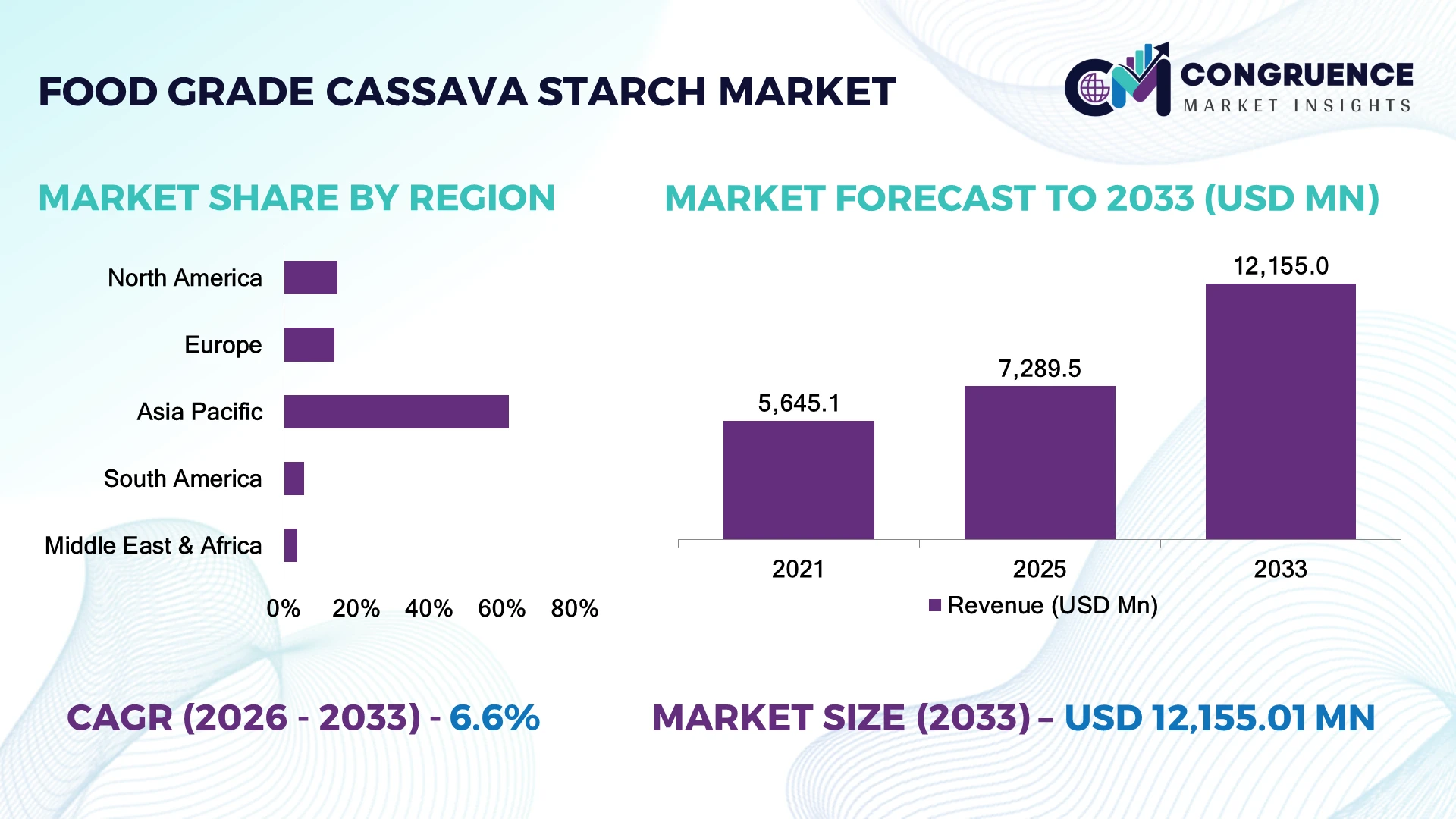
The Global Food Grade Cassava Starch Market was valued at USD 7,289.5 Million in 2025 and is anticipated to reach a value of USD 12,155.0 Million by 2033 expanding at a CAGR of 6.6% between 2026 and 2033. Rising demand for clean-label food formulations, gluten-free ingredients, and functional starch applications in processed foods is accelerating investment in advanced cassava starch processing and supply-chain modernization.
Thailand remains the dominant producer, accounting for approximately 33% of global cassava starch exports, supported by large-scale processing clusters, automated extraction facilities, and continuous investment in food ingredient manufacturing. Vietnam processes nearly 18% of global export-oriented cassava starch, while Thailand achieves over 92% food-grade production compliance through modern refining technologies. Following continued Red Sea shipping disruptions, manufacturers diversified export routes and expanded regional warehousing to maintain delivery reliability and ingredient availability.
Strategic investment increasingly favors integrated processing capacity, traceable sourcing, and high-purity food-grade starch production to secure long-term competitiveness.
Market Size & Growth: USD 7,289.5 million in 2025, reaching USD 12,155.0 million by 2033 at 6.6%, driven by clean-label food manufacturing.
Top Growth Drivers: Gluten-free demand +28%, processed food consumption +18%, functional ingredient adoption +21%.
Short-Term Forecast: By 2028, processing efficiency improves 16% through automated starch extraction.
Emerging Technologies: AI quality inspection, enzymatic modification, and digital process control enhance product consistency.
Regional Leaders: Asia-Pacific exceeds USD 6,300 million; Europe expands specialty applications; North America accelerates clean-label adoption.
Consumer/End-User Trends: Nearly 61% of new gluten-free formulations incorporate cassava-derived ingredients.
Pilot/Case Example: 2025 automated refining upgrades reduced production waste by 14% in commercial starch facilities.
Competitive Landscape: Top five producers collectively control about 48% of global supply through integrated processing.
Regulatory & ESG Impact: Water recycling systems reduce freshwater consumption by approximately 22%.
Investment & Funding: More than USD 900 million supports processing expansion and export infrastructure.
Innovation & Future Outlook: High-purity modified starches and traceable sourcing strengthen premium food ingredient positioning.
Food grade cassava starch is expanding across bakery, dairy alternatives, confectionery, sauces, and convenience foods as manufacturers prioritize label-friendly functional ingredients. Advanced purification systems improve starch purity by nearly 18%, while digital quality monitoring enhances production consistency. Increasing diversification of agricultural sourcing following global logistics disruptions is strengthening supply resilience, setting the stage for broader strategic market expansion.
Food grade cassava starch has become strategically important as food manufacturers reformulate products to satisfy clean-label expectations, gluten-free demand, and ingredient transparency requirements. Supply-chain diversification following recent global logistics disruptions has accelerated investments in regional processing facilities, contract farming, and integrated food ingredient operations, strengthening procurement resilience for multinational food producers.
Modern continuous wet-processing systems deliver approximately 17% higher extraction efficiency than conventional batch processing while reducing energy consumption by nearly 14%. Thailand continues to lead export-oriented production through highly integrated processing infrastructure, whereas Brazil is expanding domestic food ingredient applications supported by investments in value-added starch processing. Over the next two to three years, digital quality monitoring and traceability platforms are expected to support more than 45% of premium food-grade starch production.
Leading processors are deploying automated purification technologies alongside long-term grower partnerships to secure raw material quality and stable production. One notable operational trend involves integrating precision moisture control with AI-assisted quality inspection, improving consistency for bakery and beverage manufacturers. Companies prioritizing processing efficiency, supply-chain resilience, and specialty starch innovation will strengthen competitive positioning as food manufacturers increasingly demand premium functional ingredients with dependable quality and traceability.
Global food manufacturers are rapidly replacing synthetic thickeners with naturally derived starches as clean-label reformulation becomes a strategic procurement priority. More than 62% of new gluten-free bakery launches now incorporate cassava-derived ingredients, while demand for functional starches in convenience foods has increased by nearly 19%. Thailand has expanded advanced starch refining capacity to strengthen export competitiveness, supported by greater investment in automated processing. This structural shift improves product consistency and broadens application across dairy alternatives, confectionery, and sauces. In response, processors are investing in integrated production facilities, contract farming, and premium modified starch portfolios. A key competitive advantage now comes from combining traceable agricultural sourcing with high-purity processing, allowing suppliers to secure long-term contracts with multinational food manufacturers.
Cassava starch production remains vulnerable to fluctuations in root availability caused by weather variability, crop disease, and export concentration. Nearly 55% of internationally traded food-grade cassava starch originates from Southeast Asia, creating supply exposure during logistics disruptions. Raw cassava procurement costs can fluctuate by over 20% between harvest cycles, compressing processor margins and limiting pricing flexibility. Food manufacturers requiring consistent viscosity specifications face additional qualification costs when changing suppliers. To reduce operational risk, companies are expanding sourcing networks into Brazil and Africa, increasing storage capacity, and adopting long-term grower agreements. Strategic localization of processing operations has become essential to improve supply continuity while reducing dependence on a limited number of exporting countries.
Growing demand for premium food ingredients is creating opportunities for specialty cassava starch designed for protein beverages, plant-based dairy, infant nutrition, and high-performance bakery applications. Precision enzymatic modification improves functional stability by approximately 16%, while automated quality analytics reduce batch variation by nearly 14%. Indonesia and Vietnam are attracting investment in advanced starch processing as food exporters expand higher-value ingredient production. Companies are strengthening research partnerships with food formulators to develop customized starch solutions for specific texture and shelf-life requirements. An emerging opportunity lies in digital traceability platforms that connect farm-level sourcing with food manufacturing compliance, enabling premium pricing and stronger customer retention across regulated international markets.
Maintaining uniform quality across expanding production networks remains a significant operational challenge because food manufacturers demand consistent viscosity, purity, and microbiological performance. Batch variability exceeding 8% can affect formulation stability in processed foods, while laboratory testing requirements increase quality assurance costs by approximately 12%. Brazil and Thailand continue investing in digital process control, yet many medium-sized processors still rely on fragmented production systems with limited automation. Companies must integrate advanced process monitoring, predictive maintenance, and standardized supplier qualification to sustain export competitiveness. The strategic challenge extends beyond production capacity; success depends on delivering identical product performance across multiple facilities while meeting increasingly stringent global food safety and traceability requirements.
Precision Starch Modification Expands Enzymatic processing technologies now improve texture consistency by nearly 18% while reducing formulation adjustments by 15%. Food manufacturers increasingly specify customized starch functionality for bakery and dairy alternatives, prompting processors to expand application laboratories and strengthen collaborative product development with multinational food brands.
Digital Quality Control Adoption AI-assisted inspection and automated viscosity monitoring have reached approximately 47% deployment among large export-oriented processors. Digital process optimization reduces product variation by 14% and shortens release cycles. Thailand-based manufacturers are accelerating automation investments to satisfy stricter international food quality requirements and retailer compliance programs.
Supply Chain Regional Diversification Continued logistics disruptions have encouraged manufacturers to diversify cassava sourcing beyond traditional production hubs. Multi-country procurement strategies have increased by approximately 22%, while regional warehousing lowers delivery lead times by 12%. Companies are expanding contract farming and processing partnerships to strengthen ingredient availability and reduce operational exposure.
Traceability Becomes Market Differentiator End-to-end digital traceability platforms now support nearly 40% of premium food-grade starch exports. QR-enabled sourcing records simplify regulatory verification and strengthen customer confidence. Processors are integrating sustainability reporting, automated certification management, and supplier data platforms, transforming traceability from a compliance function into a competitive commercial advantage.
Native food-grade cassava starch accounted for approximately 58% of the market in 2025, maintaining leadership through cost efficiency, broad regulatory acceptance, and compatibility with bakery, confectionery, and noodle manufacturing. Its straightforward processing and stable functionality support large-scale food production, particularly across Thailand, Indonesia, and China. Modified food-grade cassava starch represents the fastest-growing segment, driven by increasing demand for enhanced freeze-thaw stability, viscosity control, and texture optimization in premium processed foods. Adoption of modified starch solutions is expanding by nearly 17% among multinational food manufacturers seeking formulation flexibility and longer shelf life.
Organic food-grade cassava starch continues gaining traction within premium clean-label categories, while instant pregelatinized cassava starch is strengthening its role in instant beverages and convenience foods because of rapid hydration performance. Manufacturers are expanding specialty starch portfolios, investing in application laboratories, and forming product development partnerships with global food brands. Investment priorities increasingly favor higher-value functional starches capable of supporting customized food formulations and premium product positioning.
According to findings published by the International Starch Institute during 2025, demand for functional modified starches continued to outpace conventional starch adoption as processed food manufacturers prioritized texture stability, clean-label performance, and formulation consistency.
Processed food accounted for nearly 44% of global demand in 2025, supported by widespread use in bakery products, confectionery, sauces, ready meals, and frozen foods. The segment benefits from high production volumes, reliable thickening performance, and compatibility with automated manufacturing systems. Dairy and dairy alternatives represent the fastest-growing application as manufacturers increasingly use cassava starch to improve creaminess, suspension stability, and texture in plant-based formulations. Product incorporation within dairy alternative launches has expanded by approximately 18%, reflecting changing consumer preferences.
Beverages, meat processing, snacks, and infant nutrition continue broadening application diversity through specialized starch formulations designed for targeted functional performance. Companies are integrating customized starch solutions into formulation platforms, expanding application-specific technical support, and strengthening collaborative innovation with food processors. Demand is becoming increasingly concentrated in applications requiring consistent viscosity, extended shelf stability, and ingredient transparency, encouraging suppliers to prioritize specialty product development over commodity starch production.
Industry assessments released by the Institute of Food Technologists in 2025 indicate that functional starch ingredients are being incorporated into more than half of newly launched clean-label processed food formulations requiring texture enhancement and stability.
Food manufacturers represented approximately 69% of total demand in 2025, driven by continuous large-scale procurement for bakery, confectionery, dairy, beverage, and convenience food production. Their purchasing strength reflects high production volumes, standardized quality requirements, and integrated manufacturing operations. Contract food processors are emerging as the fastest-growing end-user group as global brands increasingly outsource production to improve flexibility and optimize manufacturing capacity. Procurement from contract manufacturers has expanded by nearly 16%, encouraging suppliers to deliver customized starch specifications and dependable logistics support.
Foodservice ingredient suppliers, nutraceutical producers, and private-label manufacturers are also expanding purchases as demand diversifies across premium and specialized food categories. Companies are responding through application-specific product customization, technical formulation support, strategic pricing programs, and regional distribution expansion. Competitive positioning increasingly depends on providing consistent ingredient functionality, rapid technical assistance, and secure long-term supply agreements rather than competing primarily on commodity pricing.
A 2026 enterprise survey conducted by the International Food Information Council reported that ingredient consistency and traceable sourcing ranked among the highest procurement priorities for commercial food manufacturers selecting functional starch suppliers.
Asia-Pacific accounted for the largest market share at 61.9% in 2025 however, North America is expected to register the fastest growth, expanding at a CAGR of 7.1% between 2026 and 2033.

Clean-label reformulation reshapes ingredient procurement
North America is strengthening its position through rising adoption of clean-label food ingredients, expanding gluten-free product portfolios, and greater use of functional starches across industrial food manufacturing. Large food processors are increasing imports of premium cassava starch while integrating automated formulation systems that improve production consistency. Approximately 68% of major packaged food manufacturers have expanded clean-label reformulation initiatives, accelerating demand for specialty starch ingredients. Investment in regional distribution infrastructure and strategic supplier agreements is improving inventory resilience while reducing procurement risks. Companies are increasingly collaborating with global starch processors to secure traceable, high-purity ingredients for bakery, dairy alternative, and convenience food production.
United States Market Outlook: The United States dominates regional consumption through its large processed food industry, advanced food manufacturing infrastructure, and strong demand for gluten-free formulations. More than 70% of commercial bakery and snack manufacturers have expanded clean-label ingredient sourcing, while investment in automated ingredient handling and digital quality control strengthens production efficiency. Food manufacturers continue securing multi-year sourcing agreements to improve supply continuity and formulation consistency.
Premium ingredient innovation drives food modernization
Europe is expanding food grade cassava starch usage through clean-label regulations, premium food innovation, and reformulation of processed foods. Manufacturers increasingly replace synthetic stabilizers with naturally derived starches to improve product transparency and functionality. Approximately 43% of specialty food launches now incorporate plant-based functional ingredients, encouraging broader use of modified cassava starch. Investment in advanced food processing technologies and application research is strengthening demand for customized starch solutions across bakery, dairy alternatives, and confectionery. Companies continue prioritizing sustainable sourcing and traceability to satisfy retailer and regulatory expectations.
Germany Market Outlook: Germany leads regional demand through its highly developed food processing industry and extensive clean-label product development. Industrial manufacturers increasingly integrate specialty cassava starch into bakery, confectionery, and dairy formulations, supported by automated production systems. Advanced ingredient testing capabilities and strong collaboration between processors and food manufacturers reinforce Germany's position as a strategic market for premium starch applications.
Manufacturing scale secures global supply leadership
Asia-Pacific remains the global production and export hub for food grade cassava starch because of abundant cassava cultivation, integrated processing infrastructure, and competitive manufacturing costs. The region contributes more than 75% of global export-oriented production, supported by continuous modernization of refining facilities and logistics networks. Automated starch extraction technologies improve production efficiency by approximately 18%, while integrated processing clusters strengthen export reliability. Companies continue expanding specialty starch production to serve premium food manufacturers across international markets.
Thailand Market Outlook: Thailand remains the world's leading exporter of food grade cassava starch through large-scale processing capacity, advanced refining technology, and well-established agricultural supply chains. More than 90% of export production complies with international food quality specifications. Continuous investment in automation, product traceability, and integrated logistics enables Thai producers to maintain strong competitiveness across premium global food ingredient markets.
Regional processing capacity gains momentum
South America is expanding food grade cassava starch production by strengthening domestic processing capacity and increasing value-added agricultural exports. Brazil is leading modernization through investment in food ingredient manufacturing and improved cassava cultivation practices. Processing efficiency has improved by nearly 15% following automation upgrades, while regional partnerships support broader commercialization of specialty starch products. Infrastructure development continues to improve market access, although logistics constraints still influence export competitiveness. Companies are prioritizing localized production and downstream food ingredient applications to capture higher-value opportunities.
Brazil Market Outlook: Brazil is the region's most significant market due to its extensive cassava cultivation base and expanding food processing sector. Industrial processors are investing in higher-purity starch production, digital process monitoring, and specialty ingredient development. Strong domestic demand from bakery, beverage, and convenience food manufacturers supports continuous processing expansion while reducing reliance on imported specialty starch products.
Food manufacturing investment expands ingredient demand
The Middle East & Africa market is advancing through investment in food manufacturing, import diversification, and modernization of packaged food production. Regional processors increasingly utilize food grade cassava starch to support clean-label formulations and improve texture performance across processed foods. Food manufacturing capacity has expanded by approximately 14% in several industrial zones, encouraging greater procurement of specialty starch ingredients. Companies are strengthening regional distribution partnerships and warehouse infrastructure to improve supply reliability while supporting expanding food production activities.
South Africa Market Outlook: South Africa serves as the region's primary commercial market through its advanced food manufacturing industry and established ingredient distribution network. Large processors increasingly adopt premium cassava starch for bakery, sauces, and convenience food applications while expanding quality assurance capabilities. Continued investment in food processing infrastructure and regional logistics strengthens South Africa's role as an important gateway for specialty food ingredients across the African market.
The market is led by global ingredient specialists including Ingredion, Tate & Lyle, Cargill, AGRANA, and regional cassava processors such as Thai Wah and SPAC, competing against domestic starch manufacturers on functionality, supply reliability, and application expertise. The top five participants collectively account for approximately 49% of global market activity. Global leaders compete through specialty starch innovation and multinational customer relationships, while regional producers leverage raw material proximity and lower processing costs. Companies offering customized starch solutions achieve customer retention rates roughly 18% higher, while vertically integrated processors reduce procurement costs by nearly 12%. Competition increasingly centers on expanding specialty ingredient portfolios, strengthening contract farming, investing in advanced refining technologies, and forming application-development partnerships with food manufacturers. The competitive shift favors traceable, value-added starches over commodity products. Entry barriers stem from food safety compliance, consistent raw material sourcing, and application expertise. Winning requires integrated sourcing, premium functional performance, reliable quality, and technical collaboration with food manufacturers.
Ingredion Incorporated
Tate & Lyle PLC
Cargill, Incorporated
AGRANA Beteiligungs-AG
Thai Wah Public Company Limited
SPAC Starch Products (India) Limited
Visco Starch
Psaltry International Company Limited
TCS Tapioca Starch Industry Co., Ltd.
PT Budi Starch & Sweetener Tbk
Universal Starch-Chem Allied Ltd.
Banpong Tapioca Flour Industrial Co., Ltd.
Advanced wet milling, automated extraction, and digital process control have become standard technologies for premium food-grade cassava starch production. Automated process optimization improves starch recovery by approximately 16%, while AI-enabled quality inspection reduces batch variation by nearly 14%. More than 48% of export-oriented processors now deploy digital production monitoring, enabling tighter viscosity control and improved food safety compliance. These technologies strengthen operational consistency and support premium ingredient positioning across bakery, dairy, and convenience food applications.
Emerging technologies include precision enzymatic modification, membrane filtration, inline spectroscopy, and blockchain-enabled traceability. Compared with conventional batch processing, continuous automated refining improves production efficiency by around 19% while lowering energy consumption by approximately 15%. Integrated digital traceability benefits multinational ingredient suppliers by simplifying regulatory documentation and strengthening customer confidence. Companies with advanced analytical capabilities secure faster product qualification and stronger long-term supply agreements than commodity-focused processors.
Between 2026 and 2028, investment will increasingly target smart manufacturing, predictive maintenance, and application-specific starch customization. Digital twin process optimization and machine learning-based formulation control will improve production flexibility while reducing waste. Manufacturers that combine automated refining, traceable agricultural sourcing, and specialty starch innovation will strengthen competitive differentiation as global food producers demand premium functional ingredients with dependable quality, regulatory compliance, and customized performance.
November 2024 Thai Wah partnered with Fuji Nihon to establish a Thailand-based joint venture for tapioca starch manufacturing and distribution, with Thai Wah holding a 51% ownership stake, expanding high-value food ingredient production and strengthening Asian export capabilities. Source: thaiwah.com
May 2025 Tate & Lyle reported continued integration of CP Kelco while expanding its specialty food ingredient portfolio, achieving 9% growth in new product revenue and strengthening starch-based texture solutions for bakery, dairy, and beverage manufacturers. Source: tateandlyle.com
February 2026 Thai Wah reported native starch volume growth of 11.8% during 2025 alongside stronger high-value ingredient expansion, reinforcing investment in premium food-grade starch production and improving operational resilience across regional processing operations. Source: Thailand SEC
June 2026 Ingredion announced its recommended acquisition of Tate & Lyle, combining complementary specialty ingredient capabilities across texturants, sweetening, and fortification to strengthen global food ingredient innovation and broaden integrated customer solution offerings. Source: GlobeNewswire
This report provides comprehensive analysis of the food grade cassava starch market across product types, applications, end-users, and major geographic regions between 2026 and 2033. It evaluates native, modified, organic, and specialty starch categories, covering applications across bakery, confectionery, dairy, beverages, processed foods, and nutrition products. Regional assessments examine manufacturing concentration, trade dynamics, processing infrastructure, and evolving procurement strategies. Technology coverage includes enzymatic modification, automated refining, digital quality monitoring, and traceability platforms supporting premium ingredient production.
The study incorporates operational indicators including segment shares, adoption rates, processing efficiency improvements, export concentration, and supplier positioning to support strategic decision-making. It assesses competitive dynamics, investment priorities, supply-chain resilience, product innovation, and regional expansion opportunities. The report enables stakeholders to evaluate capacity planning, portfolio diversification, sourcing strategies, partnership opportunities, and long-term competitive positioning as functional ingredient demand continues shifting toward higher-value, clean-label, and application-specific starch solutions.
| Report Attribute/Metric | Report Details |
|---|---|
|
Market Revenue in 2025 |
USD 7,289.5 Million |
|
Market Revenue in 2033 |
USD 12,155.0 Million |
|
CAGR (2026 - 2033) |
6.6% |
|
Base Year |
2025 |
|
Forecast Period |
2026 - 2033 |
|
Historic Period |
2021 - 2025 |
|
Segments Covered |
By Type
By Application
By End-User
|
|
Key Report Deliverable |
Revenue Forecast, Growth Trends, Market Dynamics, Segmental Overview, Regional and Country-wise Analysis, Competition Landscape |
|
Region Covered |
North America, Europe, Asia-Pacific, South America, Middle East, Africa |
|
Key Players Analyzed |
Ingredion Incorporated, Tate & Lyle PLC, Cargill, Incorporated, AGRANA Beteiligungs-AG, Thai Wah Public Company Limited, SPAC Starch Products (India) Limited, Visco Starch, Psaltry International Company Limited, TCS Tapioca Starch Industry Co., Ltd., PT Budi Starch & Sweetener Tbk, Universal Starch-Chem Allied Ltd., Banpong Tapioca Flour Industrial Co., Ltd. |
|
Customization & Pricing |
Available on Request (10% Customization is Free) |




