
Reports
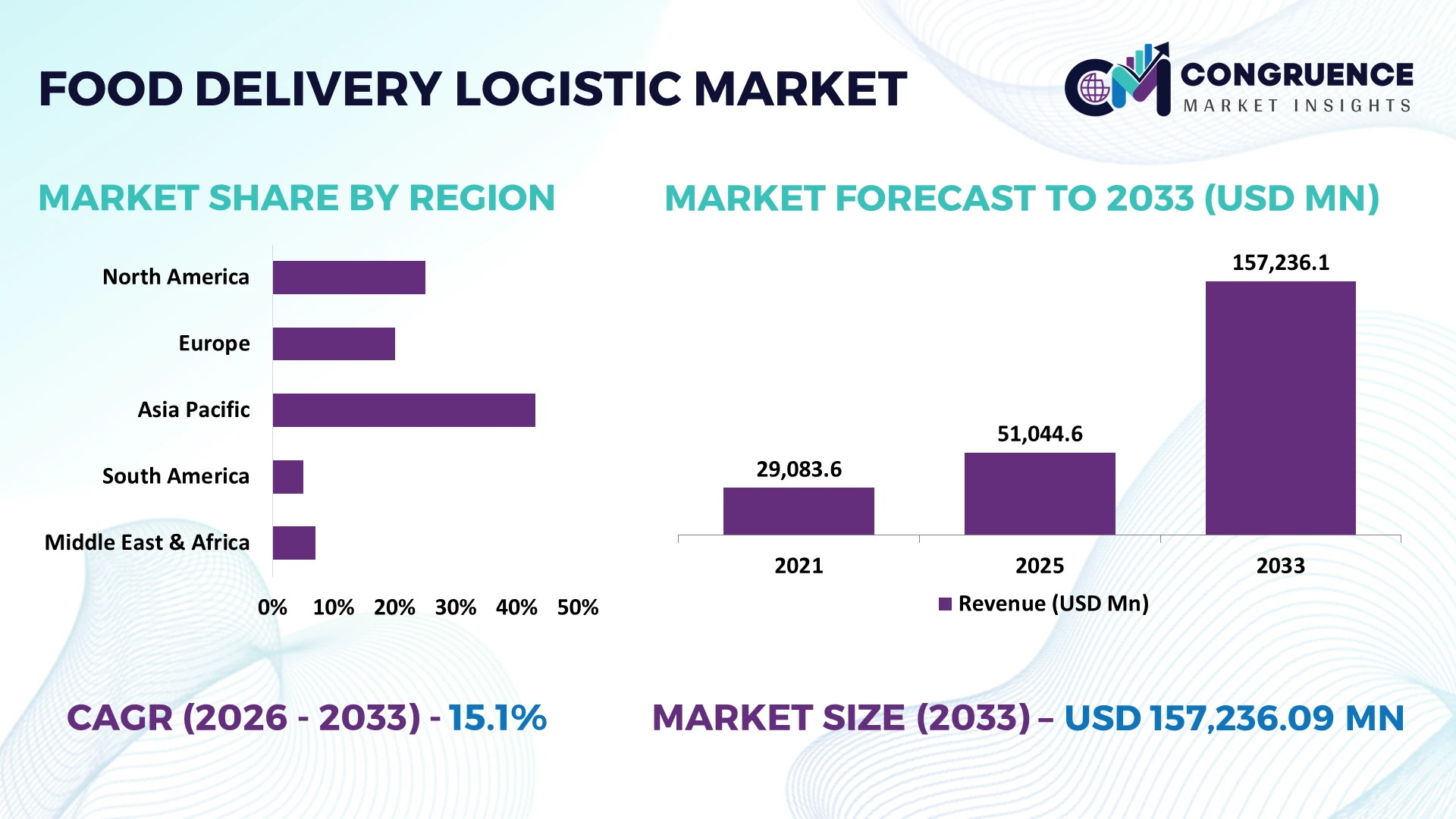
The Global Food Delivery Logistic Market was valued at USD 51044.58 Million in 2025 and is anticipated to reach a value of USD 157236.09 Million by 2033 expanding at a CAGR of 15.1% between 2026 and 2033. Growth is driven by app-based meal ordering, grocery quick-commerce, AI route optimization, dark-store networks, electric last-mile fleets, and tighter temperature-controlled delivery requirements for fresh and prepared food.
China accounts for an estimated 35% of global food delivery logistics activity, supported by more than 500 million online food-delivery users, dense urban merchant networks, and large-scale deployment of algorithmic dispatch, digital payments, and electric two-wheelers. India provides a high-growth comparison, where leading platforms collectively process millions of food orders daily and quick-commerce networks operate thousands of dark stores. U.S.–China technology and trade tensions are also encouraging platforms to diversify vehicle, battery, semiconductor, and automation technology sourcing across Asian supply chains.
Strategically, operators combining dense fulfillment networks, predictive dispatch, low-cost electric mobility, and disciplined courier utilization gain the strongest advantage in delivery economics and service reliability.
Market Size & Growth: USD 51.04 billion in 2025 reaches USD 157.24 billion by 2033 at 15.1%, driven by quick-commerce infrastructure and algorithmic last-mile orchestration.
Top Growth Drivers: Online ordering penetration above 50%, route optimization reducing delivery miles 10–20%, and electric two-wheelers lowering operating costs 20–30% accelerate logistics modernization.
Short-Term Forecast: By 2028, AI dispatch, batching, and predictive demand positioning can reduce average last-mile delivery costs by 15–20%.
Emerging Technologies: AI dispatch, autonomous delivery robots, drone logistics, and smart temperature monitoring are shifting operations toward increasingly automated fulfillment.
Regional Leaders: Applying estimated regional shares to 2033 value places Asia-Pacific near USD 66 billion, North America USD 39 billion, and Europe USD 30 billion, led by quick-commerce, platform logistics, and low-emission delivery respectively.
Consumer/End-User Trends: More than 60% of digitally active urban consumers in major markets use online food-ordering services, increasing peak-hour logistics intensity.
Pilot/Case Example: Uber Eats expanded autonomous delivery deployments in 2025, with robotic systems targeting shorter urban trips and reduced dependence on conventional courier capacity.
Competitive Landscape: Meituan commands approximately 60% of China's food-delivery platform activity; DoorDash, Uber Eats, Delivery Hero, and Grab shape other major markets.
Regulatory & ESG Impact: EU transport policy targets a 55% net greenhouse-gas reduction by 2030, accelerating electric bicycles, scooters, vans, and route-efficiency investment.
Investment & Funding: DoorDash completed its approximately USD 3.9 billion Deliveroo acquisition in 2025, reinforcing cross-market logistics scale and technology integration.
Innovation & Future Outlook: Autonomous robots, drones, predictive kitchens, and AI dispatch can shift 10–20% of suitable short-distance deliveries toward increasingly automated fulfillment models.
Food Delivery Logistic Market demand is concentrating around restaurant delivery, grocery quick-commerce, cloud kitchens, dark stores, fresh-food fulfillment, and scheduled meal distribution. Platforms increasingly integrate AI dispatch, demand forecasting, courier batching, geofencing, real-time temperature monitoring, electric two-wheelers, and automated micro-fulfillment. Route optimization can reduce delivery distance by 10–20%, directly improving courier productivity and per-order economics. Stricter gig-worker regulation in Europe and rising urban labor costs are pushing operators toward higher utilization and automation, while localized fulfillment networks shorten delivery radii. These operational changes establish the foundation for the market’s strategic and competitive evolution.
Food delivery logistics is becoming strategic infrastructure for restaurants, grocers, cloud kitchens, and digital platforms because delivery density increasingly determines customer reach and unit economics. China’s high-volume platform networks demonstrate the advantage of dense merchant-courier ecosystems, while European gig-worker regulation is forcing operators to redesign labor models. Electric two-wheelers, dark stores, and localized fulfillment are simultaneously restructuring last-mile capacity.
AI-based dispatch provides a measurable advantage over manual zone allocation: dynamic routing and order batching can reduce delivery distance by 10–20% while improving courier utilization during peak periods. China leads in delivery scale and electric two-wheelers; the United States emphasizes platform consolidation and autonomous pilots; India combines dense urban ordering with rapidly expanding quick-commerce infrastructure. Through 2028, automated dispatch and micro-fulfillment will increasingly compress delivery windows toward 15–30 minutes in dense zones.
A dark store serving a three-kilometer catchment can position fast-moving inventory closer to consumers and batch nearby orders before dispatch. Operators are investing in demand forecasting, autonomous delivery partnerships, EV fleets, and localized fulfillment nodes. Competitive advantage will increasingly depend on delivery density, automation depth, predictable service levels, and consistently lower cost per completed order.
Higher online-order density is improving the economics of food delivery logistics by allowing platforms to batch orders and increase courier utilization. China has more than 500 million online food-delivery users, while digitally mature urban markets record online food-ordering penetration above 50%. AI-based routing can reduce delivery distance by 10–20%, directly lowering fuel consumption and courier time per order. India's rapid quick-commerce expansion is reinforcing the shift toward hyperlocal fulfillment, where restaurants and dark stores operate within tightly defined catchments. Platforms are expanding micro-fulfillment capacity, integrating real-time demand forecasting, and automating dispatch. The non-obvious advantage is density itself: adding orders inside an established delivery zone can improve network economics without proportionately increasing riders, vehicles, or fulfillment infrastructure.
Courier compensation, insurance, fuel, and regulatory obligations remain structural cost constraints because last-mile fulfillment requires geographically distributed labor during concentrated meal peaks. Delivery personnel can represent 40–60% of variable last-mile operating cost, while fuel-price movements of 10% directly pressure combustion-based fleets. European platform-work regulation is strengthening requirements around employment classification, algorithmic transparency, and worker protections, increasing compliance complexity. In the United States, state-level gig-worker rules create additional operating-model variation. Platforms are responding through delivery batching, zone optimization, electric two-wheelers, merchant pickup coordination, and contracted fleet partnerships. A critical operational insight is peak-hour imbalance: maintaining enough courier capacity for lunch and dinner service creates underutilized labor between peaks, limiting profitability even when daily order volumes remain high.
Autonomous delivery, micro-fulfillment, and predictive inventory positioning create a significant pathway for lowering short-distance delivery dependence on conventional couriers. Sidewalk robots can operate within compact urban catchments, while electric two-wheelers can reduce operating costs by 20–30% compared with combustion alternatives under intensive utilization. AI demand forecasting can lower food inventory waste by 10–20% when integrated with localized fulfillment planning. The United States is becoming an important testbed as platforms expand partnerships with robotics and autonomous-vehicle developers, while China provides scale for automated logistics deployment. Companies are investing in robotics integration, dark-store automation, battery infrastructure, and API-based fleet orchestration. The non-obvious opportunity is off-peak asset utilization: autonomous fleets can support grocery and convenience deliveries between meal peaks, improving infrastructure productivity throughout the day.
Scaling food delivery requires simultaneous coordination of merchant preparation, inventory availability, courier positioning, traffic conditions, customer location, payment systems, and food-quality windows. A 10-minute restaurant preparation delay can erase routing gains and extend total delivery time by 20–30% on short urban orders. Failed handoffs and inaccurate arrival estimates can push redelivery or refund rates above 5% in poorly synchronized networks. India's congested metros and fragmented addressing illustrate how infrastructure conditions complicate algorithmic optimization despite high digital adoption. Platforms must improve merchant POS integration, geolocation accuracy, predictive preparation models, cybersecurity, and courier applications while building operational control towers. The strategic challenge is synchronization rather than fleet size: adding riders cannot sustainably fix networks where kitchen readiness, dispatch timing, and route intelligence remain disconnected.
Platforms Tighten Delivery Catchments: Operators are shrinking service radii around dense restaurant and grocery clusters to improve delivery economics. Three-to-five-kilometer catchments can support 15–30-minute fulfillment, while optimized batching reduces traveled distance by 10–20%. Indian platforms are expanding neighborhood-level fulfillment nodes and dynamically repositioning riders around demand peaks. Companies are using geospatial forecasting and merchant-density analytics to raise completed deliveries per courier-hour.
Electric Fleets Reshape Courier Operations: Electric two-wheelers are becoming increasingly important in high-frequency urban delivery, offering operating-cost reductions of roughly 20–30% under intensive utilization. China already operates hundreds of millions of electric two-wheelers, providing mature battery and vehicle supply chains. Fuel volatility and urban emission policies are accelerating fleet conversion. Platforms are forming leasing, battery-swapping, and vehicle-financing partnerships rather than owning entire fleets, limiting capital exposure.
Merchant Integration Moves Upstream: Delivery platforms increasingly connect directly with restaurant POS, kitchen-display, and inventory systems rather than accepting orders through isolated tablets. Integrated workflows can reduce manual order-entry errors by 30–50% and shorten preparation coordination by 5–10 minutes during peaks. Operators are expanding APIs and merchant software partnerships. The non-obvious benefit is improved courier productivity because accurate kitchen-ready predictions reduce unproductive waiting at pickup locations.
Platform Consolidation Expands Network Density: Large operators are acquiring or partnering with regional platforms to combine merchant coverage, courier capacity, and technology infrastructure. DoorDash's 2025 Deliveroo transaction extended operations across more than 40 countries, while network integration increases opportunities for shared dispatch technology and procurement. Companies are consolidating overlapping systems, standardizing merchant tools, and using broader geographic scale to improve technology utilization and enterprise partnerships.
Last-Mile Delivery leads with an estimated 38% share because every restaurant, grocery, cloud-kitchen, and catering order ultimately requires physical movement from fulfillment point to consumer. High delivery frequency supports route density, batching, and shared courier networks, making last-mile infrastructure more scalable than specialized premium services. On-Demand Delivery represents approximately 27%, supported by app-based ordering and dynamic courier allocation. Scheduled Delivery remains important for predictable grocery, catering, and meal-planning requirements where route consolidation improves utilization.
Express Delivery is the fastest-growing type as quick-commerce expectations move selected food categories toward 15–30-minute fulfillment. Same-Day Delivery occupies the middle ground for less time-sensitive grocery and prepared-food orders, allowing broader delivery windows and more efficient batching. Platforms are investing in geofenced dispatch, real-time traffic intelligence, micro-fulfillment, and merchant integration. Investment priorities increasingly favor systems capable of switching courier capacity between immediate, express, and scheduled orders, improving asset utilization without maintaining separate fleets for each service tier.
Restaurant Delivery accounts for an estimated 44% share, supported by dense merchant networks, high ordering frequency, established delivery applications, and consumers accustomed to real-time meal fulfillment. Restaurants benefit from platform aggregation because one courier network can serve thousands of merchants without dedicated delivery fleets. Grocery Delivery represents approximately 26%, combining supermarket orders with convenience and rapid replenishment. Catering Delivery remains more scheduled and order-value intensive, requiring dependable capacity rather than maximum dispatch speed.
Grocery Delivery is the fastest-growing application as dark stores, micro-fulfillment, digital inventory visibility, and quick-commerce platforms compress traditional delivery windows toward 10–30 minutes in dense urban areas. Cloud Kitchen Delivery is expanding through delivery-only production facilities optimized around digital demand, while Meal Kit Delivery emphasizes scheduled cold-chain handling and route consolidation. Operators are adapting by integrating inventory systems, temperature monitoring, demand forecasting, and localized fulfillment. The operational shift favors platforms capable of combining restaurant immediacy with grocery-scale basket management across shared last-mile infrastructure.
Restaurants represent the leading end-user group with an estimated 46% share because prepared meals generate frequent, time-sensitive orders requiring immediate dispatch, live tracking, merchant coordination, and dense courier coverage. Large restaurant chains increasingly integrate POS systems directly with delivery platforms, while independents rely on aggregated networks to avoid maintaining proprietary fleets. Grocery Retailers account for approximately 25%, with logistics requirements extending beyond dispatch into picking, inventory accuracy, substitutions, temperature control, and larger basket management.
Grocery Retailers are the fastest-growing end-user group as supermarkets, convenience chains, and quick-commerce operators expand hyperlocal fulfillment. Cloud Kitchens remain strategically important because delivery-only facilities can operate multiple brands from one location, improving kitchen utilization by 20–30% when demand is effectively balanced. Food Manufacturers increasingly use direct delivery for prepared foods, while Catering Companies prioritize scheduled capacity and temperature integrity. Logistics providers are responding with enterprise pricing, dedicated fleets, API integrations, cold-chain capabilities, and shared fulfillment ecosystems tailored to distinct order profiles.
Asia-Pacific accounted for the largest market share at 42% in 2025 however, Asia-Pacific is expected to register the fastest growth, expanding at a CAGR of 17.2% between 2026 and 2033.
Platform Consolidation Reshapes Delivery Density
North America accounted for approximately 25% of food delivery logistics activity in 2025, anchored by dense restaurant networks, high digital-order penetration, and mature gig-delivery infrastructure. The United States increasingly favors consolidated platforms capable of combining restaurant, grocery, convenience, and retail deliveries across shared courier pools. DoorDash completed approximately 732 million orders during Q2 2025, demonstrating the operational scale required to optimize batching, merchant integration, and courier utilization. Platforms are deploying AI dispatch, predictive preparation times, autonomous vehicles, sidewalk robots, and geofenced delivery zones to reduce pickup delays. Grocery retailers are simultaneously integrating fulfillment operations with delivery marketplaces rather than maintaining isolated fleets. Higher labor costs reinforce automation investment, while platform consolidation enables technology spending to be distributed across substantially larger order volumes and merchant networks.
United States Market Outlook: The United States combines large restaurant chains, digital grocery adoption, mature payment infrastructure, and extensive app-based courier networks. Off-premises channels represent nearly 75% of restaurant traffic, making delivery reliability operationally critical. Autonomous-delivery deployments in cities including Austin and Los Angeles are also positioning the country as an important commercialization environment for robotics-enabled last-mile food logistics.
Labor Regulation Forces Network Redesign
Europe represented approximately 19% of market activity in 2025, with the United Kingdom, Germany, France, Spain, and the Netherlands concentrating platform-based food logistics. The structural shift centers on courier economics as EU platform-work regulation strengthens algorithmic transparency and employment protections. Operators are responding by improving order batching, merchant preparation forecasting, electric bicycle deployment, and courier scheduling rather than relying solely on workforce expansion. DoorDash's acquisition of Deliveroo created a substantially broader international delivery footprint and intensified platform consolidation. Urban low-emission zones provide another operational trigger, encouraging bicycles, electric scooters, and compact EVs for last-mile fulfillment. European logistics models increasingly prioritize predictable delivery density and compliance-ready workforce systems. Grocery and restaurant delivery platforms are also integrating inventory, POS, and dispatch data to reduce rider waiting and improve completed orders per operating hour.
United Kingdom Market Outlook: The United Kingdom combines high online-order familiarity with dense restaurant and grocery networks in London, Manchester, Birmingham, and other major cities. Delivery operators increasingly integrate supermarkets, convenience retailers, and restaurants within shared applications. London's Ultra Low Emission Zone covers all boroughs, reinforcing electric bicycle and low-emission vehicle deployment while improving the operating case for localized fulfillment hubs.
Urban Density Creates Fulfillment Scale
Asia-Pacific captured approximately 42% of food delivery logistics activity in 2025, supported by China's enormous platform ecosystem, India's quick-commerce expansion, and highly digitized urban markets in South Korea, Japan, Singapore, and Southeast Asia. China has more than 500 million online food-delivery users, enabling high courier density and sophisticated algorithmic dispatch. India is reshaping logistics through thousands of dark stores supporting grocery deliveries increasingly targeted within 10–30 minutes. Dense urban demand allows platforms to shorten service radii, batch nearby orders, and distribute courier capacity across restaurants, groceries, and convenience products. Electric two-wheelers are deeply integrated into Chinese delivery operations, reducing dependence on conventional fuel. Platforms are expanding micro-fulfillment facilities, merchant software integrations, digital payments, and predictive inventory systems, creating tightly coordinated logistics ecosystems rather than standalone restaurant-delivery networks.
China Market Outlook: China offers unmatched operational scale through dense cities, digital payments, electric two-wheelers, and mature super-app ecosystems. Meituan processes tens of millions of daily orders, allowing algorithmic dispatch systems to continuously optimize courier positioning and merchant allocation. High order density also supports autonomous vehicles, delivery drones, and smart lockers in selected locations where conventional courier economics or accessibility are less favorable.
Digital Ordering Expands Urban Delivery Networks
South America accounted for approximately 7% of market activity in 2025, with Brazil dominating restaurant, grocery, and convenience delivery deployment. São Paulo, Rio de Janeiro, Buenos Aires, Santiago, and Bogotá provide dense urban environments where motorcycles remain central to rapid fulfillment. Brazil has more than 180 million internet users, providing a substantial digital customer base for app-based food logistics. Operators are extending services beyond prepared meals into supermarkets, pharmacies, and convenience products, improving courier utilization outside traditional lunch and dinner peaks. However, fuel-price volatility, traffic congestion, fragmented addressing, security concerns, and uneven logistics infrastructure increase fulfillment variability. Companies are strengthening digital payments, route intelligence, localized merchant acquisition, and motorcycle partnerships. Shared courier networks are particularly valuable because diversified order categories reduce idle capacity between meal periods without requiring separate delivery infrastructure.
Brazil Market Outlook: Brazil combines extensive smartphone usage with dense restaurant ecosystems and one of Latin America's largest motorcycle courier workforces. São Paulo provides particularly strong order density, supporting batching and short-radius dispatch. Pix instant payments processed more than 60 billion transactions during 2024, strengthening digital checkout infrastructure and reducing payment friction across restaurant, grocery, and app-based delivery transactions.
Digital Infrastructure Accelerates Fulfillment Modernization
Middle East & Africa represented approximately 7% of market activity in 2025, with Saudi Arabia, the UAE, South Africa, and Egypt providing major demand centers. Gulf markets combine near-universal internet connectivity, high smartphone usage, dense restaurant clusters, and strong consumer acceptance of app-based convenience. Saudi Arabia's internet penetration exceeds 99%, supporting digitally orchestrated restaurant and grocery fulfillment. Operators are investing in cloud kitchens, dark stores, electric delivery fleets, automated dispatch, and temperature-controlled logistics. Dubai and Riyadh provide attractive environments for high-frequency delivery because concentrated purchasing power supports premium convenience models. African markets offer substantial urban demand but face greater constraints from addressing quality, payment fragmentation, traffic conditions, and vehicle operating costs. Platforms are responding through localized payment systems, motorcycle fleets, pickup points, and city-specific merchant networks.
Saudi Arabia Market Outlook: Saudi Arabia combines digitally connected consumers, expanding restaurant chains, quick-commerce investment, and rapidly modernizing urban infrastructure. Riyadh and Jeddah concentrate high-frequency food ordering, while Vision 2030 supports broader digital-economy development. Platforms are strengthening cloud-kitchen partnerships, localized fulfillment zones, digital payments, and temperature-controlled delivery capabilities to improve order reliability across demanding climatic conditions.
Meituan competes through extreme order density in China, while DoorDash, Uber, Delivery Hero, Grab, and regional platforms contest restaurant, grocery, and convenience logistics through broader merchant ecosystems. The top five platforms account for an estimated 48% of global organized delivery activity. Competition centers on delivery speed, courier utilization, merchant coverage, and technology: AI routing can cut traveled distance 10–20%, electric two-wheelers reduce operating costs 20–30%, and integrated kitchen forecasting can shorten pickup delays 5–10 minutes. DoorDash is expanding through acquisitions, Uber combines mobility and delivery networks, Meituan scales autonomous logistics, and Grab integrates payments with fulfillment. Competition is shifting from restaurant aggregation toward multi-category last-mile infrastructure and supply control. Entry barriers include courier density, merchant relationships, customer acquisition costs, regulatory compliance, and dispatch-data scale. Winning requires dense localized networks, disciplined batching, integrated merchant technology, diversified delivery categories, and consistently lower cost per completed order across urban zones globally.
DoorDash
Uber
Meituan
Delivery Hero
Grab
Swiggy
Zomato
Just Eat Takeaway.com
Rappi
iFood
Zepto
Instacart
Glovo
Talabat
Current food delivery logistics relies on AI dispatch, GPS routing, demand forecasting, geofencing, POS integration, and courier tracking. Algorithmic route optimization can reduce delivery distance by 10–20%, while automated order batching raises courier utilization during peak periods. Compared with manual zone allocation, AI dispatch can improve routing efficiency by roughly 15–25% by matching preparation times, traffic, courier location, and delivery windows. Platforms benefit most from dense transaction data.
Emerging systems combine autonomous sidewalk robots, drones, computer vision, smart lockers, and temperature-monitoring IoT. Robotic delivery can remove courier travel from suitable short-distance orders, while electric autonomous fleets reduce direct tailpipe emissions by 100%. Drone deployments serve 10–30-minute catchments where road congestion limits conventional fulfillment. Integration with merchant POS and kitchen-display systems reduces pickup uncertainty, improving handoff speed and asset productivity.
Between 2026 and 2028, multimodal orchestration will become the technology layer, dynamically assigning orders among couriers, robots, drones, and autonomous vehicles. Predictive preparation models can reduce rider waiting by 10–20%, while AI demand forecasting can cut food waste by 10–20%. Platforms integrating merchant inventory, kitchen readiness, autonomous fleets, and customer demand gain lower fulfillment costs and service consistency. Investment now matters because network data improves optimization performance as deployment scale increases.
October 2024 Uber partnered with Avride to deploy autonomous delivery robots through Uber Eats, initially in Austin before Dallas and Jersey City expansion. Avride planned hundreds of robots for 2025, increasing automated last-mile capacity while reducing dependence on conventional couriers. Source: Uber.
April 2025 DoorDash expanded its Coco Robotics partnership into Los Angeles and Chicago, enabling autonomous deliveries from nearly 600 merchants. Coco had already completed over 100,000 DoorDash deliveries, giving the platform proven robotic capacity for dense urban fulfillment operations commercially. Source: DoorDash.
June 2025 Meituan’s Keeta Drone launched Hong Kong food delivery between Science Park and Ma On Shan, cutting waiting time by 35 minutes. The deployment connected two restaurants initially, demonstrating regulated aerial logistics for geographically constrained urban delivery corridors effectively. Source: SCMP.
March 2026 Wing announced San Francisco Bay Area drone delivery expansion after completing more than 750,000 deliveries and serving over two million customers. The expansion extends automated grocery and meal logistics into a dense metropolitan market with substantial last-mile demand. Source: Reuters.
The Food Delivery Logistic Market Report evaluates Last-Mile Delivery, Same-Day Delivery, Scheduled Delivery, On-Demand Delivery, and Express Delivery across Restaurant Delivery, Grocery Delivery, Meal Kit Delivery, Cloud Kitchen Delivery, and Catering Delivery. End-user coverage includes Restaurants, Cloud Kitchens, Grocery Retailers, Food Manufacturers, and Catering Companies. Last-Mile Delivery represents approximately 38% of type-level activity, while Restaurant Delivery accounts for nearly 44% of application demand.
Regional analysis covers North America, Europe, Asia-Pacific, South America, and Middle East & Africa, examining courier density, fulfillment infrastructure, regulation, and digital adoption. Technology coverage includes AI dispatch, predictive routing, autonomous robots, drones, IoT temperature monitoring, electric fleets, POS integration, and micro-fulfillment automation. The 2026–2033 outlook supports investment planning, geographic expansion, partnership selection, competitive positioning, fulfillment-network optimization, and strategic deployment across established and emerging delivery models.
| Report Attribute/Metric | Report Details |
|---|---|
Market Revenue in 2025 | USD 51044.58 Million |
Market Revenue in 2033 | USD 157236.09 Million |
CAGR (2026 - 2033) | 15.1% |
Base Year | 2025 |
Forecast Period | 2026 - 2033 |
Historic Period | 2021 - 2025 |
Segments Covered | By Type
By Application
By End-User
|
Key Report Deliverable | Revenue Forecast, Growth Trends, Market Dynamics, Segmental Overview, Regional and Country-wise Analysis, Competition Landscape |
Region Covered | North America, Europe, Asia-Pacific, South America, Middle East, Africa |
Key Players Analyzed | DoorDash, Uber, Meituan, Delivery Hero, Grab, Swiggy, Zomato, Just Eat Takeaway.com, Rappi, iFood, Zepto, Instacart, Glovo, Talabat |
Customization & Pricing | Available on Request (10% Customization is Free) |




