
Reports
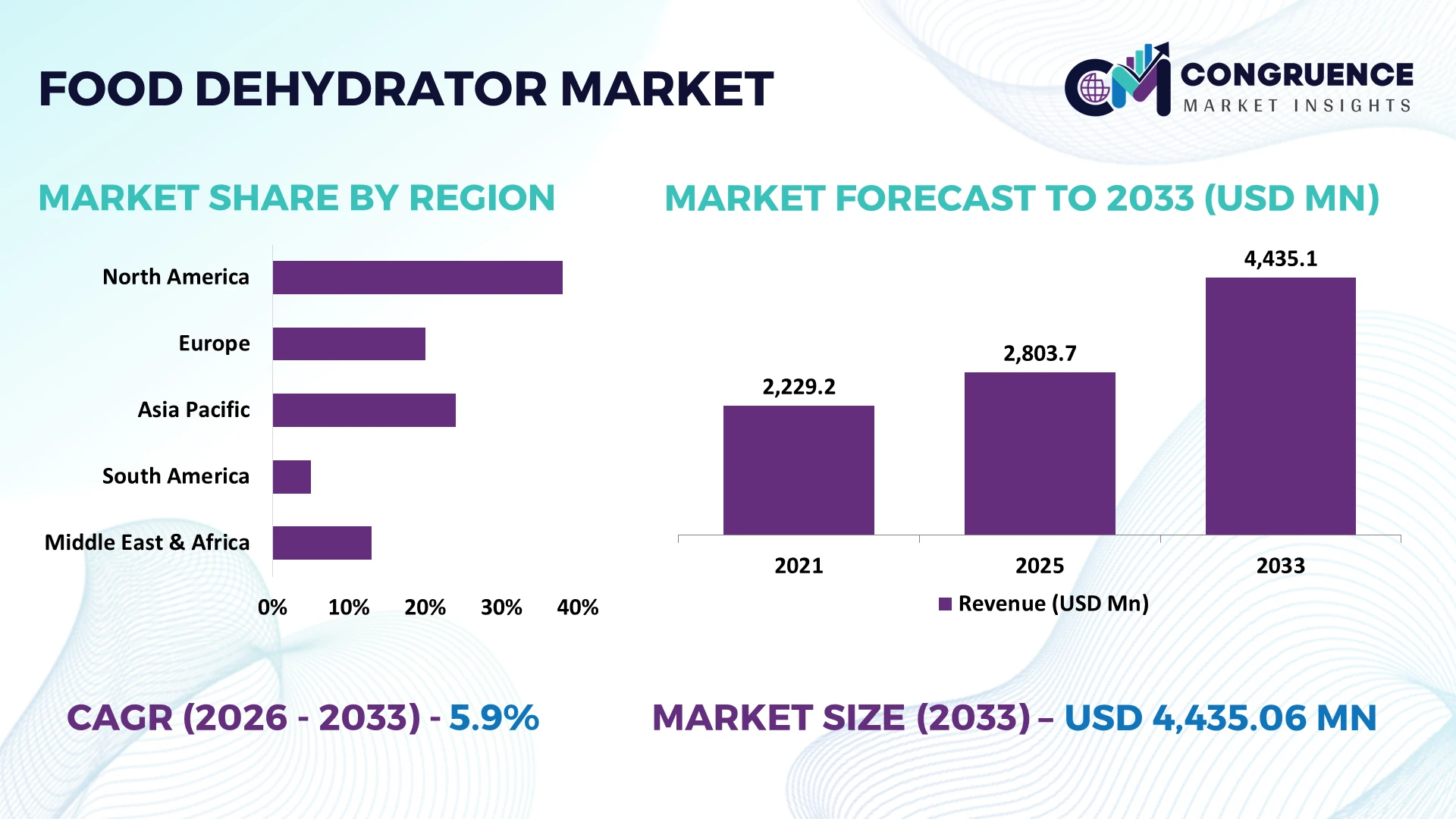
The Global Food Dehydrator Market was valued at USD 2803.7 Million in 2025 and is anticipated to reach a value of USD 4435.06 Million by 2033 expanding at a CAGR of 5.9% between 2026 and 2033. Growth is driven by commercial fruit and vegetable preservation, energy-efficient heat-pump drying, expansion of shelf-stable food manufacturing, and automated moisture-control technologies.
The United States represents a major food dehydrator market, supported by California's raisin, prune, and specialty dried-fruit industries, established food-processing infrastructure, and household appliance adoption. The country contributed approximately 12.9% of global dried-fruit production in 2024/25, compared with Iran's 13.4% and Türkiye's 12.1%. Industrial processors are adopting heat-pump and hybrid drying systems, with research demonstrating energy-consumption reductions exceeding 30% under specific operating conditions. Meanwhile, India's food-processing infrastructure program approved 1,601 projects by June 2025, demonstrating expanding opportunities for industrial preservation equipment.
Manufacturers prioritizing energy-efficient drying technology, precision moisture control, and scalable processing capacity are positioned to strengthen competitiveness across commercial and consumer applications.
Market Size & Growth: Valued at USD 2803.7 Million in 2025, projected to USD 4435.06 Million by 2033 at 5.9% CAGR, driven by clean-label preservation and food waste reduction mandates.
Top Growth Drivers: Commercial food processing expansion, pet food dehydration demand, and clean-label preservation replacing chemical additives in meat and fruit products.
Short-Term Forecast: By 2027, IoT-enabled commercial dehydrators reduce energy consumption by 15–20% through adaptive temperature and airflow control.
Emerging Technologies: Heat pump dehydration achieving 40–50% energy savings versus conventional resistive heating, AI-driven moisture sensing for process optimization, and solar-assisted commercial drying systems.
Regional Leaders: North America at 31.4% revenue share with US countertop and commercial demand, Asia-Pacific fastest-growing through China manufacturing expansion, and Europe driven by organic food processing in Germany.
Consumer/End-User Trends: Commercial dehydrators command fastest-growing segment; pet food and treat dehydration represents high-volume application with recurring processing demand.
Pilot/Case Example: Leading US pet food manufacturers expanded commercial dehydration capacity in 2025, targeting 25% throughput increase through continuous-process equipment adoption.
Competitive Landscape: Excalibur, Nesco, Cosori, and Tribest lead countertop segment; Buhler, GEA, and Bühler Aeroglide compete in commercial dehydration systems.
Regulatory & ESG Impact: EU Farm to Fork Strategy targets 50% food waste reduction by 2030; FDA FSMA compliance drives equipment sanitation and traceability requirements.
Investment & Funding: Equipment manufacturers investing in heat pump technology and IoT-enabled monitoring; commercial processors expanding capacity in pet food and plant-based protein segments.
Innovation & Future Outlook: Heat pump and hybrid solar dehydration, AI-driven process optimization, and continuous-process equipment designs reshape commercial dehydration economics.
The global Food Dehydrator Market is transitioning toward intelligent thermal processing, supported by growing requirements for dried fruits, vegetable ingredients, meat snacks, and shelf-stable food products. Manufacturers are introducing automated airflow distribution, programmable humidity control, and hybrid infrared heating to improve consistency across commercial dehydration operations. Advanced heat-pump and ultrasonic drying configurations have demonstrated processing-time reductions of approximately 25% in specific fruit and vegetable applications. India's expanding food-processing infrastructure and international food-waste reduction initiatives are encouraging investment in preservation technologies. These developments make energy efficiency, product quality, and processing flexibility central considerations for future strategic planning.
The global Food Dehydrator Market is becoming strategically important as food manufacturers prioritize preservation efficiency, product quality, and processing capacity. Approximately 13.3% of food is lost globally between harvest and retail, strengthening the business case for decentralized dehydration infrastructure. India's food-processing modernization initiatives demonstrate this structural transition, with 1,607 approved projects and 1,196 completed or operationalized by December 2025. Equipment manufacturers are expanding their focus toward modular drying lines, automated moisture management, and integrated preservation systems.
Technology differentiation increasingly determines industrial purchasing decisions. Hybrid heat-pump and ultrasonic drying systems have demonstrated energy reductions exceeding 30% and processing cycles approximately 25% shorter than conventional hot-air configurations. China's extensive processing infrastructure favors industrial-scale deployment, while European manufacturers emphasize energy recovery and sophisticated process controls. India presents opportunities for distributed processing facilities closer to agricultural production centers, reducing transportation requirements for perishable crops.
Between 2026 and 2028, manufacturers will prioritize continuous moisture monitoring, predictive maintenance, and flexible multi-product processing equipment. Apple and carrot dehydration demonstrates the operational value of hybrid systems in reducing processing time while protecting product quality. Suppliers are investing in application-specific engineering, digital controllers, and processing partnerships. Competitive leadership will depend on measurable energy efficiency, consistent finished-product specifications, and dependable equipment utilization.
Increasing food preservation requirements are accelerating industrial food dehydrator adoption across agricultural processing and packaged ingredient manufacturing. Approximately 13.3% of global food production is lost between harvest and retail, creating substantial opportunities for shelf-life extension and localized processing. In India, approximately 74.4% of approved PMKSY projects had become operational by December 2025, strengthening the broader food-processing infrastructure. Hybrid heat-pump drying technologies have demonstrated energy reductions exceeding 30% compared with conventional hot-air systems. This combination of infrastructure expansion and lower operating energy requirements encourages food processors to invest in efficient dehydration equipment. Manufacturers are responding through modular capacity expansion, localized equipment assembly, and partnerships with agricultural processing enterprises. Proximity to harvest locations creates a significant procurement advantage.
Energy-intensive drying operations and limited processing infrastructure constrain industrial food dehydrator deployment, particularly among smaller agricultural enterprises. Conventional hot-air drying systems face substantial electricity and thermal energy requirements, while advanced hybrid configurations have demonstrated energy savings exceeding 30%, highlighting the operating disadvantage of inefficient equipment. Global food loss remains approximately 13.3% before retail, while consumer-stage waste accounts for another 19% of available food, illustrating preservation and distribution inefficiencies across food systems. In India, 411 approved food-processing infrastructure projects remained under implementation in December 2025, reflecting existing execution constraints. Manufacturers are introducing phased equipment installations, lower-capacity modular systems, and alternative heat-recovery configurations. Competitive pricing increasingly depends on energy consumption, equipment financing, and maintenance accessibility.
Advanced hybrid dehydration technologies are creating opportunities for processors manufacturing premium dried fruits, vegetable ingredients, and functional food products. Research involving heat-pump and ultrasonic drying demonstrates approximately 25% shorter processing cycles and 15% higher vitamin C retention under specific experimental conditions. Separately, combined ultrasonic and infrared drying has achieved a 54.7% reduction in drying time for apple slices under near-freezing conditions. These advances support processing models that prioritize nutritional quality alongside production throughput. Japanese and German equipment developers are positioned to integrate sensor-based moisture monitoring, specialized drying chambers, and automated process optimization. Manufacturers are investing in hybrid technology research and application-specific equipment development. Premium ingredient processing offers differentiation through controlled product quality rather than manufacturing volume alone.
Maintaining consistent moisture removal across different food materials presents a critical technological challenge for industrial dehydrator manufacturers. Experimental infrared-assisted apple drying achieved processing times of 150 minutes at 70°C, compared with 210 minutes at 50°C, demonstrating a 28.6% reduction through temperature adjustment. However, excessive thermal exposure can affect texture, color, and nutritional quality. Combined ultrasonic-infrared systems have demonstrated 93.5% electrical conversion efficiency within specialized experimental configurations, introducing new equipment integration requirements. Indian processors handling mangoes, vegetables, and herbs must accommodate differences in slice thickness, moisture distribution, and product sensitivity. Manufacturers are developing programmable product-specific drying profiles, automated airflow controls, and calibration procedures. Long-term competitiveness requires reproducible product quality, validated process parameters, and specialized operator training.
Horizontal Airflow Systems Gain Preference: Commercial processors are shifting toward rear-mounted fan configurations to improve drying consistency across multiple trays. Vertical airflow represented approximately 56.5% of commercial equipment demand in 2025, while tray and cabinet configurations accounted for 45.7%. Excalibur and competing manufacturers are refining airflow distribution, adjustable shelving, and digital temperature controls. This transition reduces manual tray rotation and supports more predictable batch processing.
Freeze-Dried Pet Products Expand: United States pet food manufacturers are diversifying into freeze-dried protein treats and meal toppers. Pet food and treat sales increased 3% in 2025, while approximately two-thirds of surveyed pet owners reported occasionally adding supplementary ingredients to meals. Manufacturers are expanding freeze-drying capacity and strengthening ingredient traceability. The operational shift favors smaller premium batches with controlled moisture specifications over conventional volume-focused production.
Food Waste Regulations Reshape Procurement: The November 2025 Food Waste Breakthrough initiative established targets to halve food waste by 2030 and reduce methane emissions by up to 7%. Processing companies are improving batch documentation, product recovery procedures, and shelf-life verification. Equipment suppliers are responding with digital recordkeeping and traceable drying parameters, helping commercial operators demonstrate measurable waste prevention.
Compact Appliance Portfolios Become Sophisticated: Residential equipment manufacturers are moving beyond fixed-temperature designs toward programmable countertop systems. Shelf-style dehydrators are projected to represent approximately 38.4% of equipment demand in 2026, while residential users account for an estimated 51.4%. Excalibur and Brod & Taylor offer configurations with 10 trays and over 11 square feet of drying space, respectively. Suppliers are differentiating through storage efficiency and flexible batch capacity.
Shelf Dehydrators represent the leading product category in the Food Dehydrator Market, with an estimated 38.4% share in 2026. Their position reflects controlled horizontal airflow, accessible loading arrangements, and compatibility with residential and commercial processing operations. Models offering 10 trays and approximately 16 square feet of drying area demonstrate the scalability of cabinet-style equipment. Tray Dehydrators remain competitive among price-sensitive buyers requiring straightforward operation and flexible batch sizes. Conveyor Dehydrators serve higher-throughput industrial facilities where continuous material movement minimizes manual handling and supports standardized production.
Freeze Dehydrators represent a rapidly advancing technology category, supported by premium food preservation and specialty ingredient applications. Their low-temperature moisture removal preserves product structure, supporting differentiation from conventional thermal dehydration. Vacuum Dehydrators address temperature-sensitive formulations requiring reduced-pressure processing, while Solar Dehydrators remain relevant for agricultural operations with limited energy infrastructure. Manufacturers are expanding programmable configurations, specialized chamber designs, and product-specific drying programs. Capital allocation increasingly favors equipment combining consistent moisture removal, application flexibility, and documented product quality rather than maximum chamber capacity alone.
Fruits and Vegetables constitute the leading application segment, accounting for approximately 43.3% of the commercial food dehydrator market in 2025. Their dominance reflects recurring seasonal processing requirements, established dried-produce distribution networks, and the need for consistent moisture reduction. California's dried-fruit industry and India's horticultural processing clusters support substantial demand for batch and continuous drying equipment. Meat and Seafood applications require tighter temperature management and validated processing conditions. Herbs and Spices represent a rapidly expanding specialty application, driven by requirements for color preservation, volatile compound retention, and standardized ingredient specifications.
Pet Food is strengthening demand for freeze-dried protein ingredients, specialized treats, and premium formulations. United States pet food and treat sales increased 3% during 2025, reinforcing equipment investment across premium production categories. Ready-to-Eat Foods increasingly incorporate dehydrated ingredients for convenient preparation and extended storage. Dairy Products require carefully managed low-temperature processing, while Grains and Cereals maintain established drying applications. Manufacturers are introducing differentiated temperature programs, continuous processing systems, and automated moisture sensors. Investment priorities increasingly depend on product sensitivity, throughput requirements, and finished-food quality consistency.
Residential Consumers represent the leading end-user category, with an estimated 51.4% market share in 2026. Their position reflects demand for homemade dried fruits, vegetable snacks, jerky, and household food preservation. Compact dehydrators with programmable temperature settings and removable trays support convenient small-batch processing. Food Processing Companies constitute a strategically important commercial buyer group because industrial installations require greater throughput, process documentation, and consistent product specifications. Agricultural Producers invest in equipment for handling seasonal harvest surpluses, while Commercial Kitchens prioritize flexible processing capabilities and efficient workspace utilization.
Pet Food Manufacturers represent a particularly dynamic end-user category, supported by premium protein treats and freeze-dried product innovation. Approximately two-thirds of surveyed United States pet owners occasionally supplement regular meals with additional food products, supporting specialized ingredient preparation. Restaurants and Hotels increasingly use dehydration for menu ingredients, garnishes, and controlled food preparation. Foodservice Providers require repeatable batch outputs and sanitation-compatible equipment. Excalibur, COSORI, and industrial equipment suppliers are differentiating through programmable controls, processing capacity, and customer-specific configurations. Competitive positioning increasingly depends on matching equipment investment to utilization frequency and finished-product requirements.
North America accounted for the largest market share at 38.3% in 2025 however, Asia-Pacific is expected to register the fastest growth, expanding at a CAGR of 6.6% between 2026 and 2033.

Commercial Food Preservation and Automated Drying Infrastructure Leadership
North America maintains a leading position in commercial food dehydration, supported by established dried-fruit processing, meat snack manufacturing, premium pet food production, and residential preservation equipment demand. The region accounted for approximately 38.3% of the commercial food dehydrator market in 2025, reflecting its developed equipment installation base. California's extensive agricultural processing infrastructure supports industrial drying applications, while Canadian food manufacturers emphasize controlled moisture reduction and consistent product specifications. Commercial equipment operators are adopting programmable temperature regulation, stainless-steel drying chambers, and continuous processing configurations. Advanced cabinet systems featuring 10-tray arrangements support flexible batch production, particularly among specialty food manufacturers. Equipment suppliers including Excalibur and NESCO compete through product durability, capacity, and digital functionality. Regional procurement priorities increasingly emphasize sanitation-compatible construction, repeatable drying cycles, and equipment servicing capabilities to support food safety compliance.
United States Market Outlook: The United States anchors regional demand through its concentrated food-processing infrastructure, established consumer appliance distribution, and growing specialty snack manufacturing activities. California operated approximately 62,100 farms in 2025, supporting substantial agricultural raw-material availability. Domestic equipment manufacturers are targeting premium household preservation, commercial jerky production, and specialty ingredient processing. FDA preventive-control requirements strengthen demand for documented drying procedures, validated operating temperatures, and consistent finished-product moisture specifications.
Energy-Efficient Processing and Regulatory-Driven Equipment Modernization
Europe's food dehydrator market is shaped by industrial energy efficiency requirements, established food ingredient manufacturing, and increasingly stringent waste reduction policies. Germany, France, Italy, and the Netherlands maintain substantial fruit, vegetable, dairy, and specialty food-processing infrastructure. The European Union introduced binding food-waste reduction targets in 2025, requiring a 10% reduction in processing and manufacturing waste and a 30% per-capita reduction across retail and consumption activities by 2030. These requirements strengthen commercial interest in preservation equipment capable of recovering surplus ingredients and extending product usability. European manufacturers are incorporating heat recovery, programmable airflow regulation, and continuous moisture monitoring into drying systems. Industrial processors also prioritize equipment designs supporting hygienic operation and traceable production records. Competitive differentiation increasingly depends on energy consumption per kilogram of water removed, consistent processing quality, and integration with existing manufacturing infrastructure.
Germany Market Outlook: Germany represents a major European demand center through approximately 6,000 food manufacturing and processing enterprises employing around 658,000 workers. Its established machinery engineering capabilities support advanced dehydration equipment, automated production lines, and industrial maintenance services. Food manufacturers export approximately 36% of their production, strengthening requirements for standardized shelf-stable ingredients and consistent product quality. Equipment investment increasingly emphasizes energy monitoring, moisture-control accuracy, and efficient integration with industrial food-processing systems.
Agricultural Processing Expansion and Localized Preservation Equipment Manufacturing
Asia-Pacific represents the fastest-growing commercial food dehydrator market, supported by extensive agricultural production, expanding packaged-food manufacturing, and increasing investment in post-harvest processing infrastructure. China maintains substantial capabilities in industrial drying equipment manufacturing, while India is expanding processing facilities closer to agricultural production centers. Japan and South Korea contribute advanced automation expertise and demand for precision-controlled food preservation technologies. India's Pradhan Mantri Kisan SAMPADA Yojana recorded 1,735 approved projects by June 2026, including 1,256 completed facilities, strengthening food-processing infrastructure. Regional manufacturers are introducing modular tray systems, hybrid thermal configurations, and locally manufactured components suited to varying processing capacities. Export-oriented fruit and vegetable processors increasingly require controlled moisture levels, improved shelf-life consistency, and reliable production scheduling. Competition is shifting toward equipment affordability, localized technical support, and flexible systems capable of processing multiple agricultural commodities.
India Market Outlook: India holds a strategically important position through its horticultural production base and expanding food-processing infrastructure. Government-supported projects had created approximately 29.42 million metric tons of annual processing and preservation capacity by June 2026. Maharashtra, Andhra Pradesh, and Tamil Nadu support opportunities in fruit, vegetable, spice, and specialty ingredient dehydration. Equipment manufacturers are developing compact industrial systems, solar-assisted configurations, and batch processing solutions targeting agricultural cooperatives and small food enterprises.
Fruit Export Diversification and Industrial Processing Capacity Development
South America's food dehydrator market is supported by expanding fruit processing, agricultural export diversification, and increasing investment in value-added food manufacturing. Brazil, Chile, Argentina, and Peru maintain established agricultural production networks supplying domestic processors and international distributors. Brazil exported approximately 1.176 million metric tons of fruit between January and November 2025, representing a 23.2% increase compared with the corresponding previous-year period. This expanding export base creates opportunities for dehydrated fruit ingredients, specialty snacks, and processing technologies capable of handling seasonal harvest volumes. Chile's established dried-fruit industry supports industrial drying requirements, while Argentina maintains relevant agricultural ingredient processing capabilities. Regional manufacturers and importers are strengthening distribution partnerships, maintenance services, and modular equipment offerings. Electricity costs, limited specialized equipment manufacturing, and uneven processing infrastructure remain important purchasing considerations, favoring scalable installations with manageable operating requirements.
Brazil Market Outlook: Brazil represents a major industrial opportunity through its diversified agricultural production and established food manufacturing infrastructure. The country exported approximately 142.7 metric tons of other dried fruits under HS 081340 in 2025, with the United States and Belgium among its principal destinations. São Paulo and northeastern fruit-producing states offer opportunities for industrial dehydration equipment. Manufacturers are targeting fruit processors requiring automated temperature control, hygienic construction, and equipment capable of handling varied seasonal production volumes.
Food Security Investment and Domestic Preservation Infrastructure Expansion
The Middle East & Africa food dehydrator market is developing through agricultural value addition, food security programs, and investments in domestic processing capacity. Saudi Arabia, the United Arab Emirates, South Africa, and Egypt maintain important food manufacturing and agricultural processing activities. Saudi Arabia's industrial diversification initiatives are strengthening local food production capabilities, while Egypt's date, vegetable, and herb processing industries provide established dehydration applications. Across several markets, high ambient temperatures and agricultural supply-chain limitations increase the importance of controlled drying and reliable equipment operation. Industrial suppliers are introducing compact electric dehydrators, solar-assisted systems, and specialized processing solutions suitable for different infrastructure conditions. Regional equipment deployment increasingly depends on technical servicing availability, suitable power infrastructure, and locally accessible replacement components. Manufacturers are strengthening distributor partnerships and application engineering capabilities to address these practical operating requirements.
Saudi Arabia Market Outlook: Saudi Arabia represents a strategically significant market through expanding food manufacturing infrastructure and domestic production initiatives. The Saudi Food and Drug Authority recorded 624 licensed food factories and 5,344 food warehouses in 2025. Total licensed factories and warehouses across regulated sectors increased 18% from 2024. Domestic processors are evaluating preservation equipment for dates, specialty food ingredients, and shelf-stable products, creating opportunities for automated drying technologies, local equipment integration, and specialized maintenance services.
The global food dehydrator market combines premium appliance specialists, value-focused brands, and industrial drying-system suppliers. Excalibur and Tribest compete on cabinet airflow and processing consistency, while NESCO and Hamilton Beach prioritize accessible pricing and retail distribution. IKE challenges established brands through OEM manufacturing and configurable commercial equipment. Published commercial-grade estimates place the leading five suppliers near 54% combined share, although concentration differs across household and industrial systems. Equipment performance shapes purchasing: hybrid drying research reports energy savings exceeding 30%, while selected configurations shorten processing cycles by approximately 25%. Suppliers are expanding digital temperature controls, stainless-steel assemblies, and private-label partnerships; industrial players emphasize turnkey integration and after-sales service. Competition is shifting from tray capacity toward validated moisture uniformity, energy monitoring, and application-specific automation. Food-safety qualification, dependable replacement components, and distributor access constrain market entry. Winning requires proven process performance, competitive lifecycle costs, responsive service networks, and configurations tailored to product categories.
Commercial food dehydrators combine horizontal airflow, variable-speed fans, and programmable temperature control for moisture control across variable loads. Industrial conveyor dryers extend these functions through continuous loading and zoned heating, while cabinet systems serve smaller batches. Heat-pump dryers recover latent heat and can reduce energy use by more than 30% compared with conventional hot-air drying. Operators benefit from lower energy intensity and better control of product specifications, especially in fruit and vegetable processing. Adoption spans household cabinet equipment and installed industrial lines, although equipment utilization varies with harvest seasonality and batch scheduling.
Emerging vacuum-microwave and infrared-assisted technologies accelerate moisture removal without prolonged heating. GEA's RAY Plus freeze-drying design reduces internal pressure losses by nearly 50% against earlier models, improving vapor handling not necessarily electricity savings. EnWave's 60-kilowatt vacuum-microwave systems show commercial deployment. Integrated moisture sensors, recipe management, and batch records help processors support food-safety verification. Technology specialists gain an advantage in premium ingredient processing.
During 2026–2028, digital twin modeling, endpoint detection, and modular freeze-drying capacity will reshape equipment procurement. Suppliers integrating controls with application testing protect sensitive ingredients while reducing manual adjustment. Buyers should prioritize verified kilowatt-hours per kilogram of water removed, final moisture, over nameplate capacity and purchase price.
October 2024 – GEA introduced its RAY Plus freeze-dryer series, featuring redesigned vapor collection that cuts internal pressure losses by nearly 50%. The system supports higher throughput and more flexible equipment integration, strengthening industrial food processing efficiency. Source: gea.com.
April 2025 – EnWave signed an equipment agreement with MicroDried for an additional 60kW Radiant Energy Vacuum dehydrator in Idaho. The purchase expands production capability for shelf-stable fruit and vegetable ingredients, supporting contracted supply to packaged-food manufacturers worldwide. Source: enwave.net.
August 2025 – Glacial Freeze Dry acquired Foodynamics, combining contract manufacturing operations and specialized freeze-drying capacity. The expanded service platform advertises up to 98% nutrient retention, supporting flexible orders, faster product development, and premium food brand outsourcing strategies. Source: foodengineeringmag.com.
August 2025 – Nature Foods Company expanded Vietnam's freeze-dried food portfolio, exporting iSoup mushroom broth to Japan and I-Ya.Ua yogurt to the United States. Its two international product lines demonstrate successful commercialization of lightweight, shelf-stable convenience foods. Source: foodnavigator.com.
The Food Dehydrator Market Report examines industry structure, processing technologies, equipment specifications, and investment priorities from 2026 to 2033. Type segmentation covers Tray, Shelf, Freeze, Conveyor, Solar, and Vacuum Dehydrators. Application analysis evaluates Fruits and Vegetables, Meat and Seafood, Herbs and Spices, Dairy Products, Grains and Cereals, Pet Food, and Ready-to-Eat Foods. End-user assessment addresses residential consumers, food processors, commercial kitchens, agricultural producers, hospitality establishments, foodservice providers, and pet food manufacturers. Technology coverage includes heat-pump drying systems achieving over 30% energy savings under specific conditions.
Regional analysis encompasses North America, Europe, Asia-Pacific, South America, and the Middle East & Africa, examining manufacturing capabilities, processing infrastructure, and localized equipment requirements. Competitive assessment covers industrial automation, moisture-control precision, supplier positioning, and specialized product development. Strategic findings support capacity planning, technology selection, regional expansion, and investment evaluation across established preservation applications and emerging premium food categories.
| Report Attribute/Metric | Report Details |
|---|---|
Market Revenue in 2025 | USD 2803.7 Million |
Market Revenue in 2033 | USD 4435.06 Million |
CAGR (2026 - 2033) | 5.9% |
Base Year | 2025 |
Forecast Period | 2026 - 2033 |
Historic Period | 2021 - 2025 |
Segments Covered | By Type
By Application
By End-User
|
Key Report Deliverable | Revenue Forecast, Growth Trends, Market Dynamics, Segmental Overview, Regional and Country-wise Analysis, Competition Landscape |
Region Covered | North America, Europe, Asia-Pacific, South America, Middle East, Africa |
Key Players Analyzed | Excalibur Dehydrator, Tribest Corporation, National Presto Industries, Inc., Hamilton Beach Brands, Inc., LEM Products, Harvest Right, Guangdong IKE Industrial Co., Ltd., Magic Mill, Koolatron Corporation, Aroma Housewares Company, STX International, GEA Group AG, Bühler AG, EnWave Corporation |
Customization & Pricing | Available on Request (10% Customization is Free) |




