
Reports
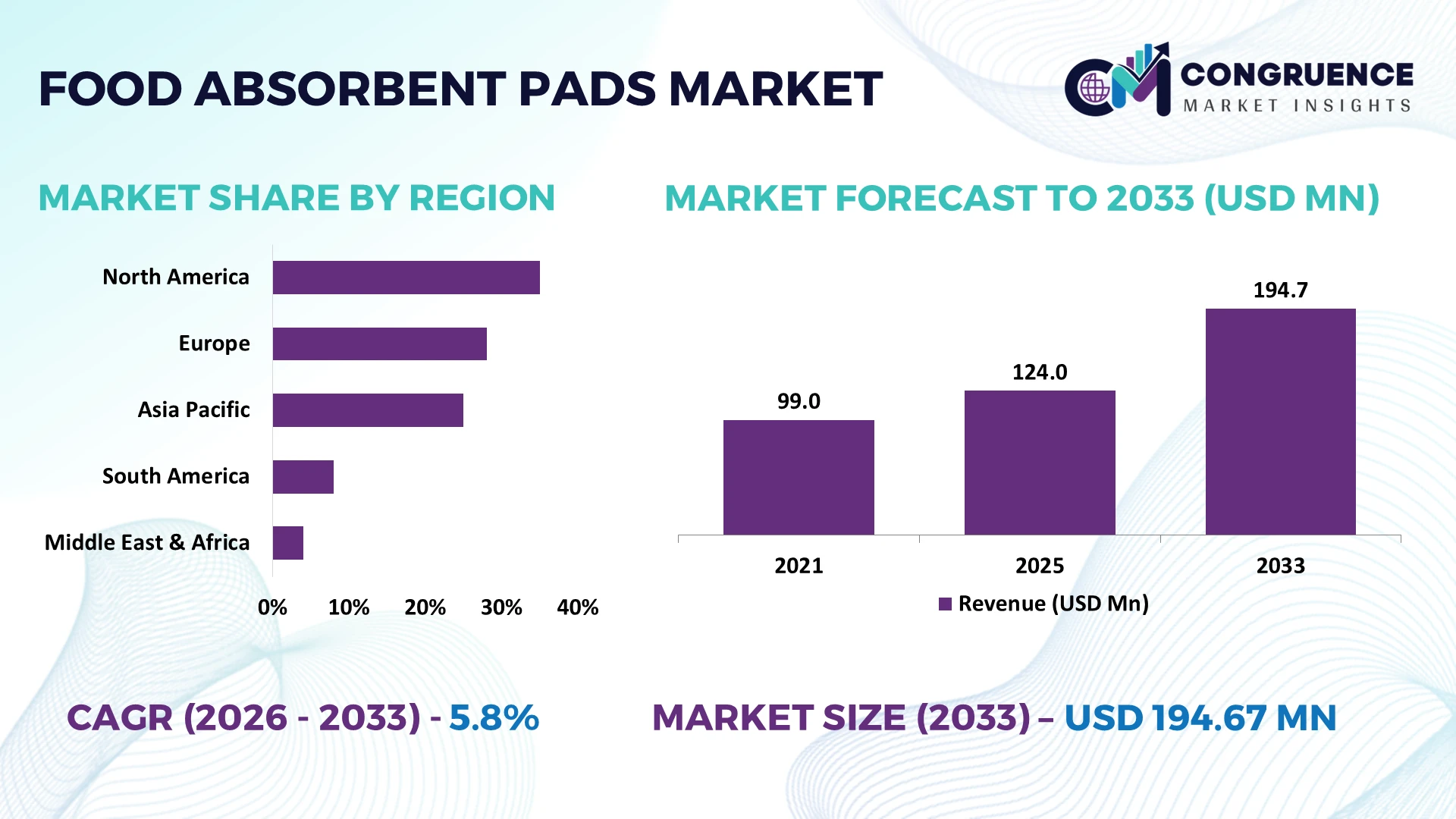
The Global Food Absorbent Pads Market was valued at USD 124.0 Million in 2025 and is anticipated to reach a value of USD 194.7 Million by 2033 expanding at a CAGR of 5.8% between 2026 and 2033. Growth is driven by the expansion of modified atmosphere packaging, stricter food-contact material requirements, and increased adoption of high-absorbency pads in automated meat, poultry, and seafood packaging operations.
The United States represents a major market for food absorbent pads, supported by its industrial meat-processing infrastructure and refrigerated retail distribution. The country produces more than 25 million metric tons of beef, pork, and chicken annually, while China processes considerably larger poultry volumes. FDA food-contact regulations and investments in automated tray-sealing systems reinforce demand for absorbent packaging materials.
Manufacturers prioritizing food-contact compliance, liquid retention performance, and compatibility with high-speed packaging lines are positioned to secure stronger relationships with major protein processors and retail packaging suppliers.
Market Size & Growth: The global market advances from USD 124.0 Million in 2025 to USD 194.7 Million by 2033, at a 5.8% CAGR, supported by automated protein packaging and advanced moisture-control materials.
Innovation & Future Outlook: Next-generation bio-based pads target 15–20% material optimization through thinner absorbent cores and improved fluid distribution.
The Food Absorbent Pads Market is increasingly shaped by fresh meat processing, poultry tray packaging, seafood distribution, and refrigerated retail operations. Superabsorbent polymer composites and cellulose-based absorbent structures are improving liquid containment, while manufacturers target 15% lower material consumption through optimized pad construction. European packaging sustainability requirements and expanding Asian cold-chain infrastructure are influencing product development, establishing important priorities for competitive strategy.
Food absorbent pads are becoming strategically important because moisture management directly affects product presentation, packaging integrity, and operational efficiency across fresh protein supply chains. Meat processors and packaging converters increasingly evaluate absorbent materials alongside tray sealing, modified atmosphere packaging, and automated production systems. The European Union's Packaging and Packaging Waste Regulation is accelerating material redesign, creating competitive advantages for suppliers offering recyclable structures and documented food-contact compliance.
Advanced superabsorbent polymer pads provide higher liquid retention per unit of absorbent material than conventional cellulose-only designs. For selected high-moisture applications, manufacturers are targeting 10–15% reductions in pad material consumption through optimized absorbent cores. The United States emphasizes high-throughput meat packaging and automation, while Germany prioritizes material recovery and packaging compliance. China and India present different opportunities, centered on refrigerated distribution expansion and cost-efficient packaging deployment.
During 2027–2029, automated pad placement and thinner absorbent structures are expected to become important procurement criteria. A poultry processor integrating automated dispensing with tray sealing can reduce manual handling and improve placement consistency. Suppliers are consequently investing in converting technology, substrate partnerships, and application-specific product development. Competitive advantage will increasingly depend on validated absorbency, regulatory readiness, and dependable integration with industrial packaging operations.
The expansion of industrial meat processing and refrigerated food distribution is strengthening demand for high-performance food absorbent pads. Fresh poultry, beef, pork, and seafood generate liquid exudate during storage, requiring reliable moisture retention to preserve package presentation and minimize leakage. In the United States, poultry production exceeds 20 million metric tons annually, creating substantial packaging throughput. Manufacturers are targeting 10–15% improvements in absorbent material efficiency and 5–10% reductions in packaging interruptions through automated pad placement. Increasing adoption of modified atmosphere packaging reinforces compatibility requirements between pads, trays, and sealing films. Suppliers are responding by expanding converting capacity, developing high-retention absorbent cores, and partnering with packaging equipment manufacturers to secure long-term industrial contracts.
Food absorbent pad manufacturers face structural cost pressures from fluctuations in cellulose pulp, polyethylene films, and superabsorbent polymer feedstocks. Petroleum-derived polymer pricing and energy-intensive converting processes influence production economics, particularly for suppliers operating with limited purchasing scale. Illustrative procurement scenarios indicate that 10–15% increases in absorbent material costs can materially compress margins when customer contracts restrict price adjustments. Additional testing, documentation, and material qualification can increase product development expenditure by an estimated 5–10%. United States FDA food-contact requirements and European chemical compliance obligations further constrain material substitutions. Manufacturers are addressing these pressures through diversified sourcing, longer-term supply agreements, optimized absorbent core weights, and localized procurement strategies. Material efficiency has become a critical profitability lever.
Sustainable food absorbent pads present opportunities for suppliers developing cellulose-rich, bio-based, and lower-plastic packaging structures. The European Union's evolving packaging requirements are encouraging converters to reconsider multilayer material combinations and end-of-life compatibility. Advanced fiber engineering and optimized superabsorbent distribution offer potential material reductions of 10–20% while maintaining required liquid retention. India presents additional opportunities as organized meat retailing, seafood exports, and refrigerated logistics infrastructure expand. Suppliers can target premium seafood packaging, ready-to-cook protein products, and private-label refrigerated foods with application-specific pad designs. Companies are investing in biodegradable material research, automated converting equipment, and partnerships with tray manufacturers. The strategic opportunity lies in combining verified absorption performance with measurable material efficiency rather than relying exclusively on sustainability claims.
Scaling advanced food absorbent pads across different processing environments presents significant technical challenges. Liquid release varies between poultry, red meat, and seafood, requiring precise absorbent capacity, fluid distribution, and dimensional stability. Manufacturers targeting 95–99% consistent pad-placement accuracy must coordinate dispensing systems with high-speed tray conveyors and sealing equipment. Illustrative validation programs also target absorbency variation below 10% across production batches. In Germany and the United States, automated packaging facilities increasingly require documented performance testing and reliable traceability across material lots. Inconsistent pad positioning or liquid retention can cause package rejection and additional inspection costs. Suppliers must strengthen quality-control systems, conduct application-specific trials, and collaborate with equipment manufacturers. Long-term competitiveness depends on reproducible performance at industrial production speeds.
Shift Toward Precision Absorbency Engineering: Food packaging converters are refining absorbent core geometry to control liquid migration and reduce unnecessary material consumption. Product development programs target 10–15% lower pad weights and 15–20% improvements in fluid distribution consistency. Manufacturers are introducing multilayer absorbent structures with controlled acquisition zones, allowing processors to specify absorption characteristics for different protein cuts. This shift improves packaging consistency and reduces material usage, encouraging partnerships between nonwoven suppliers and specialized converting companies.
Increasing Integration of Digital Quality Inspection: Automated vision inspection is becoming an important feature of food absorbent pad converting operations. Advanced production systems target 95–99% defect detection and 10–15% reductions in manual inspection requirements. German and American packaging manufacturers are integrating camera-based monitoring to identify dimensional inconsistencies, contamination, and sealing defects before shipment. Digital inspection improves batch traceability and reduces downstream packaging complaints. Suppliers are investing in inline sensors, production analytics, and integrated quality-management systems to strengthen customer qualification.
Growing Preference for Customized Packaging Formats: Food processors increasingly require absorbent pads matched to tray dimensions, product weight, and expected liquid release. Customized product programs target 10–20% improvements in material utilization and 5–10% reductions in packaging changeover losses. Japanese convenience-food suppliers and American protein processors are emphasizing standardized pad specifications across multiple packaging formats. Manufacturers are expanding flexible die-cutting capabilities and introducing modular product portfolios, improving order responsiveness while reducing inventory complexity.
Expansion of Regional Supply Partnerships: Packaging suppliers are restructuring procurement networks to reduce delivery uncertainty and improve responsiveness to processing facilities. Regional supply arrangements target 15–25% shorter replenishment cycles and 10–15% lower safety-stock requirements. United States meat processors and European packaging converters increasingly prioritize nearby converting operations for frequently replenished absorbent materials. Suppliers are strengthening distributor relationships, establishing regional finishing capacity, and coordinating demand forecasts with customers. Localized converting also enables faster specification changes without maintaining excessive finished-goods inventories.
The Food Absorbent Pads Market is segmented by type into Superabsorbent Polymer (SAP) Pads, Cellulose-Based Absorbent Pads, and Composite Absorbent Pads. Superabsorbent Polymer Pads represent the leading category, with an estimated 48.0% market share in 2025, supported by high liquid retention, compact absorbent cores, and compatibility with automated protein packaging. These pads are extensively used in fresh poultry, beef, and seafood trays where moisture control is essential. Cellulose-Based Absorbent Pads maintain a substantial position because of their established converting infrastructure and comparatively economical material composition. Manufacturers are optimizing absorbent loading and multilayer construction to improve performance while controlling production costs.
Composite Absorbent Pads represent the fastest-growing type, benefiting from combinations of cellulose fibers, polymer absorbents, and specialized barrier layers. Their estimated 22.0% market participation reflects increasing interest in application-specific moisture management and reduced material thickness. Packaging suppliers are investing in hybrid core engineering, material qualification, and partnerships with nonwoven producers. This transition strengthens product differentiation and supports premium packaging contracts.
The Food Absorbent Pads Market is segmented by application into Meat Packaging, Poultry Packaging, Seafood Packaging, and Other Food Packaging. Meat Packaging holds the leading position, accounting for approximately 40.0% of estimated market demand in 2025. Its dominance reflects extensive use in retail beef and pork trays, where purge management protects product appearance and limits liquid accumulation. Poultry Packaging represents another major application because high-throughput processing requires consistent absorbent placement and reliable fluid retention. Manufacturers are developing product-specific absorption grades and standardized tray inserts to improve packaging performance across industrial processing lines.
Seafood Packaging is the fastest-growing application, supported by expanding chilled seafood distribution, premium retail formats, and greater attention to moisture containment. An indicative 20.0% application share reflects the importance of absorbent materials in fish fillets, shellfish, and refrigerated seafood products. Other Food Packaging includes selected fresh produce, prepared foods, and specialty refrigerated products. Suppliers are expanding application testing, optimizing absorbent capacities, and partnering with seafood processors to address product-specific packaging requirements.
The Food Absorbent Pads Market is segmented by end-user into Food Processing Companies, Food Packaging Companies, Retail and Supermarket Chains, and Foodservice Providers. Food Processing Companies account for an estimated 45.0% of market demand in 2025, reflecting their extensive packaging operations and recurring procurement requirements. Large meat and poultry processors prioritize consistent absorption capacity, reliable supply, and compatibility with automated tray-sealing equipment. Food Packaging Companies represent another significant buyer group, integrating absorbent materials into packaging solutions supplied to protein processors. Manufacturers are strengthening direct supply agreements and technical service capabilities to support high-volume industrial customers.
Retail and Supermarket Chains represent the fastest-growing end-user category as private-label fresh protein programs and centralized packaging operations expand. Their indicative 20.0% market share highlights increasing demand for standardized presentation and leakage-resistant retail packaging. Foodservice Providers maintain a smaller but operationally relevant position, particularly in refrigerated ingredient handling. Suppliers are developing retailer-specific specifications, improving order flexibility, and expanding distribution partnerships to strengthen access to fragmented purchasing networks.
North America accounted for the largest market share at 35% in 2025 however, Asia-Pacific is expected to register the fastest growth, expanding at a CAGR of 7.2% between 2026 and 2033.
North America accounted for approximately 35% of the global Food Absorbent Pads Market in 2025, supported by extensive meat processing infrastructure, automated food packaging facilities, and established refrigerated distribution networks. The United States dominates regional consumption through large-scale poultry, beef, and pork processing operations, while Canada contributes through export-oriented meat production. Industrial processors increasingly integrate absorbent pads with modified atmosphere packaging and automated tray-sealing equipment to improve liquid containment and packaging consistency. The region's extensive supermarket infrastructure supports recurring demand for standardized absorbent packaging materials. Advanced converting technologies and precision pad placement are becoming important procurement considerations. Packaging manufacturers are targeting 10–15% improvements in material utilization through optimized absorbent cores and automated production processes. Strategic partnerships between absorbent material suppliers and food packaging converters reinforce supply reliability and application-specific product development.
United States Market Outlook: The United States maintains a strong competitive position through its extensive protein processing industry, specialized packaging manufacturers, and established food safety framework. Annual chicken production exceeds 20 million metric tons, creating substantial demand for refrigerated packaging materials. FDA food-contact requirements encourage material qualification and documentation, while packaging companies invest in customized absorbent structures, automated converting systems, and long-term supply agreements with industrial meat processors.
Europe represented approximately 28% of the global Food Absorbent Pads Market in 2025, supported by established meat processing industries, sophisticated retail packaging infrastructure, and increasingly stringent sustainability requirements. Germany, France, the United Kingdom, and Italy remain important markets for absorbent packaging materials used in fresh meat, poultry, and seafood distribution. The European Union's Packaging and Packaging Waste Regulation, which entered into force in 2025, is influencing packaging design, material selection, and recyclability assessments. Manufacturers are developing cellulose-rich absorbent structures and optimized multilayer pads to reduce material consumption without compromising liquid retention. Advanced converting operations are targeting 10–20% reductions in absorbent material usage through improved core engineering. European food processors increasingly prioritize documented food-contact compliance and consistent product performance. Partnerships between nonwoven manufacturers, packaging converters, and food processors support the commercialization of environmentally optimized absorbent solutions.
Germany Market Outlook: Germany holds a strategically important position through its advanced food packaging machinery industry, established meat processing sector, and technical expertise in nonwoven materials. German manufacturers emphasize precision converting, automated inspection, and packaging material efficiency. The country's industrial packaging ecosystem supports the development of thinner absorbent structures and recyclable packaging combinations, while regulatory compliance encourages closer collaboration between material suppliers and equipment manufacturers.
Asia-Pacific accounted for approximately 25% of the global Food Absorbent Pads Market in 2025, supported by expanding meat processing capacity, organized food retailing, and investments in refrigerated distribution infrastructure. China represents a major production and consumption center, while Japan maintains sophisticated standards for fresh food packaging and product presentation. India and Southeast Asian economies are increasing their focus on modern protein distribution and temperature-controlled logistics. China's large-scale pork and poultry processing industries create substantial requirements for cost-efficient moisture management solutions. Packaging manufacturers are expanding regional converting capabilities and introducing absorbent pads compatible with automated tray-packaging systems. Industrial modernization initiatives are targeting 10–15% improvements in packaging throughput and material utilization. The region's combination of manufacturing scale, expanding retail infrastructure, and increasing adoption of packaged fresh proteins supports strong competitive opportunities for specialized absorbent material suppliers.
China Market Outlook: China leads regional industrial scale through extensive pork processing operations, growing poultry production, and expanding refrigerated food distribution. The country produces more than 50 million metric tons of pork annually, supporting substantial packaging requirements across processing and retail channels. Domestic packaging manufacturers benefit from established polymer supply chains, converting equipment availability, and proximity to major food processing clusters. Investment priorities increasingly emphasize automated production and consistent absorbent performance.
South America represented approximately 8% of the global Food Absorbent Pads Market in 2025, with demand concentrated in Brazil, Argentina, and other established meat-producing economies. Brazil dominates regional packaging consumption through its extensive poultry and beef processing industries, while Argentina contributes through export-oriented beef production. International food safety requirements encourage processors to improve packaging consistency, moisture management, and product handling practices. Large protein exporters increasingly integrate absorbent materials into refrigerated retail packaging and value-added meat products. Brazil's poultry exports exceed 5 million metric tons annually, demonstrating the scale of its internationally connected processing industry. Packaging converters are expanding relationships with meat processors and distributors to strengthen material availability. However, uneven refrigerated infrastructure and imported specialty material dependencies continue to influence procurement costs. Localized converting and standardized product specifications are becoming important competitive advantages.
Brazil Market Outlook: Brazil maintains a leading regional position through its extensive poultry and beef processing infrastructure and internationally competitive protein export industry. Major processing centers in Paraná, Santa Catarina, and São Paulo support demand for industrial packaging materials. Brazilian companies increasingly prioritize moisture-control performance, packaging automation, and reliable domestic supply. Partnerships between packaging converters and protein exporters strengthen opportunities for specialized absorbent pad manufacturing and application-specific product development.
The Middle East & Africa accounted for approximately 4% of the global Food Absorbent Pads Market in 2025, supported by investments in poultry processing, refrigerated food distribution, and modern supermarket infrastructure. Saudi Arabia, the United Arab Emirates, and South Africa represent strategically important markets for absorbent packaging materials. Government-supported food security initiatives encourage domestic protein production and improvements in cold-chain logistics. Saudi Arabia's Vision 2030 framework supports food industry modernization and investment in local processing capabilities. Regional food processors are increasingly evaluating absorbent pads for fresh poultry, meat trays, and imported seafood packaging. Modern packaging facilities are targeting 10–15% improvements in operational efficiency through equipment upgrades and standardized materials. International packaging suppliers are strengthening distributor partnerships and regional technical support networks. Infrastructure development and reliable material availability remain important considerations for industrial procurement decisions.
Saudi Arabia Market Outlook: Saudi Arabia is emerging as a strategically important market through government-backed food security initiatives, poultry production investments, and expanding refrigerated retail infrastructure. The country's poultry self-sufficiency objectives encourage domestic processing capacity development and greater adoption of industrial packaging technologies. Packaging suppliers are positioning around automated tray-sealing compatibility, food-contact compliance, and dependable absorbent material distribution. Partnerships with domestic food processors support localized product qualification and procurement efficiency.
The global Food Absorbent Pads Market features competition between specialized absorbent material manufacturers, integrated packaging suppliers, and regional converting companies. Novipax, Sirane, McAirlaid's, Sealed Air, and Fibril Tex compete through absorbency performance, product customization, and distribution capabilities. The leading five suppliers collectively represent an estimated 40–45% market share, indicating moderate concentration. Specialized manufacturers target 10–15% material efficiency improvements, while integrated suppliers emphasize packaging compatibility and procurement consolidation. Regional converters compete through shorter delivery cycles and flexible production runs, targeting 15–20% faster order fulfillment. Companies are expanding converting capacity, developing cellulose-based structures, and establishing partnerships with protein processors and packaging equipment manufacturers. Competition is shifting toward thinner absorbent cores, automated quality inspection, and localized supply networks. Food-contact compliance, material qualification, and consistent liquid retention create significant entry barriers. Sustainable competitive advantage requires verified product performance, efficient manufacturing, dependable supply, and strong customer integration across industrial packaging operations worldwide.
Novipax
Sirane Group
McAirlaid's Vliesstoffe GmbH
Sealed Air Corporation
Fibril Tex Pvt. Ltd.
Cellcomb AB
MAGIC srl
Elliott Absorbent Products
Gelok International Corporation
Thermasorb
Maxwell Chase Technologies
Fresh-R-Pax
Superabsorbent polymer technology remains central to advanced food absorbent pads, providing high liquid retention within compact packaging structures. Compared with conventional cellulose-only pads, optimized polymer composites can target 15–25% higher absorption efficiency per unit of material. Multilayer acquisition systems improve liquid distribution, while specialized barrier films reduce contact between absorbed fluids and packaged food. Industrial meat processors benefit from consistent moisture control, improved presentation, and reduced packaging variability. Suppliers are prioritizing precision polymer dosing and standardized absorbency testing to strengthen product qualification.
Emerging cellulose-polymer hybrid structures and bio-based absorbent materials are reshaping product engineering. Advanced fiber bonding and thinner absorbent cores target 10–20% material savings without sacrificing retention performance. Automated optical inspection and digital process monitoring support defect detection targets exceeding 95% in appropriately configured production environments. Packaging converters adopting these technologies gain stronger dimensional consistency, lower inspection requirements, and greater production traceability. Specialized manufacturers benefit through differentiated product specifications and closer partnerships with packaging equipment suppliers.
Between 2026 and 2028, integrated pad dispensing, machine vision, and predictive maintenance will strengthen industrial packaging automation. Automated placement systems target 10–15% reductions in manual handling requirements, while connected production monitoring improves batch consistency. Competitive advantage increasingly favors suppliers combining absorbent material expertise, digital manufacturing capabilities, and application-specific engineering.
May 2024: Cellcomb reported that its Cellsorb CIRCULAR absorbent pads helped retailer Biedronka replace conventional absorbers, with estimated annual plastic savings of 55 tonnes. The collaboration demonstrated commercial deployment of cellulose-based pads and measurable packaging sustainability benefits. Source: cellcomb.com.
March 2025: Cellcomb announced European home and garden composting certification for Cellsorb CIRCULAR. Its 100% cellulose construction and four-side sealed design provide a plastic-free absorbent packaging alternative, strengthening product differentiation among fresh food retailers pursuing circular packaging. Source: cellcomb.com.
October 2025: Cellcomb renamed Cellsorb ECO to Cellsorb CORE, clarifying its product portfolio while emphasizing sealed-edge construction and food hygiene. The company also highlighted two composting certification standards for Cellsorb CIRCULAR, supporting clearer procurement and sustainability assessments. Source: cellcomb.com.
May 2025: Novipax published its VersaMat product material, extending absorbent mat applications into foodservice, healthcare, industrial, and household environments. The product documentation identifies four application categories, reflecting portfolio diversification; however, the publication does not establish a verified launch date. Source: novipax.com.
The Food Absorbent Pads Market Report provides comprehensive analysis of industry structure, competitive positioning, technological developments, and investment opportunities between 2026 and 2033. Segmentation coverage includes Superabsorbent Polymer Pads, Cellulose-Based Absorbent Pads, and Composite Absorbent Pads; applications spanning meat, poultry, seafood, and other food packaging; and end-users comprising food processors, packaging companies, retail chains, and foodservice providers. Regional analysis covers North America, Europe, Asia-Pacific, South America, and the Middle East & Africa, with country-level insights into manufacturing infrastructure and packaging adoption.
The report evaluates absorbent core engineering, sustainable materials, automated converting, and food-contact compliance. Indicative regional analysis assigns 35.0% market participation to North America and 25.0% to Asia-Pacific. Competitive benchmarking examines supplier capabilities, procurement strategies, technology differentiation, and industrial partnerships. These insights support capacity planning, geographic expansion, product development, and long-term competitive strategy.
| Report Attribute / Metric | Details |
|---|---|
| Market Revenue (2025) | USD 124.0 Million |
| Market Revenue (2033) | USD 194.7 Million |
| CAGR (2026–2033) | 5.8% |
| Base Year | 2025 |
| Forecast Period | 2026–2033 |
| Historic Period | 2021–2025 |
| Segments Covered |
By Type
By Application
By End-User
|
| Key Report Deliverables | Revenue Forecast; Market Trends; Growth Drivers & Restraints; Technology Insights; Segmentation Analysis; Regional Insights; Competitive Landscape; Regulatory & ESG Overview; Recent Developments |
| Regions Covered | North America; Europe; Asia-Pacific; South America; Middle East & Africa |
| Key Players Analyzed | Novipax; Sirane Group; McAirlaid's Vliesstoffe GmbH; Sealed Air Corporation; Fibril Tex Pvt. Ltd.; Cellcomb AB; MAGIC srl; Elliott Absorbent Products; Gelok International Corporation; Thermasorb; Maxwell Chase Technologies; Fresh-R-Pax |
| Customization & Pricing | Available on Request (10% Customization Free) |




