
Reports
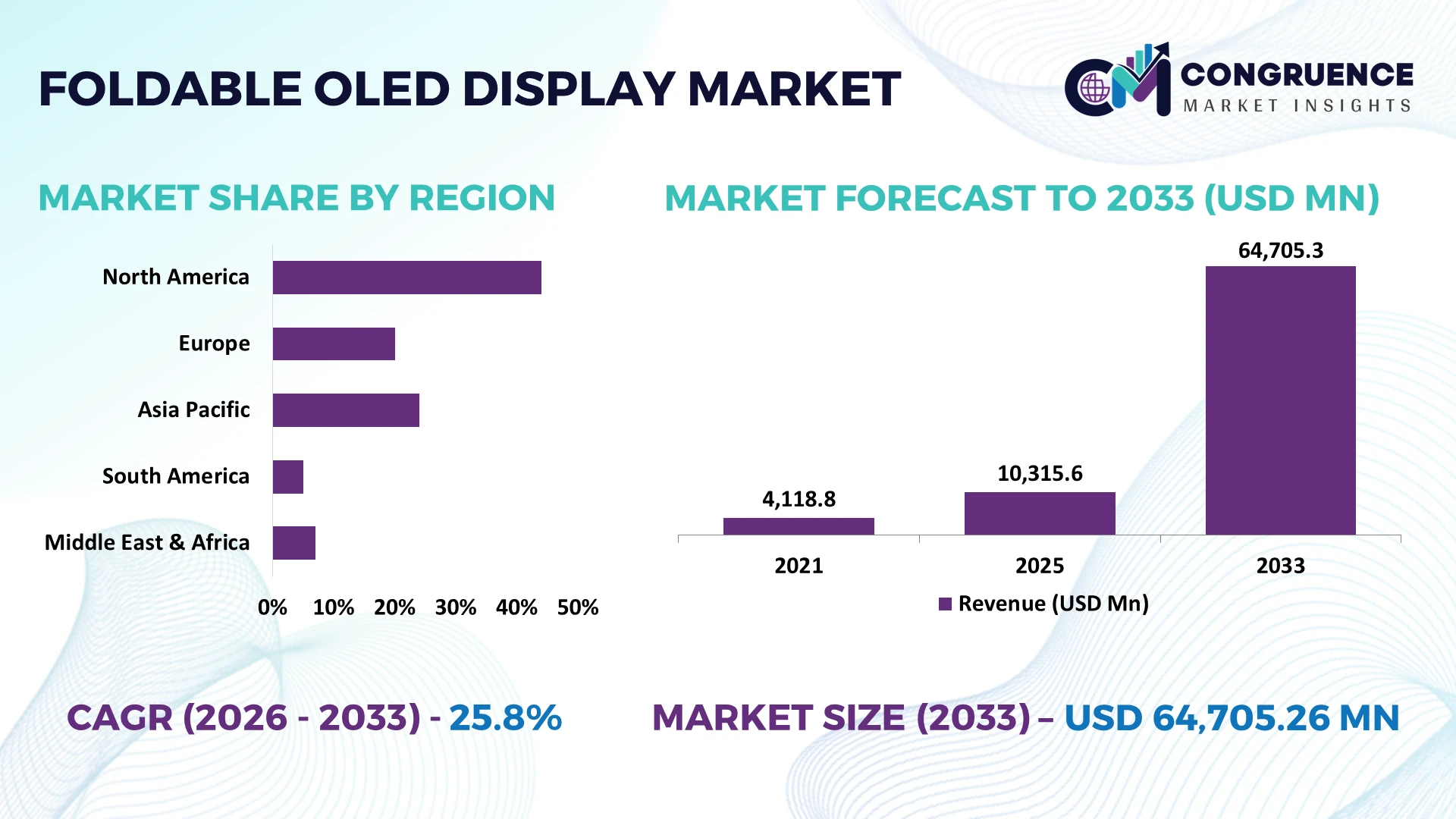
The Global Foldable OLED Display Market was valued at USD 10315.6 Million in 2025 and is anticipated to reach a value of USD 64705.26 Million by 2033 expanding at a CAGR of 25.8% between 2026 and 2033. Growth is driven by higher-yield flexible OLED manufacturing, thinner ultra-thin glass, crease-resistant structures, and smartphone makers expanding book-style, clamshell, and tri-fold devices into premium AI-enabled product lines.
China remains a dominant adoption hub, with Huawei reaching 76.6% of China’s foldable smartphone market in Q1 2025 and 2.842 million units shipped; China’s foldable sales also grew 27% in 2024. South Korea retains critical display-manufacturing strength, while Samsung Display’s 2026 Apple program targets about 3 million panels initially and achieved yields above 80%, exceeding the reported 70% qualification threshold.
The strategic implication is clear: display suppliers with high-yield flexible OLED lines, advanced encapsulation, and crease-resistant architectures are best positioned to capture premium-device supply contracts as Apple’s 2026 foldable entry reshapes sourcing competition.
Market Size & Growth: USD 10.32 billion in 2025 to USD 64.71 billion by 2033 at 25.8% CAGR, driven by premium foldable smartphones and flexible OLED innovation.
Top Growth Drivers: 40%+ foldable OLED shipment growth in 2024, 14% global foldable-device shipment growth in Q3 2025, and 2.5% global smartphone shipment penetration.
Short-Term Forecast: By 2027, advanced OLED yields are targeted above 85%, supporting lower defect rates and faster high-volume production.
Emerging Technologies: AI-ready foldables, tandem OLED, LTPO backplanes, crease-resistant structures, and ultra-thin glass are accelerating premium display differentiation.
Regional Leaders: Asia-Pacific is projected near USD 42 billion by 2033, North America near USD 12 billion, and Europe near USD 7 billion, with AI smartphones and premium-device adoption strengthening regional demand.
Consumer/End-User Trends: Foldables reached 2.5% of global smartphone shipments in Q3 2025, confirming a shift from niche premium hardware toward broader high-end adoption.
Pilot/Case Example: Samsung Display’s 2026 Apple program achieved more than 80% final production yield against a reported 70% qualification threshold, strengthening mass-production readiness.
Competitive Landscape: Samsung led global foldable shipments with about 64% in Q3 2025; Huawei, Apple, BOE, and LG Display intensify competition across advanced OLED supply.
Regulatory & ESG Impact: OLED suppliers face tighter geopolitical scrutiny; Samsung Display and BOE settled major OLED patent and trade-secret disputes in 2025, reducing prolonged supply-chain uncertainty.
Investment & Funding: Samsung Display’s Apple supply program targets roughly 3 million initial panels in 2026, signaling strategic capacity allocation toward high-value foldable OLED production.
Innovation & Future Outlook: Tri-fold OLED, crease-minimized panels, tandem structures, and AI-centric multitasking displays will shift competition toward durability, yield, thickness, and premium-device integration.
The Foldable OLED Display Market is increasingly concentrated around smartphones, tablets, notebooks, and emerging tri-fold devices, with China and South Korea anchoring manufacturing and adoption. BOE shipped almost 140 million flexible AMOLED displays in 2024, while its foldable OLED shipments increased more than 40%, demonstrating accelerating technology deployment. Apple’s 2026 entry further tightens premium-panel supply requirements and raises the strategic importance of yield, durability, and advanced OLED integration.
Foldable OLED has become strategically important because it combines premium-device differentiation with a new display architecture that reshapes smartphone design, component sourcing, and manufacturing economics. Samsung, Huawei, and emerging Chinese manufacturers are accelerating deployment, while Apple’s entry is restructuring premium-panel procurement. Foldable smartphones represented about 2.5% of global smartphone shipments in 2025, creating a measurable transition from niche hardware toward mainstream premium adoption.
The supply chain is also shifting toward higher-yield flexible OLED production, ultra-thin glass, advanced encapsulation, and crease-resistant materials. Compared with conventional rigid OLED assembly, automated flexible-panel production can reduce handling-related defects by roughly 10–15% while improving production consistency. China leads deployment scale, while South Korea retains an innovation advantage through advanced OLED fabrication and high-volume manufacturing expertise. Over the next 2–3 years, panel yields above 85% and broader tri-fold adoption will strengthen commercial viability.
Operationally, Samsung Display’s expansion for Apple’s foldable ecosystem illustrates how suppliers are reallocating capacity toward high-value panels, strengthening partnerships, and prioritizing yield optimization. Companies that secure reliable materials, automated inspection, and differentiated foldable architectures will gain stronger bargaining power. Competitive positioning will increasingly depend on manufacturing precision, durability, supply resilience, and the ability to translate OLED innovation into scalable premium-device platforms.
Flexible OLED manufacturing is accelerating as device makers prioritize thinner, lighter, and multifunctional form factors. Foldable smartphones reached about 2.5% of global smartphone shipments in 2025, while Chinese foldable sales increased approximately 27% during 2024. South Korea continues investing in high-yield OLED fabrication, with leading production programs targeting yields above 80%. The transition toward automated inspection, ultra-thin glass, and improved hinge integration is reducing defect exposure and strengthening manufacturing consistency. Chinese suppliers are expanding flexible AMOLED capacity to capture rising domestic demand, while Korean producers emphasize premium-panel quality. The strategic shift is moving competition from panel availability toward yield, durability, and design integration.
High manufacturing complexity remains a structural restraint because foldable OLED panels require additional encapsulation, precision bonding, flexible substrates, and durability testing. Production yields around 70–80% in developing programs can still trail mature rigid OLED manufacturing, increasing per-panel costs and limiting mass-market pricing flexibility. China’s large-scale manufacturing base reduces supply pressure, but premium components such as ultra-thin glass and specialized cover materials remain concentrated among a smaller supplier pool. Companies are responding through multi-source procurement, localized component development, and longer-term supply agreements. The key operational issue is that even a 5–10% yield deterioration can materially increase scrap and reduce capacity utilization, making process control commercially decisive.
Tri-fold displays create a higher-value opportunity by expanding usable screen area without converting smartphones into conventional tablets. Prototype and commercial devices are pushing foldable adoption beyond approximately 2% of global smartphone shipments, while AI-enabled multitasking increases the utility of larger flexible screens. Tandem OLED, LTPO backplanes, thinner glass, and improved crease-resistant layers can deliver roughly 10–15% better power efficiency or durability performance than earlier architectures. Chinese manufacturers are particularly active in tri-fold commercialization, creating a faster experimentation cycle than traditional premium-device markets. Suppliers can capture this opportunity through R&D partnerships, material innovation, and co-development agreements that integrate displays, hinges, touch layers, and AI-device architectures.
Long-term execution depends on solving durability, crease visibility, thermal management, and component integration at commercial volumes. Foldable devices typically require substantially more mechanical validation than rigid smartphones, with hinge and panel systems subjected to hundreds of thousands of folding cycles. Advanced manufacturing programs targeting more than 80% yield demonstrate progress, but maintaining consistency across different device geometries remains difficult. Apple’s planned foldable ecosystem is increasing pressure on suppliers to meet stringent reliability and quality requirements. Companies must therefore invest in automated stress testing, predictive defect analytics, advanced materials, and localized engineering capabilities. The strategic challenge is achieving premium-level durability without adding excessive thickness, weight, power consumption, or manufacturing complexity.
Tri-Fold Production Enters Scale: Huawei and Chinese panel suppliers are shifting tri-fold OLED from demonstration units toward commercial production, with foldable shipments rising about 14% globally in 2025 and advanced panel yields targeting 80%+. Companies are reallocating engineering capacity toward thinner hinges, stronger UTG, and automated inspection to control assembly complexity and improve launch speed.
Yield Optimization Reshapes Manufacturing: Samsung Display and Chinese producers are prioritizing process automation, optical inspection, and precision bonding as panel qualification standards tighten. Production programs exceeding 80% yield represent a critical improvement over early-stage 70% levels, reducing scrap exposure by roughly 10%. Suppliers are increasing closed-loop process controls rather than simply adding fabrication capacity.
Premium Devices Drive Specification: Foldable smartphones increasingly combine LTPO backplanes, AI processing, high-refresh displays, and thinner cover structures, pushing premium-device specifications upward. Foldables accounted for around 2.5% of global smartphone shipments in 2025, while China recorded roughly 27% annual sales growth in 2024. Manufacturers are bundling display, hinge, and AI optimization through integrated supplier partnerships.
Supply Chains Become More Localized: Geopolitical technology restrictions and component concentration are encouraging manufacturers to diversify OLED materials, cover-glass sourcing, and production footprints. Chinese suppliers are expanding domestic flexible AMOLED ecosystems, while Korean producers protect premium contracts through advanced fabrication. Multi-source procurement and regional qualification are reducing dependence on single suppliers, creating a less visible but strategically important shift toward supply resilience.
Inward-Folding displays remain the leading type, accounting for approximately 68% of foldable OLED deployments because the protected inner screen reduces exposure to scratches, enables established hinge architectures, and supports scalable smartphone manufacturing. Samsung and Chinese manufacturers continue refining this format, with durability improvements of roughly 10–15% across newer generations. Outward-Folding retains strategic relevance where manufacturers prioritize thinner device construction, but its exposed-panel architecture creates greater durability demands and limits broader deployment. Dual-Folding remains an emerging niche, capturing roughly 8% of deployments as manufacturers experiment with larger usable screen areas and complex multitasking formats.
Rollable-Folding is the fastest-growing emerging configuration, with adoption expanding approximately 25–30% as brands investigate variable screen dimensions and compact-to-large display transitions. Its growth is driven less by current volume and more by product-design flexibility, encouraging suppliers to invest in flexible substrates, motorized mechanisms, and crease-free architectures. The investment priority is therefore shifting from mature inward-folding optimization toward scalable next-generation form factors.
Smartphones represent the dominant application, contributing approximately 82% of foldable OLED demand because established mobile supply chains, premium pricing, and consumer familiarity support large-scale deployment. Foldable smartphones reached about 2.5% of global smartphone shipments in 2025, while manufacturers increasingly integrate AI functions, high-refresh LTPO panels, and thinner hinge systems. Tablets and Laptops remain smaller but strategically important, with adoption rising around 15–20% as flexible displays enable larger screens without conventional clamshell dimensions. Companies are adapting production lines to support varied panel sizes rather than relying exclusively on smartphone-scale manufacturing.
Wearable Devices show specialized potential through compact flexible surfaces, while Automotive Displays are gaining attention for premium cockpit interfaces and expandable screens. Automotive adoption remains comparatively limited but is growing around 10–15% as digital cockpits require larger, configurable interfaces. This diversification reduces dependence on smartphones and pushes suppliers toward customized OLED modules, longer qualification cycles, and application-specific durability standards.
Consumer Electronics remains the dominant end-user, representing approximately 86% of foldable OLED demand because smartphones, tablets, and laptops provide the largest commercial deployment base. Device manufacturers are increasingly specifying thinner OLED stacks, stronger cover materials, and integrated touch architectures, with premium foldable adoption expanding roughly 14% in 2025. Telecommunications remains closely linked through smartphone distribution, operator financing, and premium-device bundles, while Automotive is emerging as a higher-value application with approximately 10–15% annual deployment expansion in advanced cockpit programs.
Healthcare represents a smaller but strategically differentiated segment, where flexible displays can support portable diagnostic interfaces and compact visualization systems. Its adoption remains constrained by validation requirements but is strengthening as customized display modules improve. Automotive is the fastest-shifting buyer group because cockpit digitization requires larger, configurable interfaces without excessive dashboard volume. Suppliers are responding through application-specific engineering, joint development agreements, and localized qualification programs, shifting investment toward diversified end-user ecosystems rather than smartphone-only exposure.
Asia-Pacific accounted for the largest market share at 78% in 2025 however, South America is expected to register the fastest growth, expanding at a CAGR of 29.1% between 2026 and 2033.
Premium-device integration is shifting panel demand toward high-value applications
North America holds approximately 11% of global foldable OLED demand, supported by premium smartphone adoption, strong consumer electronics spending, and rapid integration of AI-enabled devices. The United States dominates regional deployment, with technology companies increasingly emphasizing thinner panels, higher refresh rates, and multitasking interfaces. Apple’s entry into foldable hardware is accelerating supplier qualification and increasing pressure on Korean and Chinese display manufacturers to establish dedicated capacity and quality-control programs. Advanced OLED adoption is concentrated among premium smartphones and emerging notebook formats, while automotive cockpit applications are creating secondary demand. Companies are responding through strategic sourcing agreements, engineering partnerships, and localized product validation. The region’s key advantage is purchasing power combined with technology commercialization, although most high-volume panel fabrication remains concentrated offshore.
United States Market Outlook: The United States represents the region’s strongest commercialization hub, supported by major smartphone, computing, and automotive technology ecosystems. Apple’s planned foldable-device program is expected to require approximately 3 million initial OLED panels, strengthening supplier investment in yield improvement, durability engineering, and premium flexible-display qualification.
Premium electronics and sustainable engineering reshape flexible-display adoption
Europe accounts for approximately 7% of global foldable OLED demand, with Germany, the United Kingdom, France, and Italy supporting premium-device consumption and automotive technology development. The market is increasingly influenced by energy efficiency, product durability, circular-design expectations, and stricter electronics sustainability requirements. Automotive manufacturers are evaluating flexible OLED interfaces for digital cockpits, while consumer electronics brands emphasize thinner devices and longer component lifecycles. Germany remains important for automotive display engineering, where digital cockpit programs are increasing screen integration by roughly 10–15% in premium vehicle platforms. Companies are responding through material optimization, supplier diversification, and joint development with display specialists. Europe’s strategic value lies less in panel volume than in demanding qualification standards, high-value applications, and technology-led differentiation.
Germany Market Outlook: Germany provides Europe’s strongest industrial platform through its automotive manufacturing ecosystem, advanced engineering base, and premium vehicle concentration. Flexible OLED adoption is expanding in cockpit displays and passenger interfaces, while stricter sustainability requirements encourage manufacturers to prioritize efficient materials, longer component lifecycles, and modular display architectures.
Manufacturing scale and supply-chain control reinforce regional dominance
Asia-Pacific commands approximately 78% of global foldable OLED demand and remains the core manufacturing center for flexible display technology. China dominates volume expansion through Huawei, BOE, and other domestic technology ecosystems, while South Korea retains an advantage in premium OLED engineering and high-yield fabrication. BOE shipped nearly 140 million flexible AMOLED displays in 2024, demonstrating substantial production scale, while foldable OLED shipments increased more than 40%. Japanese suppliers contribute specialized materials and manufacturing equipment, strengthening the regional supply chain. Companies are expanding fabrication capacity, integrating automated inspection, and developing thinner ultra-thin-glass structures. The region’s non-obvious advantage is vertical supply-chain depth, allowing faster coordination between panel makers, materials suppliers, handset OEMs, and component manufacturers.
China Market Outlook: China remains the most strategically important country because of its integrated smartphone manufacturing ecosystem and rapidly expanding domestic foldable adoption. Huawei captured approximately 76.6% of China’s foldable smartphone market in Q1 2025, reinforcing domestic OEM influence and encouraging suppliers to accelerate flexible-panel development and localized component sourcing.
Premium smartphone replacement cycles are opening a selective adoption pathway
South America represents approximately 2% of global foldable OLED demand, with Brazil accounting for the largest share through its sizeable consumer electronics market and established smartphone distribution networks. Adoption remains concentrated in premium smartphones because high device prices and import exposure restrict broader penetration. Brazil’s smartphone market provides a strong replacement-cycle opportunity, while telecommunications operators increasingly use installment financing and premium device bundles to improve accessibility. Foldable-device adoption is estimated to remain below 2% of regional smartphone shipments, leaving substantial room for selective expansion. Companies are responding through distributor partnerships, operator-led promotions, and localized after-sales support rather than establishing panel manufacturing facilities. Currency volatility and import dependence remain operational constraints, making inventory management and flexible pricing critical to profitability.
Brazil Market Outlook: Brazil is the region’s strongest commercialization market because of its population scale, established mobile infrastructure, and extensive operator distribution. Premium smartphone financing can reduce upfront purchasing barriers, while localized service networks improve confidence in complex foldable hardware and support gradual expansion of high-end device portfolios.
Digital modernization and premium-device investment create concentrated demand
Middle East & Africa contributes approximately 2% of global foldable OLED demand, with adoption concentrated in the Gulf states and technologically advanced urban markets. Saudi Arabia and the United Arab Emirates are leading premium-device hubs because high smartphone spending, digital transformation programs, and modern telecommunications infrastructure support advanced consumer electronics. Foldable smartphones remain a premium category, but 5G deployment and enterprise digitalization are strengthening demand for larger, portable interfaces. Saudi Arabia’s Vision 2030 modernization agenda is encouraging investment in smart infrastructure and digitally connected services, indirectly supporting advanced display applications. Companies are responding through distributor expansion, telecom partnerships, premium retail formats, and localized service capabilities. The region’s strategic opportunity is concentrated rather than volume-driven, favoring suppliers with strong channel partnerships and premium product positioning.
United Arab Emirates Market Outlook: The UAE serves as the region’s strongest technology commercialization hub, supported by high smartphone purchasing power, advanced 5G infrastructure, and rapid enterprise digitization. Premium-device adoption is concentrated in Dubai and Abu Dhabi, encouraging OEMs and telecom operators to prioritize flagship foldable launches, financing programs, and high-quality service networks.
Samsung Display, BOE, LG Display, Visionox, and TCL CSOT compete across premium technology, manufacturing scale, and regional supply control. The top five players collectively command approximately 85% of flexible OLED panel production capacity, creating a concentrated structure where Korean technology leaders compete directly with rapidly scaling Chinese suppliers. Competition centers on yield, durability, cost, customization, and delivery reliability. Advanced manufacturing programs increasingly target yields above 80%, while automated inspection can reduce defect-related losses by roughly 10–15%. Samsung emphasizes premium engineering and OEM partnerships; BOE and Visionox compete through capacity expansion and cost efficiency; TCL CSOT is strengthening integrated manufacturing. Vertical integration and localized supply chains are becoming more important as geopolitical restrictions pressure component sourcing. High capital requirements, specialized materials, and qualification barriers constrain new entrants. Winning requires sustained R&D, high-volume yield control, reliable supply, and the ability to co-develop differentiated foldable architectures with major device manufacturers.
Samsung Display
BOE Technology Group
LG Display
TCL CSOT
Visionox Technology
Tianma Microelectronics
Japan Display
AUO Corporation
Royole Corporation
EDO (Shanghai EverDisplay Optronics)
Kateeva
Applied Materials
Universal Display Corporation
Corning
Current foldable OLED production is moving toward polarizer-free Color Filter on Encapsulation, ultra-thin glass, LTPO backplanes, and automated inspection. CoE improves light transmission while LTPO architectures can reduce panel power consumption by roughly 10–15% versus conventional driving. Adoption is concentrated in premium smartphones, where integrated structures improve thickness, battery performance, and differentiation. Through 2026–2028, high-yield automation will increasingly determine supplier competitiveness and production economics.
Emerging dual-folding and tri-fold architectures are moving from prototypes toward commercialization. Samsung Display’s 2026 TriFold panel measures 0.44 mm and has demonstrated 500,000 folds, while advanced adhesives distribute mechanical stress more effectively. The durability benchmark is 2.5 times Samsung Display’s earlier internal standard. Rollable and multi-fold structures remain lower-volume but strategically important, giving OEMs new screen configurations and expanding flexible OLED into AI-enabled devices.
Disruptive progress is also emerging through inkjet printing, crease-resistant materials, and tighter digital manufacturing controls. TCL CSOT is advancing inkjet OLED, while Samsung’s 2026 Apple program reportedly exceeded an 80% final yield against a 70% qualification threshold. That 10-point yield advantage can reduce scrap exposure and improve capacity utilization. By 2028, suppliers combining materials innovation, inspection automation, and localized supply chains will capture premium contracts, while slower adopters face higher qualification costs.
July 2025 Samsung Display validated a foldable OLED panel through 500,000 folds, raising its internal durability benchmark 2.5× from 200,000. The development strengthens reliability positioning and supports premium-device qualification as manufacturers prioritize longer lifecycle performance and durability standards. Source: samsungdisplay.com
July 2024 BOE supplied HONOR Magic V3 and Vs3 with 7.92-inch flexible OLED panels using a 1.9mm bend-radius water-drop hinge design. The deployment advanced lightweight foldable engineering and strengthened BOE’s role in Chinese smartphone supply and premium differentiation. Source: boe.com
December 2025 Counterpoint Research reported foldable smartphone shipments rose 14% year over year in Q3, reaching a record volume. The acceleration strengthened the case for OLED deployment and encouraged suppliers to prepare capacity for 2026 demand and launches. Source: counterpointresearch.com
April 2026 Visionox highlighted expansion of next-generation AMOLED manufacturing, with its first 8.6-generation line using FMM-free technology entering equipment move-in. The investment advances manufacturing scalability and strengthens China’s domestic capability for higher-generation OLED production and flexible display applications. Source: visionox.com
The report covers the Foldable OLED Display Market across Inward-Folding, Outward-Folding, Dual-Folding, and Rollable-Folding architectures, alongside Smartphones, Tablets, Laptops, Wearable Devices, and Automotive Displays. Consumer Electronics, Automotive, Telecommunications, and Healthcare are evaluated as end-user groups, enabling comparison of volume-led adoption with emerging specialized applications. The analysis also examines premium-device deployment, tri-fold architectures, flexible AMOLED manufacturing, ultra-thin glass, LTPO, Color Filter on Encapsulation, advanced adhesives, and automated inspection.
Geographic coverage spans North America, Europe, Asia-Pacific, South America, and Middle East & Africa, with country-level assessment of manufacturing, adoption, infrastructure, and technology positioning. Asia-Pacific currently dominates deployment, while specialized automotive and enterprise applications create diversification opportunities. The report supports investment planning, manufacturing expansion, partnership selection, supply-chain diversification, competitive positioning, and technology prioritization, providing strategic direction for market decisions between 2026 and 2033.
| Report Attribute/Metric | Report Details |
|---|---|
Market Revenue in 2025 | USD 10315.6 Million |
Market Revenue in 2033 | USD 64705.26 Million |
CAGR (2026 - 2033) | 25.8% |
Base Year | 2025 |
Forecast Period | 2026 - 2033 |
Historic Period | 2021 - 2025 |
Segments Covered | By Type
By Application
By End-User
|
Key Report Deliverable | Revenue Forecast, Growth Trends, Market Dynamics, Segmental Overview, Regional and Country-wise Analysis, Competition Landscape |
Region Covered | North America, Europe, Asia-Pacific, South America, Middle East, Africa |
Key Players Analyzed | Samsung Display, BOE Technology Group, LG Display, TCL CSOT, Visionox Technology, Tianma Microelectronics, Japan Display, AUO Corporation, Royole Corporation, EDO (Shanghai EverDisplay Optronics), Kateeva, Applied Materials, Universal Display Corporation, Corning |
Customization & Pricing | Available on Request (10% Customization is Free) |




