
Reports
The Global Foam Glass Market was valued at USD 2,498.6 Million in 2025 and is anticipated to reach a value of USD 3,776.8 Million by 2033 expanding at a CAGR of 5.3% between 2026 and 2033. Growth is being driven by stricter building-energy requirements, replacement of moisture-sensitive insulation, and increasing use of lightweight cellular glass in industrial cryogenic and high-temperature applications.
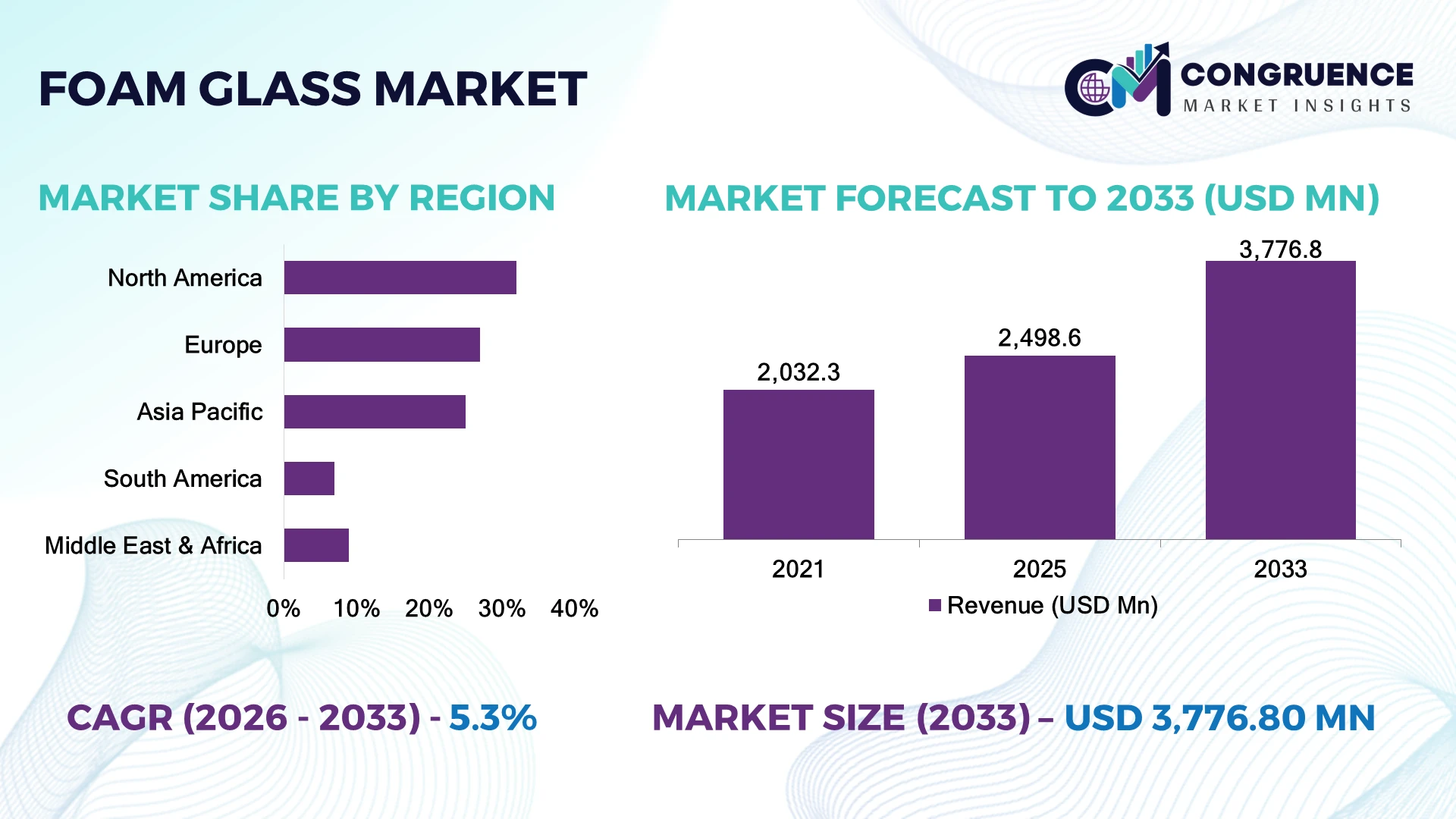
China remains the dominant manufacturing and consumption hub, representing approximately 28% of global foam glass demand, supported by large construction, district-energy, petrochemical, and cold-storage industries. Germany follows with roughly 9%, while U.S. demand is concentrated in commercial buildings and LNG infrastructure. China's building-efficiency upgrades and Europe's post-energy-crisis insulation investments are reinforcing adoption, with high-performance insulation projects increasingly specifying materials offering near-zero water absorption.
The strategic priority is to secure manufacturing scale and differentiated closed-cell insulation technology as energy-efficiency standards tighten globally.
Market Size & Growth: USD 2.50 billion in 2025 to USD 3.78 billion by 2033 at a 5.3% CAGR, supported by energy-efficient insulation and industrial replacement demand.
Top Growth Drivers: Building-energy efficiency 31%, industrial insulation 24%, and cold-chain infrastructure 18% are the leading demand catalysts.
Short-Term Forecast: By 2028, automated cutting and optimized panel production can reduce material waste by 8–12% while improving installation productivity by 10–15%.
Emerging Technologies: Closed-cell formulations, recycled-glass feedstocks, automated foaming, and precision cutting are improving thermal performance and manufacturing consistency by approximately 5–10%.
Regional Leaders: Asia-Pacific represents about 38% of demand, Europe 27%, and North America 22%, with industrial insulation and high-performance building applications driving adoption.
Consumer/End-User Trends: Commercial and industrial construction accounts for nearly 62% of demand, while LNG, refrigeration, and district-energy projects increasingly specify moisture-resistant insulation.
Pilot/Case Example: Advanced cellular-glass insulation deployments can reduce conductive heat loss by approximately 15–25% compared with conventional mineral-based insulation assemblies under comparable conditions.
Competitive Landscape: Leading suppliers collectively hold roughly 45% of global demand, competing through product density, thermal performance, manufacturing scale, project qualification, and regional distribution.
Regulatory & ESG Impact: Building-efficiency standards and embodied-carbon targets are increasing recycled-content requirements, with recycled glass increasingly representing 60–80% of raw-material input in established production routes.
Investment & Funding: Industrial insulation and energy-infrastructure projects are directing multi-million-dollar investments toward localized production, automated forming, and recycled-feedstock processing.
Innovation & Future Outlook: Next-generation foam glass will emphasize lower embodied carbon, improved dimensional precision, thinner insulation assemblies, and integration into high-performance building envelopes and industrial systems.
Foam glass is gaining strategic relevance across building envelopes, industrial piping, cryogenic systems, LNG infrastructure, refrigeration, and underground insulation because its closed-cell structure combines thermal insulation, moisture resistance, dimensional stability, and non-combustibility. Industrial applications represent an increasingly important demand base, while commercial construction remains a major volume contributor. Recycled-glass utilization above 60% is becoming increasingly important as manufacturers respond to embodied-carbon requirements and pressure to reduce virgin mineral inputs. Energy-intensive production remains a key operational consideration, encouraging manufacturers to optimize furnace efficiency, batch composition, and automated forming. Demand is increasingly shifting toward specification-driven projects where lifecycle performance matters more than initial material price.
Foam glass is becoming strategically important because insulation specifications are shifting from basic thermal resistance toward moisture control, fire safety, durability, and lifecycle performance. This favors closed-cell cellular glass in applications where insulation failure creates disproportionate operational costs, particularly LNG terminals, refrigeration systems, petrochemical facilities, and below-grade structures. Energy-efficiency regulations and building decarbonization programs are reinforcing this specification shift.
Technology differentiation is becoming more measurable. Modern foam-glass formulations and precision-manufactured panels can deliver approximately 5–10% better dimensional consistency than older production methods, while optimized cutting can reduce installation material losses by roughly 8–12%. Europe emphasizes high-performance building envelopes and industrial decarbonization, whereas China prioritizes manufacturing scale and infrastructure deployment; the United States combines commercial construction with energy and industrial projects.
Between 2026 and 2028, manufacturers are expected to prioritize recycled-feedstock processing, furnace optimization, automated cutting, and thinner high-performance assemblies. Project developers are increasingly evaluating insulation on lifecycle cost rather than purchase price alone. Companies that combine localized supply, consistent density, certified fire performance, and reliable project engineering will gain an advantage as foam glass becomes a specification-driven component of resilient, energy-efficient infrastructure.
Stricter building-energy codes and expanding LNG, refrigeration, and district-energy infrastructure are strengthening demand for closed-cell foam glass, particularly where moisture resistance and fire performance justify lifecycle savings. Industrial and infrastructure applications collectively account for approximately 55% of demand, while high-performance building projects increasingly specify non-combustible insulation. In Germany, tighter building-efficiency requirements are accelerating retrofit specifications, while China is expanding energy-efficient construction across industrial and commercial facilities. Manufacturers are responding by increasing recycled-glass utilization, optimizing furnace operations, and expanding panel-forming capacity. The non-obvious advantage is operational reliability: foam glass maintains insulation performance under moisture exposure, reducing replacement frequency and protecting downstream assets. Companies are therefore competing on density consistency, thermal performance, and project qualification rather than material price alone.
Foam glass production remains constrained by high-temperature foaming and annealing processes, making energy costs a significant profitability variable. Furnace operations can represent roughly 25–35% of manufacturing energy consumption, while energy and raw-material inputs together can influence more than 50% of conversion costs. European producers face additional electricity-price exposure, particularly during periods of industrial energy volatility. Transportation also limits scalability because rigid panels occupy substantial shipment volume relative to their weight, with logistics costs potentially adding 8–15% to delivered project economics on distant routes. Companies are mitigating pressure through regional manufacturing, recycled-glass sourcing, long-term energy contracts, furnace heat recovery, and optimized batch formulations. The strategic constraint is not material availability alone; it is maintaining competitive delivered cost while preserving controlled density and cell structure.
The strongest opportunity lies in combining recycled-glass feedstock with higher-performance cellular structures for energy-intensive infrastructure. Established production routes can incorporate roughly 60–80% recycled glass, creating scope to lower virgin-material dependence while strengthening circular-material credentials. Next-generation furnace controls and automated batch optimization can improve thermal-process efficiency by approximately 8–12%, creating a direct pathway to lower unit conversion costs. Demand from LNG terminals, cold-chain facilities, underground infrastructure, and high-performance buildings is creating specification opportunities beyond conventional wall insulation. Manufacturers are investing in automated forming, thinner panels, and application-specific systems that reduce installation volume without sacrificing thermal resistance. A particularly attractive niche is cryogenic infrastructure, where moisture resistance and dimensional stability can reduce maintenance exposure and improve insulation reliability over long operating cycles.
Long-term competitiveness depends on maintaining uniform cell structure, density, thermal conductivity, and dimensional tolerances as production volumes increase. Variations of even 5–10% in density or cell morphology can affect thermal performance, machining behavior, and installation consistency across large projects. Manufacturers also face a specialized workforce requirement covering furnace control, glass chemistry, process engineering, and quality assurance. Automated inspection can reduce manual quality-control workload by approximately 15–25%, but integrating sensors and process analytics across legacy production lines remains complex. Large infrastructure projects further require consistent supply across multiple construction phases, increasing pressure on production scheduling and regional inventory. Companies are responding through digital furnace monitoring, automated quality inspection, standardized formulations, and technical partnerships. The strategic challenge is scaling output without sacrificing the tightly controlled material characteristics that differentiate foam glass from conventional insulation.
Recycled Glass Inputs Expand Manufacturers are increasing recycled-glass content toward 60–80% as embodied-carbon requirements intensify and virgin-material exposure becomes less attractive. Automated sorting and batch preparation are improving feedstock consistency by roughly 8–12%, while producers are restructuring procurement around local glass-recycling streams. The shift is turning waste-glass availability into a strategic manufacturing advantage.
Furnace Optimization Gains Priority High-temperature furnaces are receiving greater attention as energy remains a major conversion-cost variable. Advanced controls, heat recovery, and automated batch dosing can reduce process energy consumption by approximately 8–12% and improve production stability by 5–8%. European manufacturers are accelerating efficiency upgrades as industrial electricity costs remain a critical operating consideration.
Cryogenic Projects Raise Specifications LNG, industrial-gas, and refrigeration projects are increasingly emphasizing moisture resistance, dimensional stability, and fire performance rather than insulation thickness alone. Cryogenic applications can represent more than 15% of specialized industrial foam-glass demand, strengthening the value of qualified products. Producers are responding with application-specific engineering, tighter density control, and project-level technical support.
Precision Cutting Reduces Waste Digital cutting and prefabricated insulation systems are gaining traction as contractors seek faster installation and lower material losses. Automated cutting can reduce site waste by approximately 10–15% while improving installation productivity by 8–12%. Manufacturers are responding with factory-cut panels, standardized modules, and project-specific fabrication, shifting value toward integrated supply and installation efficiency.
Closed-Cell Cellular Glass Leads Performance-Critical Insulation
Closed-cell cellular glass is the dominant type, accounting for approximately 78% of global foam glass demand in 2025, because its hermetically sealed structure combines water resistance, vapor impermeability, non-combustibility, compressive strength, and stable thermal performance. Its advantage is strongest in roofs, underground structures, industrial piping, and cryogenic installations where moisture ingress can undermine conventional insulation. High-density grades represent roughly 32% of demand and remain important for load-bearing and industrial applications, while standard-density products retain broader building-envelope use. Manufacturers are expanding grade portfolios and application-specific formulations to address different thermal and mechanical requirements.
The fastest-growing shift is toward high-performance and load-bearing cellular glass grades, supported by tighter building specifications and infrastructure projects requiring durable insulation under mechanical loads. Premium performance grades are estimated to expand their share by 4–6 percentage points through the forecast period as designers prioritize lifecycle reliability. Lower-density and specialized granulated forms remain relevant for void filling, drainage, and lightweight construction. Companies are responding through product engineering, automated cutting, recycled-feedstock optimization, and technical specification support, shifting investment toward differentiated grades rather than commodity volume.
In 2025, NAIMA member companies in the United States and Canada used more than 2.9 billion pounds of recycled materials for insulation production, demonstrating the strengthening industrial shift toward recycled feedstock across insulation manufacturing.
Building Insulation Anchors Volume While Industrial Systems Accelerate
Building insulation remains the leading application, representing approximately 46% of global foam glass demand in 2025, supported by roofing, foundations, walls, floors, and high-performance building envelopes. Its dominance reflects the material's combination of non-combustibility, compressive strength, moisture resistance, and dimensional stability. Industrial insulation accounts for around 29%, serving process piping, storage tanks, petrochemical facilities, and energy infrastructure. Underground and infrastructure insulation represent a smaller but strategically important share, particularly where water exposure and mechanical loading make conventional insulation less reliable. Companies are increasingly packaging boards, membranes, detailing components, and technical services as integrated systems.
Industrial and cryogenic insulation is the fastest-growing application, with adoption strengthening as LNG, industrial-gas, refrigeration, and process facilities prioritize corrosion control and moisture-resistant thermal barriers. This application is estimated to gain roughly 5–7 percentage points in demand mix as infrastructure projects increasingly specify long-life insulation. Building applications remain mature, but premium roofing and below-grade systems are becoming more performance-driven. Manufacturers are responding with higher-density grades, prefabricated panels, application engineering, and project-level specification support. The strategic implication is clear: demand is shifting toward applications where failure carries high maintenance or operational penalties.
A 2025 foam-glass product specification demonstrates cellular glass systems engineered for industrial, marine, HVAC, underground, roofing, and oil-and-gas applications, confirming the material's expanding role in performance-critical insulation rather than conventional building envelopes alone.
Industrial Buyers Drive High-Value Specification Demand
Industrial end-users represent the leading buyer group, accounting for approximately 41% of global foam glass demand in 2025, supported by petrochemical plants, LNG facilities, refrigeration systems, process industries, and storage infrastructure. Their purchasing decisions are driven by thermal stability, fire resistance, compressive strength, and resistance to water and vapor rather than lowest acquisition cost. Commercial construction follows at roughly 34%, where roofing and building-envelope applications provide larger project volumes but more price-sensitive procurement. Infrastructure and residential users collectively represent the remaining demand, with infrastructure projects increasingly favoring cellular glass for below-grade and load-bearing applications.
Energy and industrial infrastructure is the fastest-growing end-user group, with its share expected to increase by approximately 4–6 percentage points as LNG, cold-chain, district-energy, and process-industry investments expand. Commercial buyers remain focused on energy codes and lifecycle performance, while industrial buyers prioritize operational continuity and corrosion prevention. Manufacturers are targeting industrial customers through engineering partnerships, specification assistance, customized density grades, and regional inventory. Commercial channels increasingly emphasize system compatibility and installation support. The competitive advantage is moving toward suppliers capable of providing both certified material performance and project-specific technical execution.
In 2025, insulation manufacturers represented by NAIMA reported more than 2.9 billion pounds of recycled-material use across residential, commercial, industrial, and HVAC applications, highlighting the increasing importance of circular-material strategies in insulation procurement.
North America accounted for the largest market share at 32.0% in 2025 however, Asia-Pacific is expected to register the fastest growth, expanding at a CAGR of 6.4% between 2026 and 2033.

Industrial insulation and high-performance building envelopes strengthen regional demand
North America remains the leading foam glass market, supported by established manufacturing capacity, extensive commercial construction, LNG infrastructure, petrochemical facilities, and cold-storage networks. The region represented approximately 32.0% of global demand in 2025, with the United States accounting for the dominant share through industrial and building-envelope applications. Foam glass adoption is particularly strong where moisture resistance, non-combustibility, and dimensional stability reduce lifecycle maintenance. U.S. infrastructure modernization and energy-efficiency requirements are encouraging greater specification of high-performance insulation systems. Manufacturers are expanding technical distribution networks and developing application-specific boards and pipe sections. The strongest commercial opportunity lies in replacing moisture-sensitive insulation in below-grade and industrial environments, where performance failures carry substantially higher remediation costs than material substitution.
United States Market Outlook: The United States leads North American demand through its large industrial base, LNG infrastructure, commercial construction pipeline, and mature insulation distribution network. Industrial and commercial applications together represent more than 65% of regional foam glass consumption. Domestic suppliers are emphasizing recycled-content manufacturing, technical specification support, and higher-density products for energy and process infrastructure.
Energy-efficiency regulation accelerates premium insulation specification
Europe represented approximately 27.0% of global foam glass demand in 2025, supported by stringent building-performance requirements, industrial refurbishment, district-energy systems, and sustainability-focused construction standards. Germany, France, Italy, and the Nordic markets show stronger penetration in high-performance insulation where moisture resistance and fire safety are specification priorities. European manufacturers are increasingly integrating recycled glass feedstock into production, strengthening circular-material positioning. Building renovation programs and industrial decarbonization are shifting procurement toward longer-life insulation systems rather than lowest-cost materials. Premium applications account for an estimated 35% of regional demand, reinforcing opportunities for suppliers with certified thermal, mechanical, and fire-performance characteristics.
Germany Market Outlook: Germany represents Europe’s most strategically significant market because of its industrial insulation base, advanced construction standards, and extensive renovation activity. Foam glass benefits from stringent energy-performance requirements and demand for non-combustible insulation. Approximately 40% of German commercial foam-glass applications are associated with high-performance roofing, foundation, and industrial insulation systems, supporting premium-grade adoption.
Industrial expansion and infrastructure modernization reshape demand
Asia-Pacific accounted for approximately 25.0% of global foam glass demand in 2025 and represents the fastest-expanding regional opportunity, driven by industrial construction, LNG infrastructure, cold-chain development, and energy-intensive manufacturing. China, Japan, South Korea, and India are the principal demand centers, while Southeast Asian industrial hubs are increasing adoption in process facilities and commercial projects. China combines large-scale manufacturing capability with expanding industrial insulation requirements, while India is increasing deployment through infrastructure and energy projects. Regional manufacturers are investing in automated production and localized distribution, with capacity utilization in major production clusters estimated above 70%. The strategic opportunity is shifting from commodity insulation toward engineered systems for industrial and infrastructure applications.
China Market Outlook: China dominates Asia-Pacific production and consumption through its large industrial base, chemical processing capacity, LNG infrastructure, and construction activity. Domestic manufacturing provides cost advantages while supporting shorter delivery cycles. Industrial applications account for an estimated 45% of Chinese foam glass demand, creating strong opportunities for suppliers offering high-density grades, customized dimensions, and integrated insulation systems.
Infrastructure investment creates selective high-value insulation demand
South America accounted for approximately 7.0% of global foam glass demand in 2025, with Brazil representing the principal market because of its construction base, energy infrastructure, industrial processing, and expanding logistics facilities. Demand remains concentrated in commercial buildings, industrial plants, refrigeration, and specialized infrastructure rather than broad residential construction. Brazil’s industrial insulation requirements are increasing as energy and process facilities modernize, while imported products continue to influence premium-grade availability. Regional suppliers are strengthening distributor partnerships to reduce lead times and inventory exposure. The key constraint remains limited local manufacturing depth, making logistics efficiency and application-specific inventory strategically important for companies seeking scalable penetration.
Brazil Market Outlook: Brazil provides the strongest South American opportunity through its industrial concentration, infrastructure investment, and diversified construction ecosystem. Commercial and industrial projects account for more than 70% of regional foam-glass consumption. Local distribution partnerships are increasingly important because specialized insulation products require reliable project scheduling, technical specification support, and inventory availability across geographically dispersed construction markets.
Energy infrastructure and climate-resilient construction drive premium adoption
Middle East & Africa represented approximately 9.0% of global foam glass demand in 2025, with Gulf economies accounting for the majority of high-value industrial applications. Saudi Arabia and the United Arab Emirates are leading demand centers, supported by LNG-related infrastructure, petrochemical processing, district cooling, commercial construction, and large-scale urban development. Extreme temperatures and moisture exposure strengthen the technical case for closed-cell cellular glass in demanding insulation environments. Industrial and infrastructure projects account for more than 55% of regional demand. Manufacturers are responding through distributor expansion, project-specific technical services, and partnerships with engineering and construction contractors.
Saudi Arabia Market Outlook: Saudi Arabia is the region’s most strategically significant market because of its petrochemical infrastructure, industrial diversification programs, and large-scale construction pipeline. Industrial applications represent more than 60% of local foam-glass demand. New process facilities and energy infrastructure favor non-combustible, moisture-resistant insulation, giving technically differentiated suppliers an advantage over conventional low-cost materials.
Owens Corning, Glapor, Misapor, Foamit Group, and Chinese manufacturers compete across premium cellular-glass insulation, lightweight aggregates, and cost-led regional supply. The top five players collectively control approximately 46% of the global market, leaving a fragmented field where scale competes with specialization. Price-sensitive projects favor regional producers, while performance-led industrial and cryogenic applications prioritize certification, moisture resistance, and lifecycle durability. Premium products command roughly 20–25% higher pricing, while localized supply can reduce logistics costs by 10–15%. Owens Corning is expanding European capacity; Foamit Group is electrifying production; Misapor emphasizes recycled-content construction systems; Asian producers compete through manufacturing economics. Competitive advantage is shifting toward vertically integrated recycling, energy-efficient production, and application engineering rather than commodity volume alone. Entry barriers remain high because furnace technology, recycled-glass sourcing, certification, and project qualification require capital and technical credibility. Winning requires reliable feedstock, regional capacity, certified performance, fast delivery, and customized engineering support.
Owens Corning
Glapor Werk Mitterteich GmbH
Misapor AG
Foamit Group
REFAGLASS s.r.o.
POLYDROS, S.A.
Zhejiang Zhenshen Insulation Technology Corp. Ltd.
Zhejiang Dehe Insulation Technology Co., Ltd.
Uusioaines Oy
Earthstone International LLC
AeroAggregates of North America, LLC
SCHLÜSSELBAUER Geomaterials GmbH
Anhui Huichang New Material Co., Ltd.
VERISO GmbH & Co. KG
Modern foam glass production is shifting toward electric furnaces, automated energy recovery, precision foaming, and recycled-glass feedstock optimization. Foamit Group’s Onsøy modernization adds approximately 130,000 m³ of capacity and targets a 60% reduction in product-specific CO₂ emissions. Automated process controls improve density consistency and reduce thermal-energy losses by an estimated 5–10%, strengthening production economics and quality control. Adoption is concentrated among large European and North American producers.
Closed-cell engineering remains critical for industrial insulation because water resistance, dimensional stability, and compressive strength outperform conventional porous materials. Recycled-content manufacturing is becoming a competitive differentiator, with leading products incorporating 98–100% recycled glass. Compared with conventional quarried aggregate, foamed glass can be approximately 85% lighter, reducing transport intensity and structural loading while enabling faster handling. This advantage particularly benefits infrastructure contractors and sustainable-building developers.
Between 2026 and 2028, digital kiln monitoring, automated grading, electric thermal processing, and application-specific material formulations will reshape production. Companies combining low-carbon manufacturing with high-performance insulation gain stronger specification positioning, particularly in Europe. The priority is shifting from simply increasing output toward improving energy intensity, recycled-feedstock utilization, product consistency, and project-level lifecycle performance.
March 2024 Foamit Group committed approximately EUR 10 million to modernize its Norwegian Onsøy plant, adding two electric lines and doubling capacity, strengthening Nordic infrastructure supply while targeting 60% lower product-specific CO₂ emissions. Source: foamit.fi
June 2024 Foamit Group secured 75,000 m³ of foam-glass supply contracts for Sweden’s E20 and Norway’s E18 motorway projects, lifting recent orders to 155,000 m³ and strengthening its position in major Nordic infrastructure construction. Source: foamit.fi
June 2025 Owens Corning announced investment in its Klášterec, Czech Republic FOAMGLAS plant, increasing production capacity 50% for European flat-roof demand, with the expanded line scheduled to start during the second quarter of 2026. Source: foamglas.com
January 2025 Pennsylvania’s transportation authority maintained AeroAggregates FG-G15 on its qualified-products list for foamed-glass aggregate, reinforcing specification eligibility for lightweight embankment and structural backfill applications across state infrastructure projects. Source: dot.state.pa.us
The Foam Glass Market Report covers the industry across type, manufacturing process, application, end-user industry, and geography. Type analysis includes open-cell, closed-cell, insulating, granular, facing, and specialty foam glass formats, while application coverage spans building and industrial insulation, chemical systems, HVAC, cryogenic infrastructure, underground construction, lightweight fill, drainage, and architectural uses. End-user assessment includes residential, commercial, industrial, infrastructure, and specialized construction environments.
Regional analysis evaluates North America, Europe, Asia-Pacific, South America, and the Middle East & Africa, with country-level assessment of leading production and consumption markets. The report examines electric furnace processing, recycled-glass utilization, automated production, energy recovery, and low-carbon manufacturing. Coverage of more than 10 major companies supports competitive benchmarking, capacity planning, investment prioritization, expansion decisions, product positioning, supply-chain strategy, and technology planning through 2026–2033.
| Report Attribute/Metric | Report Details |
|---|---|
|
Market Revenue in 2025 |
USD 2,498.6 Million |
|
Market Revenue in 2033 |
USD 3,776.8 Million |
|
CAGR (2026 - 2033) |
5.3% |
|
Base Year |
2025 |
|
Forecast Period |
2026 - 2033 |
|
Historic Period |
2021 - 2025 |
|
Segments Covered |
By Type
By Application
By End-User
|
|
Key Report Deliverable |
Revenue Forecast, Growth Trends, Market Dynamics, Segmental Overview, Regional and Country-wise Analysis, Competition Landscape |
|
Region Covered |
North America, Europe, Asia-Pacific, South America, Middle East, Africa |
|
Key Players Analyzed |
Owens Corning, Glapor Werk Mitterteich GmbH, Misapor AG, Foamit Group, REFAGLASS s.r.o., POLYDROS, S.A., Zhejiang Zhenshen Insulation Technology Corp. Ltd., Zhejiang Dehe Insulation Technology Co., Ltd., Uusioaines Oy, Earthstone International LLC, AeroAggregates of North America, LLC, SCHLÜSSELBAUER Geomaterials GmbH, Anhui Huichang New Material Co., Ltd., VERISO GmbH & Co. KG |
|
Customization & Pricing |
Available on Request (10% Customization is Free) |




