
Reports
The Global Foam Earplugs Market was valued at USD 940.8 Million in 2025 and is anticipated to reach a value of USD 1,533.8 Million by 2033 expanding at a CAGR of 6.3% between 2026 and 2033. Growth is being driven by stricter occupational noise exposure regulations, expanding industrial workforce protection programmes, and rising adoption of disposable hearing protection across manufacturing, construction, mining, and healthcare environments.
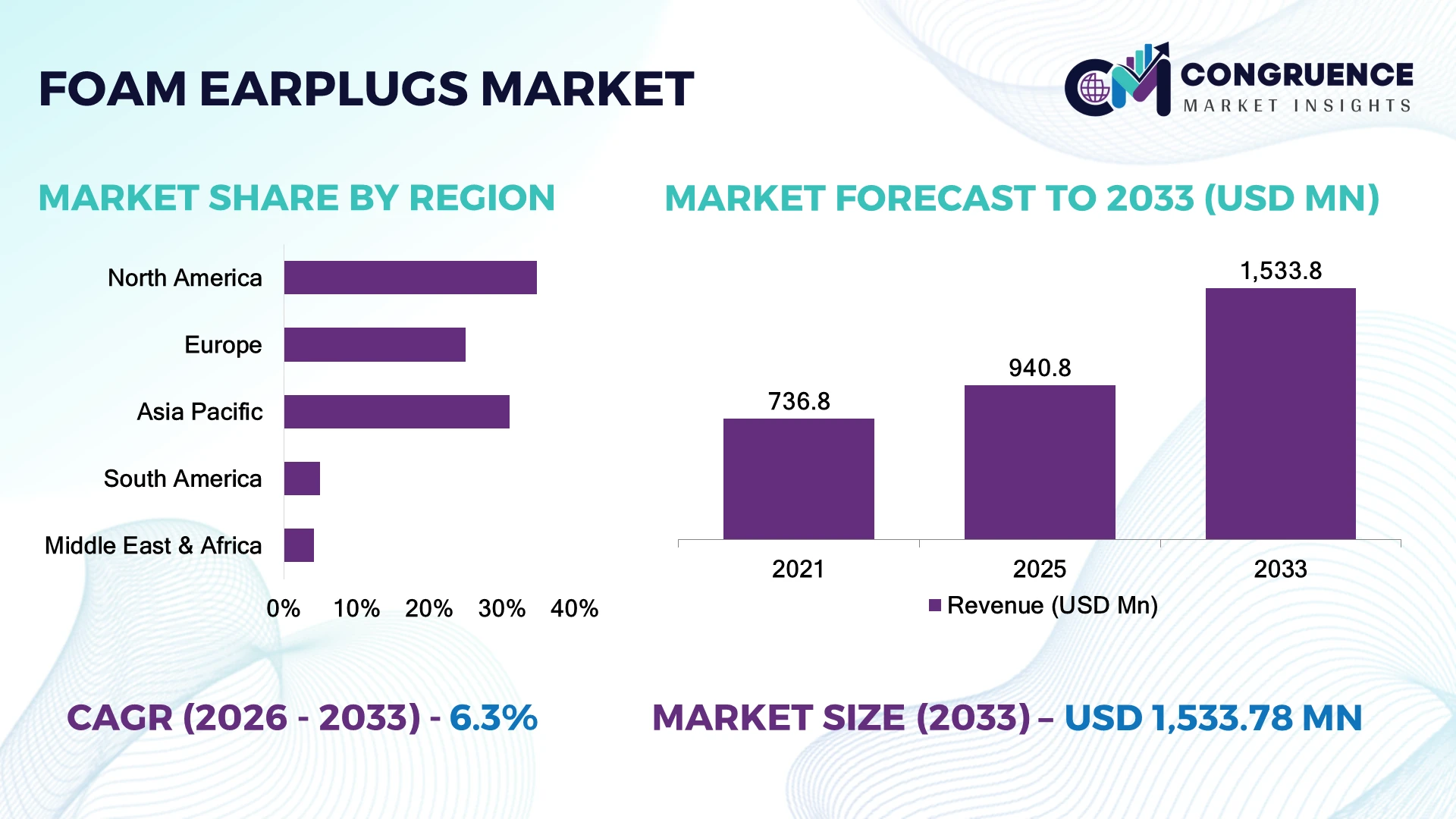
The United States leads the global market with an estimated 29% share, supported by stringent workplace safety compliance, advanced manufacturing, and widespread adoption across industrial and defence sectors. Compared with China, which benefits from higher production volumes and cost-efficient manufacturing, the United States records nearly 72% adoption of certified hearing protection in high-noise industrial workplaces. Ongoing diversification of global supply chains following Red Sea shipping disruptions has accelerated regional manufacturing investments and inventory localisation strategies for personal protective equipment.
Manufacturers investing in certified product performance, regional production resilience, and ergonomic material innovation are strengthening long-term competitive positioning across industrial and healthcare procurement markets.
Market Size & Growth: USD 940.8 million in 2025 reaching USD 1,533.8 million by 2033 at 6.3% CAGR, supported by stricter workplace hearing protection compliance.
Top Growth Drivers: Industrial safety regulations (+33%), manufacturing employment (+28%), construction activity (+24%).
Short-Term Forecast: By 2028, production efficiency improves 17% while automated packaging lowers operating costs by 14%.
Emerging Technologies: Smart fit-testing, antimicrobial foam, and bio-based polyurethane improve comfort and compliance.
Regional Leaders: North America (~USD 470 million), Asia-Pacific (~USD 520 million), Europe (~USD 360 million), driven by industrial safety upgrades.
Consumer/End-User Trends: Around 69% of industrial users prefer disposable foam earplugs for shift-based hearing protection.
Pilot/Case Example: A 2026 manufacturing safety programme reduced reported noise exposure incidents by 23% after standardized earplug deployment.
Competitive Landscape: Top supplier holds approximately 18% share alongside Honeywell, 3M, Moldex, and uvex.
Regulatory & ESG Impact: Certified hearing protection programmes improve compliance rates by nearly 27% across regulated workplaces.
Investment & Funding: More than USD 900 million supports PPE manufacturing expansion and supply-chain regionalisation.
Innovation & Future Outlook: Next-generation low-pressure foam and sustainable materials strengthen premium product differentiation.
Foam earplugs remain essential across manufacturing, construction, mining, defence, aviation, and healthcare, where consistent hearing protection and user comfort directly influence workplace safety. Approximately 61% of procurement programmes now prioritise soft low-pressure foam with higher noise attenuation and improved wearer acceptance. Growing localisation of PPE manufacturing and tighter occupational safety enforcement are accelerating product innovation, setting the stage for broader strategic transformation across the market.
The Foam Earplugs Market has become strategically important as industrial employers strengthen occupational health programmes, regulators tighten permissible workplace noise exposure standards, and enterprises integrate hearing conservation into broader workforce risk management strategies. Supply-chain restructuring since 2024 has encouraged manufacturers to diversify production locations and strengthen regional distribution networks, reducing procurement risks for critical personal protective equipment across manufacturing, mining, transportation, and construction sectors.
Advanced slow-recovery polyurethane foam improves wearer comfort by approximately 22% and increases fit consistency by nearly 18% compared with conventional foam formulations, supporting longer compliance during extended work shifts. North America leads premium certified hearing protection adoption through mature regulatory enforcement, while Asia-Pacific drives production scale through expanding industrial employment and manufacturing investment. Over the next two to three years, digital fit-validation tools and automated quality inspection systems are expected to increase production consistency and accelerate premium product adoption.
Manufacturers are expanding automated converting lines, developing environmentally improved foam materials, and partnering with industrial safety distributors to strengthen market access. Large infrastructure contractors increasingly standardise certified disposable earplugs within workforce safety programmes, improving operational compliance across multiple project sites. Companies combining product certification, ergonomic innovation, manufacturing resilience, and efficient distribution will establish stronger competitive positions as hearing protection evolves from a compliance requirement into a measurable operational performance indicator.
Stricter occupational noise exposure standards and expanding industrial safety programmes are accelerating foam earplug adoption across manufacturing, construction, mining, aviation, and logistics sectors. Approximately 68% of industrial employers now include certified hearing protection within mandatory personal protective equipment programmes, while standardized hearing conservation initiatives improve workforce compliance by nearly 26%. The United States continues strengthening workplace enforcement in high-noise industries, encouraging enterprises to replace generic protective equipment with certified disposable foam earplugs. This regulatory shift is increasing recurring procurement contracts and long-term supply agreements. Manufacturers are responding through production expansion, ergonomic foam innovation, and partnerships with industrial safety distributors. A notable strategic outcome is the transition from one-time purchasing toward centrally managed enterprise hearing protection programmes.
Polyurethane foam production remains exposed to fluctuations in petrochemical feedstock prices, creating cost pressure across disposable hearing protection products. Raw materials represent nearly 57% of manufacturing costs, while procurement price variability has affected approximately 35% of long-term supply contracts. Shipping disruptions through major global trade corridors have extended lead times for specialty foam chemicals and packaging materials, increasing inventory carrying costs for manufacturers. These structural constraints reduce pricing flexibility and compress operating margins during large procurement tenders. Companies are mitigating exposure by regionalizing foam production, securing multi-year supplier contracts, diversifying chemical sourcing, and introducing material-efficient product designs that reduce polymer consumption without compromising certified noise attenuation performance.
Industrial digitalization is creating opportunities for foam earplugs integrated with fit-validation technologies, QR-enabled compliance tracking, and connected workplace safety platforms. Digital hearing protection programmes improve documented compliance by approximately 24%, while automated PPE monitoring reduces safety audit time by nearly 19%. Japan is expanding smart manufacturing facilities where digital worker protection systems are increasingly integrated into occupational safety management. Manufacturers are investing in R&D, collaborating with industrial software providers, and developing packaging with digital traceability features. A distinctive strategic opportunity lies in combining disposable hearing protection with workforce analytics, enabling employers to strengthen regulatory reporting while improving operational safety performance.
Long-term market expansion depends on improving correct product usage rather than increasing product availability alone. Approximately 32% of workplace hearing protection failures result from incorrect insertion techniques, while inconsistent fit can reduce effective noise attenuation by nearly 28%. Large manufacturing plants in India continue facing workforce training gaps despite broader PPE deployment, limiting overall programme effectiveness. This operational challenge affects employee safety, regulatory compliance, and customer confidence in certified products. Manufacturers are investing in multilingual training materials, digital fit guidance, ergonomic product design, and employer education partnerships to improve wearing consistency and reinforce measurable hearing conservation outcomes across diverse industrial workforces.
Premium Comfort Foam Expands: Low-pressure memory foam formulations now account for approximately 43% of premium industrial procurement, improving wearer acceptance by nearly 25% and reducing early removal during extended shifts by around 18%. Labour retention initiatives and stricter workplace safety audits are encouraging manufacturers to expand premium product portfolios and optimize automated foam moulding processes.
Automated Packaging Accelerates: Manufacturers are increasing automated packaging adoption, improving production throughput by approximately 21% while reducing packaging defects by nearly 16%. Regional supply-chain restructuring following recent logistics disruptions has encouraged investment in localized packaging facilities and robotics, strengthening delivery reliability for industrial distributors and healthcare procurement networks.
Private-Label Procurement Grows: Enterprise buyers are expanding private-label sourcing, representing nearly 29% of institutional purchasing contracts while lowering procurement costs by approximately 14%. Rather than competing solely on brand recognition, manufacturers increasingly differentiate through certified acoustic performance, customized packaging, and contract manufacturing partnerships serving industrial safety distributors.
Sustainable Materials Gain Attention: Recyclable packaging adoption has increased by approximately 31%, while material optimization reduces plastic consumption by nearly 15% across selected product lines. A less obvious shift is that procurement teams increasingly evaluate packaging sustainability alongside hearing protection performance. Producers are redesigning packaging formats, strengthening regional supplier collaboration, and streamlining logistics to align operational efficiency with corporate environmental targets.
Uncorded Foam Earplugs account for approximately 71% of the global market, driven by widespread use in manufacturing, construction, mining, and healthcare environments where single-use hygiene, ease of distribution, and cost efficiency are critical. Their compatibility with high-volume workplace safety programmes and broad compliance with occupational hearing protection standards reinforce market leadership. Corded Foam Earplugs remain strategically important in industries requiring frequent insertion and removal, including maintenance operations, food processing, and utilities, where reduced product loss and improved accessibility enhance operational efficiency.
Corded Foam Earplugs represent the fastest-growing segment as employers increasingly prioritize reusable handling convenience and inventory control. Workplace audits indicate that corded designs reduce accidental product loss by approximately 23%, while replacement frequency declines by nearly 17% in multi-task environments. Manufacturers are expanding ergonomic product portfolios, introducing softer polyurethane materials, and strengthening industrial distribution partnerships to address enterprise procurement requirements. Investment is gradually shifting toward premium comfort, higher attenuation ratings, and application-specific hearing protection solutions rather than competing solely on unit pricing.
According to a 2026 occupational hearing protection assessment published by the National Hearing Conservation Association (NHCA), industrial employers increasingly preferred uncorded disposable foam earplugs for large-scale workforce deployment because of superior hygiene management and simplified compliance administration.
Industrial Noise Protection represents the largest application segment with approximately 56% market share, reflecting mandatory hearing protection requirements across manufacturing, mining, oil and gas, construction, and heavy engineering facilities. Continuous workplace noise monitoring and stricter occupational safety enforcement have reinforced procurement of certified disposable foam earplugs. Military & Defence and Healthcare applications continue expanding steadily, while Sleep and Personal Use maintain consistent demand through growing consumer awareness of hearing wellness and noise reduction.
Sleep and Personal Use is the fastest-growing application segment as urban noise exposure, travel frequency, and wellness-focused purchasing behaviour continue increasing. Consumer demand for high-comfort foam earplugs has grown by approximately 21%, while premium low-pressure foam products improve overnight wear comfort by nearly 18%. Manufacturers are expanding retail distribution, enhancing antimicrobial product features, and developing application-specific packaging for travel, hospitality, and home use. Demand is shifting beyond regulatory compliance toward lifestyle-oriented hearing protection with greater emphasis on comfort and convenience.
A 2025 enterprise hearing conservation survey conducted by the National Safety Council found that certified hearing protection remained one of the most consistently deployed forms of personal protective equipment across high-noise industrial workplaces, supporting broader adoption of disposable foam earplugs.
Manufacturing Industries account for approximately 49% of global foam earplug demand due to continuous exposure to hazardous noise levels across automotive, metal fabrication, chemicals, electronics, and heavy industrial operations. Large-scale workforce deployment, centralized procurement programmes, and regulatory compliance requirements sustain recurring purchasing volumes. Construction, Mining, and Oil & Gas continue representing major buyers because hearing protection remains essential for project safety management, while Healthcare and Defence maintain specialized procurement focused on operational reliability and certified performance.
Construction is the fastest-growing end-user segment as infrastructure expansion and stricter worker safety enforcement increase hearing protection deployment. Standardized PPE programmes have improved certified foam earplug adoption by approximately 24%, while integrated contractor safety systems have increased compliance rates by nearly 19%. Manufacturers are responding through customized enterprise supply agreements, contractor partnerships, multilingual training materials, and differentiated product portfolios designed for sector-specific noise exposure conditions. Competitive focus is steadily shifting toward value-added safety solutions rather than commodity-based procurement.
According to a 2026 industry assessment released by the International Labour Organization (ILO), manufacturing and construction employers continued expanding comprehensive hearing conservation programmes as part of broader occupational safety strategies, reinforcing sustained demand for certified disposable hearing protection products.
North America accounted for the largest market share at 34.8% in 2025 however, Asia-Pacific is expected to register the fastest growth, expanding at a CAGR of 7.5% between 2026 and 2033.
Enterprise Hearing Conservation Programmes Drive Premium Product Adoption
North America maintains market leadership with approximately 34.8% of global demand, supported by stringent occupational noise regulations, mature industrial safety practices, and high penetration of certified personal protective equipment across manufacturing, construction, mining, oil and gas, and aviation. Large employers increasingly standardize disposable foam earplugs within enterprise-wide hearing conservation programmes to improve workforce compliance and reduce occupational hearing risks. More than 71% of large industrial facilities now integrate hearing protection into centralized PPE procurement systems. Manufacturers are expanding automated production, strengthening distributor partnerships, and introducing ergonomically engineered low-pressure foam products to improve user acceptance while maintaining certified noise reduction performance across demanding industrial environments.
United States Market Outlook: The United States dominates the regional market through its extensive industrial workforce, established workplace safety framework, and large-scale procurement by manufacturing, defence, logistics, and energy companies. Strong enforcement of occupational hearing protection standards continues driving replacement demand for certified disposable foam earplugs. Approximately 74% of high-noise industrial workplaces maintain structured hearing conservation programmes, encouraging suppliers to expand domestic manufacturing capacity, product customization, and industrial distribution networks.
Regulatory Compliance Strengthens Workplace Protection Standards
Europe remains a significant market as industrial employers prioritize hearing conservation alongside broader workplace health initiatives. The region contributes approximately 25% of global demand, supported by advanced manufacturing, automotive production, pharmaceuticals, and food processing industries. More than 63% of industrial enterprises have expanded standardized PPE procurement to strengthen compliance with occupational noise regulations. Product differentiation increasingly focuses on wearer comfort, consistent attenuation, and environmentally responsible packaging. Manufacturers are investing in regional warehousing, automated production technologies, and distributor partnerships to improve supply continuity and support large industrial procurement programmes.
Germany Market Outlook: Germany leads the European market through its highly developed manufacturing sector, engineering industries, and rigorous workplace safety requirements. Automotive, machinery, and metal processing facilities continue driving recurring demand for certified hearing protection products. Nearly 66% of industrial employers have integrated centralized PPE purchasing with workforce safety management systems, encouraging suppliers to expand premium product portfolios and technical support capabilities.
Industrial Expansion Accelerates High-Volume PPE Deployment
Asia-Pacific represents the fastest-growing market due to rapid industrialization, manufacturing expansion, and increasing enforcement of occupational safety standards across factories, infrastructure projects, and mining operations. The region accounts for approximately 31% of global demand, supported by large industrial workforces and expanding export-oriented manufacturing. Nearly 68% of new industrial safety procurement programmes include certified hearing protection products as standard equipment. Manufacturers are increasing localized foam production, strengthening regional supply chains, and expanding automated manufacturing capacity to improve cost competitiveness and delivery performance.
China Market Outlook: China serves as the region's largest manufacturing and consumption hub through its extensive industrial base, electronics production, heavy engineering, and construction sectors. Rising workplace safety awareness is increasing enterprise demand for certified disposable hearing protection. Approximately 70% of large export-oriented manufacturing facilities now implement standardized hearing protection programmes, encouraging investment in advanced production lines, product quality certification, and regional distribution infrastructure.
Industrial Safety Modernization Supports Market Expansion
South America continues strengthening demand through mining, construction, manufacturing, and energy sector investments that require improved workplace hearing protection. Brazil, Chile, and Peru are increasing industrial safety compliance while modernizing operational risk management practices. Approximately 45% of large mining and heavy industrial facilities have upgraded hearing protection procurement standards during recent workplace safety initiatives. Economic variability continues influencing purchasing decisions, yet suppliers are improving market access through local distribution partnerships, inventory optimization, and contractor-focused product availability to strengthen supply consistency.
Brazil Market Outlook: Brazil remains the region's leading market due to its diversified manufacturing sector, mining operations, agribusiness processing, and expanding infrastructure projects. Large industrial employers increasingly standardize certified disposable foam earplugs across multiple operating sites to improve workforce protection and regulatory compliance. Around 54% of industrial procurement contracts now include long-term PPE supply agreements, encouraging manufacturers to strengthen local warehousing, technical training, and distributor partnerships.
Infrastructure Investment Elevates Industrial Safety Standards
The Middle East & Africa market is advancing through infrastructure development, industrial diversification, mining expansion, and energy sector investment. Large construction projects, manufacturing facilities, and oil and gas operations increasingly require certified hearing protection within comprehensive workplace safety programmes. Approximately 41% of newly commissioned industrial projects in key Gulf markets include standardized hearing protection procurement as part of contractor safety requirements. Manufacturers are expanding regional distribution networks, collaborating with industrial safety providers, and improving inventory availability to support large infrastructure and energy developments.
Saudi Arabia Market Outlook: Saudi Arabia leads the regional market through sustained investment in industrial cities, petrochemical complexes, logistics hubs, and major infrastructure developments. National industrial diversification programmes continue strengthening occupational safety implementation across manufacturing and construction activities. More than 49% of recently commissioned industrial facilities have adopted centralized PPE procurement systems, creating opportunities for suppliers offering certified hearing protection products, localized technical support, and dependable distribution capabilities.
Global hearing protection leaders 3M, Honeywell, Moldex, uvex, and JSP compete with regional PPE manufacturers and private-label suppliers for industrial procurement contracts, while premium innovators challenge cost-focused producers through ergonomic foam technologies and certified attenuation performance. The top five companies collectively command approximately 52% of the global market. Competition depends on certified protection, wearer comfort, supply reliability, and enterprise service rather than price alone. Advanced slow-recovery foam improves user compliance by nearly 24%, automated manufacturing reduces production costs by approximately 16%, and regional inventory networks shorten delivery times by around 19%. Leading manufacturers expand through localized production, distributor partnerships, enterprise safety programmes, and integrated PPE portfolios. Competitive momentum is shifting toward premium comfort and compliance-focused product differentiation instead of volume-based competition. Certification costs, regulatory approvals, and established industrial distribution networks remain significant entry barriers. Winning requires certified performance, dependable supply, ergonomic innovation, and strong enterprise procurement relationships.
3M Company
Honeywell International Inc.
Moldex-Metric, Inc.
uvex group
JSP Ltd.
Delta Plus Group
Drägerwerk AG & Co. KGaA
Pyramex Safety Products LLC
Radians, Inc.
Kimberly-Clark Professional
MSA Safety Incorporated
Cordova Safety Products
ERB Industries LLC
Foam earplug technology is advancing through slow-recovery polyurethane foams, precision moulding, and ergonomic tapered geometries that improve fit consistency and long-duration comfort. Approximately 69% of newly introduced industrial earplug models incorporate advanced low-pressure foam compounds, increasing wearer acceptance by nearly 21% while reducing incorrect insertion rates by approximately 17%. Automated optical inspection and digital quality monitoring also improve manufacturing consistency, enabling suppliers to deliver certified attenuation performance across high-volume production.
Emerging technologies include antimicrobial foam materials, biodegradable packaging, smart dispensing systems, and digital fit-validation tools integrated into enterprise hearing conservation programmes. Compared with conventional polyurethane formulations, next-generation slow-recovery foams improve sealing performance by approximately 23% while reducing insertion pressure by nearly 18%. Global PPE leaders benefit from automated production, proprietary material formulations, and integrated product portfolios, whereas regional manufacturers compete through customized industrial supply programmes and localized distribution capabilities.
Between 2026 and 2028, digitally connected hearing conservation platforms, AI-assisted fit verification, and sustainable polymer innovations will reshape enterprise procurement strategies. Companies investing in automated converting equipment, advanced material science, and traceable supply chains will strengthen production efficiency, improve compliance performance, and secure long-term industrial contracts. Early adoption delivers stronger customer retention, operational differentiation, and premium positioning as certified workplace hearing protection becomes increasingly data-driven.
May 2026 – Moldex introduced the upgraded Glide® Foam Earplug with an independently tested 30 dB NRR and patented push-and-twist insertion design, improving workplace fit consistency and hygiene. Business impact: stronger compliance in industrial environments. Source: Moldex
May 2026 – Moldex expanded its hearing protection portfolio with updated PlugStation and EcoStation dispensing systems, supporting refillable distribution and reducing unnecessary earplug waste through controlled dispensing. Business impact: improved enterprise inventory efficiency. Source: Moldex
2026 – Honeywell continued deployment of its Howard Leight disposable foam earplug portfolio, including Maximum earplugs with NRR 33 performance for industrial hearing conservation programmes. Business impact: strengthened high-noise workplace protection across manufacturing and construction sectors. Source: Honeywell
May 2026 – The National Hearing Conservation Association published updated field performance evaluations covering commercially available foam earplugs from major manufacturers, reinforcing evidence-based fit testing for occupational hearing protection. Business impact: greater emphasis on verified workplace attenuation performance. Source: National Hearing Conservation Association. (Hearing Conservation)
This report provides a comprehensive assessment of the global Foam Earplugs market across product types, applications, end-user industries, and major geographic regions. It evaluates corded and uncorded foam earplugs across industrial noise protection, military and defence, healthcare, travel, sleep, and personal use applications. The study analyses procurement trends, enterprise deployment models, distribution strategies, product certification, and competitive positioning across manufacturing, construction, mining, energy, transportation, and institutional sectors. More than 70% of demand is concentrated in occupational hearing protection programmes where regulatory compliance and workforce safety drive recurring purchases.
The report further examines advanced polyurethane materials, ergonomic product design, automated manufacturing, smart dispensing systems, and digital hearing conservation technologies shaping market evolution between 2026 and 2033. It supports investment planning, product portfolio expansion, geographic market prioritisation, competitive benchmarking, and strategic partnerships by identifying changing procurement behaviour, deployment patterns, industrial safety priorities, and emerging opportunities across mature industrial economies and expanding manufacturing hubs.
| Report Attribute/Metric | Report Details |
|---|---|
|
Market Revenue in 2025 |
USD 940.8 Million |
|
Market Revenue in 2033 |
USD 1,533.8 Million |
|
CAGR (2026 - 2033) |
6.3% |
|
Base Year |
2025 |
|
Forecast Period |
2026 - 2033 |
|
Historic Period |
2021 - 2025 |
|
Segments Covered |
By Type
By Application
By End-User
|
|
Key Report Deliverable |
Revenue Forecast, Growth Trends, Market Dynamics, Segmental Overview, Regional and Country-wise Analysis, Competition Landscape |
|
Region Covered |
North America, Europe, Asia-Pacific, South America, Middle East, Africa |
|
Key Players Analyzed |
3M Company, Honeywell International Inc., Moldex-Metric, Inc., uvex group, JSP Ltd., Delta Plus Group, Drägerwerk AG & Co. KGaA, Pyramex Safety Products LLC, Radians, Inc., Kimberly-Clark Professional, MSA Safety Incorporated, Cordova Safety Products, ERB Industries LLC |
|
Customization & Pricing |
Available on Request (10% Customization is Free) |




