
Reports
The Global Fluoropolymer in Healthcare Market was valued at USD 290.0 Million in 2025 and is anticipated to reach a value of USD 451.9 Million by 2033 expanding at a CAGR of 5.7% between 2026 and 2033. Growth is driven by increasing adoption of PTFE-lined medical catheters, fluorinated pharmaceutical processing components, high-purity fluid transfer systems, and advanced implantable medical devices.
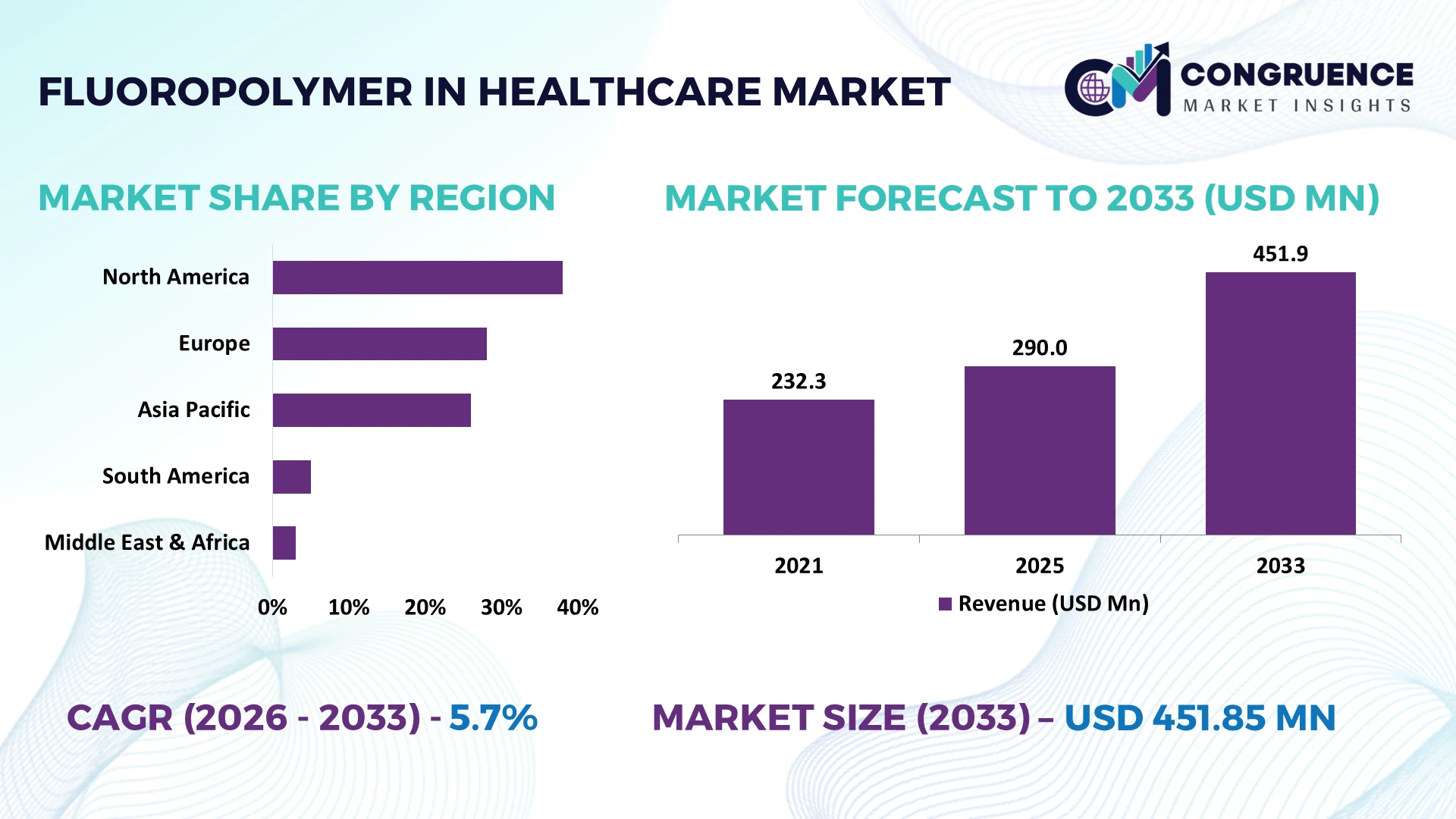
The United States dominates the global fluoropolymer in healthcare market, supported by its advanced medical device manufacturing ecosystem and extensive pharmaceutical infrastructure. The country accounts for approximately 38% of global demand, compared with China's estimated 17%. The FDA's increasingly stringent biocompatibility expectations and ongoing PFAS regulatory scrutiny are accelerating material qualification, particularly for high-performance fluoropolymers used in minimally invasive medical technologies.
Strategically, manufacturers prioritizing validated medical-grade materials, regulatory compliance, and domestic supply-chain integration will strengthen their competitive positioning.
Market Size & Growth: The global market reached USD 290.0 Million in 2025 and is projected to attain USD 451.9 Million by 2033, registering a 5.7% CAGR, supported by precision catheter manufacturing and high-purity pharmaceutical processing.
Top Growth Drivers: Estimated demand influences include minimally invasive medical devices at 38%, pharmaceutical processing applications at 32%, and advanced implantable components at 30%.
Short-Term Forecast: By 2028, optimized fluoropolymer extrusion and automated inspection are projected to reduce production scrap by 8–12% in upgraded manufacturing lines.
Emerging Technologies: Advanced PTFE microextrusion, AI-assisted defect inspection, and precision fluoropolymer coating technologies are improving dimensional accuracy, with targeted processing efficiency gains of 10–15%.
Regional Leaders: By 2033, North America is projected to reach USD 171.7 Million through catheter adoption, Europe USD 126.5 Million through pharmaceutical equipment modernization, and Asia Pacific USD 117.5 Million through medical device localization.
Consumer/End-User Trends: Medical device manufacturers represent an estimated 55% of demand, emphasizing low-friction catheter liners, biocompatibility, and long-term material reliability.
Pilot/Case Example: A representative 2026 catheter-liner process optimization scenario targets a 12% reduction in material waste through automated extrusion control; this is a modeled outcome rather than a verified commercial pilot.
Competitive Landscape: Chemours holds an estimated 18% indicative share, competing with Daikin Industries, AGC, 3M, and Solvay/Syensqo-linked specialty material businesses across medical-grade fluoropolymer applications.
Regulatory & ESG Impact: European PFAS restrictions and medical-device compliance requirements are encouraging material traceability, with manufacturers targeting 10–15% reductions in processing waste through closed-loop production.
Investment & Funding: An illustrative USD 75 Million combined industry investment scenario emphasizes cleanroom extrusion, medical-grade compounding, and qualification infrastructure rather than a verified funding total.
Innovation & Future Outlook: Next-generation fluoropolymer composites, precision coatings, and automated medical tubing production are targeting 15–20% improvements in manufacturing consistency across selected advanced applications.
The fluoropolymer in healthcare market is increasingly shaped by catheter miniaturization, implantable device engineering, and contamination-controlled pharmaceutical manufacturing. Advanced PTFE, FEP, and PFA materials support low-friction surfaces and chemical resistance, while automated extrusion offers targeted defect reductions of 10–15%. European PFAS policy developments are also strengthening the importance of material traceability, creating new priorities for technology investment and supplier selection.
Fluoropolymers are becoming strategically important to healthcare manufacturers because material performance directly influences device reliability, production efficiency, and regulatory qualification. PTFE, FEP, and PFA enable low-friction catheter navigation, chemically resistant pharmaceutical fluid pathways, and precision medical tubing. Growing scrutiny of PFAS substances is encouraging suppliers to strengthen traceability, evaluate alternative materials, and secure long-term medical-grade production capacity. This transition increasingly favors manufacturers with validated processing technologies and established healthcare customer relationships.
Compared with conventional polymer processing, optimized fluoropolymer microextrusion systems can target 10–15% lower material waste and tighter dimensional tolerances under controlled production conditions. The United States maintains advantages in advanced catheter development and regulatory expertise, while China emphasizes localized medical component manufacturing. Germany and Japan remain important centers for precision polymer processing and high-performance medical materials. These differences influence supplier qualification, production economics, and technology partnerships.
During 2027–2029, manufacturers are expected to prioritize automated inspection, high-purity extrusion, and medical-device-specific material qualification. A practical example involves integrating inline laser measurement into PTFE catheter-liner production to reduce dimensional variation and rejected components. Companies investing in application-specific formulations, manufacturing partnerships, and regulatory documentation will secure stronger competitive advantages through consistent quality and faster product commercialization.
Increasing utilization of minimally invasive procedures is strengthening demand for medical-grade PTFE, FEP, and other fluoropolymers used in catheter liners, guidewire coatings, and delivery systems. Medical device applications represent an estimated 55% of market demand, while catheter-related components account for approximately 35% of healthcare fluoropolymer consumption. Advanced low-friction liners can target 15–20% reductions in insertion resistance compared with selected conventional polymer configurations. In the United States, continued development of neurovascular and cardiovascular intervention technologies is accelerating demand for thinner, dimensionally consistent tubing. Manufacturers are responding by investing in precision extrusion, surface treatment, and automated inspection systems. Suppliers capable of combining biocompatibility documentation with tight-tolerance manufacturing gain stronger access to high-value OEM procurement programs.
Increasing regulatory scrutiny of per- and polyfluoroalkyl substances creates procurement uncertainty for healthcare fluoropolymer suppliers, particularly those serving European medical device manufacturers. Specialized fluoropolymer compounds can carry estimated processing premiums of 20–30% over conventional engineering polymers, depending on purity, production volume, and specification requirements. Material qualification and documentation activities can represent another 10–15% of selected development budgets. The European Union's ongoing PFAS restriction assessment has encouraged manufacturers to review product portfolios and evaluate critical-use requirements. These pressures increase inventory costs, complicate supplier selection, and reduce flexibility in material substitution. Companies are responding through dual sourcing, long-term resin contracts, and improved traceability systems. Maintaining validated formulations while controlling compliance expenditure has become a central purchasing consideration.
Expansion of biologics manufacturing, sterile drug processing, and advanced therapeutic delivery creates opportunities for high-purity PFA, FEP, and specialized PTFE components. Pharmaceutical processing represents an estimated 25–30% of healthcare fluoropolymer applications, while automated fluid-handling systems can target 10–15% improvements in cleaning and maintenance efficiency compared with selected conventional installations. India's expanding pharmaceutical manufacturing infrastructure presents opportunities for locally produced fluoropolymer tubing, seals, and corrosion-resistant fluid transfer assemblies. Emerging applications include miniaturized drug delivery systems, precision-coated medical instruments, and contamination-controlled single-use processing components. Suppliers are increasing investments in cleanroom fabrication, application engineering, and pharmaceutical equipment partnerships. Companies combining high-purity material performance with localized technical support can capture specialized contracts and reduce customer qualification delays.
Integrating fluoropolymers into increasingly miniaturized medical devices requires precise control of bonding, surface treatment, dimensional stability, and sterilization compatibility. Advanced catheter assemblies can require dimensional tolerances within approximately ±5–10 micrometers, while process optimization programs commonly target defect reductions of 10–15%. Multilayer constructions introduce additional validation requirements because fluoropolymers possess inherently low surface energy, complicating adhesion to other polymers and metallic components. Japanese and American medical device manufacturers face growing pressure to maintain consistent performance across complex production geometries and repeated sterilization conditions. Companies must invest in plasma treatment, advanced metrology, automated inspection, and specialized engineering capabilities. Long-term competitiveness depends on achieving repeatable manufacturing quality without extending device qualification cycles or increasing production rejection rates.
Medical Grade Material Traceability Expansion: Healthcare fluoropolymer suppliers are strengthening batch-level traceability, resin documentation, and supplier qualification procedures. Advanced quality management systems are targeting 15–20% faster documentation retrieval and 10–12% fewer material identification errors. The European Union's ongoing PFAS regulatory assessment is accelerating digital compliance workflows. Manufacturers are integrating electronic batch records, automated certification checks, and centralized material databases to reduce audit preparation time. This shift is making documentation capability an increasingly important supplier selection criterion.
Precision Coating Process Automation: Medical component manufacturers are introducing automated spray deposition, controlled thermal processing, and inline coating thickness measurement. Optimized production systems target 12–18% lower coating variability and 8–10% reductions in rework. Japanese precision manufacturing companies are increasingly integrating machine vision with programmable coating equipment. Suppliers are upgrading production lines and collaborating with automation specialists to improve coating consistency, reduce manual inspection requirements, and maintain repeatable performance across specialized healthcare components.
Regional Supply Chain Localization Strategies: Medical fluoropolymer processors are restructuring procurement networks to reduce dependence on geographically concentrated resin suppliers. Dual-sourcing programs target 15–20% shorter replenishment cycles and 10–15% lower emergency logistics exposure. United States manufacturers are expanding domestic processing partnerships, while Indian component suppliers are developing localized conversion capabilities. Companies are prioritizing regional inventory hubs, contractual supply agreements, and standardized material specifications to improve procurement resilience without duplicating expensive polymerization infrastructure.
Digital Quality Inspection Integration: Fluoropolymer component producers are deploying AI-assisted visual inspection, automated surface analysis, and digital production records. Advanced inspection workflows target 20–25% faster defect identification and 10–15% improvements in inspection productivity. German medical manufacturing facilities are increasingly emphasizing connected metrology and manufacturing execution systems. Companies are integrating sensor-based monitoring with quality databases, enabling earlier process corrections and more consistent product release decisions. The operational advantage extends beyond inspection speed to improved production scheduling and reduced documentation bottlenecks.
Polytetrafluoroethylene (PTFE) represents the leading segment of the fluoropolymer in healthcare market, accounting for an estimated 42% share in 2025. Its dominance reflects excellent chemical resistance, low friction, thermal stability, and established utilization in catheter liners, surgical components, and medical fluid-handling equipment. Fluorinated Ethylene Propylene (FEP) follows with approximately 24% share, supported by its melt-processability, transparency, and suitability for precision medical tubing. Perfluoroalkoxy Alkane (PFA) maintains a strong position in high-purity pharmaceutical processing systems where contamination control and chemical compatibility are essential.
Polyvinylidene Fluoride (PVDF) is emerging as the fastest-growing type, supported by increasing utilization in medical filtration membranes, pharmaceutical separation systems, and specialized diagnostic components. Ethylene Tetrafluoroethylene (ETFE) and other fluoropolymers serve applications requiring mechanical flexibility, radiation resistance, and specialized processing characteristics. Manufacturers are expanding application-specific compound portfolios and investing in precision fabrication technologies. Investment priorities increasingly favor materials combining validated biocompatibility with efficient processing, allowing suppliers to serve both established medical device programs and specialized healthcare applications.
Medical Devices represent the largest application segment, accounting for approximately 48% of global healthcare fluoropolymer demand in 2025. Catheter assemblies, guidewire coatings, implantable components, and surgical instruments drive material consumption because these applications require low friction, chemical stability, and reliable biological performance. Pharmaceutical Packaging accounts for an estimated 22% share, supported by chemically resistant closures, container components, and specialized barrier materials. Medical Equipment represents another established application area, particularly in sterilization-compatible tubing, seals, and fluid transfer assemblies.
Drug Delivery Systems are emerging as the fastest-growing application segment as manufacturers develop precision-controlled delivery components, advanced inhalation technologies, and specialized pharmaceutical dispensing systems. Diagnostic Equipment and other healthcare applications provide additional opportunities through chemical-resistant analytical components and high-purity sample pathways. Manufacturers are strengthening application engineering capabilities, expanding precision molding operations, and integrating automated quality controls. The competitive emphasis is shifting toward customized fluoropolymer solutions that improve functional reliability while reducing assembly complexity and material qualification requirements across specialized healthcare equipment.
Medical Device Manufacturers dominate the fluoropolymer in healthcare market, representing approximately 52% of global end-user demand in 2025. Their leading position reflects extensive utilization of PTFE liners, precision tubing, low-friction coatings, and specialized implantable components across cardiovascular, neurovascular, and minimally invasive medical technologies. Pharmaceutical and Biotechnology Companies account for an estimated 26% share, supported by fluoropolymer applications in sterile processing, chemically resistant equipment, and contamination-controlled manufacturing environments. Hospitals and Healthcare Facilities maintain established demand for fluoropolymer-containing medical instruments and specialized treatment equipment.
Diagnostic Laboratories and Research Institutions represent an emerging customer group, supported by increasing adoption of advanced analytical equipment, microfluidic systems, and high-purity laboratory components. Pharmaceutical and Biotechnology Companies are positioned as the fastest-growing end-user segment as biologics manufacturing and complex drug processing require increasingly specialized material performance. Suppliers are responding through customized tubing systems, technical partnerships, and expanded medical-grade product portfolios. Competitive positioning increasingly depends on application-specific engineering, reliable material availability, and the ability to support customer validation processes across multiple healthcare manufacturing environments.
North America accounted for the largest market share at 38% in 2025 however, Asia-Pacific is expected to register the fastest growth, expanding at a CAGR of 7.2% between 2026 and 2033.
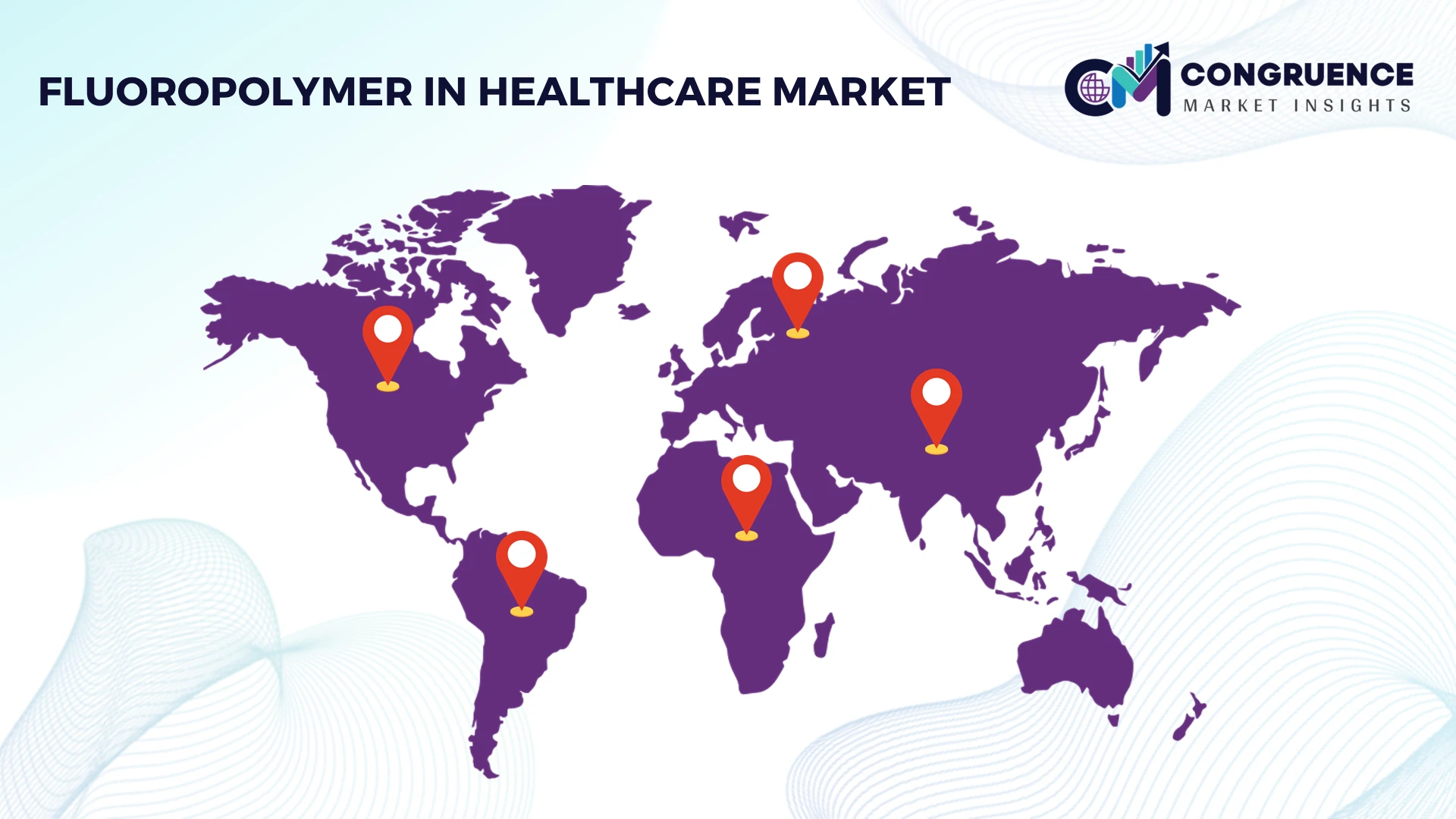
North America dominates the global fluoropolymer in healthcare market with approximately 38% share in 2025, supported by established medical device manufacturing, advanced polymer engineering, and extensive pharmaceutical processing infrastructure. The United States concentrates regional demand through cardiovascular catheter production, neurovascular intervention systems, and implantable medical components requiring PTFE, FEP, and PFA materials. Medical device manufacturers account for an estimated 55% of regional fluoropolymer consumption, reflecting extensive utilization of precision tubing and low-friction coatings. Canada's pharmaceutical manufacturing and specialized medical equipment industries provide additional demand. The region benefits from integrated material qualification systems, advanced extrusion technologies, and established supplier relationships. Manufacturers are increasingly deploying automated inspection and precision coating systems, targeting 10–15% improvements in production consistency. Strategic investments emphasize high-purity processing, medical-grade material certification, and resilient domestic supply networks.
United States Market Outlook: The United States remains the region's principal manufacturing and innovation center, supported by medical technology clusters in California, Minnesota, and Massachusetts. Its advanced healthcare manufacturing ecosystem integrates specialized polymer processors with catheter developers and medical equipment manufacturers. The FDA's Quality Management System Regulation, effective February 2026, strengthens alignment with ISO 13485 and reinforces supplier qualification requirements. Companies are prioritizing validated material formulations, automated quality assurance, and long-term procurement agreements to support complex medical device manufacturing.
Europe accounts for approximately 28% of the global fluoropolymer in healthcare market in 2025, supported by sophisticated medical device manufacturing, pharmaceutical production, and specialty polymer processing. Germany, France, Switzerland, and Ireland represent important manufacturing centers for high-performance medical components and contamination-controlled pharmaceutical systems. Germany contributes an estimated 30% of European healthcare fluoropolymer demand, reflecting its established medical technology and industrial engineering capabilities. European manufacturers increasingly emphasize traceability, biocompatibility documentation, and validated material performance under the Medical Device Regulation. The ongoing European PFAS restriction assessment is encouraging companies to reassess material portfolios and strengthen critical-use documentation. Advanced manufacturers are targeting 10–15% reductions in material processing waste through optimized extrusion and coating technologies. Investment priorities focus on precision manufacturing, regulatory readiness, and partnerships between specialty chemical suppliers and medical device producers.
Germany Market Outlook: Germany maintains a strong competitive position through its medical technology clusters in Baden-Württemberg, Bavaria, and North Rhine-Westphalia. The country's established engineering infrastructure supports precision fluoropolymer extrusion, specialized coatings, and chemically resistant pharmaceutical equipment components. German manufacturers increasingly integrate automated metrology and digital quality management into medical polymer production. The country's medical technology industry includes more than 1,500 companies in its core manufacturing ecosystem, supporting specialized material suppliers and engineering partnerships. Regulatory compliance and advanced processing capabilities remain central competitive advantages.
Asia-Pacific represents approximately 26% of the global fluoropolymer in healthcare market in 2025 and is positioned as the fastest-expanding regional market. China, Japan, India, and South Korea support demand through medical device production, pharmaceutical manufacturing, and precision polymer processing. China accounts for an estimated 45% of regional consumption, supported by extensive medical equipment manufacturing and growing domestic component sourcing. Japan maintains technological advantages in high-performance fluoropolymer processing, while India is expanding pharmaceutical production and medical device manufacturing infrastructure. Regional suppliers are increasing investments in precision extrusion, high-purity compounding, and localized technical support. Production modernization initiatives target 12–18% improvements in manufacturing efficiency across selected automated processing lines. Companies are strengthening partnerships with medical device OEMs and pharmaceutical equipment manufacturers to reduce import dependence and improve material availability.
China Market Outlook: China leads regional healthcare fluoropolymer consumption through established medical device manufacturing clusters in Guangdong, Jiangsu, and Zhejiang. The country's industrial infrastructure supports catheter components, diagnostic equipment, and pharmaceutical processing assemblies. China's medical device localization policies and domestic procurement priorities encourage greater integration of locally processed specialty polymers. The country's 14th Five-Year Plan emphasized advanced medical equipment and high-performance materials, strengthening industrial investment foundations. Manufacturers are expanding precision tubing production, automated quality control, and application-specific fluoropolymer processing to improve competitiveness against imported components.
South America accounts for approximately 5% of the global fluoropolymer in healthcare market in 2025, with demand concentrated in Brazil, Argentina, and Colombia. Brazil represents an estimated 60% of regional consumption, supported by its medical equipment manufacturing base, pharmaceutical production, and healthcare infrastructure. Regional demand centers on chemically resistant medical tubing, diagnostic components, pharmaceutical seals, and specialized hospital equipment. Domestic manufacturers continue to depend on imported high-performance fluoropolymer resins, creating procurement exposure and longer qualification cycles. Medical equipment producers are increasingly evaluating localized component processing and regional distribution partnerships. Selected production modernization initiatives target 8–12% improvements in material utilization through precision fabrication and reduced processing losses. However, limited specialty resin production capacity and uneven advanced manufacturing infrastructure constrain broader deployment. Companies are prioritizing reliable supply contracts and application-specific technical support.
Brazil Market Outlook: Brazil dominates the South American market through established healthcare manufacturing clusters in São Paulo, Minas Gerais, and Rio Grande do Sul. Its pharmaceutical industry and medical equipment producers require chemically resistant materials for sterile processing, diagnostic instruments, and specialized device components. Brazil's Unified Health System serves a population exceeding 200 million, creating a substantial healthcare infrastructure base. ANVISA's regulatory framework influences medical device qualification and material documentation. Domestic processors are strengthening relationships with international fluoropolymer suppliers while investing in precision component fabrication and regional distribution capabilities.
The Middle East & Africa region represents approximately 3% of the global fluoropolymer in healthcare market in 2025, with demand concentrated in Saudi Arabia, the United Arab Emirates, South Africa, and selected North African economies. Saudi Arabia and the UAE account for an estimated 50% of regional healthcare fluoropolymer consumption, supported by healthcare infrastructure modernization and pharmaceutical manufacturing investment. Demand primarily involves chemically resistant processing components, specialized medical tubing, laboratory equipment, and hospital technology systems. Regional manufacturing remains dependent on imported specialty fluoropolymer materials and precision-engineered components. Government-backed industrial diversification programs are encouraging localized pharmaceutical production and medical technology assembly. Selected healthcare manufacturing modernization projects target 10–15% improvements in operational efficiency through automated processing and upgraded equipment. Suppliers are establishing distribution partnerships and technical service networks to support emerging industrial requirements.
Saudi Arabia Market Outlook: Saudi Arabia is a strategically important healthcare fluoropolymer market, supported by Vision 2030 initiatives emphasizing pharmaceutical localization, medical technology development, and healthcare infrastructure modernization. The Kingdom's National Industrial Strategy targets expansion of advanced manufacturing capabilities, including pharmaceuticals and medical devices. Government healthcare transformation programs encourage domestic production of specialized equipment and pharmaceutical processing components. Saudi Arabia's population exceeds 35 million, supporting continued healthcare infrastructure requirements. International material suppliers are strengthening local partnerships, technical distribution networks, and application engineering support to serve emerging medical manufacturing operations.
The global fluoropolymer in healthcare market is moderately consolidated, with Chemours, Daikin Industries, AGC, Syensqo, and Arkema competing against specialized processors and regional material suppliers. The leading five companies collectively represent an estimated 58% market share, reflecting advantages in polymer chemistry, medical qualification, and distribution networks. Chemours and Daikin emphasize established PTFE portfolios, while AGC and Syensqo compete through high-purity formulations and application engineering. Specialized manufacturers challenge established suppliers through customization and faster component delivery. Medical-grade processing premiums can reach 20–30%, while automated inspection targets 10–15% lower rejection rates. Regional sourcing strategies aim to reduce procurement lead times by 15–20%. Companies are expanding technical partnerships, integrating precision extrusion, and strengthening regulatory documentation capabilities. Competition increasingly centers on qualified supply continuity rather than resin pricing alone. Stringent biocompatibility validation and specialized processing infrastructure restrict market entry. Winning requires reliable material performance, manufacturing precision, and regulatory expertise.
The Chemours Company
Daikin Industries, Ltd.
AGC Inc.
Syensqo SA
Arkema S.A.
3M Company
Saint-Gobain
Zeus Company LLC
W. L. Gore & Associates, Inc.
Parker Hannifin Corporation
Nitto Denko Corporation
Entegris, Inc.
Mitsubishi Chemical Group Corporation
Gujarat Fluorochemicals Limited
Precision microextrusion, advanced PTFE processing, and automated surface modification technologies are transforming healthcare fluoropolymer manufacturing. Modern extrusion systems support tighter dimensional control for catheter liners, surgical tubing, and specialized medical components. Compared with conventional extrusion equipment, optimized microextrusion platforms target 10–15% reductions in material waste and approximately 12% improvements in production consistency. Automated laser measurement and inline inspection enable earlier defect detection, reducing manual quality checks. Medical device manufacturers benefit through improved component reliability, while specialized processors gain advantages in precision manufacturing and customized production.
Emerging technologies include plasma surface treatment, multilayer fluoropolymer structures, and advanced PFA formulations for contamination-sensitive healthcare applications. Plasma treatment improves surface adhesion, with application-specific bonding improvements potentially exceeding 20% compared with untreated fluoropolymer surfaces. Multilayer processing combines chemical resistance with mechanical flexibility, supporting increasingly complex device geometries. Adoption is concentrated among advanced catheter manufacturers and pharmaceutical equipment suppliers, where validated processing capabilities determine purchasing decisions and long-term supplier relationships.
Between 2026 and 2028, AI-assisted inspection, digital manufacturing records, and automated coating systems will increasingly influence competitive differentiation. Connected production platforms target 15% faster quality assessment and approximately 10% lower rework across optimized operations. Companies integrating material engineering with digital quality infrastructure will strengthen qualification efficiency, accelerate customer onboarding, and improve manufacturing scalability across specialized healthcare applications.
January 2025: Zeus announced StreamLiner NG, its film-cast PTFE catheter liner featuring wall thicknesses of 0.001 inches or less. The innovation reduces surface imperfections and supports flexible, precision-engineered catheter designs, strengthening medical device manufacturing capabilities. Source: zeusinc.com
August 2025: Chemours announced strategic agreements with SRF Limited in India to strengthen fluoropolymer and fluoroelastomer supply capacity. The collaboration targets operational flexibility and global supply continuity, with implementation supporting essential industrial applications by 2026. Source: chemours.com
September 2025: Syensqo introduced medical-grade Solef PVDF for biopharmaceutical processing and medical devices. Building on over 30 years of material experience, the globally available formulation supports chemically resistant fluid management, diagnostics, and single-use instruments. Source: syensqo.com
December 2025: AGC announced the world's first UL2809 third-party verification for PTFE resin manufactured using recycled fluorite. The achievement strengthens circular material traceability and establishes a verification pathway for expanding recycled-resource applications across fluoropolymer products. Source: agc.com
The Fluoropolymer in Healthcare Market Report provides comprehensive analysis of industry structure, material technologies, application requirements, and competitive developments between 2026 and 2033. Segmentation covers PTFE, FEP, PFA, PVDF, ETFE, and other fluoropolymers; medical devices, pharmaceutical packaging, medical equipment, drug delivery systems, and diagnostic applications; and major healthcare manufacturing end-users. Regional assessment includes North America, Europe, Asia-Pacific, South America, and Middle East & Africa. North America's estimated 38.0% market contribution establishes an important benchmark for geographic investment evaluation.
The report examines precision extrusion, advanced coatings, high-purity processing, material qualification, and emerging healthcare polymer technologies. Competitive analysis evaluates supplier positioning, manufacturing localization, regulatory exposure, and strategic partnerships. Additional coverage addresses specialized catheter components, pharmaceutical fluid-handling systems, and medical-grade material innovation, supporting investment planning, expansion decisions, procurement strategies, and long-term competitive positioning.
| Report Attribute / Metric | Details |
|---|---|
| Market Revenue (2025) | USD 290.0 Million |
| Market Revenue (2033) | USD 451.9 Million |
| CAGR (2026–2033) | 5.7% |
| Base Year | 2025 |
| Forecast Period | 2026–2033 |
| Historic Period | 2021–2025 |
| Segments Covered |
By Type
By Application
By End-User
|
| Key Report Deliverables | Revenue Forecast; Market Trends; Growth Drivers & Restraints; Technology Insights; Segmentation Analysis; Regional Insights; Competitive Landscape; Regulatory & ESG Overview; Recent Developments |
| Regions Covered | North America; Europe; Asia-Pacific; South America; Middle East & Africa |
| Key Players Analyzed | The Chemours Company; Daikin Industries, Ltd.; AGC Inc.; Syensqo SA; Arkema S.A.; 3M Company; Saint-Gobain; Zeus Company LLC; W. L. Gore & Associates, Inc.; Parker Hannifin Corporation; Nitto Denko Corporation; Entegris, Inc.; Mitsubishi Chemical Group Corporation; Gujarat Fluorochemicals Limited |
| Customization & Pricing | Available on Request (10% Customization Free) |




